© 2014, IJCSMC All Rights Reserved 84
Available Online atwww.ijcsmc.com
International Journal of Computer Science and Mobile Computing
A Monthly Journal of Computer Science and Information Technology
ISSN 2320–088X
IJCSMC, Vol. 3, Issue. 1, January 2014, pg.84 – 89
RESEARCH ARTICLE
ARM MICRO-CONTROLLER BASED
MULTI -FUNCTION SOLAR
TRACKING SYSTEM
1
D.Rajendra Prasad,
2K.Sudhakar
1,2
Assistant Professor, Department of ECE, Mallareddy College of Engineering, Hyderabad, India
Abstract
In remote areas the sun is a cheap source of electricity because instead of hydraulic generators it uses solar cells to produce electricity. While the output of solar cells depends on the intensity of sunlight and the angle of incidence. The solar panels must remain in front of sun during the whole day. But due to rotation of earth those panels can’t maintain their position always in front of sun. This problem results in decrease of their efficiency. Thus to get a constant output, an automated system is required which should be capable to constantly rotate the solar panel. In this project we are implementing Automatic Sun tracking System on both sides. One side of automatic sun tracking system we have sensor network which track the position of sun and based on the position rotate the solar panel towards the direction where the intensity of sunlight is maximum and transmit the data to control remote system via wired or wireless medium. Based on the data received it gives the signal to stepper motor to rotate the large panel. The unique feature of this system is that instead of taking the earth as its reference, it takes the sun as a guiding source. The system can display the result on the LCD display. The primary objectives were compact design, efficient energy collection, and ability to monitor available battery charge status using ARM based Microcontroller and also provide to power supply for control system unit. In this project we are using ARM7TDMI based LPC2148 microcontroller to control the position of the solar panel ,which is having 64 pin capability ,512KB of Flash memory ,8 to 32KB of SRAM and many peripherals ,working with internal clock generation using PLLs up to 60 MHz . The application code will be developed in Embedded C language. Keil4 IDE software will be used to build the Hex file and flash magic is used to dump the GENERATED Hex file in to microcontroller.
1. INTRODUCTION
© 2014, IJCSMC All Rights Reserved 85
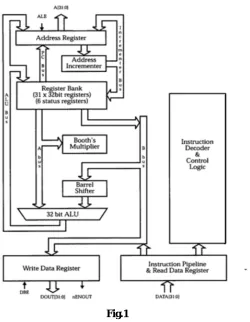
useful for implementing basic interfacing and control mechanism for simple applications. There are several applications which require lot of computation and high speed data processing. In such applications advanced microcontrollers and microprocessors are used. One such advanced architecture is ARM. The ARM7TDMI core is a 32-bit embedded RISC processor delivered as a hard macro cell optimized to provide the best combination of performance, power and area characteristics. The ARM7TDMI core enables system designers to build embedded devices requiring small size, low power and high performance. The ARM7 family also includes the ARM7TDMI processor, the ARM7TDMIS processor, the ARM720T processor and the ARM7EJ-S processors, each of which has been developed to address different market requirements. The market for microprocessors continues to diversify, based on the evolving demands of applications including wireless, home entertainment, automotive and microcontrollers. ARM core families sharing the ARMv7 architecture will cover the widening spectrum of embedded processing. The ARM architecture is based on Reduced Instruction Set Computer (RISC) principles. The RISC instruction set and related decode mechanism are much simpler than those of Complex Instruction Set Computer (CISC) design.
This simplicity gives:
· A high instruction throughput
· An excellence real-time interrupts response
· A small, cost-effective, processor macro cell
The ARM7TDMI core is the industry’s most widely used 32-bit embedded RISC microprocessor solution. Optimized for cost and power-sensitive application, the ARM7TDMI solution provides low power consumption, small size, and high performance needed in portable, embedded application. The ARM7DMI-S is synthesizable version of ARM7TDMI core. The ARM720T hard macro cell contains the ARM7DMI core, 8KB unified cache and MMU (Memory Management Unit) that allows the use of protected execution space and virtual memory. The ARM7EJ-S processor is synthesizable core that provides all the benefit of ARM7DMI, while also incorporating ARM’s latest DSP extensions and jazelle technology, enabling acceleration of Java-based applications.
1.1 LOAD-STORE ARCHITECTURE
The processor operates on data held in registers. Separate load and store instructions transfer data between the
register bank and external memory. These design rules allow a RISC processor to be simpler, and thus the core can
operate at higher clock frequencies.
1.2 ARM PROCESSOR CORE
© 2014, IJCSMC All Rights Reserved 86 Fig.1
II. PROPOSED METHOD
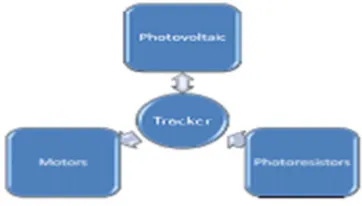
The smart solar system is a self-powered system; all components of the system depend on each other’s, the system does not need any supply from the external world but only sun light. Those components interconnect with each other’s in order to form a closed system. The solar radiation gathered by the photovoltaic cell is transformed into electrical energy; the panel will feed the input of the charger which will charge a 12 Volt DC battery. The second functionality of the cell is to give precise voltage to the tracker, in order to reach the most efficient direction and orientation of the system which will allows maximum sunlight absorption. The battery will supply the system with a 12 Volt DC. The motors, the charger, the tracker and the sensors are supplied by the battery. The battery is charged by the photovoltaic cell through the charger controller asshown in figure
Fig.2 Relations between main parts of the system
© 2014, IJCSMC All Rights Reserved 87
processor, this will guide the system in a x-y-z plane, that means all angles and locations can be detected and reached due to the two motors (two rotational axes). The accuracy of the system is enhanced by the gear factor and ratio, the used steppers motors are of 3.5 degrees/step, with the gears added to the motors many factors were improved such as the degree/step (less degree per step which leads to better accuracy in position and angles) and high torque for the motors.
Fig.3 Dependency of the tracker
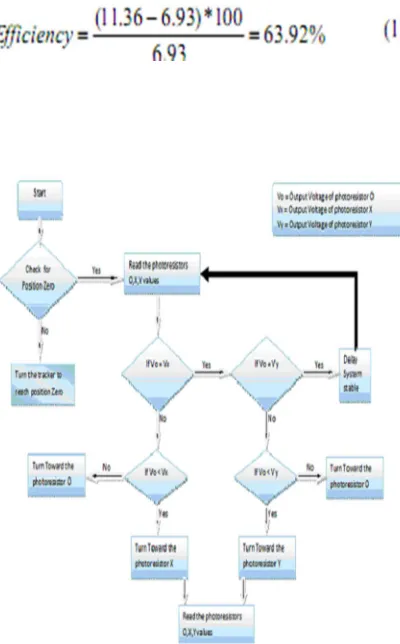
Three photoresistors are used in the tracking system all are fixed on the upper part of the system near the photovoltaic cell in an X-O-Y manner as shown in figure c. It allows a reference photoresistors the one at position O which will be compared with the photoresistors X and Y and depending on the voltage output. The tracker will compare X and O positions, the comparison will end after a very near values of outputs of those two photoresistors are reached, a loop will control the stepper motor motion and steps till a near equality of sunlight distribution will be reached. After reaching an acceptable position and values for the X-O position test, the Y-O photoresistors are tested and compared in the same manner.
Fig 4.Three photo resistors installed on PV
© 2014, IJCSMC All Rights Reserved 88 III. EXPERIMENTAL RESULTS
In order to assess the efficiency of the proposed system, some measurements were taken during a sunny summer day. Table 2 shows the comparison between the maximum current using affixed Photovoltaic panel (PV) and using the proposed system at different times.
Table 1.Comparisson of the current between fixed PV and using the proposed system
The efficiency of the proposed system can be calculated using the equation
© 2014, IJCSMC All Rights Reserved 89 IV.CONCLUSION
In this paper a universal multi-function solar tracker system is reported. The proposed system was implemented in reduced complexity architecture such as a microcontroller. The control system which is the brain of the proposed system is used to turn a small PV panel in three directions to determine the maximum output current. Three photo resistors are used every 45 minutes to redirect the PV panel to het the nearest value of the maximum sun.
REFERENCES
[1]. Honsinger, C.W., Jones, P., Rabbani, M., and Stoffel, J.C.: ‘Lossless recovery of an original image containing embedded data’. US patent no. 6278791, 2001
[2]. Goljan, M., Fridrich, J., and Du, R.: ‘Distortion-free data embedding for images’. 4th Information Hiding Workshop, LNCS, vol. 2137, (Springer-Verlag, New York, 2001, pp. 27–41.
[3]. Celik, M.U., Sharma, G., Tekalp, A.M., and Saber, E.: ‘Reversible data hiding’. Proc. ICIP, 2002, vol. 2, pp. 157–160
[4]. Tian, J.: ‘Reversible data embedding using a difference expansion’, IEEE Trans. Circuits Syst. Video Technol., 2003, 13, (8), pp. 890–896.
[5]. Xuan, G.R., Yang, C.Y., Zhen, Y.Z., and Shi, Y.Q.: ‘Reversible data hiding using integer wavelet transform and companding technique’.Proc. IWDW, 2004.
[6] J. Tian, “Wavelet-based reversible watermarking for authentication,” in Security and Watermarking of Multimedia Contents IV—Proc. SPIE, E. J. Delp III and P. W. Wong, Eds., Jan. 2002, vol. 4675, pp. 679–690. [7] B. Macq, “Lossless multiresolution transform for image authenticating watermarking,” in Proc. EUSIPCO, Sept. 2000, pp. 533–536.
Authors Bibliography
D.Rajendraprasad Received B.Tech degree in Electronics communication and Engineering from
Sreekavitha Engineering College, karepalli, Kammam. M.Tech in E.C.E From Sreekavitha Engineering College. Presently he is working in Mallareddy college of Engineering.
K.Sudhakar received B.E degree in Electronics communication and Engineering from