Real-time Incremental Speech-to-Speech Translation of Dialogs
Srinivas Bangalore, Vivek Kumar Rangarajan Sridhar, Prakash Kolan Ladan Golipour, Aura Jimenez
AT&T Labs - Research 180 Park Avenue Florham Park, NJ 07932, USA
vkumar,srini,pkolan,ladan,[email protected]
Abstract
In a conventional telephone conversation be-tween two speakers of the same language, the interaction is real-time and the speakers pro-cess the information stream incrementally. In this work, we address the problem of incre-mental speech-to-speech translation (S2S) that enables cross-lingual communication between two remote participants over a telephone. We investigate the problem in a novel real-time Session Initiation Protocol (SIP) based S2S framework. The speech translation is per-formed incrementally based on generation of partial hypotheses from speech recognition. We describe the statistical models comprising the S2S system and the SIP architecture for enabling real-time two-way cross-lingual dia-log. We present dialog experiments performed in this framework and study the tradeoff in ac-curacy versus latency in incremental speech translation. Experimental results demonstrate that high quality translations can be generated with the incremental approach with approxi-mately half the latency associated with non-incremental approach.
1 Introduction
In recent years, speech-to-speech translation (S2S) technology has played an increasingly important role in narrowing the language barrier in cross-lingual interpersonal communication. The improve-ments in automatic speech recognition (ASR), statis-tical machine translation (MT), and, text-to-speech synthesis (TTS) technology has facilitated the serial binding of these individual components to achieve S2S translation of acceptable quality.
Prior work on S2S translation has primarily fo-cused on providing either one-way or two-way trans-lation on a single device (Waibel et al., 2003; Zhou
et al., 2003). Typically, the user interface requires the participant(s) to choose the source and target lan-guage apriori. The nature of communication, either single user talking or turn taking between two users can result in a one-way or cross-lingual dialog inter-action. In most systems, the necessity to choose the directionality of translation for each turn does take away from a natural dialog flow. Furthermore, single interface based S2S translation (embedded or cloud-based) is not suitable for cross-lingual communica-tion when participants are geographically distant, a scenario more likely in a global setting. In such a scenario, it is imperative to provide real-time and low latency communication.
In a conventional telephone conversation between two speakers of the same language, the interaction is real-time and the speakers process the informa-tion stream incrementally. Similarly, cross-lingual dialog between two remote participants will greatly benefit through incremental translation. While in-cremental decoding for text translation has been addressed previously in (Furuse and Iida, 1996; Sankaran et al., 2010), we address the problem in a speech-to-speech translation setting for enabling real-time cross-lingual dialog. We address the prob-lem of incrementality in a novel session initiation protocol (SIP) based S2S translation system that en-ables two people to interact and engage in cross-lingual dialog over a telephone (mobile phone or landline). Our system performs incremental speech recognition and translation, allowing for low latency interaction that provides an ideal setting for remote dialog aimed at accomplishing a task.
We present previous work in this area in Section 2 and introduce the problem of incremental translation in Section 3. We describe the statistical models used in the S2S translation framework in Section 4 fol-lowed by a description of the SIP communication
framework for real-time translation in Section 5. In Section 6, we describe the basic call flow of our sys-tem following which we present dialog experiments performed using our framework in Section 8. Fi-nally, we conclude in Section 9 along with directions for future work.
2 Previous Work
Most previous work on speech-to-speech transla-tion systems has focused on a single device model, i.e., the user interface for translation is on one de-vice (Waibel et al., 1991; Metze et al., 2002; Zhou et al., 2003; Waibel et al., 2003). The device typi-cally supports multiple source-target language pairs. A user typically chooses the directionality of transla-tion and a toggle feature is used to switch the direc-tionality. However, this requires physical presence of the two conversants in one location.
On the other hand, text chat between users over cell phones has become increasingly popular in the last decade. While the language used in the inter-action is typically monolingual, there have been at-tempts to use statistical machine translation to en-able cross-lingual text communication (Chen and
Raman, 2008). But this introduces a significant
overhead as the users need to type in the responses for each turn. Moreover, statistical translation sys-tems are typically unable to cope with telegraphic text present in chat messages. A more user friendly approach would be to use speech as the modality for communication.
One of the first attempts for two-way S2S trans-lation over a telephone between two potentially re-mote participants was made as part of the Verbmobil project (Wahlster, 2000). The system was restricted to certain topics and speech was the only modality. Furthermore, the spontaneous translation of dialogs was not incremental. One of the first attempts at in-cremental text translation was demonstrated in (Fu-ruse and Iida, 1996) using a transfer-driven machine translation approach. More recently, an incremen-tal decoding framework for text translation was pre-sented in (Sankaran et al., 2010). To the best of our knowledge, incremental speech-to-speech trans-lation in a dialog setting has not been addressed in prior work. In this work, we address this problem using first of a kind SIP-based large vocabulary S2S
translation system that can work with both smart-phones and landlines. The speech translation is per-formed incrementally based on generation of partial hypotheses from speech recognition. Our system displays the recognized and translated text in an in-cremental fashion. The use of SIP-based technology also supports an open form of cross-lingual dialog without the need for attention phrases.
3 Incremental Speech-to-Speech Translation
In most statistical machine translation systems, the input source text is translated in entirety, i.e., the search for the optimal target string is constrained on the knowledge of the entire source string. How-ever, in applications such as language learning and real-time speech-to-speech translation, incremen-tally translating the source text or speech can pro-vide seamless communication and understanding with low latency. Let us assume that the input string
(either text or speech recognition hypothesis) isf =
f1,· · · , fJ and the target string is e = e1,· · · , eI.
Among all possible target sentences, we will choose the one with highest probability:
ˆe(f) = arg max e
Pr(e|f) (1)
In an incremental translation framework, we do not
observe the entire stringf. Instead, we observeQs
sequences,S=s1· · ·sk· · ·sQs, i.e., each sequence
sk = [fjkfjk+1· · ·fj(k+1)−1], j1 = 1, jQs+1 =
J+ 11. Let the translation of each foreign sequence
sk be denoted bytk= [eikeik+1· · ·ei(k+1)−1],i1 =
1, iQs+1=I+ 1. Given this setting, we can perform
decoding using three different approaches. Assum-ing that each partial source input is translated inde-pendently, i.e., chunk-wise translation, we get,
ˆˆ
e(f) = arg max t1
Pr(t1|s1)· · ·arg max tk
Pr(tk|sk)
(2)
We call the decoding in Eq. 2 aspartialdecoding.
The other option is to translate the partial source
in-1For simplicity, we assume that the incremental and
put conditioned on the history, i.e.,
ˆˆ
e(f) = arg max t1
Pr(t1|s1)· · ·
arg max tk
Pr(tk|s1,· · ·, sk, t∗1,· · · , t
∗
k−1) (3)
wheret∗i denotes the best translation for source
se-quencesi. We term the result obtained through Eq. 3
ascontinue-partial. The third option is to wait for all the partials to be generated and then decode the
source string which we callcompletedecoding, i.e.,
ˆˆ
e(f) = arg max e
Pr(e|s1,· · ·, sk) (4)
Typically, the hypothesisˆewill be more accurate
thanˆˆeas the translation process is non-incremental.
In the best case, one can obtainˆˆe= ˆe. While the de-coding described in Eq. 2 has the lowest latency, it is likely to result in inferior performance in compari-son to Eq. 1 that will have higher latency. One of the main issues in incremental speech-to-speech trans-lation is that the translated sequences need to be im-mediately synthesized. Hence, there is tradeoff be-tween the amount of latency versus accuracy as the synthesized audio cannot be revoked in case of long distance reordering. In this work, we focus on incre-mental speech translation and defer the problem of incremental synthesis to future work. We investigate the problem of incrementality using a novel SIP-based S2S translation system, the details of which we discuss in the subsequent sections.
4 Speech-to-Speech Translation Components
In this section, we describe the training data, pre-processing steps and statistical models used in the S2S system.
4.1 Automatic Speech Recognition
We use the AT&T WATSONSM real-time speech
recognizer (Goffin et al., 2004) as the speech
recog-nition module. WATSONSMuses context-dependent
continuous density hidden Markov models (HMM) for acoustic modeling and finite-state networks for network optimization and search. The acoustic mod-els are Gaussian mixture tied-state three-state left-to-right HMMs. All the acoustic models in this work
were initially trained using the Maximum Likeli-hood Estimation (MLE) criterion, and followed by discriminative training through Minimum Phone Er-ror (MPE) criterion. We also employed Gaussian Selection (Bocchieri, 1993) to decrease the real-time factor during the recognition procedure.
The acoustic models for English and Span-ish were mainly trained on short utterances in the respective language, acquired from SMS and search applications on smartphones. The amount of training data for the English acoustic model is around 900 hours of speech, while the data for training the Spanish is approximately half that
of the English model. We used a total of 107
phonemes for the English acoustic model, com-posed of digit-specific, alpha-specific, and general English phonemes. Digit-specific and alpha-specific phonemes were applied to improve the recognition accuracy of digits and alphas in the speech. The number of phonemes for Spanish was 34, and, no digit- or alpha-specific phonemes were included. The pronunciation dictionary for English is a hand-labeled dictionary, with pronunciation for unseen words being predicted using custom rules. A rule-based dictionary was used for Spanish.
were the same.
4.2 Machine Translation
The phrase-based translation experiments reported
in this work was performed using the Moses2
toolkit (Koehn et al., 2007) for statistical machine
translation. Training the translation model starts
from the parallel sentences from which we learn word alignments by using GIZA++ toolkit (Och and Ney, 2003). The bidirectional word alignments obtained using GIZA++ were consolidated by
us-ing the grow-diag-final option in Moses.
Subse-quently, we learn phrases (maximum length of 7) from the consolidated word alignments. A
lexical-ized reordering model (msd-bidirectional-fe option
in Moses) was used for reordering the phrases in addition to the standard distance based reordering (distortion-limit of 6). The language models were interpolated Kneser-Ney discounted trigram models, all constructed using the SRILM toolkit (Stolcke, 2002). Minimum error rate training (MERT) was performed on a development set to optimize the fea-ture weights of the log-linear model used in trans-lation. During decoding, the unknown words were preserved in the hypotheses.
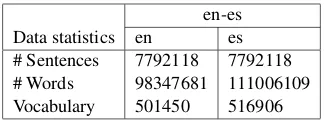
The parallel corpus for phrase-based transla-tion was obtained from a variety of sources: eu-roparl (Koehn, 2005), jrc-acquis corpus (Steinberger et al., 2006), opensubtitle corpus (Tiedemann and Lars Nygaard, 2004), web crawling as well as hu-man translation. The statistics of the data used for English-Spanish is shown in Table 1. About 30% of the training data was obtained from the Web (Ran-garajan Sridhar et al., 2011). The development set (identical to the one used in ASR) was used in MERT training as well as perplexity based optimiza-tion of the interpolated language model. The lan-guage model for MT and ASR was constructed from identical data.
4.3 Text-to-speech synthesis
The translated sentence from the machine trans-lation component is synthesized using the AT&T
Natural VoicesTM text-to-speech synthesis
en-gine (Beutnagel et al., 1999). The system uses unit selection synthesis with half phones as the basic
2
http://www.statmt.org/moses
[image:4.612.347.510.56.116.2]en-es Data statistics en es # Sentences 7792118 7792118 # Words 98347681 111006109 Vocabulary 501450 516906
Table 1: Parallel data used for training translation models
units. The database was recorded by professional speakers of the language. We are currently using fe-male voices for English as well as Spanish.
5 SIP Communication Framework for
Real-time S2S Translation
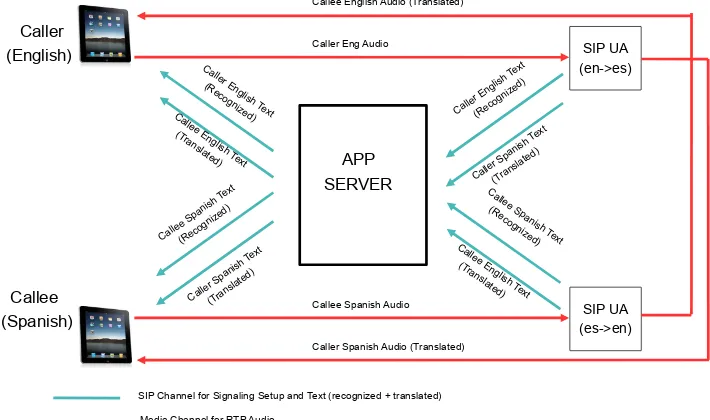
The SIP communication framework for real-time language translation comprises of three main com-ponents. Session Initiation Protocol (SIP) is becom-ing the de-facto standard for signalbecom-ing control for streaming applications such as Voice over IP. We present a SIP communication framework that uses Real-time Transport Protocol (RTP) for packetiz-ing multimedia content and User Datagram Proto-col (UDP) for delivering the content. In this work, the content we focus on is speech and text infor-mation exchanged between two speakers in a cross-lingual dialog. For two users conversing in two dif-ferent languages (e.g., English and Spanish), the me-dia channels between them will be established as shown in Figure 1. In Figure 1, each client (UA) is responsible for recognition, translation, and synthe-sis of one language input. E.g., the English-Spanish UA recognizes English text, converts it into Spanish, and produces output Spanish audio. Similarly, the Spanish-English UA is responsible for recognition of Spanish speech input, converting it into English, and producing output English audio. We describe the underlying architecture of the system below.
5.1 Architecture
1. End point SIP user agents: These are the SIP end points that exchange SIP signaling mes-sages with the SIP Application server (AS) for call control.
2. SIP User Agents: Provide a SIP interface to the
core AT&T WATSONSM engine that
SIP UA (en->es)
SIP UA (es->en) APP
SERVER Caller
(English)
Callee (Spanish)
Caller Eng Audio
Callee English Audio (Translated)
Callee Spanish Audio
Caller Spanish Audio (Translated) Caller En
glish Text (R
eco gnize
d) Callee En
glish Text (T
ran slated)
Callee Sp anish
Text (R
eco gnize
d) Callee En
glish Text (T
ran slated) Calle
r Span ish Te
xt
(T ransla
ted) Calle
e Span ish Te
xt
(R ecogn
ized)
Calle r Engli
sh Te xt
(R ecogn
ized)
Calle r Span
ish Te xt
(T ransla
ted)
SIP Channel for Signaling Setup and Text (recognized + translated)
[image:5.612.130.485.63.273.2]Media Channel for RTP Audio
Figure 1: SIP communication framework used for real-time speech-to-speech translation. The example shows the setup between two participants in English(en) and Spanish (es)
recognition.
3. SIP Application Server (AS): A standard SIP B2BUA (back to back user agent) that receives SIP signaling messages and forwards them to the intended destination. The machine transla-tion component (server running Moses (Koehn et al., 2007)) is invoked from the AS.
In our communication framework, the SIP AS re-ceives a call request from the calling party. The AS infers the language preference of the calling party from the user profile database and forwards the call to the called party. Based on the response, AS in-fers the language preference of the called party from the user profile database. If the languages of the calling and called parties are different, the AS in-vites two SIP UAs into the call context. The AS ex-changes media parameters derived from the calling and called party SIP messages with that of the SIP UAs. The AS then forwards the media parameters of the UAs to the end user SIP agents.
The AS, the end user SIP UAs, and the SIP UAs are all RFC 3261 SIP standard compliant. The end user SIP UAs are developed using PJSIP stack that uses PJMedia for RTP packetization of audio and
network transmission. For our testing, we have
implemented the end user SIP UAs to run on
Ap-ple IOS devices. The AS is developed using E4SS (Echarts for SIP Servlets) software and deployed on Sailfin Java container. It is deployed on a Linux box installed with Cent OS version 5. The SIP UAs are written in python for interfacing with external SIP devices, and use proprietary protocol for interfacing
with the core AT&T WATSONSMengine.
6 Typical Call Flow
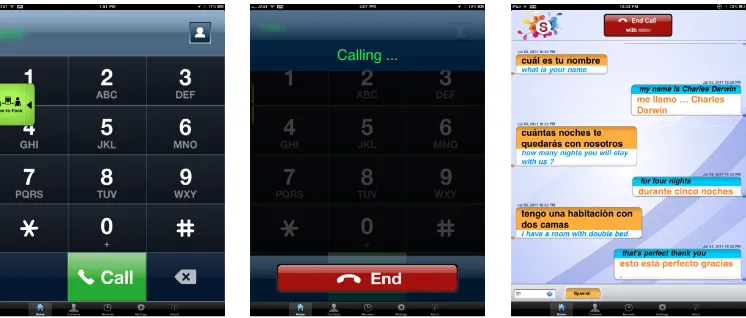
Figure 2: Illustration of call flow. The call is established using SIP and the real-time conversation appears in the bubbles in a manner similar to Instant Messaging. For illustration purposes, the caller (Spanish) and callee (English) are assumed to have set their language preferences in the setup menu.
participant is being played. We address the feedback problem from the TTS output by muting the micro-phone when TTS output is played.
7 Dialog Data
The system described above provides a natural way to collect cross-lingual dialog data. We used our system to collect a corpus of 40 scripted dialogs in English and Spanish. A bilingual (English-Spanish) speaker created dialog scenarios in the travel and hospitality domain and the scripted dialog was used as reference material in the call. Two subjects partic-ipated in the data collection, a male English speaker and female Spanish speaker. The subjects were in-structed to read the lines verbatim. However, due to ASR errors, the subjects had to repeat or improvise few turns (about 10%) to sustain the dialog. The av-erage number of turns per scenario in the collected corpus is 13; 6 and 7 turns per scenario for English and Spanish, respectively. An example dialog be-tween two speakers is shown in Table 2.
8 Experiments
In this section, we describe speech translation ex-periments performed on the dialog corpus collected through our system. We present baseline results fol-lowed by results of incremental translation.
8.1 Baseline Experiments
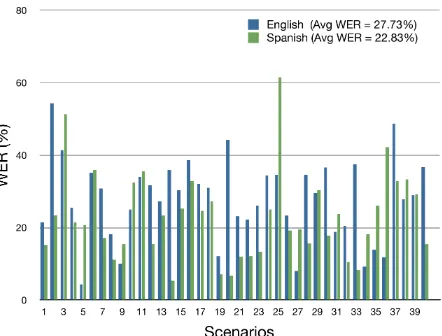
The models described in Section 4 were used to es-tablish baseline results on the dialog corpus. No
A: Hello, I am calling from room four twenty one
the T.V. is not working. Do you think you can send someone to fix it please?
B: Si, Se˜nor enseguida enviamos a alguien para que
la arregle. Si no le cambiaremos de habitaci´on.
A: Thank you very much.
B: Estamos aqu para servirle. Ll´amenos si necesita
algo m´as.
Table 2: Example of a sample dialog scenario.
0 8.5 17.0 25.5 34.0
Reference ASR
23.87 28.21 26.96 33.58
BLEU
Spanish-English English-Spanish
0 17.5 35.0 52.5 70.0
Reference ASR
63.42 59.19
55.34 47.26
TER
[image:7.612.130.488.63.164.2]Spanish-English English-Spanish
[image:7.612.78.299.221.389.2]Figure 4: TER (%) and BLEU of English-Spanish and Spanish-English MT models on reference transcripts and ASR output
Figure 3: WER (%) of English and Spanish acoustic models on the dialog corpus
8.2 Segmentation of ASR output for MT
Turn taking in a dialog typically involves the sub-jects speaking one or more utterances in a turn. Since, machine translation systems are trained on chunked parallel texts (40 words or less), it is ben-eficial to segment the ASR hypotheses before trans-lation. Previous studies have shown significant im-provements in translation performance through the segmentation of ASR hypotheses (Matusov et al., 2007). We experimented with the notion of seg-mentation defined by silence frames in the ASR out-put. A threshold of 8-10 frames (100 ms) was found to be suitable for segmenting the ASR output into sentence chunks. We did not use any lexical fea-tures for segmenting the turns. The BLEU scores for different silence thresholds used in segmentation is shown in Figure 5. The BLEU scores improvement for Spanish-English is 1.6 BLEU points higher than the baseline model using no segmentation. The
im-provement for English-Spanish is smaller but statis-tically significant. Analysis of the dialogs revealed that the English speaker tended to speak his turns without pausing across utterance chunks while the Spanish speaker paused a lot more. The results in-dicate that in a typical dialog interaction, if the par-ticipants observe inter-utterance pause (80-100 ms) within a turn, it serves as a good marker for segmen-tation. Further, exploiting such information can po-tentially result in improvements in MT performance as the model is typically trained on sentence level parallel text.
12.0 13.8 15.6 17.4 19.2 21.0 22.8 24.6 26.4 28.2 30.0
50 80 110 140 170 200 500
25.21 25.20 24.86 24.80
24.34 24.27 23.87 28.76 28.76
28.21 28.18 27.76 27.62
26.96
BLEU
Silence threshold for segmentation (ms)
Figure 5: BLEU score of English-Spanish and
Spanish-English MT models on the ASR output us-ing silence segmentation
8.3 Incremental Speech Translation Results
Figure 6 shows the BLEU score for incremental speech translation described in Section 3. In the fig-ure,partialrefers to Eq. 2,continue-partialrefers to
Eq. 3 and complete refers to Eq. 4. The
[image:7.612.318.540.399.546.2]continue-0 2.78 5.56 8.33 11.11 13.89 16.67 19.44 22.22 25.00
10 20 30 40 50 60 70 80 90 100 200 300 400 500 600 700 800 900 1000
BLEU
Speech Recognizer timeouts (msec)
Partial (Eq. 1)
[image:8.612.174.430.66.226.2]Moses ‘continue-partial’ (Eq. 2) Complete (Eq. 3)
Figure 6: BLEU score (Spanish-English) for incremental speech translation across varying timeout periods in the speech recognizer
partial-translation parameter in Moses (Koehn et al., 2007). The partial hypotheses are generated as a function of speech recognizer timeouts. Timeout is defined as the time interval with which the speech recognizer generates partial hypotheses. For each timeout interval, the speech recognizer may or may not generate a partial result based on the search path at that instant in time. As the timeout interval in-creases, the performance of incremental translation approaches that of non-incremental translation. The key is to choose an operating point such that the user perception of latency is minimal with accept-able BLEU score. It is interesting that very good performance can be attained at a timeout of 500 ms in comparison with non-incremental speech trans-lation, i.e., the latency can be reduced in half with
acceptable translation quality. Thecontinue-partial
option in Moses performs slightly better than the
partial case as it conditions the decision on prior source input as well as translation.
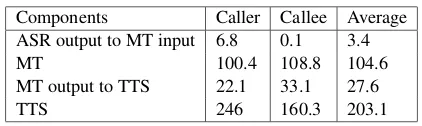
In Table 3, we present the latency measurements of the various components in our framework. We do not have a row for ASR since it is not possible to get the start time for each recognition run as the RTP packets are continuously flowing in the SIP frame-work. The latency between various system compo-nents is very low (5-30 ms). While the average time
taken for translation (incremental) is≈100 ms, the
TTS takes the longest time as it is non-incremental in the current work. It can also been seen that the average time taken for generating incremental MT
output is half that of TTS that is non-incremental. The overall results show that the communication in our SIP-based framework has low latency.
Components Caller Callee Average ASR output to MT input 6.8 0.1 3.4
MT 100.4 108.8 104.6
MT output to TTS 22.1 33.1 27.6
TTS 246 160.3 203.1
Table 3: Latency measurements (in ms) for the S2S components in the real-time SIP framework.
9 Conclusion
[image:8.612.322.533.328.391.2]References
M. Beutnagel, A. Conkie, J. Schroeter, Y. Stylianou, and A. Syrdal. 1999. The AT&T Next-Gen TTS sys-tem. In Proceedings of Joint Meeting of ASA, EAA and DEGA.
E. Bocchieri. 1993. Vector quantization for the efficient computation of continuous density likelihoods. Pro-ceedings of ICASSP.
Charles L. Chen and T. V. Raman. 2008. Axsjax: a talk-ing translation bot ustalk-ing google im: brtalk-ingtalk-ing web-2.0 applications to life. InProceedings of the 2008 inter-national cross-disciplinary conference on Web acces-sibility (W4A).
O. Furuse and H. Iida. 1996. Incremental translation uti-lizing constituent boundary patterns. InProc. of Col-ing ’96.
Vincent Goffin, Cyril Allauzen, Enrico Bocchieri, Dilek Hakkani Tur, Andrej Ljolje, and Sarangarajan Parthasarathy. 2004. The AT&T Watson Speech Rec-ognizer. Technical report, September.
P. Koehn, H. Hoang, A. Birch, C. Callison-Burch, M. Federico, N. Bertoldi, B. Cowan, Shen W., C. Moran, R. Zens, C. J. Dyer, O. Bojar, A. Constantin, and E. Herbst. 2007. Moses: Open source toolkit for statistical machine translation. InProceedings of ACL. Philipp Koehn. 2005. Europarl: A parallel corpus for
statistical machine translation. InMT Summit. E. Matusov, D. Hillard, M. Magimai-Doss, D.
Hakkani-T´ur, M. Ostendorf, and H. Ney. 2007. Improving speech translation with automatic boundary predic-tion. InProceedings of Interspeech.
F. Metze, J. McDonough, H. Soltau, A. Waibel, A. Lavie, S. Burger, C. Langley, L. Levin, T. Schultz, F. Pianesi, R. Cattoni, G. Lazzari, N. Mana, and E. Pianta. 2002. The NESPOLE! speech-to-speech translation system. M. Mohri, F. Pereira, and M. Riley. 1997. Att
general-purpose finite-state machine software tools, http://www.research.att.com/sw/tools/fsm/.
F. J. Och and H. Ney. 2003. A systematic comparison of various statistical alignment models. Computational Linguistics, 29(1):19–51.
K. Papineni, S. Roukos, T. Ward, and W.-J. Zhu. 2002. BLEU: a method for automatic evaluation of machine translation. InProceedings of ACL.
M. Paul. 2006. Overview of the iwslt 2006 evaluation campaign. InProceedings of the International Work-shop of Spoken Language Translation, Kyoto, Japan. V. K. Rangarajan Sridhar, L. Barbosa, and S. Bangalore.
2011. A scalable approach to building a parallel cor-pus from the Web. InProceedings of Interspeech. B. Sankaran, A. Grewal, and A. Sarkar. 2010.
Incre-mental decoding for phrase-based statistical machine
translation. In Proceedings of the fifth Workshop on Statistical Machine Translation and Metrics.
M. Snover, B. Dorr, R. Schwartz, L. Micciulla, and J. Makhoul. 2006. A study of translation edit rate with targeted human annotation. InProceedings of AMTA. R. Steinberger, B. Pouliquen, A. Widiger, C. Ignat, T.
Er-javec, and D. Tufis. 2006. The JRC-Acquis: A multi-lingual aligned parallel corpus with 20+ languages. In
Proceedings of LREC.
Andreas Stolcke. 2002. SRILM – an extensible language modeling toolkit. InProceedings of ICSLP.
J. Tiedemann and L. Lars Nygaard. 2004. The OPUS corpus - parallel & free. InProceedings of LREC. Wolfgang Wahlster, editor. 2000. Verbmobil:
Founda-tions of Speech-to-Speech Translation. Springer. A. Waibel, A. N. Jain, A. E. McNair, H. Saito, A. G.
Hauptmann, and J. Tebelskis. 1991. JANUS: a speech-to-speech translation system using connection-ist and symbolic processing strategies. InProceedings of ICASSP, pages 793–796, Los Alamitos, CA, USA. A. Waibel, A. Badran, A. W. Black, R.
Frederk-ing, G. Gates, A. Lavie, L. Levin, K. Lenzo, L. M. Tomokiyo, J. Reichert, T. Schultz, W. Dorcas, M. Woszczyna, and J. Zhang. 2003. Speechalator: two-way speech-to-speech translation on a consumer PDA. InProceedings of the European Conference on Speech Communication and Technology, pages 369– 372.