Volume 2011, Article ID 267641,14pages doi:10.1155/2011/267641
Research Article
MIMO Systems with Intentional Timing Offset
Aniruddha Das (Nandan)
1and Bhaskar D. Rao
21ViaSat Inc., Carlsbad, CA 92009, USA
2Center for Wireless Communication at the University of California San Diego (UCSD), La Jolla, CA 92093, USA
Correspondence should be addressed to Aniruddha Das (Nandan),[email protected]
Received 3 November 2010; Revised 4 February 2011; Accepted 6 March 2011
Academic Editor: Athanasios Rontogiannis
Copyright © 2011 A. Das (Nandan) and B. D. Rao. This is an open access article distributed under the Creative Commons Attribution License, which permits unrestricted use, distribution, and reproduction in any medium, provided the original work is properly cited.
The performance of MIMO systems with intentional timing offset between the transmitters has recently been the focus of study of different researchers. In these schemes, a nonzero (but known) symbol timing offset is introduced between the signals transmitted from the different transmitters to improve the performance of MIMO systems. This leads to a reduction in Interantenna Interference (IAI), and it is shown that an advanced receiver can utilize this information to extract significant performance gains. In this paper, we show that this transmission scheme may be used in conjunction with different kinds of receivers including ZF, MMSE, and sequence detection-based receivers. We also consider the design of novel pulse shapes that reduce the IAI at the expense of slightly higher intersymbol interference (ISI) and show that additional gains may be achieved.
1. Introduction
In multiple input multiple output (MIMO) communication systems, typically, the transmitters are all collocated, and the system is designed such that the symbol boundaries are aligned at the transmitters and also at the receivers (assuming no differential path delay). It has been shown in [1] that under the assumption of a richly scattered environment, such a system can lead to very high spectral efficiencies.
Practical communication systems typically use pulse shaping such as the square root raised cosine (SRRC) to limit the bandwidth occupied by the signal (see Chapter 9 of [2], [3], [4]). These pulses typically have an “excess bandwidth” which is usually denoted by a factor 0 ≤ β ≤
1. The presence of excess bandwidth was used to improve performance in a fractionally sampled orthogonal frequency division multiplexing (OFDM) system in [5], where the cause of gain was similar to that discussed in this paper even though the system under consideration was very different.
We showed some preliminary results and demonstrated that significant gains could be obtained via a system with intentionally offset transmissions in [6]. Independently, and at about the same time, Shao et al. also presented a similar MIMO scheme with subsymbol timing offsets between the transmitted signals [7, 8], and Wang et al. presented a
frequency domain equalization scheme for MIMO OFDM with intentional timing offsets in [9]. More recently, the capacity of MIMO systems with asynchronous pulse ampli-tude modulation (PAM) was studied in [10] where the authors show that this offset transmission scheme increases the capacity of such MIMO systems.
generally presented as a precoding scheme designed to increase the inherent diversity of the channel [13]. In our case, the intent of introducing the offset between the different transmit antennas in a single carrier system is to reduce the inter antenna interference (IAI) and introduce inter symbol interference (ISI) in the modulation while keeping maximum spatial multiplexing gain.
In MIMO systems, unlike in single-antenna systems, the multiple transmitters interfere with each other at each receive antenna resulting in IAI. In the absence of perfect Nyquist pulse shaping (or due to timing offset), ISI is introduced. Thus, there are two sources of impairment, ISI and IAI, that are distinct, and each one leads to a degradation in performance. In traditional aligned systems with Nyquist pulse shaping, there is little to no ISI, but on average, the IAI power is the same as that of the desired signal. In this paper, we show that by offsetting the transmit symbols relative to each other the IAI power can be reduced. In addition, we show that by using a different pulse shape that trades off ISI with the IAI, gains may be achieved practically for free. Although there is a large volume of prior research in the design of quasizero ISI practical pulse shapes that conform to various criterion such as spectral mask requirements, robustness to timing jitter, and peak-to-average power ratio (e.g., [2,14–18] and references therein), to our knowledge, this is the first time that pulses have been designed with this criterion of lowering the IAI.
To summarize, the contributions of this paper are the following: we demonstrate the practical gains that may be achieved in a single carrier MIMO system by intentionally introducing a subsymbol delay offset between the transmit-ted waveforms. We show the performance of zero forcing (ZF), minimum mean squared error (MMSE) and sequence detection based receivers with SRRC pulse shapes and show that the performance is always better than that of the corresponding traditional MIMO system with timing aligned transmission, contrary to previously published research (for more details, please seeSection 5). We also introduce a novel new pulse shape that lowers the energy at half symbol offsets, thus reducing the IAI and improving performance.
The remainder of this paper is organized in the following sections. In Section 3, we present an intuitive rational behind the superior performance of MIMO systems with timing offsets. Then, inSection 4, we present the analytical system model. InSection 5, different receiver structures are discussed. A novel pulse shape design criterion is given in Section 6 and following which simulation results are presented inSection 7before concluding.
2. Notation
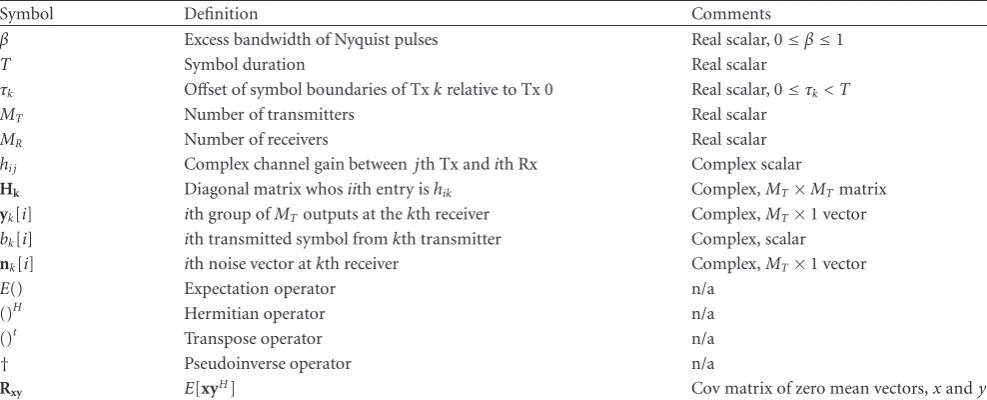
The notation adopted is as follows: lowercase boldface indicates a vector quantity, as in a. A matrix quantity is indicated by uppercase boldface as in A. Some of the most widely used symbols used throughout this paper are tabulated below. The rest of the variables will be defined as and when they appear throughout the paper (seeTable 1).
MF output for Tx2
T T
Tx1
Tx2 MF output for Tx1
Aligned MIMO Offset MIMO
Matched filter output
of offset transmitter
is lower
Figure1: Reduction of interference power in offset MIMO.
3. Motivation behind Timing Offset
In this section, we present an intuitive rationale behind the improved performance of the offset MIMO system. In traditional single carrier MIMO systems, each receive chain downconverts the received signal to baseband, carries out analog to digital conversion, and then employs matched filtering before downsampling the received signal to the system symbol rate. Assuming equal channel gain, the signals from the symbol aligned transmitters contribute equal power to the received signal at the output of the downsampled received matched filter. It may be shown that in a rich scattering environment, the channel gains are statistically independent, and thus the receiver can demodulate the inde-pendent streams in either successive interference cancellation mode or joint detection mode.
In the offset scheme proposed, the transmitters’ symbol boundaries are offset in time. Thus, when receiver-matched filtering is employed, under equal gain channel conditions the signals from the two transmitters are not of the same power. This is shown inFigure 1for rectangular pulse shap-ing. Indeed, the received signal power from the transmitter with the offset symbol islowerthan that from the transmitter which has its symbol boundaries aligned to that used by the received matched filter. Thus, for the same channel, the offset scheme has lower IAI power in comparison to that in the aligned case.
Table1
Symbol Definition Comments
β Excess bandwidth of Nyquist pulses Real scalar, 0≤β≤1
T Symbol duration Real scalar
τk Offset of symbol boundaries of Txkrelative to Tx 0 Real scalar, 0≤τk< T
MT Number of transmitters Real scalar
MR Number of receivers Real scalar
hi j Complex channel gain betweenjth Tx andith Rx Complex scalar
Hk Diagonal matrix whosiith entry ishik Complex,MT×MTmatrix
yk[i] ith group ofMToutputs at thekth receiver Complex,MT×1 vector
bk[i] ith transmitted symbol fromkth transmitter Complex, scalar
nk[i] ith noise vector atkth receiver Complex,MT×1 vector
E() Expectation operator n/a
()H Hermitian operator n/a
()t Transpose operator n/a
† Pseudoinverse operator n/a
Rxy E[xyH] Cov matrix of zero mean vectors,xandy
0 0.2 0.4 0.6 0.8 1
−3 −2 −1 0
Offset (Ts)
In
te
rfer
enc
e
p
o
wer
(dB)
Interference power for various pulse shaping as a function of offset
SRRC pulse 0% excess BW SRRC pulse 15% excess BW SRRC pulse 25% excess BW
SRRC pulse 50% excess BW SRRC pulse 75% excess BW Rectangular pulse
Rectangular pulse SRRC pulse 50% EBW
SRRC pulse 0% EBW
Figure 2: Interference power for various excess bandwidths and offsets. Note: no gain at 0 excess BW.
at an offsetτ1for a SRRC transmit pulse shape with excess bandwidthβand symbol durationT, is given by
IAI(τ1)=
k=∞
k=−∞
sin(π(kT+τ1)/T) π(kT+τ1)/T
cosπβ(kT+τ1)/T
1−2β(kT+τ1)/T
2
2 ,
(1)
and is shown for various offsets andβinFigure 2below. The above formula samples the raised cosine pulse [19, equation (3)], at symbol intervals as a function of the offset from the symbol boundary, τ1, and determines the power thus obtained. It may be seen that for a pulse with no excess bandwidth (β = 0), there is no reduction in interference power, and thus no gains. However, as the excess bandwidth increases, the interference power reduces, and thus gains increase.
In addition to the lowering of interference power, the system performs better for one more reason. Offsetting the
two transmit waveforms relative to each other introduces ISI, thus effectively converting the memoryless modulation schemes into those with memory. Consequently, an intel-ligent receiver can use the ISI to predictively cancel the interference in subsequent symbols, thus leading to an even greater suppression of interference
These two effects combine to provide significant system gains to a MIMO system with intentional timing offset in comparison to an equivalent symbol synchronous MIMO system.
4. The Timing Offset MIMO System
Figure 3shows an offset ofτ1 in a particular embodiment of the proposed system with 2 transmit antennas. The symbol duration is denoted by T with 0 ≤ τ1 < T. Other embodiments of the proposed system using MT
antennas would have differentτks offsetting the signals from
the different transmitters. For simplicity of illustration, the transmit signals are depicted with a rectangular pulse shape inFigure 3.
4.1. A2×2MIMO System with Timing Offset. For simplicity of presentation, a 2 Tx-2 Rx system with a rectangular pulse shaping is considered first. The signals transmitted from the 2nd transmitter is intentionally offset with respect to the first byτ1. Unlike in traditional symbol aligned MIMO, where the output of the matched filter downsampled to the symbol rate at the optimal sampling points are the sufficient statistics for estimating the transmitted symbols, in timing offset MIMO, the matched filter output of each receiver is sampled everykT
as well as everykT+τ1, wherek=0, 1, 2,. . ., thus collecting the output sampled optimally for both transmitters.
Lethi jbe the complex path gain from thejth transmitter
b1[i−1] b1[i]
b2[i−2] b2[i−1]
b1[i+ 1]
b2[i]
T h11 h12 MF MF SampledkT
SampledkT+τ1
SampledkT
SampledkT+τ1
h22 h21 Rx1 Rx2 τ1 Tx1 Tx2
Figure3: Subsymbol timing offset: 2 Tx antennas.
T
−T 0 τ1
ρ21 ρ12
Figure4: Cross correlations,ρ12andρ21.
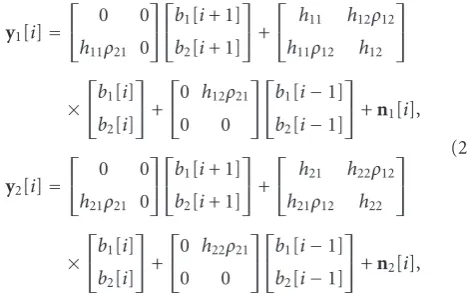
matched filters, the received vector for each of the receive antennas is given by
y1[i]=
⎡
⎣ 0 0
h11ρ21 0
⎤ ⎦ ⎡
⎣b1[i+ 1] b2[i+ 1]
⎤ ⎦+
⎡
⎣ h11 h12ρ12 h11ρ12 h12
⎤ ⎦
×
⎡ ⎣b1[i]
b2[i]
⎤ ⎦+
⎡
⎣0 h12ρ21 0 0
⎤ ⎦ ⎡
⎣b1[i−1] b2[i−1]
⎤ ⎦+n1[i],
y2[i]=
⎡
⎣ 0 0
h21ρ21 0
⎤ ⎦ ⎡
⎣b1[i+ 1] b2[i+ 1]
⎤ ⎦+
⎡
⎣ h21 h22ρ12 h21ρ12 h22
⎤ ⎦
×
⎡ ⎣b1[i]
b2[i]
⎤ ⎦+
⎡
⎣0 h22ρ21 0 0
⎤ ⎦ ⎡
⎣b1[i−1] b2[i−1]
⎤ ⎦+n2[i],
(2)
whereyk[i] is theith pair of outputs of the matched filter in
thekth receiver,bk[i] is theith transmitted symbol from the
kth transmitter, andnk[i] is the AWGN noise vector at the
kth receiver. The first row of (2) is the output of the matched filter matched to the first transmitter, and the second row is the output of the matched filter matched to the second transmitter.
The crosscorrelationsρ12 and ρ21 are a function of the pulse shape and timing offset, with the detailed form given by (9). For a rectangular pulse, ρ12 and ρ21 are shown in
Figure 4.
It is seen that when the received matched filter is aligned to the first transmitter, theith symbol of the first transmitter not only interferes with the ith symbol of the second transmitter (as would be the case in standard aligned MIMO architectures) but also interferes with the (i−1)th symbol of the second transmitter. However, the interference power is reduced due to the offset of the transmit pulses from the two transmitters.
Some simple algebraic manipulations of (2) allow us to write the received samples of receiverkas
yk[i]=
⎡ ⎣0 ρ21
0 0
⎤ ⎦
t⎡
⎣hk1 0 0 hk2
⎤ ⎦ ⎡
⎣b1[i+ 1] b2[i+ 1]
⎤ ⎦
+
⎡ ⎣ 1 ρ12
ρ21 1
⎤ ⎦ ⎡ ⎣hk1 0
0 hk2
⎤ ⎦ ⎡ ⎣b1[i]
b2[i]
⎤ ⎦
+
⎡ ⎣0 ρ21
0 0
⎤ ⎦ ⎡ ⎣hk1 0
0 hk2
⎤ ⎦ ⎡
⎣b1[i−1] b2[i−1]
⎤ ⎦+n[i].
(3)
It will be seen later that (3) is a special case of the more general formula derived for any arbitrary number of transmitters in (7). The above equations for y1[i] and y2[i] may be combined and written more compactly in the following matrix format:
r[i]=
⎡ ⎣y1[i]
y2[i]
⎤
⎦=Pb[i+ 1] +Qb[i] +Rb[i−1] +n[i].
(4)
To elucidate further,P,Q, andRare all 4×2 matrices,b[i] is a 2×1 vector andn[i] andr[i] are both 4×1 vectors.
When practical pulse shapes of longer duration such as the SRRC pulse shaping is used, then the interference from the offset is not limited to the adjacent symbols but depends on the length of the filter used. Although in theory the SRRC pulse is infinite in duration, all practical schemes use finite length pulse shapes. This may be seen in Figure 5, where a 10-symbol long raised cosine pulse shape is shown. In this case, in an offset transmission scheme, the interference arises from 10 symbols as shown inFigure 5.
In this case, the expressions equivalent to (3) get more complex. Letd(t) denote the continuous time convolution of the pulse shapes at the receiver and at the transmitter.d(t) is assumed to be of duration 2Land thus assumed to be zero for time,t, outside the interval [−LT,LT]. Let us define the two vectors
pT =d(t)|t=kT,k=−L···L=[d(−LT),. . . d(0),. . . d(LT)]t,
pτ1=d(t)|t=kT+τ1,k=−L···(L−1)
−5 0 5 −0.5
0 0.5 1
Symbol duration
ISI
amplitude
Raised cosine pulse: impact of sampling on ISI
Sampling at optimal points leads to no ISI Sampling at nonoptimal points
leads to ISI
Figure5: Raised cosine pulse: impact of sampling on ISI.
Thus, pT consists of the samples ofd(t) at each of the
symbol boundaries, andpτ1consists of the samples ofd(t) at offsets ofτ1from the symbol boundaries. It is worth noting that if two infinitely long SRRC filters are convolved together to obtain d(t), then pT will consist of all zeros except for
the middle element which will be 1. In practice, however, this is usually not true andpT will consider many nonzero
elements, but usually, all are small relative to the middle element. As is the case for most practical pulse shapes, it is assumed thatd(t) is symmetric such thatd(−t) = d(t). Analogous to (3), the received samples at the kth receiver matched to both the first and the second receiver may be expressed as
yk[i]= L
l=0
⎡
⎣ d(lT) d(lT−τ1) d(lT+τ1) d(lT)
⎤ ⎦
t⎡
⎣hk1 0 0 hk2
⎤ ⎦ ⎡ ⎣b1[i+l]
b2[i+l]
⎤ ⎦
+
L
l=1
⎡
⎣ d(lT) d(lT−τ1) d(lT+τ1) d(lT)
⎤ ⎦ ⎡ ⎣hk1 0
0 hk2
⎤ ⎦ ⎡ ⎣b1[i−l]
b2[i−l]
⎤ ⎦
+nk[i].
(6)
4.2.MT×MR MIMO System with Timing Offset. The more
general case withMT transmitters andMRreceivers is now
considered. In this setup, the relative timing offset between the first transmitter andkth transmitter isτk. Without loss
of any generality, it is assumed that 0=τ0≤τ1 ≤τ2· · · ≤ τMT−1 < T whereT is the symbol duration. Each receiver
conceptually has MT matched filters, each one matched to
one of the transmitters (but in reality, would be implemented as a single matched filter sampled MT times a symbol). It
should be mentioned that for excess bandwidth 0 ≤ β ≤
1, sampling each matched filter at 2 samples per symbol meets the Nyquist sampling criterion, and thus an intelligent receiver should be able to operate with the 2 samples/symbol out of the matched filter. In this analysis, we sample the output of the matched filer atMT samples per symbol only
to keep the receiver structure conceptually simple.
For systems using pulse shapessl(t) at thelth transmitter
such as the rectangular pulse that is zero outsidet∈[0,T], it may be shown that the samples received at thekth receiver is aMT×1 vector,yk[i], that may be expressed as
yk[i]=(R1)tHkb[i+ 1] +R0Hkb[i] +R1Hkb[i−1] +nk[i],
(7)
where theMT×MTmatrixHk=diag(hk1,hk2,hk3,. . .,hkMT)
and the correlationsρklandρlkare given by:
ρkl=
T
τ
sk(t)sl(t−τ)dt,
ρlk=
τ
0sk(t)sl(t+T−τ)dt.
(8)
The entry in the jth row,kth column of the MT ×MT
matrices,R0andR1is given by
R0j,k=
⎧ ⎪ ⎪ ⎪ ⎪ ⎨ ⎪ ⎪ ⎪ ⎪ ⎩
1, if j=k,
ρjk, if j < k,
ρk j, if j > k,
R1j,k=
⎧ ⎨ ⎩
0, if j≥k,
ρk j, if j < k.
(9)
It can be seen that (3) is a special case of (7) for
MT = 2. The zero-mean Gaussian noise process nk[i] has
the following autocorrelation matrix, whereσ2 denotes the noise variance
Enk[i]nH l
j=
⎧ ⎪ ⎪ ⎪ ⎪ ⎪ ⎪ ⎪ ⎪ ⎨ ⎪ ⎪ ⎪ ⎪ ⎪ ⎪ ⎪ ⎪ ⎩
σ2(R1)t
, if j=i+ 1, k=l
σ2(R0)t
, if j=i, k=l
σ2R1, if j=i−1, k=l
0, otherwise.
(10)
It is noted that the expressions above are very similar to those in the derivation of the multiuser discrete time asyn-chronous model developed in [20, Section 2.10]. Although the notation has been chosen to be consistent with [20], the application space is quite different. We also note that comparing (7) with (14) of [8], it may be concluded that the received samples are identical in both our model, and in the case of offset MIMO presented by Shao et al. This was been shown by us in more detail in [21].
The derivations above can be extended for use with practical pulse shapes that extend beyond t ∈ [0,T]. Analogous to the derivation of (6), (7) can also be extended to the case where the convolution of the pulse shape at the transmit and the receive side (d(t)) is nonzero fort ∈
[−LT,LT] and is assumed to be zero for t outside this interval. In that case, the received samples at thekth receiver can be written as
yk[i]= L
l=0
(Rl)tHkb[i+l] + L
l=1
where, like before,Hkis aMT×MTdiagonal matrix given by
Hk=diag(hk1,hk2,hk3,. . .,hkMT) and theMT ×MT matrix,
Rlis given by
Rl=
⎡ ⎢ ⎢ ⎢ ⎢ ⎢ ⎢ ⎢ ⎢ ⎢ ⎣
d(lT) d(lT−τ1) d(lT−τ2) · · · · d
lT−τMT−1
d(lT+τ1) d(lT) d(lT−(τ2−τ1)) 0 · · · d
lT−τMT−1−τ1
d(lT+τ2) d(lT+ (τ2−τ1)) d(lT) · · · · d
lT−τMT−1−τ2
· · · · · · · · · · · · · · · ·
dlT+τMT−1
· · · · · · · · · · d(lT)
⎤ ⎥ ⎥ ⎥ ⎥ ⎥ ⎥ ⎥ ⎥ ⎥ ⎦
. (12)
Block 1 Block 2
Interblock gap leads to loss in spectral efficiency Ssymbols per block
· · · · · ·
· · · ·
Tx1
Tx2
Figure6: Block transmission scheme.
5. Receiver Design
In this section, we develop 3 different forms of receivers for the proposed system: (i) Zero Forcing (ZF) receivers, (ii) minimum mean squared error (MMSE) receivers and (iii) Viterbi algorithm-based sequence detection receivers.
All the receivers assume memoryless linear modulations such as M-ary Phase Shift Keying (M-PSK) or M-ary quadrature amplitude modulation (M-QAM) with a block transmission scheme as shown inFigure 6. It is assumed that there is no interblock interference (IBI). This condition can be satisfied by inserting an appropriate amount of idle time between the transmission of two blocks as shown inFigure 6. Each block is assumed to containSsymbols long. Note that as
Sincreases, the overhead due to the interblock gap decreases. The transmitted symbols are assumed to be zero mean, unit energy, and uncorrelated in time and space. It is assumed that the channel is flat fading and unchanged over the duration of the entire block and independent from block to block and that the channel is known perfectly at the receiver. The noise is assumed to be Gaussian and independent of the data symbols. Two different noise models are used below—the first where the noise is spatially uncorrelated and the second where the noise has mutual coupling between the receivers.
5.1. ZF Receivers. In [8], the authors present a zero forcing (ZF) receiver whose performance is strongly dependent on the blocksize,S. They conclude that for large block sizes the performance of the offset transmission scheme isworsethan that of the traditional MIMO schemes, and thus, the offset scheme should be used only for very short block sizes. In their
work, the block sizes are typically 2, 4, or 10 symbols. This is a very severe restriction as such short block sizes lead to significant spectral efficiency reductions. With a block size of 2 symbols with 2 transmit antennas and offsetτ1 = 0.6 T, the system has a spectral efficiency that is 23% less than that of synchronized systems and with a block size of 10 symbols, the spectral efficiency is reduced by 5.7%. This reduction in spectral efficiency makes the offset MIMO scheme, proposed in [8], of limited use in practical systems.
A closer examination of the ZF receiver proposed by Shao et al. showed that it was not the optimal ZF receiver. This was first shown by us in [21]. The authors of [8] had mistakenly chosen a formulation that suffered a lot of noise enhancement as the block size,S, grew larger. To obtain the optimal ZF receiver, we first stack all the outputs of each block for thekth receiver from (7) to obtain
zk=RAkbblock+nk, (13)
wherezk=[ytk(0),ytk(1),ytk(2),. . .,ytk(S−1)] t
, the transmit-ted symbols,bblock =[bt(0),bt(1),. . .,bt(S−1)]t
andAk =
diag{Hk,Hk,Hk,. . .}.yk(i) andb(i), both MT ×1 vectors,
represent the received samples matched to each transmitter received at receiverkat timeiand the transmitted symbols from all transmitters at timei, respectively.Hkis a diagonal matrix of channel gains of size MT ×MT. Thus, in (13),
zk is a SMT ×1 vector of all received samples in a block
of S transmitted symbols per transmit antenna at receiver
k.bblockis theSMT×1 vector of all transmitted symbols in
that block,Ak is a diagonal matrix ofSMT×SMT elements
of channel gains from the transmitters to thekth receiver (assumed constant over the block).R is aSMT ×SMT real
symmetric correlation matrix given by (14), whereR0 and R1are given by (9)
R=
⎡ ⎢ ⎢ ⎢ ⎢ ⎢ ⎢ ⎢ ⎢ ⎢ ⎢ ⎢ ⎢ ⎣
R0 R1t 0 · · · · 0
R1 R0 R1t 0 · · · 0
0 R1 R0 R1t 0 · · ·
· · · ·
0 · · · 0 R1 R0 R1t 0 · · · · 0 R1 R0
⎤ ⎥ ⎥ ⎥ ⎥ ⎥ ⎥ ⎥ ⎥ ⎥ ⎥ ⎥ ⎥ ⎦
Then all the zk outputs of each receiver is stacked in the following manner: ⎡ ⎢ ⎢ ⎢ ⎢ ⎢ ⎢ ⎢ ⎣ z1 z2 .. . zMR
⎤ ⎥ ⎥ ⎥ ⎥ ⎥ ⎥ ⎥ ⎦ = ⎡ ⎢ ⎢ ⎢ ⎢ ⎢ ⎢ ⎣
R 0 · · · 0
0 R 0 · · ·
· · · ·
0 · · · 0 R
⎤ ⎥ ⎥ ⎥ ⎥ ⎥ ⎥ ⎦ ⎡ ⎢ ⎢ ⎢ ⎢ ⎢ ⎢ ⎢ ⎣ A1 A2 .. . AMR
⎤ ⎥ ⎥ ⎥ ⎥ ⎥ ⎥ ⎥ ⎦ bblock+ ⎡ ⎢ ⎢ ⎢ ⎢ ⎢ ⎢ ⎢ ⎣ n1 n2 .. . nMR
⎤ ⎥ ⎥ ⎥ ⎥ ⎥ ⎥ ⎥ ⎦ ,
ztot=RtotAtotbblock+ntot
(15)
and the optimum ZF receiver is given by
bZF opt=
AH
totRtotAtot
−1 AH
totztot. (16)
The above optimal ZF receiver not only cancels all the interference, but it minimizes the output noise variance. It can be readily derived by noting that the optimal ZF receiver is the well known best linear unbiased estimator (BLUE) [22, Chapter 6]. This can be seen by noting that in the BLUE estimation, we seek an unbiased estimator which minimizes the estimator variances. The unbiased criterion ensures cancellation of interference while minimizing vari-ance corresponds to maximizing signal to noise ratio.
It should be pointed out that the optimal ZF receiver is a batch receiver; that is, it works on the received samples from the entire block at the same time. This increases complexity and introduces latency in the system (since the first transmitted symbols can only be decoded after the samples corresponding to the last transmitted symbol in the block have been received). The above receiver also needs to calculate the pseudoinverse of a SMT ×SMT matrix. The
block sizes of practical systems often consists of hundreds (sometimes thousands) of symbols, and thus the complexity of this step is nontrivial and indeed could be impractical with current hardware.
InSection 7.5, we plot the performance of the optimal ZF receiver developed here and compare the performance to that in [8]. As will be seen, the optimal ZF receiver does not suffer any significant performance degradation when the block size is increased.
5.2. MMSE Receivers. The linear MMSE receiver is known [2] to outperform the ZF receiver and is considered in this section. The LMMSE estimate ofb, given observationr, is given by RbrR†rrr, where †indicates the pseudoinverse and Rbr = E[brH] andRrr = E[rrH] [22]. It is known that for
Gaussian noise, the MMSE solution and the LMMSE solu-tion are the same and so the terms are used interchangeably here.
Two classes of MMSE receivers are analyzed. The first class carries out joint detection of the symbols, while the second carries out layered interference cancellation. For both these receiver types, one-shot receivers (i.e., those that estimateb[i], givenr[i]) and windowed receivers (i.e., those that estimate b[i] givenr[i−W],. . .r[i],. . .r[i+W], thus implying a window length of 2W+ 1) are developed. We will
also develop an MMSE joint batch receiver, that is, one that estimates all the transmitted symbols of the block, using all the received samples in that block.
5.2.1. One-Shot LMMSE Receiver,(W =0). In this scenario, the observations, r[i], are given by (4), and only one measurement vector is used to estimate the corresponding information carrying symbols. It is assumed that: (a)b[i]s are zero mean, unit energy, and uncorrelated in time, (b)
hi js, the channel gains, are perfectly known at receiver and
do not change over the duration of a block of data, and (c) the additive Gaussian noise is spatially uncorrelated and also uncorrelated with the information carrying signal. Under these assumptions, from (4), we have
Rrr=PPH+QQH+RRH+RNN,
Rb[i]r=QH.
(17)
In the symbol aligned 2×2 model (traditional MIMO),RNN, the noise covariance matrix, is often modeled as 2×2 identity matrix scaled with the noise varianceσ2. This simple model assumes that the noise variance,σ2is the same for both the receive antennae and that there is no noise coupling between the antennas. In offset MIMO, we have 2 sets of matched filters per receiver and soRNNis a 4×4 matrix. By observing that the continuous time AWGN noise is zero mean and independent between the two receivers and by noting that part of the integration period for each symbol is the same between the two matched filters in the same receiver, it may be shown thatRNNfor this noise model is no longer a scaled identity matrix, but is given by (18), whereσ2 is the noise variance andρ12is given by(9)
RNN= ⎡ ⎢ ⎢ ⎢ ⎢ ⎢ ⎢ ⎣
σ2 ρ
12σ2 0 0
ρ12σ2 σ2 0 0
0 0 σ2 ρ 12σ2
0 0 ρ12σ2 σ2
⎤ ⎥ ⎥ ⎥ ⎥ ⎥ ⎥ ⎦ . (18)
In the more general case where the noise is not assumed to be independent between the two antenna, the noise covariance matrix in the traditional symbol aligned 2×2 system is given by
RNNaligned=
⎡ ⎣σ112 σ122
σ212 σ222
⎤
⎦, (19)
where σ112 and σ222 are, respectively, the noise variances of the 1st receive antenna and the 2nd receive antenna.σ122 and σ212 are, respectively, the covariance of the noise on the first receive antenna with that of the 2nd receive antenna and vice-versa. In all these cases, the noise is assumed to be zero mean. In this model for the noise, (18) can also be more generalized and is determined to be
RNN= ⎡ ⎢ ⎢ ⎢ ⎢ ⎢ ⎢ ⎣ σ2
11 ρ12σ112 σ122 ρ12σ122
ρ12σ112 σ112 ρ12σ122 σ122
σ2
21 ρ12σ212 σ222 ρ12σ222
ρ12σ212 σ212 ρ12σ222 σ222
Using (17) and (18) or (20), the transmitted symbols are thus estimated at the receiver to be
b[i]=QuantRb[i]rR†rr(r[i])
, (21)
wherer[i] is a vector of all observations being used for the estimate ofb[i], and the Quant{·}function is used to make hard decisions on the processed samples.
5.2.2. Adjacent Symbol LMMSE Receiver,W = 1. From the observation model, it is clear that because of correlation between adjacent measurements, an LMMSE receiver that estimates the information symbols using measurements that span more than one symbol duration can lead to improvements. In this section, the adjacent symbol LMMSE receiver that utilizes the three received vectors to decideb[i] will be considered. Using (4), the received vectors used to determineb[i] are
r[i−1]=Pb[i] +Qb[i−1] +Rb[i−2] +n[i−1],
r[i]=Pb[i+ 1] +Qb[i] +Rb[i−1] +n[i],
r[i+ 1]=Pb[i+ 2] +Qb[i+ 1] +Rb[i] +n[i+ 1].
(22)
These three equations may be stacked and expressed more compactly as
y[i]=
⎡ ⎢ ⎢ ⎢ ⎣ R 0 0 ⎤ ⎥ ⎥ ⎥
⎦b[i−2] + ⎡ ⎢ ⎢ ⎢ ⎣ Q R 0 ⎤ ⎥ ⎥ ⎥
⎦b[i−1] + ⎡ ⎢ ⎢ ⎢ ⎣ P Q R ⎤ ⎥ ⎥ ⎥ ⎦b[i]
+ ⎡ ⎢ ⎢ ⎢ ⎣ 0 P Q ⎤ ⎥ ⎥ ⎥
⎦b[i+ 1] + ⎡ ⎢ ⎢ ⎢ ⎣ 0 0 P ⎤ ⎥ ⎥ ⎥
⎦b[i+ 2] +n3[i]
=M1b[i−2] +M2b[i−1] +M3b[i] +M4b[i+ 1]
+M5b[i+ 2] +n3[i].
(23)
Note thaty[i] andn3[i] are 12×1 vectors, eachMiis a 12×2
matrix, andb[i] is a 2×1 vector. Thus, the LMMSE receiver is given by
b[i]=QuantRb[i]yR†yy
y[i]
=Quant ⎧ ⎪ ⎨ ⎪ ⎩M H 3 ⎛ ⎝5
i=1
MiMHi +RNN
⎞ ⎠ †
y[i]
⎫ ⎪ ⎬ ⎪ ⎭. (24)
In this context, the covariance matrix of the noise vectorn3[i] given byRNN is a matrix with similar structure as in (18) or
(20) except that it is a 12×12 matrix. This approach can be extended to more general receivers using a wider window of received samples to estimate theith transmitted symbol.
5.2.3. MMSE Joint Batch Receivers. The above two MMSE receivers estimated the transmitted symbol vectors one at a time; that is,b[0] is estimated, thenb[1] is estimated and so on until all the transmitted symbols of the block are estimated. In this section, we present the joint batch MMSE receiver. This receiver estimates all the transmitted symbols of the blockbblockbased on all the received samples from that block,ztot(see (15)).
Similar to the subsections above, the optimal estimate is derived below as
bMMSE-block
=Quant
#
EbblockztotHEztotztotH†ztot
$
=Quant
#
AHtotRHtot
AtotRtotAHtotRHtot+Rntotntot
†
ztot
$
.
(25)
As discussed in Section 5.1, these batch receivers are significantly more complicated to implement and require taking the inverse of matrices of sizeSMT×SMT. They also
add latency to the system and are included here for the sake of completion.
5.2.4. MMSE Receivers with Layered Detection and Interfer-ence Cancellation. The two receivers discussed above carry out joint decoding of symbols transmitted from the two transmitters. However, a vertical bell labs layered space time-(V-BLAST-) type approach [1] where one transmitter is decoded (using a LMMSE receiver), and then the decoded symbols are used to carry out interference cancellation was also designed. As shown in [1, 23], the layered approach achieves superior performance in the traditional symbol-aligned case, and here, it is expected that the layered detection will also improve performance in the proposed offset scheme.
It is well known (see, e.g., [1, 23, 24]) that optimal ordering of the decoding layers leads to performance improvements. As [1] has shown, decoding the layer with the highest SINR (or the lowest error variance) yields the optimal ordering.
Using (17), in the case of the one-shot (W = 0) offset MIMO system, the error covariance matrix may be expressed as
E#b−bb−bH
$
=Rbb−RbrR†rrRrb
=I2×2−QH
PPH+QQH+RRH+R NN
†
Q.
(26)
[0 0 0 0]
[0 0 0 1]
[0 0 1 0]
[1 1 1 1] [1 1 1 0] [0 0 1 1]
[0 1 0 0]
[0 1 0 1]
[0 0 0 0]
[0 0 0 1]
[0 0 1 0]
[1 1 1 1] [1 1 1 0] [0 0 1 1]
[0 1 0 0]
[0 1 0 1]
···
···
[B2[i−1]B1[i]B2[i]B1[i+ 1]] [B2[i−1]B1[i]B2[i]B1[i+ 1]]
Figure7: Trellis connectivity.
5.3. Viterbi Algorithm-Based Receivers. Since ISI is inherently present in the proposed offset system, the optimal receiver is the maximum likelihood sequence detector (MLSD). The Viterbi algorithm [25] is a very well known algorithm for implementing the MLSD in a computationally tractable manner. As shown in [26] and implied by [25, Section 2], the usual implementation of the Viterbi algorithm yields the MLSD only if the noise is memoryless and is independent from sample to sample. In our case, however, this is not true as the noise has temporal correlation as indicated by (10).
In order to reduce the impact of the temporal noise correlation, we carried out noise whitening over different observation windows. that is, the Viterbi algorithm was run not on the received samples, but onRnn−1/2y[i], whereRnn denotes the covariance of the noise vector andy[i] denotes the received vector as given by (4) for the one shot case and by (23) for the windowed case. Although this method whitens the noise locally, it does not whiten the noise over the entire received burst and thus is an approximation to the ML solution.
5.3.1. Rectangular Pulse. A cursory examination of (4) reveals a channel memory of 3 symbol times and with BPSK signaling with 2 transmit antenna this leads to a total of (22)3 =
64 states in the trellis. However, a more careful inspection using the structure of matricesPandRfrom (2), indicates that the channel memory can be reduced to 4 bits and thus results in 16 states as shown inFigure 7.
0 0.1 0.2 0.3 0.4 0.5
−100 −80 −60 −40 −20 0
Frequency (normalized) Frequency response of 8 times oversampled
pulse shaping filters, 25% excess BW
801 tap SRRC filter 241 tap SRRC pulse 241 tap proposed new pulse
M
ag
nitude
response
(dB)
Figure 8: Frequency response of proposed new pulse compared with SRRC Filter.
−6 −4 −2 0 2 4 6
0 0.5 1
Symbol duration
A
mplitude
Time domain response of SRRC filter and proposed new pulse, excess BW=25%
SRRC pulse Proposed new pulse
Figure9: Time response of proposed new pulse compared with SRRC Filter.
5.3.2. Raised Cosine Pulse. When the SRRC pulse shape is employed the channel memory depends on the length of the filters employed. Our simulations employed a SRRC filter of length 21 symbols with 25% excess bandwidth, and thus the ISI extends over 20 symbol durations. This causes the trellis to grow unacceptably large for implementation purposes. The optimal trellis for a pulse withLsymbol ISI and for a system usingMT transmitters and anM-ary constellation is
(MMT)Llong. This is usually impractical to implement and
The 16 state Viterbi trellis used for the sequence detection receivers is shown inFigure 7.
6. Pulse Shape Design for MIMO with
Timing Offset
In this section, we propose robustness to IAI (defined in (1)) as a new criterion for pulse shape design. The key idea is the following: once the transmitters are offset from each other, the IAI is controlled by the correlation of the transmit pulse shape with the received pulse shape at an offset equal to the offset of the symbol boundaries. Without an offset, this criterion is no longer valid since the IAI is given by the correlation of the two pulses at zero offset (which is unity for all normalized pulse shapes). Similar to the formulation of (3) in [18], we minimize the cost function
ξ=ξs+
n∈SISI
γg[n]−d[n]2+
n∈SIAI ηg2[n],
(27)
whereξsis the stop band energy of the square root Nyquist
(M) discrete-time filter given by h[n] which runs at M
samples/symbol, where n is the discrete time index. d[n] is the response of the convolution of the two square root Nyquist filters being designed with the target response given byg[n].SISIandSIAI, respectively, identify different subsets of samples ofnas shown below.γandηare weighting functions that allow us to trade offone constraint with another. In an ideal square root Nyquist filter,g[n]=h[n]∗h[−n], where
∗denotes convolution andg[n] satisfies the no-ISI Nyquist criterion given by
g[n]=
⎧ ⎪ ⎪ ⎪ ⎪ ⎨ ⎪ ⎪ ⎪ ⎪ ⎩
1, ifn=0,
0, ifn=mM, m /=0,
arbitrary, ifn /=mM.
(28)
Thus, SISI = {0,±M,±2M,. . .} is the subset of n, where constraints are placed to minimize the ISI.
In order to reduce the IAI, we need to lower the energy ofg[n] at the offset points. Thus, for example, for an offset of T/2, the sum of the square of the samples of g[n] at
±M/2, ±M(1 + 1/2), ±M(2 + 1/2), and so on need to be lowered. By choosing SIAI to be the set {±M/2,±M(1 + 1/2),±M(2 + 1/2),. . .}and by choosing appropriate weights,
γandη, we can perform a tradeoffbetween the reduction of ISI and IAI. In [18], an iterative method for designing a filter conforming to such a cost function is described in detail and is used by us.
Using this method of pulse shape generation, we can create a family of pulses that have various tradeoffs of ISI, IAI and stop-band attenuation. Here, we show an example of such a pulse, by choosing an excess bandwidth of 25% andγ = 1 andη=0.6. The key properties of this pulse in comparison to the square root raised cosine pulse shape are summarized inTable 2.
It may be seen that the residual ISI goes up from−74 dB (practically zero) in the case of two SRRC pulses convolved with each other to−19 dB (still pretty low) in the case of
Table2: Square root raised cosine versus new pulse.
SRRC∗SRRC New pulse∗new pulse
Residual ISI (dB) −74 −19
T/2 IAI (dB) −0.58 −1.02
the two proposed pulses convolved with each other. The IAI power caused by an offset of half a symbol time (T/2), however, has been improved from about−0.58 dB to about
−1.02 dB.
The frequency response of 3 different filters are plotted inFigure 8. It may be seen that compared to the frequency response of a SRRC filter of same length, the proposed pulse has worse stop band attenuation. The peak sidelobe level is still close to −30 dB below the main lobe and is thus considered acceptable. The time domain response is shown inFigure 9, where it may be seen that the two pulse shapes are similar though ISI has increased for the proposed pulse at the benefit of a lower IAI atT/2 offset.
Although we are showing only a single pulse shape here, different designers could come up with different pulse shapes depending on different weights imposed in (27) depending on various system parameters. Our emphasis here is on the importance of minimization of IAI as a filter design parameter for offset MIMO systems not so much on the exact choice of the parameters which might vary from system to system.
7. Simulation Results
The simulations have been done as a set of experiments where, in each case, comparisons have been made to similar aligned systems. In all cases, the channel is assumed to be known perfectly at the receiver. Each simulation also assumes a block fading model, where the channel is independent from block to block and is assumed to be constant over the duration of each block. The channel coefficients have been generated as samples from a mean zero, unit variance complex Gaussian random variable. To obtain statistically reliable results, each datapoint is obtained by simulating at least 10000 blocks. The total transmit power is held constant irrespective of the number of transmitters by normalizing the output power from each transmitter by the number of transmitters, MT. The performance metric of choice is
symbol error rate (SER) or bit error rate (BER) which is plotted in the following graphs as a function ofEs/N0, the ratio of the symbol energy (Es) to the noise power spectral
density (N0). The performance is compared at a SER equal to 10−2.
7.1. Comparison with OSIC VBLAST. In Figures 10 and
0 2 4 6 8 10 12 14 16 18 20 22 24
Es/N0(dB)
Offset MIMO: MMSE one shot joint detection
Offset MIMO: MMSE 2 adjacent symbols window joint detection Baseline: MMSE joint detection
Baseline: MMSE OSIC
Offset MIMO: MMSE one shot OSIC
5.5 dB of gain (joint detection)
2 dB of gain (OSIC)
10−1
10−2
10−3
10−4
SER
-pulse shape, MMSE receivers 2×2 system, block fading, rectangular
Figure10: Offset MIMO with MMSE Rx compared OSIC VBLAST, (MT,MR)=(2, 2), modulation=QPSK.
0 2 4 6 8 10 12 14 16 18 20 22 24 100
10−1
10−2
10−3
10−4
Es/N0(dB)
2×2 system, block fading, MMSE receivers: with SQRC pulse shaping (excess BW 25%)
Baseline: VBLAST MMSE joint detection Baseline: VBLAST MMSE OSIC
Offset MIMO: MMSE joint detection raised
pulse
Offset MIMO: MMSE OSIC one shot raised cosine pulse Offset MIMO: MMSE OSIC adjacent
symbol window raised cosine
1.8 dB of gain (OSIC)
0.6 dB of gain (joint detection)
SER
cosine pulse
-Figure11: Offset MIMO with SRRC pulse shaping versuss OSIC VBLAST, (MT,MR)=(2, 2), modulation=QPSK.
cosine pulse shaping with 25% excess bandwidth is shown in
Figure 11. The square root raised cosine (SRRC) filters on the transmitter and receiver sides have both been truncated to 13 symbols.
In either case, the comparison has been made to the “best” aligned VBLAST scheme which is when the VBLAST receivers employ OSIC [23]. It may be seen that the
0 5 10 15 20 25
10−1
10−2
10−3
10−4
Es/N0(dB)
BER
T R
BPSK, (M ,M )=(2, 2), MMSE (block size 128 symbols), 100 K bursts
Aligned
Offset=0.5 Ts, MMSE, one shot Offset=0.2 Ts, MMSE, one shot Offset=0.5 Ts, MMSE, windowed Rx Offset=0.2 Ts, MMSE, windowed Rx
Figure 12: BER Performance for BPSK with various offsets, (MT,MR)=(2, 2).
proposed system outperforms the VBLAST scheme both when rectangular pulse shaping is employed as well as when the raised cosine pulse shape is employed. In the latter, and more practical case, the gain is about 1.8 dB (at a BER of 10−2) when OSIC is employed on both the proposed system as well as on aligned traditional VBLAST.
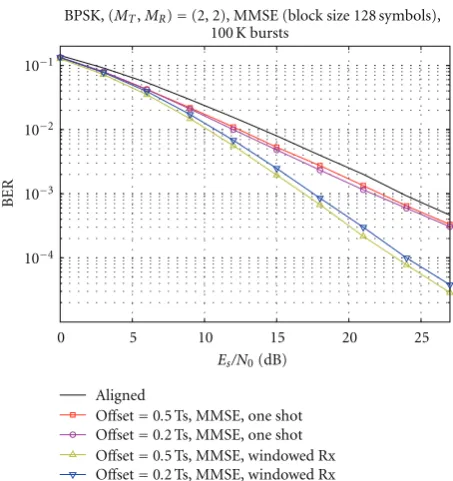
7.2. Performance for Various Offsets. In this set of simula-tions, Figure 12 shows the performance of a 2×2 system with BPSK modulation for various offsets between the first and second transmitters. A rectangular pulse shape is used. The performance of both an one-shot as well as a windowed receiver is shown. It may be seen that the MMSE windowed receiver achieves a lower BER with offset of 0.5 T, whereas when the one-shot receiver is employed, an offset of 0.2 T is better at higher SNRs. More details on the performance at various offsets as well as an analytical derivation of an optimal offset for a (MT,MR)=(2, 1) may be found in our
prior work [21].
7.3. Performance of Sequence Detection-Based Receivers. In Figure 13, the performance of Viterbi algorithm-based receivers are shown in comparison to that for a traditional 2 × 2 MIMO system employing symbol-by-symbol ML detection. BPSK modulation with rectangular pulse shaping was used in a (MT,MR) = (2, 2) system. Three curves
are shown for offset MIMO: (i) without employing noise whitening, (ii) using noise whitening on a one shot case (W = 0), and (iii) using noise whitening on an extended window basis (W=2).
Table3: Timing aligned MIMO compared to timing offset MIMO.
Offset MIMO VBLAST
Matched filter rate MTsamp/symb 1 samp/symb
ZF Needs inverse (or Pseudoinverse) ofSMT×SMTmatrix Needs inverse (or Pseudoinverse) ofMR×MTmatrix Performance gain∼5 dB
One-shot MMSE
Needs Inverse (or Pseudoinverse) ofMTMR×MTMR
matrix Needs inverse (or Pseudoinverse) ofMR×MTmatrix
Performance gain∼1.5 dB
Windowed MMSE
More gains from more complexity Complexity grows
with window size No gains over MMSE
Performance gain∼6 dB
Trellis based receivers
Trellis size (and thus complexity) can be traded for
performance Symbol-by-symbol ML receivers are optimal
Performance gain∼0.5 dB
New pulse shapes Gains from new pulses that lower IAI No gains from new pulse shapes Performance gain∼1 dB
0 1 2 3 4 5 6 7 8 9 10 11 12
10−1
10−2
10−3
Es/N0(dB)
BER
BPSK, (MT,MR)=(2, 2), offset=0.5 Ts, sequence detectors, impact of noise whitening
Timing offset MIMO, without noise whitening, rectangular pulse
Timing aligned MIMO, ML receiver, BPSK Timing offset MIMO, with noise whitening, BPSK, rectangular pulse
Timing offset MIMO, with windowed noise whitening, rectangular pulse
Figure 13: Impact of noise whitening on trellis-based receivers, (MT,MR)=(2, 2), modulation=BPSK.
approximately equal to that of the traditional symbol aligned system with ML detection. However, when noise whitening is employed, we pick up a gain of about 0.5 dB at a BER of 10−2. While the gains in this case are admittedly smaller, in some systems even a 0.5 dB gain in performance might be worth the additional complexity.
7.4. Performance of a3×3System. InFigure 14, we present the results of a 3×3 MIMO system with offset transmission with MMSE joint detection receivers. In this case, there are two offsets, and they have been set toT/3 and 2T/3. It may be
0 5 10 15 20
10−1
10−2
10−3
10−4
10−5
Es/N0(dB)
BER
(MT,MR)=(3, 3), offsets=(1/3 Ts, 2/3 Ts), BPSK, rectangular window, 10 K blocks
Baseline aligned, MMSE joint detection Offset MIMO, MMSE joint detection with extended window
Figure 14: Performance of a 3×3 system, (MT,MR) = (3, 3), modulation=BPSK.
seen that the performance gains are over 6 dB (when SER= 10−2) when used with a rectangular pulse shape.
5 10 15 20 100
10−1
10−2
10−3
10−4
Et/N0(dB)
BER
T R BER for two ZF receivers, BPSK, (M ,M)=(2, 2),
offset=0.6 Ts
ZF from [6],S=2 ZF from [6],S=10 ZF from [6],S=20
Optimal ZF,S=2 Optimal ZF,S=10 Optimal ZF,S=20 Optimal ZF
ZF from [6]
Figure15: Optimal ZF receiver versus ZF receiver from [8].
0 1 2 3 4 5 6 7 8 9 10 11 12 13 14 15 16 17 18 10−1
10−2
Es/N0(dB)
2×2 system, block fading, MMSE receivers: (excess BW 25%)
Baseline: VBLAST MMSE joint detection
Offset MIMO: MMSE joint detection raised cosine pulse Offset MIMO: MMSE joint detection using the
SER
proposed pulse (γ=2,η=0.6)
Figure16: Performance of new pulse shaping.
block sizes are equally efficient. Very short block sizes lead to considerably less spectral efficiency due to the inter gap idle time representing a higher overhead.
7.6. Performance of New Pulse Shaping. To show the benefits of the proposed pulse shaping, the performance of a system using a member of the new proposed pulse family is compared in Figure 16 to the performance of a system using an SRRC pulse. Both systems were simulated using an MMSE joint detection receiver. It may be seen that the performance is improved by using the new pulse. Note that
this, approximately 0.25 dB additional, improvement comes with absolutely no additional system complexity and can thus be regarded of as “free”. Although not shown, the new pulse could be used with the trellis based receivers or zero forcing receivers as well.
8. Conclusions
A novel MIMO transmission scheme, using transmitters that are intentionally offset in time from each other, has been analyzed in this paper. A nonzero (but known) symbol timing offset is introduced between the signals transmitted from the different transmitters to take advantage of the inefficiencies in practical signalling systems. It is shown that a suitably designed receiver can utilize this information to extract significant performance gains. This transmission scheme is studied in conjunction with different kinds of receivers: ZF, MMSE receivers, as well as MIMO MMSE receivers with ordered successive interference cancellation and trellis-based sequence detection-based receivers.
A new pulse shape design that lowers IAI has also been introduced and is shown to increase the gains of such offset transmission schemes.
A summary of highlights of the comparison between an aligned scheme like VBLAST with the proposed scheme is shown inTable 3. The main source of complexity increase is shown along with the performance gain. The performance gain is shown for a (MT,MR)=(2, 2) system with an offset
ofT/2 using BPSK at a BER of 2×10⁻³in comparison to an aligned system.
References
[1] P. W. Wolniansky, G. J. Foschini, G. D. Golden, and R. A. Valenzuela, “V-BLAST: an architecture for realizing very high data rates over the rich-scattering wireless channel,” in
Proceedings of the International Symposium on Signals, Systems and Electronics (ISSSE ’98), pp. 295–300, 1998.
[2] J. Proakis, Digital Communications, McGraw-Hill Science, 2000.
[3] ETSI, “Digital Video Broadcasting (DVB), ETSI EN 302 307 V1.1.2 (2006-06),” 2006.
[4] C. T. L. Inc, “Data-over-cable service interface specifica-tions docsis 2.0, radio frequency interface specification, cm-sprfiv2.0- i11-060602”.
[5] C. Tepedelenlioglu and R. Challagulla, “Low-complexity mul-tipath diversity through fractional sampling in OFDM,”IEEE Transactions on Signal Processing, vol. 52, no. 11, pp. 3104– 3116, 2004.
[6] B. D. Rao and A. Das, “Multiple antenna enhancements via symbol timing relative offsets (MAESTRO),” inProceedings of the 18th Annual IEEE International Symposium on Personal, Indoor and Mobile Radio Communications (PIMRC ’07), pp. 1–5, September 2007.
[8] S. Shao, Y. Tang, T. Kong, K. Deng, and Y. Shen, “Performance analysis of a modified V-BLAST system with delay offsets using zero-forcing detection,”IEEE Transactions on Vehicular Technology, vol. 56, no. 6, pp. 3827–3837, 2007.
[9] Q. Wang, Y. Chang, and D. Yang, “Deliberately designed asynchronous transmission scheme for MIMO systems,”IEEE Signal Processing Letters, vol. 14, no. 12, pp. 920–923, 2007. [10] K. Barman and O. Dabeer, “Improving capacity in MIMO
systems with asynchronous PAM,” in Proceedings of the International Symposium on Information Theory and its Appli-cations (ISITA ’08), pp. 1–6, December 2008.
[11] A. Wittneben, “New bandwidth efficient transmit antenna modulation diversity scheme for linear digital modulation,” in
Proceedings of the IEEE International Conference on Communi-cations (ICC ’93), vol. 3, pp. 1630–1634, Geneva, Switzerland, 1993.
[12] J. Tan and G. L. Stuber, “Multicarrier delay diversity mod-ulation for MIMO systems,” IEEE Transactions on Wireless Communications, vol. 3, no. 5, pp. 1756–1763, 2004.
[13] A. Dammann, S. Plass, and S. Sand, “Cyclic delay diversity— a simple, flexible and effective multi-antenna technology for OFDM,” in Proceedings of the IEEE 10th International Symposium on Spread Spectrum Techniques and Applications (ISSSTA ’08), pp. 550–554, August 2008.
[14] F. J. Harris, Multirate Signal Processing for Communication Systems, Prentice Hall PTR, 2004.
[15] N. C. Beaulieu, C. C. Tan, and M. O. Damen, “A “better than” Nyquist pulse,”IEEE Communications Letters, vol. 5, no. 9, pp. 367–368, 2001.
[16] S. S. Mneina and G. O. Martens, “Maximally flat delay Nyquist pulse design,”IEEE Transactions on Circuits and Systems II, vol. 51, no. 6, pp. 294–298, 2004.
[17] J. K. Liang, R. J. P. deFigueiredo, and F. C. Lu, “Design of optimal Nyquist, partial response, Nth band, and nonuniform tap spacing FIR digital filters using linear programming techniques,”IEEE Transactions on Circuits and Systems, vol. 32, no. 4, pp. 386–392, 1985.
[18] B. Farhang-Boroujeny, “A square-root Nyquist (M) filter design for digital communication systems,”IEEE Transactions on Signal Processing, vol. 56, no. 5, pp. 2127–2132, 2008. [19] N. C. Beaulieu and M. O. Damen, “Parametric construction of
Nyquist-I pulses,”IEEE Transactions on Communications, vol. 52, no. 12, pp. 2134–2142, 2004.
[20] S. Verdu, Multiuser Detection, Cambridge University Press, 1998.
[21] A. Das and B. D. Rao, “Impact of receiver structure and timing offset on MIMO spatial multiplexing,” inProceedings of the IEEE 9th Workshop on Signal Processing Advances in Wireless Communications (SPAWC ’08), pp. 466–470, July 2008. [22] S. M. Kay, Fundamentals of Statistical Signal Processing,
Prentice Hall, 1993.
[23] A. Paulraj, R. Nabar, and D. Gore,Introduction to Space-Time Wireless Communications, Cambridge University Press, 2003. [24] R. Bohnke, D. Wubben, V. Kuhn, and K. D. Kammeyer,
“Reduced complexity MMSE detection for BLAST architec-tures,” inProceedings of the IEEE Global Telecommunications Conference (GLOBECOM ’03), vol. 4, pp. 2258–2262, Decem-ber 2003.
[25] G. D. Forney, “The viterbi algorithm,”Proceedings of the IEEE, vol. 61, no. 3, pp. 268–278, 1973.