Performance and Capacity of PAM and PPM UWB
Time-Hopping Multiple Access Communications
with Receive Diversity
Hao Zhang
Department of Electrical & Computer Engineering, University of Victoria, BC, Canada V8W 3P6 Email:[email protected]
T. Aaron Gulliver
Department of Electrical & Computer Engineering, University of Victoria, BC, Canada V8W 3P6 Email:[email protected]
Received 29 September 2003; Revised 9 April 2004
The error probability and capacity of a time-hopping ultra-wideband (UWB) communication system with receive diversity are investigated. We consider pulse amplitude modulation (PAM) and pulse-position modulation (PPM) over additive white Gaussian channels for a single-user system. A multiuser environment with PPM is also investigated. It is shown that the communication distance and error performance are improved by employing receive diversity. The channel capacity of PPM and PAM is determined subject to the power constraints of FCC part 15 rules to illustrate the relationship between reliable communication distance and signal-to-noise ratio. The error probability with PAM and receive diversity is derived for the single-user case. The error probability and performance bounds with PPM are derived for both the single-user and multiuser cases.
Keywords and phrases:ultra-wideband communications, PAM, PPM, multiple access, channel capacity.
1. INTRODUCTION
An ultra-wideband (UWB) [1] communication system transmits information using ultrashort impulses that spread the energy of the signal typically from near DC to several GHz. Unlike conventional communication systems, UWB systems operate at baseband, and thus involve no intermedi-ate frequency and no carrier synchronization. UWB theoret-ically promises a very high data rate by employing a large sig-nal bandwidth. However, due to possible interference to ex-isting communication systems, power spectrum density lim-itations such as FCC part 15 rules are imposed, which greatly limits the system capabilities. In particular, UWB systems un-der FCC part 15 rules provide reliable communications only over small to medium distances. Typically pulse amplitude modulation (PAM), pulse-position modulation (PPM), or on/offkeying (OOK) modulation is employed. PPM mod-ulation uses the precise collocation of the impulses in time to convey information, while PAM and OOK use amplitude for this purpose. Note that the multipath signal is resolvable down to path delays on the order of a nanosecond or less due to the use of ultrashort impulses. This can be exploited to significantly reduce the effects of fading in a wireless envi-ronment.
UWB systems with PAM and PPM modulation have been extensively investigated. In [1,2,3,4], a time-hopping mul-tiple access scheme for UWB systems with PPM was consid-ered. A PPM UWB system over an AWGN channel was con-sidered from the capacity perspective (subject to FCC part 15 rules) in [5,6]. The performance of a PAM UWB system with a RAKE receiver was investigated in [7,8] for an indoor wireless channel with multipath interference. An all-digital multiple access system based upon PAM and time-division multiplexing was proposed in [9]. The construction of equal-energy N-orthogonal time-shift-modulated codes was de-scribed in [10]. In [11], the effective capacity of a pulse-position hopping code division multiple access (CDMA) sys-tem with OOK modulation was analyzed.
PPM
Figure1: System model of a time-hopping multiple accessM-ary PPM UWB system.
signal-to-noise ratio (SNR). The exact error probability and performance bounds are derived for additive white Gaussian noise (AWGN) channels with PAM and PPM in a single-user environment, as well as PPM in a multiple access environ-ment. Differentiated Gaussian pulses are used for the mul-tiple access analysis, which can easily be extended to other waveforms.
The remainder of the paper is organized as follows. In Section 2, the system model and construction of the time-hopping PPM and PAM UWB signals are described. The ca-pacity and error probability analysis for PPM and PAM with receive diversity are given inSection 3for a single-user en-vironment. The relationship between the reliable communi-cation distance and channel capacity subject to FCC part 15 rules is demonstrated. The exact error probability forM-ary PPM and PAM with receive diversity is also presented, and a simple upper bound on the probability of error for PPM is provided.Section 4presents the capacity and error probabil-ity analysis for a multiple access UWB system with receive di-versity. Numerical results on capacity and performance with receive diversity are given inSection 5. Finally,Section 6 pro-vides some conclusions.
2. SIGNAL CONSTRUCTION AND THE SYSTEM MODEL
A typical time-hopping format for the output of thekth user in a UWB system is given by [12] mitted impulse waveform that nominally begins at time zero at the transmitter, and the quantities associated with (k) are transmitter dependent.Tf is the frame time, which is
typi-cally a hundred to a thousand times the impulse width re-sulting in a signal with a very low duty cycle. Each frame is divided intoNh time slots with durationTc. The pulse-shift
patternc(jk), 0≤c(jk) ≤Nh (also called the time-hopping
se-quence), is pseudorandom with periodTc. This provides an
additional shift in order to avoid catastrophic collisions due to multiple access interference (MAI). The sequencedis the data stream generated by thekth source after channel coding,
andδis the additional time shift utilized by theN-ary PPM. IfNs >1, a repetition code is introduced, that is,Nspulses
are used to transmit the same information.
ForM-ary PPM, we have unit signal amplitude, that is, A(k)=1, so that (1) can be written as
ForM-ary PAM, we have no additional modulation time shift, that is, δ = 0, and the signal amplitude is defined as Am=2m−1−M, 1≤m≤M, so that (1) can be written as
The received signal can be modeled as the derivative of the transmitted pulses assuming propagation in free space [1]:
3. SINGLE-USER CAPACITY AND ERROR PROBABILITY
3.1. Channel capacity forM-ary PPM over AWGN channels
With a single user active in the system, AWGN is the only source of signal degradation. For simplicity, we further as-sume for PPM thatδ ≥Tp, whereTp is the pulse duration,
that is, theM-ary PPM signal constellation consists of a set ofMorthogonal signals with equal energy. The vector rep-resentation for an M-ary PPM signal is defined as anM -dimensional vector with nonzero value in the mth dimen-sion:
where Eg is the average signal energy. Then the analysis in
[13,14] for the capacity of modulated channels for PPM and PAM, and the error probability analysis in [15] for PPM and PAM, can be extended to include receive diversity.
The Shannon capacity for an AWGN channel with continuous-valued inputs and outputs is given by C = Wlog2(1 + SNR), where W is the channel bandwidth. However, a channel with M-ary PPM modulation has discrete-valued inputs and continuous-valued outputs, which imposes an additional constraint on the capacity ex-pression. Let sbe the encodedM-dimensional PPM signal vector input to the channel, and let rl be the lth diversity
channel output vector corrupted by an AWGN noise vector wl, where 1≤l≤L.wlis anM-dimensional Gaussian
vec-tor with zero mean and varianceσ2 =(1/2)N0 in each real dimension. The vector representation of (4) for a single user is then
rl=s+wl, 1≤l≤L. (6)
Due to the orthogonality of theM-dimensional signal, the received vectorrcan be defined asr =[r1,. . .,rL] with the
probability density function (PDF) conditioned onsmas the
transmitted signal given by
prsm
From [13,14,16], the channel capacity with input signals restricted to an equiprobableM-ary signal constellation, and
no restriction on the channel output, is given by
C=log2M− 1
where E{·}is the operator for expectation value. By substi-tuting (7) into (8), and definingvi=ri/σ, the channel
capac-ity for anM-ary PPM UWB system over an AWGN channel with receive diversity orderLcan be written as
CM−PPM respectively. N(x, 1) denotes a Gaussian distribution with meanxand variance 1. Monte Carlo simulations can be ap-plied to (9) to evaluate the channel capacity of PPM over AWGN channels with diversity orderL.
3.2. Channel capacity forM-ary PAM over AWGN channels
With anM-ary PAM over AWGN channels, the received sig-nal is no longer an M-dimensional Gaussian random vari-able. Let sbe theM-ary PAM signal input to the channel; then the output of thelth diversity channel,rl, with AWGN
wland 1≤l≤Lis
rl=s+wl, 1≤l≤L. (10)
The received vector r with receive diversity L has an L -dimensional joint Gaussian distribution with PDF condi-tioned onsmas the transmitted signal given by
prsm ary PAM UWB system over an AWGN channel with receive diversity orderLcan be written as
wheresiis one of theM-ary PAM signals, andwlis an AWGN
with zero mean and variance (1/2)N0in each real dimension.
3.3. Capacity of anM-ary PPM/PAM UWB system under FCC part 15 rules
Due to the possible interference to other communication sys-tems by the UWB impulses, UWB transmissions are cur-rently only allowed on an unlicensed basis subject to FCC part 15 rules which restricts the field strength level to 500 mi-crovolts/meter/MHz at a distance of 3 m. This gives a trans-mitted power constraint for an UWB system with a 1 GHz bandwidth ofPt ≤ −11 dBm. The following relationship is
obtained using a common link budget model [5,6]:
γ
G ≤ −11 dBm−Nthermal−F−10 log (4πd)n
λ , (13)
whereG=NsTfWpis the equivalent processing gain,Wpis
the bandwidth of the UWB impulse related to the pulse du-rationTp,Fis the noise figure,Nthermalis the thermal noise
floor, calculated as the product of Boltzman’s constant, room temperature (typically 300 K), noise figure, and bandwidth, λis the wavelength corresponding to the center frequency of the pulse, andnis the path loss exponent. It is easily shown that the maximum reliable communication distance is deter-mined primarily by the SNRγ. Using (9), (12), and (13), the maximum reliable distance can be calculated for anM-ary PPM/PAM with receive diversityL. The relationship between system capacity and communication range, as well as the im-pact of receive diversity, will be demonstrated inSection 5via Monte Carlo simulations.
3.4. Error probability ofM-ary PPM over an AWGN channel
Assuming EGC is used in the receiver, the received signal can be expressed as
r=
ForM-ary orthogonal PPM signals, the optimal receiver consists of a parallel bank ofMcross-correlators as illustrated inFigure 1. Lethj, 1 ≤ j ≤ M, denote the jth basis signal
vector, which is the vector representation of the basic func-tionhj(t) shown inFigure 1, defined as
hj=[0,. . ., 0, 1, 0,. . ., 0], (15)
where the nonzero value 1 is in thejth dimension. Assuming sm was sent, the optimum detector makes a decision onsm
in favour of the signal corresponding to the cross-correlator with the minimum Euclidean distance
Cr,hj
Thus with the optimum detector andNs =1, the
demodu-lated signal ˆsis given by
ˆ
Using standard techniques [15], the average probability of a correct decision is
Pc=
Finally, the probability of a symbol error for anM-ary PPM is
PM=1−Pc. (21)
3.5. A union bound on the probability of error forM-ary PPM
Since the probability of error expressions based on (19) are complex and must be evaluated via numerical integration for largeM, we now derive a simple upper bound on the sym-bol error probability. Assuming an equiprobableM-ary PPM constellation, an upper bound on the error probability of a PPM signal over an AWGN channel can be obtained:
PM|sm=PM|s1≤P
3.6. Error probability ofM-ary PAM over an AWGN channel
For anM-ary PAM, the optimal receiver has a simpler struc-ture than PPM with only one correlation receiver. With EGC assumed in (14) and using the standard techniques in [15], it is easy to show that the symbol error probability ofM-ary PAM is
4. MULTIPLE ACCESS CAPACITY AND ERROR PROBABILITY
With more than one user active in the system, MAI is a fac-tor limiting the performance and capacity, especially for a large number of users. As shown in [16], the net effect of the MAI produced by the undesired users at the output of the desired user’s correlation receiver can be modeled as a zero-mean Gaussian random variable, if the number of users is large [15] or a repetition code is used withNs1. In this
section, multiple access capacity and error probability are in-vestigated with PPM. The extension to PAM is straightfor-ward. Assuming thatδ ≥Tp, that is, theM-ary PPM signal
is an orthogonal signal withMdimensions, the capacity and error probability analysis given inSection 3for a single user can be extended to multiple access systems by modifying the noise distribution.
4.1. Multiple access interference model As given in (4), the received signal is modeled as
r(t)=
To evaluate the average SNR, we make the following assump-tions.
(a) s(k)(t−τ
lk), fork=1, 2,. . .,K, whereKis the number
of active users, and the noisewl(t) is assumed to be
independent.
(b) The time-hopping sequencesc(jk)are assumed to be
in-dependent and identically distributed (i.i.d) random variables uniformly distributed over the time interval [0,Nh].
(c) AllM-ary PPM signals are equally likely a priori. (d) The time delayτlkis assumed to be i.i.d and uniformly
distributed over [0,Tf].
(e) Perfect synchronization is assumed at the receiver, that is,τlkis known at the receiver.
It will be shown later that we may assume that each informa-tion symbol only uses a single UWB pulse, that is,Ns=1 for
simplicity (and without loss of generality).
We assume that the desired user corresponds tok = 1. The basic functions of theMcross-correlators of the
correla-tion receiver for thelth path of user 1 are
h(1)il (t)=pt−δi−τl1
, i=1,. . .,M. (26)
The output of each cross-correlator in the sample period [nNsTf (n+ 1)NsTf], wherenis an integer, is
Assuming PPM signalsm is transmitted by user 1, (27) can
be written as
ˆ
is the MAI component and
W=
is the AWGN component. By defining the autocorrelation function ofp(t) as the time difference between user 1 and userk. Under the as-sumptions listed above,∆can be modeled as a random vari-able uniformly distributed over [−Tf,Tf]. As in [1,12,17],
the MAI is modeled as a Gaussian random process for the multiuser environment. Note thatNs1 justifies the
It is easy to show that the AWGN component has zero mean and varianceLNsN0/2. However, the mean and
vari-ance of the MAI component are determined by the specific pulse waveform. In this paper, we consider the received signal pulses to be differentiated Gaussian pulses, that is, Gaussian mono pulses are transmitted. Note that this pulse satisfies the relation−∞∞ p(t)dt=0, that is, no DC value appears in the power spectrum of the pulse. As in [11], the differentiated Gaussian pulse is defined as
wDGaussian(t)= whereλ = 0.0815 is a bandwidth normalization parameter such that 99% of the pulse energy is contained in the range −Tp/2≤t≤Tp/2. The autocorrelation function of the
dif-ferentiated Gaussian pulse is then
γDGaussian(∆)=
0, otherwise.
(34)
The mean ofWMAIcan then be calculated as
E*WMAI+=E
and the variance ofWMAIfor differentiated Gaussian pulses is
On the basis that all PPM signals are equally likely a priori, we have
for differentiated Gaussian pulses. By defining the spread
ra-tioρ=Tf/Tp, (38) can be written as
Var*WMAI+=3 √
πλ(K−1)
8ρ LNsEg. (39)
Hence the outputs of the cross-correlators for the receiver of user 1 can be modeled as independent Gaussian random variables with distribution
4 entiated Gaussian pulses. Note thatσMAI2 increases withNs,
Eg, and the number of usersK, but decreases with the spread
ratioρ.
LetK =1 (single-user case, so thatσ2
MAI=0); then (40) can be written (after normalizing over&Ns) as
4
which gives the distribution of (14), the output of the corre-lation receiver for the single-user case, noting thatEs=NsEg.
This justifies the assumption ofNs=1 for the analysis in the
single-user case.
4.2. Capacity considerations for multiple access From (40), the information theoretic capacity for a PPM/PAM UWB system over an AWGN channel with a sin-gle user given in (9) can be extended to the multiple access case by substitutingσ2
MAI+NsN0/2 forσ2=N0/2, which gives
Applying the link budget model given in (13) under FCC part 15 rules, the tradeoffs between number of users, reliable distance, and channel capacity can be determined. Numerical results will be presented inSection 5.
4.3. Multiple access error probability
Given the vector representation of the time-hopping multi-ple access PPM UWB system in (41), the error probability can be obtained from (21) by substitutingσ2
MAI(LNsN0)/2 for
σ2=LN0/2, giving
5 4.5 4 3.5 3 2.5 2 1.5 1 0.5 0
0 5 10 15 20 25 30 35 40
2-ary PAM,L=1 4-ary PAM,L=1 8-ary PAM,L=1 16-ary PAM,L=1 32-ary PAM,L=1 2-ary PAM,L=2 4-ary PAM,L=2 8-ary PAM,L=2 16-ary PAM,L=2 32-ary PAM,L=2
2-ary PAM,L=3 4-ary PAM,L=3 8-ary PAM,L=3 16-ary PAM,L=3 32-ary PAM,L=3 2-ary PAM,L=4 4-ary PAM,L=4 8-ary PAM,L=4 16-ary PAM,L=4 32-ary PAM,L=4 SNR (dB)
B
its/c
hannel
u
se
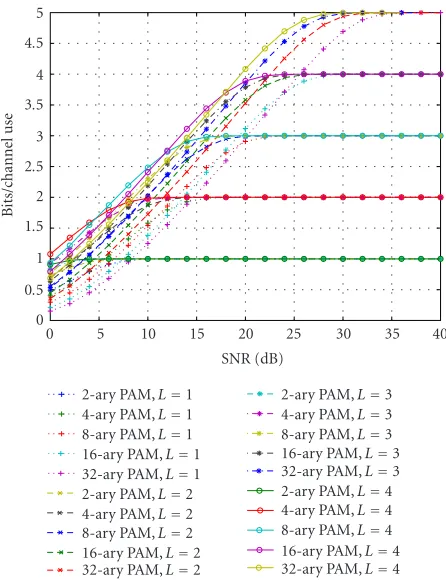
Figure2: Capacity of 2-, 4-, 8-, 16-, and 32-ary PAM UWB systems
with receive diversity from 1 to 4 over an AWGN channel.
where
Pc= ∞
0
√1
2π
r1/√σ2
MAI+LNsN0/2
−∞ e
−x2/2
dx
M−1
pr1
dr1,
(44)
pr1
= 1
2πσ2
MAI+LNsN0/2
×exp
−
r1−LNs
Eg 2
2σ2
MAI+LNsN0/2
.
(45)
The upper bound for a single-user PPM system given in (23) can then be applied to (44) to obtain
PM≤(M−1)Q 0
LNs ,
Eg
σMAI2 +LNsN0/2 1
. (46)
5. NUMERICAL RESULTS
In this section, some numerical results are presented to illus-trate and verify the capacity and error probability expressions obtained previously.
Figure 2shows the capacity of anM-ary PAM UWB sys-tem with a receive diversity order of 1, 2, 3, and 4 over an AWGN channel. As expected, the SNR threshold to achieve
5 4.5 4 3.5 3 2.5 2 1.5 1 0.5 0
−5 0 5 10 15 20
2-ary PPM,L=1 4-ary PPM,L=1 8-ary PPM,L=1 16-ary PPM,L=1 32-ary PPM,L=1 2-ary PPM,L=2 4-ary PPM,L=2 8-ary PPM,L=2 16-ary PPM,L=2 32-ary PPM,L=2
2-ary PPM,L=3 4-ary PPM,L=3 8-ary PPM,L=3 16-ary PPM,L=3 32-ary PPM,L=3 2-ary PPM,L=4 4-ary PPM,L=4 8-ary PPM,L=4 16-ary PPM,L=4 32-ary PPM,L=4 SNR (dB)
B
its/c
hannel
u
se
Figure3: Capacity of 2-, 4-, 8-, 16-, and 32-ary PPM UWB systems
with receive diversity from 1 to 4 over an AWGN channel.
full capacity is improved as the receive diversity increases, where the SNR is defined asEg/N0. In particular, a 3 dB
im-provement is obtained if the diversity order is increased from 1 to 2. Approximately 2 dB in additional improvement is ob-tained if the diversity order is increased to 3.Figure 3shows the capacity of an M-ary PPM UWB system with a receive diversity order of 1, 2, 3, and 4 over an AWGN channel. Sim-ilar SNR threshold improvements to those with PAM can be observed as the receive diversity increases.
Figure 4 shows the relationship between capacity and communication distance for a PPM UWB system under FCC part 15 limitations. The noise figureFis set to 10 dB and the path loss exponentnis set to 2. It can be shown that the max-imum distance for reliable communications can be extended significantly with multiple receive antennas. As an example, with a 4-ary PPM, the reliable distance is extended from 90 m without receive diversity to 180 m with a receive diversity or-der of 4.
5 4.5 4 3.5 3 2.5 2 1.5 1 0.5 0
0 100 200 300 400 500 600 700
2-ary PPM,L=1 4-ary PPM,L=1 8-ary PPM,L=1 16-ary PPM,L=1 32-ary PPM,L=1 2-ary PPM,L=2 4-ary PPM,L=2 8-ary PPM,L=2
16-ary PPM,L=2 32-ary PPM,L=2 2-ary PAM,L=4 4-ary PAM,L=4 8-ary PAM,L=4 16-ary PAM,L=4 32-ary PAM,L=4
d(m)
B
its
/c
hannel
u
se
Figure4: Capacity of 2-, 4-, 8-, and 32-ary PPM UWB systems
ver-sus distance with receive diversity from 1 to 4 over an AWGN chan-nel.
100
10−1
10−2
10−3
10−4
−10 −8 −6 −4 −2 0 2 4 6 8
1Rx, 2-ary PPM 1Rx, 2-ary PAM
2Rx, 2-ary PPM 2Rx, 2-ary PAM
BER
Eb/N0
Figure5: Performance of binary PPM and PAM UWB systems with
receive diversity over an AWGN channel for differentiated Gaussian pulses.
The relationship between the number of users active in the network and channel capacity is illustrated inFigure 6. The processing gain was set to 32, the SNR to 5 dB, and a repetition code withNs=2 was employed. This figure shows
2 1.8 1.6 1.4 1.2 1 0.8 0.6 0.4 0.2 0
B
its/c
hannel
u
se
100 101 102 103
Number of users
L=1
L=2
L=3
L=4
Figure 6: Capacity of a 4-ary PPM UWB system withρ = 32,
SNR=5 dB,Ns=2, and differentiated Gaussian pulses.
10−1
10−2
10−3
10−4
10−5
10−6
−4 −2 0 2 4 6 8 10 12
4-ary PPM 8-ary PPM 16-ary PPM
32-ary PPM 64-ary PPM SNR per bit (dB)
SER
L=1
L=4
Figure7: Upper bounds on the error probability for anM-ary PPM
UWB system with receive diversity over an AWGN channel.
that receive diversity can significantly improve the channel capacity as expected. Due to the MAI, the achievable chan-nel capacity decreases as the number of synchronous users increases.
10−1
10−2
10−3
10−4
10−5
10−6
0 10 20 30 40 50 60 70 80 90 100
4-ary PPM 8-ary PPM 16-ary PPM
32-ary PPM 64-ary PPM Number of users
SER
Figure8: Upper bounds on the error probability for anM-ary PPM
UWB system withρ=500, SNR per bit=1 dB,L=2,Ns=1, and
Gaussian first derivative pulses.
with multiple synchronous users are shown inFigure 8. The processing gain was set to 500, the SNR per bit was set to 1 dB, and the receive diversity order was set to 2. No repeti-tion code was used. As expected, with a given SNR per bit, the error probability increases when the number of active users increases.
6. CONCLUSIONS
In this paper, receive diversity was proposed for PPM and PAM UWB systems to improve error performance and chan-nel capacity, and extend the reliable communication dis-tance. It was shown that significant improvements can be achieved due to receive diversity, which can be obtained from multiple receive antennas or resolvable multipath sig-nals.
ACKNOWLEDGMENT
The authors would like to thank the anonymous reviewers for their constructive comments and questions that greatly improved the paper.
REFERENCES
[1] R. A. Scholtz, “Multiple access with time-hopping impulse modulation,” inProc. IEEE Military Communications Confer-ence (MILCOM ’93), vol. 2, pp. 447–450, Boston, Mass, USA, October 1993.
[2] R. A. Scholtz and M. Z. Win, “Impulse radio,” inWireless Communications: TDMA versus CDMA, S. G. Glisic and P.
A. Leppanen, Eds., pp. 245–267, Kluwer Academic, Boston, Mass, USA, 1997.
[3] F. Ramirez-Mireles and R. A. Scholtz, “System performance analysis of impulse radio modulation,” inProc. IEEE Radio and Wireless Conference (RAWCON ’98), pp. 67–70, Colorado, Colo, USA, August 1998.
[4] F. Ramirez-Mireles and R. A. Scholtz, “Multiple-access per-formance limits with time hopping and pulse position mod-ulation,” inProc. IEEE Military Communications Conference (MILCOM ’98), vol. 2, pp. 529–533, Boston, Mass, USA, Oc-tober 1998.
[5] L. Zhao and A. M. Haimovich, “Capacity of M-ary PPM ultra-wideband communications over AWGN channels,” inProc. IEEE 54th Vehicular Technology Conference (VTC ’01), vol. 2, pp. 1191–1195, Atlantic City, NJ, USA, October 2001. [6] L. Zhao and A. M. Haimovich, “The capacity of an UWB
multiple-access communications system,” inProc. IEEE Inter-national Conference on Communications (ICC ’02), vol. 3, pp. 1964–1968, New York, NY, USA, April 2002.
[7] J. R. Foerster, “The effects of multipath interference on the performance of UWB systems in an indoor wireless channel,” inProc. IEEE 53rd Vehicular Technology Conference (VTC ’01), vol. 2, pp. 1176–1180, Rhodes, Greece, May 2001.
[8] J. R. Foerster, E. Green, S. Somayazulu, and D. Leeper, “Ultra-wideband technology for short- or medium-range wireless communications,”Intel Technology Journal, Q2, pp. 1–11, May 2001.
[9] C. J. Le Martret and G. B. Giannakis, “All-digital PAM im-pulse radio for multiple-access through frequency-selective multipath,” inProc. IEEE Global Telecommunications Confer-ence (GLOBECOM ’00), vol. 1, pp. 77–81, San Francisco, Calif, USA, November 2000.
[10] F. Ramirez-Mireles and R. A. Scholtz, “N-orthogonal time-shift-modulated signals for ultrawide bandwidth impulse ra-dio modulation,” inProc. IEEE Global Telecommunications Conference (GLOBECOM ’97), Phoenix, Ariz, USA, Novem-ber 1997.
[11] O. Wintzell, D. K. Zigangirov, and K. S. Zigangirov, “On the capacity of a pulse-position-hopped CDMA system,” IEEE Trans. Inform. Theory, vol. 47, no. 6, pp. 2639–2644, 2001. [12] M. Z. Win and R. A. Scholtz, “Ultra-wide bandwidth
time-hopping spread-spectrum impulse radio for wireless multiple-access communications,”IEEE Trans. Commun., vol. 48, no. 4, pp. 679–689, 2000.
[13] R. E. Blahut, Principles and Practice of Information Theory, Addison-Wesley, Boston, Mass, USA, 1987.
[14] S. Dolinar, D. Divsalar, J. Hamkins, and F. Pollara, “Ca-pacity of pulse-position modulation (PPM) on Gaussian and Webb channels,” JPL TMO Progress Rep. 42-142, National Aeronautics and Space Administration, Jet Propulsion Lab-oratory, California Institute of Technology, Pasadena, Calif, USA, April–June 2000.
[15] J. G. Proakis, Digital Communications, McGraw-Hill, New York, NY, USA, 4th edition, 2001.
[16] F. Ramirez-Mireles and R. A. Scholtz, “Multiple-access with time hopping and block waveform PPM modulation,” inProc. IEEE International Conference on Communications (ICC ’98), vol. 2, pp. 775–779, Atlanta, Ga, USA, June 1998.
Hao Zhangwas born in Jiangsu, China, in 1975. He received his Bachelor’s degrees in telecom engineering and industrial man-agement from Shanghai Jiaotong Univer-sity, China, in 1994, his MBA degree from New York Institute of Technology, USA, in 2001, and his Ph.D. degree in electrical and computer engineering from the University of Victoria, Canada, in 2004. His research interests include ultra-wideband radio
sys-tems, MIMO wireless syssys-tems, and spectrum communications. From 1994 to 1997, he was the Assistant President of ICO (China) Global Communications Company. He was the Founder and CEO of Beijing Parco Co., Ltd. from 1998 to 2000. In 2000, he joined Microsoft Canada as a Software Engineer, and was a Chief Engi-neer at Dream Access Information Technology, Canada, from 2001 to 2002.
T. Aaron Gulliverreceived the B.S. and M.S. degrees in electrical engineering from the University of New Brunswick, Fredericton, New Brunswick, in 1982 and 1984, respec-tively, and the Ph.D. degree in electrical and computer engineering from the University of Victoria, Victoria, British Columbia, in 1989. From 1989 to 1991, he was employed as a Defence Scientist at the Defence Re-search Establishment Ottawa, Ottawa,