CSEIT172461 | Received : 21 July 2017 | Accepted : 31 July 2017 | July-August-2017 [(2)4: 352-359]
International Journal of Scientific Research in Computer Science, Engineering and Information Technology © 2017 IJSRCSEIT | Volume 2 | Issue 4 | ISSN : 2456-3307
352
A Efficient Privacy Based Multi User Computation Using Inter
Domain Routing Decision
Altamash Ali
1, Md Ateeq Ur Rahman
21M. Tech Scholar, Department of CSE, Shadan College of Engineering & Technology, Hyderabad,
Telangana, India
2
Professor, Department of Computer Science & Engineering, Shadan College of Engineering & Technology, Hyderabad, Telangana, India
ABSTRACT
In this paper, we tend to show a network will allow its peers to verify variety of nontrivial properties of its inter domain routing selections while not revealing any further information. If all the properties hold, the peers learn nothing beyond what the inter domain routing protocol already reveals; if a property doesn‘t hold, a minimum of one peer will notice this and prove the violation. We tend to gift SPIDeR, a sensible system that applies this approach to the Border entree Protocol, and we report results from AN experimental analysis to demonstrate that SPIDeR encompasses a cheap overhead. Some aspects could also be unconcealed to neighbours, enclosed in a very route written record, or exposed indirectly via glass services, however we tend to cannot expect network operators to conform to use any system that reveals even a lot of their private info. Existing work has shown that it‘s attainable to make deductions concerning that autonomous systems area unit connected, and even concerning some aspects of policy however these inferences have restricted accuracy and require extended effort to hold out, creating them unsuitable for substantiate routing selections.
Keywords : Collaborative Verification, Inter Domain Routing, Privacy, Security
I.
INTRODUCTION
In inter domain routing; there is an inherent tension between verifiability and privacy: both properties are desirable, but they seem contradictory. Communicating networks have expectations about one another's routing decisions, but they are stymied from verifying these expectations because routing configurations are usually kept confidential. Routing promises. Inter domain routing policies are routinely governed by formal agreements, such as peering and transit contracts, and the correct implementation of these policies is vital for allowing networks to achieve other contractual goals, such as maintaining traffic ratios. In some cases, such as „partial transit‟ relationships, the desired policy can be complex, placing additional cost on the implementers.
II.
METHODS AND MATERIAL
2. EXISTING AND PROPOSED SYSTEMS
2.1 Existing System
2.2 Proposed System
We can show whether a network can allow its peers to verify a number of significant properties of its inter domain routing decisions without revealing any additional information and its details. If all the properties are on hold, the peers can learn nothing beyond what the inter domain routing protocol already reveals; if some property does not hold, at least one peer can detect this and prove there are some violation. We present a SPIDeR, a practical system that applies this approach to the Border Gateway Protocol, and we report results from an experimental evaluation to demonstrate that SPIDeR has a reasonable overhead.
3. MODULES
A. User Interface Design
B. Data Upload
C. Key Generate & File Sharing
D. Key Request to Data Owner
E. Data Share In Inter Domain
A. User Interface Design
This is the first module of our project. The important role for the user is to move login window to data owner window. This module has created for the security purpose. In this login page we have to enter login user id and password. It will check username and password is match or not (valid user id and valid password). If improves the security and preventing from unauthorized data owner enters into the network. In our project we are using SWING for creating design. Here we validate the login user and server authentication.
B. Data Upload
This module is used to help the user to uploading the files. At the time of login, the user could be a valid user means only they allowed uploading their files.
C. Key Generate & File Sharing
In this module is used to help the Group member to encrypt the files and check their file is in safe also providing protection.
Key Generation is the process for generating keys to our files. That key will have to be a unique for every group member while at the time of receives.
D. Key Request to Data Owner the owner ship So user was share the file and download the file.
4. EVALUATION
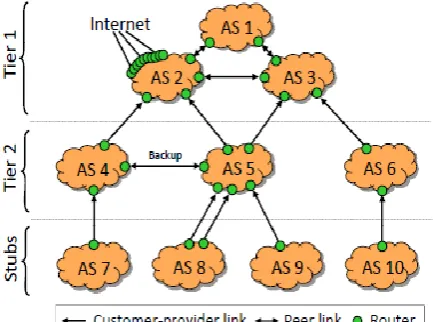
Figure 1. AS topology for our experiments a Route Views trace is injected at AS 2
The component for maintaining a tamper-evident message log with signatures and acknowledgments (but not the code for auditing, which is different in SPIDeR). We added a code for the MTT and for a generating commitments; the proof generator and checker are written from scratch. Overall, we added or changed 8,012 lines of C++ code.
We chose RSA-1024 signatures and the SHA-512 hash function, but we use only the first 20 bytes of each digest to save space. The CSPRNG is implemented by encrypting sequences of zeroes with RC4, discarding the first 3,072 bytes to mitigate known weaknesses in RC4. Our recorder implementation uses such separate threads for handling messages and for generating commitments; this prevents the message handler from blocking while MTTs are being labeled. The number c of commitment threads can be varied to take advantage of multiple cores; when c > 1, we break the MTT into sub trees that are each labeled completely by one of the threads.
4.2 Methodology and experimental setup
Our result can be estimate the cost a typical Internet AS would incur by running SPIDeR. Since it was not feasible to replicate the Internet‘s entire AS topology in our lab, we decided to set up a small, synthetic topology (shown in Fig.1) using 36 Quagga BGP daemons in 10 A Ses. However, as, we injected BGP messages from a Route Views trace into one of the A Ses. Thus, the conditions in our synthetic topology were approximately as if the A Ses had been a part of the global Internet: the routing tables contained routes
to every reachable IP prefix, and the number and the arrival pattern of the BGP UPDATEs were similar to the conditions at the Route Views collection point.
Specifically, we used a 15-minute Route Views trace that was collected by a Zebra router at Equinix in Ashburn, VA, on January 18, 2012 at 10am. This trace contains 38,696 BGP messages, and the corresponding RIB snapshot contains 391,028 distinct IP prefixes. In our experiment, we first populated the routing tables by slowly announcing the prefixes from the snapshot over a period of 30 minutes; then we replayed the 15-minute message trace. We refer to the first phase as the setup period and to the second phase as the replay period. Unless otherwise specified, we report data that was collected during the replay period, and we focus on the AS in the middle (AS 5).
Figure 2. Cost of commitments, existence proofs (EP), and non-existence proofs (NEP) with zero-knowledge sets instead of MTTs. Values shown are for AS 5. Note that we used a single core for this experiment; for a fair comparison to SPIDeR, the runtimes should be divided by c=3.
Each AS was configured with a simple routing policy based on Gao-Rexford, defined 50 indifference classes based on the number of hops, and promised to choose the shortest route to all prefixes in the BGP routing Fig.2 table. These simple choices are sufficient for measuring overhead because the cost depends mostly on the size of the MTT and thus on the number of prefixes and indifference classes. Recall from Section 3 that only very few A Ses support more than five local-pref classes, and consider that promises could be made for a specific set of prefixes (―I will give you my shortest route to Google‖); hence, 50 classes and all prefixes are both conservative choices.
to bind to a specific IP. Commitments were generated every 60 seconds. Unless otherwise specified, we used
c = 3 cores for commitments and the fourth core for message handling.
4.3 Micro-benchmarks
We first ran a number of micro-benchmarks to measure the size of a typical MTT, and the time needed to generate and verify proofs.
MTT size: The MTT from AS 5‘s last commitment in the experiment contains 22,333,767 nodes, including 389,653 prefix nodes, 950,372 inner nodes, 1,511,092 dummy nodes, and 19,482,650 bit nodes. This is expected because there is one prefix node for each IP prefix that is reachable at that point in the trace, and each prefix node has 50 bit nodes. In total, these nodes required about 137.5 MB of memory.
Labeling time: With c = 3 cores, computing the label of this MTT‘s root node took 13.4 seconds. This seems unproblematic because the computation is done by the recorder (and not by a border router!) and because it is asynchronous, i.e., does not block BGP. Thus, an AS could use our implementation to make a commitment every 15 seconds and catch any promise violations that last at least that long. For comparison, the same
Proof generation and proof size: When verification is triggered, the proof generator must reconstruct the MTT at the time of the commitment and then generate a set of bit proofs for each neighbor. For AS 5‘s last commitment, it took 13.4 s to reconstruct the MTT and 70.2 s to generate the proofs for the five neighbors. The average size of a proof was 449 MB. As a rough approximation, each bit proof with k indifference classes contributes k hashes, or 20.k bytes, plus potentially some hashes of dummy nodes.
For comparison, we also generated the proofs for an alternative promise about just one prefix: ―I will give you the shortest route to Google.‖ This took only 0.431 s to generate (after MTT reconstruction), and the corresponding proofs were 2.1 KB for the producers
and 2.1 KB for the consumers. If any AS wants to make a declaration that very many prefixes and a proof size is a concern, its neighbors could trigger verification for smaller sub trees, e.g., all prefixes in 32.0.0.0/8.
Proof checking: With c = 1 core, verification of a single proof takes 27 s on average; we observed times from 8.6 s to 40 s. As a first step, the checker needs to rebuild the part of the MTT that is included in the proof and re-label it to verify the commitment; this step took 26 s on average. Then, the checker must verify that all the required bits are present and have the appropriate value; this step accounted for the remaining 1 s.
4.4 Functionality check
Next, we performed a number of sanity checks on our implementation. First, we ran the experiment to completion and then triggered verification; as expected, no broken promises were reported. Next, we re-ran the experiment, injecting different faults into AS 5 that caused its promise to be violated
Over aggressive filter: The AS incorrectly filters out a good route from an upstream AS.
Wrongly exporting: A received route is marked as ‗not for export‘ (with a promise where some routes are worse than the null route) but the AS passes it on.
Unauthorized bit proof: The AS attempts to hide a best route by changing a little bit proof and sent to a downstream AS.
After each run, we triggered verification, and in each case the fault was detected by one of the A Ses. In the first run, the upstream AS raised an alarm because it did not receive a bit proof for the route it had supplied. In the second run, the downstream AS noticed that it had a bit proof for the zero route, which was better than the route it had actually received. In the third run, the downstream AS detected that the proof did not match and the hash value from the commitment. These examples complement the proofs to give us confidence in our implementation.
4.5 Overhead: Computation
messages and ACKs, and it also generates and labels a MTT for each commitment. To quantify this overhead, we can used the get usage system call to measure the computation time the recorder‘s threads spent overall, and we separately instrumented the code to measure the time spent on generating and verifying signatures and on labeling MTTs. We excluded the first and the last minute to avoid startup/shutdown effects.
We found that, during the replay period, the recorder spent 634.5 s of computation time overall. 9.75 s were spent on generating and verifying 3,913 RSA-1024 signatures; note that this is lower than the total number of BGP updates in the trace because, when updates arrive in bursts, the recorder can batch several of them together and sign the entire batch. Generating 13 MTTs required 519 s. All other operations, e.g., BGP RIB generation; thus, Net Review‘s CPU utilization would have been about five times lower.
SPIDeR‘s computational cost increases with the commitment generation rate, and with the number of routing updates that need to be sent (which in turn depends on the number of neighbors), since there are more messages that need signing. For a small AS with five neighbors, like AS 5, the SPIDeR recorder could easily be run on a single commodity workstation. According to CAIDA‘s topology data, 89% of the current Internet A Ses have five or fewer neighbors.
4.6 Overhead: Bandwidth
SPIDeR can also increases the amount of inter domain routing traffic because all BGP updates need to be re-announced via SPIDeR with additional signatures and acknowledgments. To quantify this overhead, we used tcp dump to capture all BGP packets and all SPIDeR packets that were sent from AS 5 during the replay period. We found that, on average, BGP sent traffic at a rate of 11.8 kbps and SPIDeR at a rate of 32.6 kbps. The relative increase (176%) may seem high, but compared to the amount of traffic A Ses commonly handle, 20.8 kbps is not very much—it is about 2% of a single typical DSL upstream.
SPIDeR additionally sends bit proofs to neighboring A Ses for verification; the amount depends on the frequency of verifications and the number of commitments checked which in turn depend on perceived AS needs. Verifying 1% of commitments every minute would result in about 3.0 Mbps of traffic for AS 5.
4.7 Overhead: Storage
Each SPIDeR recorder also requires some local storage for the message log, the information is also needed to reconstruct past MTTs, and a number of snapshots of its routing state. To qualify the amount of storage we needed, we can examined the storage of AS 5‘s recorder after the replay period. We can excluded information that was stored during the setup period.
The log contained 2.95 MB of message data, excluding snapshots; a substantial fraction (24.4%) consisted of cryptographic signatures. Thus, it grew at an average rate of about 232.3 kB per minute. Complete snapshots of the routing state were about 94.1 MB. All of this information would be stored by Net Review as well. There is a only addition in SPIDeR is the MTT-related data, which was comparatively small: each commitment added only 32 bytes to the log. This is because the MTT can be regenerated from the message trace; only the CSPRNG‘s seed needs to be stored explicitly. Based on these results, we estimate that an AS could keep a year‘s worth of logs, including one snapshot per day, in 145.7 GB of storage. This data would easily fit onto a commodity hard drive.
III.
RESULTS AND DISCUSSION
IV.
Figure -2: Login Page View in the browser
Figure -3: Entering User Name and Password and go to upload button to attach any attachment
Figure -4: After attaching the attachment the user can upload the data
Figure -5: Uploaded the data can viewed in Profile and the can share to the any user
Figure -6: After clicking the share button the messenger box will open and user can type Message also.
Figure -7: After writing the message and to address user can submit his/her request.
Figure -8: After submit the attachment, by clicking outbox user can also see the sent item.
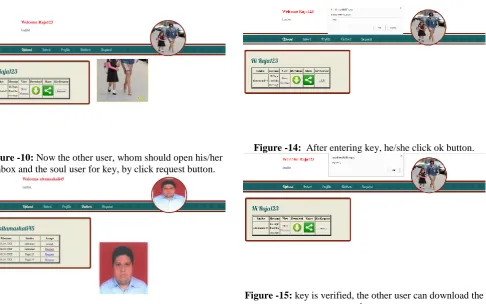
Figure -10: Now the other user, whom should open his/her inbox and the soul user for key, by click request button.
Figure -11: Now the soul user, should accept his/her request by click request button.
Figure -12: Confirmation message will be showed in web page.
Figure -13: The other will get the key and to see and download the attachment he/she write the key in page.
Figure -14: After entering key, he/she click ok button.
Figure -15: key is verified, the other user can download the attachment.
V.
CONCLUSION
This paper has demonstrated that inter domain directing frameworks don't have to settle on a decision amongst undeniable nature and security: it is conceivable to have both. Utilizing our VPref calculation for community oriented confirmation, systems can check various nontrivial guarantees about every others' BGP steering choices without uncovering anything that BGP would not as of now uncover. The outcomes from our assessment of SPIDeR demonstrate that the expenses for the taking an interest system would be sensible. VPref is not BGP-particular and could be connected to other directing conventions, or maybe even to private check undertakings in different areas.
VI.
REFERENCES
[1]. Mingchen Zhao, Wenchao Zhou, Alexander J. T. Gurney, Andreas Haeberlen, Micah Sherr, and Boon Thau Loo, "Private and Verifiable Inter domain Routing Decisions", IEEE/ACM Transactions on Networking, Vol. 24, No. 2, April 2016.
[3]. M. Bellare and P. Rogaway, "Random oracles are practical: A paradigm for designing efficient protocols," in Proc. ACM CCS ‗93, Fairfax, VA, USA, 1993.
[4]. O. Bonaventure and B. Quoitin, "Common utilizations of the BGP community attribute," Internet Draft, 2003 Online]. Available: http://tools.ietf.org/html/draft-bonaventure-quoitin-bgp-communities-00
[5]. D. Catalano, M. Di Raimondo, D. Fiore, and M. Messina, "Zero-knowledge sets with short proofs," IEEE Trans. Inf. Theory, vol. 57, no. 4, pp. 2488-2502, Apr. 2011.
[6]. E. Chen and T. Bates, "An application of the BGP community attribute in multi-home routing," in RFC 1998, Aug. 1996 Online]. Available: https://tools.ietf.org/html/rfc1998 [7]. X. Dimitropoulos et al., "AS relationships:
Inference and validation," ACM SIGCOMM CCR, no. 1, pp. 29-40, Jan. 2007.
[8]. B. Donnet and O. Bonaventure, "On BGP communities," ACM CCR, vol. 38, no. 2, pp. 55-59, Apr. 2008.
[9]. P. Faratin, D. Clark, P. Gilmore, S. Bauer, A. Berger, and W. Lehr, "Complexity of Internet interconnections: Technology, incentives and implications for policy," presented at the 35th Annu. Telecomm. Policy Research Conf. (TPRC), Arlington, VA, USA, Sep. 2007.
[10]. N. Feamster, Z. M. Mao, and J. Rexford, "Border Guard: Detecting cold potatoes from peers," presented at the 2004 Internet Measurement Conf., IMC ‗04, Taormina, Sicily, Italy, Oct. 2004.
[11]. L. Gao, "On inferring autonomous system relationships in the Internet," IEEE/ACM Trans. Netw., vol. 9, pp. 733-745, Dec. 2001.