Twenty Years of Language Resource Development and Distribution:
A Progress Report on LDC Activities
Christopher Cieri, Marian Reed, Denise DiPersio, Mark Liberman
University of Pennsylvania, Linguistic Data Consortium3600 Market Street, Suite 810, Philadelphia PA. 19104, USA E-mail: {ccieri, mreed, dipersio, myl} AT ldc.upenn.edu
Abstract
On the Linguistic Data Consortium’s (LDC) 20th anniversary, this paper describes the changes to the language resource landscape over the past two decades, how LDC has adjusted its practice to adapt to them and how the business model continues to grow. Specifically, we will discuss LDC’s evolving roles and changes in the sizes and types of LDC language resources (LR) as well as the data they include and the annotations of that data. We will also discuss adaptations of the LDC business model and the sponsored projects it supports.
Keywords: language resource; data center; common task program
1.
Introduction
The year 2012 marks the 20th anniversary of the Linguistic Data Consortium. During the past two decades, LDC has observed, adapted to and in some cases even anticipated changes in the needs and methods of the communities it supports. The changes have frequently but not always been in the direction of demands for greater volumes of data in an increasing array of languages with richer annotation and higher accuracy and reliability. Since these desiderata are in conflict with each other and the desire for shorter timeline and greater cost-efficiency, specific projects have made different trade-offs. As some HLT system performance approaches human performance we tend to see increased focus on quality at the expense of volume. However, we also continue to see growth in supply and demand of megascale data sets like the Google n-gram corpora (Franz and Brants 2006). Compare, for example Novotney, Scott and Callison-Burch (2010) arguing for lower cost, higher volume despite lower interannotator agreement with Maamouri, Bies and Kulick (2010) who show parseval scores for Arabic parsers improving with increases in interannotator agreement in the training material.
As sub-disciplines begin to explore data sharing, some researchers engage in work that straddles traditional boundaries (Yaeger-Dror 2002, Clopper & Pisoni 2006) creating a split in their communities between those who can exploit large-scale digital data and those who cannot or will not. The past few years have seen the emergence of initiatives, such as CLARIN (2011) and the numerous projects under its umbrella, that seek to bring large scale computing and data exploitation to the social sciences and humanities.
Finally, the worldwide penetration of computing, social networking and smart phones increases demand for resources in a rapidly growing list of languages.
2.
Evolution of LDC Roles
Over the past two decades LDC’s role adapted many times to community need. In the early nineties, DARPA communicated a need for a consortium to address the data distribution and archiving needs of HLT developers through a call for proposals. The LDC emerged from submission to this call written by Mark Liberman at the University of Pennsylvania, which became the LDC host institution. LDC’s early roles were limited to those of a specialized data publisher and archive guaranteeing widespread, long-term availability. In 1995, after recognizing that the existing U.S. labs doing data collection could not keep up with demand, LDC began collecting conversational telephone speech and broadcast news and doing some transcription. Today, LDC’s data collections include news text, (including blogs and newsgroups), biomedical and other text documents (both printed and handwritten), broadcast news and conversation, telephone speech and other spoken interactions including lectures, meetings, interviews, map task and role playing games, read and prompted speech, web video and even animal vocalizations.
additional round of quality control, production replication, distribution and archiving
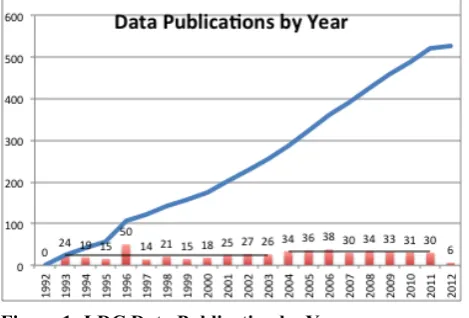
Another specific change in publication practice has been in volume. In 2003, LDC noticed that the backlog of data sets waiting for publication had begun to grow. To reduce the backlog and provide greater value, LDC decided to increase publication productivity. Since 2004, LDC has targeted a range of 30-36 publications per year. Figure 1 shows the number of publications per year as columns and cumulatively as a line adding to 520 in total. Since 2004, LDC has released on average 33 per year representing a 43% increase over the average for all prior years, 23. Productivity has also remained more consistent as seen in the post-2004 standard deviation of 2.68 versus 3.16 for prior years. The broken, horizontal “average” lines emphasize relative consistency since 2004 compared to the previous decade.
5.
Evolution in Outreach
LDC has always followed the practice of finding a way to make data available to credentialed researchers with a bona fide need for data and a genuine inability to pay. In some cases this meant making the researcher aware of an existing affiliation between their organization and LDC. In other cases it has meant correcting a misunderstanding about the fee for a resource, discounting or delaying the fee if necessary or arranging some kind of trade of data or services. In every case, LDC balances the needs of the individual researchers with the needs of the Consortium included assuring its longevity.
In 2010, LDC decided to formalize this procedure to assure that the funds the Consortium invested in supporting worthy but impecunious researchers were distributed wisely. Grants in data are given twice each year to students who demonstrate a need by submitting a two-page proposal summary and a letter of support from their advisors. Because regular members subsidize this activity through their fees, it is important to apply a rigorous procedure. The proposal summary must instill confidence in the research and make clear how and why LDC data will be used. The letter must express the advisor’s confidence in the project and assert an inability to pay. Applications are competitive. Incomplete applications are rejected out of hand and not every complete application succeeds. In some cases, LDC staff
contact successful applicants to provide additional information about offerings and suggest alternative data sets, in particular when the applicant has not selected data that will allow the work to be properly evaluated. To date, LDC has provided, at no cost to applicants, 8 corpora in 2010, 24 in 2011 and 8 in 2012. Winning applications have run the gamut of language related disciplines from computer science and electrical engineering to oriental studies, second language acquisition and teaching. Had these data been license at normal fees the total would have exceeded 40,000 USD.
From its beginning LDC has always worked to keep the communities it supports informed of its work and research products by attending and presenting its research products at conference and workshops. Since 2007, LDC has expanded its conference presence to include vendor tables, exhibiting at one event in the first year, two in 2008, three in 2009, two in 2010, five 2011 and two at the time of writing in 2012. Still in the process of determining which conferences allow one to reach the broadest audience given the cost, LDC has exhibited at: NWAV (New Ways of Analyzing Variation), Interspeech, ALA (American Library Association), LREC, ACL (Associate for Computation Linguistics), LSA (Linguistic Society of America), ICASSP and NEALLT (Northeast Association for Language Learning Technology).
LDC also conducts surveys occasionally to elicit feedback from it user communities. The first two surveys (2006, 2007) were designed principally to establish a user sentiment baseline. The 2012 survey probed sentiment as well, but it also addressed topics of interest to the Consortium including respondents’ “favorite” LRs, LDC’s 20th Anniversary (April 2012), mobile technologies, “open data” and social networking.
The 2012 survey was sent by email on January 24, 2012 to 1541 contacts from two groups: those who joined LDC or licensed data from 2009 through 2011; and LDC’s primary contact at the surveyed organizations. A reminder email was sent on February 7, and the survey closed on March 2. 99 respondents completed the survey (6.42% of the sample); 169 provided partial responses (10.97%). A 6.42% response rate approximates a 95% +/- 15% degree of accuracy for the sample group1. A 10-20% response rate is standard for web-based surveys2.
Although the results are still under analysis as of this writing, we can note some general points. Respondents indicated overall a high satisfaction level with LDC's language resources (LRs) and services; this confirmed sentiments expressed in 2006 and 2007. Respondents’ favorite LRs tended to cluster around ”benchmark” data sets, i.e. TIMIT and Penn Treebank, large text sets, such as the multilingual Gigaword corpora, and evaluation data sets, e.g., NIST’s Speaker Recognition Evaluation (SRE) releases. When asked to comment on open data, most respondents agreed that the community needs more open data, though
1http://www.greatbrook.com/survey_accuracy.pdf 2http://constantcontact.custhelp.com/app/answers/detail/a
_id/2965/~/predicting-survey-response-rates
With funding from the Department of Education, LDC has created a reading facilitation and evaluation tool and applied it to two morphologically complex but very different languages Arabic and Nahuatl. The tools use morphological analysis to mediate access to digital dictionaries for language learners. Working with Georgetown University Press and US Department of Education support, LDC is now creating Iraqi, Levantine and Moroccan Arabic dialect lexicons that will be shared as print dictionaries and lexical databases.
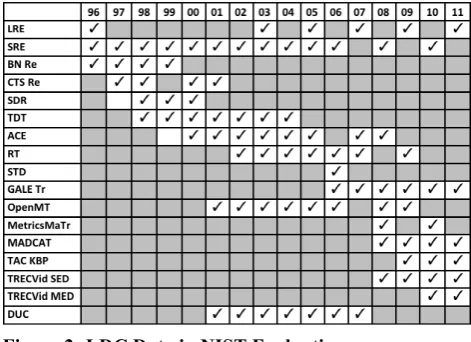
In addition to contributing to common task programs for numerous sponsors, LDC has contributed data to many technology evaluations organized by NIST. Some of these corpus-building efforts were funded directly by NIST and some by other sponsors for whom NIST conducted the evaluations. Of course, numerous other organizations including MITRE (Mani, et. al., 2009), APPEN (Schlenoff et. al., 2009) and the Universidad Politecnica de Madrid (Ortega-Garcia, et al. (1998) have also provided data to NIST for these and other evaluations. LDC has also provided data for European technology programs including TC-Star and MEDAR and secured for American programs like LCTL (Less Commonly Taught Languages) access to data created in Europe and previously only available via ELDA, for example the EMILLE corpus.
7.
Conclusion and Future Plans
This paper has sketched the evolution in selected LDC activities over its 20 year history that respond to community demands for more and larger language resources in a growing number of languages annotated with greater sophisticated. The current activities stand in
stark contrast to the original ones. The Consortium plans to maintain its leadership role and continue to create and distribute LRs while reaching into new languages genres and user communities. We will also continue integrating HLTs into our workflow, increasing research activities and outreach to students, simplifying production through efficiency and outsourcing and to expanding our work in tools and specification development.
8.
References
Ahtaridis, Eleftheria, Christopher Cieri, Denise DiPersio (2012) LDC Language Resource Database: Building a Bibliographic Database in LREC 12: Eighth International Conference on Language Resources and Evaluation, Istanbul, May 21-27, 2012.
Bird, Steven, Mark Liberman (1999) A Formal Framework for Linguistic Annotation, Tech Report MS-CIS-99-01, University of Pennsylvania, Department of Computer and Information Science, arXiv:cs/9903003v1.
Clopper, Cynthia, David Pisoni (2006) The Nationwide Speech Project: A new corpus of American English Dialects, Speech Communication v. 48, pp. 633–644. CLARIN (2011) CLARIN web site http://www.clarin.eu. Franz, Alex, Thorsten Brants (2006) All Our N-gram are Belong to You, Google Research Blog, Thursday, August 03, 2006 at 8/03/2006 11:26:00 AM,
http://googleresearch.blogspot.com/2006/08/all-our-n-gram-are-belong-to-you.html.
John S. Garofolo, et al. TIMIT Acoustic-Phonetic Continuous Speech Corpus LDC93S1. CD-ROM. Philadelphia: Linguistic Data Consortium, 1993. LDC (2011) GALE Project Task Specification and
Annotation Guidelines web page, http://projects.ldc.upenn.edu/gale/task_specifications/. LDC (2009) Linguistic Data Consortium Catalog,
http://www.ldc.upenn.edu/Catalog.
Maamouri, Mohamed, Ann Bies, Seth Kulick (2010) Upgrading and Enhancing the Penn Arabic Treebank: A GALE Challenge in Olive, Christianson, McCary, 2010.
Mani, Inderjeet, Christy Doran, Dave Harris, Janet Hitzeman, Rob Quimby, Justin Richer, Ben Wellner, Scott Mardis, and Seamus Clancy (2009) SpatialML: Annotation Scheme, Resources and Evaluation, MITRE Technical Reports 09_3827, The MITRE Corporation, The MITRE Corporation.
Marcus, Mitchell P., Beatrice Santorini, Mary Ann Marcinkiewicz and Ann Taylor. Treebank-3 LDC99T42. CD-ROM. Philadelphia: Linguistic Data Consortium, 1999.
Novotney, Scott, Chris Callison-Burch, (2010) Cheap, Fast and Good Enough: Automatic Speech Recognition with Non-Expert Transcription, Human Language Technologies: The 2010 Annual Conference of the North American Chapter of the ACL, pages 207–215, Los Angeles, California, June 2010.
Olive, Joseph, Caitlin Christianson, John McCary (2010) Handbook of Natural Language Processing and Machine Translation: DARPA Global Autonomous Language Exploitation, New York: Springer.
Ortega-Garcia, J. et al. (1998) AHUMADA: A Large Speech Corpus in Spanish for Speaker Identification and Verification, in Proceedings of ICASSP ’98, Vol.
Figure 2: LDC Data in NIST Evaluations
II, pp. 773-776.
Randi Reppen, Nancy Ide, and Keith Suderman (2005) American National Corpus (ANC) Second Release, Linguistic Data Consortium, Philadelphia, http://www.ldc.upenn.edu/Catalog/CatalogEntry.jsp?c atalogId=LDC2005T35
Schlenoff, C. I., Weiss, B. A., Steves, M. P., Sanders, G. A., Proctor, F. M., Virts, A. M. (2009) Evaluating Speech Translation Systems: Applying SCORE to TRANSTAC Technologies, Proceedings of the Performance Metrics for Intelligent Systems (PerMIS) Gaithersburg, MD, September 21-23, 2009.
Walker, Kevin, Christopher Caruso, Denise DiPersio (2010) Large Scale Multilingual Broadcast Data Collection to Support Machine Translation and Distillation Technology Development in Olive, Christianson, McCary, 2010.