DECISION MAKING IN CONSTRUCTION COMPANIES BASED ON
KNOWLEDGE BASES AND NEW TECHNOLOGICAL SOLUTIONS
DŽINO JEFTO1, TEPŠIĆ MILICA2, JOVOVIĆ JELENA3
RADIVOJEVIĆ MLADEN4
1,2
Univerzitet za poslovne studije, Bosna i Hercegovina 3,4
ITEP Banja Luka Bosna i Hercegovina
Abstract
In this paper we are dealing with decision making processes in construction
companies using new technological solutions. We want to emphasize that this is one of the
areas in which decision makers meet a large number of different challenges and that they
need appropriate specific knowledge. Here we suggest the use of a semantic web and
knowledge base that can provide decision makers with a quick access to the necessary
knowledge in the decision-making process. To update some of the knowledge we will use the
Protégé editor, the open source platform, to update them. It is not our goal to update all the
necessary knowledge needed for those who decide in construction companies, but only to
propose a new concept to their faster arrival and more efficient use.
Keywords: decision making, construction company, knowledge bases, efficient use
of knowledge.
Introduction
Decisions are a common part of everyday human life, and they strongly affect the
lives of individuals depending on the position of the decision-maker. Understanding the
decision-making process can help to avoid bad decisions and to stimulate those good.
However, there are many factors that influence decisions, and not all of them are known, nor
the ways in which they are related. At the same time, decision-making processes, due to their
complexity, approach from different points of view, even within a particular science.
If we look only at making decisions during the execution of construction projects, we
can see that it involves the management of a number of related components, such as site
GE-International Journal of Management Research ISSN (O): (2321-1709), ISSN (P): (2394-4226) Vol. 7, Issue 6, June 2019 Impact Factor: 5.779 © Association of Academic Researchers and Faculties (AARF)
design, labor productivity, unexpected events, resource allocation, rescheduling of activities
and the like. The uncertainty associated with each of these components, as well as the
changing links that exist between them, in terms of time and space, make the very core of the
complexity of managing the construction projects. Clarifying each of these complex
components is essential for effectively responding to unforeseen situations and examining
how alternative decision-making strategies are beneficial. However, it is very difficult to
predict the consequences of this complex behavior, as it often occurs within a dynamic
context.
Good management, competent and competent to make the right decisions is essential,
if the construction company wants to achieve top results and improve productivity. The
construction industry, especially the management of construction projects, is by nature a
multidisciplinary area where successful implementation of projects requires the advocacy of
all parties, including designers, contractors, investors and supervisory authorities. All of them
must initiate requests, cooperate with each other, consider and understand everyday
problems, and make decisions to solve them.
Professionals in construction and construction organizations benefit from the
employment of individuals who possess developed interpersonal skills that facilitate the
process of cooperation with a multitude of different stakeholders at various levels. The use
and even the misuse of these skills during the execution of projects can positively and
negatively affect the final outcome.
The term "construction manager", the person responsible for project management,
refers to project leaders, but is used in the widest possible sense, without a generally accepted
definition because of the uniqueness of each project and its implementation system.
In order to be able to observe a different approach to monitoring and implementing
new ideas in the quicker approach to knowledge in the decision-making process, we will
introduce some of the concepts that are necessary for us. These are primarily semantic web
and knowledge base.
The term semantic web was introduced by Tim Berners Lee (2001) as a clear structure
of the content of the website. It was created as a need for more efficient finding of certain
information and knowledge. It is based on the idea that information on the web becomes
machine-readable. Instead of documents related to hyperlinks, they should use interconnected
In order for the Semantic Web idea to work, computers should have access to
information collections. It must provide rules for reasoning on data, and enable the
presentation of data and information.
In this paper, we use the Protégé editor, an open source code for updating knowledge
that enables: reading and saving knowledge. Editor Protégé provides a rich set of modeling
structures and activities that support the creation, visualization, and manipulation of data and
information that are represented in different formats.
What is often neglected outside the industry is that modern building management
processes involve complex financial issues and demanding interpersonal skills, which means
that managers are engaged in activities such as price analysis, price control, construction
contract negotiations and contracting, performance planning works, etc. Unlike the
managerial position in the manufacturing industry, managers in construction companies have
to deal with a variety of different tasks and processes for each construction project. Building
managers not only oversee subordinates within their organizational hierarchy and make
decisions about their engagement but must provide: the purpose, direction and motivation of
subcontractors who work for them, who do not necessarily have the same or similar structure
of their organization and work process.
Every discipline requires its executives to perform similar duties, although the true
nature of these duties depends on the operation of the construction company. For example, a
designer or engineer usually manages processes related to the design and construction of
specialized objects or structures. In the construction industry, although some of the
responsibilities are duplicated, with regard to the category of work, each managerial position
deals with different stakeholders in terms of supporting the construction project and the
objectives of the construction organization. Therefore, civil engineers - managers must have
specialized interpersonal and leadership skills, especially when it comes to making decisions
on different managerial positions. Solving problems and making appropriate decisions is an
interpersonal process. Behavior during the decision-making process is directly related to the
achievements of the individual in each construction project, as well as the achievements
during his career in carrying out the assigned tasks.
The quality of decision-making within the activities and success of a construction
company depends to a large extent on decision-makers, what skills and abilities they have,
how their management style is, and what techniques and means they use in decision-making.
making, but equally important, and what professional skills, education and experience
managers have.
All individuals involved in the implementation of a construction project are exposed
to situations when a decision has to be made. Their decision-making process involves many
aspects and is influenced by several links and factors. This paper will present a
decision-making process using semantic web and knowledge base in order to get to the necessary
knowledge faster and can better understand the decision-making process itself.
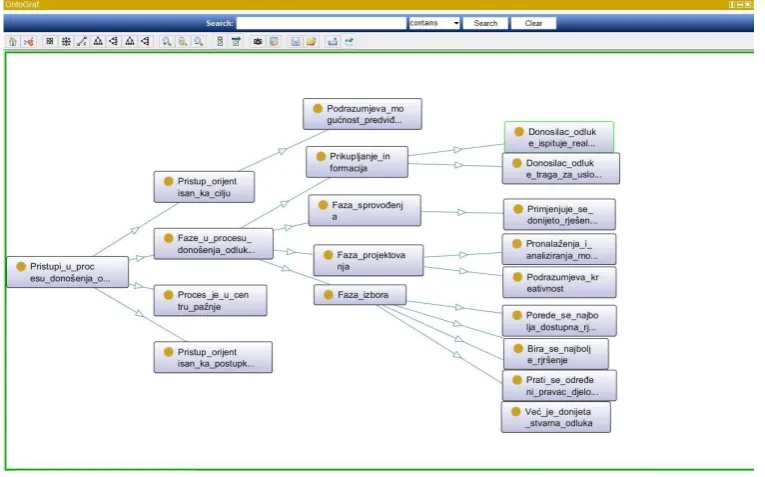
Using the Protégé editor, open source platforms will update only some basic
knowledge related to the decision-making process: - Decisions are part of everyday life,
Influence on the lives of individuals, (Helps avoid bad decisions, Stimulate those good).
Some factors that affect the decisions of a construction company are: Site mapping,
Productivity, Unexpected events, Resource allocation, Reprogramming activities
(Uncertainty associated with each component, Changing connections that exist between them,
(Time, Space)),
Good management is: Competent, Qualified to make the right decisions, Monitor the
subordinate, Provides the purpose, direction and motivation, Must have leadership skills,
Ensures the success of the construction company, Appropriate education and experience
Figure 1. Basic concepts related to the decision-making process
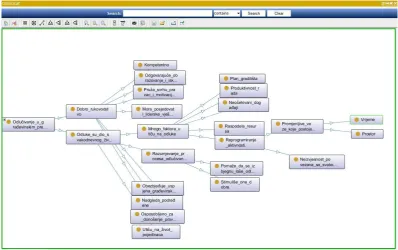
Figure 1a. OntoGraf - Basic concepts related to the decision making process
1. Deciding in construction companies
Every day, decisions are made in all construction companies, both small, daily
decisions, and those related to the strategy of the company. There are many important factors
that influence decision making, and it can be seen as the final outcome of a process, or a
choice between different options. The decision-making process can be viewed as a unity of
the following stages: the "pre-decision" phase, the "decision" stage, and the "post-decision"
phase.
In the process of decision-making in the construction company, the main goal is to
provide profit, and there are no alternatives. There are two basic approaches in the
decision-making process, a goal oriented approach and a process-oriented approach. A goal-oriented
approach implies the ability to predict outcomes, and approach-oriented approach is the one
in which the process is at the center of attention.
According to (Turban, 2011) there are several stages in the decision-making process:
Information Collection Phase: The information gathering phase is a process in which the
decision-maker examines reality in order to identify and define the problem. The decision
Design phase: This phase refers to attempts to find, develop and analyze all possible
directions for the rest of the process. The design phase involves creativity, which means that
decision-makers are looking for alternative solutions, which are then analyzed in greater
detail.
Phase of the election: In the selection phase, the actual decision has been made and a
certain course of action is monitored. The decision maker compares the best solutions that are
available and then chooses the best.
Implementation phase: In the final phase, the implementation phase of the decision,
the adopted decision is applied.
It should always be remembered that after the realization, this process does not stop.
Continuous monitoring of the decision-making process in the construction company is
crucial, in order to achieve the best results and to ensure market competitiveness.
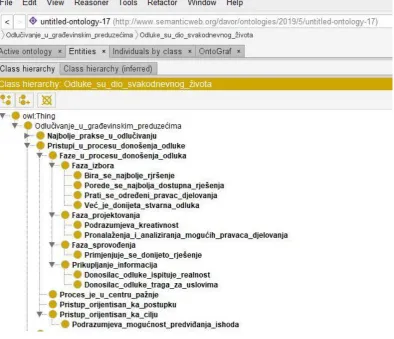
With the use of Protégé editors, we update the basic concepts related to the phases of
the decision-making phase. Phases in the decision-making process: Gathering information -
(The decision maker examines the reality, the search for conditions), Design phase - (Finding
and analyzing possible directions of action), Phase of the election - (A real decision has
already been made, A certain direction of action is followed, best available solutions, Best
[image:6.595.108.491.440.678.2]solution is chosen), Implementation phase - (Applied solution is applied) (Figures 2 and 2a).
Figure 2. Decision-making Phases
2. Best practices in decision-making
Often, managers in construction companies rely on common managerial approaches
that work well under one condition, but not in others. Why these approaches fail, even when
logic says they should prevail. The answer lies in the basic assumption of organizational
theory and practice: that a certain level of predictability and order exists in the world. This
assumption, based on Newton's science that forms the basis of scientific management,
encourages simplifications that are useful in orderly circumstances. Circumstances are
changing, however, as they become more and more complex, simplifications can be
suppressed.
Managers in their decision-making can meet: simple situations, complicated
situations, complex situations and chaotic situations.
Simple Situations: The Domain of Good Practice
Simple situations are characterized by stability and a clear cause-and-effect relationship that
every manager in the construction company can easily notice. In doing so, the right answer is
understanding. Simple situations, properly valued, require direct management and
monitoring. Here, managers recognize, categorize, and respond. They assess the facts in a
situation, categorize them, and then base their response on established practice.
Since both managers and employees have access to information necessary to deal with the
situation in this area, the style of command and control for setting up the parameters works
best. Directives are concrete, decisions can easily be delegated, and roles can be automated.
Exhilarating communication between managers and employees is usually not necessary, as
there is rarely a disagreement about what needs to be done.
Complex situations: The domain of experts
Complex situations, unlike simple ones, can contain more accurate answers, although there is
a clear connection between causes and consequences, they can not all be seen. While
managers in a simple situation must recognize, categorize, and respond to the situation,
managers in a complicated situation must recognize, analyze, and respond. This approach is
not easy and often requires expertise. Making decisions in complicated areas can often take a
long time, and there is always a shame-a long time from finding the right answer to making a
decision. When the right answer is unreachable and when a decision has to be based on
incomplete data, the situation is complex rather than complicated.
Chaotic Situations: The Domain of Rapid Response
In chaotic situations, finding the right answer would be pointless: The link between causes
and consequences is impossible to determine, because they are constantly changing and there
are no suitable patterns - only turbulence. This is an area of inaccessibility.
Business schools and organizations prepare managers to act in regulated domains
(simple and complicated), but most managers in construction companies usually have to rely
on their natural abilities when operating in an unhindered environment (complex or chaotic).
In dealing with the greater complexity of today, however, intuition, intellect and charisma are
no longer sufficient. Managers need resources and approaches to run their construction
projects through less well-known waters. In the complex environment of the present business
world, managers are often asked to act contrary to their instincts. They will have to know
when to share power, and when to keep it for themselves, when to turn to wisdom groups,
and when to consult themselves. A deep understanding of the situation, the ability to accept
complexity and paradox, and the will to flexibly change managerial style will be necessary
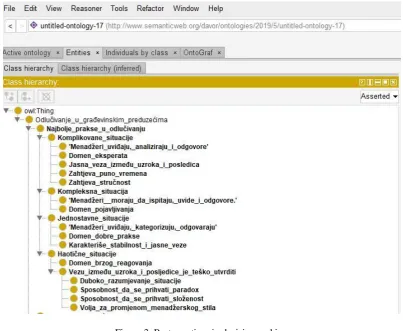
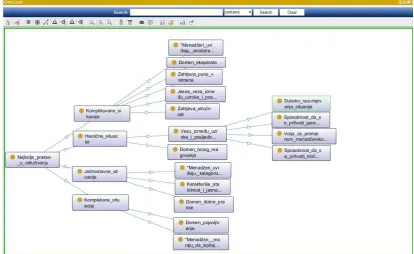
Using the Protégé editor, open source platforms will update only some of the basic
knowledge related to best practice in decision-making: Simple Situations - The Domain of
Good Practice (Characterizes Stability and Clear Connections (Managers Recognize,
Categorize, Responds)), Complex Situations - Domain Names causes and consequences,
Managers recognize, analyze, and respond - (Require expertise, Requirements a lot of time)),
Complex situation - Impression Implications (Managers must examine, insights and answers),
Chaotic situations - The domain of rapid response (The link between causes and
consequences is difficult to establish (Deep understanding of the situation, Ability to accept
[image:9.595.96.500.227.558.2]complexity, Ability to accept a paradox, Will change management style)) (Figures 3 and 3a).
Figure 3a. OntoGraf - Best Practices in Decision Making
Nowadays, the time of modern business, modern business, and decision makers, new
technological solutions are needed to quickly access the necessary knowledge. Quality
managers in the construction company must have appropriate knowledge, skills and
experience in the field of building management. This is necessary because there are decisions
that bring about different complexities in different areas.
In modern business conditions, construction companies need to find the best path,
which means harmonizing the level of vulnerability, meeting the needs of investors,
strengthening the competitive position, efficient use of resources, and key elements of
progress and accountability. A good knowledge base can certainly help them.
3. Explosion of digital data
Digitization ensures that large amounts of data are easily accessed. Data on suppliers,
deadlines, subcontractors, occupancy of construction machines, their efficiency and many
others can be obtained almost in real time. Most construction companies are ready to share all
kinds of information with co-workers and online suppliers.
Almost from the very invention, IT systems helped automate the process. Now
construction companies have a practical way to standardize and sell the processes they have
perfected. Any process that is the best but not crucial for the competitive advantage of a
such capabilities more affordable, allowing for easy distribution of software, simplified
software version control, and the like.
In the recent times, information technology deviates from its traditional role of
automation and reduction of business and process management costs. IT will continue with
this feature, but will increasingly provide new business opportunities. Whatever progresses
faster, there are increasing opportunities.
Technical and analytical progress in analyzing large amounts of data is crucial for the
development of business intelligence. By processing, storing and transferring data at
extremely low prices, digitization has the capacity to change almost every form of human
work. Digitizing and analyzing large amounts of data will open up new opportunities, which
will lead to new challenges. Remote teams are available, and the traditional hierarchical
structure disappears and transforms into an increasingly flexible, internal and networked
structure.
The applied business models based on the digitization and processing of large
amounts of data, aim to optimize the existing processes, and increase the efficiency of
construction and the quality of products and services. Digitization reduces transaction costs
for information gathering, communication, and control activities.
Using Protégé editors, we update basic concepts related to what digitalisation
provides: Large amount of data, Easy access to data, Real-time data acquisition, Large data
[image:11.595.83.505.477.737.2]analysis,Opening new features, Reduces transaction costs.
4. Adopting decisions
The success of the construction company is significantly influenced by
decision-makers, what skills and opportunities they have, how their management style is, what
techniques and honey are used in making decisions. It does not matter only the
decision-making technique, but it is important how much the professional capabilities and experience
managers have, and especially their education.
Good management is essential if a construction company wants to achieve top
performance and productivity improvements. Management in the field of building projects is
by nature a multidisciplinary area, where successful implementation of projects requires the
engagement of all, including designers, contractors, designers and government agencies.
They must all initiate requests and cooperate with each other. Civil society professionals and
building organizations benefit from the employment of individuals who possess developed
interpersonal skills that facilitate the process of cooperation with a variety of different
stakeholders at various levels of the hierarchy.
Contemporary building management processes involve complex issues and
demanding interpersonal skills, which means that managers are engaged in activities such as
price bids, price controls, job negotiations and contracts, project planning, and so on.
Building professionals must deal with a variety of tasks and processes for each construction
project. They must have specialized interpersonal and leadership skills, especially when it
comes to making decisions on different managerial positions.
There are several important factors that influence decision making, and the decision
can be considered as the final outcome of the process, or the choice between different
options. The lack of information is usually considered an important limitation for decision
making, along with the limitations of the decision-maker in terms of attention, memory,
understanding and communication. Within these constraints, it is still a fundamental
assumption that the decision maker tends to be rational.
The information available to decision makers contributes to their ability to understand
whether they are for or against a decision, to measure the utility and estimate the possibility
of outcome. Quality information increases the ability of the decision-makers to make good
decisions.
Business intelligence significantly improves the process of making business decisions,
information because it is closer to action and can be used to make more correct decisions.
Intelligence provides knowledge of the environment and serves as a basis for making quality
decisions. Business intelligence focuses attention to identifying important directions and
patterns as well as the link between the activities of the construction company and its
environment. Therefore, it can be said that business intelligence is an active knowledge of the
application of information content.
Business intelligence includes a series of activities, driven by specific information
needs of decision makers, with the aim of achieving competitive advantage. Through
business intelligence processes, the construction company can collect, analyze, and maintain
accurate and appropriate information necessary for business activities and decision making.
Conclusion
In this paper, we have shown how the decision-making process in construction
companies can be carried out using the knowledge base and semantic web. Decision makers
face different challenges and it is necessary for them to quickly get the appropriate specific
knowledge, and knowledge bases can help them in this. We did not aim to update all
necessary knowledge needed by decision makers in construction companies, but only to
propose a new concept to their quicker and more efficient use.
References:
1. Walmton, Christopher D. Agency and the Semantic Web. New York, Oxford University Press, 2007.
2. Buble, M., Tendencije u razvoju menadžmenta 21. stoljeća, Zbornik – Menadžment, vođenje i organizacija u XXI. stoljeću, Ekonomski fakultet Split, Split, 2011
3. Mokyr, J., Tehnological Creativity and Economic Progress, Oxford University Press, 2010. Oxford.
4. Peters, T., Liberation Management: Necessary Disorganization for the Nanosecond Nineties, Macmillan, New York, 1992.
5. Hamel, G., The Future of Management, Harvard Business Press, Boston, Massachusetts, 2007.;