Expressive and Secure Searchable Encryption in
the Public Key Setting (Full Version)
Zhiquan Lv1,2, Cheng Hong1, Min Zhang1, and Dengguo Feng1
1
Trusted Computing and Information Assurance Laboratory, Institute of Software, Chinese Academy of Sciences, Beijing, China
2 University of Chinese Academy of Sciences, Beijing, China {lvzhiquan,hongcheng,mzhang,feng}@tca.iscas.ac.cn
Abstract. Searchable encryption allows an untrusted server to search on encrypted data without knowing the underlying data contents. Tra-ditional searchable encryption schemes focus only on single keyword or conjunctive keyword search. Several solutions have been recently pro-posed to design more expressive search criteria, but most of them are in the setting of symmetric key encryption. In this paper, based on the composite-order groups, we present an expressive and secure asymmetric searchable encryption (ESASE) scheme, which is the first that simultane-ously supports conjunctive, disjunctive and negation search operations. We analyze the efficiency of ESASE and prove it is secure in the stan-dard model. In addition, we show that how ESASE could be extended to support the range search and the multi-user setting.
Keywords: Searchable Encryption, Asymmetric Searchable Encryption,
Ex-pressive Search
1
Introduction
In a remote storage system, a user can store his data on the remote server and then access the data using his PC or mobile devices. Since the server cannot al-ways be fully trusted, data containing sensitive information must be encrypted to protect the user’s privacy. However, it makes retrieval of such encrypted data difficult. To cope with this problem, searchable encryption schemes have been proposed, which can be divided into two versions: symmetric searchable encryp-tion (SSE) and asymmetric searchable encrypencryp-tion (ASE). Generally speaking, SSE is more efficient than ASE, while ASE is more suitable to practical scenar-ios since it does not require that different users must share a common secret key.
ĸ6HQGWKHWUDSGRRU
6HQGHU
(PDLOJDWHZD\
= Ā$OLFHā25Ā= ĀXUJHQWā
$1'127= Ā6HSWHPEHUā
ĺ5HWXUQWKHVHDUFKUHVXOWV 6HQGHU
ķ8SORDGWKHHQFU\SWHGHPDLOV
5HFHLYHU %RROHDQIRUPXOD
=
$OLFH =
XUJHQW =
2FWREHU
)LHOG
.H\ZRUG =
%RE =
XUJHQW =
6HSWHPEHU
Ĺ7HVW )LHOG
.H\ZRUG
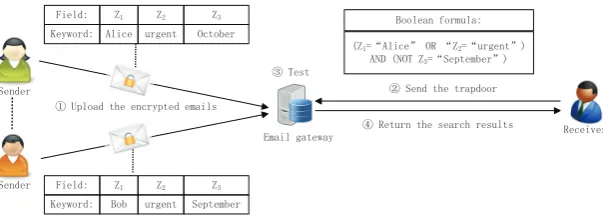
Fig. 1: An example of secure searchable email system.
Consider a secure searchable email system in Figure 1. To support the key-word search, each email will be defined some keykey-word fields, such as “Sender”, “P riority”, and “M onth”. Here we use “Z1”, “Z2” and “Z3” to denote these fields respectively. Before sending an email, a sender first encrypts the email con-tent using a standard public key encryption algorithm with the receiver’s public key, and then appends some additional encrypted keywords of the keyword fields, such as “Alice”, “urgent”, and “October”. Generally speaking, the ASE schemes focus only on the keywords encryption since it is well known that the standard public key encryption is secure. In schemes [6, 12], an email gateway might be given a trapdoor for the boolean formula (Z1 = “Alice” OR Z2 = “urgent”), which indicates that the receiver wants the gateway to return all emails either sent by Alice or having urgent priority. Since the receiver might have read all the emails in September, the trapdoor for boolean formula would actually like ((Z1= “Alice” ORZ2= “urgent”) AND (NOTZ3= “September”)). However, neither of schemes [6, 12] can work in the situations involving negation search operation. Moreover, the former is less secure and the latter is less efficient.
The requirement of supporting negation also can be found in Attribute-Based Encryption schemes, where the solutions are polynomial interpolation [20] and “2-equation technique” [21, 22]. However, these solutions cannot be applied to searchable encryption because the keywords will be disclosed to the server.
Our Contributions.Our contributions are summarized as follows.
– Based on the composite-order groups, we propose an expressive and secure ASE scheme named ESASE. To the best of our knowledge, ESASE is the first that simultaneously supports conjunctive, disjunctive and negation search operations in the public key setting.
– We show how ESASE could be extended to support a class of simple range search, which can help the user choose the search ranges based on different choices of granularity. Furthermore, we extend ESASE to the multi-user set-ting, which can minimize the overhead on computation and communication.
1.1 Related Work
Song et al. [1] initiate the research on searchable encryption and present the first practical solution in the symmetric key setting. After this work, several works [2, 3, 11, 13, 14, 17] have been proposed to improve the efficiency of the system or provide stronger security. Boneh et al. [5]. first address the concept of asymmetric searchable encryption, where anyone can use the public key to encrypt the data and keywords but only authorized users with secret key can search. However, these early schemes focus only on single keyword search.
Evidently, there are two trivial solutions to achieve conjunctive keyword search based on the single keyword search: one is to obtain the intersection of all sets where each set is the searching result for every individual keyword in the con-junction; another would be to define a meta-keyword for each possible keywords conjunction. However, as Golle et al. [4] point out, these approaches suffer from obvious drawbacks. The former allows the gateway to learn which documents contain each individual keyword based on the results of the conjunctive query, and the latter requires an exponential storage and search time for the number of keywords. Therefore, they propose the first solution for symmetric conjunctive keyword search, where each encrypted file is associated with encrypted keywords that are assigned to separate keyword fields. If a user queries a trapdoor with several keywords, the server can search a file containing those keywords with this trapdoor. Later, Park et al. [16] propose the notion of asymmetric conjunctive keyword search. To decrease the trapdoor size and the computation overhead, several solutions are presented in [8, 9, 15].
searching keywords in the trapdoor, which will let the server learn whether the encrypted data contains the keywords in the trapdoor.
2
PRELIMINARIES
2.1 Linear Secret Sharing Schemes
Our construction will make essential use of linear secret-sharing schemes (LSSS). We first describe the definition of access structure [23] that will be used in LSSS. Then, we give the definition of LSSS adapted from [23].
Definition 1 (Access Structure). Let {P1, . . . , Pm} be a set of parties. A collection A ⊆ 2{P1,...,Pm} is monotone if ∀B, C : if B ∈ A and B ⊆ C then C ∈ A. An access structure (respectively, monotonic access structure) is a collection (respectively, monotone collection)Aof non-empty subsets of {P1, . . .,Pm},i.e.,A⊆2{P1,...,Pm}\{∅}.The sets inAare called theauthorized sets, and the sets not in Aare called the unauthorized sets.
Definition 2 (Linear Secret-Sharing Schemes (LSSS)).Suppose there
ex-ists a linear secret sharing structure A= (A, ρ),where Ais a ℓ×mmatrix and ρis an injective function from{1, . . . , ℓ}to a party.Let S ∈Abe any authorized set, and I ⊂ {1, . . . , ℓ} be defined as I = {i :ρ(i)∈ S}. Therefore, there exist constants {σi∈Zp}such that
∑
i∈IσiAi= (1,0, . . . ,0),whereAiis the i’th row of matrix A. When we consider the column vector υ = (s, r2, . . . , rm), where s∈Zp is the secret to be shared,andr2, . . . , rm∈Zpare randomly chosen,then
Aυcan be regarded as the linear secret sharing where each share Aiυbelongs to party ρ(i). On the other hand, given a party set S and its corresponding rows I={i:ρ(i)∈S} in the matrix A, finding {σi∈Zp} such that
∑
i∈IσiAiυ=s is called linear secret reconstruction. Note that, for unauthorized sets, no such constants exist.
In our context, the role of the parties is taken by the keywords. Access struc-tures (i.e., search predicates) might also be described in terms of monotonic boolean formulas. As described in [23], any monotonic boolean formula can be converted into an LSSS representation.
2.2 Composite-Order Bilinear Groups
We will construct our scheme in composite-order bilinear groups [24]. LetGand
GT be two multiplicative cyclic groups of orderN =p1p2p3p4, where p1,p2, p3 andp4 are distinct primes. Letg be a generator ofGand e:G×G−→GT be a bilinear map such that e(g, g)̸= 1, and for any u, v ∈ G, a, b∈ ZN it holds e(ua, vb) =e(u, v)ab. We say thatGis a bilinear group if the group operation in
Gand the bilinear mapeare both efficiently computable.
hi ∈Gpi and hj ∈ Gpj fori ≠ j, e(hi, hj) = 1. To see this, suppose h1 ∈ Gp1 and h2 ∈ Gp2. We let g denote a generator of G. Then, g
p2p3p4 generatesG p1, andgp1p3p4 generatesG
p2. Hence, we can have:
e(h1, h2) =e((gp2p3p4)α1,(gp1p3p4)α2) =e(gp3p4α1, gα2)p1p2p3p4 = 1,
where α1 = loggp2p3p4h1 and α2 = loggp1p3p4h2. This orthogonality property of Gp1, Gp2, Gp3, Gp4 will be a principal tool in our construction and security proof.
2.3 Complexity Assumptions
We now state the complexity assumptions that will be used in our security proof. The first two assumptions are also used in [6] and the third can be easily proved by utilizing the theorems proposed in [12]. We note all of them hold in the generic group model.
Assumption 1. Let N,G,GT, ebe defined as in above section. Let g ∈ Gp1, X3∈Gp3, andX4∈Gp4 be chosen at random. Given the tuple (G,GT,N,e,g, X3,X4), this assumption states that no probabilistic polynomial-time algorithm
B can distinguish the random elements in Gp1 and Gp1p2 with non-negligible advantage.
Assumption 2.LetN,G,GT, ebe defined as in above section. Letg, X1∈Gp1, X2, Y2 ∈ Gp2, X3, Y3 ∈ Gp3, and X4 ∈ Gp4 be chosen at random. Given the tuple (G, GT, N, e, g, X1X2, Y2Y3, X3, X4), this assumption states that no probabilistic polynomial-time algorithmBcan distinguish the random elements in Gp1p2p3 andGp1p3 with non-negligible advantage.
Assumption 3. Let N,G,GT, e be defined as in above section. Let s ∈ ZN, g, u∈Gp1,g2, X2∈Gp2,X3∈Gp3,X4, h′ ∈Gp4, andB24, D24∈Gp2p4 be cho-sen at random. Given the tuple (G,GT, N, e, g, g2, X2, uh′, gsB24, X3, X4), this assumption states that no probabilistic polynomial-time algorithmBcan distin-guishusD24and a random element inG
p1p2p4 with non-negligible advantage.
3
Syntax and Security Model
3.1 Syntax
Setup(1κ): takes as input a security parameter 1κ, and generates a public key pk and secret keysk.
Encrypt(pk, W): for the public key pk and a keyword set W, produces a ci-phertextCW.
Trapdoor(pk,sk,P): given the public keypk, the secret keysk, and a predicate
P, produces a trapdoorTP.
Test(pk,CW,TP): takes as input the public keypk, the ciphertextCW, and the trapdoor TP. It outputs “1” if the keyword setW satisfies the predicateP and “0” otherwise.
3.2 Security Model
In ESASE, we assume the server who runs the Test algorithm is Honest but Curious. That is to say, it will execute correctly the proposed algorithm, but try to find out as much secret information as possible based on its inputs. Moreover, we define the security notion in the sense of indistinguishability security against chosen predicate attacks. Formally, security is defined using the following game between an attacker and a challenger.
Setup.The challenger takes a security parameter 1κ and runs the Setup algo-rithm. The public key pk is given to the adversary. The challenger keeps the secret key skto itself.
Phase 1.The adversary adaptively queries a number of predicates,P1,. . .,Pq, to the challenger. In response, the challenger runs the Trapdoor algorithm and gives the trapdoorTPi to the adversary, for 1≤i≤q.
Challenge.The adversary selects two target keyword setsW0, W1, and sends them to the challenger. The challenger picks a random bitβ ∈ {0,1}and obtains the ciphertext CWβ by running the Encrypt algorithm. Then, he gives CWβ to the adversary. Note thatW0 andW1 cannot satisfy any of queried predicates in phase 1.
Phase 2. The adversary additionally queries the challenger for trapdoors cor-responding to predicates with the restriction that none of them can be satisfied byW0 andW1.
Guess.The adversary outputs a guessβ′ ofβ and wins the game ifβ′ =β.
The advantage of the adversary in this game is defined as|Pr[β′ =β]-12|.
127
$1'
= $ $1'
= % = &
25
= $ $1'
= % = & 127 127
25
= $ $1'
= %ÿ = &ÿ
Fig. 2: An example of propagating the negation operations.
4
Construction
4.1 Overview
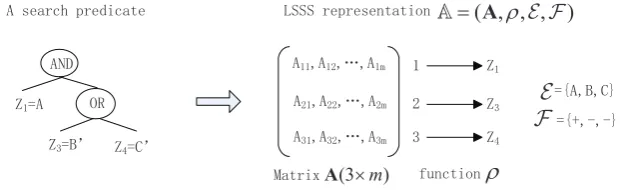
Consider any search predicate with negation operations, we can use the De-Morgan’s law to propagate the negation operations. For example, in Figure 2, a search predicate (Z1 = “A” AND (NOT (Z3 = “B” AND Z4 = “C”))) e-quals (Z1= “A” AND ((NOTZ3= “B”) OR (NOTZ4= “C”))), whereA, B andC denote the keywords in keyword fields Z1,Z3 andZ4 respectively. After the propagation, the negation operations can only be associated with keyword-s. Thus, the name of the keywords in our scheme may be of two types: either the name is normal (like x) or it isprimed(likex′). We conceptually associate primed keywords as representing the negation of unprimed keywords. Therefore, the search predicate (Z1= “A” AND (NOT (Z3= “B” AND Z4= “C”))) can be parsed as (Z1= “A” AND (Z3= “B′” ORZ4= “C′”)).
As described previously, any monotonic boolean search predicate can be con-verted into an LSSS representation A= (A, ρ), whereAis aℓ×mmatrix and ρ is a map from each row of A to a keyword field (i.e., ρ is a function from
{1, . . . , ℓ} to {1, . . . , n}). Let E = {tρ(1), . . . , tρ(ℓ)}, F = {fρ(1), . . . , fρ(ℓ)}, where tρ(i) is the keyword of keyword fieldρ(i) specified by the predicate and fρ(i) denotes whether the keyword of keyword field ρ(i) is primed or not (We can use “−” and “ + ” to denote it is primed and not primed respectively).
25 = $
$1'
= %ÿ = &ÿ
$$Ă$P
$$Ă$P
$$Ă$P
=
=
=
( , , ,
)
!
A
!
0DWUL[ IXQFWLRQ
^$%&`
!
^`$VHDUFKSUHGLFDWH
(3 m)
A
/666UHSUHVHQWDWLRQ
Thus, in our scheme, any boolean search predicate, which simultaneously supports the operations of conjunctive and disjunctive and negation, can be converted into an LSSS representation A = (A, ρ, E, F). A keyword set W = {w1, . . . , wn} satisfies a predicate A = (A, ρ, E, F) if and only if there exist I ⊂ {1, . . . , ℓ} and constants {σi}i∈I such that ∑i∈IσiAi = (1,0, . . . ,0), where Ai is the i’th row of matrixA. Note that for∀i∈I, iffρ(i) denotes the keyword of keyword fieldρ(i) is not primed, thentρ(i)=wρ(i); else,tρ(i)̸=wρ(i). In addition, we define IA,ρ as the set of minimum subsets of {1, . . . , ℓ} that satisfies (A, ρ,E,F). Figure 3 shows an example of converting a search predicate into an LSSS representation, where ℓ= 3 andIA,ρ={{1,2},{1,3}}.
4.2 Main Construction
Setup(1κ): Take as input a security parameter 1κ, it returns
params= (p1, p2, p3, p4,G,GT,e) withG=Gp1×Gp2×Gp3×Gp4, whereGandGT are cyclic groups of orderN =p1p2p3p4. Next it choosesg,u1, . . ., un ∈Gp1, X3∈Gp3, X4, h1, . . ., hn ∈Gp4 and α∈ZN uniformly at random. The public key pk is published as:
N, g, gα,{Hi=ui·hi}1≤i≤n, X4.
The secret keysk={u1, . . . , un, α, X3}.
Encrypt(pk,W): The encryption algorithm choosess∈ZNandh,Z0,{Z1,i}1≤i≤n
∈ Gp4 uniformly at random. Let the keyword set be W=(w1, . . . , wn)∈ Z n N, then the corresponding ciphertextCW = (C, C0,e {Ci}1≤i≤n) is computed as:
e
C=e(g, gα)s, C0= (gh)s·Z0, Ci= (Hiwi)s·Z1,i.
Trapdoor(pk,sk,P): Suppose that the predicateP is corresponding to (A,ρ,
E, F), where A is theℓ×m matrix, ρ(i) is a map from each row Ai of A to
{1, . . . , n},E={tρ(1),. . .,tρ(ℓ)} ∈ZℓN, andF={fρ(1),. . .,fρ(ℓ)}. The algorithm first chooses a random vectorυ∈ZmN such that1·υ=α, where1= (1,0, . . . ,0). Then, for each rowAi ofA, it chooses a randomri∈ZN and random elements V1,i, V2,i, V3,i ∈Gp3. The trapdoor keyTP = ((A, ρ,F),{D1,i, D2,i, D3,i}1≤i≤ℓ) is computed as
D1,i=gAi·υ(uρ(i))tρ(i)·ri·V1,i, D2,i=gri·V2,i, D3,i= (uρ(i))tρ(i)·ri·V3,i.
Test(pk, CW, TP): Given a ciphertext CW and a trapdoor TP, the algorithm first calculatesIA,ρ. Then, it checks if there exists an setI∈IA,ρthat satisfies
e
C=∏ i∈I
(Ui)σi,
where∑i∈IσiAi = (1,0, . . . ,0). Fori∈I: iffρ(i)denotes the keyword of keyword field ρ(i) is not primed, the above Ui = e(D1,i, C0)/e(D2,i, Cρ(i)); else, Ui = e(D1,i, C0)/e(D3,i, C0) and the equality e(C0, D3,i) = e(Cρ(i), D2,i) does not hold.
4.3 Correctness
In the Test algorithm, fori∈I such thatfρ(i) denotes the keyword of keyword field ρ(i) is not primed, iftρ(i)is equal towρ(i), we can have:
Ui =e(D1,i, C0)/e(D2,i, Cρ(i))
=e(g Ai·υ(u
ρ(i))tρ(i)·ri·V1,i,(gh)s·Z0) e(gri·V2,i,(H
ρ(i)
wρ(i))s·Z 1,ρ(i))
=e(g
Ai·υ(uρ(i))tρ(i)·ri, gs)
e(gri, u
ρ(i)wρ(i)s)
=e(g, g)sAi·υ.
Fori∈I such thatfρ(i) denotes the keyword of keyword fieldρ(i) is primed, if the equality e(C0, D3,i) =e(Cρ(i), D2,i) does not hold, it indicates thattρ(i) is not equal towρ(i). Furthermore, we can have:
Ui=e(D1,i, C0)/e(D3,i, C0) =e(g Ai·υ(u
ρ(i))tρ(i)·ri·V1,i,(gh)s·Z0) e((uρ(i))tρ(i)·ri·V3,i,(gh)s·Z0)
=e(g, g)sAi·υ.
Thus, we can have: ∏
i∈I
(Ui)σi=
∏
i∈I
(e(g, g)sAi·υ)σi=e(g, g)Σi∈IsAi·υσi=e(g, g)αs=C.e
4.4 Discussion
In Lai et al. [6], the searching keywords are disclosed in the trapdoor, which will cause a Test algorithm executor (i.e., an email gateway) to learn whether the encrypted data contains the keywords in the trapdoor. However, ESASE just discloses whether the keywords in the trapdoor are primed or not. We note that it might be inevitable in an ASE scheme that can support negation search operation, but it is acceptable if the scheme is proved secure in the security model defined in Section 3.2.
5
Security
Theorem 1.If Assumptions 1, 2 and 3 hold, then ESASE is secure.
Proof.The proof consists of the following three steps:
1. Constructing the semi-functional ciphertexts and keys.
We define two additional structures: semi-functional ciphertexts and keys, which will not be used in the real system, but will be needed in our proof.
by the Encrypt algorithm. Then, for each componentCi′, a random value γi ∈ZN is chosen. Let g2 be a generator of Gp2 and c∈ ZN be a random exponent, the semi-functional ciphertextCW = (C, C0,e {Ci}1≤i≤n) is set to be:
e
C=Ce′, C0=C0′ ·g2c, Ci =Ci′·gcγi
2 .
Note that the values{γi}1≤i≤n are chosen randomly once and then fixed in the following semi-functional keys.
Semi-f unctional Key. To create a semi-functional key, a normal trapdoor keyTP′ = ((A, ρ, F), {D′1,i, D′2,i,D′3,i}1≤i≤ℓ) should be first generated by the Trapdoor algorithm. Then, it chooses a random vector z ∈ Zm
N and sets δi = Ai·z. For each row i of the ℓ×m matrix A, a random value ηi ∈ ZN is chosen. Finally, a semi-functional key TP = ((A, ρ, F), {D1,i, D2,i,D3,i}1≤i≤ℓ) is divided into two types of forms. The type 1 is set to be:
D1,i=D′1,i·g
δi+ηiγρ(i)
2 , D2,i=D
′
2,i·g ηi
2 , D3,i=D
′
3,i·g ηiγρ(i)
2 .
The type 2 is similarly formed as:
D1,i=D
′
1,i·g δi
2, D2,i=D
′
2,i, D3,i=D
′
3,i.
2. Defining a sequence of attack games.
We organize our proof as a sequence of games. The first game,Gamereal, is the real security game defined in Section 3.2. In the next game,Game0, all of the trapdoor keys are normal, but the challenge ciphertext is semi-functional. Letq be the number of trapdoor key queries made by the attacker. For k from 1 toqandξfrom 1 ton, we define:
- Gamek,1: the firstk−1 trapdoor keys are semi-functional of type 2, the kthtrapdoor key is semi-functional of type 1, and the remaining trapdoor keys are normal. In addition, the challenge ciphertext is semi-functional.
- Gamek,2: the firstktrapdoor keys are semi-functional of type 2, and the remaining trapdoor keys are normal. In addition, the challenge ciphertext is semi-functional.
- Gamef inal,ξ: all the trapdoor keys are semi-functional of type 2, and the challenge ciphertextCWβ = (Ce,C0, {C1,. . .,Cn}) is a semi-functional encryption of Wβ with C1, . . ., Cξ, each of which is randomly chosen fromGp1p2p4.
Note that Game0,2 and Gamef inal,0 can be considered as another way of denotingGame0andGameq,2respectively.
3. Proving these attack games are indistinguishable with the real game.
Gamef inal,n, the attacker’s advantage is negligible since the challenge ci-phertextCWβ is independent of the keyword setsW0andW1. Therefore, we conclude that the advantage of the adversary inGamerealis negligible. This completes the proof of Theorem 1.
6
Efficiency
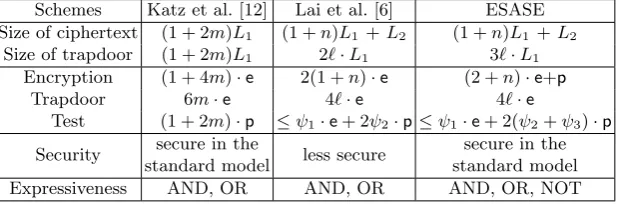
We compare our proposed scheme with Katz et al. [12] and Lai et al. [6] in Table 1.
Storage and Communication Overhead. The storage and communication
overhead is mainly determined by the sizes of the ciphertext and trapdoor re-spectively. Table 1 shows the size of a ciphertext (resp. a trapdoor), both in ESASE and [6], islinearwith the number of keyword fieldsn(resp. the number of rowsℓ) rather thansuperpolynomialin [12].
Computation Overhead.The computation overhead is mainly determined by three algorithms, including Encryption, Trapdoor, and Test. Table 1 shows that the computation overhead of Encryption (resp. Trapdoor), both in ESASE and [6], islinear with n(resp. ℓ), not superpolynomial. In addition, since ESASE supports the negation search, the Test cost of it is a little bigger than [6].
It can be concluded that the efficiency of ESASE is close to Lai et al. [6], but much better than Katz et al. [12]. Furthermore, compared with these two schemes, ESASE can simultaneously support conjunctive, disjunctive and nega-tion search operanega-tions.
Table 1: Comparisons of efficiency of existing expressive ASE schemes. Schemes Katz et al. [12] Lai et al. [6] ESASE
Size of ciphertext (1 + 2m)L1 (1 +n)L1 +L2 (1 +n)L1 +L2
Size of trapdoor (1 + 2m)L1 2ℓ·L1 3ℓ·L1
Encryption (1 + 4m)·e 2(1 +n)·e (2 +n)·e+p
Trapdoor 6m·e 4ℓ·e 4ℓ·e
Test (1 + 2m)·p ≤ψ1·e+ 2ψ2·p≤ψ1·e+ 2(ψ2+ψ3)·p
Security secure in the
standard model less secure
secure in the standard model Expressiveness AND, OR AND, OR AND, OR, NOT
1
n: the number of keyword fields;ℓ: the number of rows in the matrixA; L1 (orL2): a bit length of a group element inG (orGT);m: the length of the vector corresponding to the ciphertext in Katz et al. [12]. Note that mis proportional todℓ, wheredis the maximum degree (of the resulting polynomial) in each variable in [12].
2
e: an exponentiation operation inGorGT;p: a pairing operation;ψ1: the
7
Extensions
7.1 Range Search
Besides the boolean search, range search is also an important requirement for the searchable encryption. However, there is no expressive ASE scheme for the range search. Here we show how ESASE could be extended to support a class of simple range search [25]. Although supporting an arbitrary range search can be achieved by using the technique in [26], high complexity will be introduced when there are lots of disjunctive operations in a predicate. Therefore, we are not aiming at it.
We first introduce the concept of the keyword hierarchy. LetZibe a numerical keyword field, a keyword hierarchy overZiis a balanced treeΓ(Zi), where each internal node represents a range that is the union of the ranges of its children nodes and each leaf node is the keyword. In addition, we define some notations as follows.
- R(id): the range of a internal nodeid.
- P(z): the path from a leaf node z to the root. For every nodeidin P(z), it hasz ∈R(id).
- Γl(Zi): the node set in the l-th level of the tree, it is also called a “level -l f ie-ld”. Any node in Γl(Zi) is called a “level-l keyword” and denotes a “level-l simple range”.
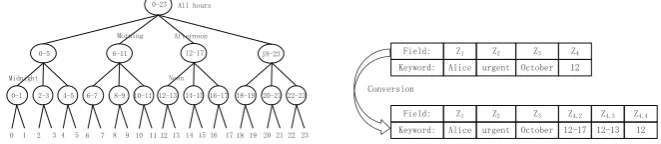
Suppose there is a “Hour” field Z4 with keywords from number 0 to 23, Figure 4 depicts the keyword hierarchy. The path of the leaf node “12” is (“0-23”, “12-17”, “12-13”, “12”), and “12-17”, “12-13” are level-2 and level-3 simple range respectively. $OOKRXUV 0RUQLQJ $IWHUQRRQ 0LGQLJKW 1RRQ
Fig. 4: The keyword hierarchy of the “Hour” field.
)LHOG .H\ZRUG = $OLFH = XUJHQW = 2FWREHU = )LHOG .H\ZRUG = $OLFH = XUJHQW = 2FWREHU = = = &RQYHUVLRQ
Fig. 5: An example of field structure con-version for the “Hour” field.
Hour field is expanded into 3 subfields. As a result, the parameter n in the Setup algorithm will be set to 6 and the keyword set to be encrypted will be
{“Alice”,“urgent”,“October”,“12−17”,“12−13”,“12”}.
Moreover, before we use a predicate with range search to generate a trapdoor, we should convert it based on the system-defined simple ranges. For example, an original search predicate (Z1 = “Alice” AND (“6” ≤ Z4 ≤ “13”)) can be converted into (Z1= “Alice” AND (Z4,2= “6-11” ORZ4,3= “12-13”)). Since ESASE supports the negation search, a search predicate ( Z1 = “Alice” OR (NOT “6”≤Z4≤“13”)) can be converted into (Z1= “Alice” OR (Z4,2= “(6-11)′” ANDZ4,3= “(12-13)′”)).
We note this class of simple range search will bring two benefits. On the one hand, the hierarchy on a numerical field can be well-designed depending on different usages. Take Figure 4 for example, the node “6-11” stands for the morning and “12-17” for the afternoon. On the other hand, a user can choose the search ranges based on different choices of granularity.
7.2 Multi-user Setting
We briefly outline how we extend ESASE scheme to the multi-user setting [9]. In a Single-user ESASE scheme, if a sender wants to send an encrypted email to multiple receivers in the example of a secure email system, he needs to encrypt the same email and the same keywords with each receiver’s public key respec-tively. A multi-user ESASE scheme can eliminate these repeated operations and minimize the size of the public key material that needs to be obtained. We use therandomness re-usetechnique [27, 28] as follows.
We observe that in the Trapdoor algorithm, the parameter αis the secret in the LSSS representationA= (A,ρ,E,F). In addition, only one element,gα in the public key depends upon α. Therefore, we can use different αto distin-guish between different users. Specifically, in the Setup algorithm of a multi-user ESASE scheme, the public parameter P P shared by all the users is published as:
P P =N, g,{Hi}1≤i≤n, X4.
while the public/secret key pair{pkx,skx} for userxis:
{pkx, skx}={gαx,(u1, . . . , un, αx, X3)}.
Note that all the users also share the same parametersu1,. . .,un, andX3. When a sender is to encrypt a keyword setW for k users, he first uses the public parameterP P to encryptW to obtain the componentsC0and{Ci}1≤i≤n, and then uses each user’s public key pkx to generate the components C1e , . . .,
e
Cx, . . ., Cke respectively. Finally, for the user x(1≤x≤k), the corresponding ciphertextCW will be:
The rest two algorithms of the multi-user ESASE scheme are the same with ESASE respectively. We compare the efficiency of the Single-user and Multi-user ESASE in Table 2. It shows that the multi-user ESASE is more efficient when there are multiple receivers.
Table 2: Comparisons of efficiency for the Single-user and Multi-user ESASE. Schemes Single-user ESASE Multi-user ESASE
OE (2 +n)·ke+k·p (1 +n+k)·e+k·p SP K (3 +n)k·L1 (2 +n+k)·L1
k: the number of the receivers;n,e,p,L1: defined as in Section 6;OE:
the encryption overhead;SP K: the size of the public key material that a sender needs to obtain.
8
Conclusion and Future Work
Searchable encryption is an important cryptographic mechanism which enables to perform secure searches over encrypted data stored on untrusted servers. In this paper, we present a new scheme ESASE, to solve the problem of expres-sive search in the public key setting. To the best of our knowledge, ESASE is the first that can simultaneously support conjunctive, disjunctive and nega-tion search operanega-tions. Then we prove ESASE is secure in the standard model. By analyzing, the efficiency of ESASE compares favorably to that of existing, less-expressive asymmetric searchable encryption schemes. Finally, we make t-wo useful extensions: one is to support the range search, and another is to the multi-user setting. A further direction is to find more efficient schemes that can achieve the expressive search in the public key setting.
References
1. Song, D.X., Wagner, D., Perrig, A.: Practical techniques for searcheson encrypted data. In: IEEE Symposium on Security and Privacy, S&P 2000, pp. 44–55 (2000) 2. Goh, E.J.: Secure indexes. IACR Cryptology ePrint Archive 2003, 216 (2003) 3. Curtmola, R., Garay, J., Kamara, S., Ostrovsky, R.: Searchable Symmetric
En-cryption: Improved Definitions and Efficient Constructions. In: ACM CCS 2006, pp. 79–88 (2006)
4. Golle, P., Staddon, J., Waters, B.: Secure conjunctive keyword search over en-crypted data. In: Jakobsson, M., Yung, M. (eds.) ACNS 2004. LNCS, vol. 3089, pp. 31–45. Springer, Heidelberg (2004)
5. Boneh, D., Di Crescenzo, G., Ostrovsky, R., Persiano, G.: Public key encryption with keyword search. In: Cachin, C., Camenisch, J. (eds.) EUROCRYPT 2004. LNCS, vol. 3027, pp. 506–522. Springer, Heidelberg (2004)
7. Moataz, T., Shikfa, A.: Boolean symmetric searchable encryption. In: ACM ASI-ACCS 2013, pp. 265-276 (2013)
8. Chen, Z., Wu, C., Wang, D., Li, S.: Conjunctive keywords searchable encryption with efficient pairing, constant ciphertext and short trapdoor. In: Chau et al. (eds.) PAISI 2012. LNCS, vol. 7299, pp. 176–189. Springer, Heidelberg (2012)
9. Hwang, Y. H., Lee, P. J.: Public key encryption with conjunctive keyword search and its extension to a multi-user system. In: Takagi et al. (eds.) Pairing 2007. LNCS, vol. 4575, pp. 2–22. Springer, Heidelberg (2007)
10. Lewko, A., Okamoto, T., Sahai, A., Takashima, K., Waters, B.: Fully secure func-tional encryption: Attribute-based encryption and (hierarchical) inner product en-cryption. In: Gilbert, H. (ed.) EUROCRYPT 2010. LNCS, vol. 6110, pp. 62–91. Springer, Heidelberg (2010)
11. Lu, Y.: Privacy-preserving logarithmic-time search on encrypted data in cloud. In: Network and Distributed System Security Symposium (NDSS). (2012)
12. Katz, J., Sahai, A., Waters, B.: Predicate encryption supporting disjunctions, poly-nomial equations, and inner products. In: Smart, N. (ed.) EUROCRYPT 2008. LNCS, vol. 4965, pp. 146–162. Springer, Heidelberg (2008)
13. Kamara, S., Papamanthou, C., Roeder, T.: Dynamic searchable symmetric encryp-tion. In ACM CCS 2012, pp. 965–976 (2012)
14. Kamara, S., Papamanthou, C.: Parallel and dynamic searchable symmetric encryp-tion. In: Financial Cryptography and Data Security (FC). (2013)
15. Ballard, L., Kamara, S., Monrose, F.: Achieving efficient conjunctive keyword searches over encrypted data. In: Qing et al. (eds.) ICICS 2005. LNCS, vol. 3783, pp. 414–426. Springer, Heidelberg (2005)
16. Park, D. J., Kim, K., Lee, P. J.: Public key encryption with conjunctive field keyword search. In: Lim, C.H., Yung, M. (eds.) WISA 2004. LNCS, vol. 3325, pp. 73–86. Springer, Heidelberg (2004)
17. Chang, Y.C., Mitzenmacher, M.: Privacy Preserving Keyword Searches on Remote Encrypted Data. In: Ioannidis, J., Keromytis, A.D., Yung, M. (eds.) ACNS 2005. LNCS, vol. 3531, pp. 442–455. Springer, Heidelberg (2005)
18. Cash, D., Jarecki, S., Jutla, C. S., Krawczyk, H., Rosu, M., Steiner, M.: Highly-Scalable Searchable Symmetric Encryption with Support for Boolean Queries. In Canetti, R., Garay, J. (eds.) CRYPTO 2013. LNCS, vol. 8042, pp. 353–373. Springer, Heidelberg (2013)
19. Islam, M., Kuzu, M., Kantarcioglu, M.: Access pattern disclosure on searchable en-cryption: Ramification, attack and mitigation. In: Network and Distributed System Security Symposium (NDSS). (2012)
20. Ostrovsky, R., Sahai, A., Waters, B.: Attribute-based encryption with non-monotonic access structures. In ACM CCS 2007, pp. 195–203 (2007)
21. Lewko, A., Sahai, A., Waters, B.: Revocation systems with very small private keys. In: IEEE Symposium on Security and Privacy, S&P 2010, pp. 273–285 (2010) 22. Attrapadung, N., Libert, B.: Functional encryption for inner product: Achieving
constant-size ciphertexts with adaptive security or support for negation. In: N-guyen, P.Q., Pointcheval, D. (eds.) PKC 2010. LNCS, vol. 6056, pp. 384–402. Springer, Heidelberg (2010)
23. Beimel, A.: Secure schemes for secret sharing and key distribution (Doctoral dis-sertation. PhD thesis, Israel Institute of Technology. (1996)
25. Li, M., Yu, S., Cao, N., Lou, W.: Authorized private keyword search over encrypted data in cloud computing. In: IEEE Distributed Computing Systems (ICDCS), pp. 383–392 (2011).
26. Lewko A., Waters B.: New proof methods for attribute-based encryption: Achieving full security through selective techniques. In: Safavi-Naini, R., Canetti, R. (eds.) CRYPTO 2012. LNCS, vol. 7417, pp. 180–198. Springer, Heidelberg (2012) 27. Kurosawa, K.: Multi-recepient public-key encryption with shortend ciphertext. In:
Naccache, D., Paillier, P. (eds.) PKC 2002. LNCS, vol. 2274, pp. 48–63. Springer, Heidelberg (2002)
28. Bellare M., Boldyreva A., Staddon J.: Randomness re-use in multi-recipient encryp-tion schemeas. In: Desmedt, Y.G. (ed.) PKC 2003. LNCS, vol. 2567, pp. 85–99. Springer, Heidelberg (2003)
A
Security Proofs
Lemma 1.If there is an algorithmAthat distinguish the GamerealandGame0 with non-negligible advantage ϵ. Then we can construct an algorithm B with advantageϵin breaking Assumption 1.
Proof.B is given{g, X3, X4, T}and will simulateGamerealorGame0 withA.
Setup. B chooses h1, . . . , hn ∈ Gp4 and α, a1, . . . , an ∈ ZN uniformly at random. Then, it sets u1 = ga1, . . . , un =gan, H1 =u1h1, . . . , Hn =unhn, and sendsAthe public keypk={N, g, gα, {H
i}1≤i≤n, X4}.
Phase 1.B can respond to trapdoor key requests by running the Trapdoor al-gorithm to make normal trapdoor keys because it knows the secret key sk =
{u1, . . . , un, α, X3}.
Challenge.A sendsBtwo keyword sets W0, W1.B first chooses random values h,Z0e , {Z1,ie }1≤i≤n ∈ Gp4. Then, it randomly chooses a keyword set Wβ from
{W0, W1}. Let Wβ ={wβ,1, . . . , wβ,n}, it computesCe =e(gα, T),C0=T·Ze0, Ci =Taiwβ,i·Z1,ie . B sets CW
β = (C, C0,e {Ci}1≤i≤n) and sends it toA as the challenge ciphertext.
Phase 2.Same as Phase 1 with the restriction that none of the query trapdoors can be satisfied byW0 andW1.
Guess.The adversary outputs a guessβ′ ofβ:
– IfT ∈Gp1p2, letT =g sgc
2, then
e
C=e(g, gα)s, C0= (gh)sZ0·gc2, Ci= (Hiwβ,i) s
Z1,i·g cγi
2 ,
where Z0 = Z0e ·h−s, Z1,i = Z1,ihe −(wβ,is)
i , γi = aiwβ,i. This is a semi-functional ciphertext and B simulates Game0. Since the values of ai, wβ,i modulop1 are uncorrelated from their values modulop2, it is properly dis-tributed.
Therefore, if A can distinguish the Gamereal and Game0 with non-negligible advantageϵ,Bcan break Assumption 1 with advantage ϵ.
Lemma 2. If there is an algorithm A that distinguish the Gamek−1,2 and Gamek,1 with non-negligible advantage ϵ. Then we can construct an algorith-m Bwith advantageϵ in breaking Assumption 2.
Proof. B is given {g, X1X2, Y2Y3, X3, X4, T} and will simulate Gamek−1,2 or Gamek,1 withA.
Setup. Same as in Lemma 1.
Phase 1.Note thatBknows the secret keysk={u1, . . . , un, α, X3}. Considering a predicate (A,ρ,E ={tρ(1),. . .,tρ(ℓ)},F ={fρ(1),. . .,fρ(ℓ)}),Bcreates the trapdoor keys as follows.
– Forj < k,Bchooses a random vectorυsuch that1·υ=α, a random vector z′, random exponents ri ∈ZN, random elements V1,i, V2,i,V3,i ∈ Gp3, and set:
D1,i=gAi·υ(u
ρ(i))tρ(i)·ri·V1,i(Y2Y3)Aiz
′
, D2,i=gri·V2,i, D3,i= (u
ρ(i))tρ(i)·ri·V3,i.
We note that this is a properly distributed semi-functional key of type 2 because the value ofAiz′ modulop2 is uncorrelated to its value modulop3.
– Forj > k, sinceBknows the secret keysk, he can create a normal trapdoor key by running the trapdoor generation algorithm.
– For thekthtrapdoor key,Bchooses a random vectorυ′ such that1·υ′=α, a random vectorz such thatz·1= 0, random exponentsηei∈ZN, random elementsVe1,i,Ve2,i,Ve3,i∈Gp3, and sets:
D1,i=gAi·υ′TAiz+ηeiaitρ(i)V1,i, D2,ie =TηeiV2,i, D3,ie =Tηeiaitρ(i)V3,i.e
Thus, ifT ∈Gp1p2p3, thenT can be written asg rgd
2V, and
D1,i=gAi·υ(uρ(i))tρ(i)·ri·V1,i·gδi+ηiγρ(i)
2 ,
D2,i=gri·V2,i·gηi
2 , D3,i= (uρ(i))tρ(i)·ri·V3,i·g
ηiγρ(i)
2 ,
where υ = υ′ +zr, ri = reηi, δi = dAiz, γρ(i) = aitρ(i), ηi = deηi, V1,i = VAiz+eηiaitρ(i)V1,ie ,V2,i=VηeiV2,ie ,V3,i=Vηeiaitρ(i)V3,ie . This is a semi-function key of type 1. Since the values ofeηi, ai, tρ(i)modulop1 are are uncorrelated from their values modulop2, it is properly distributed. IfT ∈Gp1p3, it is a properly distributed normal trapdoor key.
Challenge.A sendsBtwo keyword sets W0, W1.B first chooses random values h,Z0e , {Z1,ie }1≤i≤n ∈ Gp4. Then, it randomly chooses a keyword set Wβ from
(X1X2)·Ze0, Ci = (X1X2)
aiwβ,i ·Ze
1,i. B sets CWβ = (C, Ce 0,{Ci}1≤i≤n) and sends it toAas the challenge ciphertext. If we letX1X2=gsgc2, then
e
C=e(g, gα)s, C0= (gh)sZ0·g2c, Ci= (Hiwβ,i) s
Z1,i·g cγi
2 ,
whereZ0=Ze0·h−s,Z1,i=Ze1,ih− (wβ,is)
i ,γi =aiwβ,i. This is a semi-functional ciphertext. Since the values of ai, wβ,i modulo p1 are uncorrelated from their values modulop2, it is properly distributed.
Phase 2.Same as Phase 1 with the restriction that none of the query trapdoors can be satisfied byW0 andW1:
– IfT ∈Gp1p2p3, thek
th trapdoor key is properly distributed semi-functional
key of type 1. Thus,Bhas properly simulatedGamek,1.
– ifT ∈Gp1p3, thek
thtrapdoor key is properly distributed normal key. Thus,
Bhas properly simulatedGamek−1,2.
Therefore, ifAcan distinguish theGamek,1andGamek−1,2with non-negligible advantageε,Bcan break Assumption 2 with advantageε.
Lemma 3.If there is an algorithmAthat distinguish theGamek,1andGamek,2 with non-negligible advantage ϵ. Then we can construct an algorithm B with advantageϵin breaking Assumption 2.
Proof.Bis given{g, X1X2, Y2Y3, X3, X4, T}and will simulateGamek,1orGamek,2 withA.
Setup. Same as in Lemma 1.
Phase 1.Note thatBknows the secret keysk={u1, . . . , un, α, X3}. Considering a predicate (A,ρ,E ={tρ(1),. . .,tρ(ℓ)},F ={fρ(1),. . .,fρ(ℓ)}),Bcreates the trapdoor keys as follows.
– Forj < k andj > k, the responses to trapdoor key queries are the same as inLemma2.
– For thekth trapdoor key,Bchooses a random vectorυ such that1·υ=α, a random vectorz such thatz·1= 0, random exponentsηie ∈ZN, random elementsV1,ie ,V2,ie ,V3,ie ∈Gp3, and sets:
D1,i=gAi·υ(Y2Y3)
AizTηeiaitρ(i)Ve
1,i, D2,i=TηeiVe2,i, D3,i=Tηeiaitρ(i)Ve3,i,
Thus, ifT ∈Gp1p2p3, thenT can be written asg rgd
2V, and
D1,i=gAi·υ(u
ρ(i))tρ(i)·ri·V1,i·g
δi+ηiγρ(i)
2 ,
D2,i=gri·V2,i·g ηi
2 ,
D3,i= (uρ(i))tρ(i)·ri·V3,i·gηiγρ(i)
2 ,
whereri=rηei,δi = logg2Y2·Aiz,γρ(i)=aitρ(i),ηi=deηi,V1,i=Y Aiz
Since the values of ηei, ai, tρ(i) modulo p1 are are uncorrelated from their values modulo p2, it is properly distributed. If T ∈Gp1p3, it is a properly distributed semi-functional key of type 2.
Challenge.Same as inLemma2.
Phase 2.Same as Phase 1 with the restriction that none of the query trapdoors can be satisfied byW0 andW1:
– IfT ∈Gp1p2p3, thek
th trapdoor key is properly distributed semi-functional
key of type 1. Thus,Bhas properly simulatedGamek,1.
– ifT ∈Gp1p3, thek
th trapdoor key is is properly distributed semi-functional
key of type 2. Thus,Bhas properly simulatedGamek,2.
Therefore, if A can distinguish the Gamek,1 and Gamek,2 with non-negligible advantageε,Bcan break Assumption 2 with advantageε.
Lemma 4. If there is an algorithm A that distinguish the Gamef inal,ξ−1 and Gamef inal,ξwith non-negligible advantageϵ.Then we can construct an algorithm
Bwith advantage ϵin breaking Assumption 3.
Proof.Bis given{g,g2,X2,uh′,gsB24,X3,X4,T}and will simulateGamef inal,ξ−1 orGamef inal,ξ−2with A.
Setup. B chooses h1, . . . , hmax{1,ξ−1}, hξ+1, . . . , hn ∈ Gp4 and α, a1, . . . , amax{1,ξ−1}, aξ+1, . . ., an ∈ ZN uniformly at random. Then, it sets u1 =ga1, . . . , umax{1,ξ−1} = gamax{1,ξ−1}, uξ+1 = gaξ+1, . . ., un = gan, H1 = u1h1, . . . , Hmax{1,ξ−1} =umax{1,ξ−1}hmax{1,ξ−1}, Hξ =uh′, Hξ+1 =uξ+1hξ+1, . . ., Hn=unhn, and sendsAthe public key :
pk={N, g, gα,{Hi}1≤i≤n, X4}
Phase 1.Note thatBknows the secret keysk={u1, . . . , un, α, X3}. ConsiderA queries for a predicate (A,ρ,E ={tρ(1),. . .,tρ(ℓ)},F ={fρ(1),. . .,fρ(ℓ)}),B first chooses a random vectorυsuch that1·υ=α, a random vectorz, random exponentsri∈ZN, random elementsVe1,i,Ve2,i,Ve3,i ∈Gp3, and then set:D1,i= gAi·υ(uX2)tρ(i)·ri·V1,i·gAiz
2 , ifρ(i) =ξ, orD1,i=g
Ai·υ(gaρ(i))tρ(i)·ri·V1,i·gAiz
2 otherwise.D2,i=gri·V2,i,D3,i= (gaρ(i))tρ(i)·ri·V3,i. Thus,D1,ican be written as gAi·υ(u
ρ(i))tρ(i)·riV1,i·gδ2i, where δi = Aiz +tρ(i)rilogg2X2 if ρ(i) = ξ or δi = Aiz otherwise. Note this is a properly distributed semi-functional key of type 2.
Challenge. A sends B two keyword sets W0, W1. B first chooses random val-ues h,Ze0, {Ze1,i}ξ≤i≤n ∈ Gp4. Then, it randomly chooses a keyword set Wβ from {W0, W1} and random elements C1, . . . , Cmax{1,ξ−1} ∈ Gp1p2p4. Let Wβ ={wβ,1, . . . , wβ,n}, it computes Ce = e(g, gsB24), C0 = gsB24·Z0e , Cξ = (gsB24)wβ,ξ·T·Z1,ξe ,{Ci=gsB24aiwβ,i·Z1,ie }
Phase 2.Same as Phase 1 with the restriction that none of the query trapdoors can be satisfied byW0 andW1.
Guess.The adversary outputs a guessβ′ ofβ:
– DenoteB2,B4 to be theGp2, Gp4 parts ofB24 respectively, D2, D4 to be theGp2,Gp4 parts ofD24respectively. If T =u
sD24, then
e
C=e(g, gα)s, C0= (gh)sZ0·gc2,{Ci= (Hiwi)sZ1,i·gcγi
2 }ξ≤i≤n,
where c = logg2B2, γξ = (logg2(B wβ,ξ
2 D2))/c, {γi = aiwβ,i}ξ≤i≤n, Z0 = B4Z0e ·h−s,Z1,ξ=Bwβ,i
4 D4Z1,ξe (uh′)−(wβ,is),{Z1,i=B aiwβ,i
4 Z1,ihe −(wβ,is)
i }ξ≤i≤n. Since the values of ai, wβ,i modulo p1 are uncorrelated from their val-ues modulo p2, it is properly distributed semi-functional ciphertext with C1, . . . , Cmax{1,ξ−1} random in Gp1p2p4. Thus, B has properly simulated Gamef inal,ξ−1.
– ifT ∈Gp1p2p4, this is a properly distributed semi-functional ciphertext with C1, . . . , Cξ random chosen fromGp1p2p4. Thus, B has properly simulated Gamef inal,ξ.