Predicate- and Attribute-Hiding Inner Product
Encryption in a Public Key Setting
∗Yutaka Kawai Mitsubishi Electric
Katsuyuki Takashima Mitsubishi Electric
November 18, 2013
Abstract
In this paper, we propose a reasonabledefinition of predicate-hiding inner product en-cryption (IPE)in a public key setting, which we call inner product encryption with cipher-text conversion (IPE-CC), where original ciphercipher-texts are converted to predicate-searchable ones by an helper in possession of a conversion key. We then define a notion of full secu-rity for IPE-CC, which comprises three secusecu-rity properties of being adaptively predicate-and attribute-hiding in the public key setting, adaptively(fully-)attribute-hiding against the helper, and usefully secure evenagainst the private-key generator (PKG). We then present the first fully secure IPE-CCscheme, and convert it into thefirst fully secure symmetric-key IPE (SIPE) scheme, where the security is defined in the sense of Shen, Shi, Waters. All the security properties are proven under the decisional linear assumption in the standard model. The IPE-CC scheme is comparably as efficient as existing attribute-hiding (not predicate-hiding) IPE schemes. We also present a variant of the proposed IPE-CC scheme with the same security that achieves shorter public and secret keys. We employ two key techniques,trapdoor basis setup, in which a new trapdoor is embedded in a public key, and multi-system proof technique, which further generalizes an extended dual system approach given by Okamoto and Takashima recently.
Contents
1 Introduction 2
1.1 Background . . . 2
1.2 Our Results . . . 4
1.3 Key Techniques . . . 5
1.4 Notations . . . 6
2 Definitions 7 2.1 Dual Pairing Vector Spaces (DPVS) . . . 7
2.2 Decisional Linear (DLIN) Assumption . . . 7
2.3 Inner Product Encryption with Ciphertext Conversion (IPE-CC) . . . 7
2.4 Symmetric-Key Inner Product Encryption (SIPE) . . . 10
3 Proposed (Basic) IPE-CC Scheme 11 3.1 Construction . . . 11
3.2 Security . . . 12
3.3 Proposed (Basic 2-Level) Hierarchical IPE-CC Scheme . . . 12
4 Proposed SIPE Scheme (Conversion from IPE-CC to SIPE) 13 5 A Variant for Achieving Shorter Public and Secret Keys 13 5.1 Construction and Security . . . 14
6 Efficiency Comparisons 16 A Multi-System Proof Technique 19 A.1 Structural Comparison of our IPE-CC Scheme with the IPE in [20] . . . 19
A.2 Intuitions for Proofs of Lemmas 1–3 . . . 19
B Proofs of Lemmas 1–3 23 B.1 Proof of Lemma 1 . . . 23
B.2 Proof of Lemma 2 . . . 41
B.3 Proof of Lemma 3 . . . 45
1
Introduction
1.1 Background
The notion of predicate encryption (PE) was explicitly presented by Katz, Sahai and Waters [14] for achieving fine-grained control over revealed information on encrypted data for various predicate-searchable token key owners. In the encryption system, the owner of a (master) secret key can create and issue tokens to system users. Informally, tokens in a predicate encryption scheme correspond to predicates in some class F, and a sender associates a ciphertext with an attribute in a set Σ; a ciphertextctx associated with the attribute (or plaintext) x∈Σ can be evaluated by tokentkf corresponding to the predicatef ∈ F to learn whetherf(x) = 1. In this paper, we only consider thispredicate-onlyPE [14, 24], in which attributexcan be treated as a plaintext in a general functional encryption framework [9]. (However, we treatxas an attribute hereafter.)
an adversary in possession of tokens tkf1, . . . ,tkfh for predicates f1, . . . , fh cannot derive any information on attribute xfrom ciphertext ctx other than the values of f1(x), . . . , fh(x).
Katz, Sahai and Waters [14] also presented a concrete construction of PE for a class of predicates called inner product predicates, which represents a wide class of predicates that includes an equality test (for IBE [2, 3, 5, 11] and HVE [10]), range queries [25], disjunctions or conjunctions of equality tests, and, more generally, arbitrary CNF or DNF formulas. Informally, an attribute of inner product predicates is expressed as vector xand predicatefv is associated with vectorv, wherefv(x) = 1 iffv·x= 0. (Here,v·xdenotes the standard inner product.)
The attribute-hiding security achieved in [16, 17, 18] is more limited or weaker than that achieved in [14, 20]. The former is called weakly-attribute-hiding, and the latter fully-attribute-hiding. Although the IPE scheme [14] achieved fully-attribute-hiding, it is selectively secure under non-standard assumptions. Subsequently, several attribute-hiding IPE schemes have been proposed [16, 17, 18, 19, 23], for aiming at an IPE scheme with better security, e.g., adaptive security, fully-attribute-hiding and weaker (standard) assumptions. This research direction culminated inadaptively secureandfully-attribute-hidingIPE scheme under thedecisional linear (DLIN) assumption [20]. The basic scheme in [20] has a variant with shorter public and tokens based on the technique in [19]. A hierarchical IPE (HIPE) scheme can be realized with the same security. (For a practical variant of the schemes, refer to [22].)
However, all previous public key IPE schemes have a problem to be applied in a practical system, that is, predicate token queries may leak some sensitive information, e.g., medical personal history, patent strategy, or corporate sensitive data. This is unavoidable in a plain public key IPEsystem, since anyone can generate a ciphertext associated with any attribute, and then, by using it, check the predicate associated in (target) token. In order to avoid this problem, Shen-Shi-Waters [24] proposed asymmetric-key IPE (SIPE) scheme, where predicate in a token is hidden from any malicious users [24, 26]. The property is calledpredicate-hiding. They [24] defined a strong security notion “full security”, which implies predicate- and attribute-hiding, however, only constructed a weakly secure (selectively secure, single challenge) SIPE scheme since it is based on a weakly secure public key IPE given in [14]. Therefore, to construct a fully secure SIPE remains an interesting open problem.
Moreover, we require such an IPE functionality in apublic key setting. To see the importance of predicate- and attribute-hiding IPE in a public key setting, let us consider an example on electronic medical record (EMR) storing and managing system that allows multiple hospitals to export EMRs to a remote server. By sharing EMRs among the hospitals, patient care and cost savings are greatly improved. Moreover, the database system provides a large source of medical research for physicians, biologists, and pharmacists, etc. For example, pharmaceutical companies use it for developing a new medicine.
Here, it is desirable that such a sensitive data be treated as encrypted data even for data processing and retrievals, which protects privacy of data provider. In addition, in the above example, multiple competitors, e.g., pharmaceutical companies, like to hide their access histories from each other. Hence, to apply PE technology to the remote EMR server setting, we require
1. For providing and sharing EMRs among multiple medical institutes, PE should be realized in a public key setting.
2. Attribute-hiding (for data-provider’s privacy) and predicate-hiding (for data-retriever’s privacy) must be assured.
only when used predicates are sampled from any sufficiently unpredictable distribution. The schemes does not guarantee predicate-hiding in the above setting, in general. Hence, to give
a reasonable and useful definition of predicate-hiding IPE in a public key setting which is
applicable in the above, is also an interesting open problem from a practical and theoretical point of view.1
1.2 Our Results
1. This paper introduces a reasonable and useful definition of (a variant of) IPE for achieving predicate-hiding in a public-key setting, i.e., IPE with ciphertext conversion (IPE-CC).
Here, two types of ciphertexts, original and converted, are introduced, and a new type of key, conversion key, is used as well as public and secret keys: Each user encrypts an attributex by using public key, and the generated ciphertext ctx is called original. The ciphertext is converted to a predicate-searchable one CTx by a helper in possession of the conversion key ck.
IPE-CC has two types of secret (or trapdoor) keys, sk and ck. Depending on which key an adversary has, we have three security requirements:
(a) predicate-hiding of token key tkv and attribute-hiding of ciphertexts (ctx, CTx) against any malicious user with no secret keysk nor conversion keyck,
(b) (fully-)attribute-hiding of ciphertexts (ctx,CTx) against any malicious helper with no secret key sk,
(c) predicate-hiding of token key tkv and attribute-hiding of ciphertext ctx against any malicious PKG with no conversion key ck.
An IPE-CC scheme is calledfully secureiff it satisfies all the above three security require-ments.
2. This paper proposesthe first fully-secureIPE-CC scheme, where all the security properties are proven under the DLIN assumption in the standard model (Section 3).
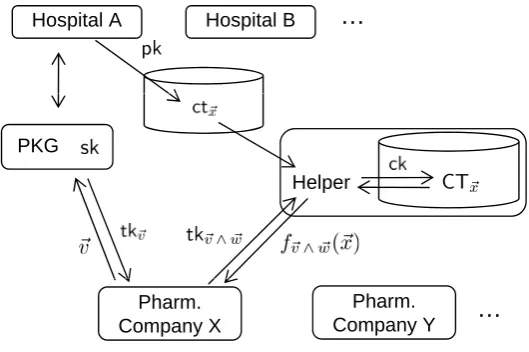
Remark: Our IPE-CC scheme addresses privacy concerns given in the above remote server system, which is illustrated in Figure 1. Every data-provider, e.g., Hospital A, B,.., can put his encrypted data ctx for data xon the shared server, and each data-retriever, e.g., Pharmaceutical Company X, Y,.., obtains his own token tkv associated with a pred-icate category v from PKG. Here, a predicate category indicates an available range for specific predicate searches, e.g., Company X is assigned for accessing patient-data in the south of the U.S., and Y is assigned for accessing patient-data in the north. (The pred-icate category may be empty condition.) The data-retriever delegates the (high-level) token tkv to a specific predicate token tkv∧w, where w indicates some medical predicate, e.g., records for cardiac patients aged 60 and above. (Refer to Section 3.3 for the 2-level hierarchical IPE-CC scheme.) Helper converts original encrypted data ctx to searchable ones,CTx, using conversion key ck(in some extra time). Note that the converted cipher-texts are not made public (while original encrypted data on the database are publicly accessible). In the figure, Company X sends a search query with delegated token tkv∧w, and he obtains search result,fv∧w(x)∈ {0,1}. The basic security (a) protects privacy for both data-providers and data-retrievers from dishonest users, e.g., competing companies. The security condition (b) assures no information leakage to the server administrator (i.e.,
Hospital A Hospital B
…
Helper PKG
Pharm. Company X
Pharm.
Company Y
…
Figure 1: Application to EMR storing and managing system, in which original encrypted data ctx are publicly accessible but converted ciphertexts CTx are not made public. Pharmaceutical Company X retrieves medical data with some medical predicate w as well as a predetermined conditionv.
helper) from ciphertexts on the server. Moreover, since converted ciphertexts are not pub-lic, security (c) assures both predicate-hiding in tokens and attribute-hiding in ciphertexts
against PKG. Since to mitigate the power of PKG is important in PE systems, this se-curity against PKG is useful and interesting. Thus, to summarize, the proposed scheme provides attribute-hiding for ciphertexts as in [20] and predicate-hiding for tokens from any malicious users but the helper. The technique can be applied to unbounded IPE in [21].
3. We propose the first fully secure symmetric-key IPE (SIPE) scheme in the sense of the definition by Shen, Shi and Waters [24] (Section 4). The scheme is (generically) converted from our public key setting IPE-CC by including public key and conversion key into (mas-ter) secret key. The security is also proven under the DLIN assumption in the standard model.
4. We also present a variant of the proposed IPE-CC scheme with the same security that achieves shorter public key and shorter (master) secret key (Section 5). Table 1 in Section 6 compares the proposed IPE-CC scheme (resp. SIPE scheme) with existing attribute-hiding IPE schemes in the public key setting (resp. the existing SIPE scheme).
1.3 Key Techniques
Figure 2: Trapdoor basis setup with conversion key ck for public key pk and (master) secret key sk, in which PK:=B is not directly used (with Enc,TokenGen,Conv,Query)
master key pair. The trapdoor (i.e., conversion key) W transforms the original ciphertexts to searchable ones, which are related to tokens through the dual orthonormal property of (B,B∗). We establish security properties against various level adversaries based on this trapdoor basis setupconstruction.
In a subsequent work [15], we extend our trapdoor basis approach for achieving fully-anonymous functional encryption schemes, where two trapdoor matrices,W1 and W2, are used in re-encryption key generation and re-encrypted ciphertext generation, respectively.
Multi-System Proof Technique: As we observed, our IPE-CC scheme implies the first
fully secure SIPE scheme. Since no previous SIPE schemes are fully secure, we develop a new technique to obtain the scheme, we call multi-system proof technique, which extends the approach given in [20].
Based on Waters’ dual system encryption methodology, in the previous work [20], a large hidden subspace was used for achieving fully-attribute-hiding of IPE, where the subspace was 2n-dimensional for n-dimensional attribute vectors and the two n-dimensional blocks played different roles in the proof. Moreover, to hide a challenge bitbfrom adversary,unbiased cipher-texts with ω0x(0)+ω1x(1) for challengex(0), x(1) ∈Fqn (and ω0, ω1 ←U Fq) played a key role in the security proof.
In this work, for achieving bothfullypredicate- and attribute-hiding security of our schemes, a simulator must deal with two types of challenges (x(0), x(1)) and (v(0), v(1)) simultaneously. Since the above unbiased ciphertext (or token) construction is not enough for this purpose, we use larger, 3n-dimensional, multi-system hidden subspace, and refined game hopping.2 See Appendix A for the details.
1.4 Notations
dimension n, ej denotes the canonical basis vector (
j−1
0· · ·0,1,
n−j
0· · ·0) ∈ Fqn for j = 1, . . . , n. GL(n,Fq) denotes the general linear group of degree noverFq.
2
Definitions
2.1 Dual Pairing Vector Spaces (DPVS)
In this paper, for simplicity of description, we will present the proposed schemes on the sym-metric version of dual pairing vector spaces (DPVS) [17, 16, 18] constructed using symsym-metric bilinear pairing groups given in Definition 1. Owing to the abstraction of DPVS, the presen-tation and the security proof of the proposed schemes are essentially the same as those on the asymmetric version of DPVS, (q,V,V∗,G
T,A,A∗, e), for which see Appendix A.2 in the full
version of [18]. The symmetric version is a specific (self-dual) case of the asymmetric version, whereV=V∗ and A=A∗.
Definition 1 “Symmetric bilinear pairing groups” (q,G,GT, G, e) are a tuple of a prime q, cyclic additive group Gand multiplicative group GT of order q, G= 0∈G, and a polynomial-time computable nondegenerate bilinear pairing e:G×G→GT i.e.,e(sG, tG) =e(G, G)st and
e(G, G)= 1. Let Gbpg be an algorithm that takes input 1λ and outputs a description of bilinear pairing groups (q,G,GT, G, e) with security parameterλ.
Definition 2 “Dual pairing vector spaces (DPVS)”(q,V,GT,A, e) by a direct product of sym-metric pairing groups (q,G,GT, G, e) are a tuple of prime q, N-dimensional vector space V:=
N
G× · · ×G over Fq, cyclic group GT of order q, canonical basis A := (a1, . . . ,aN) of V,
where ai := (
i−1
0, ..,0, G,
N−i
0, ..,0), and pairing e : V× V → GT. The pairing is defined by
e(x,y) := Ni=1e(Gi, Hi) ∈ GT where x := (G1, .., GN) ∈ V and y := (H1, .., HN) ∈ V. This is nondegenerate bilinear i.e., e(sx, ty) =e(x,y)st and if e(x,y) = 1 for all y∈V, then
x = 0. For all i and j, e(ai,aj) = e(G, G)δi,j where δi,j = 1 if i = j, and 0 otherwise, and
e(G, G) = 1∈ GT. DPVS generation algorithm Gdpvs takes input 1λ (λ∈N) and N ∈N, and outputs a description ofparamV:= (q,V,GT,A, e)with security parameterλandN-dimensional
V. It can be constructed by using Gbpg.
2.2 Decisional Linear (DLIN) Assumption
Definition 3 (DLIN: Decisional Linear Assumption [4]) The DLIN problem is to guess
β ∈ {0,1}, given(paramG, G, ξG, κG, δξG, σκG, Yβ)← GR βDLIN(1λ), whereGβDLIN(1λ) :paramG := (q,G,GT, G, e) ← GbpgR (1λ), κ, δ, ξ, σ←U Fq, Y0 := (δ+σ)G, Y1 ←U G,return (paramG, G, ξG, κG, δξG, σκG, Yβ), for β ← {U 0,1}. For a probabilistic machine E, we define the advantage of E for the DLIN problem as: AdvDLINE (λ) :=Pr
E(1λ, )→1←GR 0DLIN(1λ)
−Pr
E(1λ, )→1←R GDLIN
1 (1λ).The DLIN assumption is: For any probabilistic polynomial-time adversary E, the
advantage AdvDLINE (λ) is negligible in λ.
2.3 Inner Product Encryption with Ciphertext Conversion (IPE-CC)
Fn
q \ {0} and a predicate fv is associated with a vector v, where fv(x) = 1 iff v·x= 0. Let
Σ := Fqn\ {0}, i.e., the set of the attributes, and F := {fv|v ∈ Fqn\ {0}} i.e., the set of the predicates.
Definition 4 An inner product encryption with ciphertext conversion (IPE-CC) scheme (for predicatesF and attributesΣ) consists of probabilistic polynomial-time algorithmsSetup,TokenGen,
Enc,Conv andQuery. They are given as follows:
• Setup takes as input security parameter 1λ, and it outputs a public key pk, a conversion key ck, and a (master) secret key sk.
• TokenGen takes as input a public key pk, a (master) secret key sk, and a predicate vector
v. It outputs a corresponding token tkv.
• Enc takes as input a public key pk and an attribute (or plaintext) vector x. It returns an original ciphertext ctx.
• Conv takes as input a public key pk, a conversion key ck, and an original ciphertext ctx. It returns a converted ciphertextCTx.
• Query takes as input a public key pk, a token tkv and a converted ciphertext CTx. It outputs either 0 or 1, indicating the value of the predicate fv evaluated on the underlying attribute x.
Remark 1 In the introduction, we give an application example using a delegation fromtkv to tkv∧w(:=tk(v, w)). While we can add this functionality, the explicit description of the delegation is not included here for simple presentation. Refer to Section 3.3 for the 2-level hierarchical IPE-CC scheme.
An IPE-CC scheme should have the following correctness property: for all (pk,ck,sk) ←R Setup(1λ, n), allfv∈ F and x∈Σ, all tkv ←R TokenGen(pk,sk, v), all original ciphertextsctx ←R Enc(pk, x) and converted ciphertextsCTx ←R Conv(pk,ck,ctx), it holds that 1 =Query(tkv,CTx) iffv(x) = 1. Otherwise, it holds only with negligible probability.
We then define the full security notion of IPE-CC, which consists of three security notions, i.e., security againstmalicious users,malicious helper, andmalicious PKG.
Definition 5 (Full Security of IPE-CC) An IPE-CC scheme isfully secure if for all prob-abilistic polynomial-time adversaries A, all AdvDisUA (λ),AdvDisHA (λ) and AdvDisPKGA (λ) are negli-gible.
[Dishonest-User Game] The model for defining the adaptively predicate-hiding and adaptively attribute-hiding security of IPE-CC against malicious user A is given as follows:
1. The challenger runs Setup to generate keys pk, ck and sk, and pk is given to A. The challenger picks a random bit b.
2. A may adaptively make a polynomial number of queries, where each query is one of two
types:
• On theh-th token query,Aoutputs two predicate vectors,(vh(0), v(1)h ). The challenger responds with tkh←R TokenGen(pk,sk, v(hb)).
A’s queries are subject to the restriction that, for all ciphertext queries (x(0) , x(1) ) and all token queries (vh(0), v(1)h ), fv(0)
h (x
(0)
) =fv(1)h (x(1) ).
3. A outputs a guess b of b.
The success experiment in the above game, i.e., b = b, is denoted by SuccDisUA (λ), and the advantage ofA is defined asAdvDisUA (λ) :=Pr[SuccDisUA (λ) ]−1/2 for any security parameterλ. [Dishonest-Helper Game] The model for defining the adaptively (fully-)attribute-hiding se-curity of IPE-CC against malicious helper A is given as follows:
1. The challenger runs Setup to generate keys pk, ck and sk, and pk andck are given to A. The challenger picks a random bit b.
2. A may adaptively make a polynomial number of queries, where each query is one of two
types:
• On the -th ciphertext query, A outputs two attribute vectors (x(0) , x(1) ). The chal-lenger responds with ct←R Enc(pk, x(b)).
• On the h-th token query,A outputs a predicate vector,vh. The challenger responds with tkh ←R TokenGen(pk,sk, vh).
A’s queries are subject to the restriction that, for all ciphertext queries (x(0) , x(1) ) and all token queriesvh, fvh(x(0)) =fvh(x(1) ).
3. A outputs a guess b of b.
The success experiment in the above game, i.e., b = b, is denoted by SuccDisHA (λ), and the advantage ofA is defined asAdvDisHA (λ) :=Pr[SuccDisHA (λ) ]−1/2 for any security parameterλ. [Dishonest-PKG Game] The model for defining the adaptively attribute-hiding and predicate-hiding security of IPE-CC against malicious-PKG A is given as follows:
1. The challenger runs Setup to generate keys pk, ck and sk, and pk and sk are given to A. The challenger picks a random bit b.
2. A may adaptively make a polynomial number of queries, where each query is one of two
types:
• On the -th ciphertext query, A outputs two attribute vectors (x(0) , x(1) ). The chal-lenger responds with ct←R Enc(pk, x(b)).
• On theh-th token query,Aoutputs two predicate vectors,(vh(0), v(1)h ). The challenger responds with tkh←R TokenGen(pk,sk, v(hb)).
A’s queries are subject to no restrictions.
The success experiment in the above, i.e.,b =b, is denoted bySuccDisPKGA (λ), and the advantage of A is defined as AdvDisPKGA (λ) :=Pr[SuccDisPKGA (λ) ]−1/2 for any security parameter λ.
Since a converted ciphertext is not publicly available, it is not given to the adversary in the above Dishonest-PKG game.
2.4 Symmetric-Key Inner Product Encryption (SIPE)
This section defines symmetric-key inner product encryption (SIPE) and its security.
An attribute (or plaintext) of inner product predicates is expressed as a vectorx∈Fqn\ {0} and a predicatefvis associated with a vectorv, wherefv(x) = 1 iffv·x= 0. Let Σ :=Fqn\{0}, i.e., the set of the attributes, and F:={fv|v∈Fqn\ {0}} i.e., the set of the predicates.
Definition 6 A symmetric-key inner product encryption scheme (SIPE) for predicates F and attributesΣconsists of probabilistic polynomial-time algorithmsSetup,TokenGen,EncandQuery. They are given as follows:
• Setup takes as input security parameter 1λ, and it outputs a secret key sk.
• TokenGentakes as input a secret keysk, and a predicate vectorv. It outputs a correspond-ing token tkv.
• Enc takes as input a secret key sk and an attribute (or plaintext) vector x. It returns a ciphertext ctx.
• Query takes as input a tokentkv and a ciphertext ctx. It outputs either 0 or 1, indicating the value of the predicate fv evaluated on the underlying attribute x.
An SIPE scheme should have the following correctness property: for all sk ←R Setup(1λ, n), all fv ∈ F and x∈ Σ, alltkv ←R TokenGen(sk, v), all ciphertext ctx ←R Enc(sk, x), it holds that 1 =Query(tkv,ctx) if fv(x) = 1. Otherwise, it holds with negligible probability.
We then define the full security notion of SIPE, which is the same as that given by Shen, Shi, and Waters [24].
Definition 7 (Full Security of SIPE) The model for defining the full security of SIP E against adversary A is given as follows:
1. The challenger runs Setup to generate secret key sk, and picks a random bit b.
2. A may adaptively make a polynomial number of queries, where each query is one of two
types:
• On the -th ciphertext query, A outputs two attribute vectors (x(0) , x(1) ). The chal-lenger responds with ct←R Enc(sk, x(b)).
• On theh-th token query,Aoutputs two predicate vectors,(vh(0), v(1)h ). The challenger responds with tkh←R TokenGen(sk, vh(b)).
A’s queries are subject to the restriction that, for all ciphertext queries (x(0) , x(1) ) and all token queries (vh(0), v(1)h ), fv(0)
h (x
(0)
) =fv(1)h (x(1) ).
The success experiment in the above game, i.e.,b=b, is denoted bySuccA(λ), and the advantage of A is defined as AdvSIPEA (λ) :=Pr[SuccA(λ) ]−1/2 for any security parameter λ. An SIPE scheme is fully secure if all probabilistic polynomial-time adversaries Ahave at most negligible advantage in the above game.
3
Proposed (Basic) IPE-CC Scheme
3.1 Construction
We describe random dual orthonormal basis generatorGIPE
ob below, which is used as a subroutine in the proposed IPE-CC and SIPE schemes.
GIPE
ob (1λ, N) : paramV:= (q,V,GT,A, e) R
← Gdpvs(1λ, N), ψ←UFq×, gT :=e(G, G)ψ, X:= (χi,j)←UGL(N,Fq), (ϑi,j) :=ψ·(XT)−1, paramV:= (paramV, gT), bi :=Nj=1χi,jaj,B:= (b1, . . . ,bN), bi∗ :=Nj=1ϑi,jaj,B∗:= (b∗1, . . . ,b∗N), return (paramV,B,B∗).
We refer to Section 1.4 for notations on DPVS. For matrixW := (wi,j)i,j=1,...,N ∈FqN×N and elementg:= (G1, . . . , GN) inN-dimensionalV,gW denotes (iN=1Giwi,1, . . . ,Ni=1Giwi,N) = (Ni=1wi,1Gi, . . . ,Ni=1wi,NGi) by a natural multiplication of aN-dim. row vector and aN×N matrix. Thus it holds an associative law like (gW)W−1 =g(W W−1) =g. The proposed scheme is given as:
Setup(1λ, n) : (paramV,B:= (b1, ..,b6n),B∗:= (b∗1, ..,b∗6n))← GR obIPE(1λ, N := 6n), W U
←GL(N,Fq), di :=biW fori= 1, . . . ,6n, D:= (d1, . . . ,d6n),
D:= (d1, . . . ,dn,d5n+1, . . . ,d6n), B∗ := (b∗1, . . . ,b∗n,b∗4n+1, . . . ,b∗5n), return pk:= (1λ,paramV,D), ck:=W, sk:=B∗.
TokenGen(pk, sk, v∈Fn
q \ {0}) : σ←UFq, η←UFnq, n
3n n n
k∗:= ( σv, 03n, η, 0n )B∗, return tkv:=k∗. Enc(pk, x∈Fn
q \ {0}) : τ ←UFq, ξ←U Fnq, n
3n n n
f := ( τx, 03n, 0n, ξ )D, return ctx :=f. Conv(pk, ck:=W, ctx :=f) : ρ←U Fq, y←Uspand5n+1, . . . ,d6n,
c:= (ρf +y)W−1, return CTx:=c. Query(pk, tkv:=k∗, CTx :=c) :
if e(c,k∗) = 1, output 1, otherwise, output 0.
Remark 2 To realize a delegation from tkv totkv∧w(:=tk(v, w)) given in the introduction, we can construct a natural delegation algorithm in a similar manner to [17, 18, 19, 20]. We give the 2-level hierarchical IPE-CC (HIPE-CC) scheme in Section 3.3.
3.2 Security
The DLIN assumption is standard [18, 19, 20] and given in Definition 3.
Theorem 1 The proposed IPE-CC scheme is fully secure under the DLIN assumption, i.e., for any adversary A, all AdvDisUA (λ), AdvDisHA (λ) and AdvDisPKGA (λ) are negligible under the DLIN assumption.
Proof. The proof of Theorem 1 is reduced to those of Lemmas 1–3.
Lemma 1 For any adversary A, AdvDisUA (λ) is negligible under the DLIN assumption.
Lemma 2 For any adversary A, AdvDisHA (λ) is negligible under the DLIN assumption.
Lemma 3 For any adversary A, AdvDisPKGA (λ) is negligible under the DLIN assumption.
The proofs of Lemmas 1–3 are given in Appendix B.
3.3 Proposed (Basic 2-Level) Hierarchical IPE-CC Scheme
We refer to Section 1.4 for notations on DPVS. For matrix W := (wi,j)i,j=1,...,N ∈FqN×N and element g := (G1, . . . , GN) in N-dimensional V, for notation gW, refer to Section 3.1. The hierarchical IPE-CC (HIPE-CC) below is based on the (basic) construction idea given in [16], however, since the scheme has enough hidden subspace and randomness spaces, the security is proven from the DLIN assumption.
Setup(1λ, (n1, n2) ) : n:=n1+n2,
(paramV,B:= (b1, . . . ,b6n),B∗:= (b∗1, . . . ,b∗6n))← GR obIPE(1λ, N := 6n), W U
←GL(N,Fq), di :=biW fori= 1, . . . ,6n, D:= (d1, . . . ,d6n),
D:= (d1, . . . ,dn,d5n+1, . . . ,d6n), B∗ := (b∗1, . . . ,b∗n,b∗4n+1, . . . ,b∗5n), return pk:= (1λ,paramV,D), ck:=W, sk:=B∗.
TokenGen(pk, sk, v1∈Fn1
q \ {0}) : σ, ψ←U Fq, η0, η1, . . . , ηn2
U ←Fnq,
n
3n n n
k∗0 := ( σv1, 0n2, 03n, η0, 0n )B∗,
k∗i := ( σv1, ψei, 03n, ηi, 0n )B∗ for i= 1, . . . , n2, whereei:= ( 0i−1, 1, 0n2−i ),
return tkv1 := ( k0∗, k1∗, . . . ,k∗n2 ). Enc(pk, x1∈Fn1
q \ {0}, x2∈Fqn2) : τ1, τ2 ←U Fq, ξ←U Fnq,
if x2 =0, x2 ←UFn2
q , elsex2 :=x2,
n
3n n n
f := ( τ1x1, τ2x2, 03n, 0n, ξ )D, return ctx :=f. Conv(pk, ck:=W, ctx :=f) : ρ←U Fq, y←Uspand5n+1, . . . ,d6n,
c:= (ρf +y)W−1, return CTx:=c. Query(pk, tk:=tkv1 ortk(v1,v2), CTx :=c) :
if tk=tkv1 = (k0∗, k1∗, . . . ,k∗n2 ),
if e(c,k∗0) = 1, output 1, otherwise, output 0.
Delegate(pk, tkv1 := ( k∗0, k∗1, . . . ,kn∗2 ), v2:= (v2,1, . . . , v2,n2)∈Fn2
q \ {0}) :
ξ, δ ←U Fq, η := (η1, . . . , ηn)←U Fnq,
k∗ :=ξk0∗+δ(ni=12 v2,iki∗) +ni=1ηib∗4n+i, return tk(v1,v2)(=tkv1∧v2) :=k∗.
The full security notion of IPE-CC is extended to that for (2-level) HIPE-CC schemes in a usual way.
Theorem 2 The proposed (2-level) HIPE-CC scheme is fully secure under the DLIN assump-tion.
Theorem 2 is proven in a similar manner to Theorem 1.
Remark:
1. While we present a 2-level HIPE-CC scheme here, clearly, the construction can be extended to an arbitrary level HIPE-CC scheme.
2. While the above basic HIPE-CC scheme is built based on [16], if we apply several tech-niques given in [18, 19], efficiency of the HIPE scheme is greatly improved.
4
Proposed SIPE Scheme (Conversion from IPE-CC to SIPE)
The definitions of symmetric-key IPE (SIPE) and full security of SIPE are given in Section 2.4. From the above IPE-CC scheme, we obtain the first fully secure SIPE scheme. Namely, using the IPE-CC scheme, ΠIPE-CC:= (Setup,TokenGen,Enc,Conv,Query), a modified setup algorithm Setup(1λ, n) outputs a (master) secret keysk := (pk,ck,sk), where (pk,ck,sk)←R Setup(1λ, n), and a modified encryption algorithmEnc(sk, x) outputs a ciphertextCTx ←R Conv(pk,ck,ctx), wherectx ←R Enc(pk, x), and the rest of algorithms,TokenGenandQuery are the same as those of the IPE-CC scheme since an input sk of TokenGen includes (pk,sk). Hence, we obtain a (converted) SIPE, ΠSIPE := (Setup,TokenGen,Enc,Query).
Theorem 3 The proposed SIPE scheme is fully secure under the DLIN assumption.
Proof. By the construction, the full security for SIPE ΠSIPE is reduced from the Dishonest-User Game security for IPE-CC ΠIPE-CC, i.e., for any adversary A, we can constructA from A s.t. AdvSIPEA (λ) for ΠSIPE in Def. 7 is less than or equal to AdvDisUA (λ) for ΠIPE-CC in Def. 5. Hence,
Lemma 1 implies Theorem 3.
5
A Variant for Achieving Shorter Public and Secret Keys
5.1 Construction and Security
LetN := 6nand
H(n,Fq) := ⎧ ⎪ ⎪ ⎪ ⎪ ⎪ ⎨ ⎪ ⎪ ⎪ ⎪ ⎪ ⎩ ⎛ ⎜ ⎜ ⎜ ⎜ ⎜ ⎝ μ
1 μ2 . . . μn−1 μ μ μ
2 . .. ...
μ μ
n−1 μ n ⎞ ⎟ ⎟ ⎟ ⎟ ⎟ ⎠ μ, μ
2, . . . , μn,
μ
1, . . . , μn−1, μ∈Fq,
a blank element in the matrix denotes 0∈Fq
⎫ ⎪ ⎪ ⎪ ⎪ ⎪ ⎬ ⎪ ⎪ ⎪ ⎪ ⎪ ⎭ ,
L(6, n,Fq) :=
⎧ ⎪ ⎨ ⎪ ⎩X:=
⎛ ⎜ ⎝
X1,1 · · · X1,6 ..
. ...
X6,1 · · · X6,6
⎞ ⎟ ⎠
Xi,j ∈ H(n,Fq) fori, j= 1, . . . ,6
⎫ ⎪ ⎬ ⎪ ⎭
GL(N,Fq).
We note thatL(6, n,Fq) is a subgroup ofGL(N,Fq) (Lemma 4). ForX∈ L(6, n,Fq), we denote (ψ-times) its adjoint matrix (X−1)T as a sparse form
(X−1)T:=
⎛ ⎜ ⎝
Y1,1 · · · Y1,6 ..
. ... Y6,1 · · · Y6,6
⎞ ⎟
⎠, whereYi,j :=
⎛ ⎜ ⎜ ⎜ ⎜ ⎜ ⎝ ϑ i,j,1 ϑ
i,j,2 ϑi,j
..
. . ..
ϑ
i,j,n−1 ϑi,j
ϑ
i,j ϑi,j,2 . . . ϑi,j,n ⎞ ⎟ ⎟ ⎟ ⎟ ⎟ ⎠
for i, j = 1, . . . ,6. Here, a blank element in the above matrix denotes 0 ∈ Fq. That is, X ∈ L(6, n,Fq) is represented by 72nnon-zero entries{μi,j, μi,j,2, . . . , μi,j,n, μi,j,1, . . . , μi,j,n−1, μi,j}i,j=1,...6, andψ(X−1)Tis represented by 72nnon-zero entries{ϑi,j, ϑi,j,2, . . . , ϑi,j,n, ϑi,j,1, . . . , ϑi,j,n−1, ϑi,j}i,j=1,...6.
Random dual orthonormal basis generator GobZIPE,SK withsparsematrices below is used as a subroutine in the proposed variants of IPE-CC and SIPE schemes.
GZIPE,SK
ob (1λ,6, n) : paramG := (q,G,GT, G, e) R
← Gbpg(1λ), N := 6n, ψ U
←Fq×, gT :=e(G, G)ψ, paramV:= (q,V,GT,A, e) :=Gdpvs(1λ, N,paramG),
paramV:= (paramV, gT), X ← LU (6, n,Fq), hereafter,{μi,j, μ
i,j,2, .., μi,j,n, μi,j,1, .., μi,j,n −1, μi,j}i,j=1,...6 denotes
non-zero entries of X, and {ϑi,j, ϑi,j,2, .., ϑi,j,n, ϑi,j, 1, .., ϑi,j,n−1, ϑi,j}i,j=1,...6 denotes non-zero entries of ψ(X−1)T,
{Bi,j :=μi,jG, Bi,j, 2 :=μi,j,2G, . . . , Bi,j,n :=μi,j,nG,
Bi,j, 1:=μi,j,1G, . . . , Bi,j,n −1 :=μi,j,n −1G, Bi,j :=μi,jG}i,j=1,...6, {Bi,j∗ :=ϑi,jG, B∗i,j,2 :=ϑi,j,2G, . . . , Bi,j,n∗ :=ϑi,j,nG,
B∗
i,j,1:=ϑi,j,1G, . . . , Bi,j,n∗ −1 :=ϑi,j,n−1G, Bi,j∗:=ϑi,jG}i,j=1,...6, return (paramV,{Bi,j, Bi,j, 2, . . . , Bi,j,n , Bi,j, 1, . . . , Bi,j,n −1, Bi,j}i,j=1,...6,
{Bi,j∗ , B∗i,j,2, . . . , Bi,j,n∗ , B∗i,j,1, . . . , Bi,j,n∗ −1, Bi,j∗}i,j=1,...6).
Remark 3 Let
⎛ ⎜ ⎝
b(i−1)n+1 .. . bin ⎞ ⎟ ⎠:= ⎛ ⎜ ⎜ ⎜ ⎝ B
i,1,1 Bi,1,2 . . . Bi,1 Bi,1 B
i,1,2 . .. ...
B
i,1,n
· · · B
i,6,1 Bi,6,2 . . . Bi,6 Bi,6 B
i,6,2 . .. ...
B
i,6,n ⎞ ⎟ ⎟ ⎟
⎛ ⎜ ⎜ ⎝
b∗(i−1)n+1 .. .
b∗in
⎞ ⎟ ⎟ ⎠:= ⎛ ⎜ ⎜ ⎜ ⎜ ⎝ B∗
i,1,1 B∗
i,1,2 Bi,∗1 ..
. . ..
B∗
i,1 Bi,∗1,2 . . . Bi,∗1,n
· · · B∗
i,6,1 B∗
i,6,2 B∗i,6 ..
. . ..
B∗
i,6 B∗i,6,2 . . . Bi,∗6,n ⎞ ⎟ ⎟ ⎟ ⎟ ⎠
for i = 1, . . . ,6, and B := (b1, . . . ,b6n),B∗ := (b∗1, . . . ,b∗6n), where a blank element in the matrices denotes 0 ∈ G. (B,B∗) are the dual orthonormal bases, i.e., e(bi,b∗i) = gT and e(bi,b∗j) = 1 for 1≤i=j≤6n.
Here, we assume that input vectors,x:= (x1, . . . , xn) andv:= (v1, . . . , vn), satisfies x1 = 0 and vn= 0. The proposed scheme is given as:
Setup(1λ, n) :
(paramV,{Bi,j, Bi,j,2, . . . , Bi,j,n , Bi,j, 1, . . . , Bi,j,n −1, Bi,j}i,j=1,...6,
{Bi,j∗ , Bi,j,∗ 2, . . . , B∗i,j,n, Bi,j,∗1, . . . , B∗i,j,n−1, Bi,j∗}i,j=1,...6)← GR ZIPEob ,SK(1λ,6, n),
W U
← L(6, n,Fq), ⎛ ⎜ ⎝ d1 .. . d6n
⎞ ⎟ ⎠:= ⎛ ⎜ ⎝ b1 .. . b6n
⎞ ⎟ ⎠·W,
where (bi)i=1,...,6nis given in Eq.(1), and (di)i=1,...,6n is represented as in Eq.(1) using
{Di,j, Di,j,2, . . . , Di,j,n, Di,j,1, . . . , Di,j,n −1, Di,j}i,j=1,...6,
returnpk:= (1λ,paramV,{Di,j, Di,j,2, .., Di,j,n, Di,j, 1, .., Di,j,n −1, Di,j}i=1,6;j=1,..,6), ck:=W, sk:={Bi,j∗ , B∗i,j,2, .., Bi,j,n∗ , Bi,j,∗1, .., B∗i,j,n−1, Bi,j∗}i=1,5;j=1,..,6.
TokenGen(pk, sk, v) : σ, η1, . . . , ηn←UFq,
forj= 1, ..,6, Kj,∗1 :=ln=1−1(σvlB1∗,j,l+ηlB5∗,j,l) +σvnB∗1,j +ηnB5∗,j, K∗
j,l :=σ(vlB1∗,j+vnB1∗,j,l) +ηlB5∗,j+ηnB5∗,j,l forl= 2, . . . , n−1,
K∗
j,n :=σvnB1∗,j,n+ηnB5∗,j,n,
k∗:= (K1∗,1, . . . , K1∗,n, . . . , K6∗,1, . . . , K6∗,n)∈G6n, return tkv:=k∗. Enc(pk, x) : ω, ϕ1, . . . , ϕn U
←Fq,
forj= 1, ..,6, Fj,1:=ωx1D1,j,1+ϕ1D6,j,1,
Fj,l :=ω(x1D1,j,l+xlD1,j) +ϕ1D6,j,l+ϕlD6,j forl= 2, . . . , n−1, Fj,n :=ωx1D1,j+ϕ1D6,j+nl=2(ωxlD1,j,l+ϕlD6,j,l),
f := (F1,1, . . . , F1,n, . . . , F6,1, . . . , F6,n)∈G6n, return ctx:=f. Conv(pk, ck:=W, ctx :=f) : ρ←UFq, y←Uspand5n+1, . . . ,d6n,
c:= (ρf +y)W−1, return CTx :=c. Query(pk, tkv :=k∗, CTx :=c) :
if e(c,k∗) = 1, return 1, otherwise, return 0.
Remark 4 A part of output ofSetup(1λ, n),{Di,j, Di,j, 2, . . . , Di,j,n, Di,j, 1, . . . , Di,j,n−1, Di,j}i=1,6;j=1,...6, can be identified with D := (d1, . . . ,dn,d5n+1, . . . , d6n), whileD := (d1, . . . ,d6n) is identified
with{Di,j, Di,j, 2, . . . , Di,j,n, Di,j,1, . . . , Di,j,n −1, Di,j}i,j=1,...6 as in Remark 3. Also, {Bi,j∗ , Bi,j,∗2, . . . , B∗
i,j,n, Bi,j,∗1, . . . , B∗i,j,n−1, Bi,j∗}i=1,5;j=1,...6 can be identified with B∗ := (b∗1, . . . ,b∗n,b∗4n+1, . . . ,b∗5n), while B∗ := (b∗1, . . . ,b∗6n) is identified with {Bi,j∗ , Bi,j,∗ 2, . . . , B∗i,j,n, Bi,j,∗1, . . . , Bi,j,n∗ −1, B∗
Table 1: Comparison with pairing-based IPE schemes in [14, 20, 24], where |G|represents size of an element of G. PH, AH, PK, SK, TK, CT, GSD, and C3DH stand for predicate-hiding, attribute-hiding, public key, secret key, token, ciphertext, general subgroup decision [1], and composite 3-party (decisional) Diffie-Hellman [24], respectively.
KSW08 OT12 IPE [20] Proposed IPE-CC SSW09 Proposed SIPE IPE [14] (basic) (variant) (basic) (variant) SIPE [24] (basic) (variant)
Setting public key public key public key secret key secret key
Security selective & fully-AH
adaptive & fully-AH
adaptive & fully-secure (PH & AH)
selective & single-chal. PH & AH
adaptive & fully-secure (PH & AH) Order
of G composite prime prime composite prime
Assump. 2 variants
of GSD DLIN DLIN
A variant of GSD, C3DH,DLIN
DLIN
PK size O(n)|G| O(n2)|G| O(n)|G|O(n2)|G|O(n)|G| – – – SK size O(n)|G| O(n2)|G| O(n)|G|O(n2)|G|O(n)|G| O(n)|G| O(n2)|G|O(n)|G| TK size (2n+1)|G|(4n+1)|G| 10|G| 6n|G| (2n+ 2)|G| 6n|G| CT size (2n+1)|G|(4n+1)|G| 5n|G| 6n|G| (2n+ 2)|G| 6n|G|
c= (
n
ωx, 3n
03n,
n
0n,
n
ϕ )B, k∗ = (
n
σv, 3n
03n,
n
η,
n
0n )B∗,whereϕ := (ϕ1, . . . , ϕn), η := (η1, . . . , ηn)∈Fnq.
Theorem 4 The proposed IPE-CC scheme (with short public and secret keys) is fully secure under the DLIN assumption.
Theorem 4 is proven in a similar manner to Theorem 3 (and 4) in [19]. For achieving dual system encryption proof for IPE-CC with employing a sparse matrix,X← LU (6, n,Fq), for base change, the matrix set L(6, n,Fq) should form a (matrix) group. (For the reason, refer to [19].) Therefore, proofs of Theorem 1 and Theorem 4 have the same high-level structure using the full matrix groupGL(6n,Fq) and a subgroupL(6, n,Fq) based on Lemma 4, respectively.
Lemma 4 L(6, n,Fq) is a subgroup of GL(6n,Fq).
Lemma 4 is proven in a similar manner to Lemma 2 in the full version of [19].
6
Efficiency Comparisons
Table 1 compares the proposed IPE-CC schemes in Sections 3 and 5 with pairing-based attribute-hiding IPE schemes in [14, 20], and compares the proposed SIPE schemes in Sections 4 (and 5) with pairing-based predicate- and attribute-hiding SIPE scheme in [24].
References
[1] Mihir Bellare, Brent Waters, and Scott Yilek. Identity-based encryption secure against selective opening attack. In Ishai [13], pages 235–252.
[2] Dan Boneh and Xavier Boyen. Efficient selective-ID secure identity-based encryption with-out random oracles. In Christian Cachin and Jan Camenisch, editors,EUROCRYPT 2004, volume 3027 ofLNCS, pages 223–238. Springer, 2004.
[3] Dan Boneh and Xavier Boyen. Secure identity based encryption without random oracles. In Franklin [12], pages 443–459.
[4] Dan Boneh, Xavier Boyen, and Hovav Shacham. Short group signatures. In Franklin [12], pages 41–55.
[5] Dan Boneh and Matthew K. Franklin. Identity-based encryption from the Weil pairing. In Joe Kilian, editor,CRYPTO 2001, volume 2139 ofLNCS, pages 213–229. Springer, 2001.
[6] Dan Boneh, Eyal Kushilevitz, Rafail Ostrovsky, and William E. Skeith III. Public key encryption that allows PIR queries. In Alfred Menezes, editor,CRYPTO, volume 4622 of
Lecture Notes in Computer Science, pages 50–67. Springer, 2007.
[7] Dan Boneh, Ananth Raghunathan, and Gil Segev. Function-private identity-based encryp-tion: Hiding the function in functional encryption. In Ran Canetti and Juan A. Garay, editors,CRYPTO (2), volume 8043 ofLNCS, pages 461–478. Springer, 2013.
[8] Dan Boneh, Ananth Raghunathan, and Gil Segev. Function-private subspace-membership encryption and its applications. IACR Cryptology ePrint Archive, 2013:403, 2013.
[9] Dan Boneh, Amit Sahai, and Brent Waters. Functional encryption: Definitions and chal-lenges. In Ishai [13], pages 253–273.
[10] Dan Boneh and Brent Waters. Conjunctive, subset, and range queries on encrypted data. In Salil P. Vadhan, editor, TCC 2007, volume 4392 of LNCS, pages 535–554. Springer, 2007.
[11] Clifford Cocks. An identity based encryption scheme based on quadratic residues. In Bahram Honary, editor, IMA Int. Conf. 2001, volume 2260 of LNCS, pages 360–363. Springer, 2001.
[12] Matthew K. Franklin, editor. Advances in Cryptology - CRYPTO 2004, 24th Annual International CryptologyConference, Santa Barbara, California, USA, August 15-19, 2004, Proceedings, volume 3152 ofLNCS. Springer, 2004.
[13] Yuval Ishai, editor. Theory of Cryptography - 8th Theory of Cryptography Conference,
TCC 2011, Providence, RI, USA, March 28-30, 2011. Proceedings, volume 6597 ofLNCS.
Springer, 2011.
[14] Jonathan Katz, Amit Sahai, and Brent Waters. Predicate encryption supporting disjunc-tions, polynomial equadisjunc-tions, and inner products. In Nigel P. Smart, editor,EUROCRYPT 2008, volume 4965 ofLNCS, pages 146–162. Springer, 2008.
[15] Yutaka Kawai and Katsuyuki Takashima. Fully-anonymous functional proxy-re-encryption.
[16] Allison B. Lewko, Tatsuaki Okamoto, Amit Sahai, Katsuyuki Takashima, and Brent Waters. Fully secure functional encryption: Attribute-based encryption and (hierar-chical) inner product encryption. In Henri Gilbert, editor, EUROCRYPT 2010, vol-ume 6110 of LNCS, pages 62–91. Springer, 2010. Full version is available at http:
//eprint.iacr.org/2010/110.
[17] Tatsuaki Okamoto and Katsuyuki Takashima. Hierarchical predicate encryption for inner-products. In Mitsuru Matsui, editor, ASIACRYPT 2009, volume 5912 of LNCS, pages 214–231. Springer, 2009.
[18] Tatsuaki Okamoto and Katsuyuki Takashima. Fully secure functional encryption with general relations from the decisional linear assumption. In Tal Rabin, editor, CRYPTO 2010, volume 6223 of LNCS, pages 191–208. Springer, 2010. Full version is available at
http://eprint.iacr.org/2010/563.
[19] Tatsuaki Okamoto and Katsuyuki Takashima. Achieving short ciphertexts or short secret-keys for adaptively secure general inner-product encryption. In Dongdai Lin, Gene Tsudik, and Xiaoyun Wang, editors,CANS 2011, volume 7092 ofLNCS, pages 138–159. Springer, 2011. Full version is available at http://eprint.iacr.org/2011/648.
[20] Tatsuaki Okamoto and Katsuyuki Takashima. Adaptively attribute-hiding (hierarchical) inner product encryption. In David Pointcheval and Thomas Johansson, editors,Eurocrypt 2012, volume 7237 of LNCS, pages 591–608. Springer, 2012. Full version is available at
http://eprint.iacr.org/2011/543.
[21] Tatsuaki Okamoto and Katsuyuki Takashima. Fully secure unbounded inner-product and attribute-based encryption. In Xiaoyun Wang and Kazue Sako, editors, ASIACRYPT, volume 7658 of LNCS, pages 349–366. Springer, 2012. Full version is available at http:
//eprint.iacr.org/2012/671.
[22] Tatsuaki Okamoto and Katsuyuki Takashima. Efficient (hierarchical) inner-product en-cryption tightly reduced from the decisional linear assumption. IEICE Transactions, 96-A(1):42–52, 2013.
[23] Jong Hwan Park. Inner-product encryption under standard assumptions. Des. Codes Cryptography, 58(3):235–257, 2011.
[24] Emily Shen, Elaine Shi, and Brent Waters. Predicate privacy in encryption systems. In Omer Reingold, editor,TCC 2009, volume 5444 ofLNCS, pages 457–473. Springer, 2009.
[25] Elaine Shi, John Bethencourt, Hubert T.-H. Chan, Dawn Xiaodong Song, and Adrian Per-rig. Multi-dimensional range query over encrypted data. InIEEE Symposium on Security and Privacy, pages 350–364. IEEE Computer Society, 2007.
[26] Masayuki Yoshino, Noboru Kunihiro, Ken Naganuma, and Hisayoshi Sato. Symmetric inner-product predicate encryption based on three groups. In Tsuyoshi Takagi, Guilin Wang, Zhiguang Qin, Shaoquan Jiang, and Yong Yu, editors, ProvSec, volume 7496 of
Game 0 Game 0-4= Game 1-1 … Game 1-4 … 0
~
~
Game -1 Game -2-1-2 Game -2-1-3 Game -2-1 4Game -2
Game -3 Game Game -2-1-1 1-1 1-4 Game -4
~
~
1-2 1-3 1-4Game -2-v2-2 Game -2-v2-3 Game -2-v2-4
~
~
~
~
=~
~
~
~
… … … = 1 1 Game -2-v2-1 … = =~
~
=P2 in [16] P3 in [16] P1 and P2 in [16] P1 in [16]
DLIN … Game
v1-1 … Game
v1-4
Figure 3: Structure of Reductions in the proof of Lemma 2
A
Multi-System Proof Technique
A.1 Structural Comparison of our IPE-CC Scheme with the IPE in [20]
Since our security proofs (in particular, for Lemma 1) are extensions of the proof given in [20], we begin to compare our predicate-hiding IPE-CC with the existing attribute-hiding (not predicate-hiding) IPE [20].
Okamoto-Takashima [20] gave an attribute-hiding IPE scheme on DPVS framework. Cipher-texts (CT) and (secret-key) token (TK) of the scheme have dimension 4n+2 = 1+n+2n+n+1, where the first one dimension is for encryption of plaintext (not attribute), the second is the real-encoding part (real part, for short) for CT and TK vectors, the third is the hidden part for achieving various forms of CT and TK, the fourth is the TK randomness part, and the fifth is the CT randomness part. Here, because we do not treat a plaintext other than attribute, CT and TK of the scheme are considered as composed of four parts, as indicated below, where the dimension structure is given by 4n+ 1 =n+ 2n+n+ 1. CT and TK of our IPE-CC have the same form, but dimension of each part is different, with 6n=n+ 3n+n+n inner-structure. Particularly, 3ndimensional hidden part is crucial for our elaborated security proof of Lemma 1, where three blocks of n dimensional subspaces have different roles in the proof. We call it themulti-system proof technique, and the details are explained in Appendix A.2.
n
2n n 1
CT & TK in [20] IPE : ( real hidden TK ran. CT ran. ),
n
3n n n
CT & TK in our IPE-CC : ( real hidden TK ran. CT ran. ).
A.2 Intuitions for Proofs of Lemmas 1–3
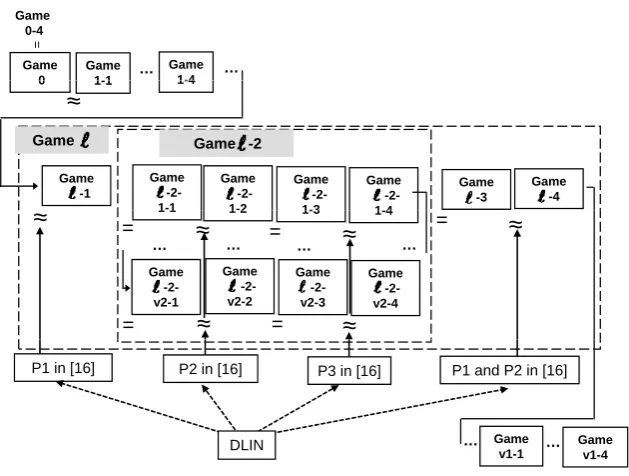
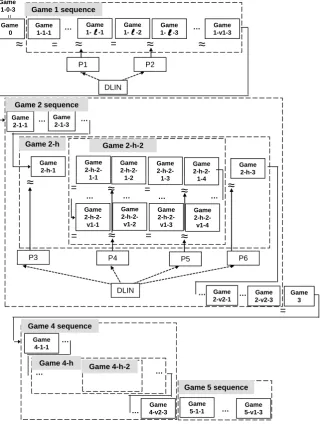
the security definition (for the malicious helper) are the equivalent to those given in [20] for fully-attribute-hiding of IPE, except that multiple ciphertext challenges are considered in this paper, while single challenge is treated in [20]. Therefore, we can take a standard hybrid argument to achieve multiple challenge security from single challenge security, which is described in Figure 3. (In the figure, P1, P2, P3 stand for Problem 1, 2, 3, respectively.) Let ν1 be the maximum number ofA’s challenge ciphertext queries andν2 the maximum number ofA’s challenge token queries. The reduction starts Game 0, and repeat Game sequences for = 1, . . . , ν1, where each sequence transform the-th queried ciphertext to an unbiased one forb∈ {0,1}. The-th sequence consists of four parts, Game -1, Game-2 sequence, Game -3, Game-4, where the main -2 sequence has another loop structure parametrized by h = 1, . . . , ν2. The Game -2 sequence repeats four Games, Game -2-h-1,. . ., Game -2-h-4, for h = 1, . . . , ν2. In the last -2-ν2-4 in the sequence, coefficients of the 2n-dimensional hidden part, i.e.,spandn+1, . . . ,d3n (resp.spanb∗n+1, . . . ,b∗3n) of theι-th queriedfι forι= 1, . . . , ν1 (resp. thej-th queried kj∗ for j= 1, . . . , ν2) w.r.t. these bases vectors are given as:
Coefficients of the hidden part offι in Game -2-ν2-4
Coefficients of the hidden part ofk∗j in Game -2-ν2-4
ι= 1 .. .
x(∗) x(∗) ..
. ν1
j= 1 σ1v1 ..
. ...
h .. .
ν2 σ
ν2vν2
wherex(∗):=τ,0x(0) +τ,1x(1) , x(∗):=τ,0x(0) +τ,1x(1) (unbiased form). In the second block of the hidden part, an unbiased vector x(∗) for the -th query (and zero for the rest of the ι(=)-th queries) in ciphertexts and (normal)v-vectors,σ1v1, . . . , σν2vν2, in tokens are placed. Therefore, the unbiased coefficientx(∗) is reflected to the real encoding part since the addition ofb-biasedτx(b)and unbiasedθx(∗)(θ←U Fq) is also unbiased, i.e., transformsf to an unbiased one. See [20] for the details.
Next, we consider the proof of Lemma 1, where malicious user has no secret keys, sk nor W, but he can ask two types of challenges, (x(0) , x(1) ) for = 1, . . . , ν1 and (vh(0), v(1)h ) for h = 1, . . . , ν2. The condition on the challenges is given byf
vh(0)(x(0) ) = fvh(1)(x(1) ). In general,
an unbiased form x(∗) := ω0x(0) +ω1x(1) does not preserve the value of the predicate, e.g., neither f
v(0)h (x(∗)) norfvh(1)(x(∗)) is determined from the value of fvh(0)(x(0)) =fvh(1)(x(1) ). Since

![Table 1: Comparison with pairing-based IPE schemes in [14, 20, 24], where |G| represents sizeof an element of G](https://thumb-us.123doks.com/thumbv2/123dok_us/7897968.1310958/16.595.81.518.143.359/table-comparison-pairing-based-schemes-represents-sizeof-element.webp)