A Note on the New Fibonacci Hyperbolic Tangent Activation Function
Nikolay Kyurkchiev and Anton Iliev
Faculty of Mathematics and Informatics, University of Plovdiv Paisii Hilendarski, 24, Tzar Asen Str., 4000 Plovdiv, Bulgaria, e-mails: nkyurk@ uni-plovdiv.bg, [email protected]
Abstract
In this note we construct a family of parametric Fibonacci hyperbolic tangent activation function (FHTAF).
We prove upper and lower estimates for the Hausdorff approximation of the sign function by means of this family. Numerical examples, illustrating our results are given.
Keywords: Fibonacci hyperbolic tangent activation function (FHTAF), Sign function, Hausdorff distance, Upper and lower bounds.
1. Introduction
Sigmoidal functions (also known as “activation functions”) find multiple applications to neural networks [4]–[14].
We study the distance between the sign function and a special class of activation functions, so-called parametric Fibonacci hyperbolic tangent activation function (FHTAF). The distance is measured in Hausdorff sense, which is natural in a situation when a sign function is involved. Precise upper and lower bounds for the Hausdorff distance are reported.
Any neural net element computes a linear combination of its input signals, and uses a logistic function to produce the result; often called “activation” function [15]– [16].
2. Preliminaries
The following are common examples of activation functions:
a) logistic
1
1
( ) =
;
1
tt
e
ϕ
−+
(1)b) Parametric Hyperbolic Tangent Activation (PHTA) function
2
2
( ) =
= 1
,
,
1;
t t t
t t t t
e
e
e
t
t
e
e
e
e
β β β
β β β β
ϕ
β
− −
− −
−
−
∈
+
+
≥
R
(2)
c) Parametric Half Hyperbolic Tangent Activation (PHHTA) function
3
1
( ) =
,
,
1.
1
t t
e
t
t
e
β βϕ
−
−−∈
β
≥
+
R
(3)In [17] the authors create the binary logistic regression model as to find the optimal vector
0 1
= [
,
,
,
n]
β
β β
β
that best fits0 1 1 2 2
1,
> 0
=
0,
otherwise
n n
x
x
x
y
β
+
β
+
β
+ +
β
+
ε
here
ε
represents the error.Evidently, in (1) t can be regarded as a variable, which is a linear weighted combination of independent variable
x
= [ ,
x
1
,
x
n]
as0 1 1 2 2 n n
.
t
←
β
+
β
x
+
β
x
+ +
β
x
Thus, the binary logistic model is [?]:( 0 1 1 2 2 )
1
( ) =
1
t x x n nxF x
e
− β +β +β + +β+
(4)where
F x
( )
represents the probability of dependent variabley
= 1
.
Fig. 1. Nonlinear, parametrized function with restricted output range [1].
Training a multilayer perceptron with algorithms employing global search strategies has been an important research direction in the field of neural networks.
used both in regression problems.
The standard feed forward networks with only a single hidden layer can approximate any continuous function uniformly on any compact set and any measurable function to any desired degree of accuracy [18]–[21].
The nonlinear, parametrized function with restricted output range is visualized on Fig.1.
It is straightforward to extend this analysis to networks with multiple hidden layers.
For recurrent neural networks are typical:
a) stable outputs may be more difficult to evaluate;
b) unexpected behavior (chaos, oscillation).
A survey of neural transfer activation functions can be found in [22].
Moreover, the nodes in the hidden layer are supposed to have a sigmoidal activation function which may be one of the following:
a) logistic sigmoid
1
1
(
) =
;
1
netnet
e
βϕ
−+
(5)
b) hyperbolic tangent
2
(
) =
net net
net net
e
e
net
e
e
β β
β β
ϕ
−
−−+
(6)c) half hyperbolic tangent
3
1
(
) =
1
net net
e
net
e
β βϕ
−
−−+
(7)where
net
denotes the input to a node andβ
is the slope parameter of the sigmoids.Definition 1 The sign function of a real number
t
is defined as follows:1,
if
< 0,
( ) = 0,
if
= 0,
1,
if
> 0.
t
sgn t
t
t
−
(8)
Definition 2 [23], [24] The Hausdorff distance (the H–distance) [23]
ρ
( , )
f g
between two intervalfunctions
f g
,
onΩ ⊆
R
, is the distance between their completed graphsF f
( )
andF g
( )
considered as closed subsets ofΩ×
R
. More precisely,( ) ( )
( ) ( )
( , ) = max{
sup inf
||
||,
||
||},
sup inf
B F g A F f
A F f B F g
f g
A B
A B
ρ
∈ ∈
∈ ∈
−
−
(9)wherein
|| . ||
is any norm inR
2, e. g. the maximum norm|| ( , ) ||= max{| |,| |}
t x
t
x
; hence the distance between the pointsA
= ( ,
t
Ax
A)
,B
= ( ,
t
Bx
B)
inR
2 is||
A B
−
||=
max t
(|
A−
t
B|,|
x
A−
x
B|)
.In [25]–[30] the authors consider some families of recurrence generated parametric activation functions on the base of (5)–(7).
The Fibonacci hyperbolic tangent function is defined by [3]:
1 1
( )
2 2
( )
( ) =
=
,
( )
t t
t t
sFh x
tFh t
cFh x
− + − +
Ψ − Ψ
Ψ
+ Ψ
(10)
where
= 1
=
3
5
2.61
2
φ
+
Ψ
+
≈
andφ
is the”Golden Section”.
A survey of new mathematical models of Nature is presented based on the Golden Section and using a class of hyperbolic Fibonacci and Lucas functions in [2].
3. Main Results
We define the following
d) Parametric Fibonacci hyperbolic tangent activation function (FHTAF)
4
( ) =
,
,
1
t t
t t
t
t
β β
β β
ϕ
Ψ − Ψ
−−∈
β
≥
Ψ + Ψ
R
(11)or
4
(
) =
net net
net net
net
β β
β β
ϕ
Ψ
− Ψ
−−Ψ
+ Ψ
(12)where
net
denotes the input to a node andβ
is the slope parameter of the sigmoid.means of
ϕ
4( )
t
.3.1 Approximation issues
The
H
-distanced sgn t
(
( ),
ϕ
4( ))
t
between the sgn function and the functionϕ
4 satisfies the relation:4
( ) =
= 1
.
d d
d d
d
d
β β
β β
ϕ
Ψ − Ψ
−−−
Ψ + Ψ
(13)The following Theorem gives upper and lower bounds for
d
0Theorem 3.1. For the Hausdorff distance
d
between the sgn function and the functionϕ
4 the followinginequalities hold for
2
2(1
)
>
1.7853
1
ln
e
β
−
≈
Ψ
:
2
2 2
1
ln 1
ln
1
2
=
<
<
=
.
1
1
1
ln
1
ln
2
2
l r
d
d
d
β
β
β
−
Ψ
−
−
Ψ
Ψ
(14)
Proof. We define the functions
( ) =
1
d d
d d
F d
d
β β
β β
− −
Ψ − Ψ
− +
Ψ + Ψ
(15)
2
1
( ) = 1
1
ln
.
2
G d
− + −
β
d
Ψ
(16)From Taylor expansion we find
2 0
( )
( ) =
(
).
F d
−
G d
O d
In addition
G d
′
( ) > 0
and for2
2(1
)
>
1
ln
e
β
−
Ψ
( ) = 0;
l(
r) > 0.
G d
G d
This completes the proof of the inequalities (13).
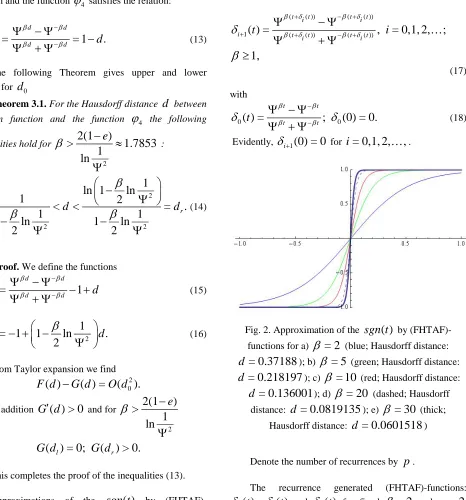
Approximations of the
sgn t
( )
by (FHTAF)-functions for variousβ
are visualized on Fig. 2.4. The Family of Recurrence Generated
Parametric Fibonacci Hyperbolic Tangent
Activation Function (FHTAF)
We consider the following family of recurrence generated (FHTAF) functions:
( ( )) ( ( ))
1
( ) =
( ( )) ( ( )),
= 0,1, 2,
;
1,
t i t t i t
i
t
t i t t i ti
β δ β δ
β δ β δ
δ
β
+ − +
+ + − +
Ψ
− Ψ
Ψ
+ Ψ
≥
(17)
with
0
( ) =
;
0(0) = 0.
t t
t t
t
β β
β β
δ
Ψ − Ψ
−−δ
Ψ + Ψ
(18)Evidently,
δ
i+1(0) = 0
fori
= 0,1, 2,
,
.
Fig. 2. Approximation of the
sgn t
( )
by (FHTAF)-functions for a)β
= 2
(blue; Hausdorff distance:= 0.37188
d
); b)β
= 5
(green; Hausdorff distance:= 0.218197
d
); c)β
= 10
(red; Hausdorff distance:= 0.136001
d
); d)β
= 20
(dashed; Hausdorff distance:d
= 0.0819135
); e)β
= 30
(thick;Hausdorff distance:
d
= 0.0601518
)Denote the number of recurrences by
p
.The recurrence generated (FHTAF)-functions:
0
( )
t
Fig. 2. Approximation of the
sgn t
( )
by (FHTAF)-functions for fixedβ
= 2
; The graphics of recurrence generated (FHTAF)-functions:δ
0 (green),δ
1 (red) and2
δ
(blue).4. Conclusions
A family of recurrence generated parametric Fibonacci hyperbolic tangent activation function (FHTAF) is introduced finding application in neural network theory and practice.
Theoretical and numerical results on the approximation in Hausdorff sense of the sgn function by means of functions belonging to the family are reported in the paper.
We propose a software module within the programming environment CAS Mathematica for the analysis of the considered family of recurrence generated (FHTAF) functions.
The module offers the following possibilities:
- generation of the activation functions under user defined values of the parameter
β
and number of recursionsp
;- calculation of the H-distance
d
p,p
= 0,1, 2,
,
between the sgn function and the activation functions0
,
1,
2,
,
pδ δ δ
δ
;- software tools for animation and visualization.
For other results, see [31]–[33].
Acknowledgments
This work has been supported by the project FP17-FMI-008 of Department for Scientific Research, Paisii Hilendarski University of Plovdiv.
References
[1] S. Haykin, Neural networks and learning machines, – 3rd ed., Copyright by Pearson Education, Inc., Upper Saddle River, New Jersey 07458, 2009.
[2] A. Stakhov, I. Tkachenko, Hyperbolic Fibonacci Trigonometry, Dokl. Akad. Nauk Ukrainy, 7, 1993, 9–14. [3] Z. Trzaska, On Fibonacci hyperbolic trigonometry and
modified numerical triangles, Fib. Quart., 34, 1996, 129– 138.
[4] N. Guliyev, V. Ismailov, A single hidden layer feedforward network with only one neuron in the hidden layer san approximate any univariate function, Neural Computation, 28, 2016, 1289–1304.
[5] D. Costarelli, R. Spigler, Approximation results for neural network operators activated by sigmoidal functions, Neural Networks 44, 2013, 101–106.
[6] D. Costarelli, G. Vinti, Pointwise and uniform approximation by multivariate neural network operators of the max-product type, Neural Networks, 2016, doi:10.1016/j.neunet.2016.06.002.
[7] D. Costarelli, R. Spigler, Solving numerically nonlinear systems of balance laws by multivariate sigmoidal functions approximation, Computational and Applied Mathematics 2016, doi:10.1007/s40314-016-0334-8,
[8] D. Costarelli, G. Vinti, Convergence for a family of neural network operators in Orlicz spaces, Mathematische Nachrichten, 2016; doi:10.1002/mana.20160006.
[9] J. Dombi, Z. Gera, The Approximation of Piecewise Linear Membership Functions and Lukasiewicz Operators, Fuzzy Sets and Systems, 154(2), 2005, 275–286.
[10] I. A. Basheer, M. Hajmeer, Artificial Neural Networks: Fundamentals, Computing, Design, and Application, Journal of Microbiological Methods, 43, 2000, 3–31, doi:10.1016/S0167-7012(00)00201-3.
[11] Z. Chen, F. Cao, The Approximation Operators with Sigmoidal Functions, Computers & Mathematics with Applications 58, 2009, 758–765, doi:10.1016/j.camwa.2009.05.001.
[12] Z. Chen, F. Cao, The Construction and Approximation of a Class of Neural Networks Operators with Ramp Functions, Journal of Computational Analysis and Applications, 14, 2012, 101–112.
[13] Z. Chen, F. Cao, J. Hu, Approximation by Network Operators with Logistic Activation Functions, Applied Mathematics and Computation, 256, 2015, 565–571, doi:10.1016/j.amc.2015.01.049.
[14] D. Costarelli, R. Spigler, Constructive Approximation by Superposition of Sigmoidal Functions, Anal. Theory Appl., 29, 2013, 169–196, doi:10.4208/ata.2013.v29.n2.8.
[16] K. Babu, D. Edla, New algebraic activation function for multi-layered feed forward neural networks. IETE Journal of Research, 2016, doi:10.1080/03772063.2016.1240633. [17] S. Wang, T. Zhan, Y. Chen, Y. Zhang, M. Yang, H. Lu, H.
Wang, B. Liu, P. Phillips, Multiple Sclerosis Detection Based on Biorthogonal Wavelet Transform, RBF Kernel Principal Component Analysis, and Logistic Regression, IEEE Access, Special section on advanced signal processing methods in medical imaging, 4, 2016, 7567–7576.
[18] G. Cybenko, Approximation by superposition of a sigmoidal function, Math. of Control Signals and Systems, 2, 1989, 303–314.
[19] K. Hornik, M. Stinchcombe, H. White, Multi-layer feed forward networks are universal approximations, Neural Networks, 2, 1989, 359–366.
[20] V. Kreinovich, O. Sirisaengtaksin, 3–layer neural networks are universal approximations for functionals and for control strategies, Neural Parallel and Scientific Computations, 1, 1993, 325–346.
[21] H. White, Connectionist nonparametric regression: multilayer feedforward networks can learn arbitrary mappings, Neural Networks, 3, 1990, 535–549.
[22] W. Duch, N. Jankowski, Survey of neural transfer functions, Neural Computing Surveys, 2, 1999, 163–212.
[23] F. Hausdorff, Set Theory (2 ed.) (Chelsea Publ., New York, (1962 [1957]) (Republished by AMS-Chelsea 2005), ISBN: 978–0–821–83835–8.
[24] B. Sendov, Hausdorff Approximations (Kluwer, Boston, 1990), doi:10.1007/978-94-009-0673-0.
[25] N. Kyurkchiev, A family of recurrence generated sigmoidal functions based on the Verhulst logistic function. Some approximation and modeling aspects, Biomath Communications, 3(2), 2016, 18 pp.
[26] A. Iliev, N. Kyurkchiev, S. Markov, A family of recurrence generated parametric activation functions with applications to neural networks, International Journal on Research Innovations in Engineering Science and Technology, 2(1), 2017, 60–68.
[27] N. Kyurkchiev, S. Markov, Hausdorff Approximation of the Sign Function by a Class of Parametric Activation Functions, Biomath Communications, 3(2), 2016, 14 pp., doi:10.11145/bmc.2016.12.217.
[28] N. Kyurkchiev, A. Iliev, S. Markov, Families of recurrence generated three and four parametric activation functions, Int. J. Sci. Res. and Development, 4 (12), 2017, 746–750. [29] V. Kyurkchiev, N. Kyurkchiev, A family of recurrence
generated functions based oh Half-hyperbolic tangent activation functions, Biomedical Statistics and Informatics, 2(3), 2017, 87–94.
[30] V. Kyurkchiev, A. Iliev, N. Kyurkchiev, On some families of recurrence generated activation functions, Int. J. of Sci. Eng. and Appl. Sci., 2017, 3(3).
[31] N. Kyurkchiev, S. Markov, Sigmoid functions: Some Approximation and Modelling Aspects. (LAP LAMBERT Academic Publishing, Saarbrucken, 2015), ISBN 978-3-659-76045-7.
[32] N. Kyurkchiev, S. Markov, On the Hausdorff distance between the Heaviside step function and Verhulst logistic function. J. Math. Chem., 54(1), 2016, 109–119, doi:10.1007/S10910-015-0552-0.
![Fig. 1. Nonlinear, parametrized function with restricted output range [1].](https://thumb-us.123doks.com/thumbv2/123dok_us/7868629.1305218/1.612.55.290.553.683/fig-nonlinear-parametrized-function-restricted-output-range.webp)