Preimage and Pseudo-Collision Attacks on
Step-Reduced SM3 Hash Function
Gaoli Wang1and Yanzhao Shen1
1School of Computer Science and Technology, Donghua University,
Shanghai 201620, China
[email protected], yanzhao [email protected]
Abstract. SM3 [11] is the Chinese cryptographic hash standard which was an-nounced in 2010 and designed by Wanget al.. It is based on the Merkle-Damgård design and its compression function can be seen as a block cipher used in Davies-Meyer mode. It uses message block of length 512 bits and outputs hash value of length 256 bits.
This paper studies the security of SM3 hash function against preimage attack and pseudo-collision attack. We propose preimage attacks on 29-step and 30-step S-M3, and pseudo-preimage attacks on 31-step and 32-step SM3 out of 64 steps. The complexities of these attacks are 224529-step operations, 2251.130-step
oper-ations, 224531-step operations and 2251.132-step operations, respectively. These
(pseudo) preimage attacks are all from the first step of the reduced SM3. Mean-while, these (pseudo) preimage attacks can be converted into pseudo-collision attacks on SM3 reduced to 29 steps, 30 steps, 31 steps and 32 steps with complex-ities of 2122, 2125.1, 2122and 2125.1respectively. As far as we know, the previously
best known preimage attacks on SM3 cover 28 steps (from the first step) and 30 steps (from the 7-th step), and there is no publicly published result on (pseudo) collision attack on SM3.
Keywords:Preimage Attack, Collision attack, Differential meet-in-the-middle, SM3, Hash function.
1
Introduction
Hash functions are an important cryptographic primitive and play a very important role in modern cryptology. They are supposed to satisfy collision resistance, preimage re-sistance and second preimage rere-sistance. There is a breakthrough in the collision attack on hash functions in 2005 [12, 13, 2]. With the collision attacks on a series of standard hash functions, preimage attack has drawn a great amount of attention from many re-searchers (see [1, 3, 5, 8, 14] for example). Up to now, the meet-in-the-middle technique and many improved techniques such as initial structure, splice-and-cut, biclique and so on have been widely used in the preimage attack. Recently, a differential view on the meet-in-the-middle technique [5] was proved very useful for the preimage attack on hash functions with linear message expansion and weak diffusion properties.
However, it has a more complex step function and stronger message dependency than SHA-256. Few attacks were published on SM3 hash function. The work in [15] pre-sented preimage attacks on 28-step (from the 1-st step) and 30-step (from the 7-th step) SM3 with complexities of 2249and 2241.5respectively. Recently, a boomerang attack on SM3 reduced to 35 steps [4] was proposed with a complexity of 2117.1.
In this paper, we focus on the security evaluation of the preimage resistance and collision resistance of SM3 hash function. Based on the differential meet-in-the-middle technique etc., we successfully present (pseudo) preimage attacks and pseudo-collision attacks on 29-step, 30-step, 31-step and 32-step reduced SM3 hash function. All of these attacks start from the first step of SM3. This result provides a better understanding concerning the message expansion and diffusion properties of SM3 hash function. The previous results and the summary of our results are given in Table 1.
The rest of this paper is organized as follows. Section 2 introduces the techniques used throughout the paper. Section 3 gives a brief description of SM3, some notations used in this paper. Section 4 presents preimage and pseudo-collision attacks on step-reduced SM3. Section 5 concludes this paper.
Table 1.Summary of the attacks on SM3 compression function (CF) and hash function (HF)
Attack CF/HF Steps Time Source
Preimage attack HF 28 2241.5 [15] Preimage attack HF 30∗ 2249 [15] Boomerang attack CF 32 214.4 [4] Boomerang attack CF 33 232.4 [4] Boomerang attack CF 34 253.1 [4] Boomerang attack CF 35 2117.1 [4] Preimage attack HF 29 2245 Sect. 4 Preimage attack HF 30 2251.1 Sect. 4 Pseudo-preimage attack HF 31 2245 Sect. 4 Pseudo-preimage attack HF 32 2251.1 Sect. 4 Pseudo-collision attack HF 29 2122 Sect. 4 Pseudo-collision attack HF 30 2125.1 Sect. 4 Pseudo-collision attack HF 31 2122 Sect. 4 Pseudo-collision attack HF 32 2125.1 Sect. 4
∗The attack starts from the 7-th step.
2
Techniques for Preimage Attack and Pseudo-Collision Attack
2.1 The Meet-in-the-Middle Preimage Attack
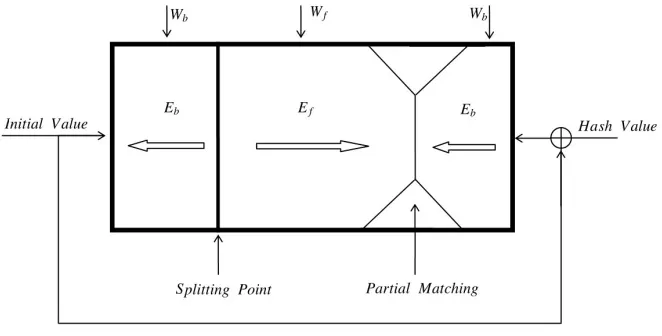
The general idea of the meet-in-the-middle preimage attack can be described as fol-lows(See Fig. 1). It is a type of birthday attack and makes use of a space-time tradeoff. Split the compression function into two subparts (Ef andEb). Ef computes forward
from the splitting point and obtain a set of values at the matching point. ThenEb
com-putes backward and gets another set of results. The two sets of results are compared to search an intersection. The two computation procedures must be independent on each other so that the birthday attack rule can be applied.
The meet-in-the-middle technique can be combined with many techniques such as initial structure technique, splice-and-cut technique, biclique technique, etc. to improve the preimage attack.
Fig. 1.Schematic view of the meet-in-the-middle attack
2.2 The Differential Meet-in-the-Middle Technique
We review the differential meet-in-the-middle preimage attack [5] which uses the trun-cated differential [7] in the following.
For a truncation mask vectorT ∈ {0,1}n, the equationA =
T BdenotesT ∧(A⊕
B) =0, where∧is bitwise AND. The compression functions of SM3 can be seen as
p2 = Pr[∆2 =T E2−1(M,H⊕IV)⊕E2−1(M⊕δ2,H⊕IV)], that is, (δ2,0) → ∆2 is a related-key differential forE−21with probabilityp2.
A candidate preimage can be searched using Algorithm 1. The above second and third conditions make sure that Algorithm 1 answers correctly with probabilityp1·p2. The error of Algorithm 1 is defined as follows:M⊕δ1⊕δ2is a preimage, but Algorithm 1 rejects it. The error probability is about 1−p1p2, which can be obtained by experiment. For the detailed description, we refer to [5]. We can also know thatL1[δ2] =T L2[δ1] (in the last loop of Algorithm 1) is equivalent toE1(M⊕δ1⊕δ2,IV)=T E2−1(M⊕δ1⊕ δ2,H⊕IV) which is true ifM⊕δ1⊕δ2is a candidate preimage.
Algorithm 1
TestingM⊕δ1⊕δ2for a candidate preimage Input:D1,D2⊂ {0,1}k,T ∈ {0,1}n,M⊂ {0,1}k Output:A candidate preimage of the hash value
Hif one is contained inM⊕δ1⊕δ2
Algorithm:
1: for allδ2 ∈D2,do
2: L1[δ2]=E1(M⊕δ2,IV)⊕∆2 3: end for
4: for allδ1 ∈D1,do
5: L2[δ1]=E−21(M⊕δ1,H⊕IV)⊕∆1 6: end for
7: for all(δ1×δ2)∈D1×D2,do 8: if L1[δ2]=T L2[δ1],then 8: returnM⊕δ1⊕δ2 9: end if
10: end for
11: returnNo candidate preimage inM⊕δ1⊕δ2
IfD1andD2both have dimensiond, for a randomM, the setM⊕D1⊕D2contains 22d =2d×2ddifferent messages. Using Algorithm 1, we can observe that a preimage
can be obtained with a complexity of (2n−dΓ+2n−tΓ
re)/(p1·p2), whereΓis the cost of one compression function operation,Γre is the cost of retesting a candidate preimage
andtis the hamming weight ofT.
2.3 Converting Pseudo-Preimage Attack into Pseudo-Collision Attack
[10] proposed a technique to convert pseudo-preimage attack into pseudo-collision attack. Assume we can get at-bit partial target preimageMwith matching point in the last step with complexity 2k, then by finding 2(n−t)/2differentt-bit partial target preimage
Ms, we can get a pseudo-collision with high probability. The total complexity to get a pseudo-collision is 2(n−t)/2×2k.
andd=5(>t/2), we can find 24(=25+5/26) 6-bit partial target preimage with complex-ity 25, which means that a 6-bit partial target preimage is found with the complexity of 2(=25/24). Then a pseudo-collision can be found with the complexity of 2(n−6)/2×2.
3
Description of SM3 and Notations
In this section, we will give a brief description of SM3 and some notations used through-out the paper.
3.1 Description of SM3
The SM3 hash function compresses any message no more than 264−1 bits into a 256-bit hash value. The algorithm first pads any given message inton512-bit message blocks. The hash function consists of the following two parts: the message expansion and the state update transformation. For the detailed description of SM3, we refer to [11]. Message Expansion.The message expansion of SM3 splits the 512-bit message block
Minto 16 wordswi(0 ≤i≤15), and expands them into 68 expanded message words
wi(0≤i≤67) and 64 expanded message wordswi0(0≤i≤63) as follows:
wi=P1(wi−16⊕wi−9⊕(wi−3≪15))⊕(wi−13 ≪7)⊕wi−6,16≤i≤67,
wi0=wi⊕wi+4,0≤i≤63,whereP1(X)=X⊕(X≪15)⊕(X≪23).
State Update Transformation.The state update transformation starts from an initial value (A0,B0,C0,D0,E0,F0,G0,H0)=IVof eight 32-bit words and updates them in 64 steps. In stepi+1(0≤i ≤63) the 32-bit wordswiandwi0are used to update the
state variablesAi,Bi,Ci,Di,Ei,Fi,Gi,Hias follows:
S S1i=((Ai≪12)+Ei+(Ti≪i))≪7,
S S2i=S S1i⊕(Ai≪12),
T T1i=FFi(Ai,Bi,Ci)+Di+S S2i+wi0,
T T2i=GGi(Ei,Fi,Gi)+Hi+S S1i+wi,
Ai+1= T T1i,Bi+1=Ai,Ci+1=(Bi≪9),Di+1=Ci,
Ei+1= P0(T T2i),Fi+1 =Ei,Gi+1 =(Fi≪19),Hi+1=Gi.
whereP0(X)=X⊕(X≪9)⊕(X≪17).
The bitwise boolean functionsFFi(Xi,Yi,Zi) andGGi(Xi,Yi,Zi) are defined as
fol-lows.
FFi(Xi,Yi,Zi)= (
Xi⊕Yi⊕Zi, 0≤i≤15,
(Xi∧Yi)∨(Xi∧Zi)∨(Yi∧Zi),16≤i≤63,
GGi(Xi,Yi,Zi)= (
Xi⊕Yi⊕Zi, 0≤i≤15,
(Xi∧Yi)∨(¬Xi∧Zi),16≤i≤63.
IfMis the last block, then (A64⊕A0,B64⊕B0,C64⊕C0,D64⊕D0,E64⊕E0,F64⊕
3.2 Notations
– ∆v: the difference corresponding to the variablev.
– ∆x=[α ∼β]: the bits from theα-th bit to theβ-th bit of∆x(x=wi,w0i) take all
possible values, and the other bits of∆xare zero.
– ∆y=hα∼βi: the bits from theα-th bit to theβ-th bit of∆y(y=Ai,Bi, . . . ,Hi) are
known, and the other bits of∆yare unknown.
– ∆y=hα∼β, γ∼δi: the bits from theα-th bit to theβ-th bit and from theγ-th bit to theδ-th bit of∆yare known, and the other bits of∆yare unknown.
– ∆y=hαi: theα-th bit of∆yis known, and the other bits of∆yare unknown. – ∆z=?:∆zis unknown.
4
Preimage and Pseudo-Collision Attacks on Step-Reduced SM3
Hash Function
In this section, we present the attacks on 29-step and 30-step SM3 hash function and expand the 30-step attacks to 32-step attacks using the biclique technique. Before de-scribing the attacks, we give a property of the integer modular addition.
Property 1.Let x,ybe two n-bit words andz = x+y. Denotex = xn−1xn−2...x1x0,
y = yn−1yn−2...y1y0 andz = zn−1zn−2...z1z0. xandyi(i = s, ...,n−1) are known, and
yi(i=0, ...,s−1) are unknown. Letprepresent the probability thatzi(i=n−t, ...,n−1)
are known, thenp≥2t+s−n, wheren−t≥s.
Proof. Denote ¯x = xn−1...xs0...0, ¯y= yn−1...ys0...0 and ¯z= x¯+y¯. If there is no carry
from the (s−1)-th bit to thes-th bit, thenzi=¯zi(i=n−t, ...,n−1) are always known.
Assume there is a bit carry from the (s−1)-th bit to thes-th bit, then there is a bit carry from the (n−t−1)-th bit to the (n−t)-th bit if and only if ¯zi =1(i= s, ...,n−t−1),
which holds with a probability of 2−(n−t−1−s+1)=2t+s−n.
4.1 Preimage and Pseudo-Collision Attacks on 29-Step SM3
The forward subpart is from the 1-st step to the 15-th step and the backward sub-part is from the 29-th step to the 16-th step. The linear spaces D1,D2 and the
trun-cation mask vector T29f,T29b are chosen as follows: D1 = {x0k. . .kx15
xi = 0,x15 ∈
[0 ∼ 5],0 ≤ i ≤ 14}, D2 = {x17k. . .kx32
x17 ∈ [26 ∼ 31],xi = 0,18 ≤ i ≤ 32},
T29f ={0,0,0,0,0,0,0,f f f f f f f f}, andT29b ={0,0,0,0,0,0,0,7f}. The differential
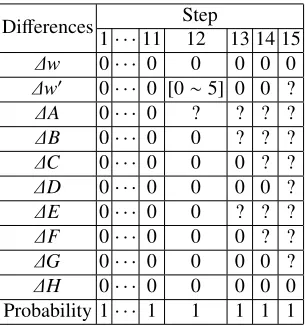
characteristics for steps 1-15 and 29-16 are presented in Table 2 and Table 3 respective-ly.
In the forward subpart, for allδ1∈D1and uniformly chosen messageM, the equa-tionPr[0=T29f E1(M,IV)⊕E1(M⊕δ1,IV)]=1 always holds, which means∆H15=0 al-ways holds. In the backward subpart, the equationPr[0=T29bE
−1
2 (M,H⊕IV)⊕E
Table 2.Differential characteristic for steps 1-15(29 steps, 6 bits)
Differences Step
1· · ·11 12 13 14 15 ∆w 0· · · 0 0 0 0 0 ∆w0 0· · · 0 [0∼5] 0 0 ? ∆A 0· · · 0 ? ? ? ? ∆B 0· · · 0 0 ? ? ? ∆C 0· · · 0 0 0 ? ? ∆D 0· · · 0 0 0 0 ? ∆E 0· · · 0 0 ? ? ? ∆F 0· · · 0 0 0 ? ? ∆G 0· · · 0 0 0 0 ? ∆H 0· · · 0 0 0 0 0 Probability 1· · · 1 1 1 1 1
The preimage attack on 29-step SM3 can also be carried out in the following
im-plementations. We chooseD1 = {x0k. . .kx15
xi =0,x15 = [3 ∼14],0 ≤ i ≤14}and
D2={x17k. . .kx32
x17 =[20∼31],xi=0,18≤i≤32}. The differential characteristics
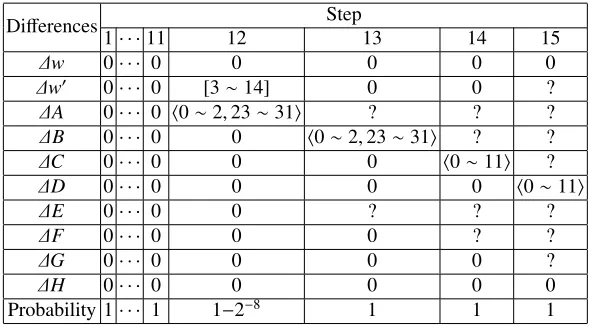
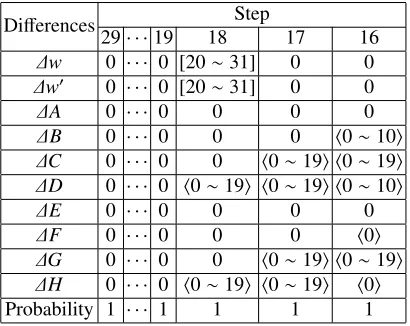
for each subpart are presented in Table 5 and Table 6.
For the forward subpart, according to the algorithm of SM3 and Property 1, we can get ∆A12 = h0 ∼ 2,23 ∼ 31i holds with probability 1−2−8. Thus∆D15 = ∆C14 = ∆B13 ≪ 9=∆A12 ≪ 9 =(h0 ∼2,23 ∼31i)≪ 9 =h0,11iholds with probability 1−2−8. We can easily get∆H15 = 0 always holds. We can get∆D15 = h0,10iand ∆H15=h0iin the backward subpart. Therefore, we choose{0,0,0,7f f,0,0,0,1}as the truncation mask vector. Hence, we can obtain a one-block preimage attack on 29-step SM3 with no padding. The complexity of the attack is (2244+2244)/(1−2−8)≈2245.
We can use the splice-and-cut technique to move the matching point to the end of the compression function, combined with the technique described in Section 2.3, a one-block pseudo-collision attack on 29-step SM3 can be obtained with the complexity of 2(256−12)/2/(1−2−8)≈2122.
4.2 Preimage and Pseudo-Collision Attacks on 30-Step SM3
The forward subpart is from the 1-st step to the 16-th step and the backward subpart is
from the 30-th step to the 17-th step. We choose the linear spacesD1={x0k. . .kx15
xi=
0,x15 =[0∼5],0 ≤i ≤14}andD2 ={x18k. . .kx33
x18 =[26∼31],xi =0,19≤i≤
33}.
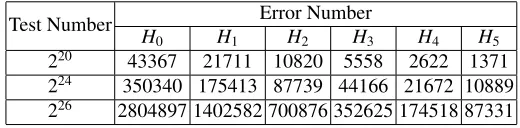
For the forward subpart,Pr[0 ={0,0,0,0,0,0,0,3f} E1 (M,IV)⊕E1(M⊕δ1,IV)] holds with the probability of 0.932(=1−0.035−0.017−0.009−0.004−0.002−0.001) on
Table 3.Differential characteristic for steps 29-16(29 steps, 6 bits)
Differences Step
29· · ·19 18 17 16 ∆w 0 · · · 0 [26∼31] 0 0 ∆w0 0 · · · 0 [26∼31] 0 0
∆A 0 · · · 0 0 0 0
∆B 0 · · · 0 0 0 ?
∆C 0 · · · 0 0 ? ?
∆D 0 · · · 0 ? ? ?
∆E 0 · · · 0 0 0 0
∆F 0 · · · 0 0 0 h0∼6i
∆G 0 · · · 0 0 h0∼25i h0∼25i
∆H 0 · · · 0 h0∼25i h0∼25i h0∼6i
Probability 1 · · · 1 1 1 1
with probability 1. We choose the truncation mask vector as{0,0,0,0,0,0,0,3f}, then the probability of∆H16 =h0∼5iholds with the probability of 0.932. So we can get a preimage with no padding of 30-step SM3 with a complexity of (2250+2250)/0.932≈ 2251.1.
Table 4.Test the probability for the forward subpart (30-step with dimension 6)∗
Test Number Error Number
H0 H1 H2 H3 H4 H5
220 43367 21711 10820 5558 2622 1371
224 350340 175413 87739 44166 21672 10889 226 2804897 1402582 700876 352625 174518 87331
∗ H
16,idenotes thei-thbit ofH16used in the forward subpart.
By moving the matching point to the end of the compression function using the splice-and-cut technique, combined with the algorithm described in section 2.3, we can get a pseudo-collision attack on 30-step SM3 with the complexity of 2((256−6))/2/0.932≈ 2125.1.
4.3 Pseudo-Preimage and Pseudo-Collision Attacks on 32-Step SM3 using bicliques
step, and the corresponding compression function is denoted asF1. The backward sub-part is from the 14-th step to the 1-st step, and the corresponding compression function is denoted asF2−1. The biclique covers the steps 15 and 16, and the corresponding
com-pression function is denoted asFbic. We choose the linear spacesD1={x16k. . .kx31
xi=
0,x31 =[0∼5],16≤i≤30}andD2={x2k. . .kx17
xi=0,x2 =[26∼31],3≤i≤17}.
From the preimage attack on 30-step SM3, we know that∆H32 =h0 ∼5iholds with with probability 0.932 in the forward subpart and∆H0 = h0 ∼ 5i holds with with probability 1 in the backward subpart.
So we focus on how to construct the bicliques. The biclique technique [6] is formal-ized from the initial structure technique [9]. A biclique forFbicis a tuple{M,D1,D2,P,Q} whereMis a message,D1andD2are linear difference spaces of dimensiond, andPis a list of 2d statesP[δ
1i] forδ1i ∈D1,Qis a list of 2dstatesQ[δ2j] forδ2j ∈ D2, such that for all (δ1i, δ2j)∈D1×D2,Q[δ2j]=Fbic(M⊕δ1i⊕δ2j,P[δ1i]) holds. With such a
biclique, the setM⊕D1⊕D2can be searched for candidate pseudo-preimage by testing
F1(M⊕δ2j,Q[δ2j])⊕∆2=T F2−1(M⊕δ1i,P[δ1i])⊕∆1⊕H, whereHis the hash value. The details of the 2-step biclique can be explained as follows. From the linear space
D1, we know that∆wi = 0 (16 ≤ i ≤ 30),∆w31 , 0 in the forward subpart, which means∆w14 =0,∆w014 =0,∆w15 ,0 and∆w015 ,0. Similarly, from the linear space
D2, we can get∆w14 =0,∆w014,0,∆w15=0 and∆w015 =0. For any randomly chosen
MandP0 =(A14,B14,C14,D14,E14,F14,G14,H14), denote the output of thei-th step as (Ai,Bi,Ci,Di,Ei,Fi,Gi,Hi) (i=15,16). We can obtain that for the messageM⊕δ2j
(δ2j , 0) and P0 = (A14, B14,C14,D14,E14,F14,G14,H14), the output of the 16-th step isQ[δ2j]=(A
δ2j 16,A
δ2j
15,C16,D16,E
δ2j
16,F16,G16,H16) whereA
δ2j
16 ,A16,A
δ2j 15 ,A15 andEδ2j
16 ,E16. For the message M⊕δ1i(δ1i ,0) andQ0 =(A16,B16,C16,D16,E16,
F16,G16,H16), we can get that the input of the 15-th step isP[δ1i] = (A14,B14,Dδ151i,
Dδ1i
14,E14,F14,H
δ1i 15,H
δ1i
14) whereD
δ1i
15 ,C14,D
δ1i
14 , D14,H
δ1i
15 ,G14 andH
δ1i 14 , H14. According to the algorithm of SM3, we get get that for M⊕δ1i⊕δ2jandP[δ1i], the
output of the 16-th step isQ[δ2j]. Therefore, the 2-step biclique covering steps 15 and
16 can be constructed and the cost of constructing the bicliques is negligible. Thus, the pseudo-preimage attack on 32-step SM3 hash function with no padding can be obtained with a complexity of about 2251.1and the pseudo-collision attack on 32-step SM3 with no padding can be obtained with a complexity of about 2125.1.
By the way, by adding 2-step biclique covering steps 15 and 16 to the preimage attack on 29-step SM3, we can obtain a pseudo-preimage attack on 31-step SM3 with the same complexity as the preimage attack on 29-step SM3. Furthermore, the pseudo-preimage attack on 31-step SM3 can be converted into the pseudo-collision attack on 31-step SM3 with the same complexity as the pseudo-collision attack on 29-step SM3. 3-step biclique cannot be constructed because of the characteristic of the state update transformation of SM3.
5
Conclusions
eren-Algorithm 2Construction of the bicliques Input:M,D1,D2 ⊂ {0,1}k
Output:A biclique Algorithm:
1: For uniformly chosenP0,doP0→Q0 2: for allδ2j∈D2,doP0→Q[δ2j]
4: end for
5: for allδ1i∈D1,doP[δ1i]←Q0 7: end for
8: returnP[δ1i]→Q[δ2j]
tials by taking advantage of some particular weakness of the state update transformation and linear message expansion of SM3. On the basis of them, we have been able to give the best preimage attack known on SM3 by applying the differential meet-in-the-middle technique. Our preimage attack works up to 32 steps (from the first step), while the anal-ysis for the biggest number of steps in the previous result worked on 28 steps (from the first step) and 30 steps (from the 7-th step). Furthermore, we convert the preimage at-tacks to the pseudo-collision atat-tacks on SM3. The time complexities of the (pseudo) preimage attacks on 29-step, 30-step, 31-step and 32-step SM3 are 2245, 2251.1, 2245and 2251.1 respectively. The time complexities of the pseudo-collision attacks on 29-step, 30-step, 31-step and 32-step SM3 are 2122, 2125.1, 2122and 2125.1respectively.
References
1. Kazumaro Aoki, Yu Sasaki, Preimage Attacks on One-Block MD4, 63-Step MD5 and More, in: Selected Areas in Cryptography - SAC 2008, in: LECTURE NOTES IN COMPUTER SCIENCE, vol. 5381, Springer, 2008, pp. 103-119.
2. Eli Biham, Rafi Chen, Antoine Joux, Patrick Carribault, Christophe Lemuet, William Jalby, Collisions of SHA-0 and Reduced SHA-1, in: Advances in Cryptology - EUROCRYPT 2005, in: LECTURE NOTES IN COMPUTER SCIENCE, vol. 3494, Springer, 2005, pp. 36-57. 3. Jian Guo, San Ling, Christian Rechberger, Huaxiong Wang, Advanced Meet-in-the-Middle
Preimage Attacks: First Results on Full Tiger, and Improved Results on MD4 and SHA-2, in: Advances in Cryptology - ASIACRYPT 2010, in: LECTURE NOTES IN COMPUTER SCIENCE, vol. 6477, Springer,
4. Aleksandar Kircanski, Yanzhao Shen, Gaoli Wang, Amr M. Youssef, Boomerang and Slide-Rotational Analysis of SM3 hash function, in: Selected Areas in Cryptography - SAC 2012, in: LECTURE NOTES IN COMPUTER SCIENCE, vol. 7707, Springer, 2012, pp. 305-321. 5. Simon Knellwolf1, Dmitry Khovratovich, New Preimage Attacks against Reduced SHA-1, in: Advances in Cryptology-CRYPTO 2012, in: LECTURE NOTES IN COMPUTER SCI-ENCE, vol. 7417, Springer, 2012, pp. 367-383.
6. Dmitry Khovratovich, Christian Rechberger, Alexandra Savelieva, Bicliques for Preimages: Attacks on Skein-512 and the SHA-2 family, in: Fast Software Encryption - FSE 2012, in: LECTURE NOTES IN COMPUTER SCIENCE, vol. 7549, Springer, 2012, pp. 244-263. 7. Lars R. Knudsen, Truncated and Higher Order Differentials, in: Fast Software Encryption
8. Ga¨etan Leurent, MD4 is Not One-Way, in: Fast Software Encryption - FSE 2008, in: Lecture Notes in Computer Science, vol. 5086, Springer, 2008, pp. 412-428.
9. Yu Sasaki, Kazumaro Aoki, Finding Preimages in Full MD5 Faster Than Exhaustive Search, in: Advances in Cryptology - EUROCRYPT 2009, in: Lecture Notes in Computer Science, vol. 5479, Springer, 2009, pp. 134-152.
10. Ji Li, Takanori Isobe, Kyoji Shibutani, Converting meet-in-the-middle preimage attack into pseudo collision attack: Application to SHA-2, in: Fast Software Encryption - FSE 2012, in: LECTURE NOTES IN COMPUTER SCIENCE, vol. 7549, Springer, 2012, pp. 264-286 .
11. Specification of SM3 cryptographic hash function (In Chinese),
http://www.oscca.gov.cn/UpFile/20101222141857786.pdf.
12. Xiaoyun Wang, Hongbo Yu, How to Break MD5 and Other Hash Functions, in: Advances in Cryptology - EUROCRYPT 2005, in: Lecture Notes in Computer Science, vol. 3494, Springer, 2005, pp. 19-35.
13. Xiaoyun Wang, Yiqun Lisa Yin, Hongbo Yu, Finding Collisions in the Full SHA-1, in: Ad-vances in Cryptology - CRYPTO 2005, in: Lecture Notes in Computer Science, vol. 3621, Springer, 2005, pp. 17-36.
14. Hongbo Yu, GaoliWang, Guoyan Zhang, XiaoyunWang, The second-preimage attack on MD4, in Cryptology and Network Security - CANS 2005, in: LECTURE NOTES IN COM-PUTER SCIENCE, vol. 3810, Springer, 2005, pp. 1-12.
15. Jian Zou, Wenling Wu, Shuang Wu, Bozhan Su, Le Dong, Preimage Attacks on Step-Reduced SM3 Hash Function, in: International Conference on Information Security and Cryptology - ICISC 2011, in: Lecture Notes in Computer Science, vol. 7259, Springer, 2011, pp. 375-390.
Table 5.Differential characteristic for steps 1-15(29 steps, 12 bits)
Differences Step
1· · ·11 12 13 14 15
∆w 0· · · 0 0 0 0 0
∆w0 0· · · 0 [3∼14] 0 0 ?
∆A 0· · · 0 h0∼2,23∼31i ? ? ? ∆B 0· · · 0 0 h0∼2,23∼31i ? ?
∆C 0· · · 0 0 0 h0∼11i ?
∆D 0· · · 0 0 0 0 h0∼11i
∆E 0· · · 0 0 ? ? ?
∆F 0· · · 0 0 0 ? ?
∆G 0· · · 0 0 0 0 ?
∆H 0· · · 0 0 0 0 0
Table 6.Differential characteristic for steps 29-16(29 steps, 12 bits)
Differences Step
29· · ·19 18 17 16 ∆w 0 · · · 0 [20∼31] 0 0 ∆w0 0 · · · 0 [20∼31] 0 0
∆A 0 · · · 0 0 0 0
∆B 0 · · · 0 0 0 h0∼10i
∆C 0 · · · 0 0 h0∼19i h0∼19i
∆D 0 · · · 0 h0∼19i h0∼19i h0∼10i
∆E 0 · · · 0 0 0 0
∆F 0 · · · 0 0 0 h0i
∆G 0 · · · 0 0 h0∼19i h0∼19i
∆H 0 · · · 0 h0∼19i h0∼19i h0i