IJEDR1504095
International Journal of Engineering Development and Research (www.ijedr.org)570
An enhanced Probability based object tracking
technique for Multiple Object Tracking
Er Harry, Er Deepinder Kaur M.tech student, Assistant professor
SUSCET Tangori, Mohali, India
________________________________________________________________________________________________________
Abstract - Object tracking is an important step used in many computer vision applications to track targets like vehicles, human, birds etc. in an environment. Object tracking is the technique which is used to track object from the image or from the video. The video consists of multiple frames and in each frame we find the location of that object. To find the location of the object technique of probability has been applied and this technique the location of the object is predicted based on the probability density which works well on single and multiple objects. In this paper, improvement has been proposed in probability based technique to track multiple objects from the video which uses a combination of particle filter , kalman filter and frame differencing method considering the issues like degeneracy, non-linearity, partial occlusion. In this proposed technique the object showing the maximum variation will be tracked automatically based on the movement of the object without human intervention. The proposed technique is implemented in MATLAB. We analyzed the difficulties in video object tracking and tried to overcome these with more accuracy and less computation time. The enhanced method has shown better results based on the selected object tracking parameters
Keywords - Object Tracking, Probabilistic approach, partial occlusion, multiple targets, particle filter, kalman filter, sequential importance resampling
________________________________________________________________________________________________________
I.INTRODUCTION
Object Tracking has been an area of interest in many computer vision applications. It has been the building block of many high level video analysis applications like public and commercial security, smart data video mining, law enforcement, detect accidents, medical therapy and military security. Detecting the moving objects in a frame is an important task and forms the foundation on many high level applications. Many of the existing methods are able to track the objects in predefined environment and do not consider the problem of non-linearity and occlusion. Object tracking usually deals with non-stationary image sequences, target objects which change their position over time. In this paper an enhanced method based on particle filter is proposed for multiple objects tracking. In a tangled environment particle filter embedded with shape, color, texture and edges is an impressive method for tracking single and multiple objects in an image sequence. The active objects are handled by estimating the probabilities of all the active objects in the given time frame. Tracking multiple objects involves many challenges which do not exist in single object tracking. One of the main issues is appearance of new objects and disappearance of existing objects. Moving objects are typically the primary source of information, most methods focus on the detection of such objects.
II.REVIEW OFLITERATURE
IJEDR1504095
International Journal of Engineering Development and Research (www.ijedr.org)571
III.PARTICLE FILTERParticle filter also known as condensation algorithm is used in many computer vision applications especially for object tracking as it keeps the record of the state of the object based on the probability density over a given time. It is used for solving the non-Gaussian and non-linear objects tracking problems. Particle filter has been used in image and video processing, weather forecasting, natural systems etc. Particle filter is based on the idea of the posterior probability density. Particle filter uses sequential Monte Carlo method to find the approximate Bayes probability. It enables to associate data for multiple object tracking and handles various uncertainties. In most of the video based object tracking problems our aim is to track the objects in a sequence of frames. To track the objects in real time we have to consider the problem of non-Gaussianity and non-linearity. To solve dynamic moving multiple object tracking we have to consider these two points. Particle filter is applied to many state models.
Particle filter has two steps 1.) Prediction 2.) Update
Observation
Hidden state
Figure1: Probabilistic model for tracking
Prediction: Each particle xt(i) evolves independently according to the state model, This prediction step yields an approximation of the prior probability density function:
p(xt) ≈𝟏
𝑵 ∑ 𝛿(
𝑁
𝑖=1 xt – xt (i) )
Update: Each particle’s weight is evaluated based on the latest measurement according to the likelihood .The posterior probability density function at time t in the form of a discrete approximation can be expressed as
p(xt|z1:t) ≈ ∑𝑁𝑖=1 𝛿(xt – xt(i) ) wt(i)
Degeneracy Problem: It is a hypothesis tracking method which calculates the posterior distribution using a set of weighted particles. Particles are weighted based on the likelihood and weight of each particle is updates based on the data associated and the observations from the current image frame. Weight disparity which leads to the weight collapse is a main problem encountered in the particle filter which can be solved using the resampling before the weights collapse. This problem is called degeneracy problem. In the resampling technique the particles with the minimum weights are discarded and new particles with higher weight in the likelihood are generated. The performance of the object tracking algorithm can be also improved by the proper choice of resampling method. Most common sampling techniques are importance sampling, stratified sampling, sequential importance resampling etc.
Sequential importance resampling: In this paper we have used the sequential importance resampling technique as this is suitable for non-linear motion tracking and posterior probability estimation.
Sequential Importance Sampling is a special case of Importance Sampling. Importance Sampling only works decently for moderate size problems. When performing importance sampling, it is quite common that all of the weight is attributed to only a very small subpart of the particles whereas they characterize the area of interest. Resampling allows to reallocate particles from low density regions into high density regions thus making a more optimal use of available particles which are used to track the objects in the given time frame. As the time index n increases, the variance of the not normalized weights {wn(X1:n(i))} tend to increase and all the mass is concentrated on a few random samples or particles. We propose to reset the approximation by getting rid in a principled way of the particles with low weights Wn(i) (relative to 1/N) and multiply the particles with high weights Wn(i) (relative to 1/N). The main reason is that if a particle at time n has a low weight then typically it will still have a low weight at time n + 1. We want to focus our computational efforts on the promising parts of the space.
IV.KALMAN FILTER
Kalman filter is a successful linear optimal recursive estimator which is used to estimate the parameters of interest from the indirect, uncertain and inaccurate observations. Kalman filter processes the measurements as they arrive. The kalman filter reduces the mean square error in the estimation provided the noise is Gaussian. Kalman filter clears the estimates up to the state estimation level. The kalman filter framework is based on the prediction of process and correction of the prediction. It predicts the locations using a linear dynamic model. The steps used in kalman filter are given below:
1.) State Prediction: At first the kalman filter makes a prediction sk for each step k
Xt Xt+1
IJEDR1504095
International Journal of Engineering Development and Research (www.ijedr.org)572
sk = Csk-1 + D ukWhere sk-1 is the process state at step k-1 and C is the process transition and uk is the control vector.
2.) Correction: After predicting the state at step k ,it corrects these prediction using the kalman gain .
Kalman Gain: kalman filter calculates the kalman gain KG to correct the estimate sk. KG= Ak BT(BAkBT + Nk)-1
Where Ak is the matrix converting state space into measurement state and N is the noise estimation used. After calculating the kalman gain and measurement from the current step the state is corrected .
sk- = sk + KG (Zk –Ask) V.METHODOLOGY
The methodology used in the proposed algorithm can be summarized as follows: In the first step we extract the frames from the videos and then we detect the foreground objects from these frames to minimize the background effects .The foreground object is calculated by differentiating the foreground image and the current image. As a result we obtain the foreground image in the binary layer. The track is initialized in this step .In the next step we apply the particle filter in the minimized area obtained from the first step to calculate the posterior probability of the particles, each particle is assigned a weight and then the objects the predicted based on the particle set. The weight values are updated based on the information from the current frame. To obtain better and even particle sets we apply the sequential particle filter technique. The particle filter tracks the objects in the adjacent frames rapidly .To obtain the precise locations of the objects we apply the kalman filter in the last step. The estimations obtained by the particle filter are used as the input to the kalman filter and thus kalman filter is applied to the more corresponding valuable regions obtained by the particle filter. Kalman filtering gives complete recursive target location estimation through the processes of prediction of state and updating the measurement. The estimations obtained by the kalman filter in the last step are the final results. The experimental results how feasibility and effectiveness of the proposed algorithm.
Figure2: Block diagram of the proposed method
Performance Evaluation: In order to evaluate the performance of the algorithm three parameters are calculated based on the ground truth. A region matching procedure is adopted which allows to establish a correspondence between the detected objects and the ground truth. In ground truth association six cases can occur with the detected regions. Let us assume that we have N
Extract frames Foreground Detection
Track intialisation
Particle filter
Sequential importance resampling
Predicted object location
IJEDR1504095
International Journal of Engineering Development and Research (www.ijedr.org)573
ground truth regions and M detected regions. Under these conditions Ct is a N × M matrix. Let us define two auxiliary vectors L(i) and C(j)L(i) =M∑𝑚𝑗=1C(i, j) i ∈ {1,…….,N} C(j) =M∑𝑛𝑖=1C(i, j) j ∈ {1,…….,M}
1) Correct Detection: Correct detection is used to check that the detected region matches one and only one region. CD ∃i : L(i) = C(j) = 1 ∧ C(i,j) = 1
2) False Alarm: The false alarm is used to check those detected regions which have no correspondence. FA ∃i : C(j) = 0
3) Object Detection Rate: Object detection rate measure the rate at which the objects are tracked. The value of object detection rate should be between 0 and 1. Value closer to zero corresponds to poor detection rate and value close to 1 represents a good detection technique
ODR = 1
𝐺𝑇∑
𝐺𝑇𝑀 𝐺𝑇 𝐺𝑇
𝑔=0
VI.RESULTS AND DISCUSSION
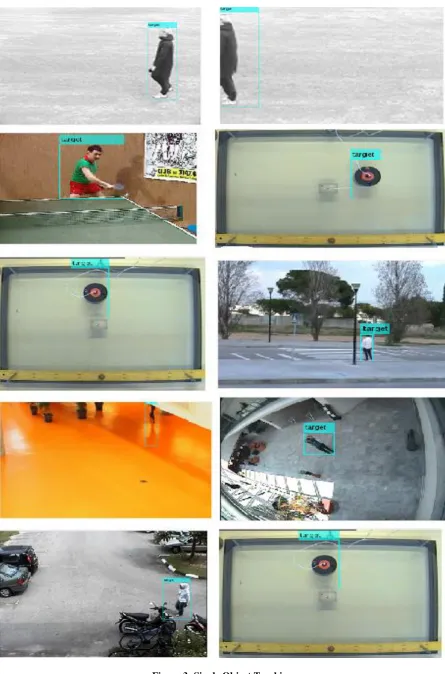
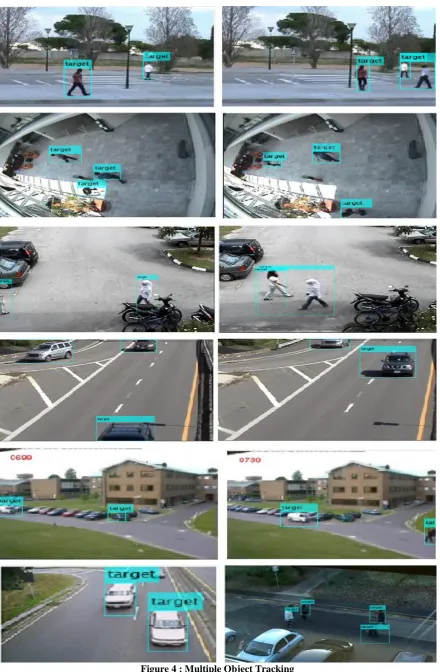
The proposed algorithm was used to track single and multiple objects in various frame sequences. According to the results obtained the proposed algorithm is successful to track single and multiple targets. The developed algorithm is efficient even in the presence of dynamic motion and partial occlusion. We have implemented the proposed algorithm in Matlab. The video datasets were obtained from PETS2004/2005 and video surveillance repository. The results obtained are for single object tracking are shown in figure 2 and results of multiple objects tracking are shown in Figure 3. With reference to results shown in [14] Lehigh Omnidirectional Tracking System has achieved the best results Lehigh Omnidirectional Tracking System which is used to detect small non cooperative targets such as snipers only. In comparison with the results obtained by our enhanced non-linear probabilistic multiple target tracking method are better.
Performance Parameters Existing Technique (LOTS)
New Technique (EPBT)
Correct Detection 91.2 94.6
False Alarm 7.2 6.1
Object Detection Rate - 0.94
IJEDR1504095
International Journal of Engineering Development and Research (www.ijedr.org)575
Figure 4 : Multiple Object TrackingVII.CONCLUSION AND FUTURE SCOPE
IJEDR1504095
International Journal of Engineering Development and Research (www.ijedr.org)576
computation time. The probabilities are calculated using combined particle filter and kalman filter. The method is able to manage partial occlusion. The performance of the proposed probabilistic method is assessed based on the object tracking parameters. According to the results obtained the developed method is efficient and tracks the objects with more accuracy and less computation time. The probabilities are calculated using combined particle filter and kalman filter approach after track initialization using frame differencing method. This method is suitable for tracking object based on the motion of the objects and it is also able to track the objects showing non-linear motion and track the objects in case of partial occlusion. This work had concluded that combined particle filter and kalman filter approach has shown better results. Sequential importance resampling generates a better particle set as compared to the importance sampling. The probability based technique is more accurate and requires fewer computations.REFERENCES
[1] Alan J. Lipton, Hironobu Fujiyoshi, and Raju S. Patil, “Moving Target Classification and Tracking from Real-time Video”, Proc. IEEE Workshop Application of Computer Vision. 1998
[2] Alper Yilmaz ,Omar Javed and Mubarak Shah, “Object Tracking: A Survey”, ACM Computing Surveys, Vol. 38, No. 4, Article 13, December 2006.
[3] Andres Alarcon Ramirez and Mohamed Chouikha, “A New Algorithm for Tracking Objects in Videos of Cluttered Scenes”, International Journal of Information Technology, Modeling and Computing (IJITMC) Vol.1, No.2, May 2013
[4] Barga Deori1 and Dalton Meitei Thounaojam, “A survey on moving object tracking in video”, International Journal on Information Theory (IJIT), Vol.3, No.3, July 2014
[5] G. Mallikarjuna Rao and Dr.Ch.Satyanarayana, “Object Tracking System Using Approximate Median Filter, Kalman Filter and Dynamic Template Matching”, I.J. Intelligent Systems and Applications, 2014
[6] Himani S. Parekh, Darshak G. Thakore and Udesang K. Jaliya, “A Survey on Object Detection and Tracking Methods ”,Springer, 2014
[7] Ismail Haritaoglu, David Harwood, and Larry S. Davis, “Real-Time Surveillance of People and Their Activities”, IEEE Transactions on Pattern Analysis and Machine Intelligence, 2000.
[8] Kiran .S. Khandar and Nilima R. Kharsan, “Digital Image Processing Techniques for Object Tracking System Using Kalman Filter”, International Journal of Scientific Engineering and Research ISSN (Online): 2347‐3878 Volume 2 Issue 6, June 2014
[9] Muammer Catak, “A probabilistic object tracking model based on condensation algorithm” Springer, 2014 [10] P.Subhashini, “ Multiple Object Tracking and Segmentation in Video Sequences ” ,
[11] International Journal of Advance Research in Computer Science and Management ,2014
[12] R. B. Khanderay and D.S.Patil, “Moving body/object detection and tracking”, International Journal on Information Theory (IJIT), Vol.3, No.3, July 2014
[13] Vishwadeep Uttamrao Landge, “Object Detection and Object Tracking using background Subtraction for Surveillance ”,IJAREE volume 3, Issue 7, July 2014
[14] Jacinto Nascimento , “Performance evaluation of object detection algorithms for video surveillance” IEEE .
[15] Md. Zahidul Islam, Chi-Min Oh and Chil-Woo Lee “Video Based Moving Object Tracking by Particle Filter” International Journal of Signal Processing, Image Processing and Pattern Vol. 2, No.1, March, 2009
[16] C. HUE J-P. LE CADR “Tracking Objects with Particle Filtering” IEEE transactions on aerospace and electronic systems. 38, no. 3 july 2002
[17] Tripthy Singh, Sanju S and Bichu Vijay, “A New Algorithm Designing for Detection of Moving Objects in Video”, International Journal of Computer Applications, Volume 96– No.2, June 2014
[18] Barga Deori and Dalton Meitei Thounaojam, “ A Survey on Moving Object Tracking in Video”, International Journal on Information Theory (IJIT), Vol.3, No.3, July 2014
[19] Andres Alarcon Ramirez and Mohamed Chouikha, “A New Algorithm for Tracking Objects in Videos of Cluttered Scenes”, International Journal of Information Technology, Modeling and Computing (IJITMC) Vol.1, No.2, May 2013
[20] K. Nummiaro, E. Koller-Meier, and L. Van Gool, “A color-based particle filter”, In Proc. First International Workshop on Generative-Model-Based Vision, 2002, pp. 53 – 60.