ADAPTIVE WEIGHTED-COVARIANCE REGULARIZED
KERNEL FUZZY C MEANS ALGORITHM FOR MEDICAL
IMAGE SEGMENTATION
1HEMALATHA K. L., 2DR. SUNILKUMAR MANVI, 3DR. H.N. SURESH
1
Research Scholar, REVA university, Bangaluru, Dept. of Computing and IT, India
2
Director
,
REVA University, Bangaluru, Dept. of Computing and IT, India3
Professor & Coordinator for PG Studies & Research, Bangalore Institute of Technology, Dept. of
Electronics and Instrumentation Technology, India
E-mail: [email protected], [email protected], [email protected]
ABSTRACT
Image segmentation is the most common method used to analyze and locate deformities in medical images. Clustering is a technique used in segmentation to group up similar data in a single cluster. FCM is the successful clustering technique employed, which is repeatedly modified by the researcher to make it more robust against noise. In this paper, we present an improved kernel FCM algorithm for image segmentation by introducing a regularization parameter with covariance weighted fuzzy factor and a Gaussian kernel metric. It calculates and uses the heterogeneity of gray scales in the neighborhood location for acquiring local contextual information and replaces the standard Euclidean distance with Gaussian radial basis kernel functions. The main advantages are adaptiveness to local context, preserve image details with enhanced robustness, independence of clustering parameters and decreased computational costs. The experiments are done in Brain Magnetic Resonance Images (MRI) and results are analyzed, show that the proposed algorithm is better segmentation accuracy and efficiency than the other methods.
Keywords: Fuzzy c-means; Gaussian Kernel; Medical images; Weighted Covariance; Magnetic
Resonance Imaging.
1. INTRODUCTION
Medical imaging is the process of observing the interior parts of the body, which aims at the maintenance of health, the prevention and treatment of disease. Many advanced techniques have been made in modern medicine to improve the collection of information about the human body. It helps in finding the abnormalities in brain, lungs, bones, tissues etc. The goal is to represent a set of meaningful areas from a single image by means of splitting it. It is very important to typically view the details of medical images where both the pre and post-surgery decisions are required in diagnosis because treatments are normally sensitive to particular disease. Many approaches on segmentation have been proposed so far [1], [2]. Clustering technique has a wide and rich history of successful image information among all. The process of converting a dataset by clusters, which are the group of data points that belong together, is
known as clustering [3]. It is done by grouping the data in the form of their properties and characteristics. Hard and soft clustering schemes are the two major classifications used, FCM is one of the major techniques used to perform medical image segmentation and it earns satisfactory results in many applications [4]. Although the FCM is good at noise free images, it lags to blend some clear information about the features of the image like location, surface etc. There comes the fuzzy c-means scheme, which gives advanced accuracy of feature description in medical image segmentation [5]. Generally, each pixel of a region in an image will have some properties; those properties are well identified and represented by the use of FCM method.
extensive set of possibilities [7], [8]. But it provides only limited knowledge about the selection of suitable kernel for a particular task. Although many kernel selection methods have been introduced, the need of producing suitable kernels is still increasing which gives raise to the repeated modification in the kernel FCM [9]. A new method of image segmentation is conducted using Adaptive Weighted-covariance regularized Kernel Fuzzy C Means (AWCKFCM), which is to provide segmentation method with less complexity. The kernel selection and control of contextual information is increased in this technique with the help of weighted [10] covariance image design. The input image is pre-processed and the clusters are formed by the feature extraction technique. FCM’s general equation or objective function is found and the spatial contents are added. The kernel metric function is derived by including a regularization parameter and a weighted covariance image calculation, so as to find the distribution of pixels in the local window with respect to its center and neighbor, which helps in producing accurate image details. At last, the new objective function is then acquired by combining the information of regularized parameter with weighted kernel function, which are continuously iterated and the pixels can be classified. The algorithms have been validated in both clinical MRI of brain medical and multimedia images with different types and levels of noises and compared with four recent soft clustering algorithms such as K-Means, FCM,
KFCM, PSO-SFCM, and ABC- KFCM
respectively. The accuracy of the proposed ARKFCM is calculated by applying the condition noise, i.e the images are tested with and without noise values. The pixel error count and the centroid estimation are the two parameters used in the validation of accuracy. Further, the variance occurred in the pixel generation and their behavior is described as well in the resulting portion.
The proposed adaptive weighted covariance based KFCM algorithm is superior in preserving image details and segmentation accuracy while maintaining a low computational complexity. Also, it provides a solution for various segmentation problems like lack of robustness to outliers, high computational cost, loss of pixel clarity and loss of image details
The remaining of this paper is organized as follows. Section 2 gives some brief background of researches related to the proposed technique. The background of the research is explained in section 3. Section 4 describes the proposed scheme. The
experimental results and discussions of the proposed approach are presented in Section 5. Finally, conclusions are summarized in Section 6.
2. LITERATURE REVIEW
Kernel FCM is one of the widely used algorithms which is constantly experimented and modified to give better knowledge about spatial information. Fuhua Zheng et al [11] proposed a fast anti-noise FCM algorithm to reduce the effect of noise by constructing spatial information with the help of pixel value and membership function combination. It gives limited clustering performance, which can be made possible by the use of adaptive choose of optimal parameters. Whereas, proposed FCM approach consumed more time for segmentation and showed complexity to the system.
Weighted fuzzy factor and kernel metric method has been proposed by R.Shalini, V. Muralidharan and M. Varatharaj [12] to identify the tumor cells in brain MR images, which has given improvement in accuracy of segmentation. The details of the pixel distribution can be improved by regularizing the weighted trade-off fuzzy factor. The use of regularization parameter to calculate weight in this paper will result in the selection of best pixel values. The proposed scheme showed comparable outcome in case of more noise, a suitable noise removal factor was to be included.
P.Sivasangareswari, K.Sathish Kumar has made a modification in FCM algorithm [13] based on distance metric to satisfy the problem of intensity in homogeneities and noise. Distance metric has been introduced to reduce the random number of variables from the segmented image of modified FCM. The local neighbor relationship is controlled adaptively with a trade-off fuzzy method, but it leads to misclassification of the kernels associated with the image.
Another method of kernel weighted FCM is proposed earlier by S. Santhosh Kumar, James Albert [14] in which the area of the tumor is calculated and shape is analyzed using edge detection technique. It improves FCM by introducing the weights for pixels within local neighbor windows, but the edge detection is followed by the morphological filtering method which carries more number of iterations. This technique segment only normal brain tissue, the abnormal tissue classification was absent.
enhanced robustness against loss of pixel details with a regularized parameter inclusion but it requires more number of iterations as it is required to calculate the local coefficient of variance with a square value. The variation of changes between dispersed pixel particles consumes time, thus covariance of weighted image is determined in the proposed algorithm to save time and complexity, which keeps the center pixel as constant and iterates the neighbor pixels. The system was complex when the number of features or iteration was more, thus weight method has been used in our research.
To overcome the above mentioned drawbacks, an effective algorithm is implemented in K-FCM, which enhances the procedure acclimated in our anticipated strategy.
3. PROPOSED SYSTEM
In FCM algorithm, the clusters in the image space are formed by assigning a membership value to each pixel. Fuzzy c-means (FCM) is a clustering method that permits one bit of data to be in the right position to two or more clusters. FCM begins with a starting guess for the cluster centers that are suggested to spot mean location of every cluster. The primary guess for these cluster centers is most like erroneous. Also, FCM allots each data point a membership ranks for every cluster. FCM repeatedly shifts the cluster centers towards the correct place inside a dataset through repeatedly updating the centers of the cluster & the membership grades for every data point. This repetition is based on minimizing an objective function that symbolizes the distance from any given data point to a cluster center weighted by that data point's membership rank.
3.1 Deriving the FCM’s general objective function
The initial step of the algorithm is to find the general equation or objective function of the Conventional FCM. The membership function is also achieved after obtaining the objective function of FCM which is denoted asJFCM. Let I be an image that consist of a set of grayscales xi at
pixeli i( =1, 2,...,N), { ,1 2,... } k N
X = x x x ⊂R in
k-dimensional space and cluster centers
1 2
{ , ,... }c
v= v v v with c being a positive integer (2< <<c N), and uij is the membership
value for each pixel i in jth cluster (j=1, 2,..., )c . The objective function of the FCM algorithm is stated as
2
1 1
|| || ,
N c
m
FCM ij i j
i j
J u x v
= =
=
∑∑
− (1)Here in Eq. 1, m is a weighting exponent to the degree of fuzziness, m>1 and ||xi−vj||2is the
grayscale distance between i and vj . Cost
function is reduced when high membership values are allocated to pixels near to the centroid of their respective clusters, then low membership values are allocated to pixels with data far from the centroid. The probability that a pixel belongs to a specific cluster signifies by the membership function. The probability is reliant only on the distance between the pixel & every single cluster centered in the feature domain in the FCM algorithm.
1 1, c ij j u = =
∑
uij∈[0,1],1 0 N ij i u N −
≤
∑
≤ (2)Using the alternate optimization method
membership function and cluster centers are updated iteratively
2 2 1/ ( 1)
1
1
,
(|| || / || || )
ij c m
i j i k
k u
x v x v −
= = − −
∑
1 1 , N m ij i ij N m
ij i u x v u − = =
∑
∑
(3)The presence of noise and image artifacts in FCM can be decreased by adding the external parameter to the fuzziness functionJFCM . One of
the imperative attributes of an image is that neighboring pixels are exceedingly correlated. It means that, these neighboring pixels have comparative feature values, & the possibility that they have a place with the same cluster is incredible. In clustering this spatial relation is essential, however, in a standard FCM algorithm it is not used. Thus, in this system, spatial information of neighboring pixels are combined with the general equation, this can be denoted as
2 _ 1 1 2 1 1 || || ( || || ), i N c m
FCM S ij i j
i j
N c m
ij r j
i j r N
R
J u x v
u x v
N α = = = = ∈ = − + −
∑∑
∑∑ ∑
(4)Where α a parameter to manage spatial information of neighbors is Ni is the set of pixel
and Nris the cardinality ofNi. In a homogenous
stays unaltered. For a noisy pixel, on the other hand, this formula decreases a noisy cluster’s weighting through the labels of its neighboring pixels. Consequently, misclassified pixels from noisy regions or spurious blobs can effortlessly be revised.
To avoid the neighborhood function to be calculated at every step as it is not so easy to be done frequently, it is decreased by the addition of
the term 2
(1 / ) || ||
R
R r N i j
N
∑
∈ x −v with 2||xi−vj|| ,
need to calculate once and used in a repetitive manner where x is the grayscale of a filtered image.
2 _ 1,2
1 1
2
1 1
|| ||
|| || ,
N c
m
FCM S ij i j
i j
N c
m
ij i j
i j
J u x v
u x v
α
= =
= =
= −
+ −
∑∑
∑∑
(5)
In addition, a Gaussian kernel-based FCM is proposed which calculates the parameter ηj at
every step of the iterations to replace α for every cluster.
The clustering is consisting of a two-pass procedure at every repetition. The first pass is similar like that in conventional FCM to compute membership function in spectral domain. In second pass, every pixel’s membership information is mapped to spatial domain, & spatial function is calculated from that. The FCM repetition continues with the new membership that is combined with the spatial function. The repetition is halted when the maximum dissimilarity between two cluster centers at two continuous repetitions is less than a threshold (=0.02). After the convergence, defuzzification is employed to allocate every pixel to a particular cluster for which the membership is maximal. Membership optimization leads a better clustering average. Here we choose sFCM 1,0 and sFCM 2,0 for testing. But optimization in centroid is highly challengeable. So we are introducing modified centroid weight particle swarm optimization. Then the kernel functions are used here to calculate the parameter value. With the intention to overcome the problem of the standard FCM algorithm, the KFCM algorithm is designed. With the aid of a nonlinear mapping function, the KFCM converts the input data in the image plane into higher dimensional feature space. The complex and nonlinear separable problem in the input plane can be converted with the aid of the mapping function into linearly separable in the future space, which is given by
min (1 ( , ))
, max (1 ( , ))
j j j j
j
k k
K v v
K v x
η ′≠ − ′
=
− (6)
HereK is the kernel function. This could give better results than FCM_S1 and FCM_S2. But it requires large number of patterns and many cluster centers to find the optimal value forηj. To
overcome this problem, the spatial context and grayscale information of the neighboring pixels are combined in the later algorithm using a fuzzy factor. The fuzzy factor Gijwas included in the objective function of the FCM i.e., (1) as follows
2
1 1
[ || || ],
N c
m
FLICM ij i j ij
i j
J u x v G
= =
=
∑∑
− +(7)
A weighted fuzzy factor ' ij
G has been derived as
'
,
(1 ) (1 ( , )), I
m
ij ik ij i j
k N i k
G ω u K x v
∈ ≠
=
∑
− − (8)Will control the local neighbor relationship and replace the Euclidean distance with a kernel function, where ωikdenotes the trade-off weighted
fuzzy factor around the central pixel i and
1−K x v( ,i j) is the kernel metric function.
3.2 The introduced regularization term
The parameter α used is to estimate the power of noise present in an image. It helps regularizing the pixel information present in the features of the image. The features affected by more noises are able to be corrected in this step with the suitable selection and application of regularization term. If
i
ϕ is too large, the regularized solution is under-smoothed, while if ϕi is too small, the regularized
solution does not fit the given data properly. A good recovered image can be obtained by choosing a suitableϕi. In general, the strength of the regularization relates to the noise level: the more severe the noise, the larger the regularization. Thus, regularization term used in this system denotes the variation of the features according to the noise. If the evaluated regularization parameter is higher, then it denotes the image containing more noise. The setting up of the regularization parameter needs a prior knowledge about noise data which is not easily possible. Hence, adaptive calculation of is necessary according to the pixel being processed.
the inverse of the covariance between all neighborhood pixels and the center pixel.
Consider the covariance equation of pixels xi
and vi as follows,
1
( )( )
cov( , )
1 i
i
N
k i k i
k N i i i
i
x x v v
x v N < = − − = −
∑ ∑
(9)Where xkis the grayscale of any pixel falling in the local window is set Ni around the pixel and
i
x is its mean gray scale value. Then the covariance equation cov( , )x vi i is applied to derive the
corresponding weights within the local window and it is denoted asωi.
1 cov( , )
i
i i x v
ω =
This can also be determined as
1
cov( , )
i x vi i
ω = − (10)
The regularization parameter is calculated with the ultimate weight assigned to every pixel in the local window 2 2 0 i i i ω ϕ ω + = − i i i i i i x x x x x x < > = (11)
The parameter ϕiassigns higher values for those
pixels with high covariance (for pixel being brighter than the average grayscale of its neighbors,
i
ϕ will be 2+ωi, and ωi will be large when the sum of covariance within its neighborhood is large) and lower values otherwise. The proposed parameter ϕi is embedded into the eq (5). The ϕi will get into a
homogenous clustering according to the pixel distribution (11) while the other existing algorithms tend to make the clustering.
That yields more homogeneous labels by incorporating the contextual information.
3.3 Devising a Weighted Image
The grayscale value of the median filter from the original image x can also be replaced by the newly formed weighted image, shown in (12). It is formed by utilizing ϕi obviously for making the weighted
image free from parameters that are difficult to adjust.
1 max( ) 1
2 max( ) 1 i
i
i i r
r N i R x x N ϕ ξ ϕ ∈ + = + + −
∑
(12)In which xr and Ni are the grayscale and
neighborhood of pixel iand Nris the cardinality ofNi.
3.4 Measuring distance using kernel function
The Euclidean distance metric is converted into a kernel metric as it is robust against outliers and noise. The kernel functions are able to project the data into higher dimensional space where the data could be more easily separated. Thus the Euclidean
distance term 2
||xi−vj|| is replaced
by|| ( )ϕ xi −ϕ( ) ||vj 2.
2
|| ( ) ( ) || ( , )
( , ) 2 ( , )
i j i i
j j i j
x v K x x
K v v K x v
ϕ −ϕ =
+ − (13)
Where K is the kernel function. This paper also uses Gaussian Radial Basis Function (GRBF), which is a popular kernel function used in various Kernalized learning algorithms to modify the derived kernel function as
2
|| ( )ϕ xi −ϕ( ) ||vj =2(1−K x v( ,i j)) (14)
The adaptive regularization parameter and kernel metric distance (14) are now replaced into the objective function of FCM as
1 1 1 1
(1 ( , ))
2
(1 ( , ))
m
ij i j
N c N c
AWCFCM m
i j i ij i j
i j
u K x v
J
u K x v
ϕ = = = = − = + −
∑∑ ∑∑
(15)This equation will goes into an alternate optimization to produce JAWCKFCM( , )u v as follows
1 ( 1)
1 ( 1)
1
((1 ( , )) (1 ( , )))
(1 ( , ) (1 ( , )))
m
m
i j i i j
ij N
i k i i j
i
K x v K x v
u
K x v K x v
ϕ ϕ − − − − = − + − = − + −
∑
(16) 1 1 ( ( , )) ( , ) ) ( ( , ) ( , )) N mij i j i i j i
i
j N m
ij i j i i j
i
u K x v K x v x
v
u K x v K x v
ϕ ϕ = = + = +
∑
∑
(17)When xi is replaced with the weighted image
i
ξ that is applied in eq (12), to get the objective function algorithm as AWCKFCMw(15) and the membership function and cluster centres for newly formed AWCKFCM is denoted as (16), (17).
heterogeneity of local grayscale distribution. It is generalized by the effective use of regularizing weighted covariance parameter which safeguards the image quality. Each component present in the pixel is examined and elaborated by the design of weighted coefficient parameters in the kernels. This designed algorithm will differentiate noise from meaningful data, where meaningful data contains the spatial characteristics of the picture. Noises present in the image are further removed by the estimation of weights.
4. EXPERIMENTAL RESULT
The AWCKFCM algorithm is implemented using MATLAB software packages. Every experiments are conducted with window size of 3 × 3 pixels, maximum number of iterations = 100, and = 0.001. The accuracy of segmentation is measured using the Jaccard Similarity (JS) metric [18] which is defined as the ratio between the intersection and union of segmented volume 1 and ground truth volume 2.
1 2
1 2
1 2
( ,
)
S
S
JS S S
S
S
∩
=
∪
(18)
The proposed Adaptive Weighted-covariance KFCM result in producing strong robustness and better performance over other existing algorithms. The weighting factor with the combination of covariance is a measure of the collinearity between the center pixel and the pixels in local window and takes into account the compactness of pixels in the clusters. The result improves the representation of pixel details, as well as good at noisy images. The proposed methodology is evaluated by comparing it with the existing algorithms and a series of segmented images and their information are collected. The k-means, FCM [17], Kernel FCM [9], Particle Swarm Optimization-SFCM (PSO-SFCM), and Artificial Bee Colony KFCM are taken into consideration. Estimation of covariance weight leads to better kernel selection and clustering formation that is done based on AWCKFCM algorithm. It show good balance between smooth borders and preserving image details due to the
introduction of adaptive local contextual
information measure
ϕ
i to replace the fixed valueof
α
. The covariance measure introduced in the local contextual information classifies the pixels affected by noise and gradually makes it efficient by comparing dispersion of the pixel with its centre and neighbour. This section begins with thecomparison of the traditional K-Means, FCM and KFCM by means of its merits and demerits.
K-Means algorithm is a fast, robust and provides tighter clusters normally easy to understand. But it contains problems such as presence of noise and outliers in the image and also it fails to solve non-linear type of datasets. The other problem is that the two highly overlapping data cannot resolve into two clusters. FCM gives best result for overlapped data set and comparatively better then k-means algorithm. Data point is assigned membership to each cluster center as a result of which data point may belong to more than one cluster center. But it is expense for more number of iterations and Euclidean distance measures can unequally weight underlying factors.
The kernel based combination of the FCM i.e, KFCM algorithm suits well for all types of medical images. It has high efficiency, low time requirement, and successive clusters distribution. Thus, it is used in this paper. The multiple KFCM and their combination with the hybrid classifiers are evaluated by performing experiments on the medical data sets and the results are tabulated for verification that is shown in the following part. SFCM-MPSO is a novel method that has a global searching ability in the feature segmentation naturally. However, the maximum and minimum velocity of particles has obvious impact on the convergence rate and it affects the efficiency [18]. ABC-KFCM is also a new method introduced to solve the segmentation problems found in the traditional methods. It is providing comparatively high efficiency than the other methods mentioned above. Thus, by considering these algorithm methods, the proposed algorithm is designed and experiments are done to demonstrate their performance over the other technique.
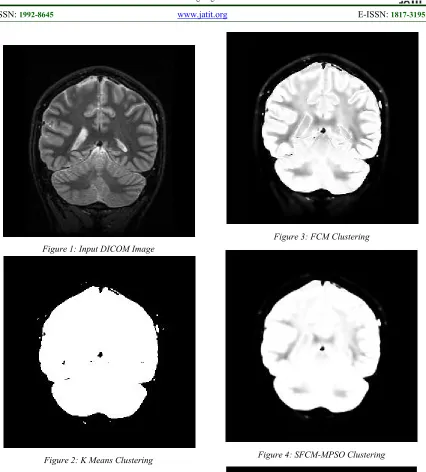
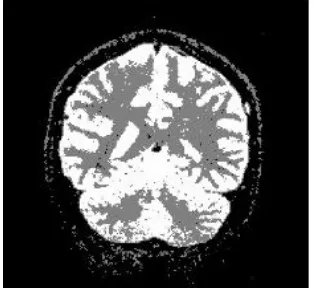
Many investigations have been carried out so far on using contextual information and grayscale values to enhance the quality of segmentation. But how the contextual information shall be used effectively is still a challenge. The below mentioned figure analysis fig 1, 2, 3, 4, 5, 6 clearly shows that the proposed AWCKFCM algorithm performs well in medical image representation. A normal input image fig 1. is taken from Digital Imaging and Communications in Medicine (DICOM) studies and experiments are conducted with the above
mentioned algorithms. The application of
regularized parameter containing weighted
Figure 1: Input DICOM Image
Figure 2: K Means Clustering
[image:7.612.325.512.522.709.2]Figure 3: FCM Clustering
Figure 4: SFCM-MPSO Clustering
Figure 6: Proposed AWCKFCM
The table 1 and table 2 denotes the ranges of the k-means, FCM, KFCM, PSO-SFCM, ABC-KFCM and the proposed AWCKFCM by means of accuracy of segmentation. The centroid value
[image:8.612.66.550.369.577.2]represents the average accuracy of segmentation. It also calculates the pixel error value with the centroid, which is given in table 2.
Table 1: Comparison analysis of segmentation accuracy and pixel error for medical images
Table 2: Comparison analysis of segmentation accuracy and pixel error for multimedia images
Method
Pixel Error Count and Cluster Centers
Segmenta tion Accuracy
Time
Centroids Error
Pixel Centroids
Error Pixel
Average Accuracy
In (secs)
K-Means 6.6254, 98.6115 1195 6.4421, 77.6890, 125.2745 1201 91.68 50.73
FCM 6.7935, 101.1125 976 6.154, 76.2868, 123.0570 987 93.18 72.22
KFCM 6.2517, 99.9285 522 121.5948, 70.2040, 4.3013 548 96.28 75.56
PSO-SFCM 6.7106, 99.1261 437 76.2868, 6.1541, 123.0570 440 96.95 99.45
ABC-KFCM 6.2476, 99.9264 424 121.5908, 70.1984, 4.2976 429 97.03 98.37
Proposed AWCKFCM Without Noise
6.2474, 99.1042 420 121.5818, 70.1978, 4.2865 425 97.61 89.70
Proposed AWCKFCM With Noise 30%
6.2517, 99.9342 654 122.6012, 70.2531, 4.3013 673 96.88 88.55
Method Pixel Error Count and Cluster Centers
Segmentation Accuracy Time
Centroids Error
Pixel Centroids
Error
Pixel Average Accuracy
(in sec)
K-Means 151.4870,
25.5933
63655 121.0076, 167.7719, 22.3747
63667 75.73 124.59
FCM 153.6055, 25.0161
59223 122.3355, 168.4849, 20.4672
59238 77.40 133.45
KFCM 23.5953,
154.3047
51236 18.3111, 168.1686, 121.3009
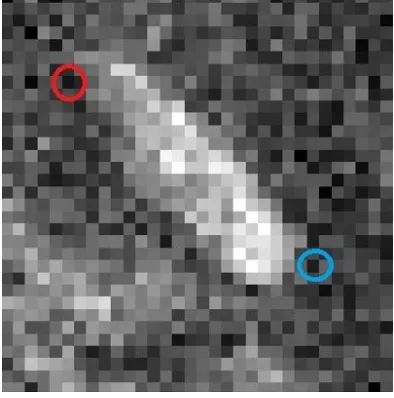
Figure 7: Input image
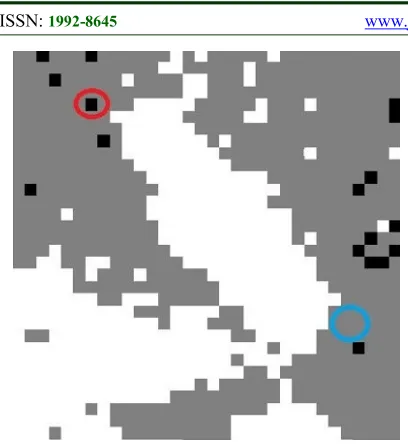
Figure 8: KFCM using variance method
4.2 Variance method
The above given figures indicate the change of pixels with respect to other pixels instead of center.
[image:9.612.319.516.340.539.2]In figure 7 and Figure 8, the blue marked pixel tends to behave as the neighboring pixel because of the rapid change occurred. Whereas the red marked pixel retains its originality in local window as there is low noise surrounded by it. It will not deviate with the consideration of central pixel which makes a contradiction of variation in pixels. Thus it is necessary to replace variance with covariance factor which performs deviation by focusing the central pixels.
Figure 9: Input image
PSO-SFCM 153.6055,
25.0161
48744 118.1560, 167.5352, 21.7026
48751 81.40 145.87
ABC- KFCM 23.5943,
154.2998
40589 18.3012, 168.1643, 121.2986
40899 84.45 144.44
Proposed AWCKFCM Without Noise
23.5936, 154.2094
40322 18.3012, 168.1566, 121.2984
40573 85.67 139.78
Proposed AWCKFCM With Noise 30%
23.5953, 154.4471
52387 18.3210, 168.1684, 121.2988
Figure 10: KFCM using covariance method
4.3 Determination of covariance factor
The figure 9 and figure 10 shows the difference of pixel formation due to its center and neighbor. In figure1, the red color circle denotes the condition that central pixel is free from noise and some pixels within its local window may be corrupted by noise. The central pixel tends to suppress the outlier or neighbor pixel and retain its originality shown in fig8. Whereas the blue circle denotes the case that the central pixel is corrupted by noise, while the other pixels within its local window are
homogenous, not corrupted by noise, the
distribution of the neighboring pixel alters the center and forms a cluster as shown in fig 9 & 10
.
4.4 Comparison of the proposed system with other system.The proposed algorithm and its application are compared with an early literature given by Ramani
et al. [19] shows that combination of FCM with the
Association Rule mining concept. The algorithm is developed by the researchers to remove the cyclic repeated patterns in sequential pattern mining (SPM) application, which comes under data mining category. The performance is measured by calculating the execution time, memory and database difference ratio. Whereas, our research is used for the application of medical sciences that deals with clinical MRI scan images that implements the pixel based classification technique. In both the methods, the clusters are formed with the help of FCM clustering algorithm and each features are added are added separately to provide
various applications. The threshold value
determination is added in [19] helps in identifying the sequential patterns found hidden in the data
[image:10.612.313.524.189.449.2]mining applications, whereas the spatial kernel metrics based weighted covariance added in this system helps in identification of pixels found in the diseased part of the medical images. The difference of characteristics between the two algorithms has been explained in the below table.
Table 3: Comparison of application in SPM-FCM and the proposed ARKFCM
Algorithm s
Process Data
used
Evaluation parameter Ramani et
al [19] (The support of
the sequential pattern for the real life data mining application)
Clustering FCM, clusters formation,
rule generation , fixing of threshold values,
Ming data- Set
mining data repository
Execution time, memory and
database difference
ratio
ARKFCM (Pixel based classificatio n technique
in solving segmentatio n problems faced by medical applications
)
Clustering FCM, Spatial addition,
Kernel function, Regulariz ation, devising a
weighted covarianc
e
Clinical data-MRI
brain image
data
Pixel error count, centroids,
variance among
pixels
5. CONCLUSION
calculated to get the accuracy of the compared systems. It shows that AWCKFCM is efficient among the other algorithms and it provides good segmentation accuracy even in the presence of noise. Further, new techniques can be developed in with the knowledge of the system and by combining the AWCKFCM with some hybrid classifiers, which can be taken as a future research.
REFRENCES:
[1] H.S. Prasantha, Dr. H.L. Shashidhara, Dr. K.N.B. Murthy, and G.M. Lata, “Medical Image
Segmentation”, International Journal on
Computer Science and Engineering, Vol. 2,
2010.
[2] A. Elnakib, G. Gimel’farb, J.S. Suri, and A. El-Baz, “Medical image segmentation: a brief survey”, Proceedings of Multi-Modality State-of-the-Art Medical Image Segmentation and Registration Methodologies, pp. 1-39, 2011.
[3] P.T. Selvy, V. Palanisamy, and T.
Purusothaman, “Performance Analysis of
Clustering Algorithms in Brain Tumor
Detection of MR Images”, European Journal of Scientific Research, Vol. 62, 2011.
[4] B. Caldairou, N. Passat, P.A. Habas, C. Studholme, and F. Rousseau, “A non-local fuzzy segmentation method: application to brain MRI”, Journal of Pattern Recognition, Vol. 44, No. 9, pp. 1916-1927, 2011.
[5] S.R. Kannan, “A new segmentation system for brain MR images based on fuzzy techniques”,
Applied Soft Computing, Vol. 8, No. 4, pp. 1599-1606, 2008.
[6] S.R. Kannana, A. Sathya, S. Ramathilagam, and R. Devi, “Novel segmentation algorithm in
segmenting medical images”, Journal of
Systems and Software, Vol. 83, No. 12, pp. 2487-2495, 2010.
[7] P. Kaur, A.K. Soni, and A. Gosain, “A robust
kernelized intuitionistic fuzzy c-means
clustering algorithm in segmentation of noisy medical images”, Pattern Recognition Letters, Vol. 34, No. 2, pp. 163-175, 2013.
[8] S.N. Sulaiman, and N.A.M. Isa, “Adaptive Fuzzy-K- means clustering algorithm for image
segmentation”, IEEE Transactions on
Consumer Electronics, Vol. 56, No. 4, 2014.
[9] S.R. Kannan, S. Ramathilagam, R. Devi, and A. Sathya, “Robust kernel FCM in segmentation of breast medical images”, Journal of Expert Systems with Applications, Vol. 38, No. 4, pp. 4382-4389, 2011.
[10] S. Ramathilagam, R. Pandiyarajan, A. Sathya, R. Devi, and S.R. Kannan, “Modified fuzzy c-means algorithm for segmentation of
T1–T2-weighted brain MRI”, Journal of
Computational and Applied Mathematics, Vol.
235, No. 6, pp. 1578-1586, 2011.
[11] F. Zheng, C. Zhang, X. Zhang, and Y. Liu, “A fast anti-noise fuzzy C-means algorithm for image segmentation”, Proceedings of 20th IEEE International Conference on Image
Processing (ICIP), pp. 2728-2732, 2013.
[12] R. Shalini, V. Muralidharan, and M. Varatharaj, “MRI Brain Tumor Segmentation using Kernel Weighted Fuzzy Clustering”, International Journal of Engineering, Vol. 3, No. 4, 2014. [13] P. Sivasangareswari, and K.S. Kumar, “Fuzzy
C-Means Clustering with Local Information and Kernel Metric for Image Segmentation”,
International Journal of Advanced Research in Computer Science & Technology, Vol. 2, 2014. [14] S.S. Kumar, and J. Albert, “Medical Image
Segmentation using Kernel Weighted Fuzzy Clustering (KWFC) Algorithm”, International Journal of Inventions in Computer Science and Engineering, Vol. 1, No. 9, 2014.
[15] A. Elazab, C. Wang, F. Jia, J. Wu, G. Li, and Q. Hu, “Segmentation of Brain Tissues from Magnetic Resonance Images Using Adaptively
Regularized Kernel-Based Fuzzy-Means
Clustering”, Computational and Mathematical
Methods in Medicine, Vol. 2015, 2015.
[16] A. Rammal, E. Perrin, V. Vrabie, I. Bertrand, and B. Chabbert, “Weighted-covariance factor fuzzy c- means clustering”, Proceedings of
Third International Conference on
Technological Advances in Electrical,
Electronics and Computer Engineering
(TAEECE), pp. 144-149, 2015.
[17] S.N. Sulaiman, N.A. Non, I.S. Isa, and N. Hamzah, “Segmentation of Brain MRI Image
Based on Clustering Algorithm”, Energy,
Environment, Biology and Biomedicine, pp. 54,
2014.
[18] J. He, and H. Guo, “A modified particle swarm
optimization algorithm,” TELKOMNIKA
Indonesian Journal of Electrical Engineering, Vol. 11, No. 10, pp. 6209-6215, 2013.
[19] R. Selvanambi, and J. Natarajan, “Cyclic Repeated Patterns in Sequential Pattern Mining Based on the Fuzzy C-Means Clustering and
Association Rule Mining Technique”,
International Journal of Intelligent Engineering