University of South Carolina
Scholar Commons
Theses and Dissertations
5-8-2015
Diagnostics and Model Selection for Generalized
Linear Models and Generalized Estimating
Equations
Chelsea Boquet Deroche University of South Carolina - Columbia
Follow this and additional works at:https://scholarcommons.sc.edu/etd
Part of theEpidemiology Commons
This Open Access Dissertation is brought to you by Scholar Commons. It has been accepted for inclusion in Theses and Dissertations by an authorized administrator of Scholar Commons. For more information, please [email protected].
Recommended Citation
DIAGNOSTICS AND MODEL SELECTION FOR GENERALIZED
LINEAR MODELS AND GENERALIZED ESTIMATING EQUATIONS
by
Chelsea Boquet Deroche
Bachelor of Science Nicholls State University, 2009
Master of Science
Louisiana State University, 2011
Submitted in Partial Fulfillment of the Requirements
For the Degree of Doctor of Philosophy in
Biostatistics
The Norman J. Arnold School of Public Health
University of South Carolina
2015
Accepted by:
James W. Hardin, Major Professor
Suzanne McDermott, Committee Member
Bo Cai, Committee Member
Kevin Bennett, Committee Member
DEDICATION
I dedicate this dissertation to my loving and understanding husband Joshua
Deroche, my encouraging and compassionate parents Kevin and Martina (Tina) Boquet
and sister Lindsey, and my supportive and forever proud grandparents William (Bill) and
Katherine (Kat) Smith. Your unlimited support, encouragement, constant love and
patience has sustained me throughout this process. I appreciate everything you have done
for me, and I am blessed to have you all in my life. I love you all more than you all will
ACKNOWLEDGEMENTS
I would like to thank my major advisor, Dr. James W. Hardin for agreeing to
mentor me and challenging me in the process. You have been extremely supportive, very
patient, and encouraging throughout the entire dissertation process. Thank you for being
there for the many weekly meetings, long coding sessions, manuscript and dissertation
edits, and random life advice. You mentorship has strengthened my statistical writing
skills and statistical consulting ability. Thank you for taking the time to sit down with me
and teach me to code in Stata. Without your creative suggestions, I would not have been
able to discover so many areas of research in biostatistics.
I would also like to extend my sincere gratitude to Dr. Suzanne McDermott for
taking me on as her graduate research assistant and mentoring me during the past three
years. You have been motivational and encouraging. Working with you has strengthened
my research skills and has opened my eyes to the statistical needs for researchers.
Without your generous financial support and advice during my PhD studies, I would not
have been able to be as successful. Thank you for being there for me not only in my
work, but also in my life and future endeavors.
Thank you, Dr. Bo Cai for instructing me in your expertise of longitudinal data
analysis and Bayesian analysis and for being patient with me in the process. Your keen
eye has kept me from making careless errors in my work, and I appreciate all the work
I would also like to thank Dr. Kevin Bennett for agreeing to be part of this
dissertation process. Your insightful advice for examples and quick feedback on my work
has helped me succeed. I appreciate your time and effort towards helping me throughout
ABSTRACT
The use of generalized linear models and generalized estimating equations in the
public health and medical fields are important tools for research, specifically for
modeling clinical trials, evaluating preventive measures, and secondary data analysis. It is
important for these researchers to have the necessary tools to analyze and model their
data correctly. This dissertation focuses on a penalized maximum likelihood estimation
method for generalized linear models, measures of association such as the coefficient of
determination and R2 for generalized estimating equations, and a modified
quasi-likelihood information criterion for generalized estimation equations.
Common problems that arise during estimation of generalized linear models are
bias of the estimates, small sample size, or complete or quasi-complete separation of data
points. To address these problems, the first part of this dissertation introduces a penalized
maximum likelihood approach that includes a penalty term directly in the score function
prior to maximization of the likelihood, and then implements this method into statistical
software.
Generalized estimating equations are also an innovative way to model the within
group correlation for longitudinal, clustered, or panel data. Currently, not many
diagnostic statistics are available for these models. In the second part of this dissertation,
we propose an R2 and several pseudo-R2 measures that help researchers with variable
selection and provide a goodness of fit measure for the selected model. These
Generalized estimating equations are an extension to the generalized linear model
specifically designed to address the within group correlation. To model the within group
correlation in generalized estimating equations, the researcher must select the working
correlation structure. However, the current quasi-likelihood information criterion for
selecting the working correlation structure is not efficient in that it tends to favor the
independent structure which assumes there is no within group correlation. In the last part
of this dissertation, we propose a modified quasi-likelihood information criterion that
outperforms the current quasi-likelihood information criterion in that this criterion favors
the correct structure a large majority of the time. The efficiency of the estimates are
TABLE OF CONTENTS
DEDICATION ... iii
ACKNOWLEDGEMENTS ... iv
ABSTRACT ...v
LIST OF TABLES ... vi
LIST OF FIGURES ... vii
CHAPTER 1:INTRODUCTION……… ...1
CHAPTER 2GENERALIZED LINEAR MODELS ...4
2.1INTRODUCTION ...4
2.2MODEL BUILDING ...5
2.3LINK FUNCTIONS ...7
CHAPTER 3PENALIZED MAXIMUM LIKELIHOOD APPROACH FOR GENERALIZED LINEAR MODELS ...12
3.1INTRODUCTION ...12
3.2CURRENT ISSUES ...12
3.3METHODS ...15
3.4STATA SYNTAX ...16
3.5REAL DATA ANALYSIS ...17
3.6CONCLUSION AND DISCUSSION ...20
CHAPTER 4GENERALIZED ESTIMATING EQUATIONS ...26
4.2EXTENSION OF GENERALIZED LINEAR MODELS ...27
4.3WORKING CORRELATION STRUCTURE ...28
4.4QUASI-LIKELIHOOD ...28
CHAPTER 5R2 AND PSEUDO-R2 FOR GENERALIZED ESTIMATING EQUATIONS ...31
5.1INTRODUCTION ...31
5.2CURRENT AVAILABILITY ...31
5.3LINK TO R2 FOR GENERALIZED LINEAR MODELS ...34
5.4REAL DATA ANALYSIS ...37
5.5CONCLUSIONS AND DISCUSSION ...38
CHAPTER 6MODIFIED QUASI-LIKELIHOOD INFORMATION CRITERION ...42
6.1INTRODUCTION ...42
6.2CURRENT QUASI-LIKELIHOOD INFORMATION CRITERION ...43
6.3MODIFIED QUASI-LIKELIHOOD INFORMATION CRITERION ...45
6.4SIMULATION STUDIES ...46
6.5CONCLUSIONS AND DISCUSSION ...48
CHAPTER 7CONCLUSIONS AND FUTURE WORK ...50
7.1CONCLUSIONS ...50
7.2FUTURE WORK ...50
REFERENCES ...52
APPENDIX A–STATA CODE FOR R2 AND PSEUDO-R2 ...54
LIST OF TABLES
Table 2.1 Corresponding canonical link, cumulant, and expected value of y ...10
Table 2.2 Common link and variance function combinations ...10
Table 2.3 Link Functions ...11
Table 2.4 Variance Functions ...11
Table 3.1 GLM Poisson model with log link ...21
Table 3.2 Penalized GLM Poisson model with log link ...22
Table 3.3 GLM Binomial model with loglog link ...23
Table 3.4 Penalized GLM Binomial model with loglog link...24
Table 3.5 Bootstrap GLM Binomial model with loglog link...25
Table 4.1 Working Correlation Structures ...30
Table 5.1 Results of xtgee model with binomial link and independent working correlation matrix ...39
Table 5.2 Results of estatg ...39
Table 5.3 Results of logit model ...40
Table 5.4 Resilts of fitstat ...41
Table 6.1 Proportion Pan’s QIC identifies correct correlation structure when the true correlation structure is exchangeable ...49
Table 6.2 Proportion modified QIC identifies correct correlation structure when true correlation structure is exchangeable ...49
Table 6.4 Proportion modified QIC identifies correct correlation structure when true correlation structure is AR(1) ...49
CHAPTER 1
INTRODUCTION
In the public health field, generalized linear models (GLM) and generalized estimating
equations (GEE) are widely used for analysis of clinical studies and secondary data
analysis. It is important for these researchers to have the necessary tools to analyze and
model their data correctly. This dissertation focuses on a penalized maximum likelihood
estimation method for generalized linear models, measures of association such as the
coefficient of determination and R2 for generalized estimating equations, and a modified
quasi-likelihood information criterion for generalized estimating equations.
Occasionally, problems with convergence of the maximum likelihood arise in
generalized linear models (GLMs). Non-convergence of the maximum likelihood
estimates can result from reasons such as complete separation in the data, extremely large
values that create a difficult situation for convergence, bias, and small sample size. When
one or more of these phenomenon occur during model estimation, researchers are limited
in the ways to deal with this situation. Researchers are even more limited in software if
the response variable is not a binary outcome. Firth’s penalized maximum likelihood
estimation approach is currently only available for binary response models in the most
widely used statistical software programs SAS, R, and Stata.
One of the first steps in estimation of the parameters in a generalized estimating
equation before maximization. If this matrix is incorrectly specified, efficiency is lost in
the generalized estimating equations estimates. The current criteria for selecting a
working correlation matrix is flawed as in it favors a more simple correlation structure
such as independent correlation matrix. The choice of the independent correlation
structure assumes that the clusters within the data are not correlated. In other words, it
assumes that there is no within group correlation, which we know is normally not the
case in panel, cluster, or longitudinal data.
Often researchers want a measure to show how much variance is explained in the
chosen model. In multiple linear regression, the R2 measure helps researchers with
variable selection and provides a goodness of fit measure for the selected model.
Currently this type of measure is not readily available for models with clustered,
longitudinal or panel data. Non-linear regression models also have pseudo-R2 measures
that are not available for generalized estimating equations models. One difference
between generalized linear models and generalized estimating equations is the
availability of the maximum likelihood. For generalized estimating equation models, the
maximum likelihood is not available, and the quasi-likelihood is used. For pseudo- R2
measures that include the maximum likelihood within the calculation, a different
approach will have to be used.
In this dissertation work, I will accomplish three tasks. First, I will extend a
penalized maximum likelihood estimation method to generalized linear models and
implement the penalized maximum likelihood estimation method in Stata, a statistical
software. Second, I will propose an R2 and some pseudo-R2 measurements for
in Stata. Third, I will propose a modified quasi-likelihood information criterion that
identifies the true underlying covariance structure better than the currently available
CHAPTER 2
GENERALIZED LINEAR MODELS
This chapter presents an introduction to generalized linear models with emphasis on
model building. Common link functions and variance functions are presented and
discussed.
2.1 INTRODUCTION
Generalized Linear Model theory was introduced by Nelder and Wedderburn [1972].
This theory provided a unity for an entire class of regression models. The basis of this
unity is a focus on the single-parameter exponential family of probability distributions.
Member distributions of the exponential family include the normal, Poisson, binomial,
gamma, inverse Gaussian, negative binomial, and geometric distributions. The
exponential family notation which includes a location (mean) parameter and a variance
which is written as a function of the mean times a scalar parameter allows the
specification of models for all exponential family member distributions including those
which are continuous, count, binary, discrete, and proportional outcomes.
The standard linear regression model can be derived from several assumptions.
The first assumption is that each observation of the response variable originates from the
normal distribution: 𝑦𝑖~𝑁(𝜇𝑖, 𝜎𝑖2). The second assumption is that the distributions for all
observations have a common variance: 𝜎𝑖2 = 𝜎2 for all 𝑖. The third assumption is that
there is a direct relationship between the linear predictor and the expected value of the
mean, 𝑥𝑖 is a vector of covariates for the 𝑖th observation, and 𝐸(𝑦) = 𝜇 = 𝛽0+ 𝛽1𝑋1+
⋯ + 𝛽𝑝𝑋𝑝. The goal of the generalized linear model is to specify the relationship between
the response variable and its’ predictors. Note that the properties of the estimators do not
depend on the assumption of normality.
Generalized linear models are developed by relaxing the assumptions of the
standard linear regression model. An initially nonlinear relationship can be restructured
into a linear relationship through the linear predictor and the mean. Generalized linear
models are defined by the specified distribution (variance function) and the link function.
The assumptions of the generalized linear model as stated by Breslow [1996] are that the
observations are independent, and that the variance function 𝑣(𝜇), the scale factor 𝑎(𝜙),
and the link function are correctly specified, the explanatory variables are in the correct
form, and the residuals have the correct distribution.
2.2 MODEL BUILDING
The components of a generalized linear model are similar to the components of the
standard linear regression model. The first component needed is the response variable, 𝑦,
for which the conditional variance follows that of a distribution belonging to the
exponential family. The second component needed is a linear systematic component (the
linear predictor), 𝜂 = 𝑿𝛽, the product of the parameters 𝛽 and the design matrix 𝑿. The
third component is the link function that relates the linear predictor to the mean. The
fourth component is the variance function 𝑣(𝜇) defining the variance of the response
variable in terms of its mean 𝜇, 𝑉(𝑦) = 𝑎(𝜙)𝑣(𝜇), where 𝑎(𝜙) is the scale factor and the
Generalized linear models are formulated within the framework of the exponential
family of distributions written as
𝑓𝑦(𝑦; 𝜃, 𝜙) =exp{
𝑦𝜃 − 𝑏(𝜃)
𝑎(𝜙) + 𝑐(𝑦, 𝜙)}
where 𝜃 is the canonical parameter of location and 𝜙 is the parameter of scale. The
canonical parameter relates to the mean and the scalar parameter relates to the variance
for the exponential family members.
Since the observations, 𝑦𝑖, are independent, the joint probability density function
of the sample of n observations, given the parameters 𝜙 and 𝜃, is defined by the product
of the densities of the individual observations. Combining these densities, the joint
probability density function expressed as a function of 𝜙 and 𝜃 given the observations, 𝑦𝑖
into what is called the likelihood, L, is written as
𝐿(𝜃, 𝜙; 𝑦1, 𝑦2, … 𝑦𝑛) = ∏ exp {𝑦𝑖𝜃𝑖 − 𝑏(𝜃𝑖)
𝑎(𝜙) + 𝑐(𝑦𝑖, 𝜙)}
𝑛
𝑖=1
To obtain estimates of 𝜙 and 𝜃 that maximize the likelihood function, it is easier
to work with the log likelihood,
ℒ(𝜃, 𝜙; 𝑦1, 𝑦2, … 𝑦𝑛) = ∑ {
𝑦𝑖𝜃𝑖 − 𝑏(𝜃𝑖)
𝑎(𝜙) + 𝑐(𝑦𝑖, 𝜙)}
𝑛
𝑖=1
since the values that maximize the likelihood are the same values that maximize the log
likelihood. The canonical parameter is represented by 𝜃, 𝑏(𝜃) is the cumulant, 𝜙 is the
dispersion parameter, and 𝑐() is the normalization parameter. This notation also provides
simple calculations of the first and second derivatives for maximum likelihood estimation
Each distribution that is part of the exponential family has a unique canonical
link, cumulant, and expectation of the canonical link. Table 2.1 shows 𝜃, 𝑏(𝜃), and 𝑏′(𝜃)
for members of the single parameter exponential family.
To obtain maximum likelihood estimates, substitute the link function of the linear
predictor for the expected value of the outcome 𝜇. The estimating equation can be written
as
[𝜕𝐿 𝜕𝛽] = 𝑋
𝑇(𝑦 − 𝐸(𝑦)
𝑎(𝜙) )
1 𝑣(𝐸(𝑦))
𝜕𝑔−1(𝜂)
𝜕𝜂 = [𝟎𝑝𝑥1]
Here the linear predictor 𝜂 is equated to the canonical link 𝜃. Any monotonic link
function that maps the linear predictor to the range implied to the variance function can
be chosen.
2.3 LINK FUNCTIONS
Each distribution that is a member of the exponential family has compatible link
functions meant to be used under different situations. The Gaussian family model
assumes a normally distributed response variable and generally uses the identity link. The
identity link assumes a continuous response and can take on negative or positive values.
The log-normal model is also based on the Gaussian distribution but uses the log link.
The log link is used for response data that only takes on positive values on the continuous
scale.
The gamma family model is used for modelling outcomes for which the response can
take on only values greater than or equal to zero. This model is generally used with
continuous response data but can also be used with count data where the count data take
the shape of a gamma distribution. The gamma model is compatible with the reciprocal
can also be used with the identity link to model duration data and assumes there is a
one-to-one relationship between 𝜂 and 𝜇.
The inverse Gaussian distribution is most appropriate to use when modeling a
nonnegative response that has a high initial peak, quick drop, and long right tail or when
modeling discrete data. The log and identity links are commonly used with such
outcomes and are similar to the gamma model.
The binomial-logit family consisting of the Bernoulli/binomial distributions are
used to model discrete or proportional responses. This family can be used to model
number of successes out of a number of trials. The links that are commonly used with this
family are logit, probit, log, complementary log, identity, log, inverse, and
log-complement. The logit link is equivalent to logistic regression where log-odds are
modeled while the probit link is used to model data in terms of normal-based
probabilities. The complementary log-log defines a sigmoid curve where the upper part is
more stretched out than the logit or probit, and the log-log defines a sigmoid curve where
the lower part is more stretched out than the logit or probit. The log link produces
estimates of the log risk ratio, the log-complement estimates log health ratio, and the
identity link yields estimates of the risk difference.
The Poisson family is used to model response variables that are counts or rates.
The identity link measures the rate difference while the log link is used to measure the
difference in the log of the expected incidence rate ratio.
The negative-binomial distribution can also be used to model count outcomes. This
model is useful with overdispersed (relative to the Poisson) count data. It can be derived
like the Poisson model. The geometric family is the negative-binomial with the scale
parameter 𝜙 equal to 1. The log link for the geometric family also measures incidence
Table 2.1 Corresponding canonical link, cumulant, and expected value of 𝑦
Distribution 𝜃 𝑏(𝜃) 𝑏′(𝜃)
Binomial 𝑙𝑜𝑔 ( 𝜃
1−𝜃) log (1 + exp(𝜃))
exp (𝜃) 1+exp (𝜃)
Normal 𝜃 𝜃2
2 𝜃
Poisson log (𝜃) exp(𝜃) exp(𝜃)
Inverse Gaussian 1
2𝜃 2
√2𝜃 √2𝜃1
Gamma 1
𝜃 − log (
1 𝜃)
1 𝜃
Negative Binomial log ( 𝛼𝜃
1+𝛼𝜃)
log (1−exp(𝜃))
𝛼
1 𝛼(
exp (𝜃) 1−exp (𝜃))
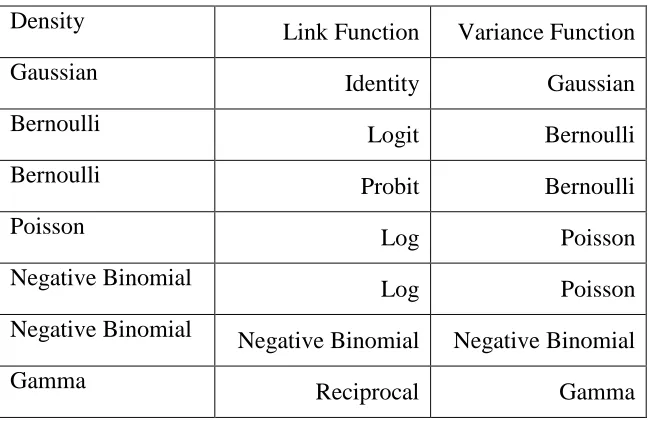
Table 2.2: Common link and variance function combinations
Density
Link Function Variance Function
Gaussian Identity Gaussian
Bernoulli Logit Bernoulli
Bernoulli
Probit Bernoulli
Poisson Log Poisson
Negative Binomial
Log Poisson
Negative Binomial Negative Binomial Negative Binomial
Gamma
Table 2.3: Link functions
Link function 𝜂 = 𝑔(𝜇)
Identity 𝜇
Logit log ( 𝜇
1−𝜇)
Log log (𝜇)
Negative Binomial log ( 𝛼𝜇
1+𝛼𝜇)
Log-complement log (1 − 𝜇)
Log-log −log (− log(𝜇))
Probit Φ−1(𝜇)
Reciprocal 1𝜇
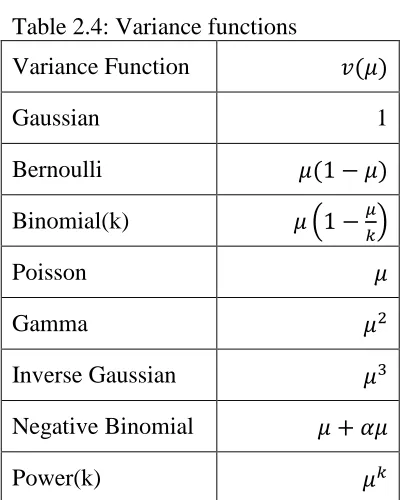
Table 2.4: Variance functions
Variance Function 𝑣(𝜇)
Gaussian 1
Bernoulli 𝜇(1 − 𝜇)
Binomial(k) 𝜇 (1 −𝜇
𝑘)
Poisson 𝜇
Gamma 𝜇2
Inverse Gaussian 𝜇3
Negative Binomial 𝜇 + 𝛼𝜇
CHAPTER 3
PENALIZED MAXIMUM LIKELIHOOD APPROACH FOR GENERALIZED LINEAR
MODELS
This chapter discusses a penalized maximum likelihood method for generalized linear
models. The derivation is described and Stata software and examples are displayed.
3.1 INTRODUCTION
This section focuses on the development of a method and its implementation into
statistical software Stata. A new Stata command for estimating generalized linear models
via penalized maximum likelihood is presented. In the past, only a subset of such models
have been available to Stata users through the user-written firthlogit (Coveney
[2008]) command for binomial models (using on the logit link function). The new
firthglm command estimates any generalized linear model supported by the glm
command using penalized log-likelihood.
3.2 CURRENT ISSUES
Firth's penalized maximum likelihood (Firth [1993]) approach was originally developed
to reduce the bias of maximum likelihood estimates. The asymptotic bias of the
maximum likelihood estimate 𝜃̂ can be written as
𝑏(𝜃) =𝑏1(𝜃)
𝑛 +
𝑏2(𝜃)
𝑛2 + ⋯
Previously two approaches were used to correct for this bias. The Jackknife
the substitution method. The substitution method substitutes 𝜃̂ for the unknown 𝜃 in
𝑏(𝜃) and gives the second order efficient, bias-corrected estimate as 𝜃̂𝐵𝐶 = 𝜃̂ − 𝑏1(𝜃̂)
𝑛 .
The jackknife and 𝜃̂𝐵𝐶 are bias-reducing only in an asymptotic sense when 𝜃̂ is infinite.
Both of these methods use a corrective approach rather than a preventive approach.
This bias arises from a combination of the unbiasedness of the score function at
the true value of 𝜃 and the curved nature of the score function. To remove bias from the
maximum likelihood estimator, Firth's method adds a bias correcting term to the score
function. For generalized linear models (GLMs), our target is the canonical parameter of
an exponential family, and in this case, the bias term is simply the Jeffreys invariant
prior. Jeffreys prior removes the bias, and the end result is a penalized log-(pseudo)
likelihood function.
Firth showed that for a random sample from a normal distribution, the
bias-reducing penalty function produces an exactly unbiased estimate for 𝜃 for sample sizes
larger than three. For logisitic regression, the maximum likelihood estimate of 𝛽 is found
to be biased away from the point 𝛽 = 0 which requires bias correction with some degree
of shrinkage of 𝛽 towards this point. When the target parameter is the canonical
parameter of an exponential family, the estimate is second-order efficient, which means
Jeffreys prior is sufficient in removing the bias from the maximum likelihood estimate.
In 2002, Heinze and Schemper claimed that this method developed by Firth was
also useful in solving the problem of separation (Heinze and Schemper [2002]). With
regard to the relationship of a covariate to an outcome variable in a data set, there are
three configurations of 𝑛 observations we can observe: complete separation,
one or more predictor variables completely. For example, consider a binary outcome
variable and a continuous predictor. If all outcomes with value 1 have corresponding
predictor values less than 4 while all outcomes with value 0 have corresponding predictor
values greater than 6, we have complete separation. In this situation, the maximum
likelihood estimate of the regression parameter on the predictor variable does not exist or
tends to infinity.
Quasi-complete separation exists when the outcome variable separates one or
more predictor variables to a certain point. Consider the previous example of complete
separation where the corresponding predictor values are separated similarly, but now the
predictor values for both outcomes (0 and 1) include the value 5. Here the only
probability to estimate is the probability the predictor value equals 5. All the other
predictor values are separated by the outcome variable. In this situation, the maximum
likelihood estimate of the regression parameter on the predictor variable also does not
exist.
Overlap exists when there is no separation in the data, and this situation is
generally not a problem for parameter estimation. Since there is no separation, the
maximum likelihood estimate exists.
When separation arises, there are a number of options to consider. One can omit
the variable from the model, allowing estimates to be obtained for the other parameters.
By omitting the variable, the information about the effect of the possible risk factor is
lost. One can manipulate the data by using an ad hoc adjustment such as changing cell
frequencies or forcing the largest or smallest observation to have the opposite effect. This
use exact regression (such as exlogit or expoisson) which replaces the maximum
likelihood estimate by a median unbiased estimate where the estimate of a parameter and
inference are based on the exact null distribution of the sufficient statistic conditional on
the observed values of the other sufficient statistics. This method is useful with one
variable but cannot be used when two or more variables lead to degenerate distributions
of all sufficient statistics.
This penalized maximum likelihood method is currently available for logistic
regression, but these situations are not limited to binary outcomes and can occur for any
specified generalized linear model. In this manuscript we introduce Firth's penalized
maximum likelihood estimation in Section 3.3. In Section 3.4, the Stata syntax is shown
for the new firthglm command, and the examples are contained in Section 3.5.
3.3 METHODS
A bias reduction of maximum likelihood estimates in generalized linear models was
introduced by Firth [1993]. Instead of taking a corrective approach by estimating the
maximum likelihood and then adding a penalty term, Firth modifies the score function
and then produces the maximum likelihood estimate. This is particularly useful when the
maximum likelihood estimate does not exist or is infinite.
The penalized likelihood equation written within the framework of the exponential family
of distributions is defined as
𝐿(𝜃, 𝜙; 𝑦1, 𝑦2, … , 𝑦𝑛) = ∏ exp {𝑦𝑖𝜃𝑖 − 𝑏𝜃𝑖
𝑎(𝜙) + 𝑐(𝑦𝑖, 𝜙)} |𝑖(𝜃)|
1/2 𝑛
where 𝑦1, 𝑦2, … , 𝑦𝑛 are the sample of independent observations, 𝜃𝑖 is the canonical
location parameter for the 𝑖th observation, 𝜙 is the scale parameter, and |𝑖(𝜃)|1/2 is the
Jeffreys [1946] invariant prior.
We can take the log of equation 2 to obtain the penalized log-likelihood
ℒ(𝜃, 𝜙; 𝑦1, 𝑦2, … , 𝑦𝑛) = ∑ {𝑦𝑖𝜃𝑖 − 𝑏𝜃𝑖
𝑎(𝜙) + 𝑐(𝑦𝑖, 𝜙)} +
1 2log
𝑛
𝑖=1
|𝑖(𝜃)|
since the values that maximize the likelihood also maximize the log-likelihood. The
estimates can then be computed using Stata's ml optimization commands.
Because the likelihood is written in exponential family notation (Hardin and Hilbe
[2011]), we can specify penalized models for not only binary outcomes, but also count,
proportional, discrete, and continuous outcomes.
Firth notes that bias reduction can be affected by the number of factors, especially
the skewness of the maximum likelihood estimate. In this case, one might sacrifice
precision in the estimates. However, in his paper, Firth states that when employing
logistic regression, the maximum likelihood estimate is unbiased and reduces the
variance of the parameter estimates. We are to expect smaller standard errors when using
firthglm. Confidence intervals will be affected since in reality, the estimate's lower
bound should be negative infinity when the maximum likelihood estimate tends to
negative infinity, and the upper bound should be positive infinity when the maximum
likelihood estimate tends to positive infinity.
3.4 STATA SYNTAX
Software accompanying this section includes the command files as well as supporting
include the usual collection of maximization and display options available to all
estimation commands.
Equivalent in syntax to the to the glm command, the basic syntax for the
penalized generalized linear model is given by
firthglm[𝑑𝑒𝑝𝑣𝑎𝑟 [𝑖𝑛𝑑𝑒𝑝𝑣𝑎𝑟𝑠] ] [𝑖𝑓] [𝑤𝑒𝑖𝑔ℎ𝑡] [ , ∗]
It should be noted, that the penalized log-likelihood maximization method is
implemented using Stata's ml commands specifying the d0 optimization method. As
such, the firthglm command does not support some of the vce()options that are
available in the glm command specifically, the firthglm command does not support
opg, unbiased, robust, or cluster. Similarly, the firthglm command does not
support the pweight option.
Help files are included for the estimation and post-estimation specifications of
these models. The help files include example specifications.
3.5 REAL DATA ANALYSIS
All examples were analyzed using the 12.1 version of Stata (Stata Corp, College Station,
TX). We show two examples in this section. The first example demonstrates bias
reduction when using a Poisson regression. The second example shows how the
penalized maximum likelihood method is useful when there is separation in the data and
the maximum likelihood does not converge. This example uses logistic regression, and
we also compare the firthglm method with bootstrapping.
The first example uses a ship accident dataset from McCullagh and Nelder
[1989], listed on page 205 of the text. This dataset includes the number of reported
the period of operation, op_00_00, the construction year, co_00_00, and the type of
ship, ship. The exposure in the model is the collective months of service. To better
define some variables, we use the indicator variables op_00_00 to show the starting and
ending years of operation and the indicator variables co_00_00 to show the starting and
ending years of construction. For example, op_70_74 shows whether the ship was in
operation from 1970 to 1974, and co_60_64 shows whether the ship was in
construction from 1960 to 1964. There is a total of 34 full observations in this dataset.
We run a Poisson model of accident on op_75_79, co_65_69,
co_70_74, co_75_79, and ship with a log link. To obtain risk ratios, we use the
eform option.
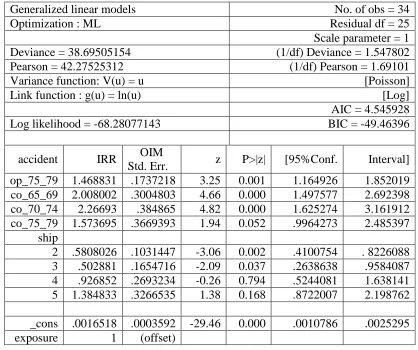
The results of the model are in Table 3.1. The results show that whether the ship
was in service between 1975 and 1979 is a significant predictor of number of accidents.
Also, whether the ship was constructed between 1965 and 1969 or between 1970 and
1974 are also significant predictors of number of accidents. The fourth indicator variable
co_75_79 is not significant with a p-value of 0.052. Ship types 2 and 3 are significantly
different from ship type 1 while ship type 4 and 5 are not significantly different from ship
type 1.
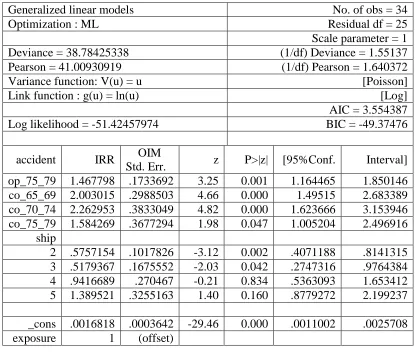
To examine bias reduction, we can run firthglm using the same model options.
From the output in Table 3.2, we can see that the penalized log likelihood of -51.4 is a
good bit smaller than the log likelihood of -68.3. The Aikaike Information Criteria (AIC)
for the penalized maximum likelihood method is smaller than the non-penalized method
(3.55 compared to 4.55). The deviance for the penalized method is slightly larger than the
for all variables in the model except co_75_79. In the non-penalized GLM model, this
variable was not significant, but is now significant with a p-value of 0.047.
The command firthglm can be applied to any generalized linear model and
canonical link supported by Stata's glm command using penalized log-likelihood. We
illustrate another model using data provided by Dr. José Villa at the USDA-ARS Honey
Bee Breeding, Genetics and Physiology Laboratory (Deroche et al. [2011]) where
convergence is not achieved in a binary response regression model with a log-log link.
Convergence is not achieved due to the issue of complete separation in the data.
These data contain the levels of mite infestation (mites) in a longitudinal study
on bee colonies from nine different genetic origins. Measurements of mite infestation
were recorded every season over a seven year period as well as the status (dead or
alive) of each colony. Here origin 9 and season 4 are the referent groups.
Two genetic origins did not experience any deaths due to the level of mite
infestation (origin 1 and origin 4). This is an example of separation. The effect of
this separation on the model can be seen when using Stata's glm command. We illustrate
a binomial model of status on mites, origin1-origin8, and
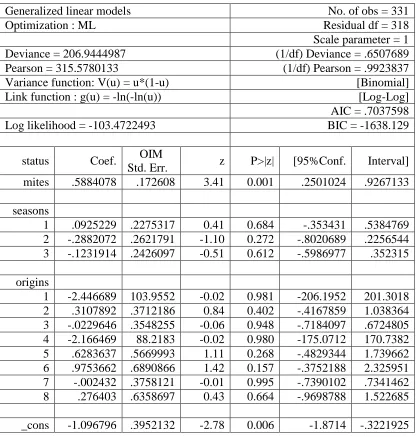
season1-season3 with a log-log link. We can see in Table 3.3 that the estimates for origin1
and origin4 are -2.45 and -2.17 with associated standard error estimates which are
approximately 104 and 88. The maximum likelihood estimates of these terms tend toward
negative infinity which implies the odds ratio is tending toward zero. From this model,
we can see that the only significant predictor of status is mites.
This inability to reach convergence is fixed by estimating a penalized maximum
link(loglog). The parameter estimates without convergence problems have
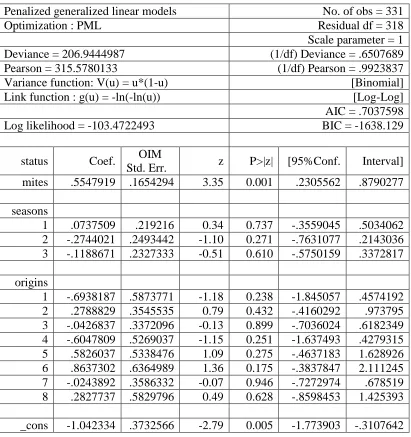
estimates and standard errors slightly smaller than those given by glm, but the significant
predictors of status have not changed. These results can be seen in Table 3.4.
Another alternative to the penalized maximum likelihood method is to use
vce(bootstrap) within the glm model. The results of this method can be seen in
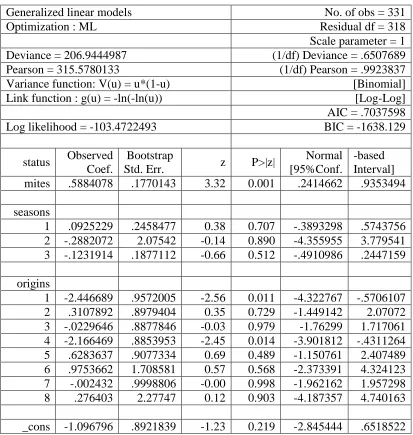
Table 3.5. The standard errors obtained are larger than those obtained through
firthglm but still much smaller than those from glm. The parameter estimates for
origin1 and origin4 are still large, but now they are significant with p-values of
0.011 and 0.014 respectively. Bootstrapping is efficient in giving smaller standard errors,
but in this case, gives misleading results. The option vce(bootstrap) is also
available within the firthglm command.
To explore other options for dealing with separation, we ran a regular logistic
model using family(binomial) and link(logit). We tried to compare this to
using exlogistic, but this method failed to estimate the model and combat the issue
of separation.
3.5 CONCLUSIONS AND DISCUSSIONS
This penalized maximum likelihood method for generalized linear models has
been proven to be useful in bias reduction and solving the problem of separation in data.
In the past, this method was only available in software for a binary outcome using logistic
models. The firthglm command broadens this penalized maximum likelihood method
to all generalized linear models regardless of the structure of the response variable or the
Table 3.1 GLM Poisson model with log link
gen double exposure = ln(service) 6 missing values generated)
glm accident op_75_79 co_65_69 co_70_74 co_75_79 i.ship, family(poiss) link(log) offset(exposure) eform nolog
Generalized linear models No. of obs = 34
Optimization : ML Residual df = 25
Scale parameter = 1
Deviance = 38.69505154 (1/df) Deviance = 1.547802
Pearson = 42.27525312 (1/df) Pearson = 1.69101
Variance function: V(u) = u [Poisson]
Link function : g(u) = ln(u) [Log]
AIC = 4.545928
Log likelihood = -68.28077143 BIC = -49.46396
accident IRR OIM
Std. Err. z P>|z| [95%Conf. Interval]
op_75_79 1.468831 .1737218 3.25 0.001 1.164926 1.852019
co_65_69 2.008002 .3004803 4.66 0.000 1.497577 2.692398
co_70_74 2.26693 .384865 4.82 0.000 1.625274 3.161912
co_75_79 1.573695 .3669393 1.94 0.052 .9964273 2.485397
ship
2 .5808026 .1031447 -3.06 0.002 .4100754 . 8226088
3 .502881 .1654716 -2.09 0.037 .2638638 .9584087
4 .926852 .2693234 -0.26 0.794 .5244081 1.638141
5 1.384833 .3266535 1.38 0.168 .8722007 2.198762
_cons .0016518 .0003592 -29.46 0.000 .0010786 .0025295
Table 3.2 Penalized GLM Poisson model with log link
firthglm accident op_75_79 co_65_69 co_70_74 co_75_79 i.ship, family(poiss) link(log) offset(exposure) eform nolog
Generalized linear models No. of obs = 34
Optimization : ML Residual df = 25
Scale parameter = 1
Deviance = 38.78425338 (1/df) Deviance = 1.55137
Pearson = 41.00930919 (1/df) Pearson = 1.640372
Variance function: V(u) = u [Poisson]
Link function : g(u) = ln(u) [Log]
AIC = 3.554387
Log likelihood = -51.42457974 BIC = -49.37476
accident IRR OIM
Std. Err. z P>|z| [95%Conf. Interval]
op_75_79 1.467798 .1733692 3.25 0.001 1.164465 1.850146
co_65_69 2.003015 .2988503 4.66 0.000 1.49515 2.683389
co_70_74 2.262953 .3833049 4.82 0.000 1.623666 3.153946
co_75_79 1.584269 .3677294 1.98 0.047 1.005204 2.496916
ship
2 .5757154 .1017826 -3.12 0.002 .4071188 .8141315
3 .5179367 .1675552 -2.03 0.042 .2747316 .9764384
4 .9416689 .270467 -0.21 0.834 .5363093 1.653412
5 1.389521 .3255163 1.40 0.160 .8779272 2.199237
_cons .0016818 .0003642 -29.46 0.000 .0011002 .0025708
Table 3.3 GLM binomial model with log-log link
glm status mites b4.seasons b9.origins, fam(binomial) link(loglog) nolog
Generalized linear models No. of obs = 331
Optimization : ML Residual df = 318
Scale parameter = 1
Deviance = 206.9444987 (1/df) Deviance = .6507689
Pearson = 315.5780133 (1/df) Pearson = .9923837
Variance function: V(u) = u*(1-u) [Binomial]
Link function : g(u) = -ln(-ln(u)) [Log-Log]
AIC = .7037598
Log likelihood = -103.4722493 BIC = -1638.129
status Coef. OIM
Std. Err. z P>|z| [95%Conf. Interval]
mites .5884078 .172608 3.41 0.001 .2501024 .9267133
seasons
1 .0925229 .2275317 0.41 0.684 -.353431 .5384769
2 -.2882072 .2621791 -1.10 0.272 -.8020689 .2256544
3 -.1231914 .2426097 -0.51 0.612 -.5986977 .352315
origins
1 -2.446689 103.9552 -0.02 0.981 -206.1952 201.3018
2 .3107892 .3712186 0.84 0.402 -.4167859 1.038364
3 -.0229646 .3548255 -0.06 0.948 -.7184097 .6724805
4 -2.166469 88.2183 -0.02 0.980 -175.0712 170.7382
5 .6283637 .5669993 1.11 0.268 -.4829344 1.739662
6 .9753662 .6890866 1.42 0.157 -.3752188 2.325951
7 -.002432 .3758121 -0.01 0.995 -.7390102 .7341462
8 .276403 .6358697 0.43 0.664 -.9698788 1.522685
Table 3.4 Penalized GLM binomial model with log-log link
firthglm status mites b4.seasons b9.origins, fam(binomial) link(loglog) nolog
Penalized generalized linear models No. of obs = 331
Optimization : PML Residual df = 318
Scale parameter = 1
Deviance = 206.9444987 (1/df) Deviance = .6507689
Pearson = 315.5780133 (1/df) Pearson = .9923837
Variance function: V(u) = u*(1-u) [Binomial]
Link function : g(u) = -ln(-ln(u)) [Log-Log]
AIC = .7037598
Log likelihood = -103.4722493 BIC = -1638.129
status Coef. OIM
Std. Err. z P>|z| [95%Conf. Interval]
mites .5547919 .1654294 3.35 0.001 .2305562 .8790277
seasons
1 .0737509 .219216 0.34 0.737 -.3559045 .5034062
2 -.2744021 .2493442 -1.10 0.271 -.7631077 .2143036
3 -.1188671 .2327333 -0.51 0.610 -.5750159 .3372817
origins
1 -.6938187 .5873771 -1.18 0.238 -1.845057 .4574192
2 .2788829 .3545535 0.79 0.432 -.4160292 .973795
3 -.0426837 .3372096 -0.13 0.899 -.7036024 .6182349
4 -.6047809 .5269037 -1.15 0.251 -1.637493 .4279315
5 .5826037 .5338476 1.09 0.275 -.4637183 1.628926
6 .8637302 .6364989 1.36 0.175 -.3837847 2.111245
7 -.0243892 .3586332 -0.07 0.946 -.7272974 .678519
8 .2827737 .5829796 0.49 0.628 -.8598453 1.425393
Table 3.5 Bootstrap GLM binomial model with log-log link
glm status mites b4.seasons b9.origins, fam(binomial) link(loglog) vce(bootstrap) nolog
(running glm on estimation sample) Bootstrap replications (50)
Generalized linear models No. of obs = 331
Optimization : ML Residual df = 318
Scale parameter = 1
Deviance = 206.9444987 (1/df) Deviance = .6507689
Pearson = 315.5780133 (1/df) Pearson = .9923837
Variance function: V(u) = u*(1-u) [Binomial]
Link function : g(u) = -ln(-ln(u)) [Log-Log]
AIC = .7037598
Log likelihood = -103.4722493 BIC = -1638.129
status Observed Coef.
Bootstrap
Std. Err. z P>|z|
Normal [95%Conf.
-based Interval]
mites .5884078 .1770143 3.32 0.001 .2414662 .9353494
seasons
1 .0925229 .2458477 0.38 0.707 -.3893298 .5743756
2 -.2882072 2.07542 -0.14 0.890 -4.355955 3.779541
3 -.1231914 .1877112 -0.66 0.512 -.4910986 .2447159
origins
1 -2.446689 .9572005 -2.56 0.011 -4.322767 -.5706107
2 .3107892 .8979404 0.35 0.729 -1.449142 2.07072
3 -.0229646 .8877846 -0.03 0.979 -1.76299 1.717061
4 -2.166469 .8853953 -2.45 0.014 -3.901812 -.4311264
5 .6283637 .9077334 0.69 0.489 -1.150761 2.407489
6 .9753662 1.708581 0.57 0.568 -2.373391 4.324123
7 -.002432 .9998806 -0.00 0.998 -1.962162 1.957298
8 .276403 2.27747 0.12 0.903 -4.187357 4.740163
CHAPTER 4
GENERALIZED ESTIMATING EQUATIONS
This chapter introduces generalized estimating equations and its link to generalized linear
models. The extension of the working correlation matrix is discussed and the
quasi-likelihood is introduced.
4.1 INTRODUCTION
One vital assumptions of generalized linear models is independence of the observations.
This assumption is violated when the data may be grouped in some manner such as
patients from the same hospital or when multiple observations are made on the same
subject over time. There are multiple ways to address clustered, panel or longitudinal
data, and each method has its own advantages and limitations. The naïve way to address
this type of data is to ignore the panel structure of the data yielding a pooled
(independence) estimator. This method results in a consistent estimator but one that is not
efficient leading to (possibly) unreliable standard error estimates. Another way to address
panel data is to include an effect for each panel in the estimating equation. This method
allows fixed or random effects and conditional or unconditional effects. When the data
include a finite number of panels in a population where each panel is represented in the
sample, it is more reasonable to consider an unconditional fixed effects estimator.
However, if there exists an infinite number of panels in the population, it is more
reasonable to consider a conditional fixed effects estimator. Here one can include a fixed
model conditions out the fixed effects from the estimation leading to a log-likelihood
which does not depend on the fixed effects. Here one can make inferences about
population averages and where the mean response is conditional only on covariates. Also
known as subject-specific models, the random effects model allows regression
coefficients (intercept and slope) to vary from person to person according to a random
effects distribution. The transitional Markov model represents the probability distribution
at each time point as conditional on the previous time point and is usually estimated using
Gibbs sampling. An increasingly popular alternative introduced by Liang and Zeger
[1986] is known as Generalized Estimating Equations.
4.2 EXTENSION OF GENERALIZED LINEAR MODELS
In their manuscript, Liang and Zeger [1986] provide an extension to generalized linear
models which they refer to as population-averaged generalized estimating equations. This
method induces an interpretation of the coefficients as population averages and
introduces the dependency (non-independence) of the observations directly into the
estimating equation of the pooled estimator. The estimating equation in a generalized
linear model which assumes independence can be written as
[𝜕𝐿 𝜕𝛽] = ∑ 𝑋𝑖 𝑇𝐷 𝑛 𝑖=1 (𝜕𝑔 −1(𝜂 𝑖) 𝜕𝜂𝑖 ) (𝑣(𝐸(𝑦𝑖)))
−1(𝑦𝑖 − 𝐸(𝑦𝑖)
𝑎(𝜙) ) = ∑ 𝑋𝑖𝑇𝐷 𝑛 𝑖=1 (𝜕𝑔 −1(𝜂 𝑖) 𝜕𝜂𝑖 ) (𝑣(𝐸(𝑦𝑖))
−12
)
𝑇
𝐼(𝑛𝑖)𝑣(𝐸(𝑦𝑖))−
1
2(𝑦𝑖 − 𝐸(𝑦𝑖)
𝑎(𝜙) )
where 𝐼(𝑛𝑖) is the identity matrix representing the within-group correlation (assumed to
be independent). One can parameterize an alternative correlation matrix to model the
within-group correlation structure by replacing the identity matrix with a working
[𝜕𝐿 𝜕𝛽] = ∑ 𝑋𝑖 𝑇𝐷 𝑛 𝑖=1 (𝜕𝑔 −1(𝜂 𝑖) 𝜕𝜂𝑖 ) (𝑣(𝐸(𝑦𝑖)) −12
)
𝑇
𝑅(𝛼)𝑣(𝐸(𝑦𝑖)) −12
(𝑦𝑖 − 𝐸(𝑦𝑖)
𝑎(𝜙) )
where 𝛼 is a vector of parameters through which the matrix 𝑅 is structurally constrained
to represent the working or within-panel correlation. Here it is shown that the focus of the
generalized estimating equation is on the marginal distribution and the estimator which
sums the panel-level contribution to the estimating equations after accounting for the
within-panel correlation. Thus, the estimating equation for the regression parameters 𝛽
are formed for the average (sum) of the panels.
4.3 WORKING CORRELATION STRUCTURE
The researcher or analyst is charged with making the correct structural choice of the
working correlation matrix for models estimated using generalized estimating equations.
There are several correlation structure choices available in software. The most commonly
used correlation structures are the independent, exchangeable, autoregressive(1), and
unstructured. These structures are illustrated in Table 4.1.
Consider independent observations from 𝑛 individuals. For each individual 𝑖, a
response 𝑦𝑖𝑡 and a 𝑝 × 1 covariate vector 𝑥𝑖𝑡 = (𝑥𝑖𝑡1, 𝑥𝑖𝑡2, … , 𝑥𝑖𝑡𝑝)𝑇 are gathered at
times 𝑡 = 1, 2, … , 𝑚𝑖. Let 𝑌𝑖 = (𝑦𝑖1, 𝑦𝑖2, … , 𝑦𝑖𝑚𝑖)𝑇 be the 𝑚
𝑖× 1 vector of responses for
the 𝑖𝑡ℎ individual and 𝑋𝑖 = (𝑥𝑖1𝑇, 𝑥𝑖2𝑇, … , 𝑥𝑖𝑚𝑖
𝑇 )𝑇 be the 𝑚
𝑖 × 𝑝 corresponding covariate
matrix. The working correlation structure is chosen for the full model prior to the model
selection of the number of covariates.
4.4 QUASI-LIKELIHOOD
The quasi-likelihood is constructed for the mean parameter 𝜇 = 𝐸(𝑦) and the dispersion
probability distribution. McCullagh and Nelder (1989) give the log quasi-likelihood
based on the model specification 𝐸(𝑦) = 𝜇 and 𝑣𝑎𝑟(𝑦) = 𝜙𝑣(𝜇) as
𝑄(𝜇, 𝜙; 𝑦) = ∫ 𝑦 − 𝑡
𝜙𝑣(𝑡)𝑑𝑡
𝜇
𝑦
The quasi-likelihood can be written as a function of the regression coefficients 𝛽, for
example 𝑄(𝛽, 𝜙; (𝑦, 𝑥)) = 𝑄(𝑔−1(𝑥𝛽), 𝜙; 𝑦). If it is assumed that the working
independence model 𝑅 = 𝐼 is selected, then the paired observations (𝑌𝑖𝑗, 𝑋𝑖𝑗) in the data
𝐷 are independent. Then the quasi-likelihood based on 𝐷 is
𝑄(𝛽, 𝜙; 𝐼, 𝐷) = ∑ ∑ 𝑄 (𝛽, 𝜙; (𝑌𝑖𝑗, 𝑋𝑖𝑗)) .
𝑛𝑖
𝑗=1 𝑛
𝑖=1
Then the quasi-deviance can be defined as
𝐷𝑒𝑣𝑖𝑎𝑛𝑐𝑒 = 2 ∫ 𝑦 − 𝜇
𝑣(𝜇) 𝑑𝜇
𝑦
𝜇 ̂
.
The quasi-likelihood can also be written in terms of the quasi-deviance as
𝑄(𝑀) = ∑ ∑ 𝑄 (𝛽, 𝜙; (𝑌𝑖𝑗, 𝑋𝑖𝑗)) = −𝐷𝑒𝑣(𝑀)
2
𝑛𝑖
𝑗=1 𝑛
𝑖=1
Table 4.1 Working Correlation Structures
Working correlation structure Example
3 x 3 matrix
Independent: 𝐶𝑜𝑟𝑟(𝑦𝑖𝑗, 𝑦𝑖𝑘) = {1 𝑗 = 𝑘
0 𝑗 ≠ 𝑘 [
1 0 0
0 1 0
0 0 1
]
Exchangeable: 𝐶𝑜𝑟𝑟(𝑦𝑖𝑗, 𝑦𝑖𝑘) = {
1 𝑗 = 𝑘
𝛼 𝑗 ≠ 𝑘 [
1 𝛼 𝛼
𝛼 1 𝛼
𝛼 𝛼 1
]
AR-1: 𝐶𝑜𝑟𝑟(𝑦𝑖𝑗, 𝑦𝑖𝑘) = 𝛼|𝑗−𝑘| [
1 𝛼 𝛼2
𝛼 1 𝛼
𝛼2 𝛼 1
]
Unstructured: 𝐶𝑜𝑟𝑟(𝑦𝑖𝑗, 𝑦𝑖𝑘) = {
1 𝑗 = 𝑘 𝛼𝑚𝑖𝑛(𝑗,𝑘),max (𝑗,𝑘) 𝑗 ≠ 𝑘 [
1 𝛼12 𝛼13
𝛼12 1 𝛼23
𝛼13 𝛼23 1
CHAPTER 5
R
2AND PSEUDO-R2 FOR GENERALIZED ESTIMATING EQUATIONSThis chapter introduces the R2 and pseudo-R2 statistics currently available for generalized
linear models. The likelihood is replaced with the quasi-likelihood and a post estimation
command for Stata is introduced.
5.1 INTRODUCTION
For generalized linear models, there are many model measures (diagnostic criteria) that
are not available for generalized estimating equation models. One of these measures is
the coefficient of determination 𝑅2. Natarajan, et.al [2007] proposed a measure of partial
association for GEE and a coefficient of determination to measure the strength of
association between the outcome variable and the fitted values based on the estimated
coefficients. The psuedo-R2 statistics to be explored are Efron’s psuedo-R2 (for
continuous and binary outcomes) [1978], McFadden’s likelihood ratio index (for any
outcome) [1974], Ben-Akiva and Lerman’s adjusted likelihood ratio index (for any
outcome) [1985], Cox and Snell [1968] and Maddala [1983] combined transformation of
likelihood ratio (for any outcome), and Cragg and Uhler’s normed measure (for any
outcome) [1970]. Where the likelihood is used for a calculation, GEE’s quasi-likelihood
calculation will be inserted.
5.2 CURRENT AVAILABILITY OF R2 IN GENERALIZED LINEAR MODELS
The most commonly used R2 is the one that involves the calculation of residual sum of
variance explained and is written as
𝑅2 = 1 −∑ (𝑦𝑖− 𝑦̂𝑖) 2 𝑛
𝑖=1
∑𝑛𝑖=1(𝑦𝑖 − 𝑦̅)2
.
It can also be interpreted as the squared correlation and the ratio of variances. The
numerator is in terms of the differences of the observed and fitted values, while the
denominator is in terms of the differences of the observed and mean values.
The above measure is used for linear regression. When these types of statistics are
applied to generalized linear models, they are called pseudo-𝑅2 statistics. Other measures
are available for models other than linear regression. The ones discussed herein are
Efron’s pseudo-𝑅2, McFadden’s likelihood ratio index, Ben-Akiva and Lerman adjusted
likelihood ratio index, Cragg and Uhler normed measure, and the Cox-Snell or
transformation of likelihood ratio.
Efron [1978] defines a measure as an extension to the regression model’s
“percent variance explained” interpretation and is given by
𝑅𝐸𝑓𝑓𝑟𝑜𝑛2 = 1 −∑ (𝑦𝑖 − 𝜇̂𝑖)
2 𝑛
𝑖=1
∑𝑛𝑖=1(𝑦𝑖− 𝑦̅)2
where 𝜇̂ is the model predicted probabilities. This measure was originally directed at
binary outcome models, but can also be used for continuous models by replacing the 𝜇̂𝑖
with 𝑦̂𝑖.
McFadden [1974] defines a measure, sometimes called the likelihood-ratio index,
as another extension to the “percent variance explained interpretation” given by
where ℒ is the log-likelihood, 𝑀𝛼 is the model with only an intercept, and 𝑀𝛽 is the
model with intercept and covariates.
Ben-Akiva and Lerman [1985] extended McFadden’s pseudo-𝑅2 to include an
adjustment for the number of parameters in the model. This adjustment is similar to the
adjusted 𝑅2 in linear regression and is given by the formula
𝑅Ben−Akiva&Lerman2 = 1 −ℒ(𝑀𝛽) − 𝑝 ℒ(𝑀𝛼)
where 𝑝 is the number of parameters in the model. The intention behind the adjustment is
to decrease the likelihood so that non-significant variables included in the model do not
cause a significant increase in the criterion measure.
By combining the work of Cox and Snell [1968] and Maddala [1983], a maximum
likelihood pseudo-𝑅2 is described in the formula
𝑅ML2 = 1 − {𝐿(𝑀𝛼) 𝐿(𝑀𝛽)}
2 𝑛
= 1 − exp (−𝐺
2
𝑛)
where 𝐺2 = −2 ln{𝐿(𝑀𝛼)
𝐿(𝑀𝛽)}. This measure is an extension to the transformation of the
likelihood ratio.
The last measure examined here is the Cragg and Uhler [1970] normed measure.
Cragg and Uhler introduced a transformation of the likelihood ratio pseudo-𝑅2 because
the 𝑅ML2 does not approach 1 as the fit of the two comparison models converge. The
normed version of the 𝑅ML2 is given by
𝑅Cragg&Uhler2 = 𝑅ML
2
max𝑅ML2 =
1 − {𝐿(𝑀𝛼) 𝐿(𝑀𝛽)}
2 𝑛
These pseudo-𝑅2 measures are available in a user-written Stata command named
fitstat. The command fitstat is a post estimation command that calculates the
McFadden, Ben-Akiva and Lerman (adjusted McFadden), Cox-Snell, Cragg-Uhler, and
Efron pseudo-𝑅2 measures after computing the clogit, cloglog, intreg,
logisitic, logit, mlogit, nbreg, ocratio, ologit, oprobit, poisson,
probit, regress, tnbreg, tpoisson, zinb, zip, or ztb regression models. The
fitstat command was developed by Long and Freese [2014].
5.3 GENERALIZED LINEAR MODEL R2EXTENSION TO GENERALIZED ESTIMATING
EQUATIONS
Natarajan, et.al [2007] proposed a measure of partial association for GEE and a
coefficient of determination to measure the strength of association between the outcome
variable and all of the coefficients. Using ordinary least squares (OLS) to estimate the
regression parameters allows the estimate of the partial correlation coefficient to be a
monotone function of the Z-statistic that is used to test whether a single regression
coefficient is equal to zero. Natarajan, et. al. propose to use the transformation of the
GEE Z-statistic as a measure of partial association. Following this same thought, they
propose to use a function of the Wald statistic that tests whether all parameters (except
the intercept) are equal to zero to generate the coefficient of determination.
For clustered data, each individual 𝑖(𝑖 = 1, … , 𝑁) has an 𝑛𝑖x1 response vector
𝑌𝑖 = [𝑌𝑖1, … , 𝑌𝑖𝑛𝑖]𝑇 and a Kx1 covariate vector 𝑥𝑖𝑗 = [𝑥𝑖𝑗1, … , 𝑥𝑖𝑗𝐾]𝑇. To calculate 𝛽
estimates through a GEE approach, the equation below is solved iteratively.
𝑆(𝛽; 𝑅, 𝐷) ≡ ∑ 𝐷𝑖′𝑉𝑖−1(𝑌𝑖 − 𝜇𝑖) = 0
𝑛
𝑖=1
where 𝐷𝑖 = 𝐷𝑖(𝛽) =𝜕𝜇𝑖(𝛽)
𝜕𝛽′ and 𝑉𝑖 is a working covariance matrix of 𝑌𝑖. The working
correlation matrix 𝑅 = 𝑅(𝛼) can be expressed in terms of 𝑉𝑖 = 𝐴1/2𝑖 𝑅(𝛼)𝐴1/2𝑖 , where 𝐴𝑖
is a diagonal matrix with elements 𝑣𝑎𝑟(𝑌𝑖𝑗) = 𝜙𝑣(𝜇𝑖𝑗), which is specified as a function
of the mean 𝜇𝑖𝑗 = 𝐸(𝑌𝑖𝑗|𝑥𝑖𝑗) = 𝑔(𝑥𝑖𝑗′𝛽). The parameter 𝛼 represents a vector of some
unknown parameters involved in estimating the working correlation structure.
The GEE Wald Z-statistic to test 𝐻0: 𝛽𝐾 = 0 is calculated using the estimate of
the 𝛽̂𝐾 and dividing it by the model-based standard error estimate of 𝛽̂𝐾; √𝑉𝑎𝑟̂ (𝛽̂𝐾) .
Since the Wald statistic has been shown to have poor properties as |𝛽̂𝐾| gets large, they
propose to use the Wald statistic with the variance of 𝛽̂𝐾 estimated under the null
𝐻0: 𝛽𝐾 = 0 by replacing 𝑉𝑎𝑟̂ (𝛽̂𝐾) with the GEE robust variance estimate 𝑉𝑎𝑟̃ (𝛽̂𝐾). This
gives a measure of partial association which under the null is approximately chi-square
with 1 degree of freedom.
𝑍̃ =𝐾 𝛽̂𝐾
√ 𝑉𝑎𝑟̃ (𝛽̂𝐾)
We then can define the measure of partial association between 𝑌𝑖𝑗 and 𝑥𝑖𝑗𝐾 to be
𝜌̃ =𝐾 𝑧̃𝐾/√𝑁 √1 + 𝑧̃𝐾2/𝑁
which ranges from -1 to 1.
For the GEE model, 𝐸(𝑌𝑖𝑗|𝑥𝑖𝑗) = 𝑔(𝑥𝑖𝑗′𝛽𝐾), the Wald test to test 𝐻0: 𝛽1 = ⋯ =
𝛽𝐾 = 0 can be used to form an 𝑅2 statistic. Following the above derivation of the
measure of partial association, it is proposed that the coefficient of determination be
𝑅̃ =2 𝑄̃/𝑁
1 + 𝑄̃/𝑁
where
𝑄̃ = [𝐶𝛽̂]′[𝐶 𝑉𝑎𝑟̃ (𝛽̂𝐾)𝐶′]−1[𝐶𝛽̂],
is the Wald statistic with the GEE robust covariance matrix estimated under the null. This
statistic will range from 0 to 1 but does not guarantee that a model with more covariates
would have a larger 𝑅̃2. This is shown by Natarajan et al. when an additional covariate
adds very little information.
In order to generalize the pseudo-𝑅2 measures discussed in section 5.3 to
generalized estimating equations, the maximum likelihood calculations must be replaced
with the quasi-likelihood calculations. The extended measures for 𝑅McFadden2 is now
𝑔𝑅McFadden2 = 1 −𝑄(𝑀𝛽) 𝑄(𝑀𝛼)
where 𝑄(𝑀𝛼) is the quasi-likelihood for the model with only an intercept and 𝑄(𝑀𝛽) is
the model with intercept and predictors. The quasi-likelihood can also be written in terms
of the quasi-deviance as
𝑄(𝑀) = ∑ ∑ 𝑄 (𝛽, 𝜙; (𝑌𝑖𝑗, 𝑋𝑖𝑗)) = −𝐷𝑒𝑣(𝑀)
2
𝑛𝑖
𝑗=1 𝑛
𝑖=1
where 𝐷𝑒𝑣(𝑀) = 2 ∫𝜇̂𝑦𝑦−𝜇𝑣(𝜇)𝑑𝜇. The extended measure for 𝑅Ben−Akiva&Lerman2 is then
given by
𝑔𝑅Ben−Akiva&Lerman2 = 1 −𝑄(𝑀𝛽) − 𝑝
𝑄(𝑀𝛼) .
Similar replacements are made for 𝑅ML2 and 𝑅
𝑔𝑅ML2 = 1 − {𝑄(𝑀𝛼) 𝑄(𝑀𝛽) } 2 𝑛 and
𝑔𝑅Cragg&Uhler2 = 𝑔𝑅ML
2
max𝑔𝑅ML2 =
1 − {𝑄(𝑀𝛼) 𝑄(𝑀𝛽)}
2 𝑛
1 − 𝑄(𝑀𝛼)2/𝑛
.
In Efron’s pseudo-𝑅2, we replace the single summand for observations with a double
summand to account for the panel observations and within a panel. The generalized Efron
pseudo-𝑅2 can be written as
𝑔𝑅Efron2 = ∑ ∑ (𝑦𝑖𝑗− 𝑦̂𝑖𝑗)
2 𝑛𝑖 𝑗=1 𝑛 𝑖=1 ∑ ∑ (𝑦𝑖𝑗 − 𝑦̅) 2 𝑛𝑖 𝑗=1 𝑛 𝑖=1
These calculations were made available in Stata in a user-written, post-estimation
command named estatg. This command is available after any GEE model is estimated
in Stata. The post-estimation command works for any link and variance function.
5.4 REAL DATA ANALYSIS
To test the extensions of the pseudo-𝑅2 measures in GEE models, one can compare the
quasi-likelihood pseudo-𝑅2 measures to the likelihood based pseudo- pseudo-𝑅2
measures with a sample dataset. We used a dataset on low birthweight from Homer and
Lemeshow (2013) in Stata. There are a total of 189 observations in this dataset. This
dataset includes an identification code for each mother, an indicator variable of low birth
weight (low), the age of the mother (age), the categorical variable race (race), an
indicator variable of whether or not the mother smoked during pregnancy (smoke), the
mother’s pre-pregnancy weight (lwt), an indicator variable of whether or not the mother
birth had uterine irritability (ui). We run a logistic model (link function as binomial and
variance function as independent) on age, lwt, race, smoke, ptl, ht, and ui on
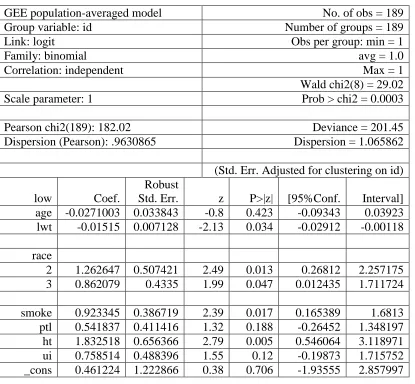
low. The xtgee model fit is shown in Table 5.1 where it is shown that lwt, race,
smoke, and ht are significant predictors of low. The output from estatg is given in
Table 5.2 for the GEE 𝑅2 and the five pseudo-𝑅2.
We can compare this to the output of fitstat after running a logit model
and see that the replacement of the maximum likelihood with the quasi-likelihood works
well in this situation. When fitting the same model under GLM and independent GEE, we
have the same results. The results of the logit model in Table 5.3 show that lwt,
race, smoke, and ht are significant predictors of low. The results of fitstat in
Table 5.4 match the results of estatg found in Table 5.2. Note that the GEE -𝑅2
measure is not available in the output of fitstat since this measure is specifically
designed for GEE models.
5.5CONCLUSION AND DISCUSSION
The 𝑅2 measure is a popular goodness of fit statistic that was not made available for GEE
models. By building on other pseudo-𝑅2 measures and writing them in terms of the
quasi-likelihood instead of the maximum likelihood, we have made an important statistic
that will be available in Stata for longitudinal, clustered, or panel data. Researchers can
now get a measure of the variance explained in a GEE model. The GEE 𝑅2 measure will
Table 5.1 Results of xtgee model with binomial link and independent working correlation
xtset id
xtgee low age lwt i.race smoke ptl ht ui, family(binomial) robust corr(ind)nolog
GEE population-averaged model No. of obs = 189
Group variable: id Number of groups = 189
Link: logit Obs per group: min = 1
Family: binomial avg = 1.0
Correlation: independent Max = 1
Wald chi2(8) = 29.02
Scale parameter: 1 Prob > chi2 = 0.0003
Pearson chi2(189): 182.02 Deviance = 201.45
Dispersion (Pearson): .9630865 Dispersion = 1.065862
(Std. Err. Adjusted for clustering on id)
low Coef.
Robust
Std. Err. z P>|z| [95%Conf. Interval]
age -0.0271003 0.033843 -0.8 0.423 -0.09343 0.03923
lwt -0.01515 0.007128 -2.13 0.034 -0.02912 -0.00118
race
2 1.262647 0.507421 2.49 0.013 0.26812 2.257175
3 0.862079 0.4335 1.99 0.047 0.012435 1.711724
smoke 0.923345 0.386719 2.39 0.017 0.165389 1.6813
ptl 0.541837 0.411416 1.32 0.188 -0.26452 1.348197
ht 1.832518 0.656366 2.79 0.005 0.546064 3.118971
ui 0.758514 0.488396 1.55 0.12 -0.19873 1.715752
Table 5.2 Results of estatg
Pseudo-R2 measures for GEE models
GEE Efron McFadden Ben-Akiva
Lerman
Cox Snell
Cragg Uhler
0.1331 0.1642 0.1416 0.0649 0.1612 0.2267
Table 5.3 Results of logit model
logit low age lwt i.race smoke ptl ht ui nolog
Logistic regression Number of obs = 189
LR chi2(8) = 33.22 Prob > chi2 = 0.0001
Log likelihood = -100.724 Pseudo R2 = 0.1416
low Coef. Std. Err. z P>|z| [95%Conf. Interval]
age -0.0271 0.03645 -0.74 0.457 -0.09854 0.044341
lwt -0.01515 0.006926 -2.19 0.029 -0.02873 -0.00158
race
2 1.262647 0.52641 2.4 0.016 0.230902 2.294392
3 0.862079 0.439153 1.96 0.05 0.001355 1.722804
smoke 0.923345 0.400827 2.3 0.021 0.137739 1.708951
ptl 0.541837 0.346249 1.56 0.118 -0.1368 1.220472
ht 1.832518 0.691629 2.65 0.008 0.476949 3.188086
ui 0.758514 0.459377 1.65 0.099 -0.14185 1.658875