ISSN 2286-4822
www.euacademic.org DRJI Value: 5.9 (B+)
Deploying a Computational Competitive
Intelligence (CI) Framework for Municipal Solid
Waste (MSW) Management Decision-Making
PERCY OKAE
Computer Science Department African University of Science & Technology (AUST) Abuja, Nigeria
Prof. AMOS DAVID
University of Lorraine Nancy, France
Abstract:
well-motivated enough to even release information they have to their organizations.
Key words: CI, observatory, MSW, DWH, Zoomlion Ghana Limited, decision-making.
1. INTRODUCTION
Competitive Intelligence (CI) is simply an information system which emanated in the 1970s and 1980s in America as a concept to enhance the effectiveness of businesses. Currently all over the World, the leading multi-national companies all have very well structured CI units established so as not to be overtaken by events. Products from organizations are every now and again undergoing enhancements and so competitors have to know the latest innovations coming from each other‘s camp to be able to remain abreast of happenings. In contrast to market research, CI is more general, performed in-house, on a rolling basis, and usually entails more uncertainty about the ultimate value of the actionable intelligence the CI process creates. Competitive Intelligence is a process automated by an organization‘s information systems to carry out the task of doing the right things rather than doing things right.
about the external environment and transforms this information through a series of processes into actionable intelligence that is then used to analyze key factors that usually have an impact on the organization‘s strategy. As a product, it is the information acquired on competitors from research and used as the premise for a specific action.
A more preferred and direct definition of CI is that it is a function that is responsible for the early detection of two key things: (1) market exploitation opportunities before they become obvious to others (by which times these opportunities would be lost) and (2) industry dissonance before market forces threaten the organization (i.e. when the company becomes captive to events). According to Aaker (1998), the CI process must have the singular objective of developing the strategies and tactics necessary to transfer market share profitably and consistently from specific competitors to the organization. However, its definition is also succinctly captured by Van Brakel (2005), as ―a business discipline that is used by companies and countries alike as a means to improve competitiveness by making better use of information.‖ Also McGonagle and Vella (1990), define CI as ―the use of public sources to develop information about the competition, competitors, and market environment.‖ According to Gilad and Gilad (1988), CI has the singular goal of monitoring an organization‘s external environment to obtain information that is relevant to its decision-making process.
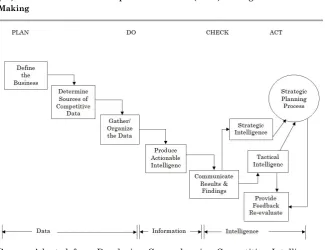
Source: Adapted from Developing Comprehensive Competitive Intelligence, IMA, 1996
Figure 1: Diagram clearly identifying the roles of each stage of the CI process cycle
Next we briefly describe each of the steps involved in the CI process
1. Define the business issues: we need to know the kind
of intelligence to gather and for what purpose. How is the intelligence going to be used in the CI process etc? In this endeavor, it is most important that senior management plays a role so that they provide direction as to the systematic collection of information, with priorities set by the users of the data and not its producers.
Examples of typical business issues are:
How can our product or service be differentiated from our competitors? How can perceived quality of our product or service be enhanced?
Is it possible to employ synergy, or a pre-emptive move to gain advantage?
2. Determine the sources of competitive data: key
sources of competitive data ought to be identified and if sanctioned, utilized. These sources usually include: Commissioned research;
Internal staff;
Third-party interviews; and Published information.
3. Gather and organize data: the importance of
organizing competitive data so that they can be logically stored and retrieved cannot be overemphasized. Typically a framework that could be adopted is one that includes a major category for broad industry data, another for data collected on each competitor being tracked, and last but not the least, another for competitive data that relate to specific areas that management is particularly concerned about in its own firm.
4. Produce actionable intelligence: all the repository of
information collected will not inure to the benefit of the organization if it is not converted into actionable intelligence. We do this by using both line and staff managers. The criteria we usually use to evaluate whether the organization can act upon the intelligence are:
Are the data in the needed format for planning purposes?
Do they meet users‘ needs?
Have alternative views and findings been identified?
5. Communicate results and findings: the
dissemination of competitive intelligence throughout a firm can be done in several ways. Generally, this is important because it closes the loop between those who did the collection and analysis of competitive information and those who are responsible for using it to make decisions. One way is to build a competitor profile report for distribution throughout the organization, either in part or in whole. Some organizations have adopted the strategy of creating a competitive intelligence center where the regular maintenance and updating of information about competitors and the firm‘s own competitive intelligence efforts are done. Managers can regularly hold meetings at this center and discuss the competitive information that is presented.
6. Provide input into the strategic planning process:
By providing management with implications and strategic alternatives, CI can effectively be integrated into the strategic management process.
7. Provide feedback and re-evaluate: feedback in any
human endeavor is important and the process of CI is no exception. Users can evaluate the market product and feed the organization with their observations for a better performance next time.
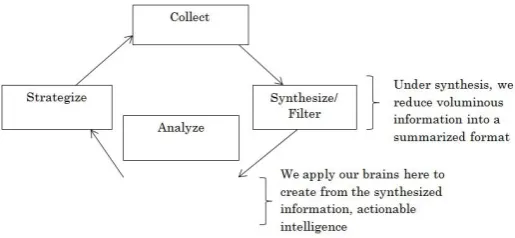
We can also summarize the above stages into Figure 2 below so as to also clearly identify the specific roles various stages play in the CI cycle.
Source: Adapted from Liebowitz, 2006.
Figure 2: Diagram clearly identifying the crucial stages of the CI process cycle
2. LITERATURE REVIEW
after making it an integral part of business (Fuld, 1985, McKinnon & Burns, 1992).. The practice has been employed in many disciplines such as wind turbine manufacturing, software development, aeronautics, automobile manufacturing, pharmaceuticals etc., with outstanding results. We can illustrate this point further by citing the software giant, Microsoft, ranked by the Futures Group as the leading user of CI (Curtis, 2001). Through a rigorous and aggressive application of CI techniques, Microsoft has been able to obliterate competitive products such as WordPerfect, Lotus 123, and Netscape Navigator etc., by deploying the equivalents namely MS Word, MS Excel, and Internet Explorer (IE) respectively. Guimares (2000) argues that every organization can improve its competitive edge as well as its overall performance if it fully adopts an effective CI program. One major fact is that the acquisition of the information alone is not enough, but getting it early enough so as to outwit competitors before it becomes common knowledge is most crucial (Johns & Van Doren, 2009). As things stand, there is more than enough literature in the body of knowledge of decision support systems (DSSs) for solid waste management. However, there are no explicit publications that have applied the dual concepts of observatory and CI to develop a DSS for MSW. Even if they exist at all, they are in alternate wordings.
2.1 Intelligence Information
available so that management decision-making will be of very high level of accuracy.
3. PROPOSED MODEL
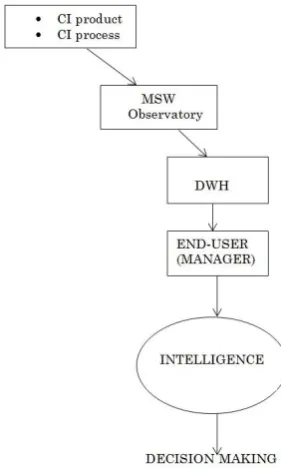
In this research work, we seek to build a system that will have as its input, the actionable intelligence acquired through the process of CI to build a design that will help in management decision-making. The model is such that actionable intelligence conceptualized through CI is input into an observatory which will eventually form the repository of data for a data warehouse (DWH).
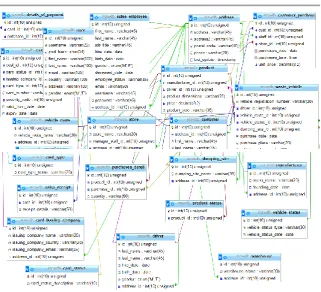
Figure 4: DWH designed through PHPMyAdmin using MySQL with data inputs from CI
3.1 MSW management enhanced by CI
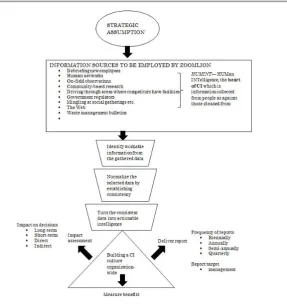
Figure 5: Conceptual framework for the return on CI to Zoomlion Ghana Limited
3.2 Benefits and pitfalls of the CI process
3.2.1 Benefits of CI
It makes managers proactive so that they are likely to experience few surprises;
Helps managers to identify new market opportunities and prospective customers;
Identification of business trends that can make or mar the business; and
Have a clear and unambiguous understanding of government policies that the organization has to know to avoid falling foul of the law.
3.2.2 Pitfalls of CI
There is likely to be misinformation as the desire to acquire information could make one consume anything that resembles one; i.e., inaccurate or incomplete information could pass for genuine information; and There is also the possibility of engaging in espionage
that is not legally acceptable by the laws of a country which could result in severe sanctions.
3.2.3 Consequences of not implementing CI
• Corporate mistakes often could have been avoided with good CI. For example, companies have:
– Developed and introduced a new product that was opposite to market trends.
– Ignored an ―inferior‖ competitor who was going to put them out of business.
– Believed in a vendor‘s story that turned out to be an absolute falsehood.
4. CI PRACTICE IN WASTE MANAGEMENT
ORGANIZATIONS IN GHANA
4.1 Present status of organizations in Ghana
stated earlier, in case there exists something of the semblance of CI at all, there is a lack of awareness even on the part of those who should be implementing it. If progress should be made on this front, then a formalization of the process is very necessary. For a fact, the absence of a CI culture company-wide as well as any formalized policies in that direction leaves a gaping loophole in business strategy. Many practitioners are of the view that true intelligence is only created after the thorough analysis and validation of collected information and its subsequent conversion into actionable intelligence which is eventually applied in strategic and tactical decision-making (Gilad & Gilad, 1985a; Gilad & Gilad, 1986; Kahaner, 1997; Calof & Miller, 1997; Herring, 1998).
In this research paper, we are using Zoomlion Ghana Limited as our case study. It is the largest solid waste management company in Ghana with a staff strength of about 80,000. The operations of the company cover the entire country. Yet still, the effectiveness of waste management in its assigned areas of operation is very unsatisfactory as a result of ineffective practices that have remained in place to this day. Most often piled up waste bins are a common sight in the streets and residential areas and could remain uncollected for days and weeks. However, with other waste management companies also in the competition, innovations by any of them is the right way to go since this will impact on the effective waste collection and subsequent effective management .
5. RESEARCH METHODOLOGY
well enough the eventual gains this concept will bring to the organization.
5.1 Implementation of CI in Zoomlion Ghana Limited
To implement the CI process in the organization of study we have identified, we want to refer to Figure 5 above. This is a framework developed to address what we think are the salient steps to take so as to bring innovations into the way solid waste is managed by Zoomlion Ghana Limited.
Firstly, the sources of information must be rigorously pursued in order to ensure that the actionable intelligence to be created eventually is incontrovertible. However, at the heart of the information source, should be HUMINT—human intelligence—classified as the heart of CI. This is because it gives more accurate and reliable information to document or hearsay information.
The company should for a start form a small CI group with the primary aim of achieving tactical and strategic targets. This group should be headed by a veteran CI professional most probably recruited from abroad who can provide the needed leadership required. The corporation should then focus on two major drivers; i.e., to improve revenue and service. This can be achieved by ensuring that all the sub-units within the CI group have a very interactive chemistry by always sharing research requests with one another.
5.2 Putting CI into action: Recycling and Composting Strategy
of waste as we currently know it coexist with the new technologies of recycling and composting.
Even though there is a great potential for recycling and composting at this company, the real opportunities lie in the new applications they bring. Recycling and composting always generate new products. We therefore need corporate decision makers to do a paradigm shift in their thinking so as to buy into these ideas. They will have to accept that shifting to a new technology will imply that less revenue will likely come from traditional methods already in existence. However, they will have to look to the future positively and accept that the opportunities the new technologies bring and the subsequent new revenues will be unlimited. The secret of success lies in the fact that the company recognizes what kind of technology will ultimately bring satisfaction to customers so that it will draw in new customers and also keep the already existing ones.
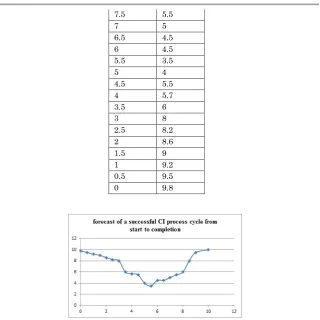
We project the CI life cycle as a U-curve. This is because from the start of the CI process, the team of researchers tends to have a high level of confidence which dips gradually as the process goes on till it turns around on the up again. This normally happens after the actionable intelligence has been applied to produce a product that eventually brings in the dividends expected in due course. During this stage, there is a reflection in the business returns and awareness is also created which ensures no surprises. Thus the curve is on the positive trend or upward trend at this point.
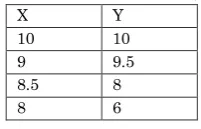
Below, we construct a U-curve using a scale of 0 to 10, where 0 represents the lowest stage of the process whilst 10 represents the optimum stage where results are showing.
Table 1: Table of values for the U-curve of a typical CI process
X Y
10 10
9 9.5
7.5 5.5
7 5
6.5 4.5
6 4.5
5.5 3.5
5 4
4.5 5.5
4 5.7
3.5 6
3 8
2.5 8.2
2 8.6
1.5 9
1 9.2
0.5 9.5
0 9.8
Figure 6: A graphical display of a forecast of the CI process cycle
5.3 Measuring the impact (effectiveness) of CI on Zoomlion Ghana Limited
According to Montes, Moreno, & Fernandez (2004), organizations that are proactive enough to roll out CI in response to environmental changes and develop new capabilities that will counter these external forces will achieve higher performance that will make them more successful. Consequently, we have identified the following measurable items to assess the impact of the value of the CI process (Herring, 1996). These are:
Client retention; Customer satisfaction; Market share;
Acceptance of products as they are on the market; Employee keenness to embrace CI;
Increased revenue; Cost savings; and Time savings.
6. CONCLUSIONS
employees right from the start so that the process is rolled out from day one.
We, however, want to reaffirm these salient time-tested objectives about CI.
It is solely meant for only the top managers of a company who use the insights to identify the bridge between the insights and the bottom-line;
Generally, you cannot and should not explicitly quantify the value of CI;
It is important to do surveys with sales people to get ratings on how effective was the inputs from the CI team.
CI should be viewed as a forecast and not as a crystal ball you can easily see through.
The management of MSW is the singular most pressing job of managers of municipalities and always the decision quality has to be high. However, in most countries, especially developing ones, the level of effectiveness in solid waste management is very unsatisfactory. Thus if the CI concept which is to impact positively on management decision-making is adopted and rolled out organization-wide, there is every likelihood that we can improve on the statistics significantly and relative to the external competition, a major paradigm shift will happen for the better.
REFERENCES:
Aaker, D. A. (1998). Strategic Market Management. (5th Ed.),
New York, John Wiley & Sons Inc.
Calof, J. L. & Miller, J. (1997). The status of CI across the globe. Proceedings of the 12th Annual Conference of the
Society of Competitive Intelligence Professionals: 213-223.
Curtis, J. (May 24, 2001). Behind enemy lines, Marketing, 28– 29.
Fuld, L. M. (1985). Competitor Intelligence: How to Get It; How to Use It. New York: John Wiley & Sons.
Gilad, B & Gilad, T. (1985a). ‗A Systems Approach to Business Intelligence‘, Business Horizons, 28(5): 65-70.
Gilad, T & Gilad, B.( 1986). ‗Business intelligence – the quiet revolution‘, Sloan ManagementReview, 27(4):53-60. Gilad, B. and Gilad, T.( 1988). The Business Intelligence
System. New York:AMACOM.
Guimaraes, T.( 2000). The impact of competitive intelligence and IS support in changing small business organisations. Logistics Information Management,
13(3):117-125.
Herring, Jan (1996). Measuring the Effectiveness of Competitive Intelligence: Assessing and Communicating CI’s Value to Your Organization. Alexandria: Society of Competitive
Intelligence Professionals. http://www.scip.org/Publications/ProductDetail.cfm?Item
Number=11972
Herring, J. (1998). ‗What is intelligence analysis?‘ Competitive Intelligence Magazine, 1(2):13-16.
Jaworski, B. J., Macinnis, D. J. & Kohli, A. K. (2002). Generating Competitive Intelligence in Organizations.
Journal of Market-Focused Management, 5:279-307. Johns, P. & Van Doren, D. C.( 2010). Competitive Intelligence
in Service Marketing: A New Approach with Practical Application. Marketing & Planning, 28(5):551-570. Kahaner, L. (1997). Competitive Intelligence: How to Gather,
Analyze and Use Information to Move your Business to the Top. New York: Simon and Schuster.
Liebowitz, J. (2006). Strategic Intelligence: Business Intelligence, Competitive Intelligence, and Knowledge Management. Boca Raton, Auerbach Publications, Taylor & Francis Group.
McKinnon, S. & Burns, W. (1992). The Information Mosaic. Boston: Harvard Business School Press.
Montgomery, D. B. and Urban, G .L. (1970). Marketing Decision-Information Systems: An Emerging View.
Journal of Marketing Research 7:226–234.
Montgomery, D. B and Weinberg, C. B. (1979). Toward Strategic Intelligence Systems. Journal of Marketing
43:41–52.
Montes, F. J., Moreno, A. R., Fernandez, L. M. (2004). Assessing the Organizational Climate and Contractual Relationship for Perception of Support for Innovation,
InternationalJournal Manpower, 25(2), 167-180.
Pearce, F. T. (1976). Business Intelligence Systems: The Need, Development and Integration. Industrial Marketing Management 5(2,3):115.
Society of Competitive Intelligence Professionals. ―What is CI?‖ accessed at www.scip.org, on 29th Nov, 2015.