ISSN (Print) : 2320 – 3765 ISSN (Online): 2278 – 8875
I
nternational
J
ournal of
A
dvanced
R
esearch in
E
lectrical,
E
lectronics and
I
nstrumentation
E
ngineering
(An ISO 3297: 2007 Certified Organization)
Vol. 5, Issue 4, April 2016
Design and Development of Automatic
Adjustment of Street Light Intensity
K.S. Ruchitha1, Neelakshi Agarwal2, Soumya Anand3, Anurima Das4, Rajasree P.M5
U.G. Student, Department of Electronics and Instrumentation Engineering, R.V College of Engineering, Mysore Road,
Bangalore, India1,2,3,4
Assistant Professor, Department of Electronics and Instrumentation Engineering, R.V College of Engineering, Mysore
Road, Bangalore, India 5
ABSTRACT: The reduction in energy consumption has become a major concern for developing countries in order to achieve sustainable development. This paper presents a low-cost design of an automatic lighting system with the aim of energy saving and autonomous operation, using an embedded system. According to Central Electrical Authority report in 2015, 61% of the electricity in India is generated using natural resources like coal, thus endangering the environment. The per capita electricity generation in India during the year 2014-2015 was 1010 kWh. Therefore, an automatic street light system is developed that senses the ambient sunlight and responds accordingly. An LDR sensor was used to regulate the intensity of LEDs through voltage divider concept. At the same time, an IR sensor was implemented to switch the LEDs between their minimum and maximum intensity. AT89C51 microcontroller is used to control and coordinate the working of this system.
KEYWORDS: Ambient light,AT89C51 (ATMEL 8051 microcontroller), IR sensor, LDR (Light Dependent Resistor), LED (Light Emitting Diode).
I. INTRODUCTION
Street lighting provides an important function; keeping pedestrians and drivers safe. All cities in India have a framework of street lighting system which depends on the availability of electricity as well as the requirement. In order to reduce the amount of electricity used, several techniques have been developed.
Studies have shown that proper street lighting can substantially reduce car fatalities and crashes with pedestrians. Lighted intersections and highways are known to have fewer crashes than their unlit counterparts. Street lights are large consumers of energy because of high hours-of-use. In the current scenario, the streetlights are such that as the intensity of sunlight falling on a sensor on the streetlight crosses a threshold level, the light automatically turns on or off. This project aims to automate the street lights by using embedded systems. This method has been explored further in this paper and uses the LDR sensor’s light dependent property.
The remainder of this work is organized as follows. Section II describes the related works that have already been implemented. Section III describes the system overview and the block diagram of this project. Finally, Section IV discusses data obtained as a result and the performance of the proposed approach based on the sensor output. Section V concludes this paper and discusses directions for potential future work.
II. RELATEDWORK
Several techniques such as the bi-level approach, sun-tracker method, etc have already been implemented and were proved less efficient and more expensive. Some of the techniques have been explained below.
ISSN (Print) : 2320 – 3765 ISSN (Online): 2278 – 8875
I
nternational
J
ournal of
A
dvanced
R
esearch in
E
lectrical,
E
lectronics and
I
nstrumentation
E
ngineering
(An ISO 3297: 2007 Certified Organization)
Vol. 5, Issue 4, April 2016
making it less power efficient [1]. A similar method of using a light dependent sensor which is interfaced to the AVR microcontroller has also been implemented to track the sunlight. When it is dark, the LED will be turned ON and vice versa thus again using only ON/OFF feature [5].
Another method developed is a small silicon area chip having a very high driving power. This chip can be used for high power LED dimming in smart city lighting systems, providing stable current to drive a LED and to avoid EMI or Electromagnetic Induction. However, the chip design is highly complicated and makes this technique expensive [2]. The street lighting monitoring system is another method in which reports that detail the energy consumption are displayed periodically. This would alert the population about the increase in the consumption of electricity. However, the volume of data that needs to be handled is quite large and is not in a standardized manner which makes its implementation difficult [3].
A method called sun-seeker or tracker was developed that enabled hardware implementation of auto light intensity and auto switching system for Smart Street lighting system. This method uses solar energy efficiently but due to the constant movement of sensing system the stability analysis is very difficult [4].
In this project, LDR sensor is used with an IR sensor to improve the bi-level approach of LED switching. It can be used in any application where light intensity needs to be varied depending on the ambient light condition. Embedded system is used to completely eliminate the manual operation of street lights. The first section consists of LDR and IR sensors operating at different voltages to send the information about the changes in surrounding conditions. The microcontroller 8051 processes this information to make changes to the LED’s intensity.
III.SYSTEM OVERVIEW
Fig.1. Block diagram of Automatic Lighting System
Fig.1 shows the block diagram of the proposed automatic intensity control system. The above block diagram consists of two parts. Both vehicle/human movement detection and the ambient light conditions are used to regulate different LEDs. The first part consists of an IR sensor which is used to send information about any vehicle movement to the microcontroller which switches the LED voltage between 5V and 12V. The second part consists of LDR sensor which uses voltage dividing circuit to constantly change the LED intensity depending on the light falling on its surface. The maximum intensity is achieved at 12V in complete darkness.
The microcontroller is used to control LEDs’ operation that depends on both IR sensor and the LDR. The hardware components used to design the system are described below:
A. LDR sensor
In the presence of light, the LDR has a low resistance. This makes the voltage at the base of the transistor high enough to turn it (the transistor) ON which turns on the LED.
The resistor controls the amount of current passing through the LED. A variable resistor is used to change the trigger point of the LED.
ISSN (Print) : 2320 – 3765 ISSN (Online): 2278 – 8875
I
nternational
J
ournal of
A
dvanced
R
esearch in
E
lectrical,
E
lectronics and
I
nstrumentation
E
ngineering
(An ISO 3297: 2007 Certified Organization)
Vol. 5, Issue 4, April 2016
B. IR sensor
The circuit of an IR sensor consists of an IR LED, a photodiode, a potentiometer and an IC operational amplifier. When the light emitted by the IR LED falls on the photodiode after hitting a moving vehicle/human, the resistance of the photodiode decreases. In the op–amp, one terminal is at the threshold value set by the potentiometer and other input is from the photodiode’s series resistor.
When the intensity of the incident radiation is more on the PD, the series resistor has a high voltage drop. Inside the IC, both the threshold voltage and the voltage across the series resistor are compared. If the threshold voltage is lesser than the voltage across the resistor, the output of the op-amp is high and the LED is turned on. The setup used for the positioning of the IR LED and the IR receiver in this case is Direct Incidence.
C. Microcontroller 89C51
Port 0 and Port 2 of AT89C51 are used to provide address to an external memory. The microcontroller programming is done in Keil µvision using C++. The relay gets input from Port 3.0 of the microcontroller. Port 2.0 of the microcontroller is used with the IR sensor. Initially, port 2.0 is set to high (1) and port 3.0 is set to low (0). When the IR sensor turns high, the relay turns on and switches on the LED and vice versa.
The software implementation of the design follows the algorithm as: The files required for the operation of AT89S52 are added. The port 2.0 is assigned as the input from the IR sensor. The port 3.0 gives output to the relay.
The detection of an object makes the IR input as 1 switching the relay to 12V. If no object is detected, the IR input is 0 and the relay keeps working at 5V.
IV.RESULTS
The results obtained for the implementation of Automatic Street light intensity variation system are tabulated below. These results were implemented and results obtained signified that it efficient for real time use. The output of the process is signified by the LED.
Fig2. Prototype of the system showing the implementation of block diagram
ISSN (Print) : 2320 – 3765 ISSN (Online): 2278 – 8875
I
nternational
J
ournal of
A
dvanced
R
esearch in
E
lectrical,
E
lectronics and
I
nstrumentation
E
ngineering
(An ISO 3297: 2007 Certified Organization)
Vol. 5, Issue 4, April 2016
TABLE 1. Shows Led Status Indication For LDR Sensors
Table 1 shows the output of the LEDs that are connected to the LDR sensor for the different light conditions. The LEDs work at maximum intensity under dark conditions and slowly reduces its intensity when light is present around the LDR.
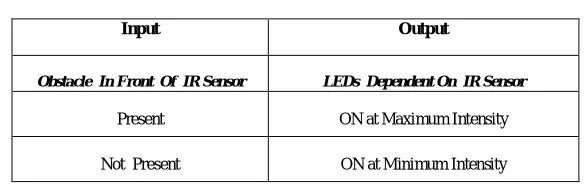
TABLE 2. Shows The LED Status Indication For IR Sensors
Table 2 shows the LEDs condition in presence and absence of a vehicle. The intensity is maximum when an obstacle is present and vice-versa.
TABLE 3. Shows The Practical Operating Values Of LED’s
Table 3 shows the practical operating voltages across LDR and IR sensors for different ambient conditions. The sensing module consists of the IR sensor whose output is used as an input to the microcontroller. The signal is generated according to detection by the IR sensor and the LEDs are turned ON or OFF using the relay. The signal from the LDR is used to vary the intensity of LDR based LEDs. The range of operation varies between 0V to 5V.
The 8051 microcontroller development board obtains the power supply from 12V DC adapter. 5V supply is given to two LDR and two IR circuits. 12V is provided to the relay circuit. When the microcontroller is switched on, the LEDs connected to the IR circuits glows at 5V minimum intensity and the LEDs connected to the LDR circuit is completely off, that is at 0V with the normal daylight condition. As the surrounding condition of LDR is made dark, the LEDs
Input Ouput
Ambient condition for LDR sensor LEDs dependent on LDR
Dark ON at maximum intensity
Light OFF
Input Output
Obstacle In Front Of IR Sensor LEDs Dependent On IR Sensor
Present ON at Maximum Intensity
Not Present ON at Minimum Intensity
Component condition Theoretical Values Practical Values
LDR (OFF) 0V 3.6V
LDR (ON) 5V 5.9V
IR (OFF) 5V 5.8V
ISSN (Print) : 2320 – 3765 ISSN (Online): 2278 – 8875
I
nternational
J
ournal of
A
dvanced
R
esearch in
E
lectrical,
E
lectronics and
I
nstrumentation
E
ngineering
(An ISO 3297: 2007 Certified Organization)
Vol. 5, Issue 4, April 2016
connected to LDR starts glowing. When the IR sensor detects the presence of a vehicle, the relay is switched to 12V. This increases the glow of LEDs connected to IR sensor to 12V.
V. CONCLUSIONANDFUTURESCOPE
The street lights are a major safety requirement therefore, the issues related to the street lights have to be taken care of efficiently. The method proposed in our project minimizes energy consumed by street lights. It uses real time sensing module to change the intensity of street light based on ambient light.
A drawback of the circuit proposed is the maintenance factor associated with the sensors and their sensitivity after continuous usage. Dust can easily accumulate on the sensor surface and would require occasional cleaning.
The lower limit of LDR does not match with the lower limit of IR sensor because of which integrated operation is not possible.
A future prospect that can be integrated into the circuit would be the use of wireless communication for automatic fault detection of the circuit using a centralized control system. Dust accumulation on the sensor surface can be avoided by using the latest Nano-cleaning technology which is still in the development phase and could be expensive.
Another approach for street light intensity variation would be the use of an astronomical timer circuit which uses thyristor to vary the intensity of the street light depending on the climate and day-night timings of a particular place.
ACKNOWLEDGEMENT We would like to thank R.V College of Engineering for providing support.
REFERENCES
[1] Sharath Patil G.S, Rudresh S.M, Kallendrachari.K ,M Kiran Kumar, Vani H.V, “Design and Implementation of Automatic Street Light Control Using Sensors and Solar Panel”, Int. Journal of Engineering Research and Applications, Vol. 5, Issue 6,pp.97-100, June 2015.
[2] Dheeraj sharma, “A Sensor-Less and Energy Efficient Street Light Control System,” International Journal of Advanced Research in Electrical, Electronics and Instrumentation Engineering, Vol. 4, Issue 3, pp. 1805-1812, March 2015.
[3] K.Y.Rajput1, Gargeyee Khatav2, Monica Pujari3, Priyanka Yadav, “Intelligent Street Lighting System Using Gsm,” International Journal of Engineering Science Invention, Vol.2, Issue 3, pp.60-69, March. 2013.
[4] Kapse Sagar Sudhakar1 , Abhale Amol Anil2 , Kudake chetan Ashok3 , Shirsath Shravan Bhaskar, “Automatic Street Light Control System”, International Journal of Emerging Technology and Advanced Engineering, Vol. 3, Issue 5, pp. 188-189, May 2013.
[5] Archana M, Mahalahshmi R, “E – Street: LED Powered Intelligent Street Lighting System with Automatic Brightness Adjustment Based On Climatic Conditions and Vehicle Movements”, International Journal of Advanced Research in Electrical, Electronics and Instrumentation Engineering, Vol. 3, Special Issue 2, pp. 60-67, April 2014.
[6] Priyanka S, Dr.K.Baskaran, “Control of Solar LED Street Lighting System Based on Climatic Conditions and Object Movements”, Journal of Information, Knowledge and Research In Electrical Engineering, Vol. 03, Issue – 02, pp. 480-486, Nov 14 to Oct 15.
[7] Ahmed Sharique, Anees, Anupriya, Ayushy Chowdhary, Shalini Dubey, Shweta Verma, “Solar Powered LED Streetlight with Automatic Intensity Control”, International Journal of Innovative Research in Electrical, Electronics, Instrumentation and Control Engineering, Vol. 3, Issue 6, pp 32-36, June 2015.