International Journal of Research (IJR)
e-ISSN: 2348-6848, p- ISSN: 2348-795X Volume 2, Issue 07, July 2015Available at http://internationaljournalofresearch.org
Using embedded system Mobile Vehicle checking &
video capture using GPS & GPRS
Nagubandi Ravikumar
1; O.Navajeevan Raju
2& D. Vijay Kumar
31M.Tech, Dept of ECE Vijaya Engineering College, Telangana, India.
Email: [email protected]
2 Assistant Professor,Dept of ECE ,, Vijaya Engineering college, Telangana,India, Email:
3 Associate Professor, HOD,Dept of ECE,Vijaya Engineering college, Telangana,India, Email:
Abstract
Due to the insecure environment the ratio of vehicle theft increases rapidly. Because of this is manufacturers of luxury automobiles has the responsibilities for taking steps to ensure the authorization for the owners and also in built the anti theft system to prevent the vehicle from theft. The proposed security system for smart cars used to prevent them from loss or theft using Advanced RISC Machine (ARM) processor. It performs the real time user authentication (driver, who starts the car engine) using face recognition, using the Principle Component Analysis (PCA) algorithm. According to the comparison result (authentic or not), ARM processor triggers certain actions. If the result is not authentic means ARM produces the signal to block the car access (i.e. Produce the interrupt signal to car engine to stop its action) and inform the car owner about the unauthorized access via Multimedia Message Services (MMS) with the help of GSM/GPRS modem. Also it can be extends to send the current location of the vehicle using the GPS modem as a Short Message Services (SMS).
Keywords: Mobile Vehicle checking; video capture; GPS; GPRS; embedded system
1.
Introduction
In the past decades, the issue of security has become more significant and the need for effective security systems has intensified [1]. Many areas were marked as restricted, since illegal access can have serious consequences for homeland security and can even result in the loss of lives in the case of an explosive armed vehicle. To increase security in access
control applications for a vehicle that enters a restricted area, this work proposes the architecture and installation of a vehicle inspection system. Three different computer vision applications are integrated in the system, namely license plate recognition, vehicle manufacturer/model detection and under-vehicle inspection.
International Journal of Research (IJR)
e-ISSN: 2348-6848, p- ISSN: 2348-795X Volume 2, Issue 07, July 2015Available at http://internationaljournalofresearch.org
their combination could improve the overall system effectiveness and identify attempts of fraudulence, such as the use of stolen plates. Typical applications would include high-security areas such as airports, embassies, power plants and military camps. In these areas, registered vehicles are allowed to enter, where other vehicles are prohibited. In the literature, License Plate Recognition (LPR) remains the principal vehicle identifier. Systems of this type, detect the vehicle license plate, segment its characters and proceed to character recognition. Such systems are still widely researched and used, despite the fact that license plates can be easily altered in case of fraud.
Fitting a piece of glass in front of the plate to cause light deflection and replacing the plates with stolen or counterfeit ones, are just a few examples. System effectiveness can be drastically improved if license plate recognition is combined with simultaneous vehicle manufacturer and model recognition. In the latter, recognition is conducted through the vehicle mask and the manufacturer logo and is based on machine learning techniques and artificial intelligence. These features can help to identify a vehicle with a tampered or stolen plate. With the development of technology, people have higher expectation of living, country has invested a huge amount of money to the capital construction, especially to roads infrastructure. In this situation, the
International Journal of Research (IJR)
e-ISSN: 2348-6848, p- ISSN: 2348-795X Volume 2, Issue 07, July 2015Available at http://internationaljournalofresearch.org
section 1describes the introduction ,section 2 describes the system design and composition techniques and the processes of video capture, vehicle license recognition system and ARM9 peripheral interface. Section 3 describes hardware design and section 4 describes the software design.
2.
Related Work
In this paper we are using the ARM9 as the core and the GPS and GSM techniques for the position and for sending the msg to mobile. We will also use the Bluetooth and 8051 controller in the place of ARM 9 in order to perform the controlling of the system. The following section represents the system function and composition of the system by using the ARM9.
2.1 System Components:
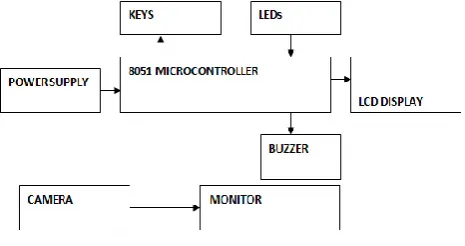
As shown in the figure 1 , this system builds a new intelligent vehicle checking system based on ARM9 embedded processing technology, processing technology of digital videos, vehicle identification technology, GSM wireless mobile telecommunication technology, GPS positioning technique, implements the security to vehicles. This system has the following features:
a. Image Capture:
When the system works, the camera in the the car capture the Image of driver
automatically and saves it in the video buffer.
b. ARM9-based embedded system (AES):
The AES is termed to the heart of System. It is designed based on a low power 32-bit ARM7 . It is a high performance and low cost solution for network applications
Fig 1: System Components.
c. GPS module:
The system can correctly send the position of vehicle to the server center by GPS positioning. The GPS module obtains the precise locality by parsing received GPS signal.
d. GSM module:
International Journal of Research (IJR)
e-ISSN: 2348-6848, p- ISSN: 2348-795X Volume 2, Issue 07, July 2015Available at http://internationaljournalofresearch.org
waves. The GSM module can send the information out by SMS (Short Message Service) message, including realtime position of the “lost” car and even the images of “the driver”.
2.2 Hardware Design:
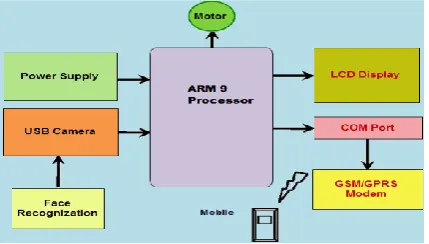
Smart vehicle Security system is composed of ARM 9 microprocessor, peripheral equipment, and video capture, GPS positioning module, wireless telecommunication module and remote control receiver. The detailed hardware composition is shown in figure 2
Fig 2: Hardware of Security System
a. ARM9 PROCESSOR:
The ARM9 processor is ideal for many real-time embedded applications with demanding size constraints and cost-sensitive considerations. The enhanced DSP extensions in the ARM9 processor remove the need for a separate DSP in the SoC design, resulting in additional savings in chip complexity, power consumption, and time-to-market. The ARM9 processor can achieve executed per clock cycle at 1.10 DMIPS/MHz.
TI provides software components and documentation that makes ARM9 processor development quick and deployment possible. TI offers Software Development Kits (SDK) for Linux and StarterWare, TI’s no-OS platform for peripheral layer libraries, which can be downloaded free of charge and are also included in hardware evaluation modules (EVM) and development kits. SDKs for ARM9 require no royalties and offer Board Support Packages (BSPs), tools, demos, documentation and more.
3.
Implementation
International Journal of Research (IJR)
e-ISSN: 2348-6848, p- ISSN: 2348-795X Volume 2, Issue 07, July 2015Available at http://internationaljournalofresearch.org
Fig 3: Block Diagram of Car Security System.
3.1 Face Detection System (FDS):
Face recognition is a non-intrusive method, and facial attributes are probably the most common biometric features used by humans to recognize one another. The applications of facial recognition range from a static, controlled authentication to a dynamic, uncontrolled face identification in a cluttered background. While the authentication performance of the face recognition systems that are commercially available is reasonable, they impose a number of restrictions on how the facial images are obtained, often requiring a fixed and simple background with controlled illumination. These system also have difficulty in matching face images captured from two different views, under different illumination conditions, and at different times. 'th' is the threshold value depending on the real time environment (varies from 300 - 400). lt is questionable whether the face itself, without any contextual information, is a sufficient
basis for recognizing a person from a large number of identities with an extremely high level of confidence.
3.2 Principle Component Analysis (PCA):
The purpose of PCA is to reduce the large dimensionality of the data space (observed variables) to the smaller intrinsic dimensionality of feature space (independent variables), which are needed to describe the data economically. The main idea of using PCA for face recognition is to express the large 10 vector of pixels constructed from 15 facial image into the compact principal components of the feature space. This can be called Eigen face Projection.
3.3 Embedded Control System:
The ARM is a 32-bit Reduced Instruction Set Computer (RISC) Instruction Set Architecture (ISA) developed by ARM Holdings. It was known as the Advanced RISC Machine, and before that as the Acorn RISC Machine. The relative simplicity of ARM processors made them suitable for low power applications. This has made them dominant in the mobile and embedded electronics market as relatively low cost and small microprocessors and microcontrollers.
3.4 Motor:
International Journal of Research (IJR)
e-ISSN: 2348-6848, p- ISSN: 2348-795X Volume 2, Issue 07, July 2015Available at http://internationaljournalofresearch.org
conductor generates a magnetic field; when this is then placed in an external magnetic field, it will experience a force proportional to the current in the conductor, and to the strength of the external magnetic field. As you are well aware of from playing with magnets as a kid, opposite (North and South) polarities attract, while like polarities (North and North, South and South) repel. The internal configuration of a DC motor is designed to harness the magnetic interaction between a current-carrying conductor and an external magnetic field to generate rotational motion.
4.
Experimental Results
In this project, the real time face recognition is performed by using the PCA method with the help of web camera.
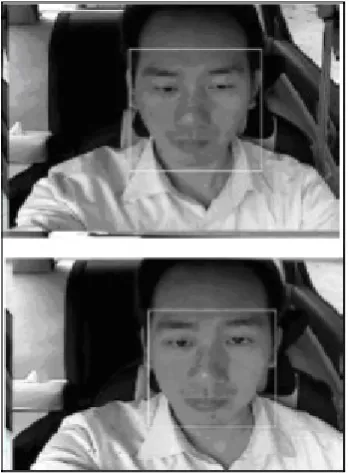
Fig 4: Face Detection in Car.
Fig 4 shows the screen short after the collection of the gallery (owner) images. Then any person getting in to the carry it will compares if matched motor will starts i.e it will signal to the car to start otherwise the unauthorized person image will send as MMS to the owners mobile which shows the below
figure 5.
Fig 5: MMS to the Car Owner Mobile.
5.
Conclusion
International Journal of Research (IJR)
e-ISSN: 2348-6848, p- ISSN: 2348-795X Volume 2, Issue 07, July 2015Available at http://internationaljournalofresearch.org
owner’s mobile. In thecurrent project if the results are unmatched, the unknown person’s image will goes to owners mobile only. In
future we can extend this by sending the information to police control room for taking immediate action.
6. References
[1] S. Ajaz, M. Asim, M. Ozair, M. Ahmed, M. Siddiqui, Z. Mushtaq, “Autonomous Vehicle Monitoring & Tracking System,” SCONEST2005, pp. 1 – 4, 2005.
[2] Joseph A. O'Sullivan, Robert Pless, Advances in Security Technologies: Imaging, Anomaly Detection, and Target and Biometric Recognition”, Microwave Symposium IEEE/MTT-S International Volume, Page(s):761 – 764, 2007.
[3] Viola P, Jones M, “Rapid Object Detection using a Boosted Cascade of Simple Features” Proceedings of the 2001 IEEE Computer Society Conference on Computer Vision and Pattern Recognition, p511, 2001.
[4] Lienhart R, Kuranov A, Pisarevsky, “Empirical analysis of detection cascades of boosted classifiers for rapid object detection” Technical report, MRL, Intel Labs, 2002.
[5] Viola P, Jones M, “Fast and robust classification using asymmetric AdaBoost and a detector cascade” NIPS 14, 2002.
[6] Goldberg D.E, “Genetic algorithms in search, optimization, and machine learning” AddisonWesley, 1989.
[7] Xusheng Tang, Zongying Ou, Tieming Su, Pengfei Zhao, “Cascade AdaBoost Classifiers with Stage Features Optimization for Cellular Phone Embedded Face Detection System” Advances in Natural Computation, p. 688, 2005.
[8] Jianxin Wu, M. D. Mullin, J. M. Rehg, “Linear Asymmetric classifier for cascade detectors”, Conf Machine Learning, 2005.
[9] PU Han-lai, LING Ming, “Performance Oriented Customization of On-Chip Memory Capacity” Journal of Applied Sciences, p. 364, 2005.
International Journal of Research (IJR)
e-ISSN: 2348-6848, p- ISSN: 2348-795X Volume 2, Issue 07, July 2015Available at http://internationaljournalofresearch.org
Authors Profiles
NAGUBANDI RAVIKUMAR pursuing his M.Tech, from
Vijaya Engineering College, Telangana, India. Email:[email protected]
O.NAVAJEEVAN RAJU completed his M.Tech and working as a Assistant Professor,
fromVijaya Engineering college, Telangana,India, Email: [email protected]
9652178557
D. Vijay Kumar completed his M.Tech and working as a Associate Professor, HOD, HOD,14-years Experience
fromVijaya Engineering college, Telangana,India, Email: