A Review on Various Face Detection and
Recognition Techniques
Aman Dhiman1, Raman2
M.Tech Student, Dept. of EEE, Arni University, Kathgarh, Kangra HP, India1
Assistant Professor, Dept. of ECE, Arni University, Kathgarh, Kangra HP, India2
ABSTRACT: Face recognition is a technique used for security purpose. Face recognition is a biometric system. It is used world widely in various real time fields. Face recognition is a biometric system which uses various algorithms or techniques for the purpose of identification and security. Face recognition is advancement in the field of image analysis. The reason behind the trend of face recognition system is advancements in commercial and law enforcement field and existence of such a feasible and dynamic technology. It is a computer based automatic system which identifies the person by matching the inputted digital image with the saved patterns. A database is used to save the facial characteristics. The digital device is used which scans the individuals face. A biometric facial recognition system is used for the purpose of security normally in those areas where people are the centre of attraction. Face recognition is a center of attraction for the researchers also due to its increased usability.
KEYWORDS: PCA, Linear Discriminant Analysis, Biometric system, Face recognition system.
I. INTRODUCTION
Face recognition is a biometric system which is used for the purpose of identification of an individual. Growing use of biometrics has increased the research work done in the field of face recognition. Face recognition is a section of pattern recognition. In face recognition system an individual’s face is scanned by a digital device. Along with the face other characteristics are also scanned like fingerprints, Iris recognition. Face Recognition system is much popular in many of the fields the main and the important one is recognition or can say as the security or authentication purpose. Researchers found this topic very interesting that they use to do lots of researches in this field. There are some conventional techniques used for face recognition. Earlier PCA was used for face recognition. The disadvantage of existing techniques was that it used only PCA that worked with small data sets but proved to be inefficient when it comes to working on large data sets. To overcome this limitation a technique named as PCA and K-mean clustering is used. This technique is combination of K-mean algorithm along with PCA. Other techniques used for biometric face recognition are like LDA, KPCA (Kernel PCA). PCA will give significant results for small data-sets and K-mean clustering approach is efficient for large data sets. This combined technique works better for task of face recognition on both small as well as large data sets and hence is an efficient technique for face recognition [1].
II. TECHNIQUES FOR FACE RECOGNITION
recognition. PCA applies on both database image and input image. Using PCA the system finds the Eigen values, Eigen vector and Euclidian distance. After comparing with database it declares the matches. PCA is sensitive to the relative scaling of the original variables. PCA is a mathematical tool or technique which transforms the correlated variables to a number of uncorrelated variables. [3] This technique is widely used in image compression and image classification. It includes process namely principal components which are used to transform the correlated variables. It computes a compact and optimal description of the data set. The first principle monitors the changes in data and each or every related component monitors the remaining variance as possible. First principal component is used to monitor the maximum variance. The second principal component is constrained exist in the subspace perpendicular of the first. The third principal component is used for maximum variance in the subspace perpendicular to the first, second and so on. The PCA is also known as Karhunen-Loève transform or the Hostelling transform. The basis vectors of PCA depend upon the data set because it does not have a inbuilt set of basis vectors like FFT, DCT and wavelet etc.
Fig. 1 Block Diagram of technique of PCA
Eigen face It is one of the most generally investigated approaches to face recognition. It is also known as Karhunen-Loève expansion, Eigen picture, eigenvector, and principal component. One of the generally used algorithms for face recognition is Eigen face method. Karhunen-Loève is based on the Eigen faces technique in which the Principal Component Analysis (PCA) is used [4].
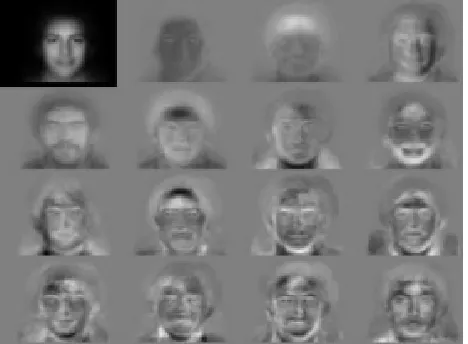
PCA is successfully used to perform dimensionality reduction. Principal Component Analysis is used by face recognition and detection. Mathematically, Eigenfaces are the principal components that divide the face into feature vectors. The feature vector information can be obtained from covariance matrix. These Eigenvectors are used to measure the variation between multiple faces. The faces are characterized by the linear combination of highest Eigenvalues. Each face can be considered as a linear combination of the Eigenfaces. The face can be approximated by using the eigenvectors having the largest eigenvalues.The best M Eigenfaces construct an M dimensional space, i.e., the “face space”. The authors reported 96 percent, 85 percent, and 64 percent correct classifications averaged over size variations, lighting, and orientation respectively. Their database contained 2,500 images of 16 individuals. Eigen face is a practical approach for face recognition. Implementation of an Eigen face recognition system becomes easy because of the simplicity of its algorithms. The accuracy of Eigen face depends on many things. The Eigen face technique finds a way to create ghost-like faces that represent the majority of variance in an image database. This technique is based on an information theory approach that decomposes face images into a small set of characteristics feature images called “Eigen faces”, which are actually the principal components of initial training set [5]. The drawback of Eigen face is, it is sensitive for lightening conditions and position of the Head. Disadvantage is finding the eigenvectors and eigenvalues are time consuming. [6]
Fig 3 Parts of Facial Feature Extraction
LDA (Linear Discriminant Analysis) Lih-Heng Chan [2] proposed a framework of facial biometric was designed based on two subspace methods i.e., Principal Component Analysis (PCA) and Linear Discriminant Analysis (LDA). First, PCA is used for dimension reduction, where original face images are projected into lower-dimensional face representations. Second, LDA was proposed to provide a solution of better discriminant. Both PCA and LDA features were presented to Euclidean distance measurement which is conveniently used as a benchmark. LDA-based methods outperform PCA for both face identification and verification. LDA is an approach used for face recognition. It is a statistical approach used to compare the unknown patterns with known patterns. This method use variables like continuous independent and category based dependent variable. This approach also used PCA for low dimension representation. LDA use classes which are based on the database by dividing the database into number of classes. On the basis of segmented classes LDA perform various operations. The classes are randomly created by using sample database. Two approaches are used in this LDA method as follows:[3]
Class dependent transformation.
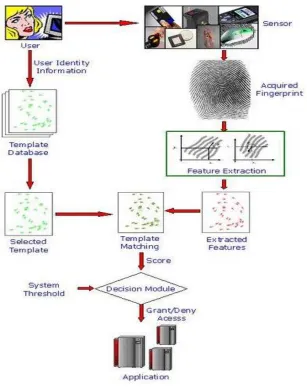
Biometric Systems A biometric system is a computer System which performs the Biometric recognition Algorithms for biometric Technique. Sensing, Feature Extraction and Matching Modules are the mai8n components of a biometric System. A biometric sensor senses the biometric parameter such as fingerprints sensors and digital camera gives the output in the Digital form. The irrelevant information is discarded form the acquired samples by using the feature of Extraction the remaining extracted and discriminatory information is normally used for Matching Process. During the process of Matching, A Query is generated by the biometric Sample that is matched with the reference information stored in the database and generates the identity associated with the Query. [11]
Fig 4 Biometric system
III. RELATED WORK
Network is used for recognition purpose. Above techniques solve the problems related to face recognition like illumination, face expressions, change in posture.
Renu bhatia, [3], “Biometrics and face recognition techniques”, in this paper author defines that face recognition is biometrics system. The people use this for the purpose of security. It has widely used for real time applications. The examples are use in forensic laboratories, for criminal security system. It is a system which compares the existing patterns with inputted patterns. It uses the following characteristics for the purpose of identification like fingerprints of individual, voice recognition, retina scan etc. All the biological characteristics are used in pattern matching for identification and authentication. In this paper author defines the biometric techniques like face recognition, iris-retina scans.
Faizan Ahmad et al. [7], “Image-based Face Detection and Recognition: “State of the Art”, In this paper author explains the face recognition system as the part of image or video. Face recognition system is used for those applications or fields where the centre of attraction is people. The images or videos are stored in the surveillance digital camera. Then various features of characteristics are used for the purpose of pattern matching. Face recognition system has many advantages or disadvantages. The main advantage of face recognition system is the acceptance and uniqueness. In this paper author evaluated face detection algorithms and techniques. All the used algorithms are the solution to the various problems related to the face detection technology and provide the highly accurate output. Solution is proposed based on performed tests on various face rich databases in terms of subjects, pose, emotions, race and light.
Navneet Jindal et al. [8], “Enhanced Face Recognition Algorithm using PCA with Artificial Neural Networks”,
In this author defines that face recognition system is a biometric system. It is used for authentication and identification. Face recognition system used large database to store pre-defined patterns. The inputted patterns are compared with the already existing patterns. If patterns are matched then to authenticate the identity otherwise it will be discarded. Many techniques and algorithms are used for this purpose. In this paper extraction process is defined along with PCA based eigenface computation methods. Author also defines the process of detection along with multi layered feed forward ANN with the help of back propagation.
Xiaoguang Lu. [9], “Image Analysis for Face Recognition”, In this Paper, author defines that face recognition technique gains much popularity among users and researchers. This In recent years face recognition has received substantial attention from both research communities and the market, but still remained very challenging in real applications. A lot of face recognition algorithms, along with their modifications, have been developed during the past decades. A number of typical algorithms are presented, being categorized into appearance based and model-based schemes. For appearance-based methods, three linear subspace analysis schemes are presented, and several non-linear manifold analysis approaches for face recognition are briefly described. The model-based approaches are introduced, including Elastic Bunch Graph matching, Active Appearance Model and 3D Morphable Model methods. A number of face databases available in the public domain and several published performance evaluation results are digested. Future research directions based on the current recognition results are pointed out.
Seema Verma et al. [10], “A Study on “A Soft Biometric Approach: Face Recognition”, In this author defines that biometric system is widely used in many real world fields. Lots of researches are still going on about this. In this paper author suggests many biometric techniques of face recognition. Many algorithms and techniques are used for face recognition system. Some algorithms are defined and used in this paper.
IV. CONCLUSION AND FUTURE SCOPE
Many papers are reviewed regarding the watermarking and its techniques. All the techniques that are studied some of them are advancement in traditional techniques and some are bases for new proposed techniques. All the techniques are efficient and have many advantages but on other side there are some disadvantages also. Making hardware oriented face recognition system that matches the facial features and turns the motor on. Turning the buzzer on when the features do not match.
REFERENCES
[1] Sujata G. Bhele1 and V. H. Mankar, “A Review Paper on Face Recognition Techniques”, International Journal of Advanced Research in Computer Engineering & Technology (IJARCET), Vol 1, Pp 339-346, 2012.
[2] Lih-Heng Chan, Sh-Hussain Salleh and Chee-Ming Ting. “Face Biometrics Based on Principal Component Analysis and Linear Discriminant Analysis.” International Journal of Computer Science (IJCS), Vol 6, Issue No 7, pp 693-699, 2010.
[3] Renu Bhatia, “Biometrics and Face Recognition Techniques”, International Journal of Advanced Research in Computer Science and Software Engineering (IJARCSSE), Vol 3, Issue 5, Pp 93-99, 2013.
[4] Rajesh Kumar Gupta and Umesh Kumar Sahu, “Real Time Face Recognition under different conditions”, International Journal of Advanced Research in Computer Science and Software Engineering (IJARCSSE), Vol 3 Issue 1, Pp 86-93, 2013.
[5] A. Gunjan Dashore and B. Dr. V.Cyril Raj , “An Efficient Method For Face Recognition Using Principal Component Analysis(PCA)” , International Journal of Advanced Technology & Engineering Research (IJATER), Vol 2, Issue 2, Pp 23-29, 2012.
[6] Tayal, Yogesh, Pramod Pandey, and D. B. V. Singh. "Face Recognition using Eigenface", International Journal of Emerging Technologies in Computational and Applied Sciences (IJETCAS), Vol 3, Issue No 1, pp 50-55, 2013.
[7] Faizan Ahmad, Aaima Najam and Zeeshan Ahmed “Image based Face Detection and Recognition: State of the Art” International Journal of Computer Science (IJCS), Vol. 9, Issue 6, No 1, Pp 169-172, 2012.
[8] Navneet Jindal, (June 2013), “Enhanced Face Recognition Algorithm uses PCA with Artificial Neural Networks” , International Journal of Advanced Research in Computer Science and Software Engineering (IJARCSSE), Vol 3, Issue No 6, Pp 846-872, 2013.
[9] Xiaoguang Lu, “Image Analysis for Face Recognition”, Journal of Cognitive Neuroscience (IJCN), Vol 3, Issue no 2, pp 112-115, 2013 [10] Seema Verma, “A Study on “A Soft Biometric Approach: Face Recognition”, International Journal of Advanced Research in Computer
Science and Software Engineering (IJARCSSE), Volume 3, Issue No 3, Pp 403-409, 2013.
[11] Rupinder Saini , “Comparison of various biometric methods “International Journal of Advances in Science and Technology (IJAST) , Vol 2 Issue 1, Pp 24-30, 2014.