ABSTRACT
BARIK, TITUS. Error Messages as Rational Reconstructions. (Under the direction of Emerson Murphy-Hill.)
Program analysis tools apply elegant algorithms—such as static analysis, model checking, and type inference—on source code to help developers resolve compiler errors, apply optimizations, identify security vulnerabilities, and reason about the logic of the program. In integrated development environments, program analysis tools provide feedback about their internal diagnostics to developers through error messages, using a variety of text and visual presentations such as error listings, tooltips, and source code underlined with red squiggles. The design of human-friendly error messages is important because error messages are the primary communication channel through which tools provide feedback to developers.
Despite the intended utility of these tools, the error messages these tools produce are cryptic, frustrating, and generally unhelpful to developers as they attempt to understand and resolve the messages. Existing approaches in programming lan-guage research have attempted to surface the internal reasoning process of program analysis tools and present these details to developers to aid their comprehension process. However, we argue that the tool-centric perspective of simply revealing details in the error message about the tools’ internal algorithms is insufficient: the fundamental problem is that computational tools do not reason about the causes of an identified error in the same way as the developer who attempts to understand and reconstruct why the tool produced that particular error.
The thesis of this dissertation is that difficulties interpreting error messages produced by program analysis tools are a significant predictor of developers’ inabili-ties to resolve defects, and that these difficulinabili-ties interpreting error messages can be explained by framing error messages as insufficient rational reconstructions in both visual and text presentations. This dissertation advances knowledge about developer comprehension during error message tasks and defends the claims of this thesis through three studies, evaluated through the theoretical framework of rational reconstruction:
1. To learn how developers use error messages during their own rational recon-structions, we conducted an eye tracking study in which participants resolved common defects within the Eclipse development environment. We found that the difficulty of reading these messages is comparable to the difficulty of read-ing source code, that difficulty readread-ing error messages significantly predicts participants’ task performance, and that participants allocate a substantial portion of their total task to reading error messages (13%–25%).
2. To learn how developers construct and are aided by diagrammatic rational reconstructions, or explanatory visualizations, we conducted a usability design experiment in which developers diagrammatically annotated and explained source code listings involving compiler error messages. We found that ex-planatory visualizations are used intuitively by developers in their own self-explanations of error messages, and that these visualizations are significantly different from baseline visualizations in how they explicate relationships between program elements in the source code.
deficient arguments, but will prefer deficient arguments if they provide a resolutionto the problem. We found that human-authored explanations con-verge to argument structures that either offer a simple resolution, or employ a proper simple or extended argument structure.
Error Messages as Rational Reconstructions
by Titus Barik
A dissertation submitted to the Graduate Faculty of North Carolina State University
in partial fulfillment of the requirements for the Degree of
Doctor of Philosophy
Computer Science
Raleigh, North Carolina 2018
APPROVED BY:
Christopher Parnin James Lester
Jing Feng Shriram Krishnamurthi
External Member
DEDICATION
In memory of Mark Lusher (1972–2015).
BIOGRAPHY
Titus Barik obtained a Bachelor of Science in Computer Engineering from the Georgia Institute of Technology in 2004. In Atlanta, he spent several years working in industry as a Project Engineer: in factory automation, process control systems, and logistics. While working full-time, Titus obtained a Master of Engineering degree from North Carolina State University in 2009. He obtained his Professional Engineering (P.Eng) license in 2011.
Titus moved to Raleigh, North Carolina and returned to academia at North Carolina State University in 2010 to pursue a PhD in Computer Science. During his academic career, Titus interned at Google (2013 and 2014) and Microsoft Research (2015). He also worked as a Research Scientist at ABB—from 2014 to 2016—to improve software developer productivity.
Titus has many research interests, evidenced through publications beyond his core research areas of software engineering and human-computer interaction. He has published in information visualization, cognitive modeling, computer science education, and digital games research. Titus is particularly curious about the role of programming as a form of play, self-discovery, and artistic expression.
The Earth of the Veda Priests
ACKNOWLEDGEMENTS
This dissertation would not have been possible without the love and unwavering support of my family. I am grateful to my wife Laurel, my son Joshua, and my daughter Emily.
For their academic guidance, thanks go to my committee members: Dr. Emerson Murphy-Hill, Dr. Chris Parnin, Dr. James Lester, Dr. Jing Feng, and Dr. Shriram Krishnamurthi. I also thank Dr. David Roberts for his advice and encouragement.
This material is based upon work supported by the National Science Foundation under grant numbers 1217700, 1318323, 1559593, and 1714538. Any opinions, findings, and conclusions or recommendations expressed in this material are those of the author and do not necessarily reflect the views of the National Science Foun-dation. ABB, Amazon, Google, and Microsoft also provided funding and support for this material.
TABLE OF CONTENTS
List of Tables. . . xi
List of Figures . . . xii
Chapter 1 My Thesis . . . 1
Chapter 2 Introduction . . . 2
2.1 Problem . . . 2
2.2 Examples . . . 3
2.2.1 Portable C Compiler . . . 3
2.2.2 GNU Compiler Collection . . . 4
2.2.3 Oracle Java Compiler (OpenJDK) . . . 5
2.2.4 Clang Compiler (LLVM) . . . 7
2.2.5 ESLint for JavaScript . . . 9
2.3 Objective, Significance, and Scope . . . 11
2.4 Theoretical Framework . . . 15
2.5 Research Paradigm . . . 17
2.5.1 Epistemology . . . 17
2.5.2 Theoretical Perspective . . . 18
2.5.3 Methodology . . . 18
2.5.4 Methods . . . 18
2.6 Who Did What . . . 19
2.7 Contributions . . . 20
2.8 How to Read the Dissertation . . . 22
Chapter 3 How Do Contemporary Program Analysis Tools Present Error Messages to Developers? . . . 25
3.1 Overview of Program Analysis Tools . . . 26
3.2 Text Representations of Program Analysis . . . 27
3.2.1 Output as Source Location and Template Diagnostic . . . 28
3.2.2 Output as Extended Explanations (--explain) . . . 33
3.2.3 Output as Type Errors . . . 38
3.2.4 Output as Examples and Counterexamples . . . 42
3.3 Visual Representations of Program Analysis . . . 45
3.4 Errors Developers Make . . . 48
3.5 Design Guidelines for Error Messages . . . 51
Chapter 4 What Do We Know About Presenting Human-Friendly
Output from Program Analysis Tools? . . . 55
4.1 Methodology . . . 56
4.1.1 What is a Scoping Review? . . . 56
4.1.2 Execution of SALSA Framework . . . 56
4.1.3 Limitations . . . 57
4.2 Taxonomy of Presentation . . . 58
4.2.1 Alignment . . . 58
4.2.2 Clustering and Classification . . . 61
4.2.3 Comparing . . . 61
4.2.4 Example . . . 62
4.2.5 Interactivity . . . 63
4.2.6 Localizing . . . 64
4.2.7 Ranking . . . 65
4.2.8 Reduction . . . 66
4.2.9 Tracing . . . 66
4.3 Conclusions . . . 67
Chapter 5 Where Do Error Messages as Rational Reconstructions Fit Within Related Work?. . . 68
5.1 Program Comprehension in Debugging . . . 68
5.1.1 Plans . . . 69
5.1.2 Beacons . . . 70
5.1.3 Information Foraging Theory . . . 70
5.1.4 Relation to Rational Reconstruction . . . 71
5.2 Human Factors in Error and Warning Design . . . 71
5.3 Expert Systems . . . 73
5.4 Preventing Errors with Structure Editors . . . 76
5.5 Error Messages for Novices . . . 77
5.5.1 Mini-Languages: The Rule of Least Power . . . 77
5.5.2 Enhancing Compiler Error Messages . . . 79
5.6 Conclusions . . . 81
Chapter 6 Do Developers Read Compiler Error Messages? . . . 82
6.1 Motivating Example . . . 83
6.2 Methodology . . . 86
6.2.1 Research Questions . . . 86
6.2.2 Study Design . . . 89
6.2.3 Procedure . . . 91
6.2.4 Data Collection and Cleaning . . . 92
6.3.1 RQ1: How effective and efficient are developers at resolving
error messages for different categories of errors? . . . 94
6.3.2 RQ2: Do developers read error messages? . . . 95
6.3.3 RQ3: Are compiler errors difficult to resolve because of the error message? . . . 96
6.4 Results . . . 98
6.4.1 RQ1: How effective and efficient are developers at resolving error messages for different categories of errors? . . . 98
6.4.2 RQ2: Do developers read error messages? . . . 100
6.4.3 RQ3: Are compiler errors difficult to resolve because of the error message? . . . 101
6.5 Discussion . . . 103
6.6 Limitations . . . 107
6.7 Related Work in Eye Tracking . . . 108
6.8 Conclusions . . . 109
Chapter 7 How Do Developers Visualize Compiler Error Messages? . 110 7.1 Motivating Example . . . 111
7.2 Pilot Study . . . 115
7.3 Explanatory Visualizations of Error Messages . . . 117
7.4 Methodology . . . 118
7.4.1 Research Questions . . . 118
7.4.2 Participants . . . 119
7.4.3 Selection Criteria for Mockups . . . 120
7.4.4 Mockup Construction Procedure . . . 123
7.4.5 Investigator Training . . . 123
7.4.6 Experimental Procedure . . . 124
7.5 Results . . . 128
7.5.1 RQ1: Do explanatory visualizations result in more correct self-explanations by developers? . . . 128
7.5.2 RQ2: Do developers adopt conventions from our visual annotations in their own self-explanations? . . . 129
7.5.3 RQ3: What aspects differentiate explanatory visualizations from baseline visualizations? . . . 132
7.5.4 RQ4: Do better self-explanations enable developers to construct better mental models of error messages? . . . 132
7.6 Threats to Validity . . . 134
7.7 Conclusions . . . 135
Chapter 8 How Should Compilers Explain Problems to Developers? . 136 8.1 Motivating Example . . . 137
8.3 Methodology . . . 140
8.3.1 Research Questions . . . 140
8.3.2 Phase I: Study Design for Comparative Evaluation . . . 141
8.3.3 Phase II: Study Design for Stack Overflow . . . 143
8.4 Analysis . . . 148
8.4.1 RQ1: Are compiler errors presented as explanations helpful to developers? . . . 148
8.4.2 RQ2: How is the structure of explanations in Stack Overflow different from compiler error messages? . . . 148
8.4.3 RQ3: How is the content of explanations in Stack Overflow different from compiler error messages? . . . 149
8.5 Results . . . 150
8.5.1 RQ1: Are compiler errors presented as explanations helpful to developers? . . . 150
8.5.2 RQ2: How is the structure of explanations in Stack Overflow different from compiler error messages? . . . 151
8.5.3 RQ3: How is the content of explanations in Stack Overflow different from compiler error messages? . . . 152
8.6 Limitations . . . 158
8.7 Conclusions . . . 159
Chapter 9 Conclusions . . . 161
9.1 Thesis Revisited . . . 161
9.2 Design Guidelines . . . 162
9.3 Toward Engineering a Compiler . . . 165
9.3.1 Approach . . . 165
9.3.2 Example: Duplicate Function Implementation Error . . . 166
9.3.3 Formative Evaluation . . . 168
9.4 Future Work . . . 169
9.5 Epilogue . . . 171
Bibliography . . . 172
Appendices . . . 210
Appendix A Study Materials for “Do Developers Read Compiler Error Messages?” (Chapter 6) . . . 211
A.1 Interview Protocol . . . 211
A.1.1 Outline . . . 211
A.1.2 Pre-arrival Steps . . . 211
A.1.3 Arrival Steps . . . 211
A.1.4 Instructions for Participant . . . 212
A.1.6 Closing . . . 213
A.2 Tasks . . . 213
A.2.1 Task 1:SUBLIST . . . 214
A.2.2 Task 2:NODECACHE . . . 215
A.2.3 Task 3:IMPORT . . . 217
A.2.4 Task 4:QUEUEGET . . . 219
A.2.5 Task 5:SETADD . . . 220
A.2.6 Task 6:KEYSETKV . . . 221
A.2.7 Task 7: CLAZZ . . . 222
A.2.8 Task 8:NEXT . . . 223
A.2.9 Task 9:READOBJSTATIC . . . 225
A.2.10 Task 10:SWITCH . . . 226
A.3 Post-study Questionnaire . . . 227
Appendix B Study Materials for “How Do Developers Visualize Compiler Error Messages?” (Chapter 7) . . . 228
B.1 Interview Protocol . . . 228
B.1.1 Pre-tasks . . . 228
B.1.2 Task 1 . . . 228
B.1.3 Questionnaire . . . 229
B.1.4 Task 2 . . . 229
B.1.5 Wrap-up . . . 230
B.2 Questionnaire . . . 230
B.3 Visual Markings Cheat Sheet . . . 231
B.4 Dimensions Survey for All Tasks . . . 231
B.5 Tasks . . . 233
B.5.1 Task: Apple . . . 235
B.5.2 Task: Brick . . . 236
B.5.3 Task: Kite . . . 237
B.5.4 Task: Melon . . . 238
B.5.5 Task: Trumpet . . . 239
B.5.6 Task: Zebra . . . 241
Appendix C Study Materials for “How Should Compilers Explain Problems to Developers?” (Chapter 8) . . . 242
C.1 Survey . . . 242
C.1.1 Demographic Information . . . 242
C.1.2 Error Message: E1 . . . 243
C.1.3 Error Message: E2 . . . 243
C.1.4 Error Message: E3 . . . 244
C.1.5 Error Message: E4 . . . 244
C.1.6 Error Message: E5 . . . 245
LIST OF TABLES
Table 4.1 Taxonomy of Presentation . . . 59
Table 6.1 Participant Compiler Error Tasks . . . 88
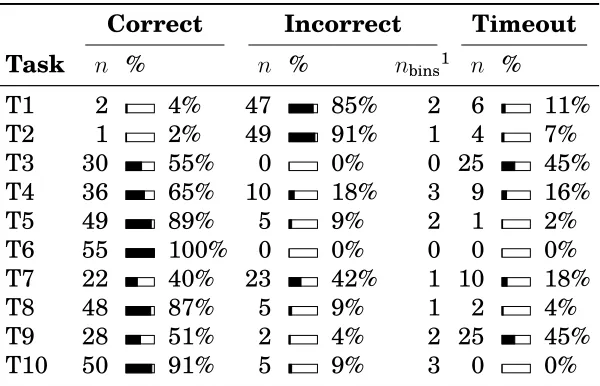
Table 6.2 Overview of Task Performance . . . 98
Table 6.3 Participant Fixations to Areas of Interest . . . 102
Table 7.1 Frequency of Visual Annotations in Pilot . . . 114
Table 7.2 Visual Annotation Legend . . . 116
Table 7.3 Participant Explanation and Recall Tasks . . . 122
Table 7.4 Number of Features by Task and Group . . . 130
Table 7.5 Cognitive Dimensions Questionnaire Responses . . . 132
Table 8.1 OpenJDK and Jikes Error Message Descriptions . . . 144
Table 8.2 Compiler Errors and Warnings Count by Tag . . . 145
Table 8.3 OpenJDK and Jikes Error Message Preferences . . . 150
Table 8.4 Argument Layout Components for Error Messages . . . 154
Table 9.1 Participants in Focus Group . . . 168
LIST OF FIGURES
Figure 2.1 For the ‘unexpected string concatenation’ error, the bare ESLint error message is appropriate when the message is presented in the Visual Studio Code IDE. Other affordances, such as the light bulb icon, tooltip overlay, and red wavy
underline, provide additional context to the developer. . . 12 Figure 2.2 The theoretical framework of rational reconstruction. . . 15 Figure 2.3 A roadmap of the dissertation. The dissertation is organized
as self-contained (at least to the extent reasonably possible), modular chapters. Three literature reviews offer the reader different perspectives on rational reconstruction; these
chapters may be read in any order. Each of the three research studies defends one of the claims in the thesis. Although the sequence of the research studies follows the sequence of claims in the thesis statement, these chapters may also be read in
any order. . . 24 Figure 3.1 A typical model checking pipeline. The source listing is
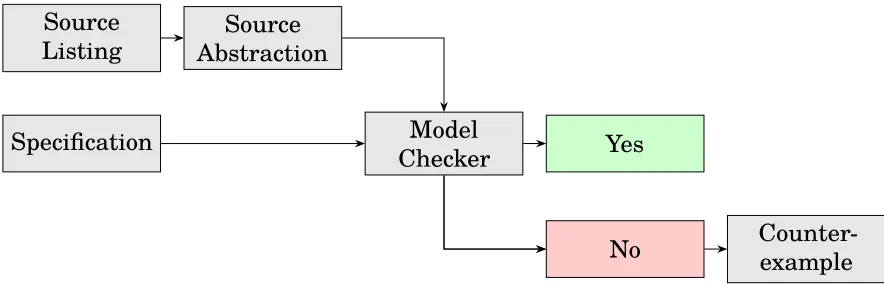
transformed into a source abstraction suitable for verification by the model checker, along with a specification describing some property for how the software should behave. Given these two inputs, the model checker can identify a violation of the property. If a violation exists, the model checker returns a counterexample of how the property can be violated. . . 42 Figure 3.2 Modern IDEs have converged on affordances for presenting
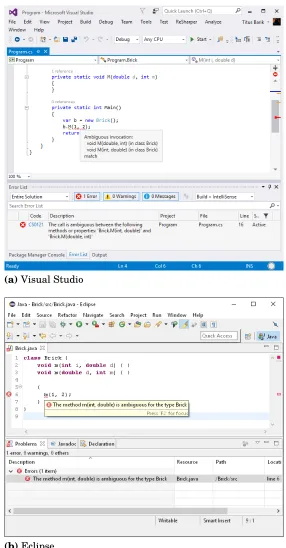
error messages to developers. . . 46 Figure 3.3 NCrunch and JetBrains dotCover are concurrent unit testing
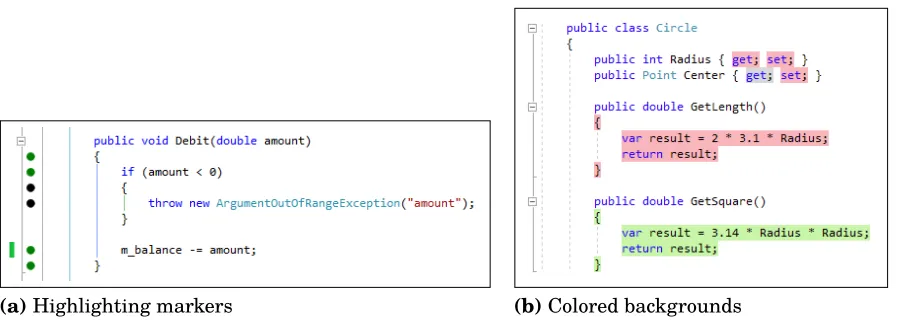
and code coverage tools that integrate with Visual Studio. Shown here are two methods for displaying code coverage information: (a) in NCrunch, as highlighting markers in the margin, or (b) in JetBrains dotCover, as colored backgrounds on the source. Green means that tests pass, red indicates that at least one test that covers the statement fails, and black or
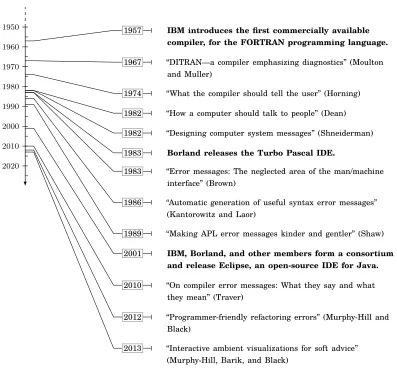
gray shows uncovered code. . . 47 Figure 3.4 History of design guidelines for error messages in program
analysis tools. In tandem with design guidelines, significant
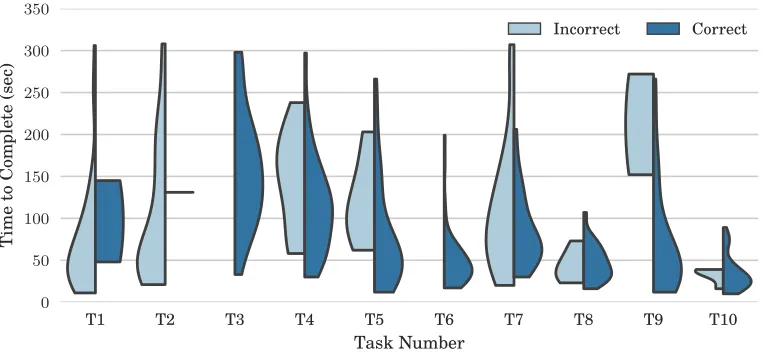
Figure 6.1 The time required for developer to commit to a solution that is correct or incorrect. Nearly all tasks (exceptions, T8 and T10) have high variance in resolution time to arrive, irrespective of correctness. . . 99 Figure 6.2 Comparison of fixation time distributions for silent reading of
English passages, reading source in the editor, and reading of error messages. . . 100 Figure 6.3 In (a), histogram of correct and incorrect task solutions by
number of revisits on error message areas of interest. In (b), nominal logistic model of the probability of applying a correct solution number by revisits on error message areas of interest. As revisits to error messages increase, the probability of
successfully resolving a compiler error decreases. . . 103 Figure 6.4 Emerging error reporting systems like LLVM scan-build
provide stark contrast to those of conventional IDEs. Here, scan-build presents error messages for a potential memory leak as a sequence of steps alongside the source code to which the error applies. . . 105 Figure 7.1 A comparison of a potentially uninitialized variable compiler
error through (a) baseline visualizations, the dominant paradigm as found in IDEs today, (b) our explanatory
visualizations, and (c) the text error message. . . 112 Figure 7.2 We presented participants with a command prompt in which
they had thecompile command available to them. The limited interaction modality forces participants to rely solely on their own memory to successfully complete the task. . . 126 Figure 7.3 Explanation rating by group. The treatment group (T)
provided significantly higher rated explanations than the
control group (C). . . 128 Figure 7.4 Annotations by group, filled with usage across tasks. The
distribution of annotations used by the control (C) and
treatment groups (T) were not identified as being significantly different, but the treatment group used annotations
significantly more often. . . 129 Figure 7.5 A contrast between visual explanations offered by (a) control
group participant with explanation rating of Fail, and (b) treatment group participant with explanation rating of
Figure 7.6 Task by explanation rating. Each of the six tasks are broken by explanation rating (1 = Fail, 2 = Poor, 3 = Good, 4 =
Excellent) from the first phase of the experiment. For each explanation rating, the frequency of correct and incorrect recall tasks from the second phase of the experiment is
indicated by filling in the bars. Higher rated explanations lead to significantly better recall correctness. . . 133 Figure 8.1 A prototypical Toulmin’s model of argument for (a) simple
argument layout, and (b) extended argument layout. The possible need for auxiliary steps to convince the other party
yields the extended argument layout. . . 138 Figure 8.2 A compiler error message from Java, annotated with
argumentation theory components. This particular message contains all of the basic argument components to satisfy Toulmin’s model:(C)= Claim,(bc W) = implied “because” Warrant, (G)= Grounds. It also includes an extended
construct,(B)= Backing. . . 140 Figure 8.3 Identified argument layouts for compiler error messages (as
found in Stack Overflow questions). Counts are indicated in
parentheses. . . 153 Figure 8.4 Identified argument layouts for Stack Overflow accepted
answers. Counts are indicated in parentheses. . . 153 Figure A.1 Error messages sheet provided to participants to familiarize
1
|
My Thesis
People spend all their time making nice things and then other people come along and break them.
The Doctor
Difficulties interpreting error messages produced by program analysis tools are a significant predictor of developers’ inabilities to resolve defects: difficulties
interpreting error messages can be explained by framing error messages as insufficient rational reconstructions in both visual and text presentations.1
2
|
Introduction
Our lives are different to anybody else’s. That’s the exciting thing. Nobody in the universe can do what we’re doing.
The Doctor
2.1 Problem
Program analysis tools are intended to help developers identify problems in their source code: they pinpoint unsafe or undesirable runtime behavior, enforce con-formance to programming language specifications, and flag stylistic issues that hinder the readability of the code [36, 53, 137, 138, 332]. Many of the problems that program analysis tools detect are also subtle to spot through manual inspection [15, 34, 177, 271]. Unfortunately, research has found that the output program of analysis tools—error messages—are confusing, unconstructive, misleading, or incompre-hensible [50, 55, 83, 356, 381]. As a result, developers spend unnecessary effort comprehending and resolving the defects identified by the tools or simply abandon otherwise useful tools because they can’t understand the error messages [65, 190].
2.2 Examples
Program analysis tools communicate these problems to developers through error messages, using various text and visual presentations. But rather than attempt to characterize precisely what an error message is (we’ll do that in Chapter 3), let’s take a tour of five concrete examples to explore different facets for why error mes-sages might be difficult for developers to comprehend. Examples in Sections 2.2.1 to 2.2.4 explore text-based error messages, as found in console or terminal environ-ments. Section 2.2.5 shifts direction and tailors text-based error messages to visual, integrated development environments (IDEs)—such as Visual Studio Code [260]. In particular, this example articulates how the appropriateness of an error message depends not only on the message content but also in how the error message is situated within the programming environment.
2.2.1 Portable C Compiler
We’ll start with the PCC [193] compiler from 1979, for which a developer attempts to write the venerable “Hello, world!” program. Here’s the source code for this program:
1 #include <stdio.h>
2
3 int main() {
4 printf("Hello, world!\n")
5 }
Despite its simplicity, this program is useful for sanity checking: seeing the words “Hello, world!” appear on the screen means that the basic libraries are in the right place, and that the source code can compile, execute, and successfully send output to a console.
However, this source listing contains an error: the rules of the C programming specification require that all statements end with a semicolon (;), and the code is missing one at the end of Line 4. The program analysis within the compiler identifies this error and outputs an error message:
hello.c, line 5: syntax error
It turns out this error message isn’t technically wrong, but it is misleading. For instance, it claims that the error is on Line 5, but it seems that the error should actually be reported on Line 4. Regardless, the error doesn’t provide any reasons for how it came to this conclusion: it leaves it to developer to identify what causes the syntax error. PCC then unhelpfully exits with the messagegoodbye!, followed with a termination status that is only useful to the operating system.
Is it fair to use a compiler written in the 1970s to illustrate confusing error messages? Probably not. But it is a good baseline for error messages. Despite its historical interest, the error message has the minimal components of modern error messages: a location indicating the problem,hello.c, line 5, and a description of the problem. And many of the design decisions within PCC continue to influence contemporary program analysis tools.
2.2.2 GNU Compiler Collection
Let’s now look at GCC [129], a modern C compiler that is part of the GNU Compiler Collection. Here’s the error message for the same “Hello, world!” program in GCC:
hello.c: In function ‘main’:
hello.c:5:1: error: expected ‘;’ before ‘}’ token }
^
The GCC compiler is an improvement over PCC: rather than a vaguesyntax errorit does tell us the semicolon is the actual token that is missing. The program analysis tool also adds a bit of color to the error message and some context about the source code, for example, by indicating that the problem is in the functionmain.
Still, the cause of the error message is disorienting from the developers’ per-spective, because the tool emits a location that followsthe problem, rather than the location that immediatelyprecedesit [140]. The easiest way to illustrate this concern is to contrast GCC with a compiler that does this correctly, at least in this case. Here’s the output from Clang [235], part of LLVM:
hello.c:4:28: error: expected ';' after expression printf("Hello, world!\n")
^ ;
The problem is now apparent, and the error message also matches the way developers would think about the problem, rather than what would be more con-venient for the toolsmith—that is, the designer of the program analysis tool—to generate [250]. In other words, “I’m missing a semicolon at the end of Line 4” is a more direct explanation than “I’m missing a semicolon at immediately before the brace on Line 5, but it would be strange to add a semi-colon at the start of the line, so it must be even before that. The compiler must actually mean the end of Line 4.” Syntax problems like these are nuisances for expert developers—even with the original error from the 1970s PCC compiler—but it’s more work than we should have to do. For novices, however, error messages like these are thoroughly discon-certing [43]. The reasoning of the compiler, strictly applied, can lead to idiosyncratic but nevertheless conformant fixes like this one:
1 #include <stdio.h>
2
3 int main() {
4 printf("Hello, world!\n")
5 ;}
2.2.3 Oracle Java Compiler (OpenJDK)
Here’s a source listing in Java:1 class Toy {
2 Toy() throws Exception { }
3 }
4
5 class Kite extends Toy {
6 }
The source listing results in the following error message from the OpenJDK [286] compiler:1
Kite.java:5: error: unreported exception Exception in default constructor class Kite extends Toy {
^
1 error
1This error message was reported as bug JDK-4071337, “misleading error message when
Let’s construct a rationale for what could cause this error message. First, we note that the error message involves a default constructor, but no such constructor explicitly appears in theKiteclass. This is probably why the bug marker^points to the class itself: default constructors are implicit and therefore there is no constructor we can actually point to directly. Let’s change the source code to add this constructor explicitly, and hope that it compels the program analysis to reveal more of its rationale:
1 class Toy {
2 Toy() throws Exception { }
3 }
4
5 class Kite extends Toy {
6 Kite() { }
7 }
We compile again. Not only does the new error message point to a different location, the message now reveals more information about the problem:
Kite2.java:6: error: unreported exception Exception; must be caught or declared to be thrown
Kite() { } ^ 1 error
Thus, we add athrows Exceptionin response to this explanation:
1 class Toy {
2 Toy() throws Exception { }
3 }
4
5 class Kite extends Toy {
6 Kite() throws Exception { }
7 }
Our last attempt is accepted by the compiler, and now we must retrospectively find reasons for why. For instance, why did we have to explicitly create a default constructor? Don’t these get created automatically if we don’t write one ourselves? It turns out that according to the Java Language Specification 9 (8.8.9) [139]:
Thus, in the case when the default constructor in the superclass has a throws clause, the compiler is forbidden from automatically generating a default constructor on behalf of the developer.
2.2.4 Clang Compiler (LLVM)
Let’s now look at a source listing in C++, namedptrcopy.cpp, in which we’ll use the Clang compiler from LLVM [235]:
1 #include <iostream>
2 #include <memory>
3 #include <vector>
4
5 int main() {
6 std::vector<std::unique_ptr<int>> foo;
7 std::vector<std::unique_ptr<int>> bar = foo;
8 }
The intent of this program is presumably to do some sort of copying, from the contents of foo to the contents of bar. But attempting to do this generates an unwieldy compiler error:
1 In file included from ptrcopy.cpp:2:
2 In file included from /usr/bin/../lib/gcc/x86_64-linux-gnu/7.2.0/../../c ../../include/c++/7.2.0/memory:64:
,→
3 /usr/bin/../lib/gcc/x86_64-linux-gnu/7.2.0/../../../../include/c++/c 7.2.0/bits/stl_construct.h:75:38: error: call to deleted constructor of
,→
,→
4 'std::unique_ptr<int, std::default_delete<int> >'
5 { ::new(static_cast<void*>(__p)) _T1(std::forward<_Args>(__args)...); }
,→
6 ^ ~~~~~~~~~~~~~~~~~~~~~~~~~~~
7 /usr/bin/../lib/gcc/x86_64-linux-gnu/7.2.0/../../../../include/c++/c 7.2.0/bits/stl_uninitialized.h:83:8: note: in instantiation of function template specialization
,→
,→
8 'std::_Construct<std::unique_ptr<int, std::default_delete<int> >, const std::unique_ptr<int, std::default_delete<int> > &>' requested here
,→
,→
9 std::_Construct(std::__addressof(*__cur), *__first);
10 ^
11 /usr/bin/../lib/gcc/x86_64-linux-gnu/7.2.0/../../../../include/c++/c 7.2.0/bits/stl_uninitialized.h:134:2: note: in instantiation of function template specialization
,→
,→
12 'std::__uninitialized_copy<false>::__uninit_copy<__gnu_cxx::c __normal_iterator<const std::unique_ptr<int,
std::default_delete<int> > *,
,→
13 std::vector<std::unique_ptr<int, std::default_delete<int> >,
std::allocator<std::unique_ptr<int, std::default_delete<int> > > > >, std::unique_ptr<int,
,→
,→
14 std::default_delete<int> > *>' requested here
15 __uninit_copy(__first, __last, __result);
16 ^
17 /usr/bin/../lib/gcc/x86_64-linux-gnu/7.2.0/../../../../include/c++/c 7.2.0/bits/stl_uninitialized.h:289:19: note: in instantiation of function template specialization
,→
,→
18 'std::uninitialized_copy<__gnu_cxx::__normal_iterator<const std::unique_ptr<int, std::default_delete<int> > *, std::vector<std::unique_ptr<int,
,→
,→
19 std::default_delete<int> >, std::allocator<std::unique_ptr<int, std::default_delete<int> > > > >, std::unique_ptr<int, std::default_delete<int> > *>' requested here
,→
,→
20 { return std::uninitialized_copy(__first, __last, __result); }
21 ^
22 /usr/bin/../lib/gcc/x86_64-linux-gnu/7.2.0/../../../../include/c++/c 7.2.0/bits/stl_vector.h:331:9: note: in instantiation of function template specialization
,→
,→
23 'std::__uninitialized_copy_a<__gnu_cxx::__normal_iterator<const std::unique_ptr<int, std::default_delete<int> > *,
std::vector<std::unique_ptr<int,
,→
,→
24 std::default_delete<int> >, std::allocator<std::unique_ptr<int, std::default_delete<int> > > > >, std::unique_ptr<int, std::default_delete<int> > *,
,→
,→
25 std::unique_ptr<int, std::default_delete<int> > >' requested here
26 std::__uninitialized_copy_a(__x.begin(), __x.end(),
27 ^
28 ptrcopy.cpp:7:43: note: in instantiation of member function
'std::vector<std::unique_ptr<int, std::default_delete<int> >, std::allocator<std::unique_ptr<int,
,→
,→
29 std::default_delete<int> > > >::vector' requested here
30 std::vector<std::unique_ptr<int>> bar = foo;
31 ^
32 /usr/bin/../lib/gcc/x86_64-linux-gnu/7.2.0/../../../../include/c++/c 7.2.0/bits/unique_ptr.h:388:7: note: 'unique_ptr' has been explicitly marked deleted here
,→
,→
33 unique_ptr(const unique_ptr&) = delete;
34 ^
35 1 error generated.
error locations are presented backwards: something happens deep insidememory, and this problem bubbles up through the various C++ files until we arrive back at the cause inptrcopy. Although it’s true that the problem doesn’t occur, strictly speaking, until we reachmemory, it’s not very helpful to have a problem identified within a library that we didn’t even write.
What if the program analysis instead presented an error message from the perspective of the developer, rather than the perspective of the compiler? Here’s an example of what such a message might look like:
ptrcopy.cpp: cannot construct 'bar' from 'foo': foo's template type is non-copyable
std::vector<std::unique_ptr<int>> bar = foo; ^
I think this version of the error message is an interesting contrast for several reasons.2First, it pinpoints a location that the developer actually wrote. Second, it
argues for a presentation that is in many ways less precise than the original LLVM error message, yet much easier to read. Third, even with this loss of precision, it’s obvious what the problem is:unique_ptris not copyable. Trying to assign a vector ofunique_ptrto another vector would mean that somewhere in the vector source code the unique pointer would necessarily need to be copied.
2.2.5 ESLint for JavaScript
Thus far, we’ve only examined text-based error messages. However, in this section we’ll argue that whether an error message is appropriate depends not only on the message content but also on how the error message is situated within the programming environment—for example, in a terminal or in an IDE. That is, sometimes the “medium is the message” [255], and it is the medium that shapes the way in which we should present error messages to the developer.
2A Stack Overflow answer refers to this version of the error message as their “ideal error message”
Let’s look at an example of this through ESLint [420], a pluggable bug-finding utility for JavaScript. By pluggable, we mean: 1) developers can add custom bug-finding rules to extend the capability of the tool, and 2) the tool is intended to be bundled and used within other workflows, such as integrated development envi-ronments and build systems. Thus, the tool supports multiple output formats, or mediums, for presentation.
Consider what happens when we apply ESLint to the following JavaScript file:
1 const who = 'Titus';
2 console.log('Hello, ' + who + '!');
Depending on the default formatter, this causes ESLint to emit the following error message:
hello.js: line 2, col 13, Error - Unexpected string concatenation. (prefer-template)
,→
We can use a template literal3to resolve the error message:
1 const who = 'Titus';
2 console.log(`Hello, ${who}!`);
In contrast to the error messages from OpenJDK, GCC, and LLVM, the error message from ESLint almost seems like a regression to an earlier era of compilers! Unlike either of these tools, the ESLint error message does not provide a contextual code snippet. Unlike GCC and LLVM, ESLint does not colorize the output. And prefer-templateseems like an internal error code, which doesn’t help the developer.
If we were solely targeting a console environment, we might consider relatively simple improvements to this error message to expand on the suggested prefer-templatefix and add a rationale for the error:
× [eslint] Unexpected string concatenation (2, 13)
Fix: Use template literals instead of concatenation.
(re-run with --fix to automatically fix this problem)
Why? Template literals give you a readable, concise syntax with proper newlines and string interpolation features. (see: airbnb.io/javascript/#es6-template-literals)
3In prior editions of the ES2015 specification, template literals were called template strings. See:
The above error message replaces the cryptic prefer-template key with natural language. Incidentally, this particular fix is trivially corrected by ESLint, and so the message also suggests the availability of this automated repair. Then, given the rationale for the error, we see that the reason ESLint recommends this change is because the Airbnb JavaScript standard considers template literals to be more readable. An extended explanation is offered through a link, and gives examples of converting string concatenation operations to template literals.
Although ESLint supports console output as a last resort, ESLint is really in-tended to be used as a program analysis building block to be incorporated within other programming and build environments. To illustrate this, let’s consider again the default formatter, but this time rendered within Visual Studio Code (Figure 2.1 on the following page). In Figure 2.1a, we see that ESLint presents its error mes-sage as a tooltip when the developer hovers over the red wavy underline. Also, the developer can double-click the error message in the problems pane to directly navigate to Line 2 ofhello.js. Given the single-line affordances in the problems pane, it now makes sense to present a terse error message that the developer can use to quickly navigate to the relevant code context. Similarly, the somewhat cryptic (prefer-template) text in the default error message now becomes an interactive affordance that allows the developer to automatically repair the code in their IDE (Figure 2.1b). Therefore, providing a contextual code snippet within the error mes-sage itself would be redundant, given that we expect the errors to be presented in the IDE.
2.3 Objective, Significance, and Scope
Given the problematic error messages we detailed in the previous section, how can we rigorously explain the difficulties developers encounter with these messages? Importantly, how can we go about improving error messages through principled approaches—so they are more useful to developers?
(a)ESLint identifies a problem.
(b)ESLint suggests a fix for the problem.
is that it demonstrates that error messages as rational reconstructions are more useful to developers than baseline error messages, because rational reconstructions align with the way in which they strategize and reason about problems in their code under the presence of errors. Furthermore, the design of human-friendly error messages is important because error messages are the primary communication channel through which tools provide feedback to developers. Consequently, the research in this dissertation advances a systematic, theoretical lens to investigate error messages in program analysis tools, and embodies six postulates that scaffold it:
Postulate I—Error messages are routine.The selected examples are everyday messages that confound developers, taken from program analysis tools used in industry. Generally, the types of error messages developer encounter don’t require them to have knowledge of esoteric language concepts, nor do the error messages arise from extraordinary circumstances [342].
Postulate II—Error messages aren’t false positives. False positives are a known problem with program analysis tools, especially static analysis tools which use approximations in order to determine whether a problem exists [65, 190]. But none of the selected examples were false positives, and all of them indicated an actual problem in the code. This suggests that developers have difficulties with error messages even when they are revealing an actual problem in the code.
Postulate IV—There isn’t only one way to automatically repair the pro-gram.Even small programs have a combinatorially large design space for program transformations that would remove the compiler error message [18]. To illustrate, an alternate way to make the “Hello, world!” syntactically valid for the examples in Section 2.2.1 and Section 2.2.2 would be to simply remove theprintfstatement entirely. Such a fix seems incredulous if the intention of the developer is to print a string to the console, but perfectly logical if the developer intended “Hello, world!” to only act as a starting point for the program they actually intended to implement. Good automatic fixes are useful as accelerators for developers, but they don’t remove the need to understand the error message.
Postulate V—Error messages present an insufficient construction of the problem.The error messages present only the symptom of the problem, and leave it to the developer to come up with the rationale for why the problem occurs. We saw this in the unreported exception example for Java in Section 2.2.3, in which the developer needed to reconstruct a chain of reasons to identify the cause of the error.
Postulate VI—Error messages are rational, but only from the perspective of the compiler.Let’s turn again to the source code listing for the “Hello, world!” example from Section 2.2.2, but this time we will reformat the listing like so:
int main(){printf("Hello, world!")}
Some compilers remove insignificant whitespace, or trivia, because they are unnec-essary in the program analysis pipeline; this results in a program that appears to the tool essentially like the above. From the perspective of the compiler, the er-ror messageexpected ';' before '}' tokenis now perfectly rational if we reorient ourselves to the perspective of how the compiler thinks about the situation. But developers shouldn’t have to know the internal mechanics of program analysis tools to understand their error messages.
Source Listing Tool Error Message Developer(Josh)
Interlocutor (Emmie)
Figure 2.2The theoretical framework of rational reconstruction.
postulate suggests that error messages are useful to developers for verification, even when tools suggest automatic fixes. The first four postulates, then, scope the dissertation. But it is the fifth and sixth postulates that motivate a theory to investigate: these two postulates conjecture a misalignment between the way program analysis tools present error messages to developers and the way in which developers attempt to comprehend the problem. In the next section, we formalize these misalignments through the theoretical framework of rational reconstruction.
2.4 Theoretical Framework
Example. Consider a scenario in which a developer, Josh, encounters a confus-ing error message. He isn’t able to comprehend the error message, so he turns to a colleague, Emmie, for assistance. Much like we did for the examples in Sec-tion 2.2, Emmie explains the error message by offering reasons and justificaSec-tions to demonstrate the problem is actually a problem. We can diagram this scenario as in Figure 2.2, with Emmie as the interlocutor—a participant in the discourse.
Definitions.The theory I apply to investigate developer difficulties with error messages is rational reconstruction [248]. Rationales are the set of reasons for some-thing: here, that something is the error message produced by the program analysis tool. If the error message is deficient and does not provide sufficient rationale, Josh must reconstruct the rationale for the error message himself and come to the same conclusion as the conclusion of the error message.
The process of identifying these rationales is rational reconstruction. Within this theory, rationales come in two forms [58, 248, 253]: 1) as a justification-explanation (called an argument), in which the rationale functions as evidence that supports the conclusion; and 2) a trace-explanations (sometimes referred without qualifier as simply an explanation), in which the rationale functions as a cause for the conclusion.
Utility.Rational reconstruction is a useful theoretical framework to apply to error messages, for four reasons:
1. Rational reconstruction is a process centered around ordinary hu-man dialogue.Having origins in philosophy and linguistics, rational recon-struction applies a human-centered lens as a means to construct intuitive, yet logical explanations intended for human consumption—such as the exchanges between Emmie and Josh. But are human-human interactions a ground truth for human-computer interactions? The influential theory of computers as so-cial actors suggests that it is: people treat computers and respond to computers as if they were real people [275]. And subsequent research has argued that it is often valuable for computational agents to mimic how people behave in human-human interactions and approximate them in human-computer interactions [31, 106, 262].
3. Rational reconstruction has been applied with some success to other areas of software engineering.For example, the design process from Par-nas and Clements [290] proposes that software design documentation should appear as if it were designed by a precise requirements process, even though we do not actually design products in that way. In other words, the software design documentation is a rational reconstruction.
4. There is formative evidence that rational reconstructions would be useful to developers.For example, Dean [89] notes that “a message whose meaning has to be explained does not communicate—it fails as a message.” A review of existing design guidelines in Section 3.5 demonstrates how rational reconstructions are a fruitful direction for error message investigation.
2.5 Research Paradigm
The research paradigm governs the philosophical assumptions and beliefs for how we conduct research and interpret research findings [76]. In this dissertation, I employ a pragmatic research paradigm, which I describe through the four basic questions of the research process [78]:
1. What epistemology informs the theoretical perspective?
2. What theoretical perspective lies behind the methodology in question? 3. What methodology governs our choice and use of methods?
4. What methods do we propose?
2.5.1 Epistemology
2.5.2 Theoretical Perspective
Pragmatic research places emphasis on identifying the research problem, and then selecting appropriate research tools or instruments to study the problem [104]. Because of the lack of epistemological commitment, the output of pragmatic research is in the form of solution-focused guidelines or interventions to understand or attack the nature of the problem. Within this perspective, theories are problem-solving tools to help understand why a particular problem occurs and what steps we can take to correct the situation. Theories are also self-correcting as new evidence emerges. A central idea of pragmatism is human inquiry: that we can advance understanding through observing how people work in their day-to-day lives, seeing what works, and identifying what doesn’t [192].
2.5.3 Methodology
I use mixed-methods in my studies, applying both quantitative and qualitative methodologies, both when appropriate and when convenient. Therefore, I reject the incompatibility thesis, which argues that integrating qualitative and quantitative research is incompatible epistemologically [95].
2.5.4 Methods
2.6 Who Did What
I am the lead author of all content presented within this dissertation. As lead author, I made substantial contributions to all aspects of the work, which include designing the experiments, collecting experimental data, performing data analysis, interpreting the data, and drafting and revising manuscripts for submission to academic venues. Consequently, I take full responsibility for all aspects regarding the accountability and integrity of the work.
With that said, this dissertation would not have been possible without the assistance of several other researchers. In the interest of responsible authorship, I report their contributions to published work that also appears in this dissertation:
• Chris Parnin and Emerson Murphy-Hill are co-authors for my scoping review (Chapter 4). Through various exchanges, Parnin and I discussed the motivation and framing for the introduction as interpreting PL papers through an HCI lens. Murphy-Hill and I had several exchanges during the design of the paper on how this work could serve towards a comprehensive literature review.
• Kevin Lubick, Justin Smith, Elisabeth Holmes, Jing Feng, Emerson Murphy-Hill, and Chris Parnin are co-authors on my eye tracking study (Chapter 6). Lubick and I both conducted studies with the participants, with each of us conducting roughly half the studies. I identified the categories of error mes-sages to be used for the study, and the software library in which to inject these errors. Lubick injected the error messages into this software library, and verified that the error messages would display properly to the participants. He also ran several early pilot studies on my behalf to identify potential issues with the study design.
techniques for tagging video data (Section 6.2), which I eventually applied to this study. Feng provided her expertise in working with professional eye track-ing equipment. Jess Cherayil, a summer undergraduate research student, contributed code for area of interest detection in video data.
• Kevin Lubick, Samuel Christie, and Emerson Murphy-Hill are co-authors on my think-aloud study on how developers visualize error messages (Chapter 7). Lubick ran approximately half of the participants for the study, and helped to annotate the participant data. Christie analyzed the data from the pilot study, and reported the frequency of annotations participants used (Table 7.1). Murphy-Hill provided suggestions on making sure the story about visualiza-tion would appeal to the VISSOFT community, recommended some related work, and suggested the title for the paper.
• Denae Ford, Emerson Murphy-Hill, and Chris Parnin are co-authors on my study investigating Stack Overflow questions and answers on error messages (Chapter 8). Ford and I had many early discussions on how to classify Stack Overflow posts before arriving at argumentation theory. In the paper, Ford wrote the query to compute Table 8.2. Ford also qualitatively coded half of the data—across multiple programming languages—and labeled Stack Overflow responses in terms of argument structure. Parnin and Murphy-Hill provided feedback on drafts.
2.7 Contributions
This dissertation advances knowledge through several contributions, and defends the claims of the thesis presented in Chapter 1. I have repeated the thesis in full below:
To defend the claim that “difficulties interpreting error messages produced by program analysis tools are a significant predictor of developers’ inabilities to resolve defects,” I offer evidence through the study in Chapter 6. The study finds that:
• Participants read error messages; unfortunately, the difficulty of reading error messages is comparable to the difficulty of reading source code—a cognitively demanding task.
• Participant difficulty with reading error messages is a significant predictor of task correctness (p < .0001), and contributes to the overall difficulty of resolving a compiler error (R2 = 0.16).
• Across different categories of errors, participants allocate 13%–25% of their fix-ations to error messages in the IDE, a substantial proportion when considering the brevity of most compiler error messages compared to source code.
To defend the claim that “difficulties interpreting error messages can be ex-plained by framing error messages as insufficient rational reconstructions in both visual and text presentations,” I offer evidence through two studies. For visual presentations, this evidence is offered through the study in Chapter 7, in which we compareexplanatory diagrammatic visualizations of error messages overlaid on source code withbaselinevisualizations used in IDEs today. The study finds that: • Explanatory visualizations yield morecorrectself-explanations than the
base-line visualizations used in IDEs today.
• These annotations are used intuitively by developers in their own explana-tions of error messages, even when explanatory visualizaexplana-tions have not been provided to them.
• Participants identified that explanatory visualizations revealed hidden depen-dencies, that is, the relationships between different program elements, in a significantly different way than those of baseline visualizations in IDEs. In addition, the study contributes a foundational set of composable, visual annota-tions that aid developers in better comprehending error messages.
• Developers prefer error messages with proper argument structures over defi-cient arguments, but will prefer defidefi-cient arguments if they provide aresolution to the problem.
• Human-authored explanations converge to argument structures that either offer a simple resolution, or to proper arguments that minimally provide a claim, ground, and warrant.
2.8 How to Read the Dissertation
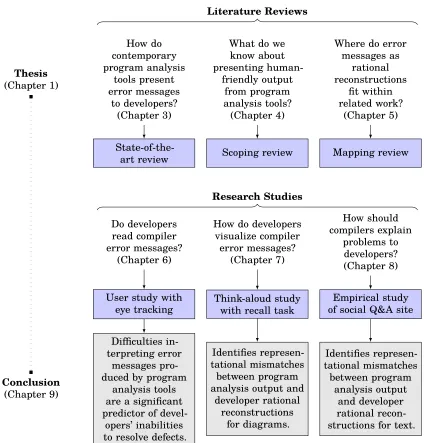
This dissertation is organized as self-contained chapters that together support the thesis (Chapter 1) and tell a coherent story about error messages as rational reconstructions. Figure 2.3 on page 24 provides a roadmap of the dissertation.
Chapter 2 (you’re reading this now!) identifies and provides context for the research problem, articulates the objective, significance, and scope of the work, and proposes the theoretical framework of rational reconstruction through which I investigate error messages.
Following this chapter are three literature reviews which survey the literature through different perspectives. The state-of-the-art review presented in Chapter 3 familiarizes the reader to the research area of error messages, framed in terms of contemporary program analysis tools that developers actually use. The scoping review in Chapter 4 identifies rational reconstruction as a problem of alignment, and contributes a taxonomy of other dimensions that are important to the design of human-friendly error messages. The chapter may be of particular interest to readers who desire to bridge the research communities of human-computer interaction and programming languages. The mapping review in Chapter 5 defends the novelty of the thesis; the chapter demonstrates how the work in this dissertation fits conceptually with neighboring research disciplines, such as artificial intelligence and human factors.
reconstructions. Chapter 7 studies rational reconstructions as visual explanations for defects in source code. Chapter 8 studies rational reconstructions as text expla-nations, through two evaluations: a comparative evaluation of error messages, and an empirical evaluation of Stack Overflow that identifies situations when developers find error messages from program analysis to be insufficient.
In Chapter 9, we revisit the key contributions of this dissertation. The chapter interprets the findings from the studies and explicates them as design guidelines. These guidelines are operationalized and evaluated through a prototype compiler implemented in TypeScript.
Thesis (Chapter 1) How do contemporary program analysis tools present error messages to developers? (Chapter 3)
What do we know about presenting human-friendly output from program analysis tools? (Chapter 4)
Where do error messages as rational reconstructions fit within related work? (Chapter 5)
State-of-the-art review Scoping review Mapping review
Do developers read compiler error messages?
(Chapter 6)
How do developers visualize compiler error messages? (Chapter 7) How should compilers explain problems to developers? (Chapter 8)
User study with
eye tracking Think-aloud studywith recall task of social Q&A siteEmpirical study
Conclusion
(Chapter 9)
Difficulties in-terpreting error
messages pro-duced by program
analysis tools are a significant predictor of
devel-opers’ inabilities to resolve defects.
Identifies represen-tational mismatches between program analysis output and
developer rational reconstructions for diagrams. Identifies represen-tational mismatches between program analysis output and developer rational recon-structions for text.
Literature Reviews
Research Studies
3
|
How Do Contemporary
Program Analysis Tools
Present Error Messages to
Developers?
A straight line may be the shortest distance between two points, but it is by no means the most interesting.
The Doctor
This chapter presents a state-of-the-art review on program analysis tools, with the goal of familiarizing readers to current matters on how contemporary program analysis tools construct and present error messages to developers. The chapter frames these error messages through our theoretical framework of rational recon-struction, emphasizing how presentation design choices support or do not support developers. As a state-of-the-art review, the literature surveyed within this chapter is presented through the context of program analysis tools that developers actually use in practice.
messages from program analysis tools; this allows researchers as well as practi-tioners to prioritize improvements in error messages to problems that developers actually encounter. Section 3.5 chronologically reviews design guidelines towards presenting human-friendly error messages.
3.1 Overview of Program Analysis Tools
Program analysis tools refer to a broad class of software intended to help developers, with applications across software architecture, program comprehension, program evolution, testing, software versioning, and verification [36]. This dissertation focuses on a particular class of program analysis tools, source code analysis, that identifies defects within source code [36]:
Source code analysis is the process of extracting information about a program from its source code or artifacts (e.g., from Java byte code or execution traces) generated from the source code using automatic tools. Source code is any static, textual, human readable, fully executable description of a computer program that can be compiled automatically into an executable form. To support dynamic analysis the description can include documents needed to execute or compile the program, such as program inputs.
We can further elaborate program analysis tools through examining charac-teristics of these tools, across two implementation dimensions found in existing literature [56, 112, 137, 332].
strengthen program analysis [112]. An as example of hybrid analysis, Check ’n’ Crash combines static theorem proving with dynamic test execution to eliminate spurious warnings and improve the ease-of-comprehension of error messages through the production of Java counterexamples [79].
The second dimension iswherethe program analysis is performed. For example, FindBugs is a standalone static analysis tool for Java thatsupplementsthe error messages provided by the Java compiler [15]. In contrast, LLVMembedsprogram analysis tools directly within the compilation pipeline; Lattner and Adve [215] demonstrate that this type of “lifelong program analysis,” such as interprocedural static leak detection, can enable identification of certain defects that would not be possible to find otherwise.
Unfortunately, neither of these implementation dimensions is satisfactory for understanding developer difficulties within the theoretical framework of rational construction (Section 2.4). In rational reconstruction, the implementation detail of whether the information for the problem is obtained using static, dynamic, or hybrid analysis is orthogonal to the appropriate presentation of the error message. For example, though both LLVM (static) and Valgrind [386] (dynamic) can report uninitialized variables, rational reconstruction suggests that the type of analysis should not dictate the appropriate error message to present to the developer.
3.2 Text Representations of Program Analysis
What do contemporary error messages look like when presented to developers through text interfaces, such as consoles and terminals? And how do program analysis tools construct these error messages?3.2.1 Output as Source Location and Template Diagnostic
The familiar error message scheme within program analysis tools consists of a loca-tion indicating where the problem occurs, a human-authored descriploca-tion indicating what has gone wrong, and some additional information—such as the severity of the problem, an error code, resolution hints, and code context—to help the developer correct the problem.In this section, we’ll first bootstrap our investigation of this error message scheme using the following three source code listings to induce an error during program analysis:
1 The Java implementation:
1 class Brick {
2 void m(int i, double d) { }
3 void m(double d, int m) { }
4
5 {
6 m(1, 2);
7 }
8 }
2 The C# implementation:
1 namespace Program {
2 class Brick {
3 void m(int i, double d) { }
4 void m(double d, int m) { }
5
6 static int Main(string[] args) {
7 var b = new Brick();
8 b.m(1, 2);
9 return 0;
10 }
11 }
12 }
3 The C++ implementation:
1 class Brick {
2 void m(int i, double d) { }
3 void m(double d, int m) { }
4 };
5
7 Brick b;
8 b.m(1, 2);
9 return 0;
10 }
In all three listings—Java, C#, and C++—we have introduced an ambiguous method error: despite the different type signatures, program analysis cannot disam-biguate which of two candidate implementations to invoke given a call of methodm(1, 2). One possible fix is to explicitly indicate the type of the argument asm((int)1, (double)2)(in Java) orb.m((int)1, (double)2)(in C# and C+).
We then input these listings into assorted compilers for that programming lan-guage to obtain error messages. For Java error messages, we use OpenJDK [286] and the Eclipse Batch Compiler [105]. For C#, we use Roslyn [259] and Mono [257]. For C++, we use LLVM/Clang [235] and GCC [129]. The choice of compilers illus-trates the diversity in how toolsmiths choose to present error messages for what is conceptually the same problem. Applying the source code to their corresponding tools yields the following error messages during compilation:
1 OpenJDK (Java):
1 Brick.java:6: error: reference to m is ambiguous
2 m(1, 2);
3 ^
4 both method m(int,double) in Brick and method m(double,int) in Brick match
,→
5 1 error
2 Eclipse (Java)
1
---2 Brick.java (at line 6)
3 m(1, 2);
4 ^
5 The method m(int, double) is ambiguous for the type Brick
6
---7 1 problem (1 error)
3 Roslyn (C#)
1 Brick.cs(8,9): error CS0121: The call is ambiguous between the following methods or properties: 'Brick.m(int, double)' and 'Brick.m(double, int)'
,→
4 Mono (C#)
1 Brick.cs(8,9): error CS0121: The call is ambiguous between the
following methods or properties: `Program.Brick.m(int, double)' and `Program.Brick.m(double, int)'
,→
,→
2 Brick.cs(3,12): (Location of the symbol related to previous error)
3 Brick.cs(4,12): (Location of the symbol related to previous error)
4 Compilation failed: 1 error(s), 0 warnings
5 GCC (C++)
1 Brick.cpp: In function ‘int main()’:
2 Brick.cpp:8:13: error: call of overloaded ‘m(int, int)’ is ambiguous
3 b.m(1, 2);
4 ^
5 Brick.cpp:2:10: note: candidate: void Brick::m(int, double)
6 void m(int i, double d) { }
7 ^
8 Brick.cpp:3:10: note: candidate: void Brick::m(double, int)
9 void m(double d, int m) { }
10 ^
6 LLVM (C++)
1 Brick.cpp:8:7: error: call to member function 'm' is ambiguous
2 b.m(1, 2);
3 ~~^
4 Brick.cpp:2:10: note: candidate function
5 void m(int i, double d) { }
6 ^
7 Brick.cpp:3:10: note: candidate function
8 void m(double d, int m) { }
9 ^
10 1 error generated.
OpenJDK, Eclipse, GCC, and LLVM inject snippets directly from the source code into the error report to provide context to the developer; Roslyn and Mono do not. I also found it interesting that Mono seems to indicate that it does not know ifm is a method or property. Finally, GCC and LLVM colorize the output of the error messages for expressiveness; the LLVM toolsmiths reasonably argue that colors make it easier to distinguish the different elements of the error message [233].
How do program analysis tools construct these error messages? The messages I have just described are output from a template diagnostic [267].1 Templates
are string literals that allow expressions to be embedded, or interpolated, within them. For example, in OpenJDK, the error description string is found in the file compiler.properties:
# 0: name, 1: symbol kind, 2: symbol, 3: symbol, 4: symbol kind, 5: symbol, 6: symbol
,→
compiler.err.ref.ambiguous=\
reference to {0} is ambiguous\n\
both {1} {2} in {3} and {4} {5} in {6} match
The parameters that can be interpolated are indicated as 0, 1,2, and so on. The Roslyn implementation uses a similar interpolation scheme, through an XML file calledCSharpResources.resx:
<data name="ERR_AmbigCall" xml:space="preserve">
<value>The call is ambiguous between the following methods or properties: '{0}' and '{1}'</value>
,→
</data>
The Roslyn implementation supports only two parameters, now evident in the presented error message.
The template string and associated metadata are bundled up as diagnostic objectsand passed to a formatter within the program analysis tool. The formatter augments the template string with metadata information, such as the location. The formatter also colorizes the output and includes pertinent source code snippets, if those capabilities are available in the formatter implementation.
We’ll end this section by describing a dastardly form of template messages that routinely frustrates both novice and expert developers alike—the neglected “battle fields of syntax errors” [210]. A syntax error occurs when program analysis encounters an unexpected token, for example, from unintentionally misplaced
1Moulton and Muller [267] (1967) called these skeletal messages, but this term seems to have
semicolons, extra or missing braces, or a case statement without an enclosing switch[4]. In particular, one frustration of syntax error messages is that program analysis tools will sometimes report the location of the syntax problem far removed from the actual cause of the syntax error [55]. For example, consider the following Racket [302] program, which implements factorial:
1 #lang racket
2
3 (define (factorial n)
4 (if (= n 0) 1
5 (* n (factorial (- n 1))))
This program implements the correct behavior, but has a syntax error due to a missing closing parenthesis. Racket reports this syntax error to the developer on Line 3:
factorial.rkt:3:0: read: expected a `)' to close `('
The error is actually correct in that there is no corresponding closing parenthesis for the opening parenthesis beginning in Line 3. However, to actually resolve the defect, the developer must add a closing parenthesis to the end of Line 5:
5 (* n (factorial (- n 1)))) )
In contrast to techniques that mathematically define notions of minimizing error distance, Campbell, Hindle, and Amaral [55] motivate a natural language model to improve error reporting by arguing that humans read code as they read natural language; follow-up work by Santos, Campbell, Patel, and colleagues [337] offer additional evidence that language models can successfully locate and fix syntax errors in human-written code, without formal parsing.
Still other approaches have investigated reducing the burden for toolsmiths to author more useful error messages. For example, Jeffery [181] describes a tool called Merr—meta error generator—that allows compiler designers to associate hand-authored diagnostic messages with syntax errors by example. From this specification of errors and the associated message, Merr identifies the relevant parse states and input token, and inserts an error function into the parser to produce the error message at the appropriate point. Pottier [308] improves upon this approach by enabling the parser to automatically build a collection of erroneous statements, rather than having toolsmiths provide examples manually. Though useful, both approaches still require toolsmiths to manually write an accompanying error message to incorporate this diagnostic information.