SIAMESE NEURAL NETWORK BASED APPEARANCE MODEL FOR MULTI-TARGET
TRACKING
Mohib Ullah
Department of Computer Science (IDI), Norwegian University of Science and Technology, Norway.
ABSTRACT
An appearance model plays a crucial rule in multi-target
tracking. In traditional approaches, the two steps of
ap-pearance modeling i.e visual representation and statistically
similarity measure are modeled separately. Visual
repre-sentation is achieved either through hand-crafted features or deep features and statically similarity is measure through a cross entropy loss function. A loss function based on cross-entropy (KL-divergence, mutual information) find closely re-lated probability distribution for the targets. However, if the targets have similar visual representation, it ends up mix-ing the targets. To tackle this problem, we come up with a synergetic appearance model named Single Shot Appear-ance Model based on Siamese neural network. The network is trained with a contrastive loss function for finding the sim-ilarity between different targets in a single shot. The input to the network is two target patches and based on their similar-ity, a contrastive score is output by the network. The proposed model is evaluated on accumulative dissimilarity metric on three datasets. Quantitatively, promising results are achieved against three baseline methods.
Index Terms— Siamese neural network, appearance model, contrastive loss, cross entropy.
1. INTRODUCTION
One of the primary tasks of computer vision is to empower the computers with a vision system similar or even more sophis-ticated than the humans. Such a capability allow the comput-ers to analyses a visual scene for a variety of tasks including
but not limited to tracking [1,2], anomaly detection [3–6],
object detection [7,8], segmentation [9–11], motion
analy-sis [12,13], emotion classification [14,15], and crowd
anal-ysis [16,17]. Designing a robust appearance model plays a
crucial rule in aforementioned applications, especially multi-target tracking. For example, the well adopted strategy for multi-target tracking is tracking-by-detection where the track-ing is divided into two discrete steps i.e. detection and asso-ciation. Usually, target detection is achieved through a
dis-criminative [18] or a generative model [19]. While the
asso-ciation is a combinatorial optimization problem and is usually
handled globally [20,21] or locally [22,23] depending upon
the underlying application constraints. The appearance model is mainly used in association to differentiate between the tar-gets. In nutshell, target appearance model consist of two main steps:
• Visual representation
• Similarity metric
Traditionally, hand-engineered features are used for the visual representation of the targets. In a nutshell, they are classified into two broad categories i.e. the local key-point features and the global or region features. The local feature extracts only
sparse features from an image or image patch [24–26].
How-ever, global features [27–29] model the whole image patch
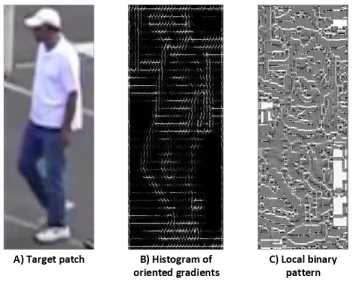
as a representative descriptor of an image patch. In Fig. 1,
the visual representation of a target patch through two feature descriptor is given.
Fig. 1: Visual representation of feature descriptors. A) shows
the RGB input of a target patch. B). HOG [27] descriptor. C).
LBP [29] descriptor
Based on the level of abstraction, global features can fur-ther be classified into zero-order, first-order, and up-to-second
[30]. For example, color histogram [31] and raw pixel
tem-plate [32] are considered to be zero-order descriptor. Level
set formulation [33] and gradient descriptor [27] are treated
as the first order while region covariance matrix [34] is
asso-ciated with the second order descriptor. More recently [35],
deep features are explored for the visual representation of the targets. Either deep features or the hand-engineered features,
RGB input Convolution +Batch Normalization
Convolution + Batch Normalization
+ Maxpool
Convolution + Batch Normalization
+ Maxpool
Convolution + Batch Normalization
+ Maxpool
Feature Vector
Siamese network branch 1
RGB input Convolution +Batch Normalization
Convolution + Batch Normalization
+ Maxpool
Convolution + Batch Normalization
+ Maxpool
Convolution + Batch Normalization
+ Maxpool
Feature Vector
Siamese network branch 2
Contrastive Loss
Contrastive score
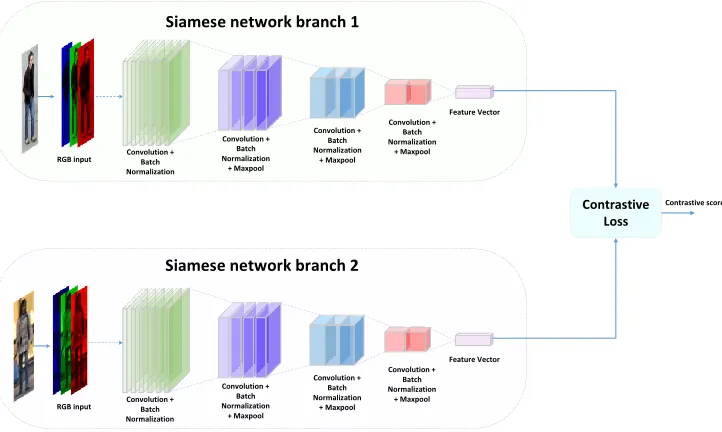
Fig. 2: A pair of targets patch is inserted in each network. The network extracts discriminative features and gives it to the contrastive loss module. The module calculates the contrast between the two patches and output a dissimilarity score.
the aim is to represent the target in the feature space in such a way that it could easily be differentiated from others. In the second step of the appearance model, the similarity be-tween two target patches is calculated through a pre-define metric. The usual adopted metrics are Kullback Leibler
di-vergence [36], Jensen Shannon divergence [37], normalized
cross correlation [38], Bhattacharya distance [39], mutual
in-formation [40], to name of few. In nutshell, the main
charac-teristic of the existing methods is it’s two-step procedure i.e. they perform the visual representation and the statistical sim-ilarity analysis independently. The focus of this paper is to introduce an appearance model where the visual representa-tion and the similarity measure are performed in a single syn-ergetic framework which we refer as single shot appearance model. The rest of the paper is organized in the following order. The overview of the proposed method is given in
sec-tion2. Network architecture, the contrastive loss function is
briefly explained in section3. Experiments are conducted in
section5and section6concludes the paper.
2. PROPOSED APPROACH
The block diagram of the proposed model is given in
Fig-ure??. Essentially, the network consists of a Siamese
net-work [41] with a contrastive loss function. Siamese neural
network is a special kind of neural network that consists of two parallel Convolutional Neural Networks (CNN). The ar-chitecture of both the networks are similar and they share common weight. Essentially, one network is the mirrored version of the other. Each network is taking an image patch corresponding to the target of interest. The target patches are
generated by the target detector or manually extracted from the image. The networks extract the discriminative feature through it’s linear and non-linear layers (convolution, activa-tion, pooling) from the patches and used as the visual repre-sentation of the target. Both the visual reprerepre-sentation is given to a contrastive loss function module which outputs the sim-ilarity score between the two patches. Compared to the clas-sical CNN, where the network learned to classify the inputs into different categories, the Siamese network gives the dis-similarity score between the corresponding inputs. In the next
section3, a brief description of the architecture and loss
func-tion is given.
3. NETWORK ARCHITECTURE
Classically, a CNN consists of convolution, activation, and
pooling layers. In any architecture [42–45], these layers are
organized in a special order. The depth of the network cor-responds to the number of layers in the network. The gen-eral rule of thumb is, the deeper the network, the better is
feature representation. In Fig.2, the generic structure of the
CNN is given. Technically, any architecture of CNN can be used as the Siamese network branch i.e. as a building block of the overall Siamese neural network. However, a well es-tablished approach in the research community is to use an already trained CNN network. One of the primary reasons for this is, designing a network from scratch is easy but training is very expensive in terms of computation. Moreover, intrin-sically, CNNs are very data hungry. Usually, a pre-trained network gives a good performance because it has been trained
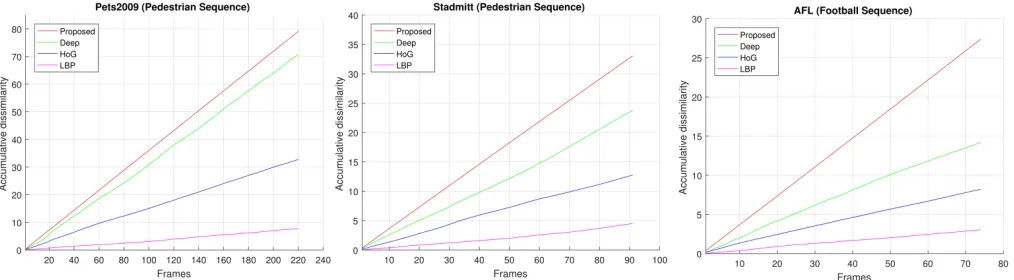
Fig. 3: Quantitative results on three datasets
we used state-of-the-art inception model of CNN [44] as the
branches of our Siamese neural network. Originally,
incep-tion model [44] is trained for the classification task of 1000
classes. However, we are interested only in the feature extrac-tion capability of the network. So, we truncated the work and removed the fully connected layers responsible for classifica-tion and inserted our contrastive lost module. The contrastive
loss [47] module compare the visual representation of both
the target patches and gives a contrastive score which shows the disparity in the distribution of both target patches. The brief overview of the contrastive lost module is given in the following:
3.1. Contrastive Loss Function
The aim of the loss function is to train and evaluate the net-work based on the given criteria. For classification, the loss function is defined in such a way to classify an image or im-age patch into a pre-define class categories. However, the aim of our Siamese network is to differentiate between two target patches rather than classifying them into different cat-egories. Therefore, a classification loss function based on
cross-entropy [36] is not suitable as we are not interested
in the class probability but rather want to get a dissimilarity score based on the visual representation of the target patches. Therefore, a contrastive loss function is the most suitable for our task. Theoretically, the contrastive loss function assesses how the network is differentiating the given target patches.
Mathematically, the contrastive loss function could be writ-ten as:
L(Dw, I, m) = (1−I) 1 2(Dw)
2+I1
2{max(0, m−Dw)}
2
(1)
where I is an indicator variable and set to zero if the inputs are
the same (similar targets) and 1 otherwise.mis an empirical
parameter and can be seen as a non-negative margin value. It penalizes the fact that if input pairs are very different from the
margin, it will not contribute to the overall loss. It is plausi-ble as our goal is to penalized the pairs that are different but
the network see them similar. Similarly,Dwis the Euclidean
distance between the visual representation of the two target patches.
Dw=
p
{FT1−FT2}2 (2)
In equation2,FT1andFT2are the visual representation of
targetT1andT2.
4. APPLICATION IN TRACKING
One of the important components of multi-target tracking is the association model which establish correspondence be-tween the targets in the consecutive frame. Target associa-tion is difficult as the appearance of targets changes tempo-rally. In case of human, it’s even more tricky because human body goes under pose changes and articulation. However, the changes in the appearance is temporally continuous and grad-ual. Therefore, in tracking, it is usually assumed that the ap-pearance remains approximately the same in two consecutive frames. Based on this assumption, ideally a target that exist
in two consecutive frames att−1andtshould have a high
similarly score compared to the other targets. Consequently, an appearance model that gives optimal scores (high for simi-lar, low for different) for the target patches would yield a high quality tracking performance. In order to validate our claim, we compared the similarity score of our model against three
baseline methods that incorporate HoG [27], LBP [29] and
deep features [44] with Jensen Shannon divergence [37]. The
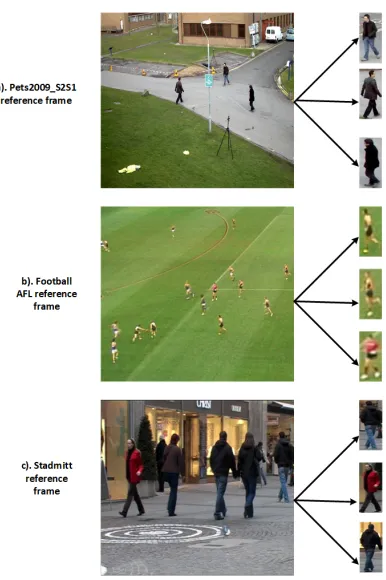
Fig. 4: Reference frames from the three datasets [48–50] and the corresponding target patches
5. EXPERIMENT
The proposed network is implemented in Matlab with Mat-convnet toolbox on a core i7 system with 8 GB RAM. To
evaluate the network, we have chosen three datasets [48–50]
that are commonly used for pedestrian tracking. The sam-ple frames and corresponding target patches are given in Fig.
??. From each datasets, target patches can be generated
by a target detector. However, we have manually annotated the targets patches to effectively evaluate our network and reduce the effect of false positive/negative. Moreover, we
used Jensen Shannon divergence [37] as the baseline
similar-ity metric and evaluated two well-known hand-crafted ( [27],
[29]) and one deep features [44]. The proposed network used
similar deep features [44] but with a contrastive loss
func-tion. For each dataset, first a reference target is selected and it’s contrastive score is calculated against all the targets. The same procedure is followed for each target in every frames. Based on the number of frames used in the simulations, the average score is calculated by normalizing it with the number of frames in the dataset. The number of targets in each dataset is also different. But we have considered only those frames where the number of target stays constant for the effective evaluation of the methods. The quantitative results show the propose network achieved a better contrastive score compared to the baseline method with a good margin.
Datasets Frame No. LBP HoG Deep Proposed
Pets2009 220 0.035 0.148 0.321 0.359
AFL 74 0.04 0.110 0.191 0.370
Stadmitt 91 0.049 0.140 0.261 0.363
Table 1: Normalized average accumulative contrastive score on 3 dataset. The proposed approach gives the best score. The second best score is given by a deep feature based method.
HoG [27] and LBP [25] based method gives third and forth
best results, respectively.
6. CONCLUSION
We proposed a single shot appearance model for multi-target tracking. It is based on a Siamese neural network with a con-trastive loss function. The input to the network is a pair of patches corresponding to targets of interest. The network output a dissimilarity score in a single shot. The quantita-tive results show that the proposed network gives better vi-sual representation and a better disparity in the feature space between different targets. The model has potential applica-tions in multi-target tracking, image indexing retrieval. In fu-ture, we will incorporate the proposed appearance model in the multi-target tracking framework.
7. REFERENCES
[1] Mohib Ullah and Faouzi Alaya Cheikh, “A directed sparse graphical model for multi-target tracking,” inIEEE Conference on Computer Vision and Pattern Recognition Workshops, 2018, pp. 1816–1823.
[2] ShiJie Sun, Naveed Akhtar, HuanSheng Song, Ajmal Mian, and Mubarak Shah, “Deep affinity network for multiple object tracking,”arXiv preprint arXiv:1810.11780, 2018.
[3] Habib Ullah, Mohib Ullah, and Nicola Conci, “Real-time anomaly detection in dense crowded scenes,” inVideo Surveil-lance and Transportation Imaging Applications 2014. Interna-tional Society for Optics and Photonics, 2014, vol. 9026, p. 902608.
[4] Mohammad Sabokrou, Mohsen Fayyaz, Mahmood Fathy, Zahra Moayed, and Reinhard Klette, “Deep-anomaly: Fully convolutional neural network for fast anomaly detection in crowded scenes,”Computer Vision and Image Understanding, vol. 172, pp. 88–97, 2018.
[5] Habib Ullah, Ahmed B Altamimi, Muhammad Uzair, and Mo-hib Ullah, “Anomalous entities detection and localization in pedestrian flows,”Neurocomputing, vol. 290, pp. 74–86, 2018.
[7] Joseph Redmon, Santosh Divvala, Ross Girshick, and Ali Farhadi, “You only look once: Unified, real-time object de-tection,” inIEEE Conference on Computer Vision and Pattern Recognition (CVPR), 2016, pp. 779–788.
[8] Kaiming He, Georgia Gkioxari, Piotr Doll´ar, and Ross Gir-shick, “Mask r-cnn,” inProceedings of the IEEE international conference on computer vision, 2017, pp. 2961–2969.
[9] Habib Ullah and Nicola Conci, “Structured learning for crowd motion segmentation,” in2013 IEEE International Conference on Image Processing. IEEE, 2013, pp. 824–828.
[10] Paolo Rota, Habib Ullah, Nicola Conci, Nicu Sebe, and Francesco GB De Natale, “Particles cross-influence for en-tity grouping,” in21st European Signal Processing Conference (EUSIPCO 2013). IEEE, 2013, pp. 1–5.
[11] Habib Ullah, Mohib Ullah, and Muhammad Uzair, “A hybrid social influence model for pedestrian motion segmentation,” Neural Computing and Applications, pp. 1–17, 2018.
[12] Habib Ullah, Mohib Ullah, and Nicola Conci, “Dominant mo-tion analysis in regular and irregular crowd scenes,” in Eu-ropean Conference on Computer Vision (ECCV) workshop on Human Behavior Understanding. Springer, 2014, pp. 62–72.
[13] Habib Ullah,Crowd Motion Analysis: Segmentation, Anomaly Detection, and Behavior Classification, Ph.D. thesis, Univer-sity of Trento, 2015.
[14] Huanghao Feng, Hosein M Golshan, and Mohammad H Ma-hoor, “A wavelet-based approach to emotion classification us-ing eda signals,” Expert Systems with Applications, vol. 112, pp. 77–86, 2018.
[15] Habib Ullah, Muhammad Uzair, Arif Mahmood, Mohib Ullah, Sultan Daud Khan, and Faouzi Alaya Cheikh, “Internal emo-tion classificaemo-tion using eeg signal with sparse discriminative ensemble,”IEEE Access, vol. 7, pp. 40144–40153, 2019.
[16] Habib Ullah and Nicola Conci, “Crowd motion segmentation and anomaly detection via multi-label optimization,” inICPR workshop on pattern recognition and crowd analysis, 2012.
[17] Habib Ullah, Muhammad Uzair, Mohib Ullah, Asif Khan, Ayaz Ahmad, and Wilayat Khan, “Density independent hy-drodynamics model for crowd coherency detection,” Neuro-computing, vol. 242, pp. 28–39, 2017.
[18] Shaoqing Ren, Kaiming He, Ross Girshick, and Jian Sun, “Faster r-cnn: towards real-time object detection with region proposal networks,” IEEE Transactions on Pattern Analysis and Machine Intelligence, , no. 6, pp. 1137–1149, 2017.
[19] Krystian Mikolajczyk, Bastian Leibe, and Bernt Schiele, “Multiple object class detection with a generative model,” in IEEE Conference on Computer Vision and Pattern Recogni-tion, 2006, vol. 1, pp. 26–36.
[20] Anton Milan, Stefan Roth, and Konrad Schindler, “Continuous energy minimization for multitarget tracking,”IEEE Transac-tions on Pattern Analysis and Machine Intelligence, vol. 36, no. 1, pp. 58–72, 2014.
[21] Mohib Ullah and Faouzi Alaya Cheikh, “Deep feature based end-to-end transportation network for multi-target tracking,” in IEEE International Conference on Image Processing (ICIP), 2018, pp. 3738–3742.
[22] Wangmeng Zuo, Xiaohe Wu, Liang Lin, Lei Zhang, and Ming-Hsuan Yang, “Learning support correlation filters for visual tracking,”IEEE transactions on pattern analysis and machine intelligence, 2018.
[23] Mohib Ullah, Faouzi Alaya Cheikh, and Ali Shariq Imran, “Hog based real-time multi-target tracking in bayesian frame-work,” in2016 13th IEEE International Conference on Ad-vanced Video and Signal Based Surveillance (AVSS). IEEE, 2016, pp. 416–422.
[24] David G Lowe, “Distinctive image features from scale-invariant keypoints,” Springer International Journal of Com-puter Vision (IJCV), vol. 60, no. 2, pp. 91–110, 2004.
[25] Michael Calonder, Vincent Lepetit, Christoph Strecha, and Pascal Fua, “Brief: Binary robust independent elementary fea-tures,” inSpringer European Conference on Computer Vision (ECCV), 2010, pp. 778–792.
[26] Ethan Rublee, Vincent Rabaud, Kurt Konolige, and Gary Brad-ski, “Orb: An efficient alternative to sift or surf,” inIEEE In-ternational Conference on Computer Vision (ICCV), 2011, pp. 2564–2571.
[27] Navneet Dalal and Bill Triggs, “Histograms of oriented gradi-ents for human detection,” inIEEE Conference on Computer Vision and Pattern Recognition (CVPR), 2005, vol. 1, pp. 886– 893.
[28] Dorin Comaniciu, Visvanathan Ramesh, and Peter Meer, “Real-time tracking of non-rigid objects using mean shift,” in IEEE Conference on Computer Vision and Pattern Recognition (CVPR), 2000, vol. 2, pp. 142–149.
[29] Timo Ojala, Matti Pietikainen, and Topi Maenpaa, “Multires-olution gray-scale and rotation invariant texture classification with local binary patterns,” IEEE Transactions on Pattern Analysis and Machine Intelligence, vol. 24, no. 7, pp. 971–987, 2002.
[30] Wenhan Luo, Junliang Xing, Anton Milan, Xiaoqin Zhang, Wei Liu, Xiaowei Zhao, and Tae-Kyun Kim, “Multiple object tracking: A literature review,”arXiv preprint arXiv:1409.7618, 2014.
[31] Dennis Mitzel and Bastian Leibe, “Real-time multi-person tracking with detector assisted structure propagation,” inIEEE International Conference on Computer Vision (ICCV Work-shops), 2011, pp. 974–981.
[32] Kota Yamaguchi, Alexander C Berg, Luis E Ortiz, and Tamara L Berg, “Who are you with and where are you go-ing?,” inIEEE International Conference on Computer Vision and Pattern Recognition (CVPR), 2011, pp. 1345–1352.
[33] Dennis Mitzel, Esther Horbert, Andreas Ess, and Bastian Leibe, “Multi-person tracking with sparse detection and con-tinuous segmentation,” inEuropean Conference on Computer Vision (ECCV). Springer, 2010, pp. 397–410.
[34] Fatih Porikli, Oncel Tuzel, and Peter Meer, “Covariance track-ing ustrack-ing model update based on lie algebra,” inIEEE Interna-tional Conference on Computer Vision and Pattern Recognition (CVPR), 2006, pp. 728–735.
multi-target tracking,” inIEEE International Conference on Image Processing (ICIP), 2017, pp. 2612–2616.
[36] Jianhua Lin, “Divergence measures based on the shannon en-tropy,” IEEE transactions on information theory, vol. 37, no. 1, pp. 145–151, 1991.
[37] Bent Fuglede and Flemming Topsoe, “Jensen-shannon diver-gence and hilbert space embedding,” inIEEE International Symposium on Information Theory (ISIT), 2004, p. 31.
[38] Kai Briechle and Uwe D Hanebeck, “Template matching using fast normalized cross correlation,” inOptical Pattern Recogni-tion XII. International Society for Optics and Photonics, 2001, vol. 4387, pp. 95–103.
[39] Thomas Kailath, “The divergence and bhattacharyya distance measures in signal selection,”IEEE transactions on communi-cation technology, vol. 15, no. 1, pp. 52–60, 1967.
[40] Hanchuan Peng, Fuhui Long, and Chris Ding, “Feature selec-tion based on mutual informaselec-tion criteria of max-dependency, max-relevance, and min-redundancy,” IEEE Transactions on pattern analysis and machine intelligence, vol. 27, no. 8, pp. 1226–1238, 2005.
[41] Gregory Koch, Richard Zemel, and Ruslan Salakhutdinov, “Siamese neural networks for one-shot image recognition,” in ICML deep learning workshop, 2015, vol. 2.
[42] Alex Krizhevsky, Ilya Sutskever, and Geoffrey E Hinton, “Ima-genet classification with deep convolutional neural networks,” inAdvances in neural information processing systems, 2012, pp. 1097–1105.
[43] Matthew D Zeiler and Rob Fergus, “Visualizing and under-standing convolutional networks,” inSpringer European con-ference on computer vision, 2014, pp. 818–833.
[44] Christian Szegedy, Wei Liu, Yangqing Jia, Pierre Sermanet, Scott Reed, Dragomir Anguelov, Dumitru Erhan, Vincent Van-houcke, and Andrew Rabinovich, “Going deeper with convo-lutions,” inIEEE Conference on Computer Vision and Pattern Recognition, 2015, pp. 1–9.
[45] Mohib Ullah, Ahmed Mohammed, and Faouzi Alaya Cheikh, “Pednet: A spatio-temporal deep convolutional neural network for pedestrian segmentation,” Journal of Imaging, vol. 4, no. 9, pp. 107, 2018.
[46] Jia Deng, Wei Dong, Richard Socher, Li-Jia Li, Kai Li, and Li Fei-Fei, “Imagenet: A large-scale hierarchical image database,” inIEEE International Conference on Computer Vi-sion and Pattern Recognition(CVPR). IEEE, 2009, pp. 248– 255.
[47] Ce Qi and Fei Su, “Contrastive-center loss for deep neural networks,” in2017 IEEE International Conference on Image Processing (ICIP). IEEE, 2017, pp. 2851–2855.
[48] James Ferryman and Ali Shahrokni, “Pets2009: Dataset and challenge,” inTwelfth IEEE International Workshop on Per-formance Evaluation of Tracking and Surveillance, 2009, pp. 1–6.
[49] Mykhaylo Andriluka, Stefan Roth, and Bernt Schiele, “Monocular 3d pose estimation and tracking by detection,” in IEEE Conference on Computer Vision and Pattern Recognition (CVPR), 2010, pp. 623–630.