735 | P a g e
Problem-Solving and Operational
Research Tools to optimize resource
allocation
Marwane Smaiti
11
Université Hassan II,
Faculté des sciences ben M'Sik,
BP 7955 Casablanca, Morocco
Dr. Mostafa Hanoune
22
Université Hassan II,
Faculté des sciences ben M'Sik,
BP 7955 Casablanca, Morocco
ABSTRACT
The distribution of resources is a key to the success of a given production process and its maintenance. Indeed, companies can gain a decisive and immediate competitive advantage. We aim to model the allocation of resources in a power type production unit proposing improvements at a later stage. A model: workers, resources, tasks will be adopted as part of our model. Once developed, this model can be the starting point for further optimization efforts for the entire value chain component of any production process. CAPEX: Reduction of operating costs by dynamic elimination of losses. To our previous efforts, we add a problem resolution framework rendering it easier for the user to identify resource importance and resource leakage.
Keywords:
Allocation, Ressources, Production Unit, Optimization of Resources, Rocdel.
I
INTRODUCTION
In economics, total factor productivity (TFP), also known as multifactor productivity, refers to the part of production that is not explained by the traditional inputs of labor and capital used. in production. [8] If all inputs are taken into account, then total factor productivity can be considered as a measure of the technological change or long-term technological dynamism of an economy.
II
MODELING
Total factor productivity (TFP) or total factor productivity (TFP) is the relative increase in wealth ("growth") that is not explained by the increase in the use of factors of production, capital and work. For example, sunshine can increase agricultural production, all other factors being constant elsewhere. Sunshine is therefore a factor of productivity.
The production function below (of the Cobb-Douglas constant-scale yield form) [16,17,18,19,20] represents output (Y) as a function of an overall factor productivity factor (A), a capital stock (factor K), labor (factor L), and the respective shares of capital and labor in the final result (α is the share of the contribution of capital).
Total factor productivity generalization: technology-oriented approach
In this paper we introduce a new model for TFP. In fact, we will describe a broader approach that can be used to simulate the impact technologies have on productivity, and namely on cost, ad to compare them.
Our model assumes to the following:
The resource allocation has been optimized ([1,2,3,4,5]). Our paper handled this issue with care [1] Many technologies exist, and many technologies can be utilized for our convenience
The main objective is to reduce cost, with the same resources and to perform the same production
Our model aim is focused only on unit cost reduction this is a new way to reduce OPEX after applying RocDel introduced in our previous work [6,7,21].
Indeed, RocDel aims to reduce the cost, resource allocation aims to improve the resource utilization, and the model we are presenting aims to reduce the unit cost.
737 | P a g e
Parameter
Description
The
number
of
resource
units
(e.g.
workforce, capital, etc.)
The cost required
Unit cost for each resource unit
A function representing the technology
impact on the required resource units to
perform the same production
Our model aims to lower cost i.e. , which can be obtained as follows:
The technology permits to get the same production with a different number of resource units (naturally a lower number of units). Thus, after utilizing a technology, for the same production, we will require another number of units as follows:
Then the new cost is given by:
Let’s compute the ratio :
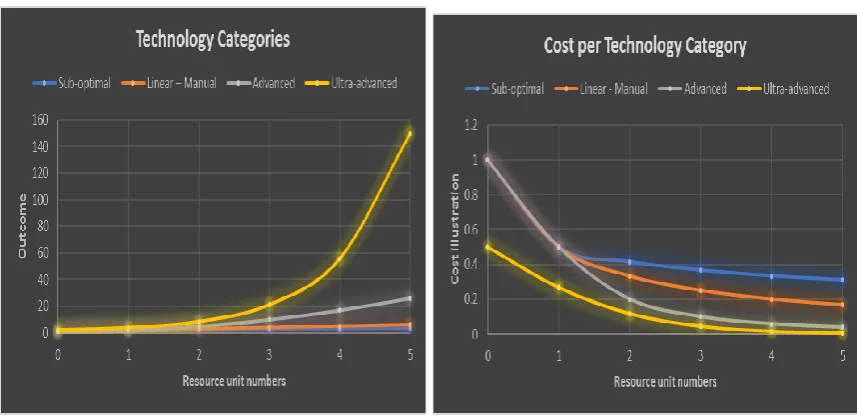
The ratio gives an idea of the linearity of the used technology. Therefore, we introduce in this paper, the technology grading concept:
1. Sub-optimal,
That is actually when resource units are under performing. The technology function here can be seen as a distraction, or a limitation that lower the performance
2. Linear–Manual,
That takes place when resources are proportional to outcome; this is a typical case of manual work using no technology, or utilizing rudimentary one.
That takes place when you are using well-advanced technologies where resource unit number lead to unproportionally better than outcome; this is a typical case of replacing manual tasks in the value chain by machine through atomization
4. Ultra-advanced,
We present the three categories as follows:
Figure 1: Technology Categories Figure 2: Technology Cost Impact
We illustrate the impact on cost as follows:
The suggested scheme can be utilized to guide technology selection accounting for its impact on cost reduction.
III CONCLUSION
In this work, we modeled the technology impact on required resources, and thus cost. We observe the more the technology is advanced, the best is the impact on cost reduction. The reduction can be dramatic if the technology is “smart enough” to involve in an auto-improvement process.
A further step of the research work is to draw a through financial assessment by including the cost of the technology, its lifetime, and its amortization. That can have a significant impact on mega-projects, especially if considered at the establishment.
REFERENCES
1. "capital expenditure (CAPEX)". BusinessDictionary. Retrieved 11 July 2017.
2. "What is a Capital Expenditure (CAPEX)?". My Accounting Course. Retrieved 11 July 2017.
3. Harry I. Wolk, James L. Dodd, Michael G. Tearney. Accounting Theory: Conceptual Issues in a Political and Economic Environment (2004). ISBN 0-324-18623-1.
739 | P a g e 5. Barry J. Epstein, Eva K. Jermakowicz. Interpretation and Application of International Financial
Reporting Standards (2007). ISBN 978-0-471-79823-1.
6. Stephan, Constantin (2012), Industrial Health, Safety and Environmental Management, epubli, Berlin, 3rd edition 2012, ISBN 978-3-7418-7478-9
7. "Environmental Leader Is Your Source For Energy, Environmental & Sustainability News". Environmental Leader.
8. Fehlauer, R., Die Sicherheitsanalyse, ein Merkbuch zu ihrer Durchführung {L'analyse de la sécurité du travail, manuel pratique). Édit. : Hüttenwerk Salzgitter AG.
9. lndustriegewerkschaft Metall für die Bundesrepublik Deutschland {Syndicat industriel des métallurgistes de la République fédérale allemande) : Sicherheitsanalyse {L'analyse de la sécurité du travail), numéro 6, Schriftenreihe Arbeitssicherheit, Francfort-sur-le-Main. Pas d'indication d'année. 10. Nutzhorn, H., RKW Leitfaden der Arbeitsanalyse {Principes de l'analyse du travail), Édit. :
Rationalisierungskuratorium der deutschen Wirtschaft, Bad Harzburg, Francfort-sur-le-Main, 1964. 11. Rijksarbeidsbureau, Handleiding voor de Functieanalyse {Manuel de l'analyse des fonctions),
Handboek van het Rijksarbeidsbureau, La Haye, 1954.
12. Trilling, L. (2006). Aide `a la d´ecision pour le dimensionnement et le pilotage de ressources humaines mutualis´ees en milieu hospitalier. PhD thesis, INSA de Lyon.
13. Val´erio de Carvalho, J. (1999). Exact solution of bin-packing problems using column generation and branch-and-bound. Annals of Operations Research, 86 :629–659.
14. Krichen, S. and Dahmani, N. (2010). A particle swarm optimization approach for the biobjective load balancing problem. Electronic Notes in Discrete Mathematics, 36 :751– 758.
15. Labed, S., Gherboudj, A., and Chikhi, S. (2012). A modified hybrid particle swarm optimization algorithm for solving the travelling salesmen problem. Journal of Theoretical and Applied Information Technology, 39(2) :132–138.
16. Mallo y Merlo, “Control de gestión y control presupuestario” Mc Graw Hill, Madrid 1995.
17. Mallo, C, Kaplan, R, Melgem,S y Gimenez, C, “Contabilidad de costos y estratégica de gestión”, Prentice Hall, Madrid, 2000.
18. Saez Torrecilla, Fernandez Fernandez, Gutierrez Díaz, “Contabilidad de Costes y Contabilidad de Gestión” Mc Graw Hill, Madrid 1996.
19. Shank, J y Govindarajan, V, “Gerencia estratégica de costos” Editorial Norma, Barcelona, 1995 - Smolje, A. y otro, “Outsourcing: Herramienta para el análisis económico y estratégico” Revista Costos y Gestión, Año VII, nº 25.
20. Tanaka, Yoshikawa y otros. “Gestión Moderna de Costos”. Editorial Diaz de Santos; Edición 1997. 21. M. Hanoune, M. Smaiti, Problem-Solving and Operational Research Tools to optimize resource