599 | P a g e
MULTI-OBJECTIVE OPTIMIZATION ON THE BASIS
OF RATIO ANALYSIS (MOORA) METHOD FOR
ACTIVATED TIG WELDED STAINLESS STEEL
PLATE
D. P. Pandya
1, A. D. Badgujar
2, N. D. Ghetiya
31,2
Mechanical Engineering Department, School of Engineering and Technology,
Navrachana University, ,Vadodara (India)
3
Mechanical Engineering Department
,Institute of Technology,
Nirma University, Ahmedabad (India)
ABSTRACT
Activate TIG (Tungsten Inert Gas) welding is used to enhance the weld penetration with high degree of quality.
In A-TIG welding fluxes are mixed with acetone and applied on the weld surface before welding. In this work,
A-TIG welding process is carry out on 310 stainless steel 5 mm thick plate . Experiments are performed to
check the effect of various welding parameters on weld penetration and weld bead width during activated TIG
welding. Box Behnken method is used for finding out the relationship between various responses (weld
penetration and weld bead width) and welding parameters (welding speed, welding current and fluxes). For
optimization Selection of optimum welding parameters leads to good functional attributes for the weld
components and increased productivity. In the present work A-TIG welding process parameters are Optimized
by Multi-Objective Optimization by Ratio Analysis (MOORA).
Keywords
:
A-TIG welding, stainless steel, oxide flux, decision making MOORA method.
I. INTRODUCTION
Gas tungsten arc welding (GTAW) process produces high quality weld deposits, the limitations of shallow penetration and low productivity are associated with the process. Activated flux gas tungsten arc welding (A-GTAW) has been reported to overcome the limitations of GTAW process. A significant increase in penetration of up to 300% has been reported in with the use of activated flux in GTAW welding [1]. Various fluxes like CaO, CrO3, Fe2O3,MnO2, TiO2, MoO3, and SiO2 are used for the A-TIG welding processes for different
materials. In A-TIG, the temperature coefficient of surface tension on the molten pool changed from a negative to a positive value. The surface tension gradient introduces reversal Marangoni convection in the molten pool. Which is responsible for high penetration depth. [1,2]
which use statistical procedure for the selection of the best alternative from the given alternatives. This method generates most suitable alternatives by considering both beneficial (maximization) and non-beneficial (minimization) alternatives and eliminates unsuitable alternatives for strengthening the existing selection procedure. The MOORA method involves lesser computations, comprehensiveness and robustness which can solve multiple numbers of criteria simultaneously [3]. Gadakh et al. [4] optimized welding process parameters simultaneously using MOORA method. Six case studies were considered to explain the applicability of this technique. Chaturvedi et al. [5] investigated electro-chemical machining process for the selection of optimum machining parameters by MOORA method. This method was reliable for solving multiple objectives with consideration of quality development for any process. This method is very simple to realize, easy to execute and provided the best alternatives.
In the present study MOORA method has been implemented for multi-objective optimization of A-TIG welding process parameter. The desired input process parameters were welding current ,welding gas and combination of flux. These process parameters were optimized for obtaining maximum penetration with minimum bead width.
II.EXPERIMENTATION
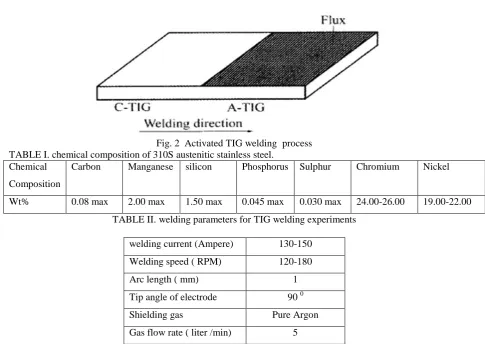
Activated Tugsten Inert Gas welding are carried out on 5 mm thick 150 mm x 100 mm grade 310 stainless steel plate. Whose chemical compositions are listed in Table I . Prior to the welding, the surface of the plate was polished onb milling machine to remove all surface impurities and then cleaned by acetone. A direct current electrode negative polarity power source was used with a mechanized system in which the test piece was fixed on bead by fixture and welding torch was moving at constant velocity . Activated flux of 40 micron particle size prepared in different combinations sets of SiO2+ZnO, SiO2+TiO2, TiO2+ZnO were prepared in powder form, and then mixed with acetone, and a layer less than 0.2 mm thick was applied to the surface of the joint to be welded by means of a brush before TIG welding.
TIG Welding process parameters used in the present work are given in Table II. The cross-sections of the weld beads were photographed using an optical microscope. After the weld preparation profile projector was used to examine the metallurgical properties of A-TIG stainless steel welds.
601 | P a g e Fig. 2 Activated TIG welding process
TABLE I. chemical composition of 310S austenitic stainless steel. Chemical
Composition
Carbon Manganese silicon Phosphorus Sulphur Chromium Nickel
Wt% 0.08 max 2.00 max 1.50 max 0.045 max 0.030 max 24.00-26.00 19.00-22.00 TABLE II. welding parameters for TIG welding experiments
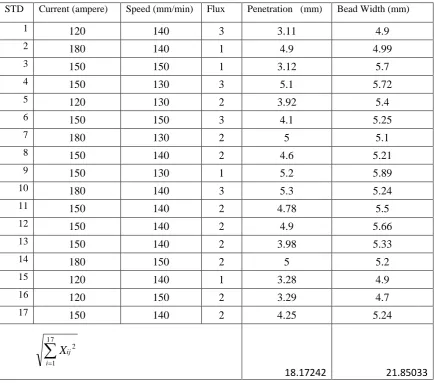
In the present study, the three-level and three-factorial Box– Behnken experimental design was chosen for finding out the relationship between weld penetration and bead width and the variables . This model has the advantage that it permits the use of relatively few combinations of variables for determining the complex response function [6]. The levels of the variables were coded as 1 (low), 0 (central point or middle) and 1 (high) as shown in the table Table III. A total 17 experiments were carried out with 3 centre point using the Box– Behnken experimental design. At zero indication selected fluxes are TiO2 + SiO2. Based on the literature and
trial experiment, parameters range was selected The actual design of matrix is shown in Table IV. TABLE III welding parameters and their levels
welding current (Ampere) 130-150
Welding speed ( RPM) 120-180
Arc length ( mm) 1
Tip angle of electrode 90 0
Shielding gas Pure Argon
Gas flow rate ( liter /min) 5
Parameter Symbol Level
Low ( -1) High 1
Welding Speed( RPM) V 120 180
Current (Ampere) A 130 150
n
X
X
X
n
X
X
X
n
X
X
X
X
m mm
1
2
...
...
2
1
...
2
1
2 2 2 1 1 1
17 1 2 i ijX
TABLE IV experimental results and their corresponding responses
STD Current (ampere) Speed (mm/min) Flux Penetration (mm) Bead Width (mm)
1
120
140
3
3.11
4.9
2
180
140
1
4.9
4.99
3
150
150
1
3.12
5.7
4
150
130
3
5.1
5.72
5
120
130
2
3.92
5.4
6
150
150
3
4.1
5.25
7
180
130
2
5
5.1
8
150
140
2
4.6
5.21
9
150
130
1
5.2
5.89
10
180
140
3
5.3
5.24
11
150
140
2
4.78
5.5
12
150
140
2
4.9
5.66
13
150
140
2
3.98
5.33
14
180
150
2
5
5.2
15
120
140
1
3.28
4.9
16
120
150
2
3.29
4.7
17
150
140
2
4.25
5.24
18.17242
21.85033
III THE MOORA METHOD
In manufacturing environment, decision-making of range of alternatives and selection of the best one is an important work. MCDM can be applied to select and rank optimum machining conditions. The MOORA method [7-10] starts with a decision matrix showing the performance of different alternatives with respect to various attributes (objectives).
(1)
603 | P a g e
m i ij ij aij
X
X
X
1 2/
a g j a ij a ij g ji
X
X
Y
1 1 a ij g j j a ij ji
W
X
W
X
Y
n g j
1 1Körth ratio etc. and concluded that for this denominator, the best choice is the square root of the sum of squares of each alternative per attribute. This ratio can be expressed as below:
(2)
where xij is a dimensionless number which belongs to the interval [0,1] representing the normalized performance of ith alternative on jth attribute.
For multi-objective optimization, these normalized performances are added in case of maximization (for beneficial attributes) and subtracted in case of minimization (for nonbeneficial attributes). Then the optimization problem becomes:
(3) where g is the number of attributes to be maximized, (n−g) is the number of attributes to be minimized, and yi is thenormalized assessment value of ith alternative with respect to all the attributes.
In some cases, it is often observed that some attributes are more important than the others. In order to give more importance to an attribute, it could be multiplied with its corresponding weight (significance coefficient) [6]. When these attribute weights are taken into consideration, Eq. 3 becomes as follows:
(4)
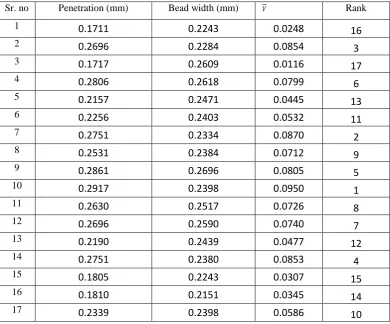
where wj is the weight of jth attribute, which can be determined applying analytic hierarchy process (AHP) or entropy method. The yi value can be positive or negative depending of the totals of its maxima (beneficial attributes) and minima (non-beneficial attributes) in the decision matrix. An ordinal ranking of yi shows the final preference. Thus, the best alternative has the highest yi value, while the wors alternative has the lowest yi value.
IV. OPTIMIZATION OF PROCESS PARAMETERS
Y
TABLE V Normalized decision-making matrix and results of multi-objective analysis
Sr. no Penetration (mm) Bead width (mm) Rank
1
0.1711
0.2243
0.0248
16
2
0.2696
0.2284
0.0854
3
3
0.1717
0.2609
0.0116
17
4
0.2806
0.2618
0.0799
6
5
0.2157
0.2471
0.0445
13
6
0.2256
0.2403
0.0532
11
7
0.2751
0.2334
0.0870
2
8
0.2531
0.2384
0.0712
9
9
0.2861
0.2696
0.0805
5
10
0.2917
0.2398
0.0950
1
11
0.2630
0.2517
0.0726
8
12
0.2696
0.2590
0.0740
7
13
0.2190
0.2439
0.0477
12
14
0.2751
0.2380
0.0853
4
15
0.1805
0.2243
0.0307
15
16
0.1810
0.2151
0.0345
14
17
0.2339
0.2398
0.0586
10
V. CONCLUSIONS
In this study, a novel activated flux that is easy to apply and provides good spreadability was developed; furthermore, it provides increased penetration capability in 310 stainless steel. ATIG welding process parameters were optimized for 310 stainless steel joints to obtain desirable penetration and bead width.
By using Multi-Objective Optimization based on Ratio Analysis (MOORA) optimum process parameter were obtained which results in maximization of penetration with bead width. Obtained optimum process parameter were welding current of 180 ampere , welding speed of 140 mm/min and flux combination SiO2 + ZnO. For these combinations of process parameter obtained penetration and bead width are 5.2mm and 5.24 mm respectively.
VI. ACKNOWLEDGMENT
We would also like to thank all those who have helped us directly or indirectly throughout the works specially, the Head of the Department and the Institute for providing us with well equipped lab facilities without which this work would have not been possible.
605 | P a g e [2.] Kuang-Hung Tseng; Development and application of oxide-based flux powder for tungsten inert gas
,Welding of austenitic stainless steels, Powder Technology 233 (2013) 72–79,
[3.] Chakraborty, S., “Applications of the MOORA method for decision making in manufacturing environment”, The International Journal of Advanced Manufacturing Technology, Vol. 54, No. 9–12, pp. 1155–1166,2011.
[4.] Gadakh, V.S., Shinde, V.B. and Khemnar, N.S., “Optimization of welding process parameters using MOORA method”, The International Journal of Advanced Manufacturing Technology, Vol. 69, No. 9–12, pp. 2031–2039,2013.
[5.] Chaturvedi, V., Jain, A., Bhadauriya, A. and Tomar, K. “Parametric optimization of ECM process parameters by MOORA method”, International Journal of Research in Engineering and Applied Sciences, Vol. 4, No. 10,pp. 1–10, 2014.
[6.] Ferreira SLC, Bruns RE, Ferreira HS, Matos GD, David JM, Brandão GC, Box–Behnken design: an alternative for the optimization of analytical methods. Anal ChimActa 597 (2007) 179–86.
[7.] Brauers WKM, Zavadskas EK, Peldschus F, Turskis Z (2008) Multiobjective decision-making for road design. Transport 23:183–193
[8.] Brauers WKM, Zavadskas EK (2009) Robustness of the multiobjective
[9.] MOORA method with a test for the facilities sector. Technological and Economic Development of Economy: Baltic J on Sustainability 15:352–375.
[10.]Brauers WKM, Zavadskas EK (2006) The MOORA method and its application to privatization in a transition economy. Control Cybern 35:445–469
[11.] Brauers WKM (2008) Multi-objective contractor’s ranking by applying the MOORA method. J of Business Economics andManagement 4:245–255
[12.]Brauers WKM, Zavadskas EK, Peldschus F, Turskis Z (2008) Multi-objective optimization of road design alternatives with an application of the MOORA method, Proc of the 25th Int Sym On Automation and Robotics in Construction, Lithuania, 541–548.
[13.]Kalibatas D, Turskis Z (2008) Multicriteria evaluation of inner climate by using MOORA method. Inf Tech and Con 37:79–83