1070 | P a g e
SOIL STABILIZATION BY USING FLY ASH
Muske Srujan Teja
1, K Sai Pradeep
2, B. Rajasekhar
3123
Assistant Professor, Department of Civil Engineering,
Mahaveer Institute of Science and Technology, Hyderabad, (India)
ABSTRACT
Soil is a peculiar material. Some waste materials such Fly Ash, rice husk ash, pond ash may use to make the
soil to be stable. Addition of such materials will increase the physical as well as chemical properties of the soil.
Some expecting properties to be improved are liquidity index, plasticity index, unconfined compressive strength
and bearing capacity etc. The objective of this study was to evaluate the effect of Fly Ash derived from
combustion of sub-bituminous coal at electric power plants in stabilization of soft fine-grained. Many areas in
Telangana region are located on high expensive soil. This paper describes about a study carried out to check
the improvement in properties of soil by adding different percentages of fly ash.
Key Words: Fly Ash, Fine-Grained Soils, Liquidity Index, Stabilization, Unconfined Compression Test
I.
INTRODUCTION
Aim of this research is to stabilize the locally available soils and connecting the village roads to district roads for
the development of villages. The stabilization is done for the following reasons.
Soil stabilization is widely used in connection with road, pavement and foundation construction such that it
improves the properties of soil.
Strength - to increase the strength and bearing capacity,
Volume stability - to control the swell-shrink characteristics caused by moisture changes,
Durability - to increase the resistance to erosion, weathering or traffic loading.
To reduce the pavement thickness as well as cost.
There are various waste materials such as Fly Ash, Rice Husk and Pond Ash, in this study Fly Ash is assumed as
stabilizing material. Fly Ash by itself has little cementatious value but in the presence of moisture it reacts
chemically and forms cementatious compounds and attributes to the improvement of strength and
compressibility characteristics of soils. It has a long history of use as an engineering material and has been
successfully employed in geotechnical applications. This in study we are taking the fine-grained soil as black
cotton soil.
Properties of black cotton soil
PROPERTY RANGE
Swelling index 40-80
Field dry density (g/cc) 1.15-1.65
Field moisture content (%) 10-30
Liquid limit (%) 40-75
Plastic limit (%) 18-35
1071 | P a g e
II.
LITERATURE REVIEW
Erdal Cokca (2001): Effect of Fly Ash on expansive soil was studied by Erdal Cokca,FLY ASH consists of
often hollow spheres of silicon, aluminium and iron oxides and unoxidized carbon.Fly Ash India 2005, New
Delhi Fly Ash Utilization Programme (FAUP), TIFAC, DST, New Delhi – 110016 are two major classes of Fly
Ash, class C and class F. The former is produced from burning anthracite or bituminous coal and the latter is
produced from burning lignite and sub bituminous coal. Both the classes of Fly Ash are puzzolans, which are
defined as siliceous and aluminous materials. Thus Fly Ash can provide an array of divalent and trivalent
cations (Ca2+,Al3+,Fe3+etc) under ionized conditions that can promote flocculation of dispersed clay particles.
Thus expansive soils can be potentially stabilized effectively by cation exchange using Fly Ash.
He carried out investigations using Soma Fly Ash and Tuncbilek Fly Ash and added it to expansive soil at
0-25%. Specimens with Fly Ash were cured for 7days and 28 days after which they were subjected to Oedometer
free swell tests. And his experimental findings confirmed that the plasticity index, activity and swelling potential
of the samples decreased with increasing percent stabilizer and curing time and the optimum content of Fly Ash
in decreasing the swell potential was found to be 20%. The changes in the physical properties and swelling
potential is a result of additional silt size particles to some extent and due to chemical reactions that cause
immediate flocculation of clay particles and the time dependent puzzolanic and self hardening properties of Fly
Ash and he concluded that both high –calcium and low calcium class C Fly Ashes can be recommended as
effective stabilizing agents for improvement for improvement of expansive soils.
S.Bhuvaneshwari and S.R. Gandhi:
This study ic carried out the effect of engineering properties of expansive soil through an experimental
programme. Infrastructure projects such as highways, railways, water reservoirs, reclamation etc. requires earth
material in very large quantity. In urban areas, borrow earth is not easily available which has to be hauled from
a long distance.
Quite often, large areas are covered with highly plastic and expansive soil, which is not suitable for such
purpose. Extensive laboratory / field trials have been carried out by various researchers and have shown
promising results for application of such expansive soil after stabilization with additives such as sand, silt, lime,
Fly Ash, etc. As Fly Ash is freely available, for projects in the vicinity of a Thermal Power Plants, it can be
used for stabilization of expansive soils for various uses. The present paper describes a study carried out to
check the improvements in the properties of expansive soil with Fly Ash in varying percentages. Both
laboratory trials and field tests have been carried out and results are reported in this paper. One of the major
difficulties in field application is thorough mixing of the two materials (expansive soil and Fly Ash) in required
proportion to form a homogeneous mass.
Pandian et.al. (2002). Studied the effect of two types of Fly Ashes Raichur Fly Ash (Class F) and Neyveli Fly
Ash (Class C) on the CBR characteristics of the black cotton soil. The Fly Ash content was increased from 0 to
100%. Generally the CBR/strength is contributed by its cohesion and friction. The CBR of BC soil, which
1072 | P a g e
predominantly of coarser particles, is contributed by its frictional component. The low CBR of BC soil is
attributed to the inherent low strength, which is due to the dominance of clay fraction.
The addition of Fly Ash to BC soil increases the CBR of the mix up to the first optimum level due to the
frictional resistance from Fly Ash in addition to the cohesion from BC soil. Further addition of Fly Ash beyond
the optimum level causes a decrease up to 60% and then up to the second optimum level there is an increase.
III. ANALYSIS OF LAB TESTS
The following laboratory tests were carried out as per IS: 2720.The test were carried out on both normal soil
and stabilized soil.
1.Specific gravity test
2.Grain size analysis
3.Atterbeg’s limits
4.Proctor compaction test
5.Un Confined Compressive strength (UCC) test
After removing impurities like vegetation, stones etc, the soil was mixed with Fly Ash in varying proportion by
volume. The Mixing was thoroughly carried out manually and the tests were conducted as per standard
procedures.
Below results are the results of the tests performed on the soil in natural conditions shown in Table: 2. These
Results will be the base of comparative study between the properties of soil in natural conditions and properties
of soil after adding fly ash shown in Table:3. Bulk density and dry density were obtained by performing core
cutter. Composition of the soil is also obtained by grain size and hydrometer tests which prove that soil is
expansive.
TEST SOIL PROPERTES
Core Cutter
Bulk density Dry density -
1.92 gm/cc 1.66 gm/cc -
Grain size analysis/ Hydrometer
test
% Gravel % Sand % Fines
1.23 8.77 90
Atterberg Limit Tests
Liquid Limit Plastic Limit PI
74.4% 38.4% 37.6%
Shrinkage Limit 9.22% - -
Proctor Compaction Test
OMC MDD -
16% 1.68gm/cc -
Unconfined Compression Test 114kN/m2 - -
1073 | P a g e
TESTFLY ASH
15%
FLY ASH
20%
FLY ASH
30%
Liquid Limit 74 73.2 72.5
Plastic Limit 32.69 31.55 32.93
Plasticity Index 41.31 41.65 39.57
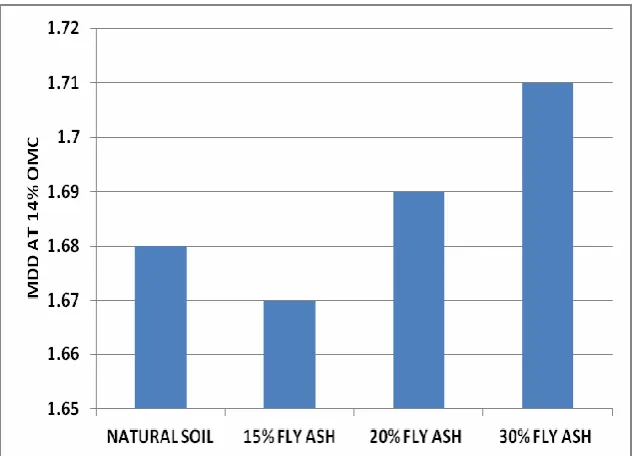
Maximum Dry Density(gm/cc) 1.67 1.69 1.71
Optimum Moisture Content (%) 14 14 14
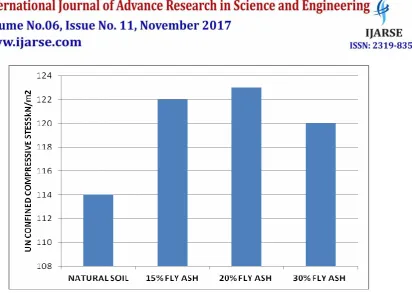
Unconfined Compressive Stress 122 123 120
TABLE: 3TEST RESULTS OF SOIL - FLY ASH MIXTURES
Comparison for liquid limit and plastic limit of the Natural soil with varying percentage of fly ash Shown in Fig. 1
And Fig. 2. The proctor tests carried out is summarized in Fig.2 at 16% OMC and also comparison for UN
confined compressive stess of natural soil with varying percentage of fly ash Shown in Fig. 3.
1074 | P a g e
Fig 2 Comparison for Plastic limit for natural soil –Fly ash Mixtures1075 | P a g e
Fig 4. Comparison for Un confined compressive stess for natural soil –Fly ash Mixtures.IV. CONCLUSIONS
Based on the present tests, the following conclusions can be drawn:
a.
As the locally available borrow soil has generally high plasticity (LL > 50) it was difficult to construction onit.
b.
The inclusion of different percentage of fly ash in natural soil generally resulted in some increasing inunconfined compressive stress.
c.
The unconfined compressive stress of natural soil without fly ash which was 114kN/m2, increased to 123kN/m2 at 20% fly ash in natural soil showing 7.89 % improvement.
d.
A liquid limit was decreases with increases in percentage of fly ash up 30% in natural soil which was 74.4%,decreased to 72.5%, showing 2.56 % decreased.
e.
Plastic limit was decreases with increases in percentage of fly ash up 30% in natural soil which was38.4%, decreased to 32.93 %, showing 14.24 % decreased.
f.
Maximum dry density was increase with increases in percentage of fly ash up 30% in natural soil whichwas 1.68gm/cc, increase to 1.71gm/cc at 14% OMC showing 1.78 % increase.
g.
As per grain size analysis the percentage of gravel 1.11%, percentage of sand 9.89% and percentage offines 89%.
REFERENCES
[1]
Berawala K. S. and Solanki C. H., 2010; “Empirical Correlations of Expansive Soils Parameters for the Surat Region”, Indian Geotechnical Conference1076 | P a g e
[3]
Chee-Ming Chan and Meei-Hoan Ho, 2010; “The Potential of Using Rubber chips as a Soft Clay Stabilizer Enhancing Agent”, Postgraduate Incentive Research Grant, University Tun Hussein Onn,Malaysia.
[4]
Dr. K.R. Arora “Soil Mechanics and Foundation Engineering”[5]
Pandian, N.S., Krishna ,K.C.& Leelavathamma B., (2002), Effect of Fly Ash on the CBR Behavior ofSoils , Indian Geotechnical Conference , Allahabad , Vol.1,pp.183-186.