588 |
P a g e
SEISMIC ANALYSIS OF STRUCTURE WITH
VERTICAL IRREGULARITIES USING SOIL
STRUCTURE INTERACTION
Prajakta Barsinge
1, L. R. Wankhade
21,2
Applied Mechanics, Govt. College of Engg., Amravati (India)
ABSTRACT
The basic configuration used in buildings on slope is step back and set back configuration. When such constructions are present in seismically prone areas, it is exposed to shear and torsion at greater extent than other conventional buildings. Buildings on slopes have fluctuated setups and asymmetry of varied mass and stiffness distribution. Mostly the effects of soil-structure interaction are generally ignored in the designing of low-rise buildings resting on shallow foundations. Ignoring such effects can lead to unsafe seismic design. Interaction between foundation and soil takes place when the structure is subjected to earthquake excitation. It gradually changes the motion of ground. The movement of the whole ground structural system is influenced by type of soil as well as by the type of structure. An attempt has been made in this paper to study the response of multi storied building subjected to seismic forces with Flexible foundations subjected to seismic forces analysed under different soil conditions like hard, medium and soft and also with fixed base condition. Also, the present paper gives a detailed methodology of Time History analysis.
Keywords:
Fixed base, Flexible base, Soil structure interaction, Step back, Step back-setback, Time history.I. INTRODUCTION
Majority of the existing reinforced concrete structures in India do not meet the current seismic requirements as
these are primarily designed for gravity loads only. However, during the earthquake, the behaviour of the
buildings depends on many parameters such as type of soil that is supporting, stiffness of infill, etc. The
building supported on medium stiff soil and stiff soil can resist certain amount of lateral forces due to
earthquakes, however the same building may not be able to resist the minor earthquake supported on soft soil. [1]
A common design practice for dynamic loading assumes the building to be fixed at their bases. Although
structures are supported on soils, most of the designers do not consider the effect of soil structure interaction on
structures during earthquake. When a structure is subjected to an earthquake excitation, it interacts with the
foundation and soil, and thus changes the motion of the ground. This means that the supporting soil medium
allows moment of the whole ground. Structural system is influenced by the type of soil as well as the type of
structure. The effect of soil structure interaction should be considered in the buildings which are located in the
earthquake prone areas.
In a few parts of the world, especially the hilly areas are more prone to seismic movement; e.g. northeast region
of India. There is a shortage of plain ground in hilly regions which constrains the construction or building
589 |
P a g e
procurements has demonstrated risky and brought about heavy death toll and property when subjected to groundmovements due earthquake. Because of hilly slopes these building ventures back towards the slope and in the
meantime they may have setback as well, having unequal statures at the same floor level. During the activity of
a earthquake these unpredictable and asymmetrical building usually come across lateral shears and torsional
moments and thus unable to withstand the twisting minutes and pivotal powers created by static loads in
isolation.[2] A discontinuity in the medium of wave’s propagation is encountered at the interface of soil and
structural foundations which leads to scattering, diffraction, reflection and refraction of the seismic waves at the
soil foundation interface their by changing the nature of ground motion at that point.[3]
II. SOIL STRUCTURE INTERACTION
Most of the civil engineering structures involve direct contact of structure with the ground. When subjected to
earthquake ground motions, the structural response and the ground displacements are not independent of each
other. Seismic waves are transmitted from the bedrock through the soil medium to a structure. The difference in
ground motion is due to interaction between the soil geological medium including soil and the structure, also
known as soil-structure interaction.
A seismic soil-structure interaction analysis evaluates the collective response of the structure, the foundation and
the geologic media underlying and surrounding the foundation, to a specified free-field ground motion. The term
free-field refers to motions that are not affected by structural vibrations or the scattering of waves at and around the foundation. SSI effects are absent for the theoretical condition of a rigid foundation supported on rigid soil.
Accordingly, SSI accounts for the difference between the actual response of the structure and the response of the
theoretical, rigid base condition.
III. NONLINEAR TIME HISTORY (TH) METHOD
Nonlinear time-history analysis is the most comprehensive method for seismic analysis. At the base of the
structure the earthquake record in the form of acceleration time history is input. At each second for the entire
duration of an earthquake the response of the structure is computed. This method differs from response spectrum
analysis because the effect of time is considered. That is, stresses and deformations in the structure at an instant
are considered as an initial boundary condition for computation of stresses in the next step. Furthermore,
nonlinearities that commonly occur during an earthquake can be included in the time-history analysis. Unlike
the response spectrum method, nonlinear time-history analysis does not assume a specific method for mode
combination. [4]
Hence, results are realistic and not conservative. In this analysis, all types of nonlinearities can be accounted for.
This could be very important when seismic retrofit involves energy dissipation using yielding of members or
plastic hinge rotation. The Input earthquake is never known with certainty. Hence, three to five different
histories should be used. For nonlinear seismic analyses, a total seismic mass including self-weight and floor
cover "Dead Load; DL" plus 25% of Live Load "LL" (1.0DL + 0.25LL) should be considered.
For buildings on hill slopes or sloping ground, two types of configuration are considered. These configurations
590 |
P a g e
Fig. 1:
4 Storey Step Back BuildingFig. 2:
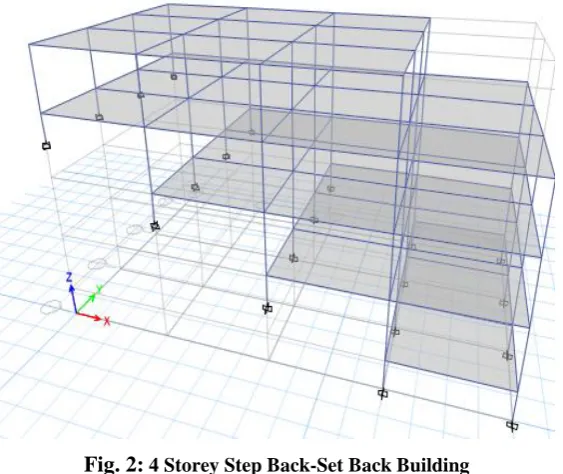
4 Storey Step Back-Set Back BuildingThe typical 4 storey step back and step back-set back configuration buildings are shown in figure (1) and
(2)respectively
IV. DESCRIPTION OF THE BUILDING MODEL
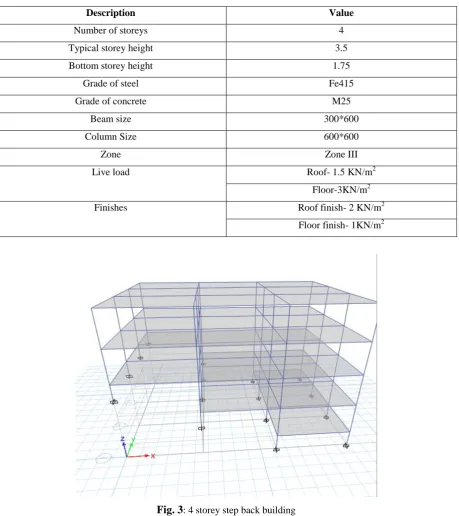
A typical 4 storey step back configuration building lying on slope is considered for the study. The
591 |
P a g e
Table 1: details of the building model
Description Value
Number of storeys 4
Typical storey height 3.5
Bottom storey height 1.75
Grade of steel Fe415
Grade of concrete M25
Beam size 300*600
Column Size 600*600
Zone Zone III
Live load Roof- 1.5 KN/m2
Floor-3KN/m2
Finishes Roof finish- 2 KN/m2
Floor finish- 1KN/m2
Fig. 3: 4 storey step back building
The frame is designed for seismic loads in ETABS 2015. Time History analysis is performed for the designed
frame. Comparison of storey drift, storey shears and time period is studied further. The building is shown in
figure 3.
For the inclusion of soil structure interaction in the given case, three types of soil, i.e., medium, soft and stiff
soil and rigid base. All the three cases are analysed by Time History method.
V. RESULTS
592 |
P a g e
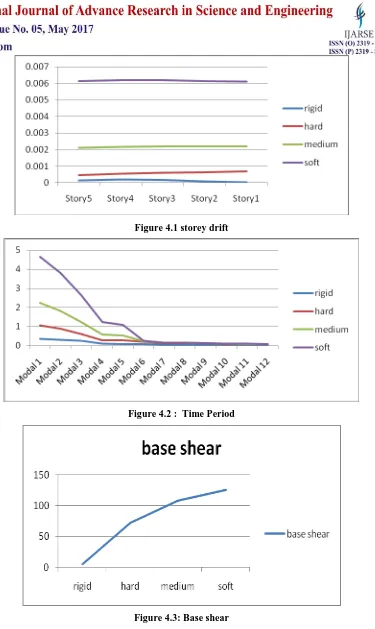
Figure 4.1 storey drift
Figure 4.2 : Time Period
Figure 4.3: Base shear
VI. CONCLUSION
From the results shown with respect to the building models considered leads to the following conclusions:
1. It is observed that the fundamental natural frequencies increase with the increase of soil stiffness and this
change is found more in soft soils.
593 |
P a g e
3. The storey drift increases when the soil changes from fixed base (rigid) to hard soil, hard to medium and thenmedium to soft.
4. Thus it can be said that Soil–structure interaction cannot be ignored while designing important structures like
buildings, bridges, nuclear power plants, liquid retaining structures, dams, etc., against the expected
earthquake forces.
5. The software used for nonlinear dynamic analysis ETABS 2015 having features of performing performance
based analysis.
REFERENCES
[1] Ramesh Baragani, S.S.Dyavanal,”Seismic evaluation of multistorey rc buildings considering soil structure
interaction with userdefined hinges”, Proceedings of 08th IRF International Conference, 05th July-2014.
[2] Md. Aqeel, Rohan S. Gurav, ”Influence of soil structure interaction in seismic behavior of buildings on hill
slopes”, International Research Journal of Engineering and Technology, Volume 2, Issue 8, Nov-2015,
[3] Amar R Chougule, S S Dyavanal,”Seismic Soil Structure Interaction of Buildings with Rigid and Flexible
Foundation”, International Journal of Science and Research (IJSR), Volume 4, Issue 6, 2013
[4] Shehata E. Abdel Raheem, Mohamed M. Ahmed, Tarek M.A. Alazrak “Soil structure interaction effects on