20 |
P a g e
SOLAR CELL CONCENTRATORS FOR HARNESSING
ELECTRICAL ENERGY
Nahid Akhtar
1, Manish Kumar Jain
2, Neeru Goyal
3, Prashant Kumar Tayal
41
Faculty, Department of Mechanical Engineering, L.I.E.T, Alwar(Raj), (India)
2
Faculty, Department of Electrical Engineering, Govt.Polytecnic College, AL Alwar(Raj), (India)
3Faculty, Department of Electrical Engineering, Sriganganagar(Raj), (India)
4
Faculty,Department of Electricalical Engineering,L.I.E.T, Alwar (Raj), (India)
ABSTRACT
The efficiency of solar cells has increased from 4-5 percent, when it was discovered in 1954, to 38-40 percent due to the use of solar cell concentrators. These concentrators could bring down the total cost of solar cells, thus making solar technology cheaper and more affordable. The Sun has been producing energy for billions of years. Solar energy, which is a renewable source of energy, is the solar radiation that reaches the Earth. The Earth receives 2.9X10¹⁵ kW of energy every day in the form of electromagnetic radiation, which is about one hundred times the total energy consumption of the world in a year. The solar energy falling on earth has been quantified as „Sun‟ and is approximately equal to 100 watts/ft2 or 1000 watts/m2. It can be converted to electricity by means of solar or photovoltaic (PV) cells.
Keywords: Electromagnetic, Photovoltaic, Renewable Etc.
I.INTRODUCTION
Photo Voltaics
21 |
P a g e
and early 1950s, when the Czochralski process was developed for producing highly pure crystalline silicon. In 1954, scientists at Bell Laboratories depended on the Czochralski process to develop the first crystalline silicon PV cell, which had an efficiency of 4 percent
.
Figure.1: Graphical Study between Performance and Cost of Solar Cells
Solar Cells
A solar cell is a device that directly converts light energy into electrical energy through the use of PV. The development of solar cell technology begins with the 1839 research of French physicist Antoine-César Becquerel. These early solar cells, however, still had energy-conversion efficiencies of less than 1 per cent. This impasse was finally overcome with the development of the silicon solar cell by Russell Ohl in 1941. Thirteen years later three other American researchers, G.L. Pearson, Daryl Chapin and Calvin Fuller, demonstrated a silicon solar cell capable of 6 per cent energy conversion efficiency when used in direct sunlight.
Figure.2:Solar Radiation Concentration comparison between old and Advanced
22 |
P a g e
Solar Concentrators
A concentrator captures a large area of solar energy and focuses it onto a small area where the solar cells are mounted. The ratio of the two areas is called concentration ratio. A typical solar concentrator unit consists of a lens or mirrors to focus the light, a tracking system to collect the solar energy from dusk to dawn and a cooling mechanism to dissipate excess heat produced by concentrated sunlight on the solar cells. This process leads to greater power falling on the area of focus thereby increasing efficiency of conversion.
Figure.3:Comparision between Solar PV v/s CPV Efficiency v/s Field Size
II. DEVELOPMENT OF SOLAR CONCENTRATORS
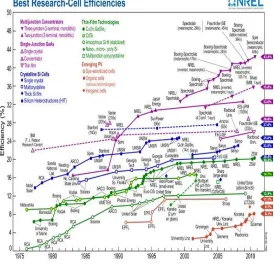
The solar cell has come a long way, from initial efficiency of 4 to 5 percent in 1954 when it was discovered, to the developments of solar cell concentrators with an efficiency of 38-40 percent, which was made possible through the development of different types of concentrators discussed below:
Point Focus Fresnel lens Solar Cell Concentrator
23 |
P a g e
Figure.4: Fresnel’s Lens Solar Cell Concentrator
line Focus Parabolic Reflective Trough Concentrator
The Australian National University (ANU) has developed a 20 kW PV trough concentrator with solar cells mounted on the under surface. The system comprised foundations, mirrors and support and aluminium passive heat sink-receivers. The above 20 kW solar concentrator featured two-axis continuous tracking. All trough modules are mechanically linked so that one motor actuates the tilt and the other actuates the roll. A time based, open loop central processing controller via a driver interface and position feedback system controlled both the motors. This allowed the concentrator to take full advantage of the daylight. The concentrator performed very well with an over system efficiency of 13 percent while the cell efficiency was reported to be 22 percent.
24 |
P a g e
Euclides Photovoltaic Concentrator
The world‟s largest PV concentration grid-connected power plant, the EUCLIDESTMTHERMI plant has been installed by BP Solarex in the south of Tenerife in Spain. The plant is rated at 480 kWp and is composed of 14 parallel arrays each 84 meters long. Each array carries 138 modules and 140 mirrors. The modules are series connected in each array. The mirror technology is based on metallic reflective sheets shaped with ribs to the parabolic profile. The modules are cooled with a passive heat sink. Two contiguous arrays are connected in parallel to one inverter of 60 kVA. The output voltage at standard operating conditions is 750 Volts. The concentrating optics uses mirrors instead of Fresnel lenses, which were used previously in all PV concentration developments. The tracking system is one axis and horizontal since it is cheaper than the two-axes tracking systems. The concentrating schemes present a more constant output than the flat panels. The system is cost effective and thus might present some advantage in the value of the electricity produced.
Figure.6:Euclides Photovoltaic Concentrator
Parabolic Reflective Dish Concentrator
25 |
P a g e
Figure.7:Parabolic Reflective Dish Concentrator
Dense Packed Array Photovoltaic Concentrator by ‘Amonix’
Relatively low-concentration systems were first built using individual cells, each with its own concentrator optics. But no further large-scale projects were undertaken until recently. „Amonix‟ has designed and installed a large-scale system using individual cells at a very high concentration (260X). The most important advantages of this type of individual-cell concentrator system are: (i) Most of the optics can be controlled at the time of manufacture so that fewer items need to be accurately aligned in the field. (ii) No fail safe provisions need to be included to prevent concentrated flux from causing damage in the event of erroneous sun tracking. (iii) The modules are sealed, flat panels, rendering cleaning a comparatively easy task.(iv) The cells are passively cooled. Thus, there are no fluids to handle and no fail safe provisions need to be incorporated to prevent damage caused by loss-of-coolant events.
26 |
P a g e
Dense Packed Array Photovoltaic Concentrator
Spectrolab USA designed, fabricated and tested two dense packed modules using high efficiency multi-junction cells. Test results were very encouraging with cell area based efficiencies over 25 percent. Further improvements in the new designs are possible for higher efficiency.
Figure.9: Spectrolab dense-packe module
Photovoltaic Cavity Converter
27 |
P a g e
Figure.10:Photovoltaic Cavity ConverterIII. MULTI-JUNCTION CELLS FOR HIGHER EFFICIENCY
Non-silicon cells have not achieved the same degree of efficiency as Si cells. Emcore, USA has developed multi-junction solar cells using GaAs and GaSb . Multi-multi-junction solar cell technology employs three solar cells in series, with each cell tuned to absorb a different color of light. This technique converts more sunlight to electricity and thus the multi-junction cells with x1000 concentration thereby can operate at much higher efficiency of the order of 38 percent as compared to 28 percent for the single junction cells.
28 |
P a g e
IV. MULTI-JUNCTION SOLAR CELL AND PANELS FOR SPACE COMMUNICATION
Emcore, an USA based company reputed with very high efficiency solar cell technology in terrestrial applications, is claiming a big success in solar power for space applications. With an overall efficiency of 28.5 percent, the multi-junction technology has completely changed the mode of the solar power generation in space applications.
V. RECENT DEVELOPMENTS IN CONCENTRATOR AND SPACE APPLICATIONS OF
HIGH-EFFICIENCY SOLAR CELL
The two-junction (cascade) Ga0.5In0.5P/GaAs cell was invented in November 1984 at the National Renewable Energy Laboratory (NREL). Over the next few years, the growth and basic properties of Ga0.5In0.5P were studied. As the purity of the source materials was improved and the device optimized, the efficiencies climbed: 4 per cent in 1985, 10 percent in 1987, 21.8 per cent in 1988, and 27.3 per cent in 1990. When the two-junction efficiencies passed the efficiency of single junction GaAs, the cascade cell became attractive for space applications. The cascade cells provide a higher efficiency, lower temperature coefficient, improved radiation resistance and reduced series-resistance losses.
29 |
P a g e
VI. ADVANTAGES AND DRAWBACKS
Using solar energy has many advantages as well as disadvantages. Solar concentrators increase cell efficiency under concentrated light. The increase in efficiency depends largely on the cell design and material used. Another advantage of the concentrator is that it can use small individual cells, because it is harder to produce large-area, high efficiency cells than it is to produce smaller-area cells. There are, on the other hand, several drawbacks to using concentrators. The concentrating optics is significantly more expensive than the simple covers needed for flat-plate modules and most concentrators must track the sun throughout the day and year to be effective. Thus, higher concentration ratios mean using not only expensive tracking mechanisms but also more precise controls than flat-plate systems with stationary structures. Also, a large area is needed to put up the solar plants.
VII. CONCLUSION
Solar energy has vast potential, but its contribution to the world‟s energy market is still very limited. Solar concentrators could bring down the total cost of the solar cells, thus making the solar technology cheaper and more affordable. At the same time it does not compromise the overall performance of the solar technology. The technology is yet not matured enough for economically harnessing solar power on a large scale. It is still capital intensive and lacks long term reliability. For about a decade, the developmental of solar concentrators in many advanced countries has been in full swing. If the prototypes with more than 40 per cent efficiency perform well, solar plants which are stand-alone or with co -generation medium will soon become a reality.
REFRENCES
[1] 500x concentration ratio is claimed at Amonix website.
[2] http://www.iea.org (2014). "Technology Roadmap: Solar Photovoltaic Energy" (PDF). IEA. Archived f rom the original on 7 October 2014. Retrieved 7 October 2014.
[3] Fraunhofer ISE and NREL (January 2015). "Current Status of Concentrator Photovoltaic (CPV) Technology" (PDF). Archived from the original on 25 April 2015. Retrieved 25 April 2015.
[4] "Snapshot of Global PV 1992-2013" (PDF). http://www.iea-pvps.org/. International Energy Agency-Photovoltaic Power Systems Programme. 2014. Archived from the original on 5 April 2014.
[5] "Photovoltaics Report" (PDF). Fraunhofer ISE. 28 July 2014. Archived from the original on 31 August 2014. Retrieved 31 August 2014
[6] PV-insider.com How CPV trumps CSP in high DNI locations, 14 February 2012
30 |
P a g e
[8] Andrews, Rob W.; Pollard, Andrew; Pearce, Joshua M., "Photovoltaic system performance enhancement with non-tracking planar concentrators: Experimental results and BDRF based modelling," Photovoltaic Specialists
Conference (PVSC), 2013 IEEE 39th, pp.0229,0234, 16–21 June 2013.doi: 10.1109/PVSC.2013.6744136