Improving Performance of HNN by using Parallel
Programming Method
T.Sameera Sulthana
1, Mr. G. Ramesh
21
Computer Science and Engineering (AI), JNTU,Ananthapuram
2
Lecturer, Department of Computer Science and Engineering, JNTU,Ananthapuram.
ABSTRACT
Automatic Hair segmentation with better performance and higher accuracy is one of the important task. An algorithm for identity verification using only information from the hair. Face recognition in the wild (i.e., unconstrained settings) is highly useful in a variety of applications, but performance suffers due to many factors, e.g., obscured face, lighting variation, extreme pose angle, and expression. The proposed algorithm is a scholarly hair matcher utilizing shape, shading and surface highlights got from restricted fixes through an Ada-Boost method with avoiding frail classifiers when highlights are absent in the given area. A technique for double order utilizing NN(neural organize) which perform preparing a grouping on same information by utilizing HNN(heuristically prepared neural system).By adding simple parallel processing techniques the performance of HNN increased by 3.4%.
Keywords: Hair Segmentation, Neural Networks, Heuristically Trained Networks (HNN).
I. INTRODUCTION
Separating hair and non-hair patches in an image is called Hair Segmentation. Hair Segmentation is used in
many applications. Hair plays an important role in appearance of a person. Hair is used for gender identification.
Automatic Hair Segmentation with higher performance and efficiency is goal of this paper.
These are pioneers who made systematic researches about hair detection. They construct a simple hair color
model and detect hair region through region growing technique.Yacoob and Davis go for the examination of
hair length, volume, shading, symmetry, and the impact of hair district in the face acknowledgment process.
Subsequently, hair discovery calculation proposed in a very straightforward and just pertinent to pictures with
homogeneous foundations. They combine shading and surface data and speak to hair locale through fluffy veil
for the use of virtual hair re-colorization. Be that as it may, this paper just gives subjective outcomes and needs
quantitative examination. The computational cost which is around 5 minutes for each picture is likewise very
high since complex picture tangling strategy is connected in this calculation. Rousset and Coulon evaluate the
underlying hair area twofold cover through shading data and recurrence space investigation. At that point they
likewise utilize picture tangling system with a specific end goal to get the last hair locale cover. The normal
preparing time for a picture of 200 × 300 is around 20 seconds on a 3 GHz CPU. For the utilization of facial
cartoon amalgamation and face activity, utilize physically named hair line together with knockout picture
following methods to portion hair areas. This strategy is extremely straightforward yet could barely manage
complex foundations. As of late, the proposed work is a compositional model based model for producing
probabilistic hair veil in the way of partition and-prevail.
II. EXISTING SYSTEM
The main reason behind the HNN is to use human-defined method when taking training samples for NN.A
human can easily identified the hair and non-hair parts in image. Based on human defined method by using
color and texture information it can easily identifies the hair patch. It is a method for binary classification using
heuristically trained networks that performs training and testing on same data. Here clustering method is used.
First the data is divided into three clusters is high-confidence positives, negatives and low confidence positives.
Here in this algorithm first it divides the image into patches then, train an NN based on the patches in the
high-confidence clusters.In theory it is easy to deal with deeper or complex HNN. It gives higher performance with
complex HNN in theory but in reality it is difficult to train complex HNN.
In [1], Locale part and combining is the most seasoned strategy in PC vision. In RS method, right off the bat
processes histogram for pictures and next it finds the edge esteem rehashes until the point when comes about are
uniform .In RM, bunches together in light of separation between nearest. Relative dissimilarities between
locales to figure out which one is to be merged. This are the techniques that are used in the existing paper.
In [2], Novel coarse to fine strategy, in this approach dynamic division with obsession (ASF) is utilized to
characterize as encased area with high review of hair pixel and prohibits extensive piece of foundation which are
effectively mistaken for hair. Next the diagram trim technique applies to competitor district to expel extra false
positives, for this Bayesian strategy is utilized to choose hair and foundation locale among the over sectioned by
mean move . SVM classifier is then take in online from this seeds and investigate to anticipate hair probability
likelihood which is sustain in to GC calculation.
In [3], Based on multi step process automatic hair segmentation created and tested on database of manually
selected images. It can be done by extracting various information components from image like color ,face
position , hair color , skin color and skin mask a heuristic based method is crested for the detection of hair
which can give better performance with highest accuracy that are been used .
III. PROPOSED SYSTEM
In the proposed work, split and merge technique for an image to achieve better performance. Firstly the given image is divided into 4 equal parts. Normalization of image is carried out. In this process the range of pixel intensity values changes.
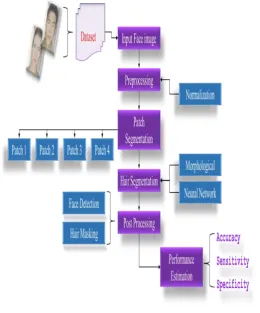
Overview of the proposed work
Six steps are involved in performing with HNN first step dividing the image into equal parts. Steps:
1. Generating positive and negative training data by using heuristic-method.
2. Training of NN with generated data.
3. Dividing the image into patches
3.1 PROPOSED METHODS
The methods that are been used in this work are listed below
3.1.1:Input Image
An image is a rectangular array of pixels. Each pixel represents the measures of property of a scene over a finite
area. The propertycontain many things, but the concentration is mainly on measure the brightness of image
filtered through red, green and blue.
Fig 1: Flow diagram of proposed work
3.1.2:Preprocessing
The motivation behind powerful range development in picture preparing, standardization is a procedure that
progressions the scope of pixel force esteems. Applications incorporate photos with poor difference because of
glare, for instance. Standardization is in some cases called differentiate extending or histogram extending. In
more broad fields of information preparing, for example, computerized flag handling, it is alluded to as powerful
range expansion. The different application is ordinarily to bring the picture, or other sort of flag, into a range
that is more commonplace or typical to the faculties, thus the term standardization.
3.1.3: Hair Segmentation
Image Segmentation plays vital role in Computer Vision and Digital Image Processing. It is the process of
image segmentation is to extract various features of the image that are used for analyzing, interpretation and
understanding of images.
3.1.4:Performance Estimation
Affectability and specificity are factual measures of the execution of a twofold arrangement test, additionally
referred to in insights as grouping capacity: Sensitivity (likewise called the genuine positive rate, the review, or
likelihood of location in a few fields) measures the extent of positives that are accurately distinguished
accordingly (i.e. the level of debilitated individuals who are effectively distinguished as having the condition).
Specificity (additionally called the genuine antagonistic rate) measures the extent of negatives that are
effectively distinguished all things considered (i.e., the level of sound individuals who are accurately recognized
as not having the condition).
Genuine constructive: Sick individuals effectively recognized as wiped out.
False constructive: Healthy individuals erroneously distinguished as debilitated
IV. EXPERIMENTAL RESULTS
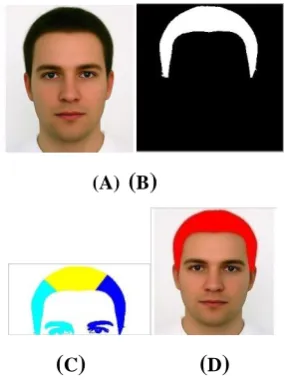
In the experimental results, the input image is loaded from dataset then normalization process is carried out. In
preprocessing, Normalization process is carried out, it is done by compressing the image. Here the values of
pixel are changed the image is splits in to equal parts after that label image is created.
(A)
(
B)
(
C) (
D)
Fig 2: (A) Input image (B) Segmented image (c)Labeled image (D) Hair masked image
Training is done directly on individual images the performance is dependent on training sample the big hair
mask and the small hair mask are created , the hair mask is created the last parameter want to optimize is the
number of hidden layers in neural networks . A deeper neural network is more capacity and is able to find more
complex features. A deeper neural network also easier to get stuck at poor minima. Performance score is a
suitable measure of performance and high accuracy low over estimation. In many cases the difference between
the accuracy and over estimation is same for different model settings. Finally the performance score is increased
V. CONCLUSION
Here, uses parallel processing techniques for improving the performance of HNN. There are many aspects of
this paper that can be improved in the future. First of all, improving the run time of the HNN by optimizing the
code with parallel programming or implementing the model on a graphics processing unit (GPU). The
expansion of hair data bases helps to test and train more number of images. If the data base is larger than
number of comparisons also increases with the state-of the-art techniques.
REFERENCES
[1]. P. Julian, C. Dehais, F. Lauze, V. Charvillat, A. Bartoli, and A. Choukroun, “Automatic hair detection in
the wild,” in Proc. 20th Int. Conf. Pattern Recognit. (ICPR), Aug. 2010, pp. 4617–4620.
[2]. C. Rother, V. Kolmogorov, and A. Blake, “„GrabCut‟: Interactive foreground extraction using iterated
graph cuts,” ACM Trans. Graph., vol. 23, no. 3, pp. 309–314, Aug. 2004.
[3]. Y. Yacoob and L. S. Davis, “Detection and analysis of hair,” IEEE Trans. Pattern Anal. Mach. Intell.,
vol. 28, no. 7, pp. 1164–1169, Jul. 2006.
[4]. C. Rousset and P. Y. Coulon, “Frequential and color analysis for hair mask segmentation,” in Proc. 15th
IEEE Int. Conf. (ICIP), Oct. 2008, pp. 2276–2279
[5]. W. Cai, S. Chen, and D. Zhang, “Fast and robust fuzzy c-means clustering algorithms incorporating local
information for image segmentation,” Pattern Recognit., vol. 40, no. 3, pp. 825–838, Mar. 2007.
[6]. X.-Y. Wang, T. Wang, and J. Bu, “Color image segmentation using pixel wise support vector machine
classification,” Pattern Recognit., vol. 44, no. 4, pp. 777–787, Apr. 2011.
[7]. L. Zhao and C. E. Thorpe, “Stereo- and neural network-based pedestrian detection,” IEEE Trans. Intell.
Transp. Syst., vol. 1, no. 3, pp. 148–154, Sep. 2000
[8]. D. D. Lewis and W. A. Gale, “A sequential algorithm for training text classifiers,” in Proc. 17th Annu.
Int. ACM SIGIR Conf. Res. Develop. Inf. Retr., 1994, pp. 3–12.
[9]. A. Bordes, S. Ertekin, J. Weston, and L. Bottou, “Fast kernel classifiers with online and active learning,”