University of Windsor University of Windsor
Scholarship at UWindsor
Scholarship at UWindsor
Electronic Theses and Dissertations Theses, Dissertations, and Major Papers
2017
Comparative Research on Robot Path Planning Based on GA-ACA
Comparative Research on Robot Path Planning Based on GA-ACA
and ACA-GA
and ACA-GA
Chenhan Wang
University of Windsor
Follow this and additional works at: https://scholar.uwindsor.ca/etd
Recommended Citation Recommended Citation
Wang, Chenhan, "Comparative Research on Robot Path Planning Based on GA-ACA and ACA-GA" (2017). Electronic Theses and Dissertations. 7403.
https://scholar.uwindsor.ca/etd/7403
This online database contains the full-text of PhD dissertations and Masters’ theses of University of Windsor students from 1954 forward. These documents are made available for personal study and research purposes only, in accordance with the Canadian Copyright Act and the Creative Commons license—CC BY-NC-ND (Attribution, Non-Commercial, No Derivative Works). Under this license, works must always be attributed to the copyright holder (original author), cannot be used for any commercial purposes, and may not be altered. Any other use would require the permission of the copyright holder. Students may inquire about withdrawing their dissertation and/or thesis from this database. For additional inquiries, please contact the repository administrator via email
Comparative Research on Robot Path
Planning Based on GA-ACA and
ACA-GA
By
Chenhan Wang
A Thesis
Submitted to the Faculty of Graduate Studies through the School of Computer Science in Partial Fulfillment of the Requirements for
the Degree of Master of Science at the University of Windsor
Windsor, Ontario, Canada
2017
c
Comparative Research on Robot Path Planning Based on GA-ACA and ACA-GA
by
Chenhan Wang
APPROVED BY:
E. Abdel-Raheem
Department of Electrical and Computer Engineering
J. Chen
School of Computer Science
D. Wu, Advisor School of Computer Science
DECLARATION OF ORIGINALITY
I hereby certify that I am the sole author of this thesis and that no part of this
thesis has been published or submitted for publication.
I certify that, to the best of my knowledge, my thesis does not infringe upon
anyones copyright nor violate any proprietary rights and that any ideas, techniques,
quotations, or any other material from the work of other people included in my
thesis, published or otherwise, are fully acknowledged in accordance with the standard
referencing practices. Furthermore, to the extent that I have included copyrighted
material that surpasses the bounds of fair dealing within the meaning of the Canada
Copyright Act, I certify that I have obtained a written permission from the copyright
owner(s) to include such material(s) in my thesis and have included copies of such
copyright clearances to my appendix.
I declare that this is a true copy of my thesis, including any final revisions, as
approved by my thesis committee and the Graduate Studies office, and that this thesis
ABSTRACT
The path planning for mobile robots is one of the core contents in the field of
robotics research with complex, restrictive and nonlinear characteristics. It consists
of automatically determining a path from an initial position of the robot to its final
position. Due to classic approaches have several drawbacks, evolutionary methods
such as Ant Colony Optimization Algorithm (ACA) and Genetic Algorithm (GA) are
employed to solve the path planning efficiently.
Firstly, grid method is used to establish the environment model, and some
mod-ifications are made to accommodate ACA to path planning in a grid-based
environ-ment. Besides, genetic operators were introduced to the fundamental ACA (GA-ACA,
ACA-GA), using the crossover and mutation operators to expand the search space
and enhance the overall solution in the previous research work.
This thesis mainly introduces these two hybrid algorithms, GA-ACA and
ACA-GA, and will compare the performance of them under multiple grid maps in static
environments.
To verify the effectiveness of these two hybrid algorithms, a path planning
sim-ulation system for mobile robots is designed based on MATLAB development
envi-ronment. The experiment results show that the algorithm efficiency of GA-ACA and
ACA-GA is better than that of the traditional GA and ACA algorithms, and it is
more suitable to apply ACA-GA than GA-AGA regarding algorithms’ convergence
AKNOWLEDGEMENTS
I would like to express my sincere appreciation to my supervisor Dr. Dan Wu for
his constant guidance and encouragement during my whole Master’s period in the
University of Windsor. Without his valuable help, this thesis would not have been
possible.
I would also like to express my appreciation to my thesis committee members Dr.
Esam Abdel-Raheem, and Dr.Jessica Chen. Thank you all for your valuable guidance
and suggestions to this thesis.
Last but not least, I want to express my gratitude to my parents and my friends
TABLE OF CONTENTS
DECLARATION OF ORIGINALITY III
ABSTRACT IV
AKNOWLEDGEMENTS V
LIST OF TABLES VIII
LIST OF FIGURES IX
1 Introduction 1
1.1 Research Background . . . 1
1.2 Mobile Robots Path Planning . . . 2
1.2.1 Off-line Path Planning Algorithms . . . 2
1.2.2 On-line Path Planning Algorithms . . . 5
1.3 Thesis Motivation and Statement . . . 7
2 Review on Ant Colony Optimization 9 2.1 Introduction to Ant Colony Optimization . . . 9
2.2 Theroretical Explanation of ACO . . . 11
2.2.1 Combinatorial Optimization Problem . . . 11
2.2.2 Basis of ACO . . . 13
2.3 Main ACO Algorithm Implementations . . . 15
2.3.1 Ant System (AS) . . . 15
2.3.2 MAX-MIN Ant System (MMAS) . . . 16
2.3.3 Ant Colony System (ACS) . . . 17
2.4 Recent Researches about ACO . . . 18
2.4.1 Traveling Salesman Problem (TSP) . . . 18
2.4.2 Other Problems . . . 20
3 Robot Path Planning based on Ant Colony Optimization Algo-rithm 21 3.1 Modeling of Robot Motion Environment . . . 21
3.1.1 Robot Motion Environment division using the Grid Method . 22 3.1.2 The Description and Definition of Path Planning Problem . . 23
4 Robot Path Planning based on ACA integrating with Genetic
Al-gorithm (GA) 28
4.1 Genetic Algorithm and Robot Path Planning . . . 28
4.1.1 Introduction of Genetic Algorithm . . . 28
4.1.2 The Implementation Steps of GA on Robot Path Planning . . 29
4.2 Robot path planning based on GA-ACA . . . 33
4.2.1 Introduction of GA-ACA . . . 33
4.2.2 The Implementation Steps of GA-ACA on Robot Path Planning 33 4.3 Robot path planning based on ACA-GA . . . 35
4.3.1 Introduction of ACA-GA . . . 35
4.3.2 The Implementation Steps of ACA-GA on Robot Path Planning 36 4.4 Performance Evaluation Indexes of Ant Colony Optimization Algorithm 37 5 Simulation Experiments 39 5.1 Previous Experiments on GA-ACA and ACA-GA . . . 39
5.2 Simulation System . . . 40
5.3 Parameter Settings . . . 40
5.4 The Implementation of Simulation Experiments . . . 42
5.4.1 The First Group of Experiments . . . 42
5.4.2 The Second Group of Experiments . . . 48
5.4.3 The Thrid Group of Experiments . . . 50
5.4.4 The Fourth Group of Experiments . . . 55
6 Conclusion and Future Work 61
References 63
LIST OF TABLES
1 The simulation platform source code list . . . 40
2 The performance index of four algorithms in Experiment one . . . 47
3 The performance index of GA-ACA and ACA-GA in Experiment two 50
4 The performance index of GA-ACA and ACA-GA in Experiment three
under map 03 . . . 54
5 The performance index of GA-ACA and ACA-GA in Experiment three
under map 04 . . . 55
LIST OF FIGURES
1 Building Blocks of Mobile Robot Navigation. . . 2
2 Path Choosing based on Pheromone. (a) An example with real ants. (b) An example with artificial ants. . . 10
3 Example of Construction Graph in ACO. . . 12
4 Basis ACO Algorithm Framework. . . 13
5 The example of grid environmental map[10]. . . 23
6 The flow chart of genetic algorithm. . . 29
7 The example of path encoding. . . 30
8 The flow chart of GA-ACA. . . 35
9 The flow chart of ACA-GA. . . 37
10 The simulation system using MATLAB. . . 41
11 (a)The optimal path obtained by GA in map 01, the length of the optimal path is 14.4853; (b)The optimal path obtained by ACA in map 01, the length of the optimal path is 13.8995. . . 43
12 (a)The optimal path obtained by GA-ACA in map 01, the length of the optimal path is 13.8995; (b)The optimal path obtained by ACA-GA in map 01, the length of the optimal path is 13.8995. . . 43
13 (a)The optimal path length evolution graph by using GA in map 01; (b)The mean path length evolution graph by using GA in map 01. . 44
16 (a)The optimal path length evolution graph by using ACA-GA in map
01; (b)The mean path length evolution graph by using ACA-GA in
map 01. . . 45
17 The simulation result of ACA in map 01 . . . 46
18 (a)The optimal path obtained by GA-ACA in map 02, the length of the
optimal path is 14.4853; (b)The optimal path obtained by ACA-GA
map 02, the length of the optimal path is 14.4853. . . 49
19 (a)The optimal path length evolution graph by using GA-ACA in map
02; (b)The mean path length evolution graph by using GA-ACA in
map 02. . . 49
20 (a)The optimal path length evolution graph by using ACA-GA in map
02; (b)The mean path length evolution graph by using ACA-GA in
map 02. . . 50
21 (a)The optimal path obtained by GA-ACA in map 03, the length of the
optimal path is 13.8995; (b)The optimal path obtained by ACA-GA
map 03, the length of the optimal path is 13.8995. . . 51
22 (a)The optimal path obtained by GA-ACA in map 04, the length of the
optimal path is 14.4853; (b)The optimal path obtained by ACA-GA
map 04, the length of the optimal path is 14.4853. . . 52
23 (a)The optimal path length evolution graph by using GA-ACA in map
03; (b)The mean path length evolution graph by using GA-ACA in
map 03. . . 52
24 (a)The optimal path length evolution graph by using ACA-GA in map
03; (b)The mean path length evolution graph by using ACA-GA in
map 03. . . 53
25 (a)The optimal path length evolution graph by using GA-ACA in map
04; (b)The mean path length evolution graph by using GA-ACA in
26 (a)The optimal path length evolution graph by using ACA-GA in map
04; (b)The mean path length evolution graph by using ACA-GA in
map 04. . . 54
27 (a)The optimal path obtained by GA-ACA in map 05(6-96), the length
of the optimal path is 10.6569; (b)The optimal path obtained by
ACA-GA map 05(6-96), the length of the optimal path is 10.6569. . . 57
28 (a)The optimal path obtained by GA-ACA in map 05(41-70), the
length of the optimal path is 10.6569; (b)The optimal path obtained
by ACA-GA map 05(41-70), the length of the optimal path is 10.6569. 57
29 (a)The optimal path length evolution graph by using GA-ACA in map
05(6-96); (b)The mean path length evolution graph by using GA-ACA
in map 05(6-96). . . 58
30 (a)The optimal path length evolution graph by using ACA-GA in map
05(6-96); (b)The mean path length evolution graph by using ACA-GA
in map 05(6-96). . . 58
31 (a)The optimal path length evolution graph by using GA-ACA in map
05(41-70); (b)The mean path length evolution graph by using GA-ACA
in map 05(41-70). . . 59
32 (a)The optimal path length evolution graph by using ACA-GA in map
05(41-70); (b)The mean path length evolution graph by using ACA-GA
CHAPTER 1
Introduction
1.1
Research Background
With the development and maturation of computer technology, control theory,
ari-tifical intelligence theory and sensor technology, the research of robot has entered an
entirely new phase. Mobile robots, as an important branch of robotics, has received
wide recognition in an academic area all over the world.
A mobile robot is an automatic machine which has the capability to move around
in the environment [28]. Mobile robots can be “autonomous” which means they are
capable of navigating an uncontrolled environment without the need for physical or
electro-mechanical guidance devices.
From 1966-1972, the Stanford Research Institute was building and doing research
on Shakey the Robot [25], which was the first robot that can avoid obstacles
automat-ically. In 1999, Sony introduced AIBO [31], a robotic dog capable of seeing, walking
and interacting with its environment. In 2003, QRIO [16] was created by Sony to
follow up on the success of its AIBO entertainment robot. QRIO is the first humanoid
robot that can accomplish many actions such as running, jumping, throwing.
In recent years, mobile robots have become more commonplace in industrial,
agri-cultural and commercial settings. In all applications of mobile robots, they perform
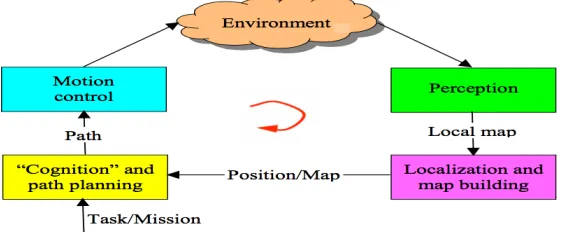
the navigation tasks using the following building blocks [26] in Fig.1. We can see that
navigation of a mobile robot involves perception of the environment, localization and
map building, cognition and path planning and motion control in Fig.1. Among the
1. INTRODUCTION
FIGURE 1: Building Blocks of Mobile Robot Navigation.
objective of path planning is about how to make mobile robots choose a collision-free
path according to the environment information.
1.2
Mobile Robots Path Planning
Path planning of a mobile robot is to determine a collision-free path from a start point
to a goal point optimizing a performance criterion such as distance, time or energy,
distance being the most commonly adopted criterion [26]. Based on the availability of
information about environment, there are two categories of path planning algorithms,
namely off-line and on-line. Off-line path planning of robots in environments where
complete information about stationary obstacles and trajectory of moving obstacles
are known in advance is also known as global path planning. When complete
infor-mation about environment is not available in advance, mobile robot gets inforinfor-mation
through sensors, as it moves through the environment. This is known as on-line
or local path planning. Both off-line and on-line path planning algorithms can be
categorized into classic approaches and evolutionary approaches.
1.2.1
Off-line Path Planning Algorithms
Examples of path planning in off-line environments are service robots operating
dur-ing maintenance period of a nuclear power plant, automated guided vehicles in a
1. INTRODUCTION
path planning algorithms can be categorized into classic approaches and evolutionary
approaches.
Classic Approaches
1. Configuration space approach [20]:
The central idea of configuration space approach is the representation of the
robot as a single point. Thus, the mobile robot path planning problem is
re-duced to a 2-dimensional problem. As robot is rere-duced to a point, each obstacle
is enlarged by the size of the robot to compensate. Then, we construct a
con-figuration space to describe the robot and its surroundings by using some basic
shapes such as a predefined convex polygon. The configuration space is
rep-resented as a connected graph, and then the path planning is performed by
searching the connected graph. This method is flexible, but the complexity of
this algorithm is proportional to the number of obstacles, and it can not
guar-antee that the method can output the shortest path under any circumstances.
That is one of the drawbacks of most classic approaches.
2. Visibility graph approach [20]:
The Visibility graph approach is drawn by joining two vertices of mutually
vis-ible polygonal obstacles that are present between start and target points. The
word ”Visibility” refers to the requirements of the robot between the vertices of
obstacles, the target point between the vertices of obstacles and the vertices of
one obstacle between the vertices of another obstacle can not cross the
obsta-cles. The shortest path is then identified through the roads obtained from the
visibility graph. Using some optimization algorithms can remove some
unneces-sary connecting lines to simplify the visibility graph, thus shortening the search
time. However, these optimization algorithms sometimes lacks flexibility, and
once the starting point and target point change, the visibility graph must be
reconstructed leading the low search efficiency.
1. INTRODUCTION
The cell decomposition approach computes the configuration space of the mobile
robot decomposes the resulting space into cells and then searches for a route
in the free space cell graph. Among the cell decomposition approaches, Grid
method [2] is the most popular one where grids are used to generate the map
of the environment. The main difficulty is how to find the size of the grids,
the lesser the size of grids, the more accurate will be the representation of
the environment. However, using lesser grids will result in exponential rise in
memory space and search range [14]. In my thesis, I will use the grid method
to establish robot motion environmental maps in chapter 3.
Evolutionary Approaches
Classic approaches sometimes take more time when selecting a feasible collision-free
path. Also, classic approaches tend to get locked in local optimal solution which may
be far inferior to the global optimal solutions. Moreover, path planning of a mobile
robot in the presence of multiple obstacles is found to be a non-deterministic
polyno-mial time hard (NP-hard) problem[3]. It becomes even more complicated when the
environment is dynamic. These drawbacks make the classic approaches incompetent
in complex environments. Hence, evolutionary approaches such as Genetic Algorithm
(GA), Particle Swarm Optimization (PSO), Ant Colony Optimization (ACO) and
Simulated Annealing (SA) is employed to solve the path planning problem efficiently.
1. Genetic Algorithm (GA):
GA is an optimization tool based on the mechanics of natural genetics and
selection. The first step in path planning using GA is a random generation
of the population containing alternative paths. [9] presented a visibility-based
repair approach that is used to quickly transform invalid paths into valid paths
and then subject to binary coded GA. GA with binary string is
computation-ally costly for the reason that before each evaluation of function, chromosomes
are transformed to phenotypes. [33] presented a genetic based path planning
1. INTRODUCTION
increases computation load resulting in higher execution time. The specific
process of how does GA works will be introduced in Chapter 4.
2. Particle Swarm Optimization (PSO) [17]:
Particle Swarm Optimization (PSO) is a widely used evolutionary algorithm in
path planning. It is an evolutionary computation technique inspired by social
behavior of bird flocking or fish schooling. Years of study on the dynamics
of bird and fish resulted in the possibilities of utilizing this behavior as an
optimization tool. Compared to GA, the advantages of PSO are that PSO is
easier to implement and there are fewer parameters to be adjusted.
3. Ant Colony Optimization (ACO) [4]:
ACO is inspired by the foraging behavior of ants for finding the shortest path
to the food source. The specific content about ACO and mobile robot path
planning based on ACO algorithm is introduced in Chapter 2 and 3.
4. Simulated Annealing (SA):
Simulated Annealing (SA) is a type of heuristic random search method and it
resembles the cooling process of molten metals through annealing. [21] present
a method employed SA for collision-free path amid static polygonal obstacles in
configuration space setting. [23] developed SA algorithm based approach which
used vertices of the static and dynamic obstacles as search space for dynamic
environments.
1.2.2
On-line Path Planning Algorithms
Applications of path planning in on-line environments include planet exploration,
mine industry, reconnaissance robots, etc [26]. Nowadays, evolutionary approaches
1. INTRODUCTION
Classic Approaches
1. Artificial Potential Field (APF) approach [18] :
The main idea of APF approach is that a point robot moves under the influence
of an APF in which obstacles are assumed to generate repulsive forces and the
target is assumed to generate attractive forces. The robot moves as per the
resultant of these forces. This approach is known for its mathematical elegance
and simplicity as path is found with very little computation. However, the
drawback of this approach is that robot may become stagnant or trapped when
there is a cancellation of equal magnitudes of attractive and repulsive forces.
2. Vector Field Histogram approach [1]:
The central idea of this approach is that a polar histogram is generated to
represent the polar density of obstacles around a robot at every instant. The
robots steering direction is chosen based on the least polar density and closeness
to the goal. In a given environment, the polar histogram must be regularly
regenerated for every instant and hence the method is suited for environments
with sparse moving obstacles.
3. Velocity obstacle approach [11]:
This method consists of choosing avoidance maneuvers to avoid static and
mov-ing obstacles in the velocity space. They used basic heuristic strategy for
priori-tizing objectives such as averting collisions, attaining the goal or accomplishing
trajectories with preferred topologies.
4. Dynamic windows approach [12]:
The dynamic window approach contains the feasible linear and angular
veloci-ties taking into consideration acceleration capability of robot. Then the velocity
at the next instant is optimized for obstacle avoidance, subject to vehicle
1. INTRODUCTION
Evolutionary Approaches
When applying on-line path planning algorithms, computation time is the most
im-portant aspect that we should consider. However, with classic approaches, the results
can hardly be achieved in very quick time because of incomplete information of the
environments.Therefore, classic approaches are often combined with evolutionary
ap-proaches like GA, PSO, etc. to overcome their drawbacks.
1. Evolutionary APF [30]:
The evolutionary APF algorithm is to derive optimal potential field functions
using GA. When the robot is trapped, a separate algorithm named escape-force
is introduced to recover from a trap.
2. APF combined with SA [22]:
This approach considers the problems of goal non-reachable with obstacles
nearby (GNRON) and local minima in soccer robots. New potential functions
have been derived by considering the distance information of start and target
points for GNRON problem.
1.3
Thesis Motivation and Statement
The thesis is mainly focused on robot path planning problem based on ant colony
optimization algorithm and two ant colony algorithms combined with genetic
algo-rithms, namely GA-ACA and ACA-GA. The previous research work of [15] and [35]
indicated that GA-ACA and ACA-GA perform better than the traditional algorithm,
ACA. However, the researchers had not compared the performance of GA-ACA and
ACA-GA in the previous work. This motivates me to do the further study on these
two algorithms.
Chapter 2 introduces the concept of ant colony optimization algorithm (ACA)
and describes how it is inspired by the nature phenomenon. Then, we give detailed
explanation of ACA in theory and describe three main ACA algorithms: Ant System,
1. INTRODUCTION
related to ACA and how it applies to the NP-hard problems.
Chapter 3 establishes the robot motion environmental model by using grid method
and introduces two main methods for grid making. Then, we describe how ant colony
optimization algorithm (ACA) for robot path planning works under grid
environmen-tal maps.
In chapter 4, two algorithms based on the ant colony algorithm are proposed:
GA-ACA algorithm and ACA-GA algorithm. We describe the process of GA-ACA
and ACA-GA respectively and compare the differences between these two hybrid
algorithms.
In chapter 5, based on MATLAB platform, we design four comparative
experi-ments to verify the validity and effectiveness of the GA-ACA and ACA-GA algorithm
under different grid maps.
The chapter 6 summarizes the work of this thesis and points out the limitations of
CHAPTER 2
Review on Ant Colony
Optimization
2.1
Introduction to Ant Colony Optimization
Ant Colony Optimization (ACO) was first introduced and proposed by Marco Dorigo
in his Ph.D. thesis in 1992 [4]. It is a metaheuristic that inspired by the food seeking
behavior of ant colony. As we all know, in the natural world, the ant is a kind of
social insect. Although the behavior of a single ant looks quite simple, multiple ants
can cooperate to construct a huge social group to accomplish much more complicated
tasks. When the ants search for food, initially they just wander randomly to explore
the area near their nest, and different ants can choose different paths to explore due
to their random behavior manner. As soon as one of the ants successfully locate the
food source, this ant will carry bearable amount of food back to its nest. During their
return journey, assuming that the ants remember its traveled route from the nest to
the located food source, it will return to the nest along the same route, and leave
chemical pheromone trail on the ground. The amount of the pheromone left may vary
depending on the quality and quantity of the food. Then, other ants now can choose
the route that has denser pheromone (which can be treated as a better route) and
guides them to the food source. This behavior will also cause the originally better
route becomes even much better by aggregating more pheromones.
This ant colony behavior can be modeled as metaheuristic, which is the core
2. REVIEW ON ANT COLONY OPTIMIZATION
(a) (b)
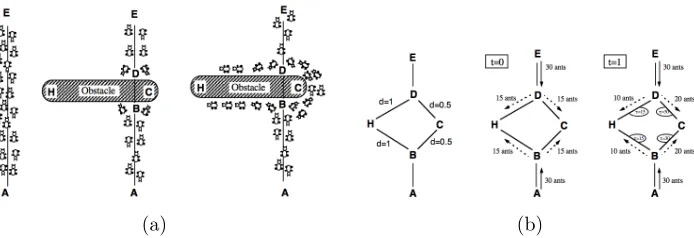
FIGURE 2: Path Choosing based on Pheromone. (a) An example with real ants. (b) An example with artificial ants.
algorithms that are used to obtain good enough solutions to solve hard combinatorial
optimization problems (CO). The goal of CO problem is to find out a good enough
solution in a reasonable amount of time.
Considering the scenario introduced in [8] as shown in Fig.2 (a), there is a path
between food source E and nest A. When an obstacle is placed to cut off the path,
ants have to decide whether to turn left or right (position H or C). Firstly there are no
pheromones left at path BH, BC, DH and DC , which can be clearly seen in Fig.2 (b);
thus the probability of choosing left or right is equal. However, since BCD is shorter
than BHD, the ants turned to C will arrive E faster than the ants which turned to H.
When the first ant returned from E arrives D, the path DC have more pheromones
since more ants have passed D from C than from H, so that this first ant that has
finished the trip will have higher probability of choosing path DCB. The consequence
is that the pheromone on the shorter path will grow faster than on the longer path,
and therefore the probability of choosing paths is quickly biased towards the shorter
one.
Having the conclusion we draw in the above paragraph, now considering the
ab-stract model shown in Fig.2(b), 30 ants depart in 1 time slot, the length of BH and
HD are both 1, and the length of BC and CD are both 0.5, if we neglect the length
of AB and DE, the length of ABHDE (path L) is 2 times larger than ABCDE (path
2. REVIEW ON ANT COLONY OPTIMIZATION
ants depart at t= 1, the probability of choosing path R is 2 3.
2.2
Theroretical Explanation of ACO
Ant Colony Optimization (ACO) algorithms can be treated as stochastic search
pro-cedures. Although multiple ACO algorithms exist, the central component of these
algorithms is the pheromone model that is used to sample the search space[6]
proba-bilistically. The model of Combinatorial Optimization (CO) problem can be used to
implement the pheromone model. In the following subsection, we will first introduce
the model of solving CO problem.
2.2.1
Combinatorial Optimization Problem
[6], [5] mentioned that a CO problem could be defined as: P = (S,Ω, f), where
• Sis a finite solution set; it is defined over a finite set of discrete decision variables
Xi, (i= 1,2, ..., n);
• Ω represents a set of constraints among the discrete decision variables Xi; • f is an objective function that assigns a cost value to every solution. f can be
defined as f :S →R+.
For the solution setS , which can also be called search space, the discrete decision variable Xi are assigned with domain values vji, where v
j
i ∈ Di = {v1i, vi2, ..., v
|Di|
i }.
s∈ S is called a feasible solution when s is a complete assignment that each discrete decision variables Xi has a domain value assigned that satisfies the constriant set Ω.
Moreover, a feasible solution s∈ S is called a globally optimal solution only if for all
s∗ ∈ S,f(s∗)≤f(s). Sometimes there is not only one globally optimal solution, the set of globally optimal solutions can be represented as S∗ ⊆ S.
This CO problem model is a finite set of solution components and a pheromone
model. The discrete decision variable Xi and one of its domain valuesv j
i is asolution
2. REVIEW ON ANT COLONY OPTIMIZATION
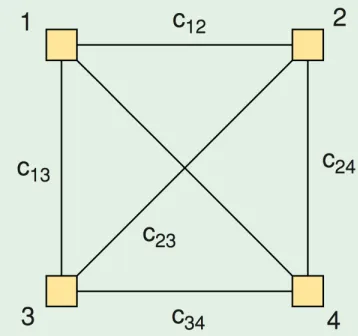
FIGURE 3: Example of Construction Graph in ACO.
model, each of the solution component cji has a pheromone trail parameter τij. All pheromone trail parameters are denoted byτ. We use Cto represent all the solution components, which means C={cj1, cj2, ..., cjn}.
The following is a specific example of the described CO problem. As shown in
Fig.3, in ACO problems, an artificial ant builds a solution by traversing the fully
connected construction graph denoted by GC = (V, E), V is the set of vertices, E is
the set of edges. In our simple example, the construction graph contains four vertices,
artificial ants move from vertex to vertex along the connected edges. For the solution
components C we just mentioned, in this case, there are four solution components:
cji, (i= 1,2,3,4), which can map to the four discrete variablesXi, (i= 1,2,3,4), and
also can represent the four vertices of the construction graph. For example, a solution
component cj2 can represent node 2 in the construction graph, and X2 indicates the
node to be visited after node 2, soX2 =cj2 means the next node visited is nodej, the
value range ofj is|Di|, which can be treated as the connected vertices withi. And in
general,cji indicates a solution that node j should be visited immediately after node
i, in order words, it indicates edge (i, j), ants deposit pheromoneτij on the edges (i, j) describes its importance of reaching the best- optimized solution. The way how an
artificial ant builds a solution by traversing the fully connected construction graph
2. REVIEW ON ANT COLONY OPTIMIZATION
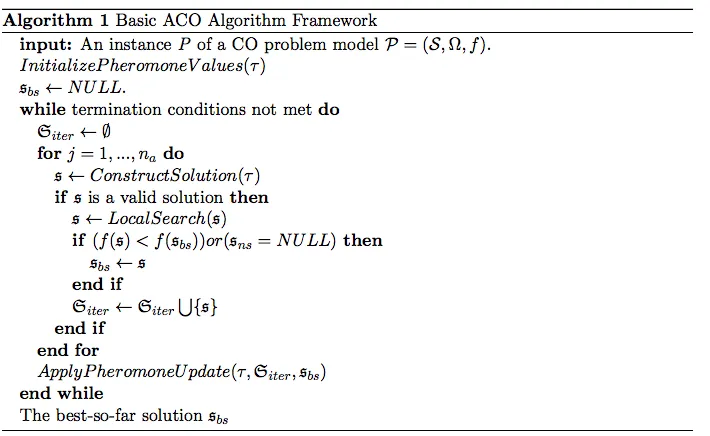
FIGURE 4: Basis ACO Algorithm Framework.
2.2.2
Basis of ACO
Fig.4 shows the framework of basic ACO algorithm [6]. Initially, all pheromone values
τij that belongs to the set of τ (the pheromone model) are initialized to a constant valuec >0, this process is finished by the functionInitializePheromoneValues shown in Algorithm 1. We assume there arenaartificial ants in total. During each iteration,
naants use the current pheromone model to probabilistically construct solutions to the
CO problem. For each ant, the function ConstructSolution is executed to construct
a solution component. This function is also the basic building block component of
any ACO algorithm as it is a constructive heuristic for probabilistically constructing
solutions. The solution constructing process can be reflected as selecting sequences of
elements from the finite set of solution componentsC, since the solution is constructed
by each ant in each iteration, thus we call this as partial solution, usingsp to represent it. The construction process is described as follows:
• Start with the empty partial solution set sp =∅;
com-2. REVIEW ON ANT COLONY OPTIMIZATION
ponent is in the set C but not yet included in the set sp.
This process can be visualized as a continuous walk along the edges of the
construc-tion graph GC = (V, E), all the vertices can be treated as the solution components
in the set C as we described in the previous section. In each step of the solution
construction, thecji that belongs tosp is chosen probabilistically based on the current
pheromone model. The probability of choosing a specific solution component cji is proportional to [τij]α ·[η(cj
i)]β[6]. η is a function that assigns to each feasible
solu-tion component, which can be treated as a heuristic value or heuristic informasolu-tion.
Parametersα and β are all positive numbers that determine the relative importance of pheromone value and heuristic information. [6] also mentioned the heuristic
in-formation is optional, but if included, the ACO algorithm can usually achieve better
performance. If considering the heuristic information, the probability of choosing the
next solution component cji is defined as follows:
P(cji|sp) = [τ
j
i]α·[η(c j i)]β
P
ck i∈sp[τ
k
i]α·[η(cki)]β
(1)
This equation is also called transition probabilities, which is first used in [8]. Each
possible solution component cji is expressed as the weight of pheromone level and weight of heuristic information (total weight of cji). Therefore, the probability of choosing cji is the weight proportion of cji among the total of ck
i with all possible
values of k.
In algorithm 1, the LocalSearch function is an optional step. It is used to
im-prove the solutions obtained by an individual ant after the partial solution has been
constructed and before updating the pheromone. As mentioned in [5], LocalSearch is
usually included in state-of-the-art ACO algorithms.
After all the ants finished the partial solution construction in one iteration, the
pheromone should be updated to increase its value to keep strong association with
the good or promising solutions. There are two main steps:
2. REVIEW ON ANT COLONY OPTIMIZATION
Usually, most ACO algorithms use the following pheromone update rule:
τij ←(1−ρ)·τij+ ρ
Supd ·
X
{s∈Supd|cji∈s}
F(s) (2)
In the equation, i = 1,2, ..., n and j ∈ |Di| , |Di| represents all the connected
vertices with i (have accessible paths to i). The parameterρ is an evaporation rate, with each update of the pheromone, the percentage of ρ of former pheromone will be deleted. The pheromone evaporation can avoid ACO algorithm converging too
quickly. Supd is the subset ofSiter, and SiterSsbs contains all the sp created by each
ant in the current iteration. sbs represents the best-so-far solution. F(s) is usually
called a quality function.
2.3
Main ACO Algorithm Implementations
During the past several decades, lots of different ACO algorithms have been proposed,
based on our knowledge, there are three kinds of main ACO algorithm
implementa-tions: Ant System (AS), MAX-MIN Ant System (MMAS), Ant Colony System (ACS).
We will give detailed explanations about these three main ACO algorithms.
2.3.1
Ant System (AS)
Ant System (AS) is the first proposed ACO algorithm in the world[8], and has been
successfully applied into the famous Traveling Salesman Problem. Similar with the
basis of ACO we introduced in section 2.2, AS updates pheromone in each iteration
based on the solution set constructed by all the ants in each iteration. By visualizing
AS as a connected construction graph (refer to Fig.3), for a vertex pair (i, j) and edge (i, j), we can re-define the pheromone τij as follows:
τij ←(1−ρ)·τij +
na
X
k=1
∆τijk (3)
∆τijk = Q Lk
if antk used edge (i, j) as part of its path
0 otherwise
2. REVIEW ON ANT COLONY OPTIMIZATION
pkij =
τijα·ηβij P
cil∈N(sp)τ
α il ·η
β il
ifcij ∈N(sp)
0 otherwise
(5)
In the equation (3), ρ is the evaporation rate, na is the total number of artificial
ants, ∆τijk is the quantity of pheromone left on edge (i, j) by ant k. Equation (4) gives the detail of how to calculate ∆τk
ij. Qis a constant, andLkis the total length of
all the edges that traveled by ant k in the current iteration. By having the τij value, the probability for ant k to go to vertex j from i is calculated as shown in equation (5). N(sp) is the set of feasible solution components that haven’t been added into the solution set yet, if visualized as graph, it can be treated as the unvisited edges by
ant k. The heuristic information ηij =
1
dij
, where dij is the length of edge (i, j).
Therefore, similar to the process we introduced in Section 2.2, in each iteration,
based on the paths traveled by each ant, the pheromone τij on each edge of the
connected construction graph is updated using equation (3). Then based on the
updated pheromone, next round iteration begins, ants will travel through the graph
again probabilistically choosing next vertex by using equation (5).
Based on the concept of AS, the authors also proposed an algorithm called
ant-cycle to apply to the famous Travelling Salesman Problem (TSP). In their proposed
algorithm, they set a terminating threshold N Cmax to terminate the iteration at last
to get the final optimal solution set.
2.3.2
MAX-MIN Ant System (MMAS)
MAX-MIN Ant System is proposed in the year 2000 [29], which is an improved ACO
algorithm based on the original AS. MMAS differs from AS mainly in the following
three aspects.
• After one iteration, only one single ant updates pheromone τ. This ant is the one who found the best solution in the current iteration (iteration-best ant) or
2. REVIEW ON ANT COLONY OPTIMIZATION
• The range of possible pheromone values on each solution component is limited to an interval [τmin, τmax];
• Initialize the pheromone values toτmax.
Based on the first different point listed above, the equation for updating pheromone
τij is modified as follows:
τij ←(1−ρ)·τij+ na
X
k=1
∆τijbest (6)
By setting the range of [τmin, τmax], if the updated τij is greater than τmax, then
the value should be set to τmax. Also, if the updated τij is smaller than τmin, the
value should be set to τmin. And ∆τijbest is decided by
1
Lbest
, if edge (i, j) belongs to the path at the current iteration.
The author of MMAS claims that the main contribution they made is to utilize the
pheromone limits to prevent premature convergence. Using the range of [τmin, τmax]
can prevent some edges have too large pheromone value, which can cause the solution
convergence too soon so that the final solution may not be the best global solution.
Not only MMAS, but also some other improved ACO algorithms also utilize the idea
of only updating the pheromone by the single ant which found the best solution in
current single iteration.
2.3.3
Ant Colony System (ACS)
The Ant Colony System (ACS) was first proposed in 1996 [13], it is also proposed by
the same author (the author that proposed the concept of Ant Colony Optimization
in his Ph.D. thesis at 1992. [4]). The proposed ACS algorithm has 4 phases:
• Phase 1: initialize the pheromone value to τ0, place each artificial ant k based
on some pre-defined policies to different vertices of the construction graph;
• Phase 2: execute in a cycle, in each round of the cycle, an artificial antk makes a move from vertex i to vertex j and update the τij based on the following
formula:
2. REVIEW ON ANT COLONY OPTIMIZATION
• Phase 3: the artificial ants which achieved the pathLbest computes the delayed
reinforcements (Lbest−iter)
−1
, and updatingτij as follows:
τij ←(1−α)·τij +α·(Lbest−iter)−1 (8)
• Phase 4: check whether the termination condition is satisfied, if not, jump back to Phase 2.
As we can see in the 4 phases of the ACS algorithm, the main difference between
AS and ACS is that ACS updates the pheromone value τij for the edge (i, j) in each
move (each construction step) of the artificial ants (move from one vertex to another
vertex), not like AS, only updates τij at the end of one construction process after
one iteration was done (all the artificial ants finished their visiting to all vertices).
We call the updates in each construction step as local pheromone update, and the
updates after one iteration is called offline pheromone update. The main goal of the
local update is to diversify the search performed by subsequent ants inside the current
iteration. It can be used to decrease the pheromone concentration on some specific
traversed edges so that the probability of several ants create identical paths during
one iteration is lower.
2.4
Recent Researches about ACO
Since the year 1992 when Macro Dorigo proposed the first concept of ACO, the
interest of digging into ACO problem has risen gradually. ACO has been applied
into the full range of different research topics. In the following subsections, we will
introduce some current research branches utilizing ACO.
2.4.1
Traveling Salesman Problem (TSP)
The majority of the applications of ACO is to solve NP-hard problems. The
defi-nition of NP-hard problem is the best-known algorithms to solve the problem have
ap-2. REVIEW ON ANT COLONY OPTIMIZATION
from traditional algorithms to solve the NP-hard problem. ACO can quickly work
out high-quality good enough solutions.
Traveling Salesman Problem (TSP)is one of the most famous NP-hard
prob-lems, and it is also the most common problem been studied by most of the ACO
researchers over the years. Firstly, [8] described using Ant System (AS) to solve TSP;
later, [13], [7], [7] mentioned using Ant Colony System(ACS) to solve TSP. TSP can
be defined as follows:
Given a list of cities and distances between each pair of cities, find the shortest
route that travels to each given cities and finally returns back to the original city.
It is a typical combinatorial optimization problem. We can refer to Fig. 3, each
vertices in the construction graph can be treated as a city; the weighted edges can be
treated as the distances between cities. If using ACS to solve TSP, the four phases
listed in section 3.3 should be followed. For the Combinatorial Optimization Problem
P = (S,Ω, f), Xi ∈ S represent the cities in the graph, the solution component cji
means choosing the path from city i to city j. Also, the pheromone valueτij means
the level of pheromone information left on the path from city i to city j. And the probability of choosing next vertex for an artificial ant is computing using equation
(5) and the pheromone value is updated using equation (7), (8) if using ACS, or
equation (3), (4) if using AS.
In [7], the authors compared the performance of ACS with other naturally
in-spired global optimization methods including simulated annealing (SA), evolutionary
program- ming (EP), genetic algorithm (GA), etc. Their comparison results are
shown in Fig. 3. They reported the best integer tour length (path length when
fin-ished traveled all cities and back to the original city), the best real tour length in
parentheses, and number of tours / iterations required to find the best integer tour
length in square brackets. We can see for the number of iterations, ACS significantly
2. REVIEW ON ANT COLONY OPTIMIZATION
2.4.2
Other Problems
The TSP can be categorized as routing problems under NP-hard problems. Apart
from TSP, there are also lots of other literature described using ACO to solve other
NP-hard problems. For example, the vehicle routing problem (find a set of
mini-mum cost routes, starting and ending at a single location and serving a number of
customers, while each customer must be served exactly once.) which also belongs to
routing problems, has been studied by [27]. Their method is to split the problem into
several disjoint sub-problems based on a starting solution, then using an Ant System
process to solve each of them.
Moreover, assignment problems, scheduling problems, subset problems are also
CHAPTER 3
Robot Path Planning based on Ant
Colony Optimization Algorithm
3.1
Modeling of Robot Motion Environment
The establishment of robot motion environmental model is a very important part
of robot path planning. The actual working environment of the robot is a realistic
physical space, however, the space that robot path planning algorithm to deal with
is an abstract environmental space. Environmental modeling is one mapping from
physical space to abstract space.
This section uses the grid method to establish the environmental model in order
to simulate the actual working space of the robot. Using grids to represent maps of
the robot working space can avoid complex calculations when dealing with obstacle
boundaries. In the application of grid method, the division of the grid size is critical:
the smaller of the grid size, the more accurate the representation of the obstacles,
but at the same time, a huge amount of storage is required and the search range of
the algorithm will increase exponentially; However, the larger of the grid size, the
3. ROBOT PATH PLANNING BASED ON ANT COLONY OPTIMIZATION ALGORITHM
3.1.1
Robot Motion Environment division using the Grid
Method
For any shape of two-dimensional topographic, there are always limited number of
obstacles, the coordinate location of these obstructions are easily mapped, so these
can be regarded as known environmental information. Grid map can be established
after traverse learning of two-dimensional space.
Without regard to robot information in height direction, two-dimensional space
robots work is marked as AS, whose inner distributes limited static obstacles [35]. The size and location of the obstacles have been known, and they will not change
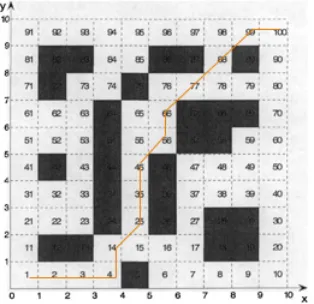
in the motion process. In AS, the left bottom in Fig.5 is regarded as coordinates origin, the level right as X axis positive direction, the vertical upward as Y axis positive direction to establish Cartesian coordinate system P
, respectively, and the
maximum of the X axis and Y axis are Xmax and Ymax.
Take the walk step length of the robot is δ. The step δ is used to divide X axis and Y axis regularly to get grids respectively. The number of grids in each line is
Nx = Xmax/δ, and the number of grids in each row is Ny = Ymax/δ. If there is no
obstacle in a grid, this grid will be called free grid and filled with white, or it will be
called obstacles grid and filled with grey.
When Xmax is equal to Ymax (both are equal to 10), and δ is 1, the grid model of
the robot work space is shown in Fig.5.
We adopt two main methods for grid making, named Rectangular coordinate
method and Serial number method.
• Serial number method: From the left bottom of the grid map, coding the grid from bottom to top, from left to right in Fig.5. The serial number is from 1 to
100. The grid using serial number method to mark is gn, e.g., the grid of serial
number 1 is marked as g1.
3. ROBOT PATH PLANNING BASED ON ANT COLONY OPTIMIZATION ALGORITHM
FIGURE 5: The example of grid environmental map[10].
There is a conversion relation between serial number si(i= 1,2,3, ...,100) and its
coordinates:
xi=mod(si−1,10) + 0.5
yi =int((si−1)/10) + 0.5
(1)
,wheremodrepresents remainder operation andintrepresents rounding operation. In my thesis, we define the starting point of robot path planning as g1 in the left
bottom of the map, likewise, the target point of robot path planning as g100.
3.1.2
The Description and Definition of Path Planning
Prob-lem
To simulate the real ant colony seeking food behavior, we assume that the starting
point of robot path planning g1 as ant colony nest, and the target point gn as food
source. Robot path planning based on ant colony optimization algorithm is actually
3. ROBOT PATH PLANNING BASED ON ANT COLONY OPTIMIZATION ALGORITHM
mutual effect and cooperation to avoid all obstacles. We make several definitions to
explain the following sections conveniently.
• Definition 1: city = 1,2, ..., nrepresents the set of all grids,nis the total amount of girds, n= 100 in Fig.5;
• Definition 2: ant = 1,2, ..., m represents the set of all ants, m = 10 in this algorithm of my thesis;
• Definition 3: DIST AN CEn∗n is a matrix that records the distance between
each grid. DIST AN CE(i, j) represents the distance between gi and gj, we
have this equation:
DIST AN CE(i, j) = q
[a(i)−a(j)]2+ [b(i)−b(j)]2 (2)
,a(i) anda(j) are the X-axis of theg(i) andg(j) respectively, likewise,b(i) and
b(j) are the Y-axis of the g(i) and g(j) respectively.
3.2
Robot Path Planning based on Ant Colony
Optimization Algorithm (ACA)
3.2.1
Several Changes of ACA when Solving Robot Path
Planning
The mathematical model of ACA has solved the TSP problem successfully. Before
ap-plying ACA on the field of robot path planning, we should make several modifications
on ACA based on the features of robot path planning.
Using Pseudo-random-proportional Rule instead of Random-proportional
Rule to Choose Path
In Ant System introduced in section 2.3, we have the following state transition rule,
3. ROBOT PATH PLANNING BASED ON ANT COLONY OPTIMIZATION ALGORITHM
which ant k in cityi chooses to move to the city j.
pkij =
τijα·ηβij P
cil∈N(sp)τ
α il ·η
β il
ifcij ∈N(sp)
0 otherwise
(3)
Obviously, the ant choose the next path relied heavily on probability under
random-proportional rule. To make the most of the heuristic information between adjacent
nodes and pheromone value existed on each path, we decide to use a new state
transi-tion rule called pseudo-random-proportransi-tional rule, given by (4), instead of the previous
random-proportional rule. s=
argmax{τilα·ηilβ} ifq≤q0 (exploitation)
S otherwise (biased exploration)
(4)
, where q is a random number distributed in [0,1],q0 is a parameter, 0≤q0 ≤1,
and S is a random variable selected according to the probability distribution given in (3). The parameter q0 determines the relative importance of exploitation versus
exploration: every time an ant in city i has to choose a city j to move to, it samples a random number q. If q ≤ q0, then the best edge, according to (4), is chosen
(exploitation), otherwise an edge is chosen according to (3) (biased exploration).
Redefine of Heuristic Information ηij
In Ant System (AS), ηij =
1
dij
, and dij is the distance between grid gi and grid gj.
However, in the robot motion environment introduced in this thesis,dij could be 1 or √
2 so that the function of heuristic search is not obvious and has few differences. To
increase the probability of ants choosing the next grid that closer to the destination
grid gn, we redefine the heuristic information, given by (5):
ηij =
C djn
(5)
, whereCis a constant anddjnis the distance between next gridgj and the destination
3. ROBOT PATH PLANNING BASED ON ANT COLONY OPTIMIZATION ALGORITHM
3.2.2
The Implementation Steps of ACA on Robot Path
Plan-ning
Under grid map environment which has n grids, The implementation steps of ACA on Robot Path Planning are shown as follows:
Step 1: Set the initial parameters, initialize ant colony
The parameters including start gridg1, destination gridgn, iteration timesNc = 0,
max iteration timesNc max, impact index of pheromonesα, impact index of heuristic
factor β, pheromone evaporation rateρ, constant Q, and initial pheromone τij(0) =
const.
Set routh bestto record the shortest path in every iteration, length bestto record the length of the shortest path in every iteration,length averageto record the average length of all paths got in each iteration.
All the ants m are placed in the start grid g1, and put g1 into the taboo table of
the ant k, tabuk(k = 1,2,3, ...m) ;
Step 2: Each ant move into next grid
According to pseudo-random-proportional rule given by (3) and (4), each ant
selects a next grid to move in, and the next grid will put into the taboo table of this
ant. If the current grid is the destination grid, let this ant dead.
Step 3: Repeat step 2, until all the ants have selected the next grid
Step 4: Local pheromone update
After all ants have selected the next grid, the algorithm implements local pheromone
updating given by (6).
τij(n+ 1) = (1−ρ)·τij(n) +ρ·∆τijk (6)
, where ∆τk
ij is a constant,τmin <∆τijk < τmax. Whenτij(n+1)< τmin, setτij(n+1) =
τmin; When τij(n+ 1) > τmax, set τij(n+ 1) =τmax
Step 5: Repeat Step 2, Step 3, and Step 4, until all the ant move into
the destination grid
3. ROBOT PATH PLANNING BASED ON ANT COLONY OPTIMIZATION ALGORITHM
Step 7: Global pheromone update
After each iteration, the algorithm implements global pheromone updating given
by (7) and (8).
τ(r, s)←(1−α)τ(r, s) +α∆τ(r, s) (7)
∆τ(r, s) =
1 Lbest−iter
if (r,s) belongs to the global optimal path
0 otherwise
(8)
Step 8:Clear the tabuk, Nc = Nc + 1, if Nc ≤ Nc max, move to Step 2; if
Nc ≤ Nc max, move out the whole iteration, get the optimal path and the
CHAPTER 4
Robot Path Planning based on
ACA integrating with Genetic
Algorithm (GA)
4.1
Genetic Algorithm and Robot Path Planning
4.1.1
Introduction of Genetic Algorithm
Genetic Algorithms became popular through the work of John Holland in the early
1970s. A Genetic Algorithm (GA) is a meta-heuristic inspired by the process of
natural selection that belongs to evolutionary algorithms (EA) [24].
In a genetic algorithm, an optimization problem can be simplified to a process
to find a better solution from a population of candidate solutions. Each candidate
solution has a set of properties which can be mutated and altered; traditionally,
solutions are represented in binary as strings of 0s and 1s, but other encodings are
also possible.
A typical genetic algorithm requires a genetic representation of the solution
do-main and a fitness function to evaluate the solution dodo-main. A standard
representa-tion of each candidate solurepresenta-tion is as an array of bits. The main property that makes
these genetic representations convenient is that their parts are easily aligned due to
their fixed size, which facilitates simple crossover operations [34]. Variable length
4. ROBOT PATH PLANNING BASED ON ACA INTEGRATING WITH GENETIC ALGORITHM (GA)
FIGURE 6: The flow chart of genetic algorithm.
this case. Once the genetic representation and the fitness function are defined, a
GA proceeds to initialize a population of solutions and then to improve it through
repetitive application of the mutation, crossover, inversion and selection operators.
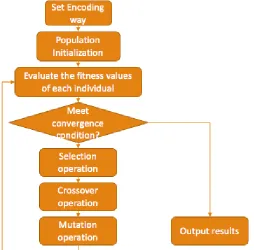
In summary, the core content of genetic algorithm involves the generation of
ini-tial population, the selection of fitness function, the design of genetic operators and
termination conditions. The flow chart of GA is shown in Fig.6.
4.1.2
The Implementation Steps of GA on Robot Path
Plan-ning
Due to the capability of rapid global search and rapid search to global optimal path
that genetic algorithms have, genetic algorithms have been applied to multi-robot
path planning. In this section, it will adopt genetic algorithm to find the optimal
path based on the grid environmental map introduced in chapter three. The
imple-mentation steps of GA on Robot Path Planning are shown as follows:
4. ROBOT PATH PLANNING BASED ON ACA INTEGRATING WITH GENETIC ALGORITHM (GA)
FIGURE 7: The example of path encoding.
Binary coding or floating point coding is not suitable when using GA to solve
robot path planning problems. This thesis adopts a series of grid numbers as path
encoding, which means each path can be represented as a series of numbers. Due to
one path can not pass the obstacle grids, nor can it pass through the repeated grids,
this series of numbers can not be the serial number of obstacle girds or repeated girds.
For example, one path can be represented as follows in Fig.7:
1-2-3-4-14-25-35-45-56-66-77-88-99-100
The path is identified with orange line, and the figure 1 represents the serial
number of path planning’s starting grid, likewise, the figure 100 represents the serial
number of path planning’s target grid. The rest of numbers represent the serial
number of path planning’s middle grids.
Step 2: The generation of initial population
In the grid environment model, the path from the starting grid to the target grid
is variable, so in the genetic algorithm, the chromosome representing the path is also
variable. The initial path individual generation process is as follows: starting from
the starting grid 1, step by step, non-repeated to choose next free grid until moves
to the target grid 100. Therefore, the path population consist of the multiple path
individuals that gained from step 2.
Step 3: The selection of fitness function
4. ROBOT PATH PLANNING BASED ON ACA INTEGRATING WITH GENETIC ALGORITHM (GA)
stability of the genetic algorithm. As robot path planning problem has to satisfy
the condition of the shortest path, the fitness function set the path length as the
evaluation criterion. The fitness function in this thesis is shown as follows [35]:
f = 1
(1 +√ 1
N−1)d
(1)
where,N represents the number of passed grids in each path,drepresents the length of each path.
Step 4: The design of genetic operators
This thesis introduces four genetic operators: selection operator, crossover
opera-tor, mutation operaopera-tor, deletion operator.
• Seletion operator:
The selection operation is also called copy operation, which means it selects the
individual from the parent and passes individual to the offspring instantly. In
the process of copy, the probability that an individual in each parent copied to
the next generation is determined by the value of its fitness function. Individuals
with larger fitness function value, ie, individuals with shorter paths, are more
likely to be copied to the next generation. So how to select individuals to
copy to the next generation; this thesis uses roulette method. To illustrate the
working principle of roulette method, assuming that the population has path
1, path 2 and path 3 three individuals, with the fitness function value 2, 3, 5,
respectively. The probability of these three individuals to be selected is [0.2,
0.3, 0.5], and cumulative probability is [0.2, 0.5, 1]. Generate a random number
rand between 0 to 1, if rand falls in [0, 0.2], path 1 is selected; if rand falls in [0.2, 0.5], path 2 is selected; if rand falls in [0.5, 1], path 3 is selected.
• Crossover operator:
The crossover operation is to intersect different individuals from the parent
to produce new individuals. The typical crossover methods have single point
crossover, double point cross and multipoint crossover. This thesis uses single
4. ROBOT PATH PLANNING BASED ON ACA INTEGRATING WITH GENETIC ALGORITHM (GA)
two path individuals from the parent to cross and exchange the part of the path
afer the intersection point.
For example, One path is: 1-4-14-25-45-56-66-99-100, another path is
1-4-14-15-65-66-76-80-100, the crossover grid is 66, then two path will be
1-4-14-25-45-56-66-76-80-100 and 1-4-14-15-65-66-99-100, respectively.
• Mutation operator:
Mutation operation plays a key role in increasing population diversity.
Con-sidering the diversity of the paths after searching, the path individuals after
mutation operation is not considered to be superior to the path individuals
be-fore mutation operation. According to a given mutation probability, we select
a serial number of grid from one path individual randomly and replace an
ar-bitrary serial number with the selected serial number of the grid. For example,
one path is 1-4-14-25-45-56-66-99-100, if the mutation grid is 56, if we choose
55 to replace that grid, the new path after mutation will be
1-4-14-25-45-55-66-99-100,
• Deletion operator:
Due to the initial randomness and mutation operations, the individuals from
the path population may have an obstacle grid number, and the path individual
can not contain an obstacle grid number, which requires the removal of obstacles
in the path individual. When implementing crossover and mutation operations,
the path individuals may contain some repeated grid numbers, which is not
allowed, It is necessary to delete the serial numbers of which two repeated grids
4. ROBOT PATH PLANNING BASED ON ACA INTEGRATING WITH GENETIC ALGORITHM (GA)
4.2
Robot path planning based on GA-ACA
4.2.1
Introduction of GA-ACA
Genetic algorithm (GA) is a global optimal algorithm based on natural selection
and natural genetic, with the capability of rapid global search and rapid search to
global optimal path. However, without the use of the feedback information of the
sys-tem, this method usually cause redundancy iteration and reduce solution efficiency.
Ant colony optimization algorithm (ACA) converge to the optimal path through
pheromone accumulation and update, with distributivity, parallelism and global
con-vergence ability, but in the initial stage pheromone among all paths are equal, which
makes it equate to greedy algorithm and leads to slow convergence speed, the obtained
solution is often not the optimal solution.
To overcome the drawback of two algorithms in robot path planning application,
a method of path planning was put forward, which combined genetic algorithm with
ant colony optimization algorithm, called GA-ACA. GA-ACA algorithm is firstly
using genetic algorithm to generate distributed initialization pheromone, then using
ant colony algorithm for the optimal solution, thus this way effectively combines fast
convergence of genetic algorithm and information positive feedback mechanism of ant
colony algorithm.
GA-ACA is superior to the genetic algorithm in computational efficiency, and is
superior to the ant colony optimization algorithm in time efficiency.This algorithm
has become a kind of heuristic algorithm which has better computational efficiency
and time efficiency.
4.2.2
The Implementation Steps of GA-ACA on Robot Path
Planning
Under grid map environment which has n grids, The implementation steps of GA-ACA on Robot Path Planning are shown as follows:
4. ROBOT PATH PLANNING BASED ON ACA INTEGRATING WITH GENETIC ALGORITHM (GA)
path can be represented a series of numbers. The series of numbers can not be the
serial number of obstacle grids or repeated grids. Then, we generate initial path
population and select the fitness function related to the path length.
Step 2: We calculate the value of fitness function for each path individual from
the path population and use the roulette method to select the path individuals that
will be done by crossover and mutation operations.
Step 3: According to the given crossover ratePc, we select two path individuals to
do the crossover operation. The specfic method is to generate a random numberrand
between 0 to 1, ifrand < Pc, do the crossover operation, otherwise, don’t operate.
Step 4: According to the given mutation rate Pm, we select two path individuals
to do the mutation operation. The specfic method is to generate a random number
rand between 0 to 1, if rand < Pm, do the mutation operation, otherwise, don’t
operate.
Step 5: Repeat Step 2 to Step 4, until satisfies the given convergence condition
and iteration times and generate several optimized path individuals.
Step 6: Generate distributed initialization pheromone according to the optimized
path individuals. Next, set the initial parameters of the ant colony algorithm. All
the ants m are placed in the start grid g1, and put g1 into the taboo table of the ant
k, tabuk(k= 1,2,3, ...m) ;
Step 7: Each ant selects a next grid to move in according to the state transition
rule, and the next grid will be put into the taboo table of this ant.
Step 8: Repeat Step 7, until this ant constructs a completive path, and pheromone
is updated locally.
Step 9: Repeat Step 7 and Step 8, until all the ants complete their paths
respec-tively, and pheromone is updated globally.
Step 10: Remove the taboo table of all ants, repeat from Step 7 to Step 9, until
reach the set number of cycles or meet certain termination condition.
Step 11: Output the optimal path.
4. ROBOT PATH PLANNING BASED ON ACA INTEGRATING WITH GENETIC ALGORITHM (GA)
FIGURE 8: The flow chart of GA-ACA.
4.3
Robot path planning based on ACA-GA
4.3.1
Introduction of ACA-GA
The GA-ACA algorithm introduced in 4.2 apply GA and ACA in two stages
essen-tially, rather than an integration of these two algorithms in the true sense. In this
section, we will integrate into solution of ant colony optimization algorithm an idea
of crossover about genetic algorithm. The main framework of this algorithm is ACA,
but it integrates with GA during the intermediate solution process. To distinguish
this new algorithm with GA-ACA, we call it ACA-GA.
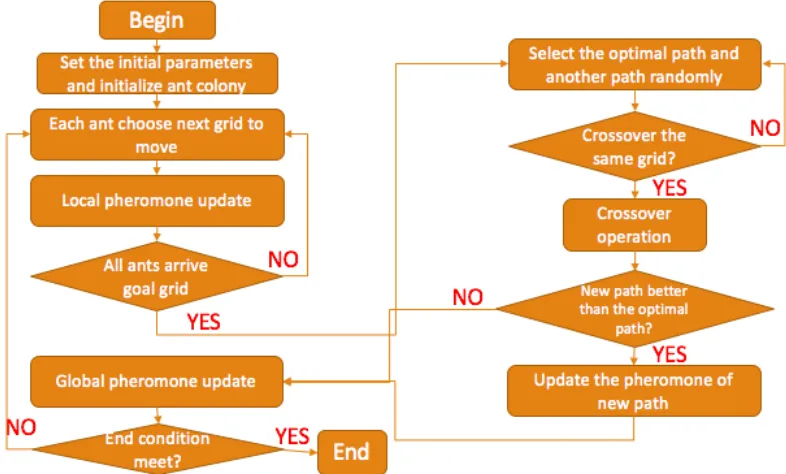
In short, ACA-GA selects two paths randomly after one iteration, and do the
crossover operation on two paths, and update pheromone of new path if it is better
than the optimal path in current iteration.
The crossover operation in the genetic algorithm is introduced into the ant colony
optimization algorithm, which can increase the diversity of the solution and speed up
![FIGURE 5: The example of grid environmental map[10].](https://thumb-us.123doks.com/thumbv2/123dok_us/1378790.1170549/35.612.180.468.83.351/figure-the-example-of-grid-environmental-map.webp)