Reversible Data Hiding in Encrypted Image:
Algorithm, Result and Analysis
Chetan G. Tappe1, Prof. A.V. Deorankar2
P.G. Student, Department of Computer Engineering, Govt. College of Engineering, Amravati, India1
Associate Professor, Department of Information Technology, Govt. College of Engineering, Amravati, India2
ABSTRACT: The proposed scheme is made up of image encryption, data embedding and data extraction, image-recovery phases. The content owner encrypts the original uncompressed image using an encryption key to produce an encrypted image. Then, the information hide compresses the least significant bits (LSB) of the encrypted image using a data-hiding key to create a scrubby space to accommodate the embedded data. At the receiver side, the data embedded in the created space can be easily retrieved from the encrypted image containing additional data according to the data-hiding key. Since the data embedding only affects the LSB, a decryption with the encryption key can result in an image similar to the original version. When using both of the encryption and data-hiding keys, the embedded additional data can be successfully extracted and the original image can be perfectly recovered by exploiting the spatial correlation in natural image.
KEYWORDS:RDH, Image encryption, Secure communication, LSB, Reversible image transformation (RIT).
I. INTRODUCTION
Now, images from various bases are recurrently used and conveyed through the internet for various applications, such as online personal photograph albums, private enterprise archives, document storage systems, medicinal imaging systems, and army image databases. These images usually contain private or confidential information so that they should be protected from leakages during communications. Recently, many methods have been planned for securing image transmission, for which two collectivemethods are image encryption and data hiding. Another normally used method for secure image transmission is data hiding, in data hiding secret image is hidden behind a carrier; carrier can be anything an image, document, audio file and a video file. Now a day for secure image transmission a new concept is being in used that is of mosaic image in the field of data hiding.
Application scenarios, an inferior assistant or a channel administrator hopes to append some added message, such as the origin data, image symbolization or secret data, within the encrypted image though he does not know the original image data. For example, when medical images have been encrypted for protecting the patient secrecy, a database manager may aim to embed the private information into the consistent encrypted images. It may be also confident that the original content can be retrieve without any error after decryption and recover of extra message at receiver side. That means a reversible data hiding scheme for encrypted image is necessary.
II. RELATED WORK
zhang separated the encrypted image into some blocks. by flipping 3 LSBs (least significant bits) of the half of pixels in each block, room can be vacated for the embedded bit. the data insertion and image retrieval proceed by finding which part has been flipped in one block. this process can be recognized with the help of spatial association in the decrypted image. the decoder side by further exploiting the spatial correlation using a dissimilar estimation equation and side match technique. for both methods in [2] and [3], decrypting image and extracting data must be jointly executed.
Recently, zhou et al. [4] proposed a novel RDH-EI method for joint decryption and extraction, in which the correlation of plaintexts is further exploited by unique the scrambled and non-scrambled pixel blocks with a two-class classifier. to separate the data extraction from image decryption, zhang emptied out space for data embedding by directly using the typical manner of cipher text compression that is, compressing the encrypted pixels in a lossless manner by using the syndromes of parity-check matrix of channel codes.
III. PROPOSED ALGORITHM
A. Least Significant Bit Algorithm
1. Read image and convert pixel value in binary format. 2. Convert data byte into binary format.
3. Perform binary addition.
4. Convert resultant binary values into pixels RGB values. 5. Initialize new bitmap image with changed pixels.
6. Continue steps 2,3,4,5 until all the data bytes get processed. 7. Save the resultant image.
Example of LSB
Let’s assume that we want to embed the letter ‘A’ into a 24-bit cover image. The binary value of ‘A’ is 10000011. Assume the three adjacent pixels of the image are the following:
(10110100 11010111 10001110) (00011100 11110110 11010111) (10001110 00011100 11100101)
After applying LSB steganography algorithm the following pixels of stego-image is acquired. Bits that have been changed because the cover image pixels did not match the message bits are represented in red.
(10110101 11010110 10001110) (00011100 11110110 11010110) (10001111 00011101 11100101)
B. Pixel Shuffling Algorithms
i. X Reverse
ii. Y Reverse
i. X Reverse
1. Initialise string str with with x pixel values 2. initialize rev[] character array
3. initialize i=str.length-1 Initialize counter cnt=0 4. for i= str.length-1 to 0 5. rev[cnt]=str[i]
6. decrement value of i by 1 7. if i<0 then repeat steps 5 & 6 8.else stop
ii. Y Reverse
1. Initialise string str with y pixel values 2. initialize rev[] character array 3. initialize i=str.length-1 Initialize counter cnt=0 4. for i= str.length-1 to 0 5. rev[cnt]=str[i]
6. decrement value of i by 1 7. if i<0 then repeat steps 5 & 6 8.else stop
IV. SIMULATION RESULTS
This section gives brief idea about comparison of computational analysis and experimental analysis. Here we are compare both model on the basis of some analysis parameter. Here we choose two parameter for Peak Signal Noise Ratio and Mean Square Error. Which is expressed in terms of bits per pixel (bpp)? The objective of any reversible image transformation algorithm is to reduce the mean square error. And increase peak signal noise ratio improves for image quality.
Then the statistical measurement like peak signal to noise ratio (PSNR) and mean square error (MSE) are obtained using .net platform and shown in Table 4.4.1.
The peak signal to noise ratio is the most important terms with respect to measure the quality of a cover image and its corresponding stego-image. The PSNR is measured using the following equation-
= 10 log 255
Where M is peak signal level for a color image and MSE is computed by the equation:
Table:4.4.1 Statistical Measurement Propose System
Encoded Image size
(MB) 8 bit Image
PSNR dB
MSE SD Mean
8 62.62 0.032 38.018 142.99
14 80.55 0.005 48.74 118.60
7 53.08 0.319 30.85 87.74
14 54.032 0.256 36.35 160.66
3 54.12 0.319 36.69 159.20
2 44.02 0.619 48.41 118.171
2 40.07 0.719 43.29 141.21
2 34.02 25.74 48.41 118.17
3 34.19 24.50 29.92 87.43
4 35.96 16.29 30.32 87.37
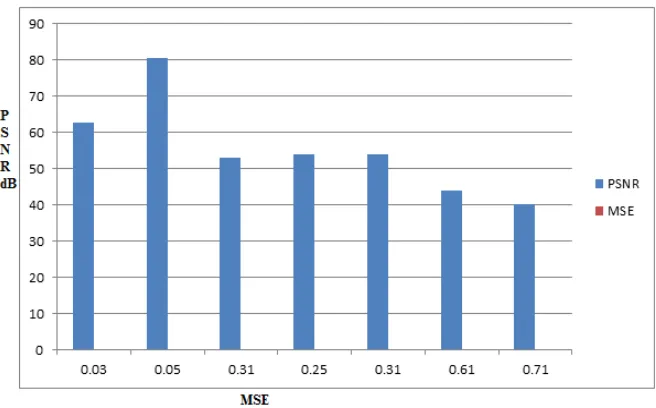
Table 4.4.1. gives the Peak Signal Noise Ratio, Mean Square Error, Standard Deviation of the image file. While Comparing the result on the basis of Analytic and experimental result outlines can be depicts. A graphical figure 4.4.1 showing a result for different images on the basis of the PSNR and MSE of the provided images.
Figure 4.4.1: Graphical Representation of PSNR and MSE
Table 4.4.2: Comparison Between Existing System vs Propose System
Experiment Images
Existing System Propose System
PSNR dB PSNR dB
A 30.68 54.032
B 30.72 54.12
C 30.95 44.02
D 30.09 40.07
E 30.83 34.02
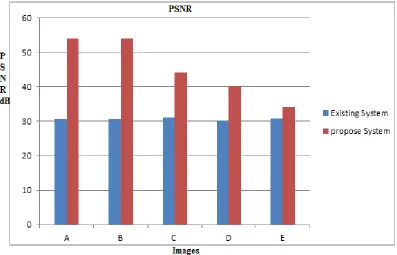
Table 4.4.2 gives the statistical measurements of the proposed method ensure the better PSNR value compared to existing system. A graphical figure 4.4.2 showing a result for different images on the basis of the PSNR for comparing existing system vs propose system.
Figure 4.4.2: Graphical Representation of Comparison of Existing Vs Propose System
V. CONCLUSION AND FUTURE WORK
PSNR value obtained is much higher than that of existing reversible data hiding techniques in encrypted image. If the receiver has both keys, he can extract the data and recover the original image completely.
REFERENCES
1. X. Zhang, “Reversible data hiding in encrypted images,” IEEE Signal Process, vol. 18, No. 4, pp. 255–258, Apr. 2011.
2. W. Liu,W. Zeng, L. Dong, andQ.Yao, “Efficient compression of encrypted gray scale images,” IEEE Trans. Image Process., vol. 19, No. 4, pp. 1097–1102, Apr. 2010.
3. X. Zhang, “Reversible data hiding in encrypted images,” IEEE Signal Process. vol. 18, No. 4, pp. 255–258, Apr. 2011. 4. X. Zhang, “ data hiding in encrypted image,” IEEE Trans. Inf. Forensics Security, vol. 7, No. 2, pp. 826–832, Apr. 2012.