Delay-Constrained Shared Multicast Trees
Hussein F. Salama
ECE Department
North Carolina State University
Box 7911, Raleigh, NC 27695
Phone: (919) 515-5348
Fax: (919) 515-2285
[email protected]
Douglas S. Reeves
CSC & ECE Departments
North Carolina State University
Box 8206, Raleigh, NC 27695
Phone: (919) 515-2044
Fax: (919) 515-7896
[email protected]
Yannis Viniotis
ECE Department
North Carolina State University
Box 7911, Raleigh, NC 27695
Phone: (919) 515-5148
Fax: (919) 515-2285
[email protected]
Abstract
We study the problem of constructing delay-constrained shared multicast trees for
real-time applications in connection-oriented high-speed networks. We formulate the problem as a
diameter-constrained minimum Steiner tree problem, and prove that it is NP-complete. Then
we propose distributed, dynamic heuristics for solving this problem. Most previous work on
shared multicast trees starts by selecting a multicast center, and then constructs a shared tree
around it. One of the heuristics we propose eliminates the need for a dedicated center selection
phase. We use simulation to evaluate the performance of the proposed heuristics.
1
Introduction
Broadband Integrated Services Digital Networks (B-ISDN) [1] are evolving at a fast pace. B-ISDNs
use the Asynchronous Transfer Mode (ATM) [1] which is based on high-speed packet-switching
technology. ATM is a connection-oriented technique in the sense that a communication session first
has to set up virtual connections between the sources and the receivers participating in that session
prior to the actual transmission of packets (denoted as cells in ATM terminology). These virtual
connections can guarantee certain performance levels to the communication session. This has given
rise to new real-time networking applications such as video conferencing. Real-time applications
have quality of service (QoS) requirements that must be guaranteed by the underlying network,
e.g., bounds on the acceptable end-to-end delay, delay jitter, and packet loss rate. In addition, many
real-time applications utilize the network bandwidth intensively, and involve multiple sources and
multiple receivers.
Multicast trees are used to transport the sources’ traffic streams to the receivers. In wide-area
high-speed networks, link delays are dominated by the fixed propagation components [1]. For
these networks an upper bound on end-to-end delay from any source to any destination, denoted as
delay constraint, can be guaranteed by constructing the appropriate multicast trees.
There are two alternate approaches for constructing multicast trees for a given application. One
approach is to construct source-specific multicast trees. One tree is constructed for each source to
transport that source’s traffic stream to all receivers. The other approach is to use a single shared
multicast tree to transport the traffic from all sources to all receivers.
This paper focuses on real-time applications with delay constraints. Previous work on
delay-constrained multicast trees considered only source-specific trees. Several algorithms for
construct-ing delay-constrained source-specific multicast trees has been studied by several research groups
in recent years [2, 3, 4, 5, 6, 7, 8]. We present a comparison of different source-specific algorithms
in [9]. In this paper, we study delay-constrained shared multicast trees.
Shared trees have the following advantages over source-specific trees. It takes less overhead
to construct and maintain one shared tree per multicast session than to construct a source-specific
tree for every source. With shared multicast trees, when a new source starts transmitting to an
merely has to find a path to connect itself to the existing shared tree. Similarly, when a node joins
an existing multicast session as a receiver, it merely has to find a path to connect itself to that
session’s shared tree. If source-specific trees are used instead, the new receiver would have to join
the source-specific trees of each source transmitting to the already existing multicast session. In
addition, with shared multicast trees, a source does not have to keep an explicit list of the receivers,
and similarly, a receiver does not have to keep an explicit list of all sources.
Simulation results presented in [10] show that the end-to-end delays along shared trees are
longer than the corresponding delays when source-specific trees are used instead. This makes
the problem of constructing delay-constrained shared trees more challenging, but, fortunately, the
algorithms we propose for constructing delay-constrained shared trees are not of higher complexity
than those proposed for constructing delay-constrained source-specific trees.
The remainder of this paper is structured as follows. In section 2, we formulate the problem,
prove its NP-completeness. In section 3, we review previous work on related problems. Then in
section 4, we propose three heuristics for constructing delay-constrained shared multicast trees.
We evaluate the performance of the proposed heuristics using simulation in section 5. Finally, we
present our conclusions in section 6.
2
Problem Formulation
A point-to-point communication network is represented as a connected simple network
N
=(V;E
),where
V
is a set of nodes andE
is a set of undirected links. Any linke
= (u;v
)2E
has a costC
(e
)(same asC
(u;v
)) and a delayD
(e
) (same asD
(u;v
)) associated with it.C
(e
) andD
(e
)may take any nonnegative real values. The link cost
C
(e
)may be either a monetary cost or somemeasure of the link’s utilization. In this paper, we define link cost as a function of the utilized link
bandwidth, because our objective is to achieve efficient management of network resources. The
link delay
D
(e
) is a measure of the delay a packet experiences when traversing linke
. It mayconsist of switching, queueing, transmission, and propagation components.
We define a path as an alternating sequence of distinct nodes and links. We use the following
notation to represent a path:
P
(v
0;v
k) = fv
0 $v
1 $:::
$v
k ,1P
(v
0;v
k)is defined as the sum of the costs of the links constitutingP
(v
0;v
k).Cost
(P
(v
0;
v
k))= X
e2P(v0;v k
)
C
(e
) (1)Similarly, the end-to-end delay along the path
P
(v
0;v
k)is defined as the sum of the delays on thelinks constituting
P
(v
0;v
k).Delay
(P
(v
0;
v
k))= X
e2P(v0;v k
)
D
(e
) (2)For our investigations, we consider a conferencing application in which all multicast group
members are both sources and receivers. The multicast group is given as
G
= fg
1;g
2;:::;g
ngwhere
n
=jG
jjV
jis the size of the multicast group.A shared multicast tree
T
(G
)E
is a tree spanning all members of the groupG
such that anyleaf node of
T
(G
)is a member ofG
. The total cost of a shared treeT
(G
)is simply the sum of thecosts of all links in that tree.
Cost
(T
(G
))= Xe2T(G)
C
(e
) (3)The diameter of the shared tree
T
(G
)is the maximum delay along the tree links between any twomulticast group members.
Diam
(T
(G
))=maxgi 2G (max gj 2G ( X
e2P T
(g i;gj
)
D
(e
))) (4)where
P
T(g
i;g
j)is the path fromg
i tog
j along the treeT
(G
).Our objective is to minimize the total cost of the shared tree such that its diameter does not
violate the end-to-end delay constraint, ∆, imposed by the multicast application. The optimal problem can be formulated as a diameter-constrained minimum Steiner tree (DCMST) problem.
Its objective function is:
min
T(G)2T 0
(G)
Cost
(T
(G
)) (5)where T 0
(
G
)is the set of trees spanning all nodes inG
for which the diameter is bounded by∆. T0
(
G
)is a subset ofT(G
),T 0(
G
) T(G
), whereT(G
)is the set of trees spanning all nodes inG
. IfT
(G
)2T(G
)thenT
(G
)2T0
(
G
)if and only ifDiam
(T
(G
))∆:
(6)Proof. We prove that a decision version of the problem is NP-complete.
The DCMST Decision Problem: Given an undirected network
N
= (V;E
), a nonnegativecost
C
(e
) for eache
2E
, a nonnegative delayD
(e
) for eache
2E
, a multicast groupG
=f
g
1;:::;g
ngV
, a positive delay constraint ∆, and a positive real valueB
, is there a treespanning all group members such that
Cost
(T
(G
))B
andDiam
(T
(G
))∆?The problem is clearly in NP, because a nondeterministic algorithm can guess a set of links to
form the tree. Then it is possible to verify in polynomial time that these links do form a tree, that
this tree spans all nodes in the group
G
, that the total cost of the tree isB
, and that the diameterof the tree is∆.
Next we restrict the DCMST decision problem to a known NP-complete problem, the
un-constrained minimum Steiner tree decision problem [11]. This can be done by setting the delay
constraint to a value greater than or equal to the largest simple path delay between any two nodes in
the network. For the restricted case, a solution to the unconstrained minimum Steiner tree decision
problem is a solution to the diameter-constrained minimum Steiner tree decision problem. Since
the restricted problem is NP-complete, it follows that the general DCMST decision problem is also
NP-complete. 2
We implemented an optimal algorithm for the DCMST problem using a branch and bound
technique. We denote this optimal algorithm as DiamOPT. However, this algorithm has excessive
execution times, and we could apply it only to small networks. Therefore, it is useful only for the
purpose of benchmarking heuristics.
We review previous work on related problems in the next section. Then in section 4, we propose
heuristic solutions for the DCMST problem that avoid the excessive execution times of DiamOPT.
3
Related Work
No work has been reported to date on delay-constrained shared multicast trees. However, two
multicast routing protocols, currently being developed for the Internet, define unconstrained shared
multicast trees as part of their specifications. The two protocols are Protocol Independent
on unconstrained shared trees. All schemes proposed for constructing unconstrained shared trees
consist of two phases. In the first phase, a node is selected to be the center of the multicast session.
The initial shared multicast tree consists of the selected center only. Then in the second phase,
multicast sources and receivers can dynamically join and leave the shared tree. Thus the first phase
is a center selection phase while the second phase is a route selection phase. Routing algorithms
applied during the route selection phase are variations of the popular shortest path algorithms [14]
similar to those used for constructing source-specific trees. Therefore, research on shared multicast
trees focused on the center selection phase. In PIM, the center of a shared tree is denoted as the
Rendezvous Point (RP), and it is selected randomly from a list of candidate RPs. In CBT, the center
of the shared tree is called the core. A core is placed by hand based on the topological distribution
of the multicast group membership at session initiation time. Note that the traffic originating from
one multicast group member is forwarded to all other group members over the shortest path to each
member, along the shared tree. Such a shortest path does not necessarily have to pass through the
center.
David Wall’s work was the first on shared trees [15]. His focus was mainly on shared broadcast
trees, a special case of the shared multicast trees. In his work, he considered only link delays.
He presented several variations of the problem, and proved that optimal shared broadcast tree is
NP-complete. Wall proposed three center selection heuristics and proposed a distributed
imple-mentation scheme for these heuristics. Wall also established upper bound on the delays along
shared trees as compared to the delays if source-specific trees were used instead. One important
bound is that if the shortest path tree1 of a randomly chosen center node is used as a shared tree,
then the maximum delay between any two nodes along that tree is at most two times the maximum
delay achieved if source-specific shortest paths trees were used instead.
Wei and Estrin [16] evaluated the tradeoffs between source-specific multicast trees and shared
multicast trees using simulation. They also showed that restricting the center to be one of the
multicast group members does not significantly affect the performance of the shared tree.
Shukla et al. [17] proposed a protocol for constructing both source-specific and shared multicast
trees. They proposed a center selection protocol for shared multicast trees based on a tournament.
1In this case, a shortest path tree was a least-delay tree that minimizes the delay from the root to any node on the
A simplified version of the tournament works as follows. Each receiver is paired with a source
in decreasing order of distance. The node at the middle of the shortest path between each pair
is the winner of that pair. All winners are then paired together, and the next group of winners is
computed, and so on until only one winning node remains. This node is the center of the shared
tree.
Calvert et al. [18] compared different center selection algorithms with respect to their effect
on bandwidth and delay. Their results confirm the Wei and Estrin’s results [10]. Wei and Estrin
showed that center selection algorithms tend to favor nodes that are close to the center of the
network. When many shared multicast trees exist, this results in high traffic concentration on the
links attached to these central nodes. Calvert et al. proposed to distribute the centers uniformly
(randomly) over all network nodes to reduce traffic concentration. They showed that the resulting
traffic concentration is as low as that resulting from source-specific trees.
Thaler and Ravishankar [19] proposed two distributed center selection protocols. The protocols
permit the center of multicast session to migrate dynamically. The authors evaluated their protocols
and most of the previously proposed center selection mechanisms.
All the work reviewed above considered best-effort datagram networks. In this paper, we study
algorithms for constructing shared multicast trees in connection-oriented network that support
multicast applications with QoS constraints.
4
Heuristic Solutions
In this section, we propose heuristic solutions for the DCMST problem formulated in section 2.
The heuristics we propose for constructing delay-constrained shared trees consist of two phases.
In the first phase, we construct an initial delay-constrained shared tree and designate a node on that
tree to be the center of the multicast session. In the second phase, all multicast group members can
dynamically join and leave the shared tree.
We denote the algorithm used to by nodes to join or leave a shared tree as the Delay-Constrained
Shared Routing (DCSHARED) algorithm. It is a variation of the delay-constrained unicast routing
(DCUR) algorithm proposed in [20]. Both DCUR and DCSHARED are distributed and have a worst
case message complexity of
O
(jV
j3
fewer messages are needed. In addition, both algorithms require limited network state information
to be kept at each node in the form of a delay vector and cost vector. These vectors are similar to
the distance vectors used for routing purposes in current networks [21, 22]. The delay vector at
node contains information about the least-delay paths to all other nodes. Similarly, the cost vector
contains information about the least-cost paths to all other nodes. Both DCUR and DCSHARED
scale well to large network sizes. In DCSHARED, a new multicast group member joins an existing
shared tree via a delay-constrained path towards the center of the tree. A distributed
member-initiated algorithm is used to construct this path. The objective of the algorithm is to minimize the
path cost, such that the diameter of the resulting shared tree does not violate the delay constraint.
Of course, a node may fail to join a multicast session, if the routing algorithm fails to construct a
path connecting it to the corresponding shared tree such that the diameter of the final tree does not
violate the delay constraint. When a node leaves a multicast group, it simply prunes itself from the
corresponding shared tree. Complete description, and pseudo code, of the functions used for both
the join and leave operations of DCSHARED are given in [23].
In the remainder of this section, we present algorithms for the first phase of shared tree
construction. All proposed algorithms are distributed and their implementation is based on the
information available in the delay vectors and cost vectors existing at all nodes, i.e., they do not
require more network state information than the routing algorithm discussed above.
One heuristic for the first phase of delay-constrained shared multicast tree construction simply
chooses a random node to be the center of the multicast session. We call this heuristic RAND.
Of course implementation of RAND does not even require the information available in the delay
vectors and cost vectors. One way to implement RAND distributedly is to install the same random
center generator at all nodes. When a node receives the group address and the initial multicast group
members of a new multicast session, it applies this information to the random center generator which
computes the address of the center node. This approach does not require any message overhead,
because each node selects the center independently. A similar approach is used to choose the RPs
in PIM [12]. In addition, Calvert et al. [18] have shown that selecting the center of an unconstrained
shared tree randomly reduces the traffic concentration on few links in the network.
Another heuristic for selecting a center is the MinMaxD heuristic. Each node
v
computesmulticast group member. This value can be obtained by comparing the entries of the delay vector
corresponding to the group members. This requires
O
(jG
j)time in the worst case, wherejG
jis thesize of the multicast group. After computing its criterion value,
v
broadcasts this value to all othernodes. When a node
w
receives nodev
’s criterion value, it continues forwarding it downstreamalong the broadcast tree only if node
v
’s criterion value is smaller than the criterion values nodew
has received from any other nodes so far. Each node saves the lowest criterion value it received so far and the address of the node advertizing that value. In the worst case, each node’s broadcastmessage will reach all other nodes in the network. Therefore,
O
(jV
j2
)messages are required in
the worst case to select the center. After all broadcast operations are complete, all nodes will
have the same minimum criterion value saved. The node which advertized that value, i.e., the
node with minimum maximum delay to any multicast group member, is the selected center. This
approach for distributed center selection has been proposed by Wall [15]. The same heuristic can
be implemented using different criteria such as the average delay to the multicast group members,
the average path cost to the group members, or the maximum path cost to any group member.
However, the maximum delay to any multicast group member is the best suited criterion for our
work, because we study delay-constrained shared trees, and one of our objectives is to limit the
maximum delay2.
After selecting a center for a new multicast session using either RAND or MinMaxD, that center
is the only node in the initial tree rendered at the end of the first phase of shared multicast tree
con-struction. Nodes can then join and leave the shared tree using DCSHARED. When RAND is used
together with DCSHARED, we denote the overall heuristic RAND-DCSHARED. Similarly, when
combining MinMaxD and DCSHARED we denote the resulting heuristic MinMaxD-DCSHARED.
To avoid the use of a separate center selection phase preceding the routing phase, we propose
to use the first phase to construct an initial shared multicast tree that spans a subset of the multicast
group members, then select one of the nodes in that tree to be the multicast center. We propose
a heuristic called DCINITIAL to construct the initial delay-constrained shared tree and to select
its center, and we call the overall shared tree construction heuristic DCINITIAL-DCSHARED.
DCINITIAL starts by selecting a random multicast group member. That random member searches
its delay vector to find the group member farthest away in terms of delay. A delay-constrained
cost path is constructed between these two nodes using a variation of DCUR. This path constitutes
the initial shared tree. Finally, the node on that path closest to its middle is selected to be the center
of the shared tree, and the address of the selected center is advertized to all nodes in the network.
The operation of DCINITIAL is very similar to the operation of DCUR. Constructing the initial
delay-constrained path takes
O
(jV
j3
) messages in the worst case. Selecting the center requires
traversing the constructed path backwards which takes
O
(jV
j)messages. Broadcasting the addressof the selected center requires (j
V
j,1) messages. Thus, overall DCINITIAL requiresO
(jV
j3
)
messages in the worst case to construct an initial shared tree that spans at least two multicast group
members and to select the multicast center, and it eliminates the need for a separate center selection
phase. More detailed description of DCINITIAL is given in [23].
DCINITIAL makes better use of the first phase of the problem than RAND and MinMaxD,
because the initial shared tree it constructs includes at least two multicast group members. On the
other hand, the initial trees constructed by RAND and MinMaxD consist of the center only.
So far, we formulated the delay-constrained shared multicast tree problem as a DCMST problem
which is NP-complete. Therefore, its optimal solution, DiamOPT, is not suitable for large networks.
Then we proposed three heuristics to solve the same problem: RAND-DCSHARED,
MinMaxD-DCSHARED, and DCINITIAL-DCSHARED. In the next section, we evaluate the performance of
all these algorithms using simulation.
5
Simulation Results
The objective of this section is to evaluate the performance of the different delay-constrained
shared multicast tree construction algorithms. We ran several simulation experiments. Full duplex,
simple, connected, undirected, random networks were used in the experiments. We varied the size
of the networks from 20 nodes up to 100 nodes and used a fixed average node degree of 4. The
node positions were fixed for each network size and the links interconnecting these nodes were
generated using the random link generator described in [23]. The networks spanned an area of 3000
2400 Km
2(0.015
0.012 seconds
2in terms of propagation delay), and 155 Mbps links were used.
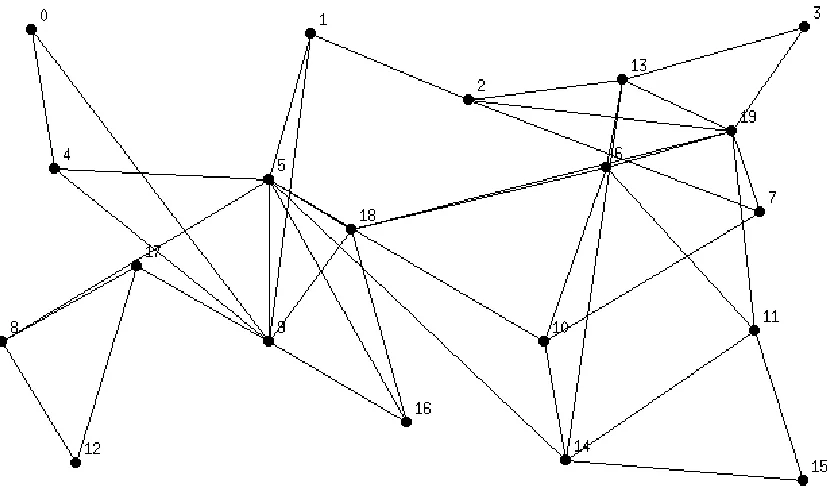
Figure 1 shows an example of a randomly generated 20-node network. In such wide-area
Figure 1: A randomly generated network, 20 nodes, average degree 4.
dynamic function of the reserved link bandwidth. When reserving link bandwidths for a multicast
session, we reserved the same amount of bandwidths on both directions of each full duplex link in
the shared tree carrying that session’s traffic streams. These resources are to be shared among the
traffic streams from all multicast group members3. We adopted this bandwidth reservation scheme
to preserve the symmetricity of the link costs, and hence to keep the network undirected.
The first experiment compares the different shared tree construction algorithms when each of
them is applied to create a single delay-constrained shared multicast tree for a given multicast
group. The optimal algorithm, DiamOPT, is static. It fails if it does not succeed in constructing a
delay-constrained tree spanning all group members. On the other hand, the three heuristics,
RAND-DCSHARED, MinMaxD-RAND-DCSHARED, and DCINITIAL-RAND-DCSHARED, are dynamic. They can
construct delay-constrained shared trees which span only a subset of the multicast group. For a
fair comparison between DiamOPT and the three heuristics, we considered a run of an algorithm
successful only if it results in a tree spanning all multicast group members. For each run of the
experiment we generated a random set of links to interconnect the fixed nodes, we generated random
background traffic for each link to obtain nonzero link costs, and we selected a random multicast
3
This resource reservation scheme resembles the shared reservation style of RSVP [24]. It is suitable mainly for
0 0.2 0.4 0.6 0.8 1
6 8 10 12 14 16 18 20
Probability of group success
Number of group members RAND-DCSHARED MinMaxD-DCSHARED DCINITIAL-DCSHARED DiamOPT
(a)∆=0:035 seconds
0 0.2 0.4 0.6 0.8 1
6 8 10 12 14 16 18 20
Probability of group success
Number of group members RAND-DCSHARED MinMaxD-DCSHARED DCINITIAL-DCSHARED DiamOPT
(b)∆=0:05 seconds
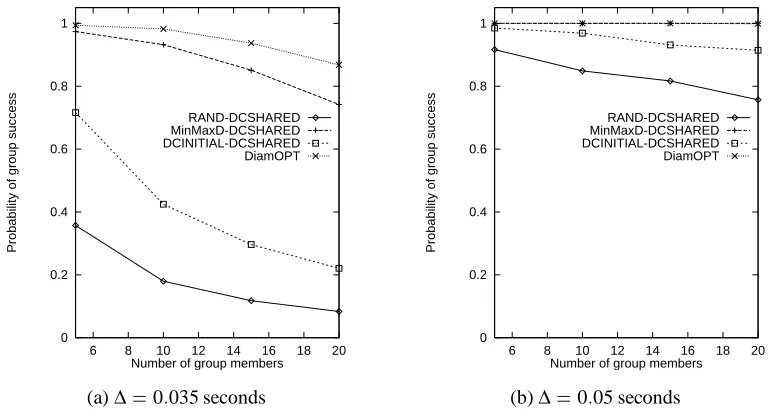
Figure 2: Probability of group success of shared multicast tree construction algorithms, 20 nodes,
average degree 4,
B
min =5 Mbps,B
max =125 Mbps .group. Each link’s background traffic was a random variable uniformly distributed between
B
minand
B
max. The experiment was repeated with different multicast group sizes and different delayconstraint values. We measured the probability of group success of an algorithm and the cost of
the shared tree. The probability of group success is defined as the probability that an algorithm
succeeds in constructing a delay-constrained shared tree spanning all group members. We selected
the link loads such that no links were saturated, and hence delay constraint violation was the only
cause of failure. The experiment was run repeatedly until confidence intervals of less than 5%,
using 95% confidence level, were achieved for all measured quantities. At least 500 networks were
simulated for each measurement.
Figure 2 shows the probability of group success of the different algorithms versus the group size
for 20-node networks for two settings of the delay constraint,∆, 0.035 seconds and 0.05 seconds. The probability of group success decreases as the multicast group size increases. DiamOPT always
succeeds in finding a solution if one exists. Unfortunately, none of the three heuristics is guaranteed
to find a solution if one exists. MinMaxD-DCSHARED achieves probabilities of group success
within 10% from DiamOPT when the delay constraint is set to 0.035 seconds. Both DiamOPT
10 15 20 25 30 35 40 45 50 55 60
6 8 10 12 14 16 18 20
% excess cost relative to DiamOPT
Number of group members RAND-DCSHARED MinMaxD-DCSHARED DCINITIAL-DCSHARED
(a)∆=0:035 seconds
10 15 20 25 30 35 40 45 50 55 60
6 8 10 12 14 16 18 20
% excess cost relative to DiamOPT
Number of group members RAND-DCSHARED MinMaxD-DCSHARED DCINITIAL-DCSHARED
(b)∆=0:05 seconds
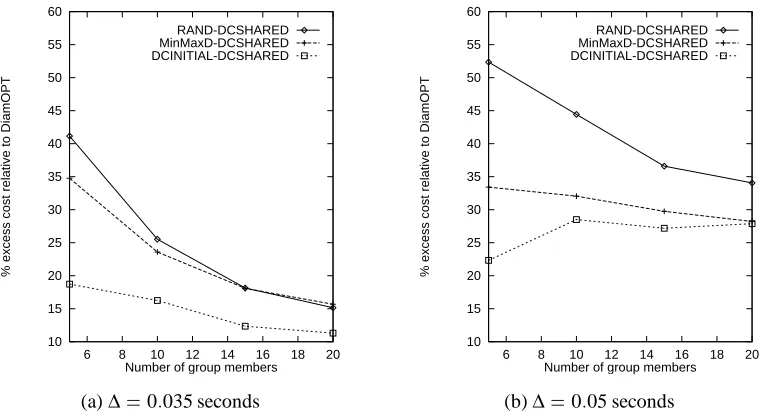
Figure 3: Excess cost of a shared multicast tree relative to DiamOPT, 20 nodes, average degree 4,
B
min =5 Mbps,B
max =125 Mbps.is 0.035 seconds. We tried to repeat this experiment using a delay constraint value of 0.02 seconds,
but the probabilities of group success of all algorithms were very low, so we could not obtain good
confidence intervals. MinMaxD-DCSHARED’s good performance indicates clearly the advantage
of using delay as a criterion for selecting the multicast center, particularly for small delay constraint
values.
The percentage excess cost of a shared multicast tree relative to the cost of the optimal tree
is given in figure 3. The costs of all three heuristics increase relative to optimal when the delay
constraint is relaxed from 0.035 seconds to 0.05 seconds. DCINITIAL-DCSHARED has the best
cost performance of the three heuristics, but the difference between it and MinMaxD-DCSHARED
is not more than 15%.
We repeated the first experiment using 100-node networks. Unfortunately, DiamOPT could not
be applied to networks of that size due to its excessive execution times. DCINITIAL constructs
an initial shared tree, and RAND and MinMaxD also construct an initial shared tree consisting of
the center node only. After that multicast group members, not already in the initial tree, attempt
to join the tree one member at a time using DCSHARED. When running the first experiment on
100-node networks, we measured the probability that a multicast group member succeeds in joining
0 0.2 0.4 0.6 0.8 1
0.015 0.02 0.025 0.03 0.035 0.04 0.045 0.05 0.055
Probability of member success
Delay Constraint (seconds) RAND-DCSHARED MinMaxD-DCSHARED DCINITIAL-DCSHARED
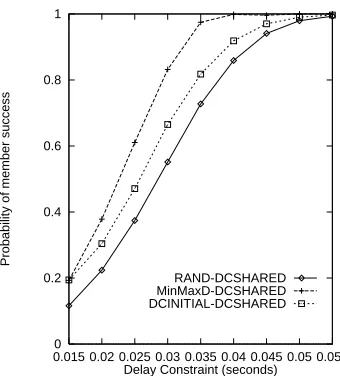
Figure 4: Probability of member success of shared multicast tree construction algorithms, 100
nodes, average degree 4, 25 multicast group members,
B
min =5 Mbps,B
max=125 Mbps.of group success discussed above. Figure 4 shows the probability of member success versus the
delay constraint for a multicast group of 25 members. MinMaxD-DCSHARED’s performs better
than the other two heuristics. The probability of member success is independent of the group
size, because the success of a member’s attempt to join a shared tree, i.e., the success of the
DCSHARED routing algorithm, depends only on the least-delay value between that member and
the center [23]. MinMaxD chooses the node with least maximum delay to any group member to be
the center. Thus increasing the probability that DCSHARED succeeds. MinMaxD-DCSHARED’s
good performance with respect to enabling individual members to join the shared tree leads to its
superior performance relative to the other heuristics with respects to successfully constructing a
shared tree that spans all group members, as has been shown already in figure 2.
In the first experiment, we studied a single multicast group, and constructed a single shared
multicast tree. MinMaxD-DCSHARED has higher probability of success than
DCINITIAL-DCSHARED. However, the shared trees DCINITIAL-DCSHARED constructs are of lower costs.
The performance of RAND-DCSHARED is poor with respect to both the probability of success
and the tree cost.
We conducted a second experiment in which we started with an unloaded networks, and kept
adding multicast groups and constructing the corresponding shared trees until the cumulative tree
considered a shared tree construction operation, and the corresponding multicast session, a failure
if, after all multicast group members attempt to join the tree, the final tree spans less than two group
members. The reason is that any useful communication activity requires at least two participants. A
member node may fail to join the shared tree either because no delay constraint violation or because
of link saturation. Bandwidth could be reserved on a link until its cost exceeded 85% of the link’s
capacity, then the link got saturated. Before the routing algorithm, DCSHARED, added a link to
the shared tree, it verified that sufficient unreserved bandwidth was available on that link. When
a link was added to a shared tree, a bandwidth of 5 Mbps was reserved on that link. We repeated
the experiment with randomly chosen multicast groups of different sizes. Our objective was to
determine how efficiently the shared tree construction algorithms manage the network bandwidth.
The experiment was repeated, until the confidence intervals for all measured quantities were
<
5%using the 95% confidence level. Similar to the first experiment, a random network was generated
before each run of the experiment. This experiment could not be applied to the optimal algorithm,
DiamOPT, because of its large execution times.
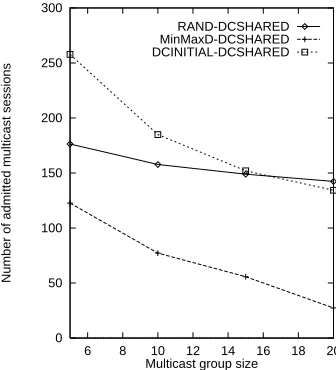
The first quantity we measured in the second experiment was the number of successfully
admit-ted multicast sessions at the end of each run of the experiment. Figure 5 shows the measured values
versus the multicast group size for 20-node networks and a delay constraint value of 0.035
sec-onds. As the multicast group size increases, the size of the shared tree increases, and hence the total
amount of network bandwidth reserved for that tree also increases. Therefore, the network saturates
after admitting less sessions. When the multicast group size is small, DCINITIAL-DCSHARED
admits the largest number of sessions followed by RAND-DCSHARED. For large group sizes,
both algorithms have comparable performance. MinMaxD-DCSHARED’s performance is
approx-imately 25% worse than DCINITIAL-DCSHARED’s performance when the group size is small and
its performance deteriorates fast as the group size increases. Measuring the number of successfully
admitted sessions was not sufficient, since the size of the corresponding multicast trees may vary
largely, because a multicast session was considered successful if the corresponding tree spanned
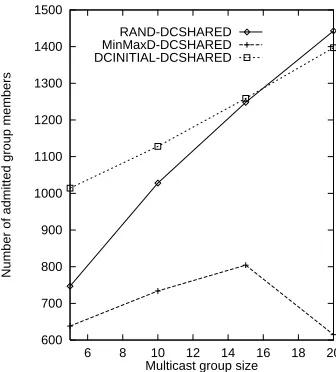
at least two of its group members. Therefore, we also measured the number of admitted group
members for all successfully admitted sessions. The number of admitted group members is shown
in figure 6.
0 50 100 150 200 250 300
6 8 10 12 14 16 18 20
Number of admitted multicast sessions
Multicast group size RAND-DCSHARED MinMaxD-DCSHARED DCINITIAL-DCSHARED
Figure 5: Number of admitted multicast sessions, 20 nodes, average degree 4,∆=0.035 seconds.
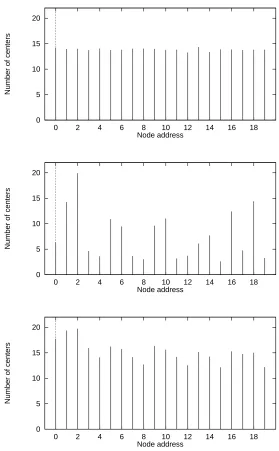
number of centers allocated to each node at the end of each run of the experiment. Note that the
positions of the nodes are fixed, and only random links are created for each run. The fixed node
positions are given in figure 1. Each node has an integer valued address as shown in the figure.
Figure 7 shows the average number of centers allocated at each node.
Figure 7(a) shows that, as expected, The random center selection algorithm, RAND, results
in a uniform distribution of the centers over all nodes in the network. The uniform distribution
of the centers leads to uniform load distribution over the links, and therefore the probability of
traffic concentration at any individual links is very small. However, selecting the centers randomly,
may result in cases where the center is too far from the multicast group members and no
delay-constrained paths exist from the center to some, or even any, group members. These cases occur
more frequently when the multicast group size is small. That is why RAND-DCSHARED’s
performance is not as good as DCINITIAL-DCSHARED’s performance for small group sizes.
The results given in this paper for RAND-DCINITIAL confirm the results given in [18] for
unconstrained shared multicast trees. Random center selection results in good load balancing and
reduces the traffic concentration on any particular links.
On the contrary to RAND, MinMaxD favors to select the center from among the nodes that are
near the geometric center of the network, e.g., nodes 2 and 18, as can be seen from figure 7(b). The
reason is that MinMaxD’s center selection criterion is the maximum delay to any multicast group
600 700 800 900 1000 1100 1200 1300 1400 1500
6 8 10 12 14 16 18 20
Number of admitted group members
Multicast group size RAND-DCSHARED MinMaxD-DCSHARED DCINITIAL-DCSHARED
Figure 6: Number of admitted multicast group members, 20 nodes, average degree 4, ∆=0.035
seconds.
is more probable that the nodes close to the geometric center will minimize the selection criterion.
Therefore, MinMaxD-DCSHARED keeps allocating centers at these nodes. The results are heavy
traffic concentration at the links attached to these nodes and unbalanced load distribution, and the
network saturates after admitting much fewer sessions than the other algorithms.
Naturally, the number of admitted group members increases as the multicast group size increases
as can be seen from figure 6. However, for MinMaxD-DCSHARED, this value drops when the
group size approaches the network size, i.e., in the broadcast case. In the broadcast case, the group
members are the same for all sessions. MinMaxD uses the static delay vectors for center selection.
It keeps selecting the same node to be the center irrespective of the costs of the links attached to that
node. This results in extremely heavy traffic concentration on these links, and very early network
saturation. Thus MinMaxD-DCSHARED’s performance in the broadcasting case is even worse
than its performance in the general multicast cases.
DCINITIAL constructs an initial delay-constrained path and selects the node closest to the
mid-dle of that path to be the center. DCINITIAL is a delay-constrained least-cost routing algorithm.
Therefore, it avoids using heavily loaded, high-cost links. This is good for load balancing purposes.
In addition, the success of DCINITIAL in constructing an initial path ensures that the final shared
tree constructed by DCINITIAL-DCSHARED spans at least two group members. No such
0 5 10 15 20
0 2 4 6 8 10 12 14 16 18
Number of centers
Node address
0 5 10 15 20
0 2 4 6 8 10 12 14 16 18
Number of centers
Node address
0 5 10 15 20
0 2 4 6 8 10 12 14 16 18
Number of centers
Node address
Figure 7: The average number of centers at each node at network saturation time for the 20-node
2 4 6 8 10 12 14 16 18 20
6 8 10 12 14 16 18 20
Number of admitted group members per mutlicast session
Multicast group size RAND-DCSHARED MinMaxD-DCSHARED DCINITIAL-DCSHARED
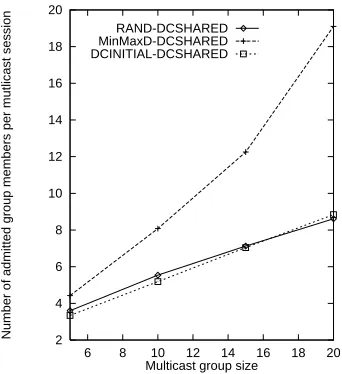
Figure 8: Number of admitted group members per multicast sessions, 20 nodes, average degree 4,
∆ =0.035 seconds.
performs better than the other algorithms with respect to the number of admitted sessions (figure 5)
and the total number of admitted group members (figure 6) in case of small group sizes.
How-ever, figure 7(c) shows that selecting the node at the middle of an initial path to be the multicast
center does not result in perfectly uniform distribution of the multicast centers. When the group
size is large, the advantage of having at least two group members in the initial path is no longer
significant. More important in that case is the uniform distribution of the multicast centers which
results in uniform distribution of the network load on all links. That is why RAND-DCSHARED
catches up with DCINITIAL-DCSHARED as the group size increases. In the broadcast case,
RAND-DCSHARED performance is even better than DCINITIAL-DCSHARED’s performance.
In figure 8, we show the average number of group members which successfully join the
shared tree per multicast session. MinMaxD-DCSHARED performs much better than the other
algorithms with that respect, which confirms the results of the first experiment. Thus, we conclude
from the second experiment that MinMaxD-DCSHARED’s only weakness lies in its tendency to
concentrate the centers of multicast sessions at a few nodes, and hence its inability to distribute
the load uniformly over all network links. RAND-DCSHARED and DCINITIAL-DCSHARED
distribute the centers more uniformly throughout the network and therefore they can manage the
6
Conclusions
In this paper, we studied the problem of constructing shared multicast trees subject to a delay
constraint in connection-oriented networks. We formulated the problem as a diameter-constrained
minimum Steiner tree problem, and proved that this problem is NP-complete. We implemented an
optimal algorithm for this problem, DiamOPT. Previous work on shared multicast trees targeted
datagram networks and considered only unconstrained cases.
We divided the problem into two phases. During the first phase, we constructed an initial shared
tree and selected one of its nodes to be the multicast center. We proposed a distributed routing
algorithm, DCSHARED, for the second phase. DCSHARED permits nodes to join and leave the
shared multicast tree dynamically without violating the delay constraint. DCSHARED is
O
(jV
j3
)
messages in the worst case. Our work focused on the first phase. We studied three distributed
heuristics for the first phase of the problem: RAND, MinMaxD, and DCINITIAL. RAND chooses
a random node to be the center. It has no message overhead. MinMaxD chooses the node with
the least maximum delay to any multicast group member to be the center. Its worst case message
complexity is
O
(jV
j2
). DCINITIAL is a heuristic which we proposed to avoid dedicating the
first phase of the problem for center selection only. DCINITIAL does both routing and center
selection. It constructs an initial shared tree consisting of a delay-constrained path between two
group members. Then it selects the node closest to the middle of that path to be the multicast center
and advertizes its address to all nodes. DCINITIAL’s worst case complexity is
O
(jV
j3
)messages.
DCINITIAL makes better use of the first phase of the problem than RAND and MinMaxD, because
the initial shared tree it constructs includes at least two group members. On the other hand, the
initial trees constructed by RAND and MinMaxD consist of the center only.
A first phase heuristic followed by the route selection algorithm, DCSHARED, constitutes a
complete delay-constraint shared tree construction heuristic. We evaluated three such algorithms,
RAND-DCSHARED, MinMaxD-DCSHARED, and DCINITIAL-DCSHARED, in addition to the
optimal algorithm DiamOPT. We ran two simulation experiments. DiamOPT had excessive
exe-cution times, so it could not be applied in some experiments. It is useful only to benchmark other
algorithms. There is no clear winner among the three heuristics. MinMaxD-DCSHARED has
to join those trees than the other two heuristics. DCINITIAL-DCSHARED constructs shared trees
of lower cost than the other two heuristics. RAND-DCSHARED and DCINITIAL-DCSHARED
are more efficient in managing the network resources than DCSHARED.
MinMaxD-DCSHARED causes high traffic concentration at a few links, and hence it results in unbalanced
network loading. So each heuristic has its advantages and disadvantages.
References
[1] M. de Prycker, Asynchronous Tranfer Mode, Solution for Broadband ISDN. Prentice Hall,
3rd ed., 1995.
[2] V. Kompella, J. Pasquale, and G. Polyzos, “Multicast Routing for Multimedia
Communica-tion,” IEEE/ACM Transactions on Networking, vol. 1, no. 3, pp. 286–292, June 1993.
[3] V. Kompella, J. Pasquale, and G. Polyzos, “Two Distributed Algorithms for the Constrained
Steiner Tree Problem,” in Proceedings of the Second International Conference on Computer
Communications and Networking (IC3N ’93), pp. 343–349, 1993.
[4] C. Noronha and F. Tobagi, “Optimum Routing of Multicast Streams,” in Proceedings of IEEE
INFOCOM ’94, pp. 865–873, 1994.
[5] R. Widyono, “The Design and Evaluation of Routing Algorithms for Real-Time Channels,”
Tech. Rep. ICSI TR-94-024, University of California at Berkeley, International Computer
Science Institute, June 1994.
[6] Q. Zhu, M. Parsa, and J. Garcia-Luna-Aceves, “A Source-Based Algorithm for
Delay-Constrained Minimum-Cost Multicasting,” in Proceedings of IEEE INFOCOM ’95, pp. 377–
385, 1995.
[7] Q. Sun and H. Langendoerfer, “Efficient Multicast Routing for Delay-Sensitive Applications,”
in Proceedings of the Second Workshop on Protocols for Multimedia Systems (PROMS ’95),
[8] G. Rouskas and I. Baldine, “Multicast Routing with End-to-End Delay and Delay Variation
Constraints,” in Proceedings of IEEE INFOCOM ’96, pp. 353–360, 1996.
[9] H. Salama, D. Reeves, and Y. Viniotis, “Evaluation of Multicast Routing Algorithms for
Real-Time Communication on High-Speed Networks.” accepted for publication in the IEEE
Journal on Selected Areas in Communications.
[10] L. Wei and D. Estrin, “A Comparison of Multicast Trees and Algorithms,” Tech. Rep.
USC-CS-93-560, Computer Science Department, University of Southern California, September
1993.
[11] R. Karp, “Reducibility among Combinatorial Problems,” in Complexity of Computer
Compu-tations (R. Miller and J. Thatcher, eds.), pp. 85–103, Plenum Press, 1972.
[12] S. Deering, D. Estrin, D. Farinacci, V. Jacobson, C.-G. Liu, and L. Wei, “The PIM Architecture
for Wide-Area Multicast Routing,” IEEE/ACM Transactions on Networking, vol. 4, no. 2,
pp. 153–162, April 1996.
[13] A. Ballardie, P. Francis, and J. Crowcroft, “Core Based Trees (CBT): An Architecture for
Scalable Inter-Domain Multicast Routing,” in Proceedings of ACM SIGCOMM ’93, pp. 85–
95, September 1993.
[14] D. Bertsekas and R. Gallager, Data Networks. Prentice-Hall, 2nd ed., 1992.
[15] D. Wall, Mechanisms for Broadcast and Selective Broadcast. PhD thesis, Stanford University,
June 1980.
[16] L. Wei and D. Estrin, “The Trade-offs of Multicast Trees and Algorithms,” in Proceedings
of the Third International Conference on Computer Communications and Networking (IC3N
’94), pp. 17–24, 1994.
[17] S. Shukla, E. Boyer, and J. Klinker, “Multicast Tree Construction in Network Topologies
with Asymmetric Link Loads,” Tech. Rep. NPS-EC-94-012, Naval Postgraduate School,
[18] K. Calvert, E. Zegura, and M. Donahoo, “Core Selection Methods for Multicast Routing,”
in Proceedings of the Fourth International Conference on Computer Communications and
Networking (IC3N ’95), 1995.
[19] D. Thaler and C. Ravishankar, “Distributed Center-Location Algorithms: Proposals and
Comparisons,” in Proceedings of IEEE INFOCOM ’96, pp. 75–84, 1996.
[20] H. Salama, D. Reeves, and Y. Viniotis, “A Distributed Algorithm for Delay-Constrained
Unicast Routing.” accepted for IEEE INFOCOM ’97, April 1997.
[21] C. Hedrick, “Routing Information
Pro-tocol.” Internet RFC 1058, http://ds.internic.net/rfc/rfc1058.txt, June
1988.
[22] D. Waitzman, C. Partridge, and S. Deering, “Distance Vector Multicast Routing Protocol.”
In-ternet RFC 1075,http://ds.internic.net/rfc/rfc1075.txt, November 1988.
[23] H. Salama, Multicast Routing for Real-time Communication on High-Speed Networks. PhD
thesis, North Carolina State University, Department of Electrical and Computer Engineering,
November 1996. In Preparation.
[24] R. Braden et al., “Resource Reservation Protocol (RSVP) - Version 1 Functional