ABSTRACT
CHAPMAN, LEEANNA TIFFANY YOUNG. Factors Affecting the Development and Evolution of the Teaching Beliefs of Future Geoscience Professors. (Under the direction of David McConnell).
The pedagogical beliefs of university instructors influence how they design their courses and whether they choose to use research-validated teaching methods that have been shown to improve student learning. The next generation of professors will be drawn from today’s graduate students and post-doctoral fellows but we know relatively little about their preparation to use research-validated teaching practices. We followed a broad population of geoscience graduate students and post-docs over a three year period to evaluate changes in teaching beliefs.
This study employed a longitudinal mixed-methods experimental design including surveys, short interviews, and longer case study interviews to: a) collect information on the teaching beliefs of geoscience graduate students and post-doctoral scholars; and b) identify experiences that contributed to the development of reformed teaching beliefs and their interest in an academic career. We collected initial surveys from more than 600 participants and re-surveyed more than 300 of these participants 12-18 months later. We conducted an initial round of interviews with 61 participants and repeat interviews with 31 of these individuals. The survey utilized was the Beliefs about Reformed Teaching and Learning (BARSTL); the interview tool was the Teacher Belief Interview (TBI). Finally, we conducted detailed case study interviews with a sample of ten participants who were either PhD
The data were examined to determine if there was a difference in beliefs about teaching on the basis of factors including number of years in graduate school, teaching assistant (TA) experiences, gender, and participation in professional development. Data from the large initial population were interpreted to show that participation in teaching-related professional development was the experience that was most likely to result in more reformed pedagogical beliefs among graduate students and post-doctoral fellows. Participants who took part in professional development experiences with a duration of a semester or longer exhibited the most reformed beliefs. In addition, females, PhD students and post-doctoral scholars, and participants with teaching assistant experience had statistically more reformed beliefs than their counterparts.
A second round of survey and data collected 12-18 months after the first data collection event revealed that participants who had completed teaching-related professional development in the interim were the only population to experience a statistically significant improvement toward more reformed teaching beliefs. Longer and more rigorous experiences such as pedagogy courses resulted in greater change toward more reformed beliefs
Factors Affecting the Development and Evolution of the Teaching Beliefs of Future Geoscience Professors
by
LeeAnna Tiffany Young Chapman
A dissertation submitted to the Graduate Faculty of North Carolina State University
in partial fulfillment of the requirements for the Degree of
Doctor of Philosophy
Marine, Earth, and Atmospheric Sciences
Raleigh, North Carolina 2017
APPROVED BY:
_______________________________ _______________________________
Dr. David McConnell Dr. Stith Gower
Committee Chair
_______________________________ _______________________________
DEDICATION
BIOGRAPHY
ACKNOWLEDGMENTS
First, I have to acknowledge and thank my family. Nathan, I couldn’t have done this without you. Your support and encouragement (no matter how crazy my idea may be) means the world to me. Mom and Dad, thanks for teaching me to believe that I can do anything. Daphne and Opie, thanks for your endless love and hugs!
A special thanks to my adviser, David McConnell. Thanks for believing in me and helping me grow as a researcher, scientist, instructor, and individual. You showed me that it’s possible to love your job and helped me become more confident in all aspects of my life. I am also very appreciative of my other committee members: Karen McNeal, John Nietfeld, and Tom Gower for their guidance and suggestions along the way.
TABLE OF CONTENTS
LIST OF TABLES ... x
LIST OF FIGURES ... xii
CHAPTER 1: Introduction ... 1
References ...3
CHAPTER 2: Promoting the development of reformed pedagogical beliefs among future geoscience faculty: a mixed methods study ... 4
Abstract ...4
Introduction ...4
Background ...6
Methods ...8
Population ...8
Instruments ...10
Beliefs About Reformed Science Teaching and Learning (BARSTL) ... 10
Teacher Belief Interview (TBI) ... 12
Data Analysis ...13
Results ...14
BARSTL Results ... 14
TBI Results ... 21
Discussion...31
Acknowledgements ...36
References ...37
CHAPTER 3: Tracking the evolution of teaching beliefs among future geoscience faculty ... 43
Abstract ...43
Introduction ...43
Background ...44
Methods ...45
Population ...47
Instruments ...47
Beliefs About Reformed Science Teaching and Learning (BARSTL) survey ... 47
Teacher Belief Interview (TBI) ... 48
Data Analysis ...49
Results ...50
BARSTL Survey Results ... 50
TBI Results ... 54
Discussion...60
Conclusions ...62
Limitations ...62
Acknowledgements ...63
CHAPTER 4: What? When? How? Case studies exploring experiences motivating the
development of reformed teaching beliefs among future geoscience faculty. ... 67
Abstract ...67
Introduction ...67
Purpose of this study ...69
Methods ...69
Participants ...72
Results: Emergent Themes...74
Influences on wanting a career involving teaching ... 74
Influences on wanting to teach ... 77
Influences on teaching beliefs ... 81
Implications ...85
Conclusions ...88
Limitations ...89
Acknowledgements ...90
References ...91
APPENDICES ... 94
Appendix 1: Beliefs About Reformed Science Teaching and Learning (BARSTL) Survey ...95
Appendix 2: Additional survey questions included in the BARSTL survey ...100
LIST OF TABLES
CHAPTER 1: Introduction
Table 1: Research questions guiding this study. ... 2
CHAPTER 2: Promoting the development of reformed pedagogical beliefs among future geoscience faculty: a mixed methods study Table 1: TBI questions. ... 12
Table 2: BARSTL variables examined (PD = professional development). ... 16
Table 3: Average BARSTL scores by gender and type of Professional Development (PD) experience. ... 18
Table 4: Mean scores on the BARSTL sub-categories among low, medium and high scoring participants. ... 20
Table 5: TBI variables examined ... 27
Table 6: Average TBI scores by gender and type of Professional Development (PD) experience. ... 29
Table 7: Average TBI scores by question among low, medium and high scoring participants. ... 30
CHAPTER 3: Tracking the evolution of teaching beliefs among future geoscience faculty Table 1: TBI questions ... 49
Table 2: BARSTL and TBI variables examined (PD = professional development)... 52
Table 3: BARSTL score change by professional development (PD) type. ... 53
Table 4: TBI score change by professional development (PD) category ... 56
CHAPTER 4: What? When? How? Case studies exploring experiences motivating the development of reformed teaching beliefs among future geoscience faculty
LIST OF FIGURES
CHAPTER 1: Introduction
Figure 1: Experimental design ... 1 CHAPTER 2: Promoting the development of reformed pedagogical beliefs among future geoscience faculty: a mixed methods study
Figure 1: Map indicates the geographical distribution of participants. Lighter colors represent a small number of participants from that state; red signifies states with greater than 20
participants. ... 9 Figure 2: Academic program (a) and institution type (b) of participants. “Research”
institutions are doctoral-granting with high or very high research activity. “Doctoral” institutions have at least 20 doctorate degrees and low to moderate research activity. An institution is considered “international” regardless of classification if located outside the US. “Other” includes baccalaureate colleges, special focus institutions, and institutions not
classified by the Carnegie Foundation for the Advancement of Teaching. ... 10 Figure 3: Distribution of BARSTL scores of the 607 participants. BARSTL scores were normally distributed with an average of 85 and standard deviation of 7. ... 15 Figure 4: BARSTL scores broken down by the duration of teaching-related professional development experiences. Participants who had participated in semester-long PD had an average BARSTL score of 89 followed by an average of 86 for participants with PD less than a semester long. Participants with no PD had an average BARSTL score of 84. ... 17 Figure 5: Average BARSTL scores broken down by gender. Females had a higher average BARSTL score of 86 versus males with an average of 84 (p<0.001; Cohen’s d=0.29). ... 18 Figure 6: Distribution of TBI scores for study participants (n=60). The average TBI score was 20 with a standard deviation of 3. ... 22 Figure 7: Histograms showing the distribution of interview codes for each TBI question. ... 24 Figure 8: TBI scores of participants categorized by teaching-related professional
Figure 9: Average TBI scores of males versus females. Females had a higher average TBI score of 21 than males with an average of 19 (p=0.026; Cohen’s d=0.59). ... 29 CHAPTER 3: Tracking the evolution of teaching beliefs among future geoscience
faculty
Figure 1: Average BARSTL scores among all 607 phase one participants during phase one, 308 phase two participants during phase one, and 308 phase two participants during phase two (a); difference in phase one and phase two (phase two – phase one) BARSTL scores between phase two participants (b). ... 51 Figure 2: Average gain in BARSTL score from phase one to phase two by duration of
professional development experience. Participants who took part in long-term PD
experienced much higher BARSTL gains than those with shorter or no PD experiences. .... 54 Figure 3: Average TBI scores among all 61 phase one participants during phase one, 31 phase two participants during phase one, and 31 phase two participants during phase two (a); difference in phase one and phase two (phase two – phase one) BARSTL scores between phase two participants (b). ... 55 Figure 4: Difference in TBI score from phase one to phase two by duration of professional development. Participants who have taken part in long-term PD had a statistically significant higher TBI gain than participants with shorter or no PD. ... 57 CHAPTER 4: What? When? How? Case studies exploring experiences motivating the development of reformed teaching beliefs among future geoscience faculty
Figure 1: A: Phase one BARSTL scores of the entire study population (n=609); B: Phase two BARSTL scores (n=308); C: Phase one TBI scores of the entire study population (n=61); D: Phase two TBI scores (n=31). Arrows indicate score of each case study participant. ... 73 Figure 2: The differences between influences on the teaching beliefs of Thomas and Danielle model the differences between reformed and traditional participants, respectively.
CHAPTER 1: Introduction
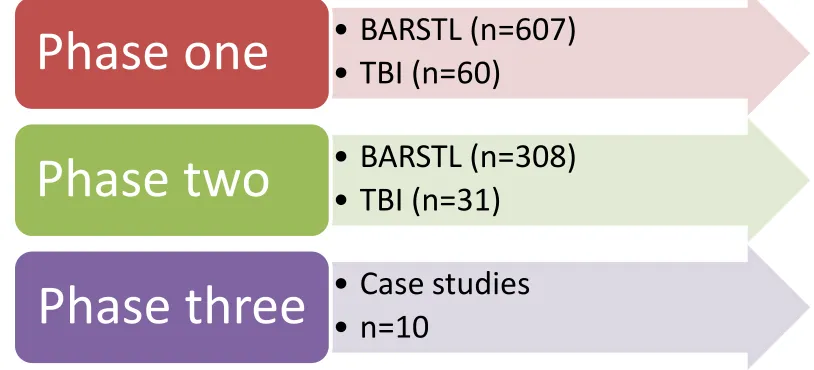
This work consists of a longitudinal mixed methods study encompassing three years and three phases (Figure 1). Phase one of the study used surveys and short interviews to characterize the teaching beliefs of more than 600 geoscience graduate students and post-doctoral scholars. Phase two repeated this process to determine change in teaching beliefs for more than 300 of the original participants twelve to eighteen months later. Phase one and phase two utilized the Beliefs About Reformed Science Teaching and Learning survey
(BARSTL; Sampson, Enderle, & Grooms, 2013) and the Teacher Belief Interview (TBI; Luft & Roehrig, 2007). In phase three, ten participants were selected who participated in both prior phases. Phase three involved detailed case study interviews to determine what
experiences lead participants to become interested in an academic career and contributed to the development of their teaching beliefs. Each chapter represents one phase of the study.
• BARSTL (n=607)
• TBI (n=60)
Phase one
• BARSTL (n=308)
• TBI (n=31)
Phase two
• Case studies
• n=10
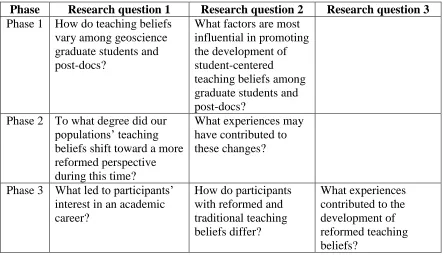
Table 1: Research questions guiding this study.
Phase Research question 1 Research question 2 Research question 3 Phase 1 How do teaching beliefs
vary among geoscience graduate students and post-docs?
What factors are most influential in promoting the development of student-centered teaching beliefs among graduate students and post-docs?
Phase 2 To what degree did our populations’ teaching beliefs shift toward a more reformed perspective during this time?
What experiences may have contributed to these changes?
Phase 3 What led to participants’ interest in an academic career?
How do participants with reformed and traditional teaching beliefs differ?
References
Luft, J. A., & Roehrig, G. H. (2007). Capturing Science Teachers ’ Epistemological Beliefs : The Development of the Teacher Beliefs Interview. Electronic Journal of Science Education, 11(2), 38–63.
CHAPTER 2: Promoting the development of reformed pedagogical beliefs among future geoscience faculty: a mixed methods study
Abstract
The next generation of professors will be drawn from today’s graduate students and post-doctoral fellows but we know relatively little about their preparation to use research-validated teaching practices. This study characterizes the teaching beliefs of graduate students and post-doctoral fellows, the future geoscience instructors. We analyzed results from more than 600 participants who completed the Beliefs about Reformed Teaching and Learning (BARSTL) survey and a subpopulation of sixty participants who responded to the Teacher Belief Interview (TBI). We compared teaching beliefs on the basis of a range of factors including gender, teaching assistant experiences, and participation in professional development. Our results indicate the factor most likely to result in reformed pedagogical beliefs is participation in teaching-related professional development, especially longer more rigorous experiences.
Introduction
primarily interested in a faculty career, but feel that they are not adequately prepared for some of the responsibilities a faculty job entails (Golde & Dore, 2001, 2004). Many current graduate students and post-docs may soon be teaching college courses, but most have minimal training in effective teaching practices as doctoral programs focus almost
exclusively on research (Austin, 2010). The pedagogical beliefs of instructors impact how they design and structure their courses and whether they choose to use research-validated teaching methods that have been shown to improve student learning (Freeman et al., 2014; Woodbury & Gess-Newsome, 2002). Graduate students have opportunities to gain direct experience teaching as teaching assistants, to observe teaching practices in their own classes, to discuss the teaching experience with peers and mentors, and to participate in a variety of professional development programs. They are frequently confronted with opportunities to observe and participate in teaching. How do these experiences shape the teaching beliefs of potential future professors?
Background
An instructor’s teaching beliefs are one of the fundamental constructs that control changes in practice (Woodbury & Gess-Newsome, 2002). Teaching beliefs are tacit
assumptions about course content and situational factors including student experiences and classroom settings and directly impact how knowledge is presented to students (Kagan, 1992). However, the teaching beliefs of university STEM faculty are often deeply engrained and resistant to change (Henderson & Dancy, 2007). In contrast, the pedagogical beliefs of graduate students and post-doctoral fellows are more malleable and are influenced by both professional and personal experiences (Southerland, Sowell, Blanchard, & Granger, 2010). New instructors rely on their own ideas about how students learn when deciding how to teach (Gess-Newsome et al., 2014). A substantial majority (83%) of respondents to a survey on doctoral education noted that the enjoyment of teaching motivated them to become faculty, and approximately half (51%) reported that they participated in a workshop or seminar on teaching in their discipline (Golde & Dore, 2001).
extensive lecture is greater in STEM fields than in other disciplines (Hurtado et al., 2012). If future instructors are not trained in the implementation of research-validated teaching strategies, they will likely teach as they were taught (Halpern & Hakel, 2002).
Researchers face many challenges when investigating instructional beliefs. Classroom observations can be misleading and questions (written or oral) may not expose ideas that influence decision making (Yerushalmi, Henderson, Heller, Heller, & Kuo, 2007). Carefully designed interviews featuring open-ended questions permit deeper exploration of teaching practices and beliefs of instructors and allow unexpected issues to emerge (AAAS, 2012). Interviews have many advantages over surveys as they provide flexibility to ask follow-up questions, to identify new topics, to collect both qualitative and quantitative data, and to provide insight into the reasons behind participant’s beliefs. Interviewing as a data collection method also has many challenges (AAAS, 2012) as interviews can be time and labor
intensive (including design, delivery, and analysis) and may require training or experience to accurately collect and analyze responses. Further, interviews utilize self-report data from the interviewee which feature personal perceptions and may not accurately align with
measurements or observations determined from other instruments (Frechtling, 2002). Because of these challenges, interviews are often used in research studies as an
accompaniment to another instrument, such as a survey or observations. This study used a mixed-methods approach that combined survey data with results from a suite of interviews.
Methods
The primary goal of this research is to obtain a detailed understanding of the pedagogical beliefs of geoscience graduate students and post-doctoral fellows. An
exploratory sequential design was employed, first using a survey to explore quantitative data and then using interviews to collect qualitative data to help explain the quantitative results in more depth. Data collection initially consisted of the Beliefs About Reformed Science Teaching and Learning (BARSTL) survey (Sampson, Enderle, & Grooms, 2013) and some demographic questions. This was followed by an interview protocol that included the Teacher Belief Interview questions (Luft & Roehrig, 2007) and additional questions to designed to collect information on participant experiences. Previous studies have utilized the BARSTL and TBI together to represent participants’ pedagogical beliefs (Pelch &
McConnell, 2016; Ryker, 2014). All participants completed the BARSTL and demographic survey, while a subset of 10 percent of the population were also interviewed using the TBI. TBI participants were chosen to represent the entire range of BARSTL survey scores. The Institutional Review Board for Research with Human Subjects approved all data collection procedures.
Population
Graduate students and post-docs in more than 150 geoscience departments or
programs were emailed and invited to participate. Participants were recruited from the top ten geoscience degree granting institutions for four-year faculty (AGI, 2014) and top earth
students in at least one geoscience graduate program from each state in the US were invited to participate (Figure 1). Participants were also sought from the 2014 Preparing for an Academic Career in the Geosciences workshop
(http://serc.carleton.edu/NAGTWorkshops/careerprep2014/index.html) and the 2014
Geological Society of America annual conference in an effort to obtain a diverse population.
Figure 1: Map indicates the geographical distribution of participants. Lighter colors represent a small number of participants from that state; red signifies states with greater than 20
participants.
Figure 2: Academic program (a) and institution type (b) of participants. “Research” institutions are doctoral-granting with high or very high research activity. “Doctoral” institutions have at least 20 doctorate degrees and low to moderate research activity. An institution is considered “international” regardless of classification if located outside the US. “Other” includes baccalaureate colleges, special focus institutions, and institutions not classified by the Carnegie Foundation for the Advancement of Teaching.
Instruments
Beliefs About Reformed Science Teaching and Learning (BARSTL)
The BARSTL is a 32-item Likert-type self-report questionnaire designed to quantify an instructor’s pedagogical beliefs are relative to reformed-based teaching of science
(Sampson et al., 2013). Participants indicate whether they strongly disagree, disagree, agree, or strongly agree with each item, represented by a statement. Half of the BARSTL statements are phrased from a traditional perspective and are reverse scored. Possible BARSTL scores range from 32 to 128 points, with higher scores reflecting more reformed, student-centered beliefs. The BARSTL has four categories with eight statements each. The four sub-categories are: PhD 60% n=362 Masters 35% n=211 Post-doc 5% n=34 Research 84% Doctoral 3% Master's 6%
International 4% Other 3%
1. How people learn about science 2. Lesson Design and Implementation
3. Characteristics of Teachers and the Learning Environment 4. Nature of the Science Curriculum
The BARSTL is a validated, reliable (α=0.77, p=0.001) survey tool (Sampson et al., 2013). We also calculated reliability for our use of the tool using Winsteps software.
Winsteps calculates both item and person reliabilities using logit values. Analysis revealed a person reliability of 0.74 with person separation of 1.7 and item reliability of 1.0 with item separation of 21.5. These results indicate the BARSTL displays good internal reliability and construct validity and is an acceptable measurement instrument (Boone, Townsend, & Staver, 2011).
Teacher Belief Interview (TBI)
The TBI (Luft & Roehrig, 2007) is a semi-structured interview with coding maps designed to capture the epistemological beliefs of participants. The TBI consists of seven focused questions pertaining to teaching and learning (Table 1). The TBI shows a strong significant correlation with classroom observations of teaching practice (Ryker et al., 2013). Only PhD students and post-docs were invited to participate in interviews. All interviews were conducted by the first author, were recorded and transcribed using an online
transcription service, and were coded using the protocol outlined by Luft and Roehrig (2007). One quarter of the interviews were co-coded with an independent colleague not involved in the research to assess research reliability. Inter-rater reliability analysis found a Cohen’s Kappa value of 0.90 between raters which qualifies as “almost perfect agreement” (Viera & Garrett, 2005). Due to strong agreement, the remaining interviews were coded by the first author alone.
Table 1: TBI questions.
1. How do you describe your role as a teacher?
2. How do you know when your students understand a concept in class? 3. How do you decide when to move on to a new topic in your class? 4. In your class, how do you decide what to teach or what not to teach? 5. How do your students learn science best?
Each answer to the seven questions was individually coded on a five point scale (1: traditional, 2: instructional, 3: transitional, 4: responsive, 5: reformed). Traditional and instructive responses are considered to represent instructor-centered views, the idea that science is a series of facts and rules. Transitional responses indicate that science is objective, consistent, and connected. Responsive and reformed responses are considered to represent student-centered teaching beliefs, where science is seen to be dynamic and integrated within social and cultural constructs. Possible TBI scores range from 7 to 35, with a maximum score of 35 representing the most reformed pedagogical beliefs.
Data Analysis
Results
BARSTL Results
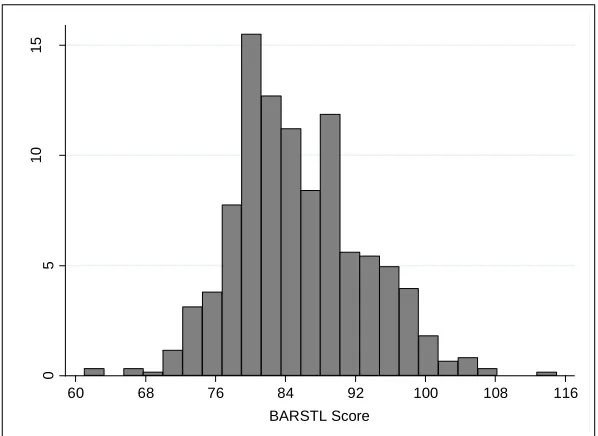
Figure 3: Distribution of BARSTL scores of the 607 participants. BARSTL scores were normally distributed with an average of 85 and standard deviation of 7.
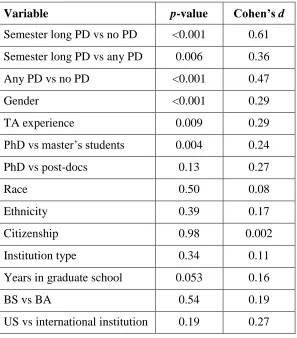
We examined the relationship between BARSTL scores and several demographic variables (Table 2). Most demographic variables did not significantly influence BARSTL scores. The type of institution participants attended as classified by the Carnegie Foundation was not statistically significant, nor was there a statistically significant difference in scores due to race, ethnicity, citizenship, US versus international institution, PhD versus post-doc, undergraduate degree of Bachelors of Science versus Bachelors of Arts, or number of years in graduate school (Table 2). However, we did see contrasts in BARSTL scores on the basis of professional development, gender, teaching assistant experience, and graduate student rank (Table 2).
0
5
10
15
Pe
rce
n
t
60 68 76 84 92 100 108 116
Table 2: BARSTL variables examined (PD = professional development).
Variable p-value Cohen’s d
Semester long PD vs no PD <0.001 0.61 Semester long PD vs any PD 0.006 0.36 Any PD vs no PD <0.001 0.47
Gender <0.001 0.29
TA experience 0.009 0.29
PhD vs master’s students 0.004 0.24
PhD vs post-docs 0.13 0.27
Race 0.50 0.08
Ethnicity 0.39 0.17
Citizenship 0.98 0.002
Institution type 0.34 0.11
Years in graduate school 0.053 0.16
BS vs BA 0.54 0.19
US vs international institution 0.19 0.27
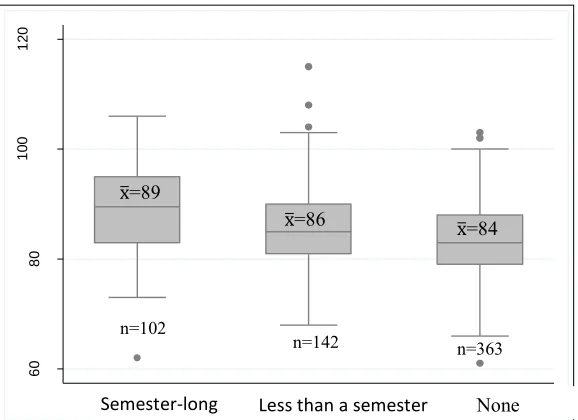
of 89 compared with an average of 86 of those with PD less than a semester long (Figure 4; p=0.006; Cohen’s d=0.36).
Figure 4: BARSTL scores broken down by the duration of teaching-related professional development experiences. Participants who had participated in semester-long PD had an average BARSTL score of 89 followed by an average of 86 for participants with PD less than a semester long. Participants with no PD had an average BARSTL score of 84.
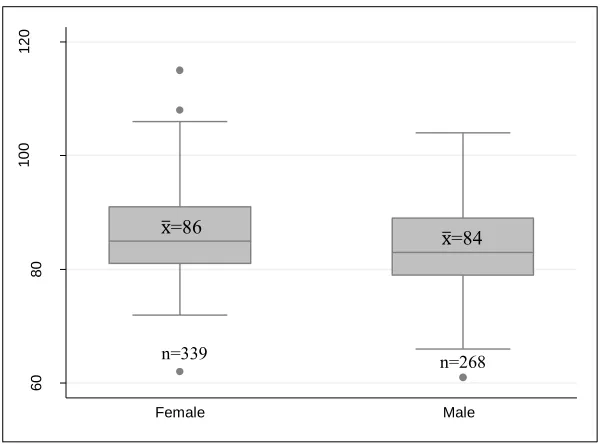
After participation in professional development, the next most significant variable on BARSTL score was gender, which had a small effect size (Table 2; p<0.001; Cohen’s d=0.29). Female participants averaged statistically higher BARSTL scores (86) than males
(84; Figure 5). A larger proportion of female participants (19.8%) had completed semester-long PD experiences than male participants (13.4%). However, females scored higher than males on every PD category (Table 3). In addition, we conducted a two-way ANOVA to
60 80 1 0 0 1 2 0 B A RS T L S co re
1 3 4
Semester-long Less than a semester None
n=102
n=142 n=363
x̅=89
check for interaction effects between professional development type and gender. There were no statistically significant interaction effects between gender and PD type (p=0.1052)
Table 3: Average BARSTL scores by gender and type of Professional Development (PD) experience.
No PD Single-day PD Multi-day PD Semester PD Female 84 (n=199) 88 (n=36) 87 (n=37) 90 (n=67)
Male 83 (n=164) 86 (n=39) 83 (n=29) 87 (n=36)
Figure 5: Average BARSTL scores broken down by gender. Females had a higher average BARSTL score of 86 versus males with an average of 84 (p<0.001; Cohen’s d=0.29).
60
80
1
0
0
1
2
0
BAR
ST
L
Sco
re
Female Male
x̅=86 x̅=84
Experience as a teaching assistant also has a statistically significant effect on
BARSTL score (p=0.009), with a small effect size (Cohen’s d=0.29). Participants who have been a teaching assistant or instructor at least once had a higher average BARSTL score of 86 versus the non-teaching assistant average of 84. PhD students had a statistically
significant (p=0.004) higher BARSTL average of 86 than master’s students’ average of 84, with a small effect size (Cohen’s d=0.24; Table 2). BARSTL scores of PhD students and post-docs showed no statistical difference (Table 2) and will be considered together as a single population hereafter as PhD students.
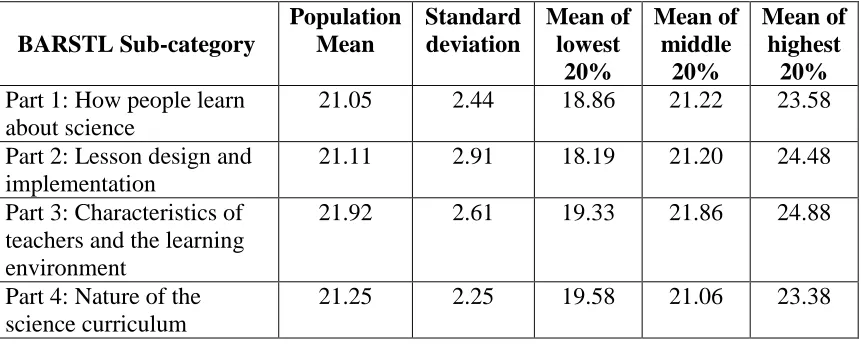
Table 4: Mean scores on the BARSTL sub-categories among low, medium and high scoring participants. BARSTL Sub-category Population Mean Standard deviation Mean of lowest 20% Mean of middle 20% Mean of highest 20% Part 1: How people learn
about science
21.05 2.44 18.86 21.22 23.58 Part 2: Lesson design and
implementation
21.11 2.91 18.19 21.20 24.48 Part 3: Characteristics of
teachers and the learning environment
21.92 2.61 19.33 21.86 24.88
Part 4: Nature of the science curriculum
21.25 2.25 19.58 21.06 23.38
inquiry instead of through a lecture, a reading, or a demonstration,” the most reformed 20% responded with mostly “strongly agree,” (x̅=3.50) while the most traditional 20% responded with “disagree” or “agree” (x̅=2.48). Item 16: “Assessments in science classes should only be given after instruction is completed; that way, the teacher can determine if the students have learned the material covered in class” also showed significant variation between groups. This statement is reverse-scored, in which “strongly agree” would score a “1.” The reformed group responded with “disagree” and “strongly disagree” (reversed x̅=3.21) while the traditional group responded with mainly “agree” (reversed x̅=2.18).
TBI Results
Based on visual inspection of the TBI quantile-quantile (Q-Q) plot, data are normally distributed. A kurtosis value of 2.3 with a skewness value of -0.29 also support the
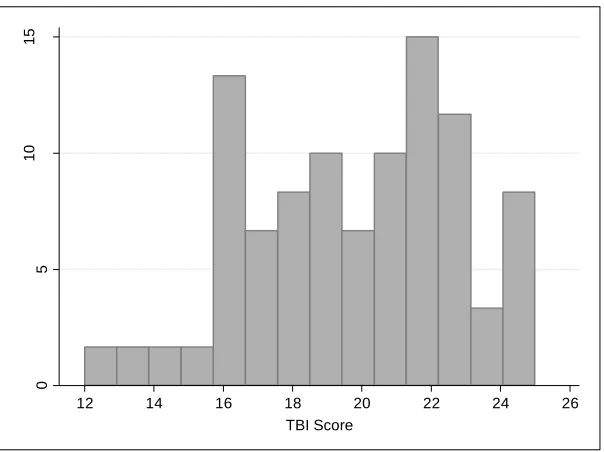
Figure 6: Distribution of TBI scores for study participants (n=60). The average TBI score was 20 with a standard deviation of 3.
The lowest TBI score was 12, with the individual responding with a either traditional or instructive responses on each question. The highest TBI score was 25, with individual question responses coding as transitional, responsive, or reformed. Responses to the question “How do your students learn science best?” highlight the difference between these extremes. Jacob (all names used are pseudonyms), the individual with the most traditional teaching beliefs responded “From a teacher who is well organized and presents material in a logical organized manner and especially from homework assignments.” Emily, a more reformed participant, responded “I think it just depends on the students. I think it’s very individual. I think a mixture of all things. Just being told stuff isn’t enough. They need to be able to do an activity and get involved and get them thinking about it themselves. Think about it rather
0
5
10
15
Pe
rce
n
t
12 14 16 18 20 22 24 26
than just telling them. And also working as a group I think is a very big help in terms of learning.”
Figure 7: Histograms showing the distribution of interview codes for each TBI question.
The TBI question that participants scored lowest on was “How do you decide when to move on to a new topic in your class?” The low score was primarily due to a lack of control and contemplation of this decision. Many individuals coded as instructive by mentioning assigning quizzes or homework to determine student understanding before moving to a new topic (Figure 7c). Some individuals mentioned being required to follow the syllabus or
a
b
c a
e
f
g
follow the direction of their supervisor, resulting in a traditional code. Ethan mentioned “Well, as a teaching associate doing lab work, I don’t really have much of a choice for the most part, and that’s largely just determined, like, you get this subject this week and another subject next week.” Other participants such as Ava mentioned a pre-determined syllabus and time constraints, “Well, I think the biggest constraint is just time. We plan out the syllabus and we had a goal for each day and it was like the decision was made before any student walked into the room.”
Lack of classroom control also commonly appeared in the question “How do you decide what to teach or what not to teach?” John mentioned, “As a TA I've only really taught what was assigned to me to teach. It’s whatever is required by the instructor” (traditional). The majority of responses coded as instructive to this question (Figure 7d), mentioning that they teach concepts they’re interested in or think the students need to know.
Participants scored the highest on the question “How do your students learn science best,” with most participants coding either transitional (3) or responsive (4). Many
“How do you know learning is occurring in your classroom” resulted in mostly transitional responses (Figure 7f). Participants often mentioned they could tell learning was occurring by subjective conclusions such as “the looks on their faces” or by the level of activity in the classroom. Mike mentioned “People asking interested and informed questions is a good sign of learning. When I had complete silence I was most worried. That was not a good sign of learning.” The question “How do you maximize learning in your classroom” also had a majority of transitional responses (Figure 6g), with participants mainly mentioning the importance of including multiple types of activities. Renea mentioned “I maximize learning by I think spending a lot of time, um, in class doing actual activities and stuff where students are actively involved” and Ben agreed by stating “I do different ways of presenting the material.”
Only two variables had a statistically significant impact on TBI score: professional development and gender (Table 5). Participation in professional development related to teaching had the greatest effect on TBI score with a large effect size (p=0.035; Cohen’s d=0.72). Individuals who had participated in any teaching-related PD had a TBI average of
21 compared with an average 19 for individuals with no PD experience (Figure 8). Again, we examined the duration of the professional development experience. Semester-long (or longer) PD experiences resulted in a statistically significant difference on TBI score compared to no PD experience with a large effect size (p=0.004, Cohen’s d=1.04). Participants with
experiences also had a statistically significantly higher TBI score relative to participants with any PD experiences (p=0.035, Cohen’s d=0.72). Participants with PD experiences shorter than a semester had an average of 20 compared to the semester-long PD experience average of 22 (Table 5). Semester long experiences included discipline-based education research graduate courses, Center for the Integration of Research, Teaching, and Learning (CIRTL) courses, graduate courses in education departments, and teaching certifications.
Table 5: TBI variables examined
Variable p-value Cohen’s d
Semester long PD vs no PD 0.004 1.00 Semester long PD vs any PD 0.035 0.72 Any PD vs no PD 0.015 0.67
Gender 0.026 0.59
TA experience 0.650 0.17
PhD vs post-docs 0.125 0.56
Race 0.814 0.08
Ethnicity 0.933 0.04
Citizenship 0.065 0.61
Institution type 0.691 0.21 Years in graduate school 0.327 0.31
Figure 8: TBI scores of participants categorized by teaching-related professional
development. Participants who had participated in semester-long PD had an average TBI score of 22, followed by an average of 20 for participants with PD less than a semester long. Participants with no PD had an average TBI score of 19.
The other variable with a statistically significant impact on TBI score was gender (p<0.026; Cohen’s d=0.59). There was a statistically significant difference between females with an average TBI score of 21 and males with an average of 19 (Figure 9). Most of this contrast arose from differences in scores by gender among participants who had either no PD experience or who had participated in single-day PD (Table 6).
10
15
20
25
T
B
I
S
co
re
n=15
Semester-long Less than a semester None n=15 n=23 n=22
x̅=22
x̅=20
Figure 9: Average TBI scores of males versus females. Females had a higher average TBI score of 21 than males with an average of 19 (p=0.026; Cohen’s d=0.59).
Table 6: Average TBI scores by gender and type of Professional Development (PD) experience.
No PD Single-day PD Multi-day PD Semester PD
Female 20 (n=10) 23 (n=1) 20 (n=6) 22 (n=11)
Male 17 (n=12) 18 (n=5) 20 (n=10) 22 (n=5)
Other variables were also examined for their effect on TBI score and were not found to be statistically significant (Table 5). Unlike the BARSTL, experience as a teaching
assistant showed no statistically significant difference. Comparable to the BARSTL, the type of institution, race, ethnicity, citizenship, BS versus BA, or number of years in graduate school were not statistically significant.
10
15
20
25
T
BI
Sco
re
Female Male
n=28 n=32
x̅=21
We also grouped participants into bins of lowest 20% (most instructor-centered), middle 20%, and highest 20% (most student-centered) scores for the TBI. Two questions showed a large discrepancy between the lowest and highest scoring groups. In response to “How do you describe your role as a teacher” most in the high scoring group responded transitionally, while the majority in the low-scoring group responded with a traditional response (Figure 7; Table 7). Differences also arose in response to “How do you know learning is occurring in your classroom?” Almost everyone in the low-scoring group scored instructive, while the high-scoring group had transitional and responsive statements (Figure 7; Table 7).
Table 7: Average TBI scores by question among low, medium and high scoring participants.
TBI Question Population Mean Standard deviation Mean of lowest 20% Mean of middle 20% Mean of highest 20% How do you describe your
role as a teacher?
2.45 0.91 1.58 2.50 3.0
How do you know when your students understand a concept in class?
2.88 0.98 2.17 2.75 3.42
How do you decide when to move on to a new topic in your class?
2.15 0.94 1.5 1.83 2.83
In your class, how do you decide what to teach and what not to teach?
2.62 1.01 2.33 2.75 3.58
How do your students learn science best?
3.48 0.85 2.83 3.50 3.92
How do you know learning is occurring in your classroom?
2.98 0.79 2.17 3.08 3.58
How do you maximize learning in your classroom?
Discussion
The primary goals of this research are to describe and explain the variation in pedagogical beliefs among geoscience graduate students and post-doctoral fellows. In this population, teaching beliefs ranged widely from traditional instructor-centered beliefs to reformed student-centered beliefs. Results from both self-report survey and interview data reveal that teaching-related professional development is the most influential factor shaping teaching beliefs. Students who have participated in semester long teaching-related
center, participation with CIRTL, or appropriate courses in the education department.
Elsewhere, departments or colleges with a focus on discipline-based education research may offer courses that specifically address research on teaching and learning in college science classes.
The second most influential variable on teaching beliefs was gender. More females participated in the original BARSTL survey (56% female) and females were more likely to participate in long-term professional development (Table 3). However, female participants’ higher scores in BARSTL and TBI cannot be attributed to a larger proportion of the
population participating in semester-long PD. Females averaged higher scores than males on every PD category. Our results echo findings of Norton et al. (2005) who noted that female instructors at higher education intuitions in the United Kingdom were more likely to consider teaching as learner facilitation while males more often considered teaching as knowledge transmission. Regardless of experience, academic discipline, or institution, female instructors had statistically higher scores on problem solving, interactive teaching, and facilitative teaching, while men obtained higher scores on imparting information (Norton et al., 2005). Female participants’ higher TBI and BARSTL scores may reflect differences in underlying beliefs about teaching on the basis of gender so that female instructors view their roles in more student-oriented terms than males.
information while a reformed perspective believes learning is the modification of existing ideas (Sampson et al., 2013). Consequently, while professional development programs may address a variety of pedagogical topics, we suggest that program leaders may wish to provide participants with access to research literature about how science is best learned (e.g., Singer et al., 2012).
This work is one of the first to study the teaching beliefs of geoscience graduate students and post-docs. The BARSTL and TBI have been infrequently employed to study the teaching beliefs of current science faculty. Howard (2014) utilized the BARSTL to study the teaching beliefs of 81 community college science faculty. The average BARSTL score of the community college instructors was 84.4 with a range from 70 to 105. Geoscience graduate students and post-docs in our study have similar teaching beliefs to this population (x̅=85.3).
The TBI has been used previously to examine the teaching beliefs of geoscience faculty and can be used to compare our potential future faculty to current faculty. The average TBI score for a population of 17 geoscience faculty prior to attending a multi-day professional development workshop was 17.9, with a range from 11 to 23 (Czajka & McConnell, 2015). Pelch & McConnell (2016) assessed the teaching beliefs of 21 faculty who participated in a 2-year long materials development program. The pre-material
as new faculty with reformed teaching beliefs at least on par with those of more experienced faculty.
Conclusions
Participation in long-term teaching-related professional development is the experience that is most likely to result in more student-centered, reformed pedagogical beliefs among graduate students and post-doctoral fellows. This finding indicates a need for more robust pedagogical training procedures for graduate students who aim for academic careers featuring teaching. Participants who have taken part in professional development experiences with a duration of a semester or longer exhibited the most reformed beliefs. While seminars and short workshops may be the most accessible way to experience
professional development, graduate students and post-docs interested in an academic career that involves teaching should be encouraged to participate in longer experiences.
Characterizing teaching beliefs represents an initial step toward determining the most effective method for developing reformed teaching beliefs and practices. The next step is to determine what specific types of experiences result in a shift toward more reformed beliefs.
Limitations
post-approximately 5-10 percent. Low response rates are typical of surveys, but may result in a lack of representation of all groups.
In addition, the BARSTL and TBI were not developed and validated for this
population. The BARSTL was originally designed and validated for K-12 teachers, while the TBI was originally designed and validated for secondary science teachers. These tools were selected because the investigators feel that the items on both tools were applicable to
graduate students and post-doctoral scholars and thus provided an accurate estimation of their pedagogical beliefs.
Acknowledgements
References
AAAS. (2012). Describing & Measuring Undergraduate STEM Teaching Practices.
AGI. (2014). Ranking and Top 10 Degree Granting Institutions for Four-Year University Faculty. Geoscience Currents, (88).
Austin, A. E. (2010). Reform efforts in STEM doctoral education: Strengthening preparation for scholarly careers. In Higher education: Handbook of theory and research (pp. 91– 128). Springer.
Boone, W. J., Townsend, J. S., & Staver, J. (2011). Using Rasch theory to guide the practice of survey development and survey data analysis in science education and to inform science reform efforts: An exemplar utilizing STEBI self-efficacy data. Science Education, 95(2), 258–280.
Carnegie Foundation for the Advancement of Teaching. (2012). Carnegie Classifications Data File.
Czajka, C. D., & McConnell, D. A. (2015). Evaluating the Teaching Beliefs and Practices of Geoscience Faculty. Geol. Soc. Am. Abst. with Prog., 47(7), 254.
Derting, T., & Ebert-May, D. (2010). Learner-centered inquiry in undergraduate biology: positive relationships with long-term student achievement. CBE-Life Sciences Education, 9, 462–472.
Eagan, K., Stolzenberg, E. B., Lozano, J. B., Aragon, M. C., Suchard, M. R., & Hurtado, S. (2014). Undergraduate Teaching Faculty: The 2013-2014 HERI faculty Survey.
Eddy, S. L., & Hogan, K. A. (2014). Getting under the hood: How and for whom does increasing course structure work? CBE Life Sciences Education, 13(3), 453–468.
Frechtling, J. (2002). The 2002 User-Friendly Handbook for Project Evaluation. The 2002 User-Friendly Handbook for Project Evaluation.
Freeman, S., Eddy, S., McDonough, M., Smith, M. K., Okoroafor, N., Jordt, H., & Wenderoth, M. P. (2014). Active learning increases student performance in science, engineering, and mathematics. Proceedings of the National Academy of Sciences, 111(23), 8410–8415.
Freeman, S., Haak, D., & Wenderoth, M. P. (2011). Increased course structure improves performance in introductory biology. CBE Life Sciences Education, 10(2), 175–186.
Gess-Newsome, A. J., Southerland, S. A., Johnston, A., Woodbury, S., & Gess-newsome, J. (2014). Educational Reform , Personal Practical Theories , and Dissatisfaction : The Anatomy of Change in College Science Teaching. American Educational Research Journal, 40(3), 731–767.
Golde, C. M., & Dore, T. M. (2001a). At Cross Purposes: What the Experiences of Today’s Doctoral Students Reveal about Doctoral Education. Pew Charitable Trusts, January, 1–15.
Doctoral Students Reveal about Doctoral Education. (Vol. January).
Golde, C. M., & Dore, T. M. (2004). The survey of doctoral education and career preparation: The importance of disciplinary contexts. In Paths to the professoriate: Strategies for enriching the preparation of future faculty (pp. 19–45). Jossey-Bass San
Francisco, CA.
Haak, D. C., HilleRisLambers, J., Pitre, E., & Freeman, S. (2011). Increased Structure and Active Learning Reduce the Achievement Gap in Introductory Biology. Science, 332(6034), 1213–1216.
Halpern, D. F., & Hakel, M. D. (2002). Learning That Lasts a Lifetime: Teaching for Long-Term Retention and Transfer. New Directions for Teaching and Learning, 2002(89), 3– 7.
Hawkins, D. M. (1980). Identification of outliers (11th ed.). London: Springer.
Henderson, C., & Dancy, M. (2007). Barriers to the use of research-based instructional strategies: The influence of both individual and situational characteristics. Physical Review Special Topics - Physics Education Research, 3(2), 20102.
Hoaglin, D. C., & Iglewicz, B. (1987). Fine-tuning some resistant rules for outlier labeling. Journal of the American Statistical Association, 82(400), 1147–1149.
Hurtado, S., Eagan, M. K., Pryor, J. H., Whang, H., & Tran, S. (2012). Undergraduate teaching faculty: The 2010–2011 HERI Faculty Survey. Los Angeles: Higher Education
Research Institute, UCLA.
Kagan, D. (1992). Implications of Research on Teacher Belief. Educational Psychologist, 27(1), 65–90.
Luft, J. A., & Roehrig, G. H. (2007). Capturing Science Teachers ’ Epistemological Beliefs : The Development of the Teacher Beliefs Interview. Electronic Journal of Science Education, 11(2), 38–63.
Norton, L., Richardson, T. E., Hartley, J., Newstead, S., & Mayes, J. (2005). Teachers’ beliefs and intentions concerning teaching in higher education. Higher Education, 50(4), 537–571.
Pelch, M. A., & McConnell, D. A. (2016). Challenging instructors to change: a mixed methods investigation on the effects of material development on the pedagogical beliefs of geoscience instructors. International Journal of STEM Education, 3(5).
Pfund, C., Mathieu, R., Austin, A., Connolly, M., Manske, B., & Moore, K. (2012). Advancing STEM Undergraduate Learning: Preparing the Nation’s Future Faculty. Change: The Magazine of Higher Learning, 44(6), 64–72.
Pollock, S. J., & Finkelstein, N. D. (2008). Sustaining educational reforms in introductory physics. Physical Review Special Topics - Physics Education Research, 4(1), 1–8.
experiences. Science, 316, 548–549.
Ryker, K. (2014). An Evaluation of Classroom Practices, Inquiry and Teaching Beliefs in Introductory Geoscience Classrooms. North Carolina State University.
Ryker, K., McConnell, D., Bruckner, M. Z., Iverson, E., & Manduca, C. (2013). Teaching is believing: pedagogical beliefs, practices, and professional development. Geol. Soc. Am. Abst. with Prog., 45(7), 470.
Sampson, V., Enderle, P., & Grooms, J. (2013). Development and Initial Validation of the Beliefs About Reformed Science Teaching and Learning (BARSTL) Questionnaire. School Science and Mathematics, 113(1), 3–15.
Singer, S. R., Nielsen, N. R., & Schweingruber, H. A. (Ed.). (2012). Discipline-based education research: Understanding and improving learning in undergraduate science
and engineering. National Academies Press.
Southerland, S. A., Sowell, S., Blanchard, M., & Granger, E. M. (2010). Exploring the Construct of Pedagogical Discontentment: A Tool to Understand Science Teachers’ Openness to Reform. Research in Science Education, 41(3), 299–317.
Viera, A. J., & Garrett, J. M. (2005). Understanding Interobserver Agreement: The Kappa Statistic. Family Medicine, 37(5), 360–363.
Yerushalmi, E., Henderson, C., Heller, K., Heller, P., & Kuo, V. (2007). Physics faculty beliefs and values about the teaching and learning of problem solving. I. Mapping the common core. Physical Review Special Topics - Physics Education Research, 3(2), 1– 31.
Zolas, N., Goldschlag, N., Jarmin, R., Stephan, P., Owen-smith, J., Rosen, R. F., & Allen, B. M. (2015). Wrapping it up in a person: Examining employment and earnings outcomes for Ph.D. recipients. Science, 350(6266).
CHAPTER 3: Tracking the evolution of teaching beliefs among future geoscience faculty
Abstract
Tomorrow’s professors will be drawn from today’s graduate students and post-docs. The pedagogical beliefs of instructors impact how they design their courses and whether they choose to use research-validated teaching methods that have been shown to improve student learning. We employed a longitudinal mixed-methods experimental design including both a survey and follow up interview to collect information on experiences that contributed to changes in the teaching beliefs of a group of geoscience graduate students and post-doctoral scholars over approximately 18 months. We collected pre- and post-surveys from more than 300 participants and conducted concurrent interviews with 31 of these individuals. Results indicate that participation in teaching-related professional development produces a
statistically significant (p=0.01) impact on participants’ teaching beliefs, with long-term experiences producing the greatest change.
Introduction
We sought to investigate the evolution of teaching beliefs among geoscience graduate students and post-doctoral scholars (post-docs) to determine what types of experiences lead to the development of reformed teaching beliefs. We used a longitudinal mixed-methods research design that included repeated surveys (n=308) and interviews (n=31) to characterize participants’ teaching beliefs at the beginning and end of a 12-18 month period. The research questions guiding this study were: (1) To what degree did our populations’ teaching beliefs shift toward a more reformed perspective during this time? (2) What experiences may have contributed to these changes?
Background
Discipline-based education research demonstrates that reformed, student-centered teaching practices help improve learning among STEM students (Freeman et al., 2014; Handelsman, Miller, & Pfund, 2004; Singer, Nielsen, & Schweingruber, 2012) reduce the achievement gap (Eddy & Hogan, 2014; Haak et al., 2011), and increase retention rates (Russell, Hancock, & McCullough, 2007). Reformed teaching practices provide
information transmission from the “expert” instructor to the “novice” students (Singer et al., 2012).
An instructor’s teaching beliefs directly impact how knowledge is presented to students (Kagan, 1992) and are one of the fundamental constructs that control changes in practice (Woodbury & Gess-Newsome, 2002). Teaching beliefs have a significant correlation with classroom observations of teaching practice (Ryker et al., 2013). The teaching beliefs of faculty are often deeply engrained and resistant to change (Henderson & Dancy, 2007). However, the teaching beliefs of graduate students are evolving and may be more malleable and easier to influence through personal and professional experiences (Southerland, Sowell, Blanchard, & Granger, 2010). A majority of PhD students are motivated to become faculty due to their enjoyment of teaching (Golde & Dore, 2004), suggesting this population is open to adopting strategies that will result in positive changes of their teaching techniques.
However, without some form of intervention, these new instructors are likely to teach as they were taught (Halpern & Hakel, 2002), leading approximately half of undergraduate teaching faculty to rely heavily on lecture (Eagan, et al., 2014).
Methods
assistant, or progression further into their graduate program. We employed a longitudinal mixed-methods experimental design consisting of the Beliefs About Reformed Science Teaching and Learning (BARSTL) survey (Sampson, Enderle, & Grooms, 2013),
demographic questions, and an interview using the Teacher Belief Interview protocol (TBI; Luft & Roehrig, 2007).
The mixed-methods approach of this study involves quantitative measures (BARSTL) to obtain a broad look into the beliefs of hundreds of participants and qualitative responses (TBI) to provide deeper exploration of participants’ teaching beliefs. In phase one during fall 2014 and spring 2015, 609 geoscience graduate students and post-docs from various
institutions completed the BARSTL survey along with a suite of demographic questions (Chapman & McConnell, 2016). To further investigate the pedagogical beliefs of this population, a representative sample of ten percent of the initial population (n=60) were interviewed during phase one using the TBI, a semi-structured interview with coding maps designed to capture the epistemological beliefs of teachers (Luft & Roehrig, 2007). In phase two, twelve to 18 months after taking the initial survey (spring 2016), we asked participants to re-take the BARSTL and TBI to observe any change in the teaching beliefs of the
Population
Our population for phase two includes 308 master’s students, PhD students, and post-docs from over 100 institutions across the United States and five international institutions. The majority (58%) of participants were PhD students at the time of the second round of data collection. Master’s students comprised 15% of the population, 13% were post-docs, and 14% were no longer students. From phase one to phase two, 30% of our populations’ academic status changed: 16% completed their master’s, PhD, or post-doc program, 8% progressed from PhD to post-doc, 5% progressed from a master’s to a PhD program, and 1% left their program. 15 of these individuals were hired as assistant professors or instructors.
Instruments
Beliefs About Reformed Science Teaching and Learning (BARSTL) survey
Following completion of the BARSTL survey, we asked participants to complete a short demographic questionnaire to allow for comparison between groups. Demographic questions included personal characteristics of participants (e.g., gender, race), their academic experience (e.g., prior degrees, current academic status), their participation in professional development, and experience as a teaching assistant. In addition, participants were asked if they were willing to participate in a follow up interview about their teaching beliefs. The subset of participants who were interviewed using the TBI were chosen from those who indicated “yes” on this question.
Teacher Belief Interview (TBI)
The TBI (Luft & Roehrig, 2007) is a semi-structured interview with coding maps designed to capture instructors’ beliefs about teaching and learning. The TBI consists of seven focused questions pertaining to teaching and learning (Table 1). Each answer to the seven questions is individually coded on a five point scale (1: traditional, 2: instructional, 3: transitional, 4: responsive, 5: reformed) using coding maps as a guide (Luft & Roehrig, 2007). Traditional responses emphasize the delivery of information; instructive answers focus on experiences provided by the teacher; transitional comments indicate interactions between students and the instructor; responsive statements stress student collaboration and feedback; and reformed responses emphasize student opportunities to monitor and reflect on their learning (Luft & Roehrig, 2007). Possible TBI scores range from 7 to 35, with a
All interviews were conducted via phone by the first author, were recorded and transcribed using an online transcription service, and were coded using the protocol outlined by Luft and Roehrig (2007). One third of the interviews were co-coded by with an
independent colleague not involved in the research to assess research reliability. Inter-rater reliability analysis found a weighted Cohen’s Kappa value of 0.89 between raters which qualifies as “almost perfect agreement” (Viera & Garrett, 2005). Due to strong agreement, the remaining interviews were coded by the first author alone.
Data Analysis
Phase one and phase two data were compared to determine statistically significant change in participants’ pedagogical beliefs. The quantitative data generated by the BARSTL
Table 1: TBI questions
1. How do you describe your role as a teacher?
2. How do you know when your students understand a concept in class?
3. How do you decide when to move on to a new topic in your class? 4. In your class, how do you decide what to teach or what not to teach?
5. How do your students learn science best?
whether there was a statistically significant difference in BARSTL and TBI scores between phase one and phase two on the basis of factors such as participation in professional
development opportunities related to teaching, experience as a teaching assistant, number of years in graduate school, academic status (master’s, PhD, post-doc), gender, ethnicity, race, and citizenship. One-way ANOVAs were performed to check for type I error. ANOVA results agree with t-test results, therefore we present t-test results.
Results
BARSTL Survey Results
The average phase one BARSTL score of the 308 participants who participated in both phases was 86.2 with a 49 point range (Figure 1a). The phase two BARSTL score of this population was 87.9 with a 48 point range (Figure 1a). This 1.74 increase in the mean BARSTL score of the population was a statistically significant gain with a small effect size (p<0.001; Cohen’s d=0.21). This finding indicates that participants’ teaching beliefs became slightly more student centered over the study period. We used the difference in BARSTL score from phase one to phase two (BARSTL difference) as our comparison variable (Figure 1b). Based on visual inspection of the BARSTL difference quantile-quantile (Q-Q) plot, data are normally distributed. A kurtosis value of 3.81 with a skewness value of -0.04 also support the assumption of a normal distribution. The minimum BARSTL difference was -20
(participant scored 20 points lower in phase two than phase one), maximum was 22
6.36 (Figure 1b). Using the outlier labeling rule and g-factor described in Hoaglin and Iglewicz (1987), no outlier values were detected.
Figure 1: Average BARSTL scores among all 607 phase one participants during phase one, 308 phase two participants during phase one, and 308 phase two participants during phase two (a); difference in phase one and phase two (phase two – phase one) BARSTL scores between phase two participants (b).
0
5
10
15
20
Pe
rce
n
t
-20 -15 -10 -5 0 5 10 15 20
Difference in BARSTL Score
(a)
To determine what influenced BARSTL score change between phases, we examined the BARSTL score difference and several demographic variables. Only items related to professional development (PD) correlated with increases in BARSTL scores (Table 2 2). Participation in any PD related to teaching beyond a required teaching assistant orientation session was statistically significant (p=0.001) with a medium effect size (Cohen’s d=0.39). Participants who had taken part in any teaching-related PD had a statistically higher average BARSTL gain of 3.3 compared to 0.9 of those with no PD.
Table 2: BARSTL and TBI variables examined (PD = professional development).
We further examined the impact of PD on BARSTL difference by duration of the PD experience. Generally, the longer the PD experience, the more impact it had on BARSTL score (Table 3; Figure 2). Participants with no PD showed a statistically significant BARSTL gain of 0.9 points, though the effect size is very small (Cohen’s d=0.12), indicating little
Variable BARSTL
p-value BARSTL Cohen’s d TBI p-value TBI Cohen’s d
Any PD 0.001 0.39 0.32 0.20
Gender 0.97 0.14 0.21 0.48
Teaching assistant experience 0.23 0.29 0.50 0.25
PhD vs master’s students 0.77 0.05 -
-PhD vs post-docs 0.87 0.03 0.58 0.22
Race 0.14 0.28 0.39 0.47
Ethnicity 0.85 0.06 - -
Citizenship 0.26 0.18 0.44 0.34
practical significance. Participants (n=78) who took part in a short-term PD experience over the study period such as a seminar or workshop experienced a statistically significant increase of 2.3 points in their average BARSTL score (p=0.007; Cohen’s d=0.27). Participants with long-term PD such as a semester long teaching methods course had a statistically significant average BARSTL gain of 5.7 with a large effect size (p=0.0002; Cohen’s d=0.67).
Table 3: BARSTL score change by professional development (PD) type.
Variable BARSTL
phase one
BARSTL phase two
BARSTL p-value
Figure 2: Average gain in BARSTL score from phase one to phase two by duration of professional development experience. Participants who took part in long-term PD
experienced much higher BARSTL gains than those with shorter or no PD experiences.
TBI Results
For the TBI, we again use difference in score from phase one to phase two as our variable of interest. Based on visual inspection of the TBI quantile-quantile (Q-Q) plot, data are normally distributed. A kurtosis value of 3.11 with a skewness value of 0.39 also support the assumption of a normal distribution. Using the outlier labeling rule and g-factor described in Hoaglin and Iglewicz (1987), there are no outliers. Changes of TBI scores for this
population (n=31) range from -3 (TBI score decreased 3 points from phase one to phase two) to 8 (TBI score increased 8 points from phase one to phase two) with an average of 1.5 and standard deviation of 2.5 (Figure 3). The average phase one TBI score was 20.0 with a 12 point range. The phase two TBI score of this population was 21.5 with a 16 point range. This
-2 0 -1 0 0 10 20 D if fe re n ce i n BAR ST L Sco re
None Short-term Long-term
x̅ = 0.9 x̅ = 2.3
x̅ = 5.7
n = 78 n = 197
1.5 increase in the mean TBI score of the population was a statistically significant gain with a medium effect size (p=0.002; Cohen’s d=0.45).
Figure 3: Average TBI scores among all 61 phase one participants during phase one, 31 phase two participants during phase one, and 31 phase two participants during phase two (a); difference in phase one and phase two (phase two – phase one) BARSTL scores between phase two participants (b).
0
10
20
30
40
Pe
rce
n
t
-3 -1 1 3 5 7 9
TBI difference
(a)
Most TBI participants did not take part in PD over the study period (n=19), yet experienced a slight (statistically significant) TBI score increase of 1.1 (Table 4; Figure 4). Average TBI score increased with short-term PD, but the sample population was small (n=7) and gains were not statistically significant (p=0.52; Table 4). Individuals who participated in long-term teaching-related PD had an average TBI gain of 3.8, a statistically significant change with a very large effect size (p=0.03; Cohen’s d=1.24). Most participants with this type of PD took part in a teaching related course at their institution. TBI participants were asked if they desired a future academic career, but this variable was not statistically significant with regard to TBI score difference.
Table 4: TBI score change by professional development (PD) category
Variable TBI
phase one
TBI phase two
TBI
p-value