University of Windsor University of Windsor
Scholarship at UWindsor
Scholarship at UWindsor
Electronic Theses and Dissertations Theses, Dissertations, and Major Papers
2017
Implementation and Web Mounting of the WebOMiner_S
Implementation and Web Mounting of the WebOMiner_S
Recommendation System
Recommendation System
Amrutraj Alhad Chachad University of Windsor
Follow this and additional works at: https://scholar.uwindsor.ca/etd
Recommended Citation Recommended Citation
Chachad, Amrutraj Alhad, "Implementation and Web Mounting of the WebOMiner_S Recommendation System" (2017). Electronic Theses and Dissertations. 5970.
https://scholar.uwindsor.ca/etd/5970
Implementation and Web Mounting of the
WebOMiner_S Recommendation System
By
Amrutraj Chachad
A Thesis
Submitted to the Faculty of Graduate Studies through the School of Computer Science in Partial Fulfillment of the Requirements for
the Degree of Master of Science at the University of Windsor
Windsor, Ontario, Canada
2017
Implementation and Web Mounting of the
WebOMiner_S Recommendation System
By
Amrutraj Chachad
APPROVED BY:
______________________________________________
A. Sarker
Department of Mathematics and Statistics
______________________________________________
Y. H. Tsin
School of Computer Science
______________________________________________
C. I. Ezeife, Advisor School of Computer Science
DECLARATION OF ORIGINALITY
I hereby certify that I am the sole author of this thesis and that no part of this thesis has been published or submitted for publication. I certify that, to the best of my knowledge, my thesis does not infringe upon anyone’s copyright nor violate any proprietary rights and that any ideas, techniques, quotations, or any other material from the work of other people included in my thesis, published or otherwise, are fully acknowledged in accordance with the standard referencing practices. Furthermore, to the extent that I have included copyrighted material that surpasses the bounds of fair dealing within the meaning of the Canada Copyright Act, I certify that I have obtained a written permission from the copyright owner(s) to include such material(s) in my thesis and have included copies of such copyright clearances to my appendix.
ABSTRACT
The ability to quickly extract information from a large amount of heterogeneous data available on the web from various Business to Consumer (B2C) or Ecommerce stores selling similar products (such as Laptops) for comparative querying and knowledge discovery remains a challenge because different web sites have different structures for their web data and web data are unstructured. For example: Find out the best and cheapest deal for Dell Laptop comparing BestBuy.ca and Amazon.com based on the following specification: Model: Inspiron 15 series, ram: 16gb, processor: i5, Hdd: 1 TB. The “WebOMiner” and “WebOMiner_S” systems perform automatic extraction by first parsing web html source code into a document object model (DOM) tree before using some pattern mining techniques to discover heterogeneous data types (e.g. text, image, links, lists) so that product schemas are extracted and stored in a back-end data warehouse for querying and recommendation. Although a web interface application of this system needs to be developed to make it accessible for to all users on the web.
This thesis proposes a Web Recommendation System through Graphical User Interface, which is mounted readily on the web and is accessible to all users. It also performs integration of the web data consisting of all the product features such as Product model name, product description, market price subject to the retailer, etc. retained from the extraction process. Implementation is done using “Java server pages (JSP)” as the GUI designed in HTML, CSS, JavaScript and the framework used for this application is “Spring framework” which forms a bridge between the GUI and the data warehouse. SQL database is implemented to store the extracted product schemas for further integration, querying and knowledge discovery. All the technologies used are compatible with UNIX system for hosting the required application.
Keywords
DEDICATION
ACKNOWLEDGEMENT
I would like to give my sincere appreciation to all of the people who have helped me throughout my education.
This thesis is dedicated to my supervisor Dr. C.I. Ezeife who has been a constant source of knowledge and information. I express my humble gratitude for her generosity to spend quality time to train her students to achieve their goals with sheer hard work.
I would also like to thank my external reader, Dr. Animesh Sarker, my internal reader, Dr. Yung H. Tsin, and my thesis committee chair, Dr. Ngon for making time to be in my thesis committee, reading the thesis and providing valuable input. I appreciate all your valuable suggestions and the time, which have helped improve the quality of this thesis.
TABLE OF CONTENTS
DECLARATION OF ORIGINALITY ... iii
ABSTRACT ... iv
DEDICATION ... v
ACKNOWLEDGEMENT ... vi
TABLE OF FIGURES ... ix
CHAPTER 1. INTRODUCTION: ... 1
1.1. Web data Mining………..1
1.2. Applications of Web data extraction systems: ... 7
1.2.1. Enterprise Application: ... 8
1.2.2. Social Applications: ... 9
1.3. Thesis Contributions………...…...10
1.3.1. Feature Contribution………..….…...10
1.3.2. Method Contribution………..……...11
1.4. Outline of Thesis: ... 12
CHAPTER 2. RELATED WORK ... 13
2.1. Existing Web Scrapers: ... 13
2.2. Related Systems: ... 14
2.2.1. IEPAD: Information Extraction Based On Pattern Discovery ... 14
2.2.2. STALKER: A Hierarchical Approach to Wrapper Induction ... 17
2.2.3. DEBYE: Data Extraction By Example ... 19
2.2.4. LIXTO: Visual Web Info Extraction ... 21
2.2.5. Simultaneous record detection and attribute labeling in web data extraction ... 23
2.2.7. WebOMiner_S:Comparative mining of B2C Websites…….………31
2.2.7.1. Major Limitations………...……….39
CHAPTER 3. PROPOSED WebOMiner_SRec System ... 40
3.1. WebOMiner_SRec system: ... 40
3.1.1. Architecture of our WebOMiner_SRec System: ... 40
3.1.2. Algorithm for our WebOMiner_SRec System: ... 41
3.1.3. WebOMiner_SRec System modules and working: ... 43
3.1.3.1. Schema Mapper: ... 43
3.1.3.2. Data warehouse loader: ... 47
3.1.3.2.1. Data Access object class: ... 49
3.1.3.3. Query manager: ... 52
3.2. Possible contributions and developments: ... 58
CHAPTER 4. IMPLEMENTATION: ... 59
4.1. Where are the source code files: ... 59
4.1.1. Which OS is supported by the WebOMiner_SRec: ... 59
4.2. Installation and Working procedure: ... 60
4.2.1. Steps for Windows installation: ... 61
4.2.2. Steps for Unix installation: ... 62
4.3. How to use the WebOMiner_SRec system: ... 62
4.3. Comparing WebOMiner_SRec with other existing systems: ... 73
CHAPTER 5. CONCLUSION AND FUTURE WORK:………...74
5.1. Future Work: ………..………..74
REFERENCES ... 76
APPENDIX - A ………...……….80
TABLE OF FIGURES
FIGURE 1: Example Input webpage……….4
FIGURE 2: Expected output page……….5
FIGURE 3: Output data extracted from Amazon……….6
FIGURE 4: Googleshop interface ………....9
FIGURE 5: Web page with data regions and data blocks.………… ………26
FIGURE 6: WebOMiner Algorithm….………...27
FIGURE 7: Content object array for data block identification and classification……28
FIGURE 8: Architecture of the WebOMiner system………..29
FIGURE 9: Experiments conducted on web data sources………...30
FIGURE 10: Extracted schema class……….……….34
FIGURE 11: Temp.xml file……….……….…………35
FIGURE 12: Occurrence.data file…...….………...36
FIGURE 13: WebOMiner_SRec system architecture……….………40
FIGURE 14: Seller fact table for Datawarehouse.………… ………50
FIGURE 15: Product table for Datawarehouse……..………51
FIGURE 16: Create session……….55
FIGURE 17: Hibernate configuration file…..…….………...55
FIGURE 18: Hibernate mapping file….……….56
FIGURE 19: Input page to WebOMiner_SRec………...63
FIGURE 20: Scraped data display result………64
FIGURE 21: Quick search results...…… ………...65
FIGURE 22: Advanced search Interface…….………66
FIGURE 23: Advanced search for error free inputs………...67
FIGURE 24: Advanced search results..………… ………..68
FIGURE 25: Filter search results……….………...69
FIGURE 26: Comparative search results………70
FIGURE 27: Historical search results……...………..71
CHAPTER 1: INTRODUCTION
Web data drives today's businesses and the Internet into a powerhouse of information. Most businesses rely on the web to gather data that is crucial to their decision-making processes. Thus, it has become increasingly necessary for users to utilize automated tools in finding the desired information resources, and to track and analyze their usage patterns. Companies also, regularly assimilate and analyze product specifications, pricing information, market trends and regulatory information from various websites and when performed manually,
this is often a time-consuming, error-prone process. World Wide Web (WWW) is growing
exponentially over the years and the web documents constitute some of the largest repositories of information (Kosala and Blockeel 2000). The web poses great challenges for resource and knowledge discovery based on the following observations: (1) The web is too huge; (2) Complexity of Web pages; (3) Web is dynamic information source; (4) Diversity of user communities; (5) Relevancy of Information. Web content usually refers to the information that can be seen on a web document by an individual. It also includes some hidden information, which help users interact with web contents (Cooley et. al., 1997). Therefore, there is a huge need for a value-added service that can be used to integrate information from multiple sources.
1.1. Web data Mining:
Web mining aims to discover useful information or knowledge from the Web hyperlink structure, page content, and usage data (Zhou et. al., 2007). Although Web mining uses many data mining techniques, as mentioned above it is not purely an application of traditional data mining techniques due to the heterogeneity and semi-structured or unstructured nature of the Web data.
Web structure mining: Web structure mining discovers useful knowledge from hyperlinks (or links for short), which represent the structure of the Web (Chakrabarti 2000). For example, from the links, we can discover important Web pages, which is a key technology used in search engines. We can also discover communities of users who share common interests. Traditional data mining does not perform such tasks because there is usually no link structure in a relational table.
Web content mining: Web content mining extracts or mines useful information or knowledge from Web page contents (Bharanipriya and Prasad 2011). For example, we can automatically classify and cluster Web pages according to their topics. These tasks are similar to those in traditional data mining. However, we can also discover patterns in Web pages to extract useful data such as descriptions of products, postings of forums, etc., for many purposes. Furthermore, we can mine customer reviews and forum postings to discover consumer opinions. These are not traditional data mining tasks.
Web usage mining (Srivastava et. al., 1997): Web usage mining refers to the discovery of user access patterns from Web usage logs, which record every click made by each user. Web usage mining applies many data mining algorithms. One of the key issues in Web usage mining is the pre-processing of clickstream data in usage logs in order to produce the right data for mining. However, due to the richness and diversity of information on the web, there are a large number of Web mining tasks.
Example:
Gathering customizable website information through robots/crawlers, comparison-shopping agents, meta-search engines and newsbots, etc. Web pages have hyperlinks and anchor texts, which do not exist in traditional documents. Hyperlinks are extremely important for search and play a central role in search ranking algorithms. Anchor texts associated with hyperlinks too are crucial because a piece of anchor text is often a more accurate description of the page than its hyperlink points. Second, Web pages are semi-structured (Hammer et.al., 1997). A Web page is not simply a few paragraphs of text like in a traditional document. A Web page has different fields, e.g., title, metadata, body, etc. The information contained in certain fields (e.g., the title field) is more important than in others. Furthermore, the content in a page is typically organized and presented in several structured blocks. Some blocks are important and some are not (e.g., advertisements, privacy policy, copyright notices, etc). Effectively detecting the main content block(s) of a Web page is useful to Web search because terms appearing in such blocks are more important.
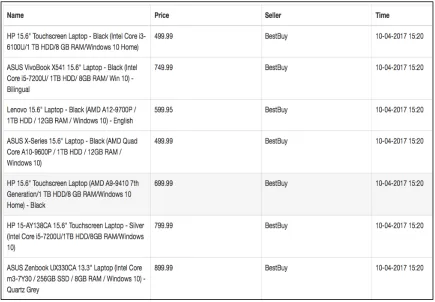
Figure 1 shows a Web page segment containing a list of Laptops on BestBuy (This is the source input HTML page). The description of each Laptop is a data record.
Figure 1: Example input web page
Figure 2: Expected output
Defined by the BestBuy input HTML page, the expected output gives a list of Laptops with the following description:
- Laptop Model: for eg. Asus Zenbook UX330CA - Processor: Intel Core m3
- Memory: 256 GB
- RAM: 8GB
- Operating System: Windows 10 - Color: Quartz Grey
- Price: 899.00$
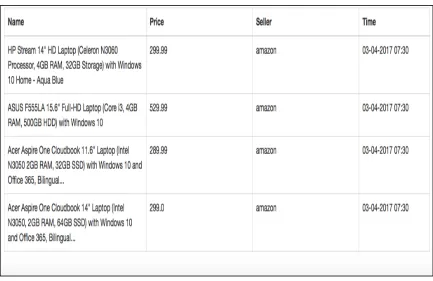
Another example of a similar input page from Amazon:
Figure 3: Output Data extracted from Amazon
In this example, we observe that along with Best Buy, Amazon also has a list of laptops that have similar kind of product description. This is the main reason for developing a system that can produce comparative queries in order to obtain such kind of result: Find the cheapest Acer laptop which has a processor of Intel i5 generation, a HDD with at least 512 GB memory space and an operating system which supports at least Windows 10 application. Additional features can be graphic card description or the weight restrictions of the laptop.
Types of pages used for extraction:
in a database which are published on to a webpage following a strict template. Such data can be extracted using wrappers by generating the extraction rules manually or automatically based on the target data. In a structured web page there are two classifications, the List Page and the detail page (Chang et. al., 2006).
We have chosen to mine a list page instead of a detail page because of the following reasons:
1. List pages provide the most important attributes of the object in the customers perspective whereas the detail pages contains all the attributes of the object. As our main objective is to develop a system that can perform a comparative mining and historical querying as value added service for the customers.
2. Our observation is that the detail page contains more noise than the list page, on Considering the recommendations and advertisements. As we work towards eliminating noisy data in our data warehouse we prefer to mine less noisy web pages.
It is very resource consuming to extract data from the list page then move to another description page for data extraction as the list page has a list of products and each product link has a pointer to a description page. Detail web page displays only one object with all of its attributes (Annoni and Ezeife 2009). The object is a Laptop and the detail page displays all the additional attributes of this object such as name of the laptop, price, configuration, dimensions and weight, build quality, etc. All this can be extracted to store into a data warehouse for value added services.
1.2. Applications of Web data extraction systems:
1.2.1. Enterprise Application:
• Context advertising: The main underlying principle is to present, to the user, commercial advertisements together with the content of the Web page, ensuring a potential increase of the interest in the ad. This aim can be reached by analyzing the semantic content of the page, extracting relevant information, both in the structure and in the data, and then contextualizing the ads content and placement in the same page. Contextual advertising, compared to the old concept of Web advertising, represents an intelligent approach to provide useful information to the user, statistically more interested in the ads, and a better source of income for advertisers.
• Customer Care: Usually medium/big sized companies with customers support receives a lot of unstructured information like emails, support forum discussions, documentation, shipment address information, credit card transfer reports, phone conversation transcripts, etc. The capability of extracting this information simplifies the way of classifying them, analyzing relationships, populating own structured databases and ontologies, etc.
• Database building: In the Web marketing sector this can be defined as the activity of building a database about a particular domain. Fields of application are countless. Financial companies could be interested in extracting financial data from the Web, e.g. scheduling the activities to be executed automatically and periodically.
Companies selling products or services probably want to compare their pricing with other competitors. Other related tasks, obviously involved in the Web data extraction are: duplicating an on-line database, extracting dating sites information, acquiring job postings from job sites, etc.
1.2.2. Social Applications:
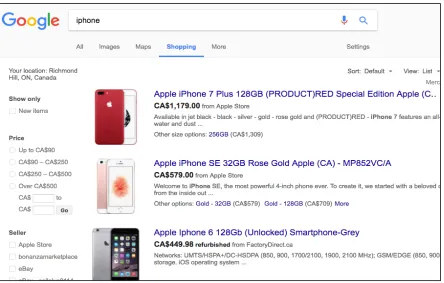
• Comparison Shopping: One of the most appreciated Web social services is the comparison shopping, through platforms with the capability to compare products or services, going from simple price comparison to features comparison, technical sheets comparison, user experiences comparison, etc. These services heavily rely on Web data extraction, using websites as sources for data mining to make possible the comparison of similar items. There are a lot of comparison-shopping systems available on the Internet, which is also known as web data extraction systems. For example Googleshop, NextTag, ShopZilla, etc.
Figure 4 shows an example working of the Googleshop web data extraction application available for comparison-shopping:
1.3. Thesis Contributions:
1.3.1. Feature Contribution:
1. Extending the WebOMiner_S data extraction system with a Web GUI for querying extracted E-Commerce data from multiple data sources through UNIX server for web access and availability.
2. Extending the WebOMiner_S data extraction system such that the extracted product schemas previously extracted from the web, which were stored in the database as generic schema and attribute name like Product1 (column1, column2. Column3, column …n) are now assigned more meaningful product table and attribute names such as laptop (price, model, cpu, etc.).
Secondly, the old system stored schemas from different websites eg. (Staples, BestBuy,etc) as separate tables like product1(column1, column2, column …n) and product 2 (column 1, column 2, … column n) making comparative querying difficult. This thesis renames extracted tables and attributes and also integrates them into one product data-warehouse table called in the database for comparative and historical querying.
1.3.2. Method Contribution:
To achieve the goals of our system, thesis proposes the system called the WeboMiner_SRec, which accepts user queries about comparative prices and features of retail E-Commerce store products as well as previously extracted product schema and their data values from E-Commerce websites. It outputs through the GUI, the results on product and pricing data drawn from stored accumulated multiple data source (e.g. Staples, BestBuy) product information into data warehouse. Input is Product1 (Column 1, Column 2, … Column n) and the Output is Laptop (product name, price, etc.). The WebOMiner_SRec system does this through the following sequence of steps:
1. Query manager algorithm is devised to process the flow of the entire application. It works as follows:
(i) It creates an environment to run the WebOminer_SRec on the web using miner
server (Debian server in Unix environment) using Maven plugin (Maven scripts help to run the java application through Unix terminal).
(ii) JDBC connection class ensures a secure connection to the data-warehouse by calling Servlet() methods in Java for data-warehouse connection parameters.
(iii) After the connection is done successfully queries are made to fetch desired results that are encapsulated in the form of java objects and rendered back to the view interface as “ResultList” data object.
2. Schema Mapper function creates a feature and column element such as (Dell Laptop, product name). Then it maps the feature to its respective columns using:
(i) Schema Mapper generates mapping rules based on the data type, for example: an explicit rule is defined for each of the column attributes specified in the data-warehouse product table. These rules check for data type: as <Integer> with symbols like “$” to be placed in the “price” column element. Accordingly, all columns have their respective rules scripted for appropriate data value matching. (ii) Once all the feature elements are mapped to their respective column elements,
3. Data-warehouse loader accepts the renamed product schema e.g. Laptop (product name, price, …) from step 1to store it in an already existing data warehouse product table. It also includes one dimension table for the seller called “Seller table” that stores information about the sellers. The third file is the Load file element to transport data from the source database to the data warehouse. This is done as follows:
(i) Seller_fact table contains foreign key attribute about the seller information such as (seller name, ID, time/date, seller url, …) from the product table that helps to categorize and mantain information based on the sellers/vendors.
(ii) A <load file> method is called that contains the data and feature to column mapping file that loads entire data or the amount of data specified by the buffer size of the Load file directly into the already existing product table in the data-warehouse.
1.4. Outline of Thesis:
Chapter 2: A survey of related articles and existing similar systems specifying the architecture, algorithms and major limitations associated with these related systems.
Chapter 3: Discusses the proposed WebOMiner_SRec system and the advantages it has over the other related systems. It defines the architecture, algorithm and the system requirements to execute this model.
Chapter 4: Discusses the major contributions, developments and implementation for our proposed WebOMiner_SRec system.
Chapter 5: Provides conclusion and future work for our approach. Chapter 6: Provides a list of References.
APPENDIX – A
CHAPTER 2: RELATED WORK
Web data extraction system is defined as a software automatically and repeatedly extracting data from Web pages with changing contents and delivers extracted data to a database or some other application (Baumgartner et al., 2009). It introduces three important aspects:
• Automation and scheduling: The automation of page access where creating many instances of the same task to handle asynchronous update changes is important. Scheduling is also important, e.g. if a user needs to grab data from a news website, the scheduler is necessary to execute scripts automatically and periodically.
• Data transformation: The steps between data extraction and data delivery such as data cleaning are captured in the process of data transformation. Here, the main objective is to fetch a unique homogenous structure for the data (Rahm & Do, 2000).
• Use of the extracted data: After the data is extracted and parceled in the required format, It is now represented as structured data and is now ready to be stored in any form of DBMS, warehouse or CMS management. This storage is necessary to either structure the data or for the purpose of statistical analysis (Berthold & Hand, 1999).
2.1. Existing web data extraction systems available on the web:
There are several systems and applications available on the web that perform web data extraction and compare product results. Examples of such systems are:
1. Google Shop (Best Application available on the web)
2. NextTag (One of the most popular depending on viewers choice) 3. Price-Grabber
2.2. Related System:
2.2.1 IEPAD: Information Extraction Based On Pattern Discovery
(Chang & Lui, IEPAD: information extraction based on pattern discovery, 2001)
IEPAD is the semi-supervised learning system, which extracts data from web without using some manual methods such as labeling the Sample pages. It highlights the usage of repetitive patterns occurred in web pages in order to present the target data as a structure called PAT trees. And, multiple sequence alignment is used to comprehend all record instances.
The Major contributions of the paper include 1) Identifies the target data record without any human intervention by examining the fact that data records occur as repetitive patterns in a web document and data is pushed into web pages from underlying databases using a common template. 2) Uses a data structure called PAT trees a Binary suffix tree, to discover repetitive patterns as they only record exact match for suffixes. 3) Uses multiple sequence alignment by the center star method, which begins from each occurrence of a repeat and ends before the beginning of next occurrence.
The Architecture of the system has 3 modules first is an Extraction rule generator, the pattern viewer and the Extractor module. Where the first module analyses the html tag structure and generates rules, the second module displays the rules to the uses to select one rule among them to perform extraction and the third module extracts all the data records that match with the rule selected. Their algorithm is explained with a running example as follows
Example 1: For Instance consider this 2 lines of html code as input for the system in their first step.
<B>Congo</B>< I>242</I><BR> <B>Egypt</B><I>342</I><BR>$
The HTML page is given as an input to this component it then translates into a string of abstract representations called tokens, which is identified by a binary code. Here tokens are divided into two types, tag tokens and text tokens where tag tokens are the html tags and text tokens are the original text in between the tags denoted by Text().
Example 2: Token string generated by the translator for the above example is as follows Html(<B>)Text(_)Html(</B>)Html(<I>)Text(_)Html(<BR>)
Html(<B>)Text(_)Html(</B>)Html(<I>)Text(_)Html(<BR>)$ These as encoded into binary strings as shown below
Html (<B>) 000, Html (</B>) 001, Html (<I>) 011 then the pattern would be 00000101. The binary pattern, which is the output of the previous step, is given as input to this step. A Patrica tree is a specification of binary suffix tree where 0 goes to left and 1 goes to right. Here, each internal node is an indication of which bit is to be used for branching. Every sequence of bits starting from each of the encoded token extending it to the end of the token string. Each string is represented by a bit position. An important observation in pat tree is that, all suffix strings with the same prefix will be under the same sub tree. Also, each edge is associated with a virtual edge label, which is the string between those two nodes. We can uniquely identify a string by its prefix.
K J L M O P K J L X O P K J L X O -
For a path label in the internal node v if its sub tree is having different left characters then it is called Left_Diverse. Based on this a lemma is proposed that maximum repeat should be a left diverse. The number of times any pattern has occurred can be easily known by the occurrence counts and the reference positions. Hence the user has to define a threshold value or it can even be a default value. Regularity, compactness and coverage are defined as the standard deviation of the interval between two adjacent occurrences is calculated as regularity. Whereas compactness is a measure of the density of a maximal repeat, this is used to eliminate maximal repeats that are scattered apart beyond a given bond. Along with these, Coverage measures the volume of content in the maximal repeats. IEPAD uses multiple string alignment for pattern matching; it does not allow any partial or inappropriate matching only strings exactly matched are considered. For Example, Suppose “kjl” is the pattern discovered for token string, if we have multiple
alignments kjlmn, kjlm, kjlmo the extraction pattern can be generalized as “kjl[m\x]o[p\-]” where “ –“ represents missing
characters. Thus the problem is transformed to find the multiple alignments of the k strings. The approximation algorithm is used to find the center string Sc in K strings. Once the
center string is found, each string is iteratively aligned to the center string to construct multiple alignments, which is in turn used to construct the extraction pattern.
The extraction process starts when the user selects one or more patterns from the pattern viewer. The extractor searches the PAT tree for maximum occurrences to find the target data but if the web page cannot be expressed as PAT tree then a normal pattern-matching algorithm can be used for extraction. Their results show 97% accuracy in successfully identifying the target data. However the major Short comings of the paper includes the following
1) The assumption that multiple data records will be homogenous fails as data records in web pages can have different attributes because of the missing values.
2) Requires a trained user that can infer rules to extract actual data records.
3) Their assumption that target data will be under the same parent node fails for large number of web pages, as there is no necessity in HTML5 after using the block tags to section web pages.
5) Their use of binary suffix trees only produces exact matches is a huge drawback because of the missing attribute values in data records.
6) Did not discuss about the heterogeneity of the web data such as the Images and their extraction process.
2.2.2 STALKER: A Hierarchical Approach to Wrapper Induction
( Muslea, Minton, & Knoblock, A hierarchical approach to wrapper induction, 1999)
This is a supervised approach for data extraction, where the user labels some sample pages from which the system generates the extraction rules. There by data in web pages having similar structure can be extracted by matching those rules. It performs a hierarchical data extraction by using embedded catalog formalism. The Major Contributions of the paper includes 1) Introducing the concept of hierarchical data extraction using embedded catalogue tree in which leaves are the attributes and internal node are the tuples.2) web content can be extracted by some consecutive tokens called landmarks that enable the wrapper to locate data x with in a data region p. 3) Multiple scans are performed to handle missing values and multiple permutations. The Stalker proposed to represent a web page as typical embedded catalogue tree where each leaf node contains the target data and the internal nodes form the list of K tuples. Again the items in k tuples can be a leaf node l or another list L. Each edge of the tree is associated with an extraction rule in order to extract x from p.
For example consider theRestaurant description as given below 1:<p> Name: <b> Yala </b><p> Cuisine: Thai <p><i>
2:4000 Colfax, Phoenix, AZ 85258 (602) 508-1570
The stalker inductive algorithm generates extraction rules to capture each data item by taking as input the set of sequence of prefix tokens. User identifies the start of x from the sample page using the GUI. For instance consider that the user has marked the area codes then the sequential covering algorithm starts by generating linear l, as it then covers all the examples and generates disjuncts. In the fore mentioned example algorithm initially generates SkipTo() it matches E2 and E4 but does not match E1, E3. While in the second
2.2.3 DEBYE: Data Extraction By Example
(Laender, Ribeiro-Neto, & da Silva, DEByE–data extraction by example, 2002)
A supervised learning system where user marks example pages there by the structure is learnt from the pages through patterns and from it structures can be extracted by comparing the new data records with previous one. The Major contributions of the paper involve 1) this paper proposes Object oriented content extraction without loss of relationship between the data items. 2) It extracts atomic components first and then it assembles them into objects. 3) Uses pattern matching to identify the similar tokens for extraction.
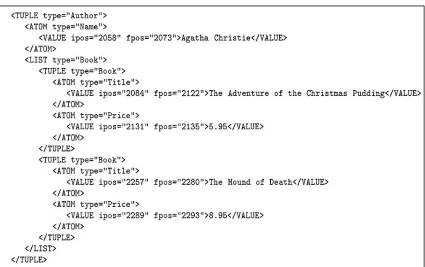
Debye has 2 modules The Graphical interphase and The Extractor. An object is denoted as a pair O= <T, V> such that V є domain (T) where V is a type of O. thus O is an instance of T. domain(T)={a1,a1,a3….an}(n>=1).Instances of A-types are termed as atoms. The pair
<T, ai> is termed as attribute value pair User has to highlight the target data from the web
page using the GUI. This target data is treated as objects. Such assembled objects are used to generate oe_patterns in xml. These patterns are used to extract data from the new web pages. The initial and final positions of occurrence of data are indicated by ipos, fpos respectively. Attribute value pair patterns are described as <T,ai>, a local syntactic context
is associated to each avp it is the tokens surrounded by avp. Using this context information avp patterns are built. In the given example in order to identify avp pattern for type price would be as expressed in (a) that the value should be prefixed by Spre =“A deadly lie--$” in
particular and suffixed by
Ssuf = “; dead online”. So it strictly extracts only specific values. A more generalized pattern
OE patterns represent the structure of the data that the user needs to extract, its internal nodes form another OE tree or type nodes (like price, book) and leaves are avp patterns. There are two extraction strategies specified, the bottom up and the top down strategy. The Top down strategy is a straight forward, the oe patterns are assembled for each example object and using these patterns to discover new objects. This procedure is repeated based on the number of example pages provided. Here the whole object is demolished into components thus called a top down approach. This approach does not work well if the page is variable structure.
In the Bottom up strategy the avp’s are priory recognized and extracted. For this approach objects are represented as triple O = <T, V, L> where t is the type of the object, v is the value and l is the index. The last row of circles indicates the avps. Each is avp is associated with a label li. Contiguous pairs of title, price are formed as book instances. The values in
L9 are in reverse order and L11 does not have the price component, the bottom up strategy
can handle such cases. The list of objects assembled after the first step is indicated in 2nd row. Further the book instances are grouped up as list of book instances. From the example l1 is combined with l2 and l8 is combined with l9. Thus the data can be extracted from
similar pages. Major Short Comings are 1) Extraction precision falls low in case of missing attributes or multi-ordered attributes. 2) Multiple scan of input page is needed to extend each atomic attribute.
2.2.4 LIXTO: Visual Web Info Extraction:
(Baumgartner, Flesca, & Gottlob, 2001)
class of predicates are the pattern predicates that indicates to patterns and their relationship their parents. A standard rule in Elog is as quoted here New(S, X) ← Par ( -, S), Ex(S, X), Co(S, X, . . .)[a, b], where S is the parent instance variable, X is the pattern instance variable, Ex (S, X) is an extraction definition atom, and the optional Co(S, X) are further imposed conditions. A set of such rules forms a pattern. All the rules in a pattern uses the same information like the name of the pattern, its parent etc. Such patterns form an extraction program, which can be applied to similar pages. For Example, A wrapper for the above quoted example every item is stored in its own table extracted by <record>, all such patterns are defined in the same record. The price attribute uses concept attribute, namely isCurrency which matches with the string like $ and the bids pattern uses a reference to price. The final two patterns are strings.
2.2.5 Simultaneous record detection and attribute labeling in web data extraction
(Zhu, Nie, Wen, Zhang, & Ma, 2006)
This paper proposes a method called hierarchical conditional labeling, A novel graphical approach to mutually optimize record recognition and attribute naming. Major contributions of the paper involve 1) This approach extracts data from list web pages as well as detail web pages. 2) Uses a vision based tree construction mechanism. 3) The problem data record detection is viewed as assigning data record labels to the block in the vision tree. Attributes labeling is considered as assigning labels to leaf blocks, and both the tasks can be performed simultaneously.
4) Efficiently incorporates all useful features and their importance weights. Web pages are represented as vision trees by using page layout features such as font, color, size separators are the horizontal and vertical lines that do not cross any node visually.
A block in a web page is represented as a node in the vision tree Conditional Random Fields are markov random fields, If x, y are 2 random variables then G= (V, E) where x=label over observation to be labelled and y is the variables over corresponding labels. Here, y could be a linear chain.
Now the problem of web data extraction can be narrowed as finding the maximum conditional probability of y over x, where x are the features of all blocks , y are the possible label assignments.
Based on the hierarchical representation of data a model can be constructed by denoting inner nodes as rectangles and leaf nodes as ellipses. A random variable Y is associated with each label. Based on the model graph a junction tree is constructed by mapping ellipses clique nodes and rectangles as separators. Then the algorithm selects the arbitrary clique node as a root node. The figure 2 represents the junction tree of the aforementioned example. The value in each internal node are the values of that particular node along with its child nodes. The value in the root is thus {0,1,2}.This is followed by two phases. Using HCRFmodel for web extraction it is necessary to define the leabel spaces followed by seperation between the variables at leaf nodes and those at inner nodes, because we need to extract the attribute value of the laf node where a for the inner node has to be identified
wether it is a data record or not. There is a necessity to explicitly define label space and inner label space each for its own pupose. Forexample the leaf label space for the extraction of products data can be {Product name, product id, prcice, description etc}.
How ever inner label space has 2 partitons object _type independent an dobject tpe dependent.There are certain labels like page head, nav bar , page tail etc, that links to different parts of web page. Such objects are independent of Object_type. The intermediate labels such as data reocrs are dependent on Object_type. The feaures of Elements and Blocks in HCRFS are for each element , the algorithm extracts both vision and content features, all the information can be obtained form the vision tree features. The tree distance of two blocks is defined as the edit distance of their corresponding sub-trees. To exploit the similaruty between blocks the shape an dtype distamce can also be computed.They alo consice that rpeated information in web pages odes not give useful information, as an example they quote that the “add to cart” button and such types occur repeatedly in each page which are not useful.
2.2.6. WebOMiner: Towards Comparative mining of Web document objects with NFA
(Ezeife & Mutsuddy, 2012)
Example:
Give comparative analysis of products during the past 2 years including number of sales, views and comments about the product from all the possible websites that deliver the expected product. Consider the following figure taken from (Ezeife & Mutsuddy, 2012) that provides a representation of the regular web content available in any B2C website:
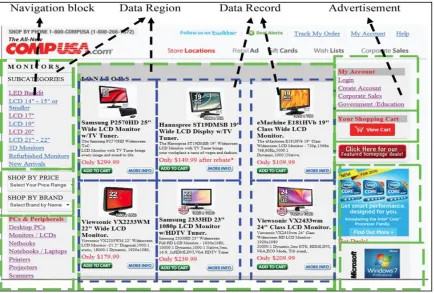
Figure 5: Web page with data regions and data blocks
The above product web page consists of Data regions, Data blocks, Data records, Navigation block and the Advertisement block. Data records are usually found in the data regions, which are represented as sub-trees in a DOM tree representation.
Example: A Product data record may contain: Product (title: string, image: image-file, difSize (product number: integer, brand: string, price: real)).
mirror the web contents such as text and image files into the local computer system. In this case, the crawler stores a local copy of the HTML source page in the computer system.
• Cleaner Module: The cleaner module is an important part of this technique that helps in cleaning the input HTML document by revising the structure, eliminating noise information, using transformation rules and so on. The output of the cleaner module is given to the extractor module for further processing.
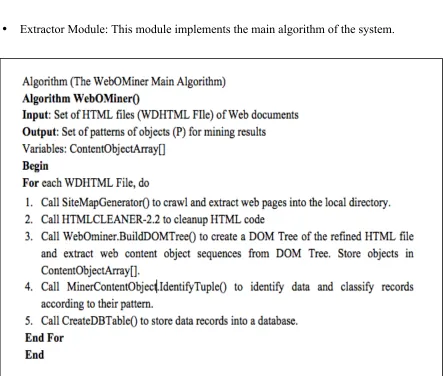
• Extractor Module: This module implements the main algorithm of the system.
The extractor module takes as input the cleaned HTML file and constructs a DOM Tree to classify the data by assigning them to object classes and further appends these objects to the content array list.
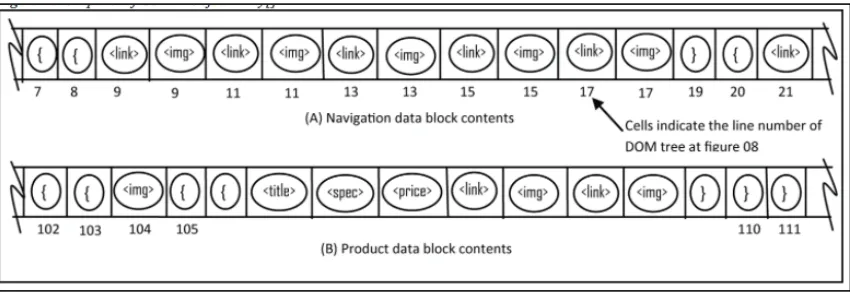
Further, MinecontentObject.IdentifyTuple() function is called which generates the seed NFA pattern for the data objects. Classification is done by matching and storing the appropriate tuples in their respective TupleList category.
Example: product tuple, image tuple, list tuple, text tuple, form tuple, etc.
Figure 7: Content Object array for data block identification and classification
NFA (Non-deterministic finite state automata):
After the data recorded by the DOM Tree construction is analyzed, NFA is used to identify individual tuples or individual records of data found in this DOM tree structure. The NFA algorithm helps in assigning and classifying the data and their respective data types into well-defined categories.
In NFA each pair of states has a next state. NFA functions by being able to identify any kind of schema.
• Architecture of the WebOMiner system is as follows (Ezeife & Mutsuddy, 2012):
Figure 8: Architecture of the WebOMiner system
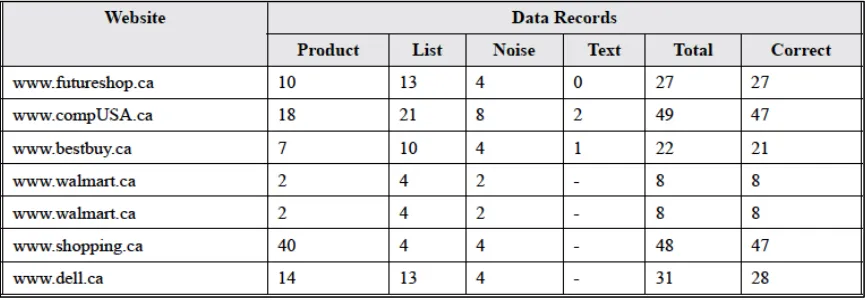
Figure 9: Experiments conducted on web data sources
Precision is defined to be the ratio of total correct records retrieved = 176 by the total number of records retrieved by the system which happen to be 176.
Recall is defined to be the ratio of total correct records retrieved = 176 by the total number of records available in the web page which happen to be 185.
Precision = 176/176 = 100 % Recall = 176/185 = 96 %
2.2.6.1. Major Limitations of WebOMiner system:
1. The WebOMiner system works on only limited types of data tuples such as product name, price, etc. to extract information. Any other kind of information necessary or unnecessary stays unnoticed.
2. System is not automated. Data extraction is performed manually for each web page. 3. Crawler scans through the whole web site. Instead, it needs to automatically focus on
only targeted web pages.
5. Object warehouse schema needs to be designed for effective integration of these database schemas generated for each websites.
6. Cleaner module is incapable of handling long tag attributes. Noise data handling is uncertain after the web page is cleaned.
7. Data warehouse schema design and implementation is unknown. Therefore, it is unclear to understand if the system would perform well with different and complex data sets.
8. NFA is a slow and difficult matching technique. Therefore, performance can be disappointing in terms of large datasets or huge websites.
2.2.7. WebOminer_S: Comparative Mining of B2C Web Sites by discovering web database schemas: (Ezeife & Peravali, 2016):
The purpose of this application is to extract schema from the entire webpage in order to retrieve only the required information from any B2C website and store it in the data warehouse for comparative mining. It contains five modules, which are described as follows:
Crawler module:
Cleaner module:
HTML cleaner is open source software used to clean web pages that are usually un-clean in the form of missing tags and ill formed structure; therefore they are unsuitable for further processing. HTML cleaner works by redefining all elements individually and maintaining a well formed structure.An example is shown below to represent Uclean and Clean HTML file:
1. Unclean HTML:
<h1>CONTENT</h1>
<table id=table1 cellspacing=2px
<td><a href=index.html>1 -> Home Page</a> <td><a href=intro.html>2 -> Introduction</a>
2. Cleaned HTML:
<h1>CONTENT</h1>
<table id="table1" cellspacing="2px"> <tbody>
<tr>
<td>
<ahref="index.html">Home Page</a> </td>
<td>
<ahref="intro.html"> Introduction</a> </td>
</tr> </tbody> </table>
The HTML cleaner is used to transform unclean html page to a clean html page. It helps in quickly skipping certain unwanted tags or attributes and restructuring the page contents. Therefore, it easily avoids the expensive document model manipulation process required after cleaning.
This module is implemented in java file called runBatchFile.java. The fuction runFile() calls the input argument file called inputUncleaned HTML. As the name says, this file is unclean and needs structuring.
This file is then provided to the htmlcleaner-2.2.jar in the form of a batch file called cleanHTML.bat, which produces the cleaned HTML file. This cleaned file is stored in the project folder with the name outputCleanedHTML. The module is designed to create a batch file if it does not exist while cleaning process begins.
The syntax to use the html cleaner-2.2.jar with source and destination arguments is as follows:
Java –jar*\rootfolder\htmlcleaner-2.2.jar src=business.html dest=business_.html
Here, the src=business.html is the input unclean HTML file and
Dest=business_.html is the cleaned HTML file which is then stored at a specific location which is later used by the HTML parser.
An HTML parser or syntactical analyzer is a parser used to analyze a string of symbols either in natural or computer language using the rules of grammar. But in this case, the HTML parser takes in HTML code and extracting relevant information like the title of the page, paragraphs in the page, headings in the page, links, bold text etc.
Example: Object generated of the extractSchema class is as follows, (Ezeife & Peravali, 2016):
Figure 10: Extract Schema class main() method
The method called from the Extract Schema class does the following work on the cleaned HTML file:
1. Extracts and stores all block of data such as <div>, <span>, <table> into a file called temp.xml.
A view of the temp.xml file contents (Ezeife & Peravali, 2016):
Figure 11: Temp.xml file
A view of the occurrence.data file:
Figure 12: Occurence.data file
The occurrence.data file gives the information about the parent node of the block usually present with maximum frequency including children blocks as well.
Frequent pattern structure finder:
Frequent pattern structure finder analyzes the occurrence.data file to read the tag information and the frequency of these tags to identify the data of focus. Further, it functions as follows:
2. Xpath is then used for defining various parts in the XML document and navigating between them. It retrieves the complete node using parent tag name.
3. The frequency of this node obtained is stored using the function printFinalTree(). 4. The frequency children block is considered as the product data block.
Example:
Figure 21 is the occurrence.data file. It shows maximum number of child nodes present within each parent node. Structure Finder algorithm marks these occurrences in order to find the most frequent pattern. Tags such as <divclass=”clear”>, <divclass=”contentno-bottom-pad”>, <divclass=”product-contentn-wrapperclear-fix”> provide the structure to extract the database schema.
The frequent structure finder algorithm is shown below:
Algorithm FSFinder ():
Input: occurrence.data file, #WDHTML file Output:
Nodelist frequent structures patterns (FRS), data tuples Xmlnodetag: string (concatenating all the data tuples) xpathExpression expr: string, path: string
Nodelist tag structure: struct list, data tuple: product block Packages: Java DOM, Java Path, Java transformer
Begin
1. Call DocumentBuilderFactory ()
2. Call xpathFactory () to create xpath object to obtain the node list 3. For each tag in occurrence.data file,
Retrieved xml is stored in xmlnodetag[1] Path = “//div[@class=”+xmlnodetag[1]”]”; xpathExpression expr = xpath.compile(path)
nodelength = struct list.getlength()
#childs = struct list (0).getchildnodes().getlength()
If nodelength >= final nodelength, then final nodelength = nodelength & If #childs > final childs, then final child = #child
Product block = xmlnodetag[1]
Data tuples (product blocks) = struct list End For
4. For structlist child nodes Begin
Append child nodes to the Frequent structure list End for
5. Return string of integrated Data tuples (product blocks)
End
Schema extractor module:
The extractSchema.java file performs the task of this module. On identification of the product block it efficiently retrieves the schema in the following manner:
1. All tags in the block are read to recognize the data type. 2. Each type of data is then classified into their respective types.
Example:
Tags such as <img> are categorized into image data type and so on.
3. Finally the schema consists of all the tag fields and their data types integrated into a single String variable (WebSchema), which is the final output of this project that can be further stored in a database.
A view of the string variable WebSchema is as follows (Ezeife & Peravali, 2016):
Discovered schema for a single page of bestbuyWebsite is below: ---
Product (prod-image: String img300x300: image prodDetails: String prodTitle: String
prodPrice: String priceblock: String pricetitle: String shop-now: String customer-rating: String
rating-title: String rating-stars:String )
The extracted data above is from the best buy website. Similarly, many more website data’s can be extracted and stored in a data warehouse with the entire source website attributes and properties participating as the dimension tables values.
2.2.7.1.Limitation for the WebOMiner_S:
1. Limitation of the WebOMiner_S is that it does not have a web-based application. WebOminer_S does not have a provision for querying data records available in the data warehouse.
CHAPTER 3: PROPOSED WebOMiner_SRec SYSTEM
3.1. System Design, architecture and algorithm:
The purpose of the proposed WebOMiner_SRec system is to take input: the discovered Product_Schema from the (WebOMiner_S system containing: crawler module, cleaner module, HTML parser module, frequent pattern finder module schema extractor module) and developing the (WebOMiner_SRec: Schema_Mapper module and the Query Management Interface). The output of the WebOMiner_SRec system is the answer to all the queries made to the datawarehouse for analysis. Let us understand all the modules and their working in detail.
3.1.1. Architecture for our WebOMiner_SRec system:
Our systems aims at developing a Simplistic user interface by mounting the WebOMiner_SRec system on the web domain using Java Enterprise Web functions. The WebOMiner_S is a web data extraction system for yielding all essential information about products. The WebOMiner_S on its final stage outputs a product schema such as Product 1(column 1, column 2, … column n), which is then taken as an input for our WebOMiner_SRec system. The WebOMiner_SRec has an algorithm called “Schema_mapper” for giving meaningful names to the column attributes of the already existing product table in the data warehouse. It then creates a mapping container that provides an environment based on annotators to map all the column elements to the appropriate feature element such as (Dell Laptop Inspiron series to product name). Annotators are the rules or conditions written in a <scriplet> format that contains an annotation tree to map the column attributes to their exact data types. A Load file element is introduced to perform the transport of all the mapped data from the database to the data warehouse.
Once the transformed data is loaded to the datawarehouse product table, another table called the seller table is created which stores all the information about the seller (for e.g. Seller name, Id, seller url, date/time). This information is referenced directly from the product table. Seller ID is the foreign key attribute used for integrating the Seller information. Therefore, the final step of the WebOMiner_SRec is to create a secure non-terminating connection between the data warehouse and the GUI. A connection is created calling the JDBC.session.connection () methods to request data from the warehouse. Java object method() handles the transaction processing for providing the perfect response to the requested interface query. The final output of the WebOMiner_SRec is the ResultList object that gives query results to the web users.
3.1.2. Algorithm for our Web Recommendation system:
Algorithm WebOMiner_SRec
Begin
1. Schema_Mapper: Define a feature to column (attribute) mapping container: For each (input product_data),
1.1.Define a feature <element> (n) and a column <element> (m)
1.2.Check the annotation rules for mapping feature and column <element> 1.3.If “n” satisfies the rules for “m” condition
Then, map “n to m”
Note: the rules are defined based on RegEx and equivalent data types 1.4. If n! = m, set m value = Null//
2. Loadfile<element>:
2.1.If mapping is performed completely for all “m to n” values Then, load all mapped data to loadfile.xml
2.2.Loadfile.xml specifies the buffer size (0 – 1024 MB) 2.3. For every loadfile.xml,
Check: if loadfile.xml is ready “OR” in uploading stage from Mapping_Container.
2.4.If ready: upload the mapped data to the datawarehouse. End For
3. Query_Manager: Establish connection between data warehouse and java object class.
4. Object data access: If connection to the database is made:
4.1.Query request consists: Access permission to the data values. 4.2.If required data exists,
Encapsulate the data into Java object for access by appropriate display fields. If not, gives an IO Exception
4.3.Map HTML/CSS interface fields to exact display data objects 4.4.Render query data on the Interface to show results.
3.1.3. System modules and working:
3.1.3.1. Schema_Mapper module:
Algorithm for SchemaMapper:
Input: Product schema and data tuples obtained from WebOMiner_S
Output: Product schema with meaning column values assigned to the product_domain table in the datawarehouse and the datatuples to be stored in the datawarehouse product_domain table.
Other: MappingAnnotations.xml file
Begin
1. Schema_Mapper: Define a feature to column (attribute) mapping container: for each (input product_data),
2. Define a feature <element> (n) and a column <element> (m) 3. Connect to the database using
4. Check if “m” equals to every column attribute of the product_domain table 5. Check the annotation rules for mapping feature and column <element>
Where rules define conditions for column to data type matching:
If value=integer [0-9 && (!/) ends with $] map the integer value to price column, etc.
6. If “n” satisfies the rules for “m” condition Then, map “n to m”
7. if n != m, set m value = Null// end for;
End
How Schema_Mapper works:
Features have a range type that indicates the type of value that the feature must have, such as String.
For example, the text span "HP laptop 1TB HDD i3 processor" might be spanned by an annotation of type Product with the features (product name, product description).
The type system defines the types of objects (feature structures) that may be discovered. The type system defines all possible feature structures in terms of types and features (attributes). It is possible to define any number of different types in a type system. A type system is domain and application specific.
The analysis annotators produce their analysis results in the form of annotations. Annotations are a special kind of feature structure that is designated for analysis processing. An annotation spans or covers a piece of input data and is defined in terms of its beginning and end positions.
Working example:
An annotator that recognizes expressions created for the data "100.55 US Dollars" an annotation of type Expression that covers the text with the feature currencySymbol set to "$".
All Schema_mapper structures are stored in the MappingAnnotations.xml file.
The Schema_Mapper structure contains the following objects:
1. The type system description that indicates the types, subtypes, and their features for (e.g. Dell laptop i5 processor).
2. The column and feature attributes (e.g. product description).
Format structure for the @annotator is as follows:
<SchemaMappingSpec> <name>com.tt.DocumentAnnotation</name> <filter syntax="FeatureValue">toBeProcessed=0</filter>
<JdbcMappings> <explicitMappings>
<explicitMappingRuleapplyToSubtypes="false"> <type>com.ibm.omnifind.types.Product</type> <table>sample.Product</table>
<featureMappings>
<feature>uniqueId()</feature>
<column>ProductId</column></featureMapping>
<featureMapping><feature>uniqueId()</feature><column>ProductId()</column> </featureMapping>
Annotator mapping rules are provided for the <Feature> and the <Column> element. These mapping rules perform accurate validation methods.
For example:
$validator.mappingRule(“currency”, function(feature{product_price}, column{PRICE}) { return this.(featureMapping) ||
/`\$(\d{1,3}(\,\d{3})*|(\d+))(\.\d{2}?$/.test(productdb.table{price, product_price});) };
The above rule explains:
1. Validation annotation for price. It calls the MappingRule method to validate <feature> product_price, and <column> PRICE.
2. Mapping rule method checks for data integrity constrains for e.g. If it is a price attribute, it checks for integer value, decimal value, “.” Product before the decimal value and also symbols like “$”.
The Schema_mapper structure, is created as follows:
1. Create the Schema structure mapping file as the XSD schema:
JDBCMapping.xsd in ES_INSTALL_ROOT/configurations/parserservice/data directory. 2. Include the mapping in a <JdbcConfiguration xmlns="jdbc/100/xml"> element. The
namespace (specified in the xmlns attribute) must be exactly as shown.
3. Add a <databaseConnection> element that contains all database configuration information and a <JdbcMappingSpec> element that contains the mapping structure for the product table columns such as (product name, product id, prod description, etc.) that are stored in the data warehouse product table.
4. Add the following component elements to the <databaseConnection> element: (i) Mandatory: A <connectionUrl> element. This element contains the database connection URL. Depending on the JDBC driver implementation, we can use local or remote access to the database.
(ii) Mandatory: A <driver> element. This element contains the name of the JDBC driver class, for example com.db2.jcc.DB2Driver.
(iii) Mandatory: A <driverLibraries> element. This element lists the driver libraries. (iv) Mandatory: An <authentication> element. This element contains the user name and password for the database (e.g. username: root, password: tiger).
The following component elements are added to the <jdbcMappingSpec> element:
A <JdbcMapping> element shows the types and features that are mapped to the data warehouse product table and its respective columns.
5. The <ExplicitMappingRule> must contain the attribute applyToSubtypes, which, if set to true, stores not only the feature structure that is listed in the <type> element, but also all of the feature structures derived from it. Add the following component elements to <explicitMappingRule>:
7. A <type> element that contains the feature structure type.
8. A <table> element that contains the product schema and table name. The syntax follows the rule schema.table_name.
9. A <filter> element that contains an explicit condition that is evaluated each time the mapping rule matches. If the condition evaluates to true, the annotation stores the feature structure in the mappings file.
10. The <featureMapping> element component structure works as follows: If we are mapping a feature or feature path, the component elements include:
11. A <feature> element with the name of the feature. The feature must be defined for the feature structure. We use a feature path construct to list all the features. (for e.g. feature/prod_ID/schema.product_table).
12. A <column> element with the name of the column in which the feature value is to be stored (for e.g. schema.product_table/product_name: Apple iphone 6). Database columns that are not used in any feature mappings use a default value (usually null).
3.1.3.2. Datawarehouse Loader:
Algorithm for Datawarehouse loader:
Input: product_schema obtained from schema mapper module and data tuples to be stored in the data warehouse product table.
Begin
1. Create database connection along with product_domain table with column attributes specific to the product schema obtained from Schema Mapper from Mapping Annotations.xml file.
2. A loadfile<> element is defined to transport all the extracted data to the product_domain table.
3. For each attribute;
Store all the data tuples with their unique ID End for;
4. Create another seller_fact table having attributes for seller information. For each seller in the product_domain table;
Map the unique ID of the seller to the seller_fact table as the Foreign key along with the date/time attribute.
End for;
End
How datawarehouse loader works:
1. A <loadFile> element contains the following components:
§ The load file directory in a <loadFileDirectory> element.
§ The load file size in a <loadFileSize> element. The load file size limits are 10 <=
loadFileSize <= 10240 (10MB <= loadFileSize <= 10GB). If no value is defined, the default is 1024 MB (1GB).
§ The load script name in a <loadScript> element.