Australian Journal of Teacher Education
Changing Perceptions Of Knowledge: Evaluation of an innovative
program for pre-service secondary teachers
Neil Hooley and Rod Moore
Victoria University Melbourne
Contact
Neil Hooley
School of Education
Victoria University
PO Box 14428
Melbourne Australia 8001
03 9919 4407 (T)
03 9919 4646 (F)
Changing Perceptions Of Knowledge: Evaluation of an innovative
program for pre-service secondary teachers
Abstract
Pre-service programs for secondary teachers have traditionally involved method subjects, where participants are inducted into the curriculum practices of two disciplinary or subject areas. In 2003, Victoria University of Technology, Melbourne, enrolled a small group of fourteen pre-service teachers into an innovative Graduate Diploma of Secondary Education that directly challenged these program assumptions. Method subjects were collapsed into an integrated study of the theory, skills and practices of classroom work and connections were drawn between all enrolled subjects or knowledge. Another key feature of the program involved all pre-service teachers being placed at the one school for their partnership experience, including classroom teaching and a requirement to
undertake an applied curriculum project negotiated as being important for the school. Mentor teachers from the school presented a series of evening tutorials on issues such as systemic requirements, curriculum innovation, school organization. This approach to Site-Based Teacher Education builds on a project funded by Department of Education, Science and Technology and conducted by Victoria University some years previously. The paper describes the evaluation of the program including suggested curriculum changes and the resources required. It also provides some advice for the establishment of similar site-based work that attempts to break the mould of traditional thinking on separated knowledge in teacher education.
Secondary education in context
Most teachers in Victorian secondary colleges have followed a traditional route into the profession, that is a three-year undergraduate degree followed by a one-year Graduate Diploma in Secondary Education (GDSE). The structure of this latter degree, commonly referred to as the ‘Dip Ed’ or ‘Grad Dip,’ usually comprises a mix of education subjects and two ‘method’ subjects regarding teaching specialism. This structure for pre-service education reflects the traditional secondary curriculum where subjects are clearly separated from each other and teachers generally confine themselves to their particular content areas. In contrast to the primary curriculum where knowledge is by and large integrated and where there is a focus on broad language development across domains, the secondary curriculum assumes that pre-determined knowledge in specific packets can be accurately transferred from the teacher to student in a linear fashion. There appears to be little justifiable reason as to why there is such a stark philosophical contrast between primary and secondary education. Certainly, the ‘photon’ view of knowledge should be just as contentious in education as it is in physics.
Central to the notion of whether knowledge should be separated or integrated, is the question of practice and theory. In other words, do different humans come to an
a united feature of social life, would not support a segmented curriculum for children at any level. The committee that established the Year 12 Victorian Certificate of Education for example, commented that all secondary schools should be comprehensive so that ‘the interests of developing a higher theoretical basis for technical pursuits and of giving more students the experience of relating practical and theoretical studies’ (Blackburn 1985, p. 51) could be achieved. Underpinning this idea of an integrated knowledge/practice/theory is of course the view that all children are capable of learning in all domains however defined and that there is a democratic right of all children to participate in the great ideas of the past and present so that they can actively construct their own futures. Deliberately excluding children because of assumptions regarding background and an inability to learn must not be a curriculum principle.
The context for secondary education in Australia is also fluid and in many respects, unclear. Should the purpose of secondary schools be in preparation for university, preparation for employment, or preparation for the academic disciplines, a form of schooling for young people always preparing for something else? Or, is it more
appropriate for the secondary school to ensure that all students experience knowledge to the broadest extent and are encouraged to build their own learning from direct
experience? A recent publication by the Australian Council of Deans of Education (2004) indicates very strongly that the time has come for a reconceptualisation of schooling in respect to both teaching and learning. Allan Luke (2004, p.15) in similar vein, notes that schools now need to cope with a new range of emerging knowledges such as new
biological and social sciences, new technologies and new student identities. He describes students in Singapore who move between ‘three languages and dialects, who are engaged everyday with secular and non-secular knowledge, who respect their elders and hang out in shopping malls.’ In this way, Luke is drawing attention to the changing aspects of young peoples’ lives and how this must impact on the school curriculum. Maintaining the secondary school as a monument to a previous age seems doomed to failure.
The social analysis provided by poststructuralism, also places pressure on the secondary provision. The postmodern writer Patti Lather (2001, p. 241) in discussing the turns and shifts that have taken place in regards validity in educational research, suggests that:
Rather than nostalgia for a lost world of certain knowledge, to engage and transvalue these shifts is to move towards a thought of dissensus rather than consensus, a dissensus not easily institutionalised into some new regime of truth. Such turns are about the ‘ruins’ of validity, the end of transcendent claims of validity, the end of grand narratives of validity, validity under erasure.
This type of approach can be discounted, or be taken as a serious challenge to our views of science and knowledge and how such matters are handled with integrity in schools. The charge that the dominant paradigm in schools is still one of ‘nostalgia’ for
where the ‘shelf life’ of knowledge is decreasing. The poststructural view of looking for ways to undermine and destabilise categories of knowledge may be useful in assisting teachers find new avenues into knowledge and of not locking students into rigid boundaries of understanding. Breaking open the old and establishing new frontiers of school mathematics for example, may have benefits for many students.
In late 2003, the Victorian Government announced a number of initiatives to improve the quality of public schools (DET, 2003). Following this, the Victorian Curriculum and Assessment Authority released a consultation paper that outlined a ‘framework of essential learning’ (VCAA, 2004) structured around three ‘pillars’ of core disciplinary concepts, cross curriculum skills and personal and social skills. While the final version of a curriculum based on ‘essential learning’ is not yet available, it is thought that the three pillars have been converted to the three ‘strands’ of personal, social and physical
learning, disciplinary-based learning and interdisciplinary learning. Each of the three strands comprise a number of ‘domains’ which are considered ‘essential’ as distinct from specific content. For example, the disciplinary-based strand consists of the domains of Mathematics, English and LOTE, Science, Arts and Humanities. It is interesting to note that Studies of Society and Environment (SOSE) has been replaced by the Humanities domain made up of History, Geography and Economics. At this stage, it is believed that schools will have the responsibility of constructing a curriculum from the strands and essential domains. Guidance on content together with performance standards and
assessment techniques are not as yet available. From the Victorian Government’s point of view, the notion of ‘essential learning’ seems to have been raised to ensure that all
children access what is considered valued knowledge and that all children in both public and private schools have a similar curriculum in that regard. There has been limited debate within the profession regarding whether valued knowledge resides in the academic disciplines and whether or not a school curriculum should mimic this arrangement. The current Curriculum and Standards Framework that is available to guide school curriculum will remain as a support document.
Characteristics of innovation
Victoria University has been developing its partnership-based pre-service teacher education programs over the past ten years. ‘Project Partnerships’ (Victoria University 2004) as the program is generically called comprises school-university partnerships designed to enhance the learning of school students and pre-service teachers. They provide opportunity for curriculum inquiry, curriculum development, teaching practice and participation in the full life of the school. Strong partnerships enable pre-service teachers to express responsibility for school students and their learning while working with mentor teachers on a curriculum program or initiative, called the Applied
Curriculum Project. Establishing a GDSE partnership with a local secondary college therefore needed to embrace these characteristics as the main organising principles of the program. Site-based teacher education (see Kruger, 1999) as envisaged here supports a democratic and discursive learning and teaching environment which:
• commences from a concern with and enhances the learning of school students • supports teachers in planning and teaching
• provides continuous practice for pre-service teachers in which to develop competence and practical insights
• enables pre-service teachers to generalise and critique their insights within the framework of a formal university program
• requires teacher educators in working with pre-service teachers to connect and critique theory contained in the educational and other literature
• constructs a framework connecting the interests of teachers and teacher educators which promotes ongoing practitioner focused research and professional
development.
The secondary college at which the GDSE group was based, has a unique form of work organization and pedagogy. This setting allowed the lecturers to challenge some of the naïve beliefs about schooling that are held by pre-service teachers and to engage them in reflective practice. At this college, teacher teams take responsibility for the curriculum and welfare needs of students, remaining with the same group for up to four years. This group is smaller than the normal cohort as teachers teach more than one subject to them. The structure is underpinned by flat management principles and the belief that any organisational design must support teachers in classrooms. The autonomy granted to teachers has also allowed some teams to explore alternative methods of curriculum delivery and pedagogy including negotiated, integrated curriculum as deemed appropriate to meet the needs and interests of students in the middle years.
learning in preparation for graduation, registration, employment and induction into the profession. The portfolio process is a practical expression of the view that knowledge, skills and understandings cannot be compartmentalised.
Of particular significance to the program outline above was the integrated approach taken towards the traditional method subjects. Rather than separating into different subject areas, the group undertook a consideration of knowledge, learning, curriculum and teaching as a whole, developing an agreed and consolidated set of principles to guide their partnership work at the college. This was included within the Theory and Skills of Classroom Organisation subject. After progressing in this way for Semester 1, the group was then divided into two sections with either a humanities or sciences perspective. At this stage, more specific curriculum and lesson planning was undertaken to meet particular learning outcomes as suggested by the curriculum document being utilised (Department of Education and Training, 2002). The final step in this process was to request from each individual pre-service teacher detailed lesson planning for specific content taken from each of their two specialist areas of teaching. Lesson planning of this type was also followed each week as pre-service teachers worked alongside their mentor teachers in college classrooms. Tackling the ‘method question’ in this way was designed to encourage new entrants to the profession at the secondary level to challenge current and stereotypical curriculum practices and to be as innovative as possible in curriculum and lesson planning to meet individual and class learning need.
Project Partnerships at Victoria University has pursued the development of the reflective practitioner, inquiry learning and practice-theory constructs over time. It is these
principles that need to dominant, not separate content domains. This has led to an understanding that the enhancement of school students’ learning is the most powerful stimulus for the committed and changing practice of pre-service teachers. It also provides the basis for theorising about practice that initiates the pre-service teacher’s professional knowledge and judgement. The transformation of separated method subjects therefore into integrated studies enables both the pre-service teacher and school student to draw upon their combined understandings and culture around the negotiation and pursuit of practical projects of investigation. The idea of multiple intelligences (Gardner, 1993) is also important here, in recognising that humans should not be locked into the one way of seeing the world and that different interpretations emerging from the learner’s
experience, can be equally valued. The integrated approach to the traditional GDSE method arrangement does not deny subject content, but it does locate learning in a broader frame where a variety of background knowledge can be brought to bear on new situations.
Evaluation Design
1. Evaluation roundtable with students
The roundtable discussion extended over ninety minutes and was structured around the following starter questions provided by staff:
• Are you ready to teach?
• What are the strengths and weaknesses of the program? • How do you see your understanding of practice and theory?
• How have your views of education, teaching, learning, society changed during the program?
2. Portfolio presentations
All members of the group including staff sat around a circle of tables, sharing and commenting on all portfolios over a two-hour period. There was then a general discussion of overall impressions of what the portfolios were saying.
3. Evening seminar and presentation of Applied Curriculum Projects
Each member of the group presented their Applied Curriculum Projects to an evening seminar involving school mentor teachers, members of the school Administration and staff from Victoria University. Questions and general discussion took place at the conclusion of each presentation.
4. E-mail comment by employing school
Comment by one Principal who employed two graduates was obtained via e-mail.
5. Views of program staff.
Apart from the questions listed above for school staff, the University staff also considered to what extent have outcomes of social justice, professionalism, readiness to teach, becoming a change agent in schools and broader perspectives of knowledge, education and society been achieved. Throughout the program, an Internet diary or ‘blog’ had been compiled on a regular basis and a range of comment was therefore available for analysis.
6. Survey of school staff
A survey of school mentor teachers and school Pre-service Teacher Co-ordinator was conducted with the following starter questions:
• What are the strengths and weaknesses of the program? • Are the pre-service teachers ready to teach?
• Was communication with the university adequate? • How could the program be improved?
The evaluation was conducted at the end of what amounts to a brief pre-service program and would have benefited if the conversation was extended over time as the graduates moved through the induction and beginning teaching phase. The full outcome of a program is often not known at its conclusion, but must be tested in practice as the emerging thoughts of participants are challenged with new circumstances. At this stage, there is no plan to conduct a longitudinal evaluation of this type.
Discussion of findings
Both qualitative and quantitative data suggests that student teachers involved in this program experienced an enhanced sense of beginning teacher competence. This is validated by questionnaires directed at both supervising/mentor teachers and the students themselves. Questionnaires, focus group discussions, written reflections, teaching reports and observations failed to elicit any data or comment that would suggest that the
integrated approach to methods disadvantaged students in any way. Of those currently teaching (8 of the 11 graduates) only one felt under-prepared and that was in relation to the content of a Year 12 course. This only serves to remind us that we must, in the analysis of course outcomes, attempt to discriminate between critique that could easily apply to most forms of teacher education and the model described here.
The cohort
Of the 14 pre-service teachers originally enrolled 3 failed to complete the course during the original year. Since then however, 1 has returned and completed the program and a further 1 has returned and should complete in the near future. Original costing of the program suggested that an ideal cohort would consist of 15 students. Due to the short time frame and the mid-year start fewer applications were received than would be the case for the traditional February start. It was also determined that the methods offered would be limited to Science, Mathematics and IT (where teacher shortfalls were occurring) balanced by some students offering English and SOSE. This was also a budgeting decision for it meant that two university lecturers could be assigned to offer an overview in the two streams in conjunction with the specialized knowledge that teachers could impart.
Survey Data
Mentor Teachers. The survey indicated that:
• 43 percent of mentor teachers believed that pre-service teachers were ‘Better prepared than other cohorts in different programs of teacher education’ • .43 percent believed that they were ‘As well prepared’ and
• 14 percent that they were ‘Less well prepared.’
benefits ‘For themselves as teachers’ (100 percent strongly agree) and ‘For school students’ (86 percent strongly agree, 14 percent agree).
Readiness to teach. Mentor teachers were asked to indicate whether or not they felt that pre-service teachers were adequately prepared in the areas shown in Table 1.
Table 1. Comment by mentor teachers regarding readiness to teach
Strongly Agree % Agree % Disagree %
Method subjects 83 17
Classroom Management
71 29
Meeting student need 83 17
General school life 29 57 14
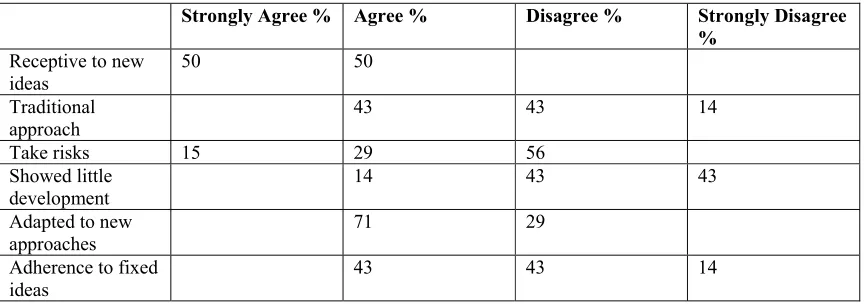
Innovation. The particular college P-12 site was chosen for its innovative approaches to teaching and learning in order to challenge pre-service teachers’ preconceptions, in particular those who might have viewed teaching as the transmission of content. At the same time the School of Education was mindful of the need to balance a Craft
Apprenticeship approach to teaching with approaches that included Critical Theory, Reflection and Research Based Enquiry. Whilst this sat well with most pre-service teachers not all were swayed as statistics reveal in Table 2.
Table 2. Comment by pre-service teachers regarding personal approaches to teaching and learning
Strongly Agree % Agree % Disagree % Strongly Disagree %
Receptive to new ideas
50 50
Traditional approach
43 43 14
Take risks 15 29 56
Showed little development
14 43 43
Adapted to new approaches
71 29
Adherence to fixed
ideas 43 43 14
Whilst there appear to be certain anomalies in the data, they in effect support the notion that whilst it is possible to alter pre-service teachers perceptions it is a process that takes time. We might also speculate that the changes are assisted by enculturation.
Student feedback
more methods (often using integrated approaches) to the same group of students it enabled the pre-service teacher to gain an intimate knowledge of the students in each class. Pre-service teachers reported a growing sense of comfort and agency:
I feel a lot more confident after getting involved with the students and mentor teachers.
I am happy with my mentoring teachers. They are both supportive and provide great constructive feedback. The mentors have encouraged me to start teaching classes and have helped me to become more creative with lessons and activities. The mentors have been both flexible and encouraging in their support making me feel part of the team and valued as a practicing teacher.
Teaching as Subjects. Near the conclusion of their course pre-service teachers were asked to record what they considered to be enabling features in school organisation, curriculum, pedagogy and assessment. The summary notes for curriculum and pedagogy follow here:
• Curriculum: Make it interesting, relate to students everyday life; engage all learning styles; less reliance on text books and more flexibility to diverge in order to engage; frameworks useful; need to integrate literacy and numeracy across the curriculum; should be more integrated across key learning areas; time for
discussion.
• Pedagogy: Student engagement and participation; cater to different teaching styles; offer different strategies; relate to students, respect them and treat them equally; be approachable; share ideas with other teachers; democratic and
negotiated where practical; be aware of student learning needs; develop resilience and independence;
Teaching your method is not as cut and dried as I once thought and I find the complexities fascinating as I continue to learn with each class.
Interesting to see that people have consolidated knowledge regarding key theorists. People were obviously passionate about their views and application of their ideas. It was great to feel part of a purposeful movement. It is exciting to see people/colleagues
exploring the notions of change and the purpose of education..
Keep doing group discussions.
Observation
The school had a designated teaching space (the Learning Centre) for students set aside on two days. The lecturers would visit on one of those days to check attendance, monitor progress, offer suggestions, act as a sounding board, receive feedback from the teacher coordinator of pre-service programs, and occasionally visit classrooms to observe. Thus a more detailed view of pre-service teacher progress was gained.
At no stage did either pre-service or mentor teachers indicate a concern that the university was teaching methods using an integrated approach. Neither was there any evidence that subject knowledge was lacking in the units and lessons taught.
It should also be pointed out that the organization of lesson planning, preparation for classroom work generally and teaching practice was no different from the traditional course. Extra time that was provided during Semester 2 when a staff member visited each Monday was significant in providing support. It enabled discussions to occur with pre-service teachers regarding lesson planning, debriefing after lessons, organization of Applied Curriculum Projects and Portfolios and liaison with supervising teachers.
The college was a fantastic school to do teaching rounds, and I enjoyed my time there, and love Yellow Team. Fortunately for me, I had three excellent leading teachers in my team who were amazing with their insight, sharing of ideas, communication and positive/constructive feedback
Personality and pre-disposition
Maris (see Sykes, 1994, pp. 5-6) claims that, ‘Human beings are innately conservative in the sense that we build up orderly, predictable lives in which we construct meaning for ourselves. And, when we ask people to change in dramatic ways, that predictability, that orderliness, is broken, is disrupted.” Sykes goes builds on this by stating that the
conservative impulse ‘is as necessary for survival as adaptability. And indeed,
adaptability itself depends upon it, for the ability to learn from experience relies on the stability of interpretations by which we predict the pattern of events. We assimilate new experiences by placing them in the context of a familiar, reliable construction of reality, and the structure in turn rests not only on the regularity of events themselves, but on the continuity of their meaning.’
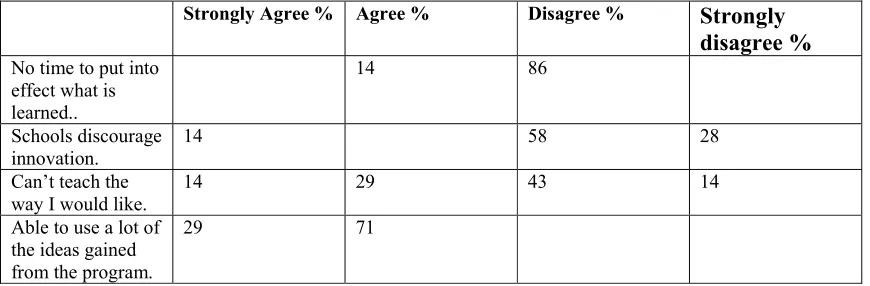
The context offered by this particular partnership experience was intended to disrupt the ‘continuity of their meaning’ and to a large extent succeeded. Only two of the eleven pre-service teachers who remained in the course can be said to have resisted the need to change. The survival of a new concept of knowledge in the minds and hearts of the remaining graduates may well depend on the teaching context they find themselves in the next few years.
acquired. For example, when pre-service teachers were asked to reflect on their program on specific items, the results as shown in Table 3 were obtained.
Table 3. Comment by pre-service teachers regarding future approaches to teaching and learning
Strongly Agree % Agree % Disagree % Strongly
disagree %
No time to put into effect what is learned..
14 86
Schools discourage
innovation. 14 58 28
Can’t teach the way I would like.
14 29 43 14
Able to use a lot of the ideas gained from the program.
29 71
One graduate had this to say:
Most of the theory, such as De Bono’s hats, multiple intelligences and the like are only just being brought to the attention of the staff. This makes it interesting at PD’s especially when they speak of thinking skills or the thinking curriculum and I have already been taught a lot of what they are saying. Otherwise all is well with my year 9 and 10 classes as most of their course was designed for me to follow so there has been little confusion. I love teaching so I have continued to learn with determination and will see this
employment as my true vocation. I hope the other students form the mid-year intake feel the same way. Thank you for the chance to train in the Grad Dip Ed. It’s great to be paid for doing something you love.
Where to from here?
From the above brief and preliminary analysis, two broad areas for continuing work present themselves:
1. That the provision of site-based programs be incorporated as one strategy into the mix of approaches available for pre-service teacher education and taking into account that:
• It may not be feasible for all pre-service provision to be undertaken in a site-based manner, but it should be possible to include one or a number of sites that have these characteristics.
• It is clear that not all school settings may be amenable to site-based work for a range of reasons.
• Each program will construct its arrangements differently, so it is difficult to estimate costs and whether such costs are prohibitive or not. In terms of innovation and progress, initiatives often have a cost over and above regular arrangements, but it is taken that such expense is necessary and will be recouped over time.
• Staff time is a significant expense in supporting site-based programs.
2. That the following model be adopted as one of the possible arrangements that are available for site-based pre-service teacher education:
• Pre-service teacher groups of about 15 in number and involving specialist areas from across the curriculum.
• Flexible timetabling enabling maximum scope for staff and pre-service teachers to negotiate and arrange their work collaboratively and to meet school student need and interest.
• Integrated subjects to encourage all participants to pursue their investigations from the perspective of personal interest and background.
• Partnership as key organising principle between school and university and between university staff, school staff and pre-service teachers.
• Curriculum features such as professional portfolios and applied curriculum projects.
• Seminars conducted by school staff on key issues of curriculum and school matters generally.
• Allocation of staff time for both school and university personnel to support the program and in the formation of necessary program teams and organisational arrangements.
Significance in the current circumstances
Overall, we believe that the evaluation has shown that the program has been successful and is deserved of ongoing development. Given the satisfaction shown by mentor
In terms of method subjects for the GDSE, the evaluation suggests that it may not be necessary to provide a wide range of individual studies, but that more generic curriculum subjects can be offered. For example, broad groupings such as Humanities and Sciences may be appropriate with scope for specific areas such as Languages other than English and Physical Education. As mentioned earlier, this proposal is based on the philosophical idea that knowledge is integrated rather than segmented and that inquiry approaches to learning flow across the curriculum. It may be appropriate to schedule a series of seminars throughout the year that highlight particular issues in particular curriculum subjects, but generally, a generic method should enable all the key teaching and learning issues to be encountered. Philosophical opposition to this view would need to contend that knowledge can indeed be grouped into specific epistemological domains each separate and different from each other. Mathematical knowledge for example could be argued as demanding a discrete approach precisely because it is discrete and different from all other knowledge forms. Equally, mathematics could be viewed as knowledge of human construction and therefore treated in exactly the same way as all other subject knowledge.
This discussion is particularly germane in Victoria (and in other states and territories as they move away from a strict Key Learning Area design) with the new ‘essential learnings’ curriculum. If a traditional disciplinary approach is adopted as the central organising principle for curriculum (which does not seem to be planned), then it follows that a similar number of individual method subjects will also be required. On the other hand, if school subjects are not seen as being based on the academic disciplines, but are rather constituted by a mix of information loosely grouped, then school subjects can be seen very clearly as embodying the same approaches and the generic method comes into play. At Victoria University in 2005, a second small GSDE intake is again following an integrated approach to knowledge using the Humanities/Sciences divide and it is intended that a much larger intake will be enrolled the following year. How far the integrated view of knowledge, teaching and learning will be pursued will be debated and disputed in both universities and schools as is the case with all significant change. The secondary
curriculum in Victoria may not be transformed, but perhaps a new trend may be introduced.
References
Australian Council of Deans of Education. (2004) New Teaching, New Learning: A Vision for Australian Education, ACDE.
Blackburn, J. (Chair) (1985) Ministerial Review of Postcompulsory Schooling, Report Volume 1.
Department of Education and Training. (2003) Blueprint for Government Schools, DET.
Gardner, H. (1993) Frames of Mind: The theory of multiple intelligences, London: Fontana.
Lather, P. (2001) Validity as an Incitement to Discourse: Qualitative Research and the Crisis of Legitimation, in Richardson, V. (Ed) Handbook of Research on Teaching Fourth Edition, Washington DC: AERA, pp. 241-249.
Kruger, T. (Chair) (1999) Innovative Approaches to Site-Based Teacher Education, Report to DETYA, Victoria University of Technology.
Luke, A. (2004) Education from Australia to Asia: a conversation with Allan Luke, Professional Educator, 3(1), pp. 14-17.
Neuman, W. L. (2003) Social research methods: Qualitative and quantitative approaches, 5th Edition, Boston: Allyn and Bacon.
Patton, M. Q. (2002) Qualitative research and evaluation methods, Thousand Oaks California: SAGE Publications.
Sykes, G. (1994) Change as Interpersonal and Organisational Conflict Michigan State University, referring to Marris, P. Loss and Change (1974)
Victoria University. (2004) Project Partnerships 2004, Bachelor of Education P-12, School of Education, Victoria University and http://education.vu.edu.au/partnerships
accessed I July 2005.
Victorian Curriculum and Assessment Authority. (2004) Victorian Curriculum Reform 2004 Consultation Paper: A Framework of Essential Learning, VCAA.