DEVELOPMENT OF A COGNITIVE RADIO MODEL USING WAVELET PACKET TRANSFORM - BASED ENERGY DETECTION TECHNIQUE
Oluseye A Adeleke1† --- Olagoke L Babawale2 1,2
Department of Electronic and Electrical Engineering, Ladoke Akintola University of Technology, Ogbomoso Nigeria
ABSTRACT
The term Cognitive Radio (CR) is an intelligent technique for opportunistic access of idle radio resources. In
Cognitive Radio, spectrum sensing is one of its important attributes which is used to sense the unused spectrum in an opportunistic fashion. Energy detection constitutes a preferred approach for spectrum sensing due to its simplicity
and ease of applicability. The conventional energy detection technique, which is based on fixed threshold is susceptible to noise uncertainty, which in practical sense, is actually unavoidable – this noise uncertainty makes the fixed threshold energy sub-optimal in its performance. In this paper, wavelet packet transform is proposed as a
preferred energy detection technique for optimal CR performance. Simulation results show that the proposed Wavelet Packet Transform Energy Detection technique (WPT-ED) gave higher probability of detection Pd than the
conventional type, which implies that the WPT-ED would give a more accurate detection of the primary user’s presence in the channel compared to the conventional technique.
© 2016 AESS Publications. All Rights Reserved.
Keywords:Wavelet transform, Detection, Primary user, Secondary user, Energy, Spectral efficiency.
Received: 24 February 2016/ Revised: 4 June 2016/ Accepted: 18 August 2016/ Published: 9 September 2016
Contribution/ Originality
This study is one of the very few studies which have investigated energy detection in the Cognitive radio network. However, the major contribution of this work is the utilization of the wavelet packet transform for the
purpose of optimal cognitive radio performance.
1. INTRODUCTION
In recent years it has bee n observed that the scarcity of radio spectrum is mainly due to the inefficiency of traditional static spectrum allocation policies. This issue leaves little or no spectrum for future demands. Spectrum
scarcity has thus become increasingly serious leading to intensified attention [1]; [2]. Cognitive radio network (CRN) has emerged as a promising technology to enable the access of the intermittent periods of unoccupied frequency bands, called white space or spectrum holes, and thereby increasing spectral efficiency [3].
According to the Federal Communications Commission (FCC), Cognitive radio is a system that senses its surrounding environment and dynamically adjusts its radio parameters to communicate efficiently. A typical CRN is
comprised of two types of users: primary users (PUs) and secondary users (SUs). PUs are authorized to utilize
Journal of Asian Scientific Research
ISSN(e): 2223-1331/ISSN(p): 2226-5724
licensed bands/channels whenever they have demands. In contrast, SUs are not licensed users, but they are allowed to temporarily access channels without harmful interference to the PUs through dynamic spectrum access (DSA). If the
interference from SUs to PUs is dominant and destructive, SUs have to take necessary actions to avoid it. This concept of cognitive radio enables a coexistence of the legacy systems and new users i.e. the primary and the secondary users [4]; [5].
This distinct feature of CRNs raises an essential and challenging question, i.e., how to accurately estimate or predict interference from SUs to PUs. This topic has recently attracted considerable attention. Using spectrum sensing
to detect the presence of the primary users is, therefore, a fundamental requirement in cognitive radio networks. A longer sensing time will improve the sensing performance; however, with a fixed frame size, the longer sensing time will shorten the allowable data transmission time of the secondary users. Hence, a sensing-throughput tradeoff problem was formulated to find the optimal sensing time that maximizes the secondary users’ throughput while providing adequate protection to the primary user. Another technique to improve the spectrum sensing performance is
cooperative sensing [6]; [4].
Most of the existing models and related analyses are significantly complex. For instance, the conventional energy detection technique, based on fixed threshold is prone to noise uncertainty, which has the tendency of making the
energy detection suboptimal in its performance. This paper aims at improving the energy detection, with less complexity and greater efficiency. The rest of this paper is organized as follows: Section II gives the System model
and analysis of the proposed technique while Section III gives the simulation results and discussion. Finally Section IV concludes the paper.
2. SYSTEM MODEL AND METHODOLOGY
Fig-1. System Model of the proposed technique Source: Haykin [7]
The following specific steps were undertaken for the development of the proposed cognitive energy detection
technique:
1. Development of a wavelet transform-based energy detection spectrum sensing model. 2. Simulation of the developed spectrum sensing model using the MatLab software.
From Fig.1, the received signal could either contain a primary user signal or not. The equations for these two scenarios are as follows:
(Primary user is absent): r (t) = n (t) (1) (Primary user is present): r (t) = h*x (t) + n(t) (2) where
r(t) = the received signal by the CR user
n(t) = the additive white Gaussian noise (AWGN)
x(t) = the transmitted signal of the primary user
h = the channel gain from the primary user to the secondary user’s receiver = density of power signal
= density of noise signal R = signal received
= gain of estimated signal
The total energy of the received signal can be expressed as:
∑ | [ ]| (3)
where k is the number of samples in the signal
In order to decide whether the spectrum is being occupied by the primary user, the total energy, E calculated from the received signal will be compared with a threshold value Eth. Thus, the probability that the signal detector
detects rightly the presence of a primary user can be expressed as:
)
(
1H
E
E
P
P
R
r
th (4)while the probability that the detector detects wrongly the presence of a primary user can be expressed as:
)
(
0H
E
E
P
P
th rw
(5)where PR = probability of right detection
Pw = probability of wrong detection
H1 = presence of a primary user
Fig-2. Block Diagram of the steps involved in the work
3. SIMULATION, RESULTS AND DISCUSSION
The simulations were carried out on both the developed Wavelet Transform energy detection and the conventional type while the evaluation of the system was performed using the signal to noise ratio (SNR).
The signal is decomposed in to original signal (A) and noise signal (D) using a wavelet packet transform, the reconstruction of the signal will determine the magnitude of the presence of original signal (AAD) and or noise signal
(ADD).The spectral density frequency of the original signal is relatively low and that of noisy signal is relatively high as shown in Fig. 3.
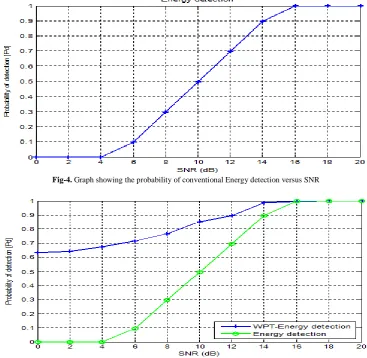
Fig-4. Graph showing the probability of conventional Energy detection versus SNR
Fig-5. Graph comparing the probabilities of WPT-ED and the conventional ED
Fig. 4 shows the plots for the probability of the conventional energy detection technique against the signal-to-noise ratio (SNR). It can be seen from the graph that from a SNR of 0 dB to 4 dB, the probability is zero, and as the
SNR increases beyond 4 dB, the probability is seen to increase, as can be seen from the figure.
However, coming to Fig. 5 which shows the plots of the probabilities of the conventional energy detection technique and the proposed Wavelet Packet Transform – Energy Detection technique, it is seen that, though the
probabilities of both techniques vary directly with the SNR, that of the proposed technique clearly outperforms the conventional one. For instance, at a SNR of 2 dB, the conventional technique has a probability of 0 while the
proposed has a probability of 0.62. This clearly shows that the proposed WPT-ED technique has a better performance than the conventional one. This finding also implies that the WPT-ED would give a more accurate detection of the primary user’s presence in the channel compared to the conventional technique.
4. CONCLUSION
Wavelet Transform is a key technique that addresses spectrum sensing under uncertain noise power and proposes an energy detection algorithm, based on the wavelet packet transform; noise power and signal power are estimated,
and the threshold for spectrum sensing is obtained. This paper has shown that the wavelet packet transform energy detection method out-performs the conventional energy detection method. The simulation results also show that the proposed algorithm has the robustness to the noise uncertainty inherent in the conventional detection method and is a
Funding: This study received no specific financial support.
Competing Interests: The authors declare that they have no competing interests.
Contributors/Acknowledgement: All authors contributed equally to the conception and design of the study.
REFERENCES
[1] A. Sahai, N. Hoven, and R. Tandra, "Some fundamental limits on cognitive radio," presented at the Allerton Conference
on Communication, Control, and Computing, 2003.
[2] L. Zeng, "Spectrum sensing is a key to cognitive radio: A survey," International Journal of Next Generation Networks,
vol. 3, pp. 2-18, 2005.
[3] J. Mitola and G. Q. Maguire, "Cognitive radios: Making software radios more personal," IEEE Personal
Communications, vol. 6, pp. 13-18, 1999.
[4] F. Akyildiz, W. Y. Lee, M. C. Vuran, and S. Mohanty, "Next generation/dynamic spectrum access/cognitive radio
wireless networks: A survey," Computer Networks, vol. 50, pp. 2127–2159, 2006.
[5] M. Subhedar and B. Gajanan, "Spectrum sensing techniques in cognitive radio networks: A survey," International
Journal of Next–Generation Networks, vol. 3, pp. 37-51, 2011.
[6] S. M. Mishra, A. Sahai, and R. W. Brodersen, "Cooperative sensing among cognitive radios," presented at the IEEE International Conference on Communications ICC ’06, 2006.
[7] S. Haykin, "Cognitive radio: Brain-empowered wireless communications," IEEE J. Selected Areas in Communications,
vol. 23, pp. 201-220, 2005.