IJEDR1403015
International Journal of Engineering Development and Research (www.ijedr.org)2980
Color based segmentation using clustering techniques
1
Deepali Jain,
2Shivangi Chaudhary
1
Communication Engineering,
1Galgotias University, Greater Noida, India
________________________________________________________________________________________________________
Abstract - Segmentation of an image defines as a process of partitioning the image into its constituent parts or similar objects. There are two approaches for image segmentation i.e. discontinuity based and similarity based. In this paper, color based segmentation on noisy image using K-means and Fuzzy c-means is shown. Images are the best means of conveying information. Image is in RGB color space, transforming it in LAB color space which is more compatible to human vision. Clustering is one of the best methods for segmentation even if the data is large. The main aim of this paper is to compare the performance of K-means and Fuzzy c-means techniques over the noisy image. The best results can be seen after finding the accuracy of the segmented images using clustering techniques.
Index Terms - Image segmentation, k-means clustering, Fuzzy c-means clustering
________________________________________________________________________________________________________
I.INTRODUCTION
Image segmentation is a salient part of image processing. Segmentation refers to a process in which a digital image is separated into uniform and non-overlapping regions. Each region should be homogeneous means based on some similarity measures [1]. Segmentation has wide applications in the field of biomedical, pattern recognition, image coding etc. Image segmentation is a basic and key step for better analyzing an image. Noisy background or adhere noise in the image made the image segmentation process a big and challenging research issue. The main objective is to clarify the image which is easy to analyze. The main focus is to segregate the digital image into set of pixels where pixels should be similar in color, intensity, texture etc. There are many approaches for segmentation like region based segmentation, edge based segmentation, thresholding and clustering. Clustering is one of the best and simplest techniques for differentiating an image into similar attributes.
In literature review we come to know about the image segmentation via soft computing method, this approach helps in upgrading the clarity and the recognition capabilities of grey level image [2]. Some other important clustering techniques were proposed earlier like shape based clustering where HMM is used for finding the number of clusters and then data is clustered according to their shape similarity [3]. Large data set is a challenging task for segmentation but via clustering the execution time can be minimized [4].Fuzzy ISODATA algorithm is known for the class of convergence of class of clustering. In this paper arbitrary sequence created by Picard iterations constantly terminate at local minima, this is proved by the help of Zangwill theory [5].
II.CLUSTERING
Clustering is a process of collecting objects into groups of similar attributes and separate it with the dissimilar ones. Cluster analysis is an essential part of clustering which help us in discriminating the similar object in one cluster and dissimilar ones in another cluster [6]. Clustering methods tells us about the interconnection between the data. In recent scenario, clustering is kind of boom, it has significance in many real world applications such as marketing, land use, urban planning, bank and internet security, spam pattern discovery and in image processing etc. Clustering techniques assist in dealing with the noisy data, dealing with different types of attributes, clusters of arbitrary shapes and to deal with high-dimensional data [7]. It has various future applications like in biomedical field; if a patient is suffering from a disease then doctors can predict what will be the impact of this disease after few years with the help of clustering.
Clustering Methods
Many clustering algorithms have been proposed till now in the literature. There are two types of clustering algorithms one is hard (or crisp) and other is fuzzy. Hard means each data point of the data set belongs to one and only one cluster and fuzzy means one data point of the data set can belong to more than one cluster [6]. Major clustering methods can be classified as partitioning methods, Hierarchical methods and Density based clustering [7]. The main objective is to choose correct algorithm for particular data type and this depends on the data type available, the nature and motive of the application.
III.PROPOSED ALGORITHM
IJEDR1403015
International Journal of Engineering Development and Research (www.ijedr.org)2981
6. Otherwise go to step 2.Now, coming on to Fuzzy c-means clustering, it is a soft computing method. It is the supplement of K-means because fuzzy allot membership function to the data points. Membership function means each data point is allowed to be in more than one cluster. Fuzzy c-means is an extension of the fuzzy set theory. Membership can be assigned by calculating the distance between the cluster center and the data points, the data point having less distance with the cluster centre comes in that particular cluster [11]. Number of clusters, the fuzziness exponent and the termination tolerance are three main parameters of Fuzzy c-means clustering.
Algorithm:
1. Randomly assign the cluster centers.
2. Compute the Euclidean distance from the data point to each cluster center.
3. Check the distance from data points to the centers, the data point having minimum distance with the 4. Cluster center has high membership and assigns it with that particular cluster.
5. Evaluate new cluster centers.
6. This process repeat until there is no movement in the centers. 7. Otherwise go to step 2.
IV.METHODOLOGY
IJEDR1403015
International Journal of Engineering Development and Research (www.ijedr.org)2982
Figure1: Membership function of input variable 1 Figure2: Membership function of input variable 2
Figure3: Sugeno rule base Figure4: Output
IJEDR1403015
International Journal of Engineering Development and Research (www.ijedr.org)2983
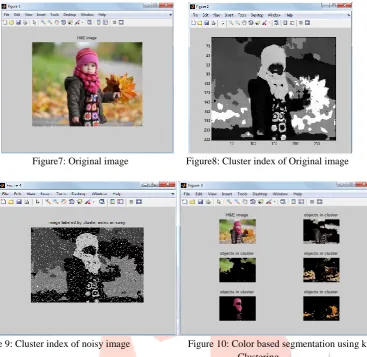
Figure7: Original image Figure8: Cluster index of Original image
Figure 9: Cluster index of noisy image Figure 10: Color based segmentation using k-means Clustering
Cluster index means it segregate the whole image in the pixel labels where all the pixels labeled in the form of numbers means which pixels fall in which cluster. Hence, the mapping is done between the noisy and noiseless image, the technique which gives the more corrected segments considered as the best technique.
IJEDR1403015
International Journal of Engineering Development and Research (www.ijedr.org)2984
Figure13: Cluster index of noisy image Figure14: Color based segmentation using Fuzzy c--means Clustering
After doing the whole clustering procedure, the accuracy we get from the Fuzzy c-means is 88.92% and that we get from K-means is 75.82%. This shows fuzzy c-K-means gives better results and accuracy than K-K-means in case of color based segmentation as shown in TableI.
Table I Clustering techniques results Clustering Techniques Accuracy
K-means 75.82%
Fuzzy C-means 88.92%
VI.CONCLUSION
Fuzzy c-means is superior to K-means because it gives good results on whether the data is incomplete, overlapped or uncertain and has wider applicability. K-means-means belongs to hard clustering and Fuzzy c-means is a soft computing method. K-means is not efficient because the mean of the cluster changes on every iteration. Fuzzy c-means is better because it can properly work on high dimensional data than K-means. No doubt, Fuzzy c-means is slower and takes times to process but gives better and improved efficiency than K-means. In this paper, the effect of noise on the image using different clustering techniques is measured. Fuzzy c-means technique gives more segmented image and more appropriate accuracy than K-means.
REFERENCES
[1] F.Meyer. (1995). Color image segmentation. IEEE International Conference, (pp. 303-306).
[2] Senthilkumaran, N., & Rajesh, R. (2009). Image segmentation -A Survey of Soft computing Approaches. International Conference, (pp. 844-846).
[3] Bhardwaj, S., Srivastava, S., & Gupta, J. (2013). A Novel Clustering Approach Using Shape Based Similarity. Springer, (pp. 17-27).
[4] Saraswathi, S., &Allirani, A. (2013). Survey on image segmentation via clustering. International Conference, (pp. 331-335).
[5] J.Bezdek (1980) A Convergence Theorem for the Fuzzy ISODATA Clustering Algorithm. IEEE Journal, (pp. 1-8). [6] Xu, R., &Wunsch, D.(2005). Survey of Clustering Algorithms," Neural Networks IEEE Transaction, (pp. 645-678 [7] Lukic, I., Kohler, M., &Slavek, N. (2012). The segmentation of Data set Area method in the clustering of uncertain data International Convention, (pp. 405-410).
[8] Dharmarajan, A., &Velmurugan, T. (2013). Applications of partition based clustering algorithms. IEEE International conference, (pp. 1-5, 26-28).
[9] K, M., & M.M., M. (2010). Color image segmentation using k-means clustering and Optimal Fuzzy C-Means clustering. International Conference (pp. 229-234).
[10] Kalam, R., &Manikandan, K. (2011). Enhancing K-means Algorithm for image segmentation. International Conference, (pp. 1-4, 20-22).
[11] Ningbo, G. (2004). Fuzzy cluster analysis and applications. China: House of Indian University).
[12] DING Zhen, Zhong-shan, H., Jing-yu, Y., Zhen-min, T., & Yong-ge, W. (1997). A Fuzzy clustering based approach to image. IEEE, (pp. 536-541).