It can scarcely be denied that the supreme goal of all theory is to make the irreducible basic elements as simple and as few as possible without having to
surrender the adequate representation of a single datum of experience.
University of Alberta
The Processing of Lexical Sequences
by
Cyrus Shaoul
A thesis submitted to the Faculty of Graduate Studies and Research in partial fulfillment of the requirements for the degree of
Doctor of Philosophy
Department of Psychology
©Cyrus Shaoul Spring 2012 Edmonton, Alberta
Permission is hereby granted to the University of Alberta Libraries to reproduce single copies of this thesis and to lend or sell such copies for private, scholarly or scientific research purposes only. Where the thesis is converted to, or otherwise made available in
digital form, the University of Alberta will advise potential users of the thesis of these terms.
The author reserves all other publication and other rights in association with the copyright in the thesis and, except as herein before provided, neither the thesis nor any substantial portion thereof may be printed or otherwise reproduced in any material form whatsoever
Abstract
Psycholinguistics has traditionally been defined as the study of how we process units of language such as letters, words and sentences. But what about other
units? This dissertation concerns itself with short lexical sequences called n -grams, longer than words but shorter than most sentences. N-grams can be phrases (such as the 3-gramthe great divide) or just fragments (such as the 4-grammeans nothing to a). Words are often thought to be the universal, atomic building block of longer lexical sequences, but n-grams are equally capable of carrying meaning and being combined to create any sentence. Are n-grams more than just the sum of their parts (the sum of their words)? How do
Acknowledgements
The research in this thesis would not have been possible without the support of Dr. Chris Westbury and the members of the Westbury Lab. I
collabo-rated with Georgie Columbus on the eye-tracking research in Chapter 3 (She
was responsible for the experimental software programming and part of the data collection). Dr. Chris Westbury, Dr. Harald Baayen, Dr. Christina
Gagn´e and Dr. Norman Brown provided advice and inspiration throughout
the development of this dissertation.
Chapter 1, in part, is a revised version of the material as it appears in Shaoul and Westbury (2011). The dissertation author was the primary
inves-tigator and author of this material.
Chapters 2, 3 and 4, in full, are currently being prepared for submission for publication. The dissertation author was the primary investigator and author
Table of Contents
1 Introduction 1
1.1 Foundations: Information & Learning Theory . . . 3
1.1.1 Information Theory . . . 3
1.1.2 Learning Theory . . . 4
1.2 Empirical Evidence of N-gram Processing . . . 6
1.2.1 Evidence from memory research . . . 6
1.2.2 Evidence from linguistic ambiguity research . . . 8
1.2.3 Evidence from acceptability judgment research . . . 8
1.2.4 Evidence from phonology research . . . 10
1.2.5 Evidence from eye movement studies . . . 11
1.2.6 Evidence from reading speed and repetition studies . . 12
1.3 Methodological issues in studying n-grams . . . 17
1.3.1 Models of probability, expectation and predictability in language . . . 20
1.4 Beyond rule-based descriptions of language . . . 24
1.5 Summary . . . 25
1.6 Three experimental studies . . . 26
2 The subjective frequency of n-grams. 28 2.1 Introduction . . . 28
2.1.1 Words and N-grams . . . 35
2.1.2 Subjective and objective frequency of words andn-grams 35 2.2 Experiment 1 . . . 37
2.2.1 Participants . . . 37
2.2.2 Methods and Materials . . . 37
2.2.3 Results . . . 38
2.2.4 Discussion . . . 43
2.3 Experiment 2 . . . 44
2.3.1 Relative frequency of words . . . 44
2.3.2 Participants . . . 45
2.3.3 Methods and Materials . . . 45
2.3.4 Results . . . 47
2.3.5 Discussion . . . 50
2.4 Experiment 3 . . . 52
2.4.1 Relative frequency of n-grams . . . 52
2.4.2 Participants . . . 52
2.4.3 Materials . . . 53
2.4.4 Methods . . . 54
2.4.5 Results: Accuracy . . . 54
2.4.6 Discussion: Accuracy . . . 57
2.4.7 Results: Response Time . . . 59
2.4.8 Discussion: Reaction Time . . . 60
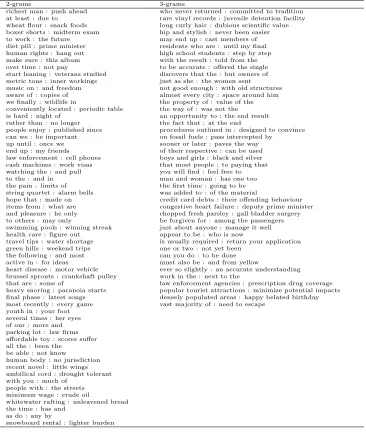
2.6 Experimental Stimuli . . . 66
2.7 Distribution of n-gram frequency ratios in Experiment 3 . . . 69
3 Probabilistic information influences eye movements when read-ing trigrams. 71 3.1 Introduction . . . 72
3.2 Probabilistic Information . . . 76
3.3 Methods . . . 79
3.3.1 Participants . . . 79
3.3.2 Materials . . . 80
3.3.3 Procedure . . . 81
3.3.4 Data Preparation . . . 83
3.4 Statistical Methodology . . . 85
3.5 Results . . . 86
3.5.1 First Analysis: Total Duration . . . 86
3.5.2 Discussion . . . 89
3.5.3 Second Analysis: Regressive Saccades . . . 91
3.5.4 Discussion . . . 95
3.5.5 Third Analysis: Number of Fixations . . . 95
3.5.6 Discussion . . . 98
3.5.7 Fourth Analysis: First Sub-gaze . . . 99
3.5.8 Discussion . . . 103
3.5.9 Fifth Analysis: Second Sub-gaze . . . 104
3.6 Conclusion . . . 108
3.6.1 Contribution of Frequency . . . 109
3.6.2 Contribution of PMI . . . 111
3.6.3 Contribution of TIC . . . 112
3.6.4 Contribution of cc2 . . . 113
3.7 Final Thoughts . . . 115
3.8 Appendix: Variable loadings for principal components PC1 to PC5 . . . 117
3.9 Appendix: Closed class word list . . . 118
3.10 Appendix: Intercorrelations of predictors before and after PCA. 119 4 N-gram probability effects in a cloze task. 121 4.1 Introduction . . . 121
4.2 Statistical Considerations . . . 129
4.3 Experiment 1 . . . 130
4.3.1 Participants . . . 131
4.3.2 Materials . . . 131
4.3.3 Procedure . . . 131
4.3.4 Results . . . 132
4.3.5 Discussion . . . 135
4.4 Experiment 2 . . . 136
4.4.1 Participants . . . 139
4.4.2 Materials . . . 139
4.4.3 Procedure . . . 139
4.4.4 Results . . . 140
4.4.5 Response Entropy and Family Size . . . 144
4.4.6 Response Order . . . 149
4.4.7 Discussion . . . 152
4.5 Conclusion . . . 153
4.6 Appendix: Stimuli, Experiment 1 . . . 159
4.7 Appendix: Stimuli, Experiment 2 . . . 160
5 The nature of n-gram processing 163
5.1 General Discussion . . . 163
5.1.1 N-grams are more than the sum of their parts . . . 164
5.1.2 N-gram processing is an anticipatory process . . . 165
5.1.3 N-gram Frequency Effects are epiphenomenal . . . 168
5.1.4 N-grams and the existence of a mental lexicon: Storage versus computation . . . 169
5.1.5 Language as an emergent process . . . 173
5.2 Future directions . . . 176
List of Tables
2.1 Regression Model Comparisons for Experiment 1. Two models for predicting the mean sub-jective frequency ratings ofn-grams are given for each size ofn-gram, with the first model nested within the second. Models in bold type were the best models for each type ofn-gram. ∆df denotes the change in the number of free parameters between the two models being
compared. . . 42
2.2 Accuracy Model Comparisons for Experiment 2. Pos is the position of the higher frequency word, either above or below the fixation cross. FreqRatio is the log transformed ratio of the word frequencies. The base model included crossed random effects of subject and item, and random slopes were fitted for each subject based on their sensitivity to the item’s frequency ratio. . . 48
2.3 Coefficients for the fixed effects in the generalized linear mixed effects model fitted to the observed accuracy for word pairs in Experiment 1. FreqRatio is the log transformed ratio of the word frequencies and Position is the location of the higher frequency word on the screen. This model also included random intercepts of subject and item as well as random slopes for each subject based on their sensitivity to the item’s frequency ratio. . . 48
2.4 RT Model Comparisons for Experiment 2. FreqRatio is the log transformed ratio of the word frequencies. Length is the number of letters in the word. The Random Slopes in these models were fitted for each subject based on their sensitivity to the frequency ratio. All models except the first one contain the fixed effect of previous trial RT. . . 49
2.5 MCMC-based estimates for the coefficients for the fixed effects in the linear mixed effects model fitted to the observed RT in Experiment 2. FreqRatio is the log-transformed ratio of the word frequencies, Length is the length of the word in letters and PrevTrialRT is the log-transformed RT for the preceding trial. . . 51
2.6 Accuracy GLME Model Comparisons for Experiment 3. All models contain crossed random effects for subjects and items. Models in bold type were the best models for each type of n-gram. All models include a random intercept for each item and a random slope for the effect of the frequency on each subject. . . 56
2.7 Coefficients for the fixed effects in the generalized linear mixed effects model fitted to the observed accuracy on 4-gram pairs in Experiment 3. . . 58
2.8 Coefficients for the fixed effects in the generalized linear mixed effects model fitted to the observed accuracy on 5-gram pairs in Experiment 3. . . 58
2.9 Markov-chained Monte Carlo (MCMC) based estimates of the coefficients for the fixed effects in the linear mixed effects model fitted to the observed RTs on 4-gram pairs in Experiment 3. 59 2.10 2-grams and 3-grams used in Experiment 3. . . 66
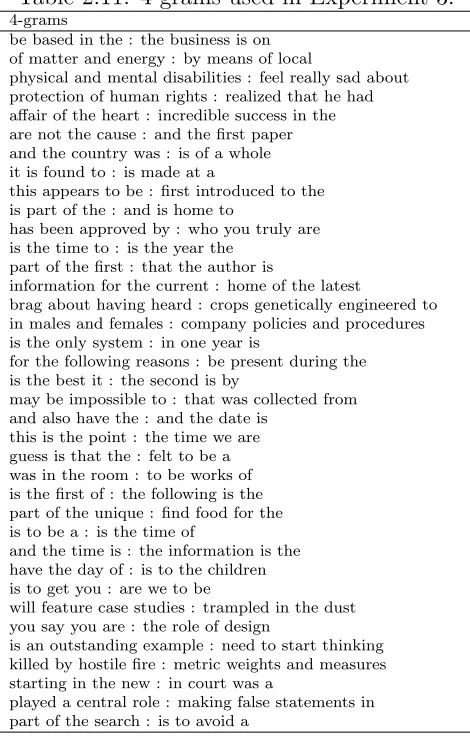
2.11 4-grams used in Experiment 3. . . 67
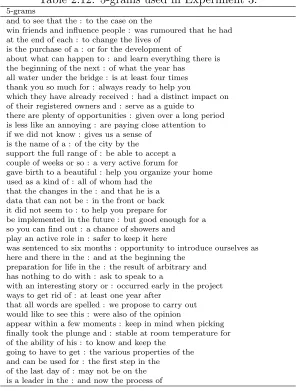
2.12 5-grams used in Experiment 3. . . 68
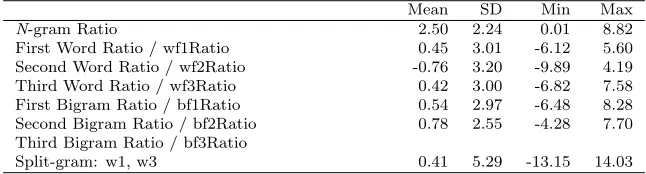
2.13 Descriptive statistics for 2-grams used in Experiment 3 (log-transformed). . . 69
2.14 Descriptive statistics for 3-grams used in Experiment 3 (log-transformed). . . 69
2.15 Descriptive statistics for 4-grams used in Experiment 3 (log-transformed). . . 69
2.16 Descriptive statistics for 5-grams used in Experiment 3 (log-transformed). . . 70
3.1 Inputs to the statistical models. All frequencies are log-transformed. . . 84
3.2 Model Comparisons for models predicting total reading time for a trigram. ∆AIC denotes the change in AIC between two models. . . 87
3.3 Coefficients for linear predictors in the best fitting GAM for the total reading duration of the trigrams. . . 88
3.4 Model Coefficients for smooth predictors in the best fitting GAM for the total reading duration of the trigrams. The⊗symbol denotes the tensor product. . . 89
3.5 Model Comparisons for models predicting probability of one or more regressive saccades in a trial. ∆AIC denotes the change in AIC between two models. . . 92
3.6 Model Coefficients for linear predictors in Regressive Saccade probability GAM . . . 94
3.7 Regressive Saccade Model Parameters for smooth predictors in the GAM . . . 94 3.8 Model Comparisons for models predicting total fixations for a trigram. ∆AIC denotes the
3.9 MCMC-based estimates for the coefficients for the fixed effects in the linear mixed effects model fitted to the observed total fixations. . . 97 3.10 MCMC-based estimates for the random effects in the linear mixed effects model fitted to the
observed number of fixations. . . 98 3.11 Model Comparisons for models predicting SG1 for a trigram. ∆AIC denotes the change in
AIC between two models. All random slopes were for for the random effect of subject. . . 100 3.12 MCMC-based estimates for the coefficients for the fixed effects in the linear mixed effects
model fitted to the observed SG1. . . 100 3.13 MCMC-based estimates for the random effects in the linear mixed effects model fitted to the
observed SG1. . . 101 3.14 Model Comparisons for models predicting SG2 for a trigram. ∆AIC denotes the change in
AIC between two models. All random slopes were for for the random effect of subject. . . 105 3.15 MCMC-based estimates for the coefficients for the fixed effects in the linear mixed effects
model fitted to the observed SG2. . . 105 3.16 MCMC-based estimates for the random effects in the linear mixed effects model fitted to the
observed SG2. . . 108 3.17 Loading of the first 5 principal components in the PCA solution for frequency, length and
completeness. Correlations over 0.4 are shown in boldface. Correlations over 0.7 are shown in italics. . . 117 3.18 The list of words used to classify closed class words in our stimulus list. . . 118
4.1 Model coefficients for smooths predicting response frequency in the best fitting GAM for the prepended responses. . . 143 4.2 Model coefficients for smooths predicting response frequency in the best fitting GAM for the
appended responses. . . 144 4.3 Coefficient estimates from a cumulative link mixed model for response order for prepended
responses. . . 151 4.4 Coefficient estimates from a cumulative link mixed model for response order for appended
responses. . . 151 4.5 Stimuli for the letter and word completion tasks. . . 159 4.6 Trigram Stimuli dropped from in Experiment 2 due to lack of quadragram frequency data in
the Web1T corpus. . . 162 4.7 Comparison of dropped and retained stimuli. Bootstrapped 95% confidence intervals for
List of Figures
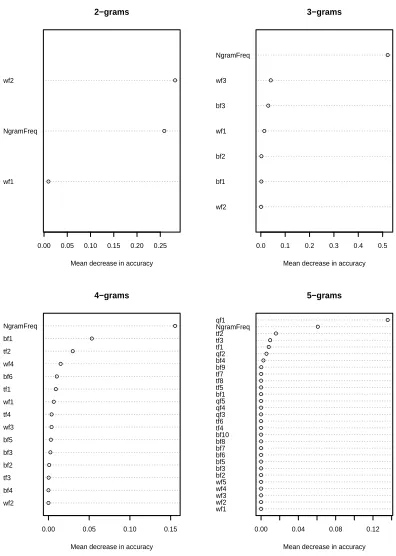
2.1 Importance for predictors in a random forest model of mean item rating in Experiment 1. After creating random forest models, I calculated the relative importance of all of the log transformedn-gram frequency variables in predicting mean subjective frequency ratings ad-justed for correlations between predictor variables (both for the main effects and the inter-actions). The names of the frequencies are abbreviated in the following manner: 2, 3 and 4-grams are assigned the lettersb,t, andq. The abbreviationtf2stand forSecond Trigram
Frequency. A full description of all these abbreviations is given in Section 2.7. . . 41
2.2 Distribution of relative frequencies of stimuli for all word pairs presented in Experiment 2. . . 46 2.3 A) Relationship between item accuracy and log frequency ratio for all the word pairs in
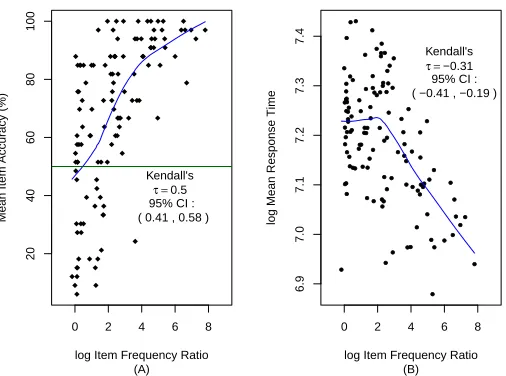
Ex-periment 2. The green line is at the 50% accuracy level. (B) Relationship between frequency ratio and response time for all the word pairs in Experiment 2. In both of these graphs, Kendall’sτ is reported rather than Pearson’sr due to the heteroskedasticity of the distri-bution, and I have included bootstrapped 95% confidence intervals. The blue lines show the LOWESS (locally weighted scatterplot smoothing) smooths. . . 47 2.4 Distribution of relative frequencies of stimuli for alln-gram pairs presented in Experiment 3. 53 2.5 Conditional importance of predictors in a random forest model for accuracy in Experiment
3. After creating random forest models, I calculated the relative conditional importance of all of then-gram frequency variables in predicting mean accuracy, adjusted for correlations between predictor variables, both for the main effects and interactions. . . 55 2.6 Importance for predictors in a random forest model for RT in Experiment 3. After creating
random forest models, I calculated the relative importance of all of the n-gram frequency variables as well as string Length in predicting mean subjective frequency ratings adjusted for correlations between predictor variables, both for the main effects and interactions. . . . 58
3.1 One of the 1000 frequency bands that were used to select stimuli. . . 80 3.2 A) Partial Effects of N-gram Frequency and Pointwise Mutual Information Tensor Product
Smooths on Total Reading Time. B) Partial Effects of Total Information Content and Point-wise Mutual Information Tensor Product Smooths on Total Reading Time. The dependent measure has been transformed back to milliseconds before plotting, using the reverse of the Box-Cox transformation. . . 90 3.3 Partial effects on the probability of a regressive saccade during a trial for A) Interaction
betweenn-gram frequency and sTIC. B) Interaction between sPMI and sTIC. The dependent measure was transformed from logits to probabilities before plotting. . . 93 3.4 Partial effect of the interaction between Pointwise Mutual Information and class of second
word in predicting the number of fixations. . . 96 3.5 Partial effect of the interaction between Pointwise Mutual Information and class of first word
in predicting SG1. . . 102 3.6 Partial effects of predictors in linear mixed effects model predicting SG2. A) Interaction
between Pointwise Mutual Information and log n-gram frequency, B) Interaction between Pointwise Mutual Information and class of second word. . . 107 3.7 Matrix of correlations for all predictors before orthogonalization. The lower triangle contains
scatterplots for all the predictor relationships. The stimulus sampling technique used enabled us to have the broad coverage seen in the scatterplots for all the corpus frequency measure (n-gram frequency, bigram frequencies and word frequencies). The upper triangle contains pairwise Pearson correlations for all the predictors, with the size of the font used showing the size of the correlation. The diagonal contains histograms for each predictor. . . 119 3.8 Matrix of correlations for new set of predictors after orthogonalization. . . 120
4.1 Item level scatterplots for all items in the letter completion task with best fitting linear regression line. To make the graphs easier to read, the log-transformed rank is shown on the y-axis. The outcome of the analyses are identical when the untransformed rank is used. . . . 132 4.2 Item level scatterplots for all items in the word completion task with best fitting linear
4.3 Plots of the smooths from the GAM models for response frequency. Relationship between con-ditional probability and response frequency for prepended (A) and appended (B) responses. Relationship between response length and response frequency for prepended (C) and appended (D) responses. . . 145 4.4 Scatter plots including best fit regression lines and 95% confidence intervals for A) the
re-lationship between trigram 3rd word frequency and the ratio of numbers of appended and prepended responses, and B) the relationship between trigram PMI and response entropy (for prepended responses). . . 146 4.5 Contour plot of the fit for the linear regression model for family size predicted by PMI and
Chapter 1
Introduction
There is a new and growing interest in psycholinguistics in the
men-tal representation of (not necessarily phrasal) lexical sequences and in
how knowledge of these sequences relates to word, phrase, and sentence
knowledge. In this chapter I summarize the evidence for the existence of
distinct mental representations for these types of sequences. Studies of
sentence processing, contextual ambiguity resolution, speech production
and compound word processing provide indirect evidence for frequency
effects for lexical sequences. Recent studies of adult reading behaviour
have looked more directly at the effects of holistic frequency on reading
performance. I end by considering the relevance of lexical sequences to
existing cognitive models of language and speculating on how they may
impact future models.
The urge to analyze language in a reductionist way has been evident from
the earliest psycholinguistic experiments. Language has long been conceived
of as a stream of discrete words that can be broken down into their
compo-nents (morphemes, syllables, phonemes, and letters) or combined together to produce phrases or sentences. Relatively little consideration has been given
to linguistic units intermediate between these two levels of analysis: lexical
sequences that are not necessarily phrasal. In this chapter I address two main questions: Are there any units of language that have a mental representation
that is larger than a word but smaller than a phrase, and do they matter to
of psycholinguistics and linguistics that bear on these questions.
Though words and sentences have been studied extensively by
psycholin-guists, the concept of lexical sequences as a behaviorally relevant unit is a
relatively new one (Bybee & Scheibman, 1999) 1. The concept has been given many names by different researchers. Some terms that have been used (not
quite identically) include: lexical bundles (Biber, Conrad, & Cortes, 2004),
formulae, collocations, adjuncts, idioms, multi-word expressions, multi-word
sequences, chunks, holophrases, prefabricated routines, lexical patterns, word combinations, multi-word combinations, N-grams, and formulaic sequences
(Wray, 1998). Some definitions of these sequences allow for flexibility in
inter-vening words with open slots, some allow for arbitrarily long sequences, some imply figurative meaning, and some imply semantic compositionality or
non-compositionality. The scope of these terms is potentially very large. In this
dissertation I will use the term n-grams, and limit it strictly to the subset of non-lexicalized word sequences that are between two and five words long.
Despite the lack of consensus on the definition of formulaic sequences,
lin-guists agree that they are extremely prevalent in both spontaneous speech and
writing. Biber (1999) proposed that for a series of words to be considered to be
a formulaic sequence, it must occur at least ten times per million in a corpus for sequences between two and four words long, and at least five times per
mil-lion for longer sequences. This is obviously an arbitrary threshold, but its use
has become a common way for investigators to identify formulaic sequences. According to Erman and Warren (2000), over 50% of spoken and written
lan-guage is made up of such formulaic sequences. The Google Web1T Database
(Brants & Franz, 2006), which consists of approximately one trillion word
tokens of text found in publicly accessible Web pages, lists approximately 78 million formulaic sequences of two words, 244 million sequences of three words,
328 million of four words, and 294 million of five words. These numbers are
so large that it may seem beyond the scope of possibility that the human
brain could represent any information about formulaic sequences. However, a
growing body of evidence suggests that they can. I begin by presenting a brief
history of the study of formulaic sequences and of the evidence suggesting that
they may be represented.
1.1
Foundations: Information & Learning
The-ory
The conceptual roots for conceiving language in terms of n-grams comes from information theory. The behavioral manifestations of an information-theoretic conceptualization of the mind have been studied in learning theory. In this
section I briefly review these two foundational theories.
1.1.1
Information Theory
One of the first people interested in the probabilistic nature of language was
Claude Shannon (Shannon, 1948). He demonstrated that strings of letters
generated at random with the constraint that they follow real bigram dis-tributions produced words that were word-like and pronounceable, and that
sentences created by stringing together words in the same way produced
sen-tences that were sometimes readable. The computational resources he had
available for this work were of course tiny compared to those that exist today. After discussing how sentences could be approximated using two-word
transi-tion probabilities, Shannon remarked that “It would be interesting if further
approximations could be constructed, but the labor involved becomes
enor-mous at the next stage.” (Shannon, 1948, p.8). Sixty years later, advances in computational technology have made this enormous labor tractable. The
arguments made by Shannon (1948) form a foundational assumption of
infor-mation theory relevant to n-grams: that analyzing the probability of discrete patterns in a signal can lead to insights about how to simplify the processing
of that signal. During the decade after Shannon’s paper was published,
psy-chologists delved into information theory. They felt that this new direction of
psy-cholinguistics (Osgood et al., 1954). However, during the Chomskian era that
followed, with its emphasis on rule-based generative models, almost no further
work was done on probabilistic models of psycholinguistics (Newmeyer, 1996).
The beginning of the large-data revolution in the 1990s marked the return of probabilistic psycholinguistics (Jurafsky, 2003).
1.1.2
Learning Theory
Much of what we know about how organisms deal with statistically patterned information comes from traditional learning theory. Learning theory and
the-ories of language learning and use have largely been de-coupled for decades, in
part due to the belief in the “poverty of the stimulus” — the claim originally due
to Chomsky (1980) that there is insufficient information in the language stream for a language user to master language, especially with little or no negative
evidence. The corollaries (or, perhaps more accurately, the pre-assumptions)
of this claim were that language was special, that it required special resources for learning and processing, and that therefore language learning could never
be explained by the same learning theories being used to explain other forms
of learning. I believe that the claim of the poverty of the stimulus is an
example of what the philosopher Daniel Dennett (1991, p. 401) has called “Philosopher’s syndrome”: mistaking a failure of imagination into an insight
of necessity. One of the exciting aspects of work on sequences is that it schools
our imaginations, making it possible for us to imagine how traditional learning theory might be able to account for language learning and use. It does this
by giving us a principled way of understanding how much information can
actually be extracted from the language stream. When we conceive of
lan-guage as a set of nested sequences (of letters or phonemes and words) whose (first-order and higher-order2) co-occurrence probabilities may be
ously computed, the language stream appears richer in information than it
has traditionally been imagined to be. Early learning theorists studied how
the frequency of exposure to a stimulus improved fluency in processing that
stimulus. A well-known outcome of increased exposure is increased processing speed, as captured in the power law of learning (Newell, 1990; Speelman, 2005)
which describes the relationship between practice and performance in the
ac-quisition of a wide range of cognitive skills. Just as with other skills, exposure
to words has the largest impact in the early stages of language acquisition, but after enough repeated exposure, the impact shrinks. The shape of the tail of
the learning distribution curve is a general property of practice. As such, any
theory of formulaic language will need to address how frequency of exposure shapes learning. Diessel (2007), building on ideas from learning theorists
(An-derson, 1982; Newell, 1990), proposed three psychological mechanisms that
underpin frequency effects specifically in learning word sequences:
1. Increased frequency causes the strengthening of linguistic representa-tions. Increased exposure reinforces the representation in memory. This,
in turn, influences the activation and interpretation of these
representa-tions during language use.
2. Increased frequency causes the strengthening of expectation. Words are
arranged in recurrent orders, and people develop expectations as to which
word or words may occur after a particular word or set of words.
3. Increased frequency causes the automatization of chunks. Words that are frequently combined together may develop into discrete processing
units, where the boundaries between words become unclear and the
whole chunk becomes reduced or compressed, as, for example, in the reduction of the phrase going to to gonna or the phrase don’t know to
dunno.
These three simple mechanisms together provide a set of tools for constructing
1.2
Empirical Evidence of
N
-gram Processing
Learning theory and information theory provide the theoretical foundations
for building a model of how n-grams may be sufficient for building a model of language. In this section I review some of the empirical evidence that
suggests that people are indeed sensitive to the probabilities of sequences,
across multiple dependent measures and subdomains of psychological research.
1.2.1
Evidence from memory research
Memory research has addressed word-association and how theories of episodic
memory may apply to the learning of associations. Recall accuracy are used
as a measure of well an association has been learned. By manipulating the a priori co-occurrence between two words, one deduce whether or not those
a priori probabilities are impinging upon the strength of association of those
words, and therefore whether or not they were already associated in a person’s mind. By manipulating the context of recall, one can deduce whether or not
that association is context-dependent.
The work of Prior and Bentin (2003) is a good example of this kind of work,
and of particular relevance. Prior and Bentin were interested in the possibility of incidental word associations being stronger when the words were seen in a
sentence rather than when they were seen without any context. They used
a three-stage experiment. First, pairs of nouns were read by the subjects in one of two styles: in a sentence or as separate words. Subjects were asked to
make an incidental semantic category judgment (flower or jewelry?). These pairs were shown five times to each subject, during which time learning or
implicit memory encoding took place. Subjects were unaware that they would later be asked to remember paired associations. In the second stage, subjects
performed an explicit learning task with the same words as in the first stage,
with the addition of a set of words that were not shown in the first stage.
They were asked to memorize word pairings for later testing. In the final testing stage, subjects were asked to perform a cued-recall task (given one
test (with an equal number of old and new words). Critically, performance
on the cued-recall task was reliably more accurate for the incidental sentence
exposure stimuli than for the non-sentential stimuli. There was no difference
between the non-incidental stimuli and the non-sentential stimuli. To rule out the confounding influence of sentence memorization, Prior and Bentin did the
experiment again, using five difference sentence contexts instead of repeating
the same sentence five times. This manipulation did not change the results.
Their conclusion, providing a basis for the psychological reality of n-grams, was that the mere act of reading words in the context of a sentence triggers
an associative process that links co-occurring words together.
In a subsequent study, Prior and Bentin (2008) demonstrated that the mechanism behind this phenomenon was that words are incidentally
associ-ated as part of semantic integration during sentence comprehension. They
used a similar experimental method, but instead of using only meaningful
sentences, they added syntactically acceptable but semantically anomalous sentences such as The brown shoe pleased the tired fly. Consistent with their previous (2003) study, they found that episodic memory of a shared context
created an association that transferred over to later paired memory tasks, but
only for the coherent sentences. Anomalous sentences created significantly weaker associations. They also tested for sentence recall, finding that coherent
sentences were recalled much more accurately than anomalous sentences.
These results point to the quality of the memory traces as the source of the association boost. Anomalous sentences that could not gain any boost
from semantic integration created weaker memory traces. To determine if
the explicit paired association task was required to obtain this effect, Prior
and Bentin (2008) conducted a final experiment using a set of anomalous and coherent sentences. This time there was no explicit memorization during test.
Rather, implicit association was tested using a sequential new/old recognition
task. Subjects again had a strong associative priming effect for word pairs that were seen in coherent sentences, but not for those that were seen in anomalous
sentences.
pro-cessing. Words that appear during natural language use in the same context
build associations with each other over time, and this association process is
automatic and efficient when the context is semantically coherent.
1.2.2
Evidence from linguistic ambiguity research
Studies of lexical ambiguity in language have also provided empirical evidence
suggesting that we are sensitive to word co-occurrence frequencies. Evidence that word co-occurrence statistics are involved in the interpretation of an
am-biguous sentence would imply that n-gram probabilities are both accessible and used in normal language processing.
One of the first studies to approach semantic ambiguity effects from this perspective was a study by Macdonald (1993). She looked at reading times just
after ambiguous words embedded in sentences, such as the word fires in the sentence The union told reporters that the warehouse fires many workers each spring without giving them proper notice. She found that there was a strong tendency towards incorrect interpretations for ambiguous sentences when there
was a supportive bias towards the incorrect interpretation. Reading times were
reliably slower for sentences in that category. Both the probability of the first word being the head or modifier and, most importantly, the probability of
the two words co-occurring accounted for variance in the ambiguity resolution
tasks.
1.2.3
Evidence from acceptability judgment research
Acceptability judgments are closely related to ambiguity judgments, and the same logic applies for the use of acceptability judgment in studies of formulaic
sequences: evidence of word co-occurrence impinging on acceptability
judg-ments is taken as evidence that those co-occurrences are accessible and
nor-mally used in language processing. However, acceptability judgments are also of particular interest because they address an important theoretical point of
contention, the poverty of the stimulus argument. One of motivations for the
poverty of the stimulus argument and related arguments for “special
language users should not be able to understand sequences they have never
been exposed to, but it is also obvious that we can understand them. When
we think of sentences as being composed of multiple levels of co-occurrence
rather than as a single flat structure, it becomes possible to start doubting that intuitively obvious belief: that is, it becomes possible to see the poverty
of the stimulus argument is a failure of imagination.
The key to overcoming the idea that unencountered sentences contain no
information is the idea of statistical smoothing (closely related to second order co-occurrence, which was mentioned in Footnote 2). Statistical smoothing is a
set of techniques invented by natural language processing engineers that allows
them to assign probabilities greater than zero to word strings that have never been encountered by their language models, and which therefore have
empiri-cal probabilities of zero from the model’s point of view. One technique, empiri-called
distance-weighted averaging, starts from the assumption that the probability
of a particular string is not only dependent on the transition probabilities of words in that string, but also on the transition probabilities of words in strings
that are similar. For example, if we have never seen word aardvaark followed by the word dig, we can compute the probability that word dig will follow words that are related to aardvaark, and use the average probability of those related strings to estimate the probability of the unencountered string. If the
language stream tells us that many other mammal names can be followed by
the worddig, then we have some reasonable grounds to assume that the unen-countered phrase aardvaarks dig is probably acceptable. Roberts and Chater (2008) used statistical smoothing to see if novel sentences would be more
ac-ceptable if they had a higher estimated probability. They extracted adjectives
and nouns from a corpus of English and constructed new sentences with them that included novel (zero frequency) co-occurrence sequences. One example
of a pair of these zero frequency sequences is: The intolerable mediocrity will be discussed and The unequivocal tsarist will be discussed. Adjectives that co-occurred with similar nouns were the ones chosen by their statistical smoothing
technique. In the example given, the smoothed frequency of the first sentence
rated significantly higher on a scale of acceptability by their participants.
Ac-ceptability for these types of sentences was accurately predicted by smoothed
co-occurrence probabilities. This is strong evidence for a probabilistic model
of lexical preference in these types of tasks.
1.2.4
Evidence from phonology research
Related evidence of sensitivity to subtle informational probabilities in the
lex-ical stream comes from studies of phonologlex-ical reduction. The efficiency of producing spoken language is predicted to increase with practice. Words that
co-occur together more frequently should receive more practice than words
that occur together less frequently and should, therefore, be more predictable
for the listener who will be able to understand the words even in a reduced form. The information contained in word co-occurrence data should
there-fore predict phonologically reduction. One measure of word co-occurrence is
Mutual Information (Church & Hanks, 1990), which is defined the following way:
M I(X;Y) =log
(F requency(XY))
(F requency(X))×(F requency(Y))
(1.1)
The MI between two linguistic tokens is the degree to which the first token predicts the occurrence of the second. Several researchers have shown that
this informational measure predicts phonological reduction.
For example, Pluymaekers, Ernestus, and Baayen (2005a) studied face-to-face conversations in Dutch and found that articulatory planning is
continu-ous and sensitive to informational redundancy. They focused on words using
the adjectival suffix -lijkand measured the time to say the words in different contexts. One of the best predictors of phonological reduction was Mutual Information for the preceding and following words. Similar findings have been
reported by Church and Hanks (1990), Bybee and Scheibman (1999) and
1.2.5
Evidence from eye movement studies
Many psycholinguists have begun using gaze tracking to gather data about the location and time of visual fixation of subjects as they read natural language.
Eye-tracking measures take advantage of the fact that contextual predictability
has a large impact on the ease of processing a text. Ease of processing manifests
itself operationally in measures such as the probability of making a regression (re-reading text that has already been read), how long a person fixates on each
word, and second-pass reading time (how much time is spent in re-reading).
One of the benefits of using this methodology in formulaic sequence research
is that the stimuli used can be more ecologically valid than in many other paradigms, allowing for the study of regular text instead of just single words.
Furthermore, the fixation data are the outcome of automatic processes that
are independent of participant control and decision-making, allowing us to find evidence that sequence probabilities affect the automatic functional structuring
of language processing. These factors make eye tracking a potentially powerful
tool to study responses to the probabilistic nature of language.
One of the first studies done on the influence of transitional probabilities on eye movements was carried out by McDonald and Shillcock (2003). They
used corpus data from the British National Corpus (BNC) to calculate the
probability of the previous and next word when reading, looking for a
rela-tionship between this transitional probability and eye movements. They found that both forward and backward transitional probabilities predicted an early
processing measure (first fixation duration, how long a person fixates on a
word for the first time) and a later processing measure (gaze duration) inde-pendent of other factors such as length, launch distance, and word frequency.
As would be expected, first fixation and gaze duration were both shorter for
bigrams with higher transitional probabilities. They note that these results
were contingent on availability of parafoveal information about target words, implying that frequency effects for fixations across word pairs depend on fast
feedback from the visual system using parafoveal preview of the next word.
creation of a representation of contingency statistics. This ability to predict
upcoming words using lexical statistical information is a computationally
in-expensive mechanism that may contribute to proficient reading.
1.2.6
Evidence from reading speed and repetition
stud-ies
A more direct way to measure the effect of information measures on language
than looking at eye movements or phonological reduction is to look for effects of
sequence probabilities on reading speed. The assumption is that well-learned sequences should be easier to read or repeat (as measured by reading or
rep-etition time) than less well-learned sequences. Despite the apparent ease by
which this kind of experiment can be carried out, this type of investigation has not been attempted until very recently. Several experimental issues make this
type of research more difficult than it may seem. The first is that stimuli must
be carefully chosen because if care is not taken, any effects could be related to
the frequency of the individual words in the sequence, or perhaps to substrings in the sequence (a two or three word sequence that is contained within a four
word sequence, for example). The second is that it is not trivial to obtain large
corpora and to calculate all the frequencies for all sequences of all lengths in those corpora. Selecting matched stimuli from these lists is also a challenge.
For these reasons, some of the recent attempts to look at reading of formulaic
sequences have been weakened by a lack of experimental control.
For example Conklin and Schmitt (2008) found evidence that formulaic (idiomatic) sequences, such as a breath of fresh air, were read faster than near-identical sequences that had small changes in their word order rendering
them non-formulaic (e.g. fresh breath of some air). These were embedded in short stories, and subjects read the stories in a self-paced reading task. Con-klin and Schmitt reported facilitation (for both native and non-native English
speakers) for formulaic versus non-formulaic sequences embedded in short
sto-ries. Unfortunately they did not attempt to control for embedded sequence frequency or substring frequency, weakening the relevance of their evidence.
reading times for compositional formulas and used Mutual Information (MI)
and whole-sequence frequency to try to predict reading time performance
(Ex-periment 1). They chose to add MI to the list of predictors because they felt
that the MI score captured the coherence of the sequence whereas the fre-quency of the whole sequence only captured familiarity. They found that MI
was a reliable predictor of RT, whereas sequence frequency was not.
Interpre-tation of the study is limited by the fact that they did not control for substring
frequency or substring MI and had a sample size of only 11 participants. The first experiment to use strict substring frequency control was a study
of phrase repetition in children by Bannard and Matthews (2008). Taking
the usage-based language acquisition stance that was proposed by Tomasello (2003), they wanted to investigate how children process frequent four word
sequences, pointing out that in child-directed speech, many sequences of this
length occur more frequently than single words. They proposed that children
simultaneously use several complementary representations of language at dif-ferent levels of granularity (morpheme, word, and multi-word). The fact that
some sequences are very frequent may explain why children exploit them to
build representations. To deal with the issue of substring frequencies in these
four-word sequences, they used a technique that was first proposed by Taft (1979) to investigate the contribution of morpheme frequency in regularly
in-flected words. Taft reasoned that if the frequency of whole forms affected
pro-cessing independently of the frequency of their components, then people must be storing information about the whole forms. Bannard and Matthews (2008)
extended this reasoning to word sequences by hypothesizing that, when they
controlled for all component frequencies, any increase in speed or accuracy for
higher frequency word sequences would indicate whole sequence storage. They found that the surface frequency of four word sequences predicted the accuracy
and speed with which two and three year-olds repeated these sequences and
therefore concluded that young children have a stored representation of those sequences. They also pointed out that this is evidence against purely
algorith-mic processing of word combinations, as proposed by Ullman (2001). The same
of predictability, semantic density, and entropy on performance (Matthews &
Bannard, 2010). As in their earlier study, they used stimuli that were matched
on all sub-sequence frequencies except the final one, two, or three words. For
each of the initial three words they calculated the slot entropy for the final word’s slot, using the following entropy equation:
H(X) = −X
x∈X
p(x)log2p(x) (1.2)
where X is a slot, and p(x) is the probability of seeing word x in that
posi-tion (p. 467). Word sequences with a high slot entropy value have increased
uncertainty for what word goes in that slot. Such sequences might be easier to generalize and therefore be easier to process for children than sequences
with lower slot entropy. They also calculated HAL-like co-occurrence vectors
(Burgess, 1998) for all the words that filled these slots and measured the
sim-ilarity of all these vectors using the cosine function. They then calculated a measure of distributional homogeneity they called semantic density, which is
the mean pair-wise distance of all the possible completions in that slot. They
hypothesized that sequences with many semantically similar completions (e.g.
back in the ) might be processed differently from sequences with seman-tically diverse completions (e.g. a piece of ). Since the ten sub-string frequency measures for each four word sequence were highly multi-collinear,
they extracted four orthogonal dimensions using principal component analy-sis (PCA), and entered these four principal component factors as predictors.
Their two- and three-year old subjects were more likely to correctly repeat
unfamiliar sequences with high slot entropy. The linear mixed effects model they used included the PCA-based frequency factors, age, and semantic
den-sity, but semantic density was not a strong predictor for unfamiliar sequences.
For familiar sequences, the reverse was true: semantic density was a strong
predictor of accuracy but slot entropy was not. The authors were not able to provide any explanation of why familiar sequences should show this effect, and
warn that it could have been due to peculiarities in their very small stimuli
set (only nine of the 27 stimuli were of this category). Their final conclusion
play a role in language behaviour at the ages of two and three years.
The first study to look at the role of sequence frequency in adults was
re-cently reported by Arnon and Snider (2010). The goals and the rationale they
used were identical to those of Bannard and Matthews (2008) in that they were looking to find speedier processing of sequences when they controlled
for component frequency. Another goal was to compare the threshold theory
of n-gram processing (advantages only for sequences of a frequency above a particular frequency) versus a continuous effect of frequency (incremental ad-vantages for all sequences spanning the full frequency spectrum). The stimuli
set was made up of matched pairs of four word sequences from three
differ-ent frequency bands (High, Medium and Low) measured in a twdiffer-enty million word corpus of transcribed spontaneous speech from telephone conversations.
Twenty-six subjects performed a timed plausibility judgment task on the
se-quences, with some of the items being nonsense (e.g. I saw man the and jump during the pool) and the rest being matched pairs occurring with high fre-quency (e.g. Don’t have to worry, 15.3 times/million) or low frequency (e.g.
Don’t have to wait, 1.5 times/million). To avoid repetition effects, each mem-ber of a matched pair was presented in a different block, with a 5-minute filler
task between blocks. Despite these efforts, they did find a strong block effect in the reaction times. They used linear mixed effects models to analyze their
data, included the frequency (coded as high or low) as a categorical predictor.
Models that included this dichotomous frequency predictor fit the data better than models that didn’t include it. In a separate analysis that included data
from all three frequency categories, they used the sequence frequency as a
con-tinuous predictor. Models that used dichotomous frequency predictors fit the
data poorly when compared to the models with continuous frequency predic-tors, leading them to conclude that sequence frequency influences processing
across the frequency spectrum.
Finally, the most recent work in this area was a study of reading times of lexical bundles by Tremblay, Derwing, Libben, and Westbury (2011). As in
the first analysis done by Arnon and Snider (2010), they created a
per million (e.g. in the middle of the) were hypothesized to have a process-ing advantage over less frequent sequences (e.g. in the front of the). Their choice of stimuli extends the type of sequence beyond those used byBannard
and Matthews (2008), Arnon and Snider (2010), and Matthews and Bannard (2010), who all limited their stimuli to sequences that were either constituents
(verb phrases, noun phrases, prepositional phrases) or intonational phrases,
who all compared sequences that differed only in their final word, and who all
displayed the sequences out of sentential context. Tremblay et al. hoped to show that frequency effects could be found for stimuli that were not restricted
in that way. They used only non-constituent sequences, matched them on
words in the non-final position, and embedded the sequences in valid sen-tences such as I sat in the middle of the bullet train. To investigate sequence reading performance, Tremblay et al. (2011) performed three self-paced
read-ing experiments: word-by-word readread-ing, portion-by-portion readread-ing and whole
sentence reading. In all of these self-paced reading experiments, HF/LF was a strong predictor of reading speedup.
One question that arises is: Does the ease of processing that they found for
HF sequences come from practice effects during reading without any benefit
of a stored representation, or does it come from a stored representation that exists because of their frequency? To tease these sources of facilitation apart,
Tremblay et al. created a memory task to look for recall advantages for n -grams in working memory. Their rationale was that if HF sequences have a holistic stored representation, the memory load for these sequences should be
smaller than for LF sequences, which should not be expected to have such
a representation. Two memory experiments were done: one in the auditory
modality and another in the visual modality. Each sequence was followed by a list of six random words. Participants heard these read by a speech
synthesizer, and were asked to immediately type in all that they had heard.
The two dependent measures were accuracy of sentence recall and accuracy of word recall. In the auditory modality the HF/LF predictor explained the
difference in sentence recall accuracy, but it did not explain the number of
had a reliable effect for both sentence recall and number of words. These
results are evidence for stored representations of high frequency sequences.
However, there are some issues with the design of the experiment that need
to be addressed (as acknowledged by the authors): the factorial design creates problems for continuous measures such as frequency, and lack of control for
substring frequency could be a confound.
1.3
Methodological issues in studying
n
-grams
The research on n-grams that I have discussed has involved many different paradigms and methodologies with differing levels of stimulus selectivity.
Fu-ture research should aim to avoid the pitfalls of previous experiments and take
into account the experimental variables that are known to affect performance. To aid in this process, I present a list of methodological issues that should be
considered during experimental design and analysis.
Frequency and collinearity
Tremblay et al. (2011) used a single categorical frequency variable to describe
their grams (one they called lexical bundles, defined as having a whole
n-gram frequency greater than or less than 10 occurrences per million words for 4-grams). The key difficulty with this approach is that power is lost when
a continuous variable is arbitrarily dichotomized (Baayen, 2010b). Since
fre-quency is a covariate and not a treatment variable, correlational designs are much more appropriate for any studies involving stimuli made up of lexical
sequences. Some of the most common stimulus covariates that are taken into
consideration in single-word lexical processing experiments are orthographic
frequency, orthographic neighborhood size, mean bigram frequency, image-ability/concreteness, length, and age of acquisition. Of these covariates,
or-thographic frequency often absorbs more variability in statistical models than
the others. For this reason, many experiments attempt to constrain their stim-ulus sets so that these covariates do not reliably differ, other than for a single
that the number of items that satisfy these constraints may be so small that
the results can no longer be claimed to be applicable to any other words, as
the stimulus set is a nearly exhaustive list of the items in the language that
meet the criteria. Baayen and Hendrix (2011) point out that Arnon and Snider (2010) should not have considered their stimuli to be generalizable beyond a
very small set of n-grams for this very reason. The potential list of stimuli
that fit these requirements is extremely small compared to the full set of
n-grams. Baayen and Hendrix (2011) argued that case items must be treated as a fixed effect rather than a random effect. The reason that Arnon and
Snider (2010)employed their constraints (matched n-grams must not vary in
frequency except for a two frequency variables, the final word and the whole 4-gram frequency) was that they wanted to avoid undue influence of frequency
variability in the stimuli on the reading time they measured. The
covaria-tion of frequency is the most important issue to be dealt with, and I will now
discuss it in more detail. When moving from words to lexical sequences, the issues of stimulus covariates are magnified: the powerful effect of frequency
now has many components. Each n-gram can be described by a large set of
frequencies: the whole n-gram frequency, the sub-component n-gram
frequen-cies, and the word frequencies. For example, the 3-gram the blue lagoon has seven frequencies associated with it:
• One whole n-gram (the blue lagoon)
• Two 2-grams (the blue and blue lagoon)
• One non-contiguous 2-gram (the lagoon)
• Three single word frequencies (the, blue, and lagoon)
With longer n-grams, the number of frequency measures grows larger. As of
yet, the individual predictive properties of these frequencies are unclear and their interactions have yet to be explored. What is known is that these
fre-quencies are often collinear. This makes it problematic to enter them into
statistical models that assume uncorrelated predictors. This problem is
Hendrix (2011). They found that by applying a very powerful statistical model,
a generalized additive model, and added non-linear relationships between the
frequency variables and the reading time, a complex interaction of 4-gram
fre-quency and 4th word frefre-quency emerged. Baayen and Hendrix (2011) found a facilitatory effect of n-gram frequency across the full range of fourth word
frequencies. This effect of fourth word frequency, for a fixed n-gram frequency,
was non-linear and inverse U-shaped – the greatest response latencies were
predicted for intermediate fourth word frequencies. This is the danger of at-tempting to eliminate the effect of frequency covariates by matching using only
a subset of these covariates.
The methods used by Matthews and Bannard (2010) to mitigate the influ-ence of n-gram frequencies offer one solution to this issue. They used principal
component analysis (PCA) to transform the set of multi-collinear frequency
co-variates into uncorrelated set of principle components (PCs). They also tested
these PCs for collinearity before entering them into their regression model to make sure that they were not confounded with each other. (Matthews &
Ban-nard, 2010, Appendix S2) (Matthews and Bannar, 2010, Appendix S2). This
method of analysis makes sense, and is not difficult to do. If these PCs are
entered into statistical models, their contribution can be easily understood and taken into account.
Tremblay and Baayen (2010) chose to include all the component n-gram
probabilities into their statistical models without de-correlating them because they found that the collinearity did not effect the outcome of their
analy-sis. They then added many other covariates, in particular the log conditional
probabilities (the log-transformed probability of obtaining a 4-gram given one
of the contained 3-grams for example.) They eliminated all frequencies that did not improve the fit of their multiple regression model with mixed effects.
This demonstrates another approach to the problem of including frequency
information into statistical models: show how the complete set of covariates influences the outcome, and demonstrate the null effect of multi-collinearity.
A more general statistical issue exists for experimental designs that involve
collected. In most experiments discussed in this chapter the designs include
many fixed and random effects, both nested and crossed. Instead of merely
dealing with group averages, trial-level predictions make much more sense for
these types of experiments. For this reason, many analyses have used linear mixed effects models that contain crossed random effects for items and subjects
(Baayen, 2008). Applying the by-item and by-subject ANOVA or multiple
regression without dealing with the crossed random effects structure of the
model leads to loss of power and other statistical problems (Baayen, 2008). There is a final methodological issue that needs discussing: the volatile
nature of this area of investigation. With each new model presented, multiple
derivative statistical measures are being proposed. As we have seen, condi-tional probability (Tremblay & Baayen, 2010), entropy (Matthews & Bannard,
2010) , and mutual information (N. C. Ellis & Simpson-Vlach, 2009) have all
been used to explain variations in response to n-gram stimuli. Whenever pos-sible, researchers should attempt to calculate and enter these competing mea-sures into their models and see if there is any evidence that they are reliable
predictors. It is difficult to keep track of these many new statistical measures,
but without a consistent focus from all investigators in the field it will be very
difficult to discern the informative measures from the less informative ones.
1.3.1
Models of probability, expectation and
predictabil-ity in language
In this final section before concluding, I consider how the evidence for the exis-tence ofn-gram effects fits with extant language models. Most psycholinguistic models attempt to predict behaviour in word reading or sentence reading;
rel-atively few address word sequences. However, there are some models that
indirectly implicate sequence processing because they have the capacity to si-multaneously take into account frequency at multiple granularities. I will focus
on these models.
Some of the first models that considered word sequences were built by peo-ple investigating sentence processing. Mitchell, Cuetos, Corley, and Brysbaert
coarse-grained analyses of sentences. In this kind of parsing research, the
goal is to model behaviour for sentences with ambiguous parses. They found
evidence against exclusively fine-grained (lexical) record keeping, as well as
abundant evidence suggesting that the statistical information used to resolve ambiguities is based on counts using categories that are higher than the lexical
level. Mitchell et al. (1995) did not specifically mention word sequences, but
their work provides a pathway towards a sequence-processing model.
Jurafsky (1996) created a probabilistic model of lexical access and dis-ambiguation that gets closer to sequence modeling. He proposed a single
probabilistic algorithm that modeled both the access and disambiguation of
linguistic knowledge. The algorithm was based on a parallel parser that ranked constructions by their conditional probability using a Bayesian or evidential
access algorithm that accounted for data from access and disambiguation
ex-periments by ranking constructions according to their posterior probability
given the evidence. This type of model is interesting because it unifies lexical and supra-lexical information in a single probabilistic model. In a similar
fash-ion, Levy (2008) built an expectation-based model of sentence comprehension
that also included probabilistic information. Levy looked at a construct called
the surprisal of words in sentences. Surprisal, also called self-information, is a measure of the information content associated with the outcome of a random
variable (Shannon, 1948). Levy created a parallel model using a
constraint-based, resource-allocation paradigm of ambiguity resolution. Like the work of Mitchell et al. (1995) considered in the last paragraph, the ideas in these
mod-els were not directly applied to word sequences, but may help us understand
how to model them.
Bell, Brenier, Gregory, Girand, and Jurafsky (2009) created a model of speech production that integrated sequence frequency. In their regression
study of conversational speech, they found that frequency, contextual
pre-dictability, and repetition each made separate contributions to the length of time it took to produce words. They also found that content-and
function-word durations were affected differently by their frequency and predictability.
function words had no change in their duration. Both content and function
words were influenced by predictability from the word following them.
Sen-sitivity to predictability from the preceding word was largely limited to very
frequent function words. This evidence supports the use of probabilistic in-formation in planning articulation for speech but does not use any formal
mathematical models to predict word duration.
Automated speech recognition (ASR) is one domain of language studies
in which statistical models of language have become the dominant tool. Sta-tistical methods, especially stochastic processing with hidden Markov models
(HMMs), were introduced to the field in the early 1970s. HMMs are the only
way ever found for computers to perform accurate ASR (Baker et al., 2009). HMMs are trained from corpus data, and they learn to recognize conditional
probabilities in the input speech signal despite the high variability of speech.
HMMs can link the acoustic signal to candidate sequences, and ASR systems
include complex sequence models that increase the performance of the systems. Google used probabilities from the world’s largest set of n-grams to beat twenty other translation systems in translation accuracy at a competition
con-ducted by the Speech Group of the US National Institute of Standards and
Technology’s Information Access Division (Geer, 2005). This type of purely statistical machine translation depends on simple models and large datasets,
whereas most other systems use complex sets of grammatical rules to
trans-late between languages. Although these two examples of word sequences being used to help machines to perform linguistic tasks do not bear directly on the
question of human representations, they do provide suggestive evidence of the
utility of the information available in word sequence probabilities.
Another type of probabilistic model that deals with the temporal depen-dencies of words is the connectionist Simple Recurrent Network model (SRN;
Elman, 1990). This model, extended by Loewenstein, Tabor, and Tanenhaus
(1999), uses a hidden layer of nodes that take the current state of the network as input (hence the recurrency). SRNs have the ability to encode probabilities
arti-cle corpus after being trained on similar text (Rodriguez, 2003). These models
assume that linguistic units are emergent consequences of a learning process
operating over the latent structure in the language stream. The lack of other
assumptions in this type of model allowsn-gram units to emerge from the sta-tistical information in the language stream, making it one of the few models
that does. Words emerge from a stream of letters, and sentences emerge from
a stream of words.
Finally, a recently proposed model by Baayen, Milin, Djurdjevic, Hendrix, and Marelli (2011) is perhaps the best exemplar of the power of modeling
language using statistical learning algorithms. Their model uses the standard
learning equations of the Rescorla-Wagner model at equilibrium (Danks, 2003) to model morphological processing effects. They go on to extend this model
beyond single words and compounds and show how it is also able to explain
the phrase frequency effects found by Arnon and Snider (2010). Remarkably,
Baayen et al’s model contains no representations that correspond to whole words or whole phrases, only letter unigrams and bigrams. Nevertheless, the
statistical regularities observed by the model allow it to learn any regularities
from a language stream. This is the reason they call their model a naive
dis-criminative learning framework: the model begins with no information about the language, and builds a precise representation of the language by
learn-ing how form maps to meanlearn-ing without uslearn-ing any explicit rules for parslearn-ing.
The model applies the basic principles of discriminative learning to the prob-lem of mapping form to meaning. They define the activation of a linguistic
meaning as the model’s estimate of the posterior probability of that meaning
given its unigrams and bigrams and the co-occurrence probabilities of these
unigrams, bigrams, and meanings. The simplicity of this model and its suc-cess at modeling a wide variety of phenomena powerfully demonstrate that
probabilistic information processing can help explain data from experiments
1.4
Beyond rule-based descriptions of language
We began this chapter by arguing that there are two theoretical foundations
to studyingn-grams: information theory and learning theory. I have reviewed evidence showing that information-theoretic measures predict human behavior
on a wide range of language-related tasks, and reviewed a number of models
that allow for the learning of this information without assuming the existence
of any language-specific machinery. The study of n-grams can seem like a curiosity, since it largely ignores the sentence structure and the special status
of grammatical phrases that many believe are what makes human language
special. However, a thorough investigation of n-gram effects may result in a radical re-conceptualization of human language in the near future – indeed,
I believe that this re-conceptualization is already underway. I conceive of
language as a probability calculation across multiple levels of granularity
(in-cluding second-order co-occurrence, which is shared context), from phonemes or letters to sentences. This conception allows several thorny problems – most
notably, the problem of the [alleged] poverty of the stimulus and the closely
re-lated problem of how we can understand sentences we have never encountered
(Plato’s Problem, see Landauer & Dumais, 1997)- to simply evaporate. The success of Google’s n-gram based machine translation software and Baayen et al. (2011) NDR model of language learning demonstrate empirically that
relatively simple and algorithmically well-defined processes of probability max-imization could underlay much or all of language.
More generally, putting language on such a basis also allows us to see
a way to overthrow the philosophical dominance that rule-based models of
language processing have held for so long. I believe that rules are useless as explanatory devices because (as David Bloor has written in a related but
different context): “Verbalised principles, rules and values are the phenomena
to be explained. They are dependent, not independent variables.” (Bloor, 1983, p. 137). Linguistic rules are high-level post-hoc descriptions of language.
The role of language scientists must not be merely to describe, but to explain,