HUMAN LABOUR SUPPLY: A NECESSARY EVIL?
D. I. J. Samaranayake1 1Department of Economics and Statistics, Faculty of Arts, University of Peradeniya, Sri Lanka
ABSTRACT
Article History Received: 19 May 2017 Revised: 22 June 2017 Accepted: 13 July 2017 Published: 2 August 2017
Keywords Labour-leisure dichotomy Cost of production Wages
Leisure and comfort Mechanizing robots
JEL Classification: J22, J30, N30.
Study concludes how the human labour supply appears to be a cost but a necessary component. Observations are made through comparative literature and evidences emerged over patterns and symmetries in the middle of orthodox and heterodox discourses of labour-leisure dichotomy. Analysis reveals that the tradeoffs between leisure with various types of labour supply appear as a cost, simply an evil which can reduce leisure, comfort of people or profits of a firm. In terms of human capital formation; having full time higher education generates „Twin Cost‟ on graduate employee. As in Buddhist economics ideology, there is a complementary relationship between work and leisure. Creating a better surface for work can reduce some level of cost of workers. Along with Marxist viewpoint on labour supply, since there is a surplus value for labour, it may generate a cost for the workers. Somehow new technological development may create some freedom for workers while utilizing the dead labour. However, along with futuristic ideology, an advanced society with an intensity to zero labour supply with robotics replacements, human beings are going to be deceased; not in terms of their lives but due to termination of their values in future.
Contribution/Originality: This study contributes in the existing literature by focusing on the evolution of both
orthodox and heterodox perspectives of labour-leisure dichotomy leaning towards composite argument as necessity and evilness of human labour supply.1. INTRODUCTION
„Necessary evil‟ refers to something disfavored or unpleasant but understanding that it needs to exist and be accepted by the respondents. Those respondents can be people who represent any type of community all over the world. Community refers to self-organized network of people with common agenda, cause or interest. It can be initiated by any economic, political, social or ecological factors. For an example, rational economic behavior of human beings split them into different communities such as low income, lower middle income, upper middle income and high income level communities. Each and every community represents some specific characteristics and values. It‟s open and free for any human being to shift from one community to other in accordance to their capacity and ability. However the specific feature with those necessary evils is, no matter from which category or community the respondents are, they have to deal with such evils. However the way that evils deal and struggle can differ by the type or stage of community.
Asian Development Policy Review
ISSN(e): 2313-8343
ISSN(p): 2518-2544
DOI: 10.18488/journal.107.2017.53.175.190 Vol. 5, No. 3, 175-190
This study used to identify one of such evils and then to understand the depth and connectivity of it while using economical justifications and reasons. It is important to state that this attempt may not to use only the conventional orthodox approaches to understand the economic behavior of current world economy. This may use the assistance of few unorthodox disciplines in understanding economic features and progress of the world. For this purpose, study uses popular orthodox theories where „labour-leisure dichotomy‟ discussed with graphical illustrations from Kaufman (1991); Smith (1994) with remarks and conceptual contribution by author and heterodoxy perspective from Schumacher (1993); Alexandrin (1993) and Marx (1992a;1993) also with futuristic viewpoint on human labour supply by Ford (2013;2015) to argue how the supply of labour become necessary but an evil for both forms (physical and mental) of efforts by human beings.
2. LITERATURE REVIEW
„Human labour‟ can be identified as one of the most important sources of wealth creation and accumulation. Both orthodox and heterodox perspectives in economic analysis had elaborated the importance, consequences and the role of human labour supply. Human labour represents physical activities that can give birth to any output. This can be a physical or even a mental effort. Definition of human labour supply can be categorized using two characteristics, (1) Human activity that provides goods or services in an economy, (2) The services performed by workers in return of wages and profit to entrepreneurs. According to Walker (1985) „a good‟ is a material object produced by human labour and it is tangible, discrete and mobile. On the other hand „a service‟ does not express a material form such as a play or lecture. However both material (goods) and non-material (services) forms of production generated through human labour is identified as a vital setting in an economy (Hill, 1977; Henrich and Boyd, 2008; Dohmen, 2014).
The other approach of defining human labour supply emphasizes behaviour of firms and human capital formation. Wright et al. (1994) emphasize on resource based competitive advantage of firms using human resource as a primary and vital source of a production mechanism. They discuss how human resources meet the criteria for sustained competitive advantage and how they are valuable, rare, unique, and non-substitutable. There are number of models developed by economists to describe interrelationships and behavioral dynamics of labour supply, human capital formation and profit seeking firms. Blinder and Weiss (1976) presented a life-cycle model of the behaviour of a utility maximizing individual. As in the model, such individual is free to allocate his/own daily time among leisure, work and education. Further they discussed on optimal plan towards an increasing human wealth with possible time allocation strategies. Further, Bodie et al. (1992) examines the effect of the labor-leisure choice on portfolio and consumption decisions over an individual's life cycle. Later these time allocation preferences and possible tradeoffs were extensively discussed by scholars (Kaufman, 1991; Smith, 1994; Becker, 1996). Kaufman (1991) wrote more on labour-leisure dichotomy with extensive theoretical and graphical analysis. Smith (1994);
Becker (1996) discussed more of education, human capital formation using extensive theoretical and graphical methods while paying attention on labour-leisure dichotomy.
extends the margins of ideological prophesy on human labour supply. Also it provides an opportunity to capture the commonalties in the middle of discourses between orthodox and heterodox viewpoints of human labour supply, leaning towards more sterilized argument. Therefore the foremost objective of this study is to critically evaluate both orthodoxy and heterodoxy perspectives of „Labour-leisure dichotomy‟ to investigate the interception where all economists and economic philosophers encountered correspondingly.
3. METHODOLOGY
This study uses „Inductive Reasoning approach‟ which merely known as the „Bottom-up‟ approach. In inductive reasoning, we begin with specific evidence, initiate to detect patterns and symmetries, formulate tentative hypotheses that we can explore, and finally end up developing general conclusion or theory.
Figure-3.1. Schema of Inductive Reasoning Approach Source: Author‟s Preparation
Figure-3.2. Schema of the Study
(Source: Author‟s Preparation using Lee (2012))
Study builds only an evidential convergence towards a „formal argument‟ and it reflects the difference between formal grounded theory and the inductive method used in this study. Two tentative hypothesis, „Human labour supply is an evil fact‟ and 'Necessity of human Labour supply matters‟ are converge towards the formal argument embedded. The model explains, generation of argument through comparative analysis of both subsumes and assumes with verification and accurate description using evidence used.
4. RESULTS AND DISCUSSION
4.1. The Matter of Optimal Selection and the Conventional Discourse
the optimal selection for both employer and employee. From the employers‟ perspective; employers are supposed to produce the expected level of production at the lowest possible cost.
When we consider the conventional production approaches, the lower the expenditure on labour supply, lower will be the cost of production. This can occur due to low labour costs, where number of labour units may vary for the same level of output or when the wage rates are reduced. Though wage rates are sticky in most of the economies, the ultimate target of the employer or the producer is to produce the given level of production at the lowest possible supply of labour. On the other hand the employees; people who supply labour consider it as a tradeoff between the leisure time and wage. An employee, who works more, will increase his/her disutility. Therefore they prefer the same amount of wage at the lowest possible supply of labour.
Figure-4.1. Supply of labour at employer‟s and employee‟s perspectives
Source: Author‟s Preparation
According to the above figure, when the expected level of production of a firm is they will choose option
at the initial stage with a zero supply of labour. Since that selection is not an empirical achievement at the real
world, they choose the option instead of or . Because will produce the same level of
production at lower labour costs. Similarly, if the expected amount of wage is then people who supply labour will
prefer at the initial stage with a zero supply of labour. Since this selection is also not possible for employees in
the real world, they choose the option instead of or . Because will allow them to earn the
same amount of wages while they will be able to save more time for leisure purposes. Therefore this logic may provide an imperative clue that; whether it is employer or employee, they prefer lowest possible labour supply to achieve the expected outcome. Therefore it all is about reducing labour supply towards zero, which otherwise is a cost, simply an evil which can reduce leisure, comfort of people or profits of a firm.
work within any market structure. Therefore in an economy with topical conditions, producers are able to either increase the supply of labour or use modern technology for more production.
On the other hand, a rational employee is supposed to earn more wages than what he obtaining recently. Then he can request his employer to increase their salary or he can work more to earn more. Requesting a wage increase may work if trade unions bargain with the firms. However a positive result of trade unions bargaining is not guaranteed. But the best possible option to earn more is supply more labour than he does recently.
Figure-4.2. Variety of rational employer‟s and employee‟s decisions
Source: Author‟s Preparation
Let us assume both producer with his firm and employee with his ability hold more capability than the existing
level. If producer needs to produce more output to then the use of new technology to improve the production
procedure while using the same amount of labour may work. Technology can be new machinery, efficient
production techniques or advanced raw materials. Then producer can produce amount of output while spending
the same cost for labour as he previously does. On the other hand he can simply produce such output while using more labour supply to the production process. Then the choice between these two options may differ according to the relative costs for each option. If it is a large scaled advanced production firm, then the use of new technology can be relatively cheaper than the expected cost for labour. Hence, this type of firm may prefer to utilize technology within their production process to produce more. When it is a small scale or an infant level industry, it will be
relatively cheap to use more labour supply rather than new technology to achieve .
Moreover, this preference can differ according to the type of economy. A developed nation with an advanced economy may prefer to utilize new technology instead of more labour supply. As technological innovation is one of the key features within developed nations. On the other hand underdeveloped nations will suffer from limited access to deal with new technology. Even the available access requires relatively high costs. Therefore these types of underdeveloped nations use more labour supply instead of new technology within their production process and prefer those labour intensive methods. In accordance with employers‟ perspective, labour supply is unpleasant since it increases the cost of production but it is a necessary factor. However the use of such evil factors expresses some varieties. Firms or countries with higher capability will materialize the threat while substituting technology. But firms or countries with lower level of capabilities may strictly command to use labour supply to achieve more.
If an employee needs to gain more wages up to they are able to request a wage increase from their
the wage will increase from to while keeping labour supply unchanged at . If the request is declined, then
the employee has to work more to gain more. Then they need to supply amount of labour to achieve .
Therefore even in employees‟ perspective, labour supply is unpleasant since it generates disutility through reducing the leisure time and comfort of people. Employees with high bargaining power will materialize the threat by requests for higher salary. But employees with lower level of bargaining power may provide more labour (work hard) to achieve more.
According to the above explanation, employees who participate in the labour force may not be willing to supply labour without any incentive. Therefore they require higher income to work more. Otherwise labour supply may appear as an unpleasant factor which limits their leisure time and comfort while creating more disutility. If we think of nonparticipants, people who not supply labour even if they possess the ability to supply labour. This may depend according to their non labour income. Labour/leisure model by Kaufman (1991) will be utilized for further explanation.
Figure-4.3. A Corner Solution and Nonparticipation in the Labour Force
Source:Kaufman (1991)
This model assumes that there are 100 hours which can be substituted between work and leisure per week. Therefore a particular person can decide to what extent he should work or spend time as leisure. Since the budget line of the said person represents ABC, it will show all possible combinations of income and leisure available within the range of 100 hours per week. Therefore the slope of the budget constraint reflects the value of the wage rate
( ). It explains different levels of income that can be earned through work different number of hours. , and
are a series of indifference curves that represents the person‟s preference either income or leisure. The slope of the indifference curve measures the marginal rate of substitution (how much of extra amount of income the person needs to give-up in order to reduce one working hour). Therefore, here the labour supply (working hours)
represents the cost substituting the hours of leisure for income. The point indicates the non labour income of a
particular person and any point above represents wage income per hour of work.
In general, a rational person, in order to maximize his utility should choose the highest possible indifference curve with the best achievable combination of income and leisure. According to the figure 4.3, the highest level of
called a „corner solution‟. At the corner solution, particular person maximizes his utility without working a single hour. It means this person is not included within the labour force and uses his entire time for leisure or other
non-market activities. Therefore it is important to identify the reasons for the corner solution. First the slope of the
curve at the zero hours of working as the reservation wage. „Reservation wage‟ refer to the lowest wage rate at which a worker would be willing to accept a particular type of job. The value of the reservation wage is shown in
figure above by the slope of the dash line xy which is tangent to at point B. When the market wage (slope of the
budget constraint) is less than the reservation wage, there will be zero labour supply. Because it appears to be a utility loss for the particular person if they work even one hour beneath a lower wage rate and it seems relatively better to spend it as his leisure time. Therefore this mechanism will ask for higher wage rates than the reservation wage to attract such people to engage with the labour force.
However in practice, this model may become true if such people who with zero labour supply have a sufficient non labour income to use and utilize with his needs and requirement of the week. If the expected or required non
labour income per week is then the initial non labour income is not sufficient to survive. Then such a person
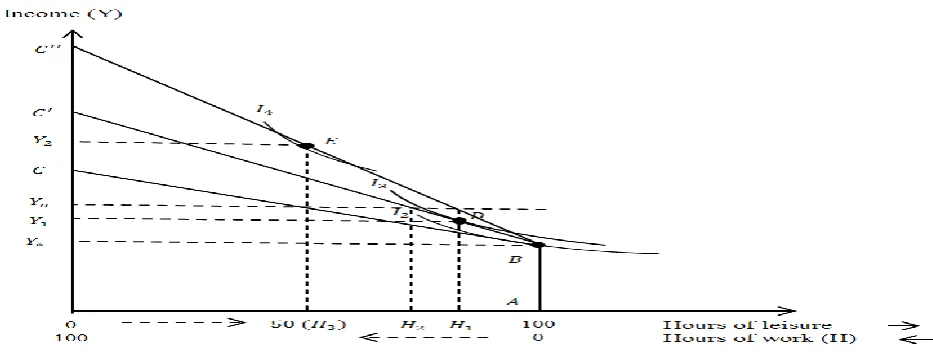
has to work a required number of hours to gain the expected income at a situation with constant wage rate and non labour income. As in figure 4.3, a person has to work 50 hours to increase his income up to the expected level. Number of hours to work may differ according to the steepness of the available budget constraint. Therefore this can be used to understand the fact that employees are a part of the labour force due to lack of other options. With a
situation where a corner solution might be a possible outcome, but the other way if person has to be
engaged with labour force and sacrifice his or her leisure time for work (labour supply).
Figure-4.4. The Effect of a Change in the Wage Rate on Labour Supply
Source:Kaufman (1991)
Since non labour income with zero hours of work is the most preferable outcome for a person, then they may be
looking for further solutions to prevent the situation where expected income exceed the non labour income (
. Increase of the wage rate over the reservation wage or increase the non labour income is two solutions which
people in to the labour force where there is a situation with lack of labour supply. Then this kind of improvement of the wage rate may create comparatively easy access for people to achieve the expected level of income.
As in Figure 4.4, if the wage rate increase from to , then the budget constrain may change as .
Therefore the tangent point may change from to with higher indifference curve . Then the tangent point is
not the corner solution more, because the new wage rate exceeds the previous reservation wage which is the slope
of and particular person may work some hours to gain more income. It means this person starts engaging with
the labour force. At the tangent point he or she will gain level of income while working amount of hours
per week. However this new income level also lags behind the expected level of income per person. Then he or she
needs to work more hours up to to achieve the expected level of income . Therefore this situation as explained
further, though wage rate has been increased to some extent he or she has to supply extra amount of labour without
any benefit. Therefore still this person has to sacrifices hours of leisure time up to hours of work.
At the next stage if the wage rate improve again up to , then the new budget constraint is . With this
new budget constraint, this person may reach the expected level of income while working only amount of hours
per week. It tends to decrease the level of disutility with the new wage rate. Further if we consider the number of
hours (50 hours) this person needs to achieve the expected income at the initial wage rate will give him a very
high income . However this wage rates are not a tool which employees can control. Changes in wage rates may
depend under the producer or employers‟ decision. In reality profit seeking suppliers may not increase wage rates in large amounts and may use it as a trick to absorb more people and their labour supply in a situation with shortage of labour supply or with high potential to produce more output.
Figure-4.5. Effect of an Increase in Non-labour Income on Labour Supply
If initially a person works amount of hours as a member of labour force and earn amount of income, this
may be because there is no other choice for him to gain required income. Therefore tangent point is not a corner
solution. It creates disutility while reducing his or her leisure time from 100 hours to 100- . At the moment this
person has no non-labour income. If this person decides to rent out a part from his house to another person, then
suppose he will gain of income per week. Then this new income exceeds his or her initial income. It means the
rental; non labour income is sufficient for him for his weekly consumption.
As a result of that, this person can decide to move out from the labour force. It means this person chooses the corner solution while consuming all hours for leisure, comfort and other nonmarket activities. Therefore new
tangent point is while creating the corner solution with a higher indifference curve . Then the new budget
constraint is with zero hours of work and of income per week. Moreover, this zero hours of work makes
him gain more utility.
4.2. Labour Leisure Dichotomy and the “Twin Cost” of Graduate Employee
Human labour can be either a physical or a mental effort. Therefore number of hours working as a part of labour force is not only the way such use of labour can be appeared. A student who uses mental effort for studies instead of leisure or a married woman who does daily household work while taking care of her children also appear to be a part of human labour activism. Therefore labour supplies not only a factor which deals only with market activities. It can include such non-market activities as well.
Figure-4.6. Tradeoff Among Hours of Study, Leisure to the level of Education
Source: Author‟s Preparation
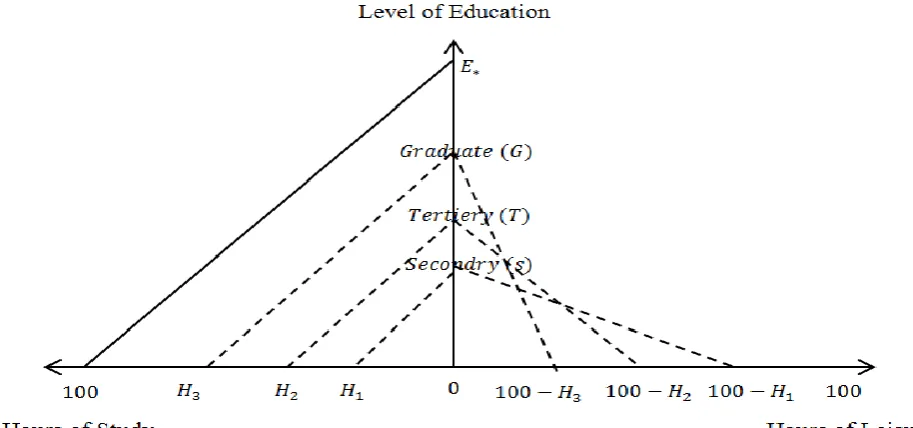
either work per a week. If this person study for total 100 hours, then he or she can achieve the highest possible
education level . Meanwhile hours they spend for leisure time is zero. But in general they may not use all hours
for education and the number of hours may depend with the level of education of each person. People who may consume all 100 hours for leisure may not belong to any education level and meet a zero outcome. If a person spent
number of hours per week for secondary education, then he or she will consume 100- amount of leisure. When
the level of education increase up to tertiary and graduate level, then the number of hours for study may increase
from to and . As consequences of that, hours of leisure for particular person may decrease from 100- to
100- and 100- respectively. The steepness of the lines , and will represent the ability of the
person to study. When the ability is high, then the lines may be much steeper and he or she will complete each level of his education while consuming comparatively less hours for studies. Then it will make him achieve another level of education or to consume more leisure time than they did before.
Figure-4.7. Changes in Degree of Tradeoff According to Ability to Study
Source: Author‟s Preparation
When the number of hours for a particular person to complete graduate studies reduces from to , line
will rotate backward to . It means this person has higher ability to complete graduate studies in less
number of hours. As a result of that his or her leisure time will increase from 100- to 100- . On the other hand
a person with low ability may take more hours of study to complete such graduate studies. As a result of that line
will rotate upward to . Meanwhile hours of leisure will decline from 100- to 100- . These effects can be
possible with each level of education and the ability of one particular person also can be dissimilar for each level of education of another. For an example a person may complete secondary education while studying very few hours
per week below but may take more hours than and to reach tertiary and graduate education levels.
hours of study to achieve each level of education. Hours spent on education demonstrate a part of non-market human labour activism. Then a simple question arises. „Why people sacrifice their leisure time and comfort to achieve higher levels of education?‟
Figure-4.8. Cost-benefit Comparison for Graduate and Non-graduate Workers
Source: Smith (1994)
As in figure 4.8, if the ages limit for the labour force in a particular economy is 18 – 65 years of age, where tertiary level education end at 18 years and take three more years to complete graduate education. Then a person
who completes his or her tertiary education can directly join the labour force and earn of average income per
year. Otherwise this person can stay out of labour force till 21 years old and join to the labour force after
graduation. When and are two levels of annual average income where , graduate person may take
higher salary with his or her higher qualifications.
However, above graph clearly outline both the cost and benefit of graduate education. This person has to
sacrifice amount of average income for three years and it appears as the cost. In addition to that, since more
leisure and comfort is the individuals‟ first preference, studying more hours to complete the graduation is also a cost for this person. Therefore, he or she has to sacrifice number of hours of leisure for education for three years. Then it implies an idea about „Twin cost’ for graduate employee. First the cost of three years out of labour force and second the cost of hours for leisure and comfort. Both of these costs appear at the same time with the same incident. Benefit for the graduate employee will depend with the degree of new earning level. Though, it appears to be the new earning level for graduate employee for 44 more years will surely give more benefits while the employee without
graduate education still continues level of annual earning for entirety of his or her career. This logic may only
exist within an economy, which considers higher level of education as a necessary requirement to earn more income. Until that person may accept the twin cost of education while sacrificing their leisure and comfort.
4.3. Heterodoxy Discourse of Human Labour Supply
economics within a subjective approach1 rather the objective approach of orthodox economics. Their idea about human
labour supply is also slightly different from the other ideologies. According to Buddhist perspective, labour supply; the function of work can be useful in three different ways (Alexandrin, 1993; Schumacher, 1993). They are,
To give people a chance to utilize and develop his capabilities.
To allow them to overcome their self-centeredness by joining with other people in a common task.
To bring out the goods and services needed for the existence of human beings and society.
Then these three reasons flourish the importance and necessity of labour supply while concerning physical as well as moral components. Moreover, to overcome above outcomes, current fundamental production processes need to be re-structured. Usual production procedures with a boring and a disutility creating surface with priority for goods rather than human beings will not generate the expected outcome. According to the Buddhist economists, work and leisure are complementary parts of the same living process and cannot be separated without destroying the enjoyment of work and the happiness of leisure. Therefore not only the wages, a healthy working surface will do the needful. Then it is not good so far to consider that leisure may be the only the factor which gives more utility and working hours create disutility. Working surface need to be arranged to make workers feel more comfortable and while they are working. Then the labour-leisure tradeoff issue will be less destructive than before.
However, issue arises with the question, „Up to which extent this rearrangement of a working surface could be a reality in practice?‟ As in some other ideological frameworks, there is no remedy to overcome the cost of labour under the current capitalist regime or to restructure the surface without seeing the end of fundamentalism.
According to the philosopher and economist Marx (1992a;1993) labour supply or the power of labour produces surpluses beyond the existing costs of workers. Therefore the wage level existing in a capitalist market will not pay the true cost of labour supplier that he or she sacrifices. Since such wages will not pay the true value of employees‟ labour time, then this surplus value is the ultimate source of the profit. Therefore according to Marx (1992b;1993)
this surplus of wage labour is the organized base of the process of capitalist accumulation. This is broadly known as the Marx‟s Theory of Value which deliberates in the first volume of Capital. He focused on an exchange value; where this value is the labour time which uses to produce the commodities. He introduced this value as „Crystallized social labour‟ and stated that such labour time and nature of production (number of outputs and the raw materials) may vary with each producer while deciding the value of production. Therefore a production which requires higher labour times will increase the cost of final output. It seems this labour time appears to be socially a necessary condition which should equally be considered with the nature of production.
Moreover, Marx (1992a;1993) saw this labour power as a secret commodity, especially a service for producers which is the only factor that can produce more value than the cost of its production. Here the cost of labour power generally includes its direct and indirect costs such as skill training, level of education, experience and wasted time from his or her time to enjoy leisure and comfort. Then according to the explanation by Marx (1992b;1993) it means that wages paid for employees are not up to the pure cost even without considering their losses from leisure and comfort. Therefore since human labour supply appears to be a necessary condition or factor for production, it creates surplus value for producers while undermining the cost and all sacrifices of workers. As in further writings of Marx (1992a;1993) he observes how the workers relationship has been transformed with new technology and machinery. Industrialization makes the difference and pre-industrialized society concerns an expert human body as the major tool and use all other tools devoted under the power of labour. However with the industrial revolution, this relationship has been changed and the human body becomes an element of the machine. This means that the machine dominates the production, and people control it as a part. Marx (1992b;1993) identifies these machines as
1 Economists who think of values as “subjective,” they assume that there is no objective standard for determining moral value; they assume that objective value is only
the dead labour. Since these machines dominate the labour, then he saw it as a procreative process with creating new freedom to the workers by control or engage as a part of the dead labour.
4.4. Absence of Human Labour Supply towards an Absurd Future
Labour supply seems to be necessary but costly component for the human beings. However, in a situation where this necessity of labour gets abolished, eventually people may gain and deal with more freedom. But it may necessary to re question, absence of labour supply actually make a sense of human beings in future? Exactly, the future is going to be more absurd than we expect a surface with the absence of human labour supply. What if when robots tend to provide all our necessities? In fact, what will happen when the human beings get rid of supply of labour with the assistance of advanced technology in future? Robots have loomed over the future of labor for decades, at least since robotic arms started replacing auto workers on the assembly line in the early 1960s. Reformers say that more robots will lead to greater productivity and economic growth in both advanced and developing countries.
In contrasts, pessimists Ford (2013;2015) complain that massive bands of the labor force will see their employment options mechanized out of existence with a huge unemployment issue in future. Each has a point, but there is another way to look at this seemingly inevitable trend. What if both are right? As robots start doing more and more of the work humans used to do, and doing it so much more efficiently as well as professionally than we ever did. Then what if the need for jobs disappears altogether? What if the robots end up producing more than enough of everything that everyone needs in future?
Undoubtedly, with a robot-powered society or a production mechanism will set mass leisure feels like a better-off scenario at the beginning for human beings. Because, at the present, each work has often seems harder for human beings to accomplish with the total utilization at the production efficiency with compared to robots. But assuming a future that, a lot of people could end up with a lot more time on their hands amid with the production efficiency producer expects with the robotics mechanisms is not going to be almost good at all. In that case, robots will not just be taking our jobs; they will be forcing us to confront a major existential dilemma: if we didn‟t have to work anymore, what would we do? As a result of that, though both orthodoxy and heterodoxy intellectuals identify machines as the dead labour or a tool, eventually in future, human beings going to be dead, not in terms of their lives but in terms of their value. This may provide an assistance to converge with previous clarification with heterodoxy and orthodoxy disciplines, the human labour supply is an evil but necessary component to be exists.
5. CONCLUSION
idea about „Twin cost’ for graduate employee. First the cost of three years out of labour force and second the cost of hours for leisure and comfort. Both of these costs appear at the same time with the same incident.
As in Buddhist economic ideology there is a complementary relationship between work and leisure. Crating a better surface for work can be reduced some level of cost of workers. Schumacher (1993); Alexandrin (1993) discuss the importance and necessity of labour supply while concerning physical as well as moral components. Production process needs to be re-structured. Usual production procedures with disutility generating surface with priority for goods rather human beings will not generate the expected outcome. Work and leisure are complementary parts of the same living process and cannot be separated without destroying the enjoyment of work and the happiness of leisure. Therefore, not only the wages, a healthy working surface will do the matter. It is not fair to consider only leisure makes utility and working hours create disutility. Then the issue with labour-leisure tradeoff will be less destructive than before.
According to Marx, since there is a surplus value for labour it may generate a cost for the workers. However, issue arises with this ideology is „to what extent this rearrangement of working surface can be a real in practice?‟ There is no remedy to overcome the cost of labour under the current capitalist regime or to restructure the surface without seen the end of fundamentalism. According to the philosopher and economist Marx (1992a;1993) labour supply or the power of labour produces surpluses beyond the presence costs of workers. Therefore, the wage level exists in a capitalist market will not pay the true cost of labour supplier that he or she sacrifices. Since such wages will not pay the true value of employees‟ labour time, then this „surplus value’ is the ultimate source which generates disutility. This surplus of wage labour is the organized base of the process of capitalist accumulation. Then labour supply seems to be necessary but costly component for the human beings. Somehow new technological development may create some freedom for workers while utilizing the dead labour.
However, if we think further with an advanced or plural society in future with intensity to zero labour supply by mechanizing robots to provide all our necessities. Human beings are going to be dead in future with an absurd outcome, where not in terms of their lives but in their value. This may provide an assistance to converge with previous clarification by heterodoxy and orthodoxy disciplines, the human labour supply is an evil but necessary component to remain over present as well as future.
Funding: This study received no specific financial support.
Competing Interests: The author declares that there are no conflicts of interests regarding the publication
of this paper.
REFERENCES
Alexandrin, G., 1993. Elements of buddhist economics. International Journal of Social Economics, 20(2): 3-11.View at Google Scholar |
View at Publisher
Becker, G.S., 1996. Investment in human capital: Effects on earnings, in human capital: A theoretical and empirical analysis with special reference to education. Chicago, IL: University of Chicago Press.
Blinder, A.S. and Y. Weiss, 1976. Human capital and labor supply: A synthesis. Journal of Political Economy, 84(3): 449-472.
View at Google Scholar
Bodie, Z., R.C. Merton and W.F. Samuelson, 1992. Labor supply flexibility and portfolio choice in a life cycle model. Journal of Economic Dynamics and Control, 16(3-4): 427-449.View at Google Scholar | View at Publisher
Dohmen, T., 2014. Behavioral labour economics: Advances and future directions. IZA Discussion Paper No. 8263.
Ford, M., 2013. Could artificial intelligence create an unemployment crisis? Communications of the ACM, 56(7): 37-39.View at
Google Scholar | View at Publisher
Ford, M., 2015. Rise of the robots: Technology and the threat of a jobless future. Basic Books: New York, United States. Glaser, B.G. and A.L. Strauss, 1967. The discovery of grounded theory: Strategies for qualitative research. New York: Aldine.
Henrich, J. and R. Boyd, 2008. Division of labor, economic specialization, and the evolution of social stratification. Current Anthropology, 49(4): 715-724.View at Google Scholar | View at Publisher
Hill, T.P., 1977. On goods and services. Review of Income and Wealth, 23(4): 315-338.View at Google Scholar Kaufman, B., 1991. The economics of labour markets. Chicago: The Dryden Press.
Lee, F., 2012. Critical realism, grounded theory, and theory construction in heterodox economics. Retrieved from
http://mpra.ub.uni-muenchen.de/40341/.
Mandel, E., 2002. An introduction to marxist economic theory. Australia: Resistance Books, 23 Abercrombie St, Chippendale NSW 2008.
Marx, K., 1992a. Capital: A critique of political economy. London, United Kingdom: Penguin Classics,1. Marx, K., 1992b. Capital: A critique of political economy. London, United Kingdom: Penguin Classics,2. Marx, K., 1993. Capital: A critique of political economy. London, United Kingdom: Penguin Classics,3. Schumacher, E.F., 1993. Small is beautiful – a study of economics as if people mattered. London: Vintage Books. Smith, S., 1994. Labour economics. London, United Kingdom: Roultledge.
Walker, R.A., 1985. Is there a service economy? The changing capitalist division of labor. Science & Society, 49(1): 42-83.View at
Google Scholar
Wright, P.M., G.C. McMahan and A. McWilliams, 1994. Human resources and sustained competitive advantage: A resource-based perspective. International Journal of Human Resource Management, 5(2): 301-326. View at Google Scholar | View at
Publisher