Performance Comparison of Different Classifier Models
In Sentiment Analysis
1G.Sailaja , 2K.V. R.V.Prasanth Kumar , 3Ch.Venkata Nagendra Babu , 4A.Sai Phanindra
1,2,3,4Department of IT, Lakireddy Bali Reddy College of Engineering, Mylavram-A.P, India.
1[email protected],2[email protected], 3[email protected] ,4[email protected]
Abstract
The goal of this paper is to analyse the
performance of the different machine
learning algorithms for data mining . In
this study, 20 Machine Learning models
were benchmarked for their accuracy and
speed performance on different hardware
architectures. These are applied when
applied to 2 multinomial datasets differing
broadly in size and complexity. Therefore,
our study performs a benchmarking of
different classification algorithms
highlighting the adequacy and efficiency of
different classifiers
Keywords
1. Introduction
Data mining is the process to pull out
patterns from large datasets by joining
methods from statistics and artificial
intelligence with database management. It
is an upcoming field in today world in
much discipline. It has been accepted as
technology growth and the need for
efficient data analysis is required. The plan
of data mining is not to give tight rules by
analysing the data set, it is used to guess
with some certainty while only analysing a
small set of the data. Over the last years,
the machine learning community has
become increasingly aware of the need for
statistical validation of the published
results. This can be attributed to the
maturity of the area, the increasing number
of real-world applications and the
availability of open machine learning
frameworks that make it easy to develop
new algorithms or modify the existing, and
compare them among themselves.
The advent of Web 2.0 has led to an
increase in the amount of sentimental
content available in the Web. Such content
is often found in social media web sites in
the form of movie or product reviews, user
comments, testimonials, messages in
discussion forums etc. Timely discovery of
the sentimental or opinionated web content
has a number of advantages, the most
important of all being monetization.
Understanding of the sentiments of human
masses towards different entities and
products enables better services for
contextual advertisements,
recommendation systems and analysis of
largest online vendors in the World.
People often gaze over the products and
reviews of the product before buying the
product on amazon itself. But the reviews
on amazon are not necessarily of products
but a mixture of product of product review
and service review. The buyer is misled as
the overall sentiment (rating classification)
that amazon gives is a collective one and
there is no bifurcation between a service
review and product review. The proposed
model satisfactorily segregates service and
product review, in addition to this it also
classifies the review as feature review if
the user talks about some particular
product feature. A featured review is
nothing but a product review, our model
also gives sentiment of the text about the
product feature. For example, if the user
writes in his review, “the camera for this phone is very good.”, then we also classify
camera feature as positive. This paper
develops an automated system which
extracts the sentiments from the online
posts from twitter. Our system shows
sentiment identification, which expresses
opinion associated with each entity. Also it
consists of scoring phase, which assigns
scores to each entity, on which the tweets
are classified. Finally we have leveraged
Naive Bayes, Support vector machine and
other classifiers algorithms to do the
sentiment analysis on this myriad of data.
2. Topic Extraction and Sentiment Analysis
Before WWW we were lacking a
collection of opinion data, in an individual
needs to make a decision, he/she typically
asks for opinions from friends and
families. When an organization needs to
find opinions of the general public about
its products and services, it conducted
surveys and focused groups. But after the
growth of Web, especially with the drastic
growth of the user generated content on
the Web, the world has changed and so has
the methods of gaining ones opinion. One
can post reviews of products at merchant
sites and express views on almost anything
in Internet forums, discussion groups, and
blogs, which are collectively called the
user generated content. Extracting features
from user opinion information is an
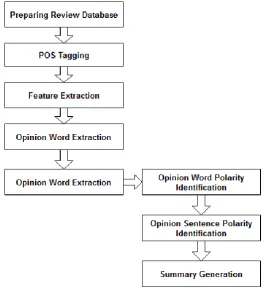
Fig 1. Basic Step of Feature Extraction
In Fig 1, a generic model of feature
extraction from opinion information is
shown, firstly the information database is
created, next POS tagging is done on the
review, next the features are extracted
using grammar rules such as adjective +
noun or so on, as nouns are features and
adjectives are sentiment words. Next
Opinion words are extracted followed by
its polarity identification. Some models
also calculate sentence polarity for
accuracy. Lastly the results are combined
to obtain a summary. Many algorithms can
be used in opinion mining such as Naïve
Bayes Classification, Probabilistic
Machine Learning approach to classify the
reviews as positive or negative, have been
used to get the sentiment of opinions of
different domains such as movie, Amazon
reviews of products. For the purpose of
this work our focus is on mining topics
from user-generated product reviews and
assigning sentiment to these topics on a
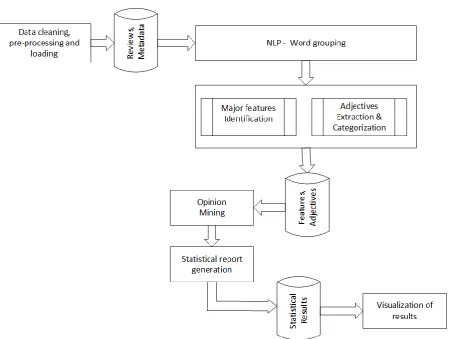
Fig 2. System architecture for extracting topics and assigning sentiment for user generated reviews
Data Pre-processing & Loading
The available data is in JSON format files. The data pre-processing and loading into database
using R
NLP- Word Grouping
The review text undergoes Natural Language Processing to identify the noun phrases, verb
and adjectives.
Major Features Identification
The major features of a product that are mentioned by most of the reviewers are identified
and stored in database.
Adjectives identification and categorization
The adjectives mentioned about the features are identified and categorized as positive or
negative and stored in database.
Opinion Mining
Statistical Report generation
Statistical data on the number of negative reviews for each feature of a product is saved.
Visualization of results
The generated results are displayed in a user interactive portal.
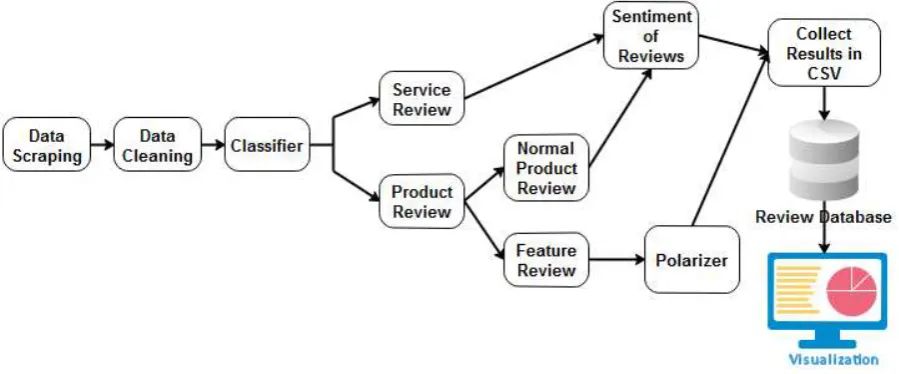
Fig 3. Detailed Block Diagram of System
Data Scraping
Crawl the Amazon review url to extract all
required details from it. We need to take
care of the text so as to satisfy the required
format, for e.g.<br/> tags have a special
meaning to the browser i.e. break read or
next line, we need to explicitly convert
each <br/> tag to spaces or else the
crawling result will be improper. When
working with online reviews there is
always a question in our mind, how can I
trust the review. This is not a problem with
Amazon reviews, Amazon reviewers can
up vote or down vote a review, this
collectively is available as helpful count.
We have taken a special care in extracting
the data from web pages smallest
necessary data is extracted for processing.
The following is the list of items that we
have extracted: Review of Title, Helpful
Count, User Review and Date of Review.
Caution: Websites uses utf-8 character set
for encoding characters, but sometimes
this encoding can give errors during web
scraping as scraping involves matching
strings and patterns. Solution to this is
simply enforce the string to be coded in
utf-8 format.
Data Cleaning and Processing
The data extracted need to be cleaned so
that we get proper text review on which
analysis can be performed. Cleaning of
crawled data is done by removal of all
in order to retrieve best results. After
cleaning the crawled content copy it into a
csv file. The next step is processing the
cleaned data, firstly review is classified as
service, feature or product review. If the
review is a feature review then feature
extraction is done using POS Tagging and
grammar rule all stated below. After
feature extraction the feature opinion
polarization is obtained.
All processed output is stored in
one CSV file for further use.
The file is then loaded into the
database for use in visualization
and summarization.
Finally the summarization of
sentiments is generated as charts
and displayed to the user as an
attractive dashboard
Algorithm for Feature Extraction
Step 1: Crawl the Amazon review url to extract all required details from it. Special care for
required format of information must be taken, example <br/> tags have a special meaning to
the browser i.e. break read or next line, we need to explicitly convert each <br/> tag to spaces
or else the crawling result will be improper.
Step 2: Cleaning the crawled data. Removal of all special characters (such as : “:/.,’#$*^&-)
must be done in order to retrieve best results. This also saves our review processing time. Put
the crawled content into a CSV file.
Step 3: Read the CSV file for processing, for each review do the following:
Step 3.1: Perform a service review test where the review is tested for occurrence of
service words, i.e. if the review length is shorter than 15 words and service words are
found in the review the review is classified as service review else if the length of
review is greater than 15 then more than 2 service must occur in the review for it to be
a service review.
Step 3.2: If the review fails for the service test then it is tested for features of a
product (such as camera, microphone and battery) if these exist then we classify the
review as a feature review.
Step 3.2.1: For each feature we extract its sentiment from the review using
POS tagging and ruled based extraction (using regular expressions).
Step 3.2.2: Each phrase of sentiment extracted above is then sent to polarizer
negative.
Step 3.3: If the review fails the feature test also, then the review is classified as a
product review.
Step 4: A new final CSV is generated with the classification and sentiment of the feature
phrases.
Step 5: This CSV is then loaded into the database for creating the visualizations by querying
data from the database.
3. Sentiment Polarity Methodology
The service and the product review’s
polarity is the rating the user provides for
that review. The Good Reviews are those
with rating 5 stars and 4 stars, Average
Reviews are those with rating 3 stars and
Bad Reviews are those with rating 2 stars
and 1 star. Finally, when a feature
sentiment is extracted the sentiment phrase
is sent to a polarizer method, this method
basically returns +1 if the phrase is a
positive sentiment else -1 if the phrase is a
negative sentiment. Firstly, the phrases are
tested for indirect opinions such as
“Battery no better than iPhone 4s”, the test
phrase is tested for certain pre-defined
phrases that were found during manual
analysis of reviews. Next if the phrase test
fails, the review is tested for the word
“not” if the word not exists then
everything after not is polarized meaning
every word after not is tested for whether it
is a positive word or a negative word and
consecutive words polarity are added and
finally negated, for example “Camera is not good” this phrase is classified as negative as the word “good” is negated by the word “not”. Lastly if “phrase” and “not” test fail the test phrase is broken
down into words and polarity of each word
is found from a dictionary of sentiment
words bifurcated as good and bad words
and collective polarity is considered i.e. if
the sum is below 0 the outcome is negative
(-1) else outcome is positive (+1).
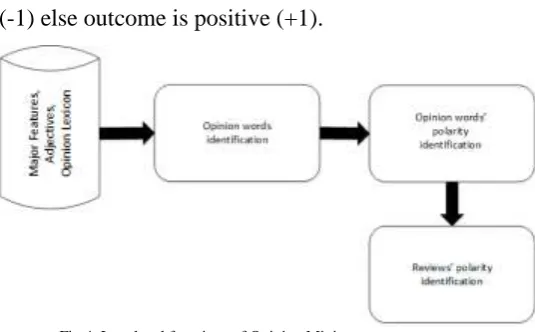
Fig 4. Low level functions of Opinion Mining
The following are some rules that our
model uses to extract feature and its
sentiment:
Adjective + Noun Noun +Adjective Adverb + Noun
Adverb +Adjective + Noun Noun + Adverb + Verb Noun + Verb
Noun + Verb
Noun +Verb + Noun
Noun +Determiner + Adjective Noun + Verb + Adverb
Noun + (verb or Adjective or Adverb)
5. Datasets & Setup
The review data for this experiment was
extracted from Amazon.com during
December 2017; 51,837 reviews from
1,384 unique products. We focused on 4
product categories—Digital Cameras
(DC), GPS Devices, Laptops, Tablets —
and labelled them as helpful or unhelpful,
depending on whether their helpfulness
score was above 0.75 or not, as described .
For the purpose of this experiment, all
reviews included at least 5 helpfulness
scores (to provide a reliable ground-truth)
and the helpful and unhelpful sets were
sampled so as to contain approximately the
same number of reviews. Table 1 presents
a summary of these data, per product type,
including the average helpfulness scores
across all reviews, and separately for
helpful and unhelpful reviews. Each
review was processed to extract the
classification features are described. Here
we are particularly interested in
understanding the classification
performance of different categories of
features. In this case we consider 8
different categories, AGE, RAT, SIZE,
TOP, SENT-1, SENT-2, READ, CNT.
Note, we have split the sentiment features
(SENT) into two groups SENT-1 and
SENT-2.
6. Results
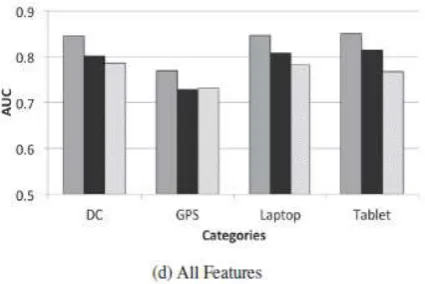
The results are presented in Figures 5-8. In
Figures we show the AUC performance
for each classification algorithm (RF,
SVM, NB) separately; each graph plots the
AUC of one algorithm for the 8 different
categories of classification features for
each of the four different product
categories (DC, GPS, Laptop, and Tablet).
Figure 8 provides a direct comparison of
all classification algorithms (RF, SVM,
NB); here we use a classifier using all
features combined. AUC values in excess
of 0.7 can be considered as useful from a
classification performance viewpoint.
Overall we can see that RF tends to
produce better classification performance
product categories. Classification
performance tends to be poorer for the
GPS dataset compared to Laptop, Tablet,
and DC. We know from previous research
that ratings information proves to be
particularly useful when it comes to
evaluating review helpfulness. It is perhaps
no surprise therefore to see that our
ratings-based features perform well, often
achieving an AUC > 0.7 on their own; for
example in Figure 5 we see an AUC of
approximately 0.75 for the Laptop and
Tablet datasets, compared to between 0.65
and 0.69 for GPS and DC, respectively.
Other ‘traditional’ feature groups (AGE,
SIZE, READ, and CNT) rarely manage to
achieve AUC scores > 0.7 across the
product categories. We can see strong
performance from the new topic and
sentiment feature-sets proposed in this
work. The SENT-2 features consistently
and significantly outperform all others,
with AUC scores in excess of 0.7 for all
three algorithms and across all four
product categories; indeed in some cases
the SENT-2 features deliver AUC greater
than 0.8 for DC, Laptop and Tablet
products; see Figure 5. The SENT-2
feature group benefits from a combination
of sentiment and ratings based features but
a similar observation can be made for the
sentiment-only features of SENT-1, which
also achieve AUC greater than 0.7 for
almost classification algorithms and
product categories. Likewise, the topical
features (TOP) also deliver a strong
performance with AUC > 0.7 for all
product categories except for GPS.
6. Conclusion
User-generated reviews are now an
important source of knowledge for
consumers and are known to play an active
role in decision making in many domains.
In this paper we have described techniques
for mining topical and sentiment
information from user-generated product
reviews as the basis for a review quality
classification system. We have
demonstrated that these topical and
sentiment features help to improve
classification performance above and
beyond that which is possible using more
conventional feature extraction techniques.
We have further described a possible
application of this classification approach
and evaluated its ability to make high
quality review recommendations in
Fig 5 Performance using Naive Bayes Classifier
Fig 6. Performance using SVM classifier
Fig 7. Performance using Random Forest Classifier
Fig 8. Performance for all the classifier
REFERENCES
[1] J. Ashok Kumar and S. Abirami, "An
Experimental Study of Feature Extraction
Techniques In Opinion Mining," International Journal on Soft Computing, Artificial Intelligence and Applications (IJSCAI), Vol.4, No.1, February 2015.
[2] GurneetKaur and AbhinashSingla, “Sentimental Analysis of Flipkart reviews using Naïve Bayes and Decision Tree algorithm,” International Journal Of Advanced Research in Computer Engineering & Technology (IJARCET), Vol. 5, ISSN: 2278- 1323, January 2016
[3] Mohamed Ibrahim Abouelhoda , Stefan Kurta and Enno Ohlebusch,”Replacing suffix trees with enhanced suffix arrays”, 1570-8667, 2004.
[4] Aashutosh Bhatt, Ankit Patel, Harsh Chheda
and Kiran Gawande, "Amazon Review
Classification and Sentiment Analysis",
International Journal of Computer Science and Information Technologies, Vol. 6, ISSN:0975-9646, 2015.
[5] Jeevanandam Jotheeswaran and S.
Koteeswaran,“Feature Selection using Random Forest method for Sentiment Analysis,” Indian Journal of Science and Technology, vol.9. ISSN : 0974-5645, Jan. 2016.
[6] Lisette García-Moya, Henry Anaya-Sánchez, and Rafael Berlanga-Llavori, “Retrieving Product Features and
Opinions from Customer Reviews”, IEEE Intelligent Systems, vol. 28, pp. 1541-1672, May/Jun 2013.
International Journal Of Computer Science And Applications, vol. 6, ISSN: 0974-1011, Apr 2013. [8] Dim En Nyaung, Thin Lai Lai Thein, "Feature Based Summarizing From Customer Reviews", International
Journal Of Scientific Engineering and Technology Research, vol.03, ISSN 2319-8885, Dec-2014. [9] Bing Liu, Sentiment analysis and opinion mining, Morgan & Claypool Publishers, 2012. [10] R Krishna, Kavitha S, Yamini S,Rekha
A,“Analysis of Various Opinion Mining