Succinct Arguments from Multi-Prover Interactive Proofs
and their Efficiency Benefits
∗Nir Bitansky† [email protected]
TAU
Alessandro Chiesa [email protected]
MIT
December 1, 2012
Abstract
Succinct arguments of knowledgeare computationally-sound proofs of knowledge for NP where the verifier’s running time is independent of the time complexity t of the nondeterministic NP machine
M that decides the given language. Existing succinct argument constructions are, typically, based on techniques that combine cryptographic hashing and probabilistically-checkable proofs (PCPs). Yet, even when instantiating these constructions with state-of-the-art PCPs, the prover needsΩ(t)space in order to run in quasilinear time (i.e., timet·poly(k)), regardless of the space complexitysof the machineM.
We say that a succinct argument iscomplexity preservingif the prover runs in timet·poly(k)and space
s·poly(k)and the verifier runs in time|x| ·poly(k)when proving and verifying that at-times-space random-access machine nondeterministically accepts an inputx. Do complexity-preserving succinct arguments exist? To study this question, we investigate the alternative approach of constructing succinct arguments based on multi-prover interactive proofs (MIPs) and stronger cryptographic techniques:
(1)We construct a one-round succinct MIP of knowledge, where each prover runs in timet·polylog(t)
and spaces·polylog(t)and the verifier runs in time|x| ·polylog(t).
(2)We show how to transform any one-round MIP protocol to a succinct four-message argument (with a single prover), while preserving the time and space efficiency of the original MIP protocol; using our MIP protocol, this transformation yields a complexity-preserving four-message succinct argument.
As a main tool for our transformation, we define and construct asuccinct multi-function commitmentthat (a) allows the sender to commit to a vector of functions in time and space complexity that are essentially the same as those needed for a single evaluation of the functions, and (b) ensures that the receiver’s running time is essentially independent of the function. The scheme is based on fully-homomorphic encryption (and no additional assumptions are needed for our succinct argument).
(3)In addition, we revisit the problem ofnon-interactivesuccinct arguments of knowledge (SNARKs), where known impossibilities prevent solutions based on black-box reductions to standard assumptions. We formulate a natural (but non-standard) variant of homomorphic encryption having a homomorphism-extraction property. We show that this primitive essentially allows to squash our interactive protocol, while again preserving time and space efficiency, thereby obtaining a complexity-preserving SNARK. We further show that this variant is, in fact, implied by the existence of (complexity-preserving) SNARKs.
∗
An extended abstract of this paper appears in the proceedings of CRYPTO ’12. This is the full version.
†
Contents
1 Introduction 1
1.1 Existing Succinct Arguments And Their Efficiency . . . 1
2 Summary Of Our Results 2 3 Overview Of Our Results 4 3.1 A Complexity-Preserving1-Round Succinct MIP Of Knowledge . . . 4
3.2 Complexity-Preserving Succinct Arguments From MIPs? . . . 6
3.3 A Complexity-Preserving Four-Message Succinct Argument Of Knowledge . . . 7
3.4 A Complexity-Preserving SNARK . . . 11
4 Open Problems 15 5 Definitions 16 5.1 Homomorphic Encryption . . . 16
5.2 Universal Relation andNPRelations . . . 17
5.3 Succinct Multi-Prover Interactive Proofs Of Knowledge . . . 17
5.4 Succinct Arguments Of Knowledge . . . 20
5.5 SNARKs . . . 21
6 A Complexity-Preserving1-Round Succinct MIP Of Knowledge 24 6.1 An MIP For Testing Proximity ToRM . . . 25
6.2 An MIP For Testing Proximity ToVRM . . . 27
6.3 An MIP For Multivariate Polynomials . . . 29
6.4 An MIP For Circuits . . . 33
6.5 An MIP For Random-Access Machines . . . 35
7 Succinct Multi-Function Commitments 36 7.1 Constructing Succinct Single (and Multi) Function Commitments From FHE . . . 39
7.2 A 4-Message Weakly-Binding Protocol . . . 42
7.3 Amplifying Binding Using Parallel Repetition . . . 47
8 (Interactive) Succinct Arguments From MIPs And SMFCs 54 9 Homomorphism-Extractable Encryption Schemes 56 9.1 Remarks And Discussion . . . 58
9.2 Candidate Constructions . . . 59
10 From Homomorphism-Extractability To SNARKs And Back Again 60 10.1 Construction Details . . . 60
10.2 Proof Of Security . . . 62
10.3 From SNARKs To HEE Schemes . . . 65
Acknowledgements 66
1
Introduction
Interactive proofs & succinctness. Interactive proofs [GMR89] are central to modern cryptography and complexity theory. One extensively-studied aspect of interactive proofs is their expressibility; this study culminated with the result thatIP=PSPACE[Sha92]. Another aspect, the focus of this work, is that proofs forNP-statements can potentially be verified much faster than by directly checking anNPwitness.
Unfortunately, in interactive proofs with statistical soundness, non-trivial savings in verification time are unlikely [BHZ87, GH98, GVW02, Wee05]. However, if we settle for proof systems with onlycomputational
soundness (also known as argument systems [BCC88]), then significant savings can be made.
Indeed, using collision-resistant hashes (CRHs) and probabilistically-checkable proofs (PCPs) [BFLS91], Kilian [Kil92] showed a four-message interactive argument where membership of an instancex in anNP languageLcan be verified in time bounded byp(k+|M|+|x|+ logt), wheretis the time to evaluate the NPverification machineMforLon inputxand a valid witness,pis a fixed polynomial independent ofL, andkis a security parameter. Following tradition, we call such argument systemssuccinct.
A natural strengthening of computational soundness is (computational)proof of knowledge: it requires that, whenever the verifier is convinced by an efficient prover, not only can we conclude that a valid witness for the theoremexists, but also that such a witness can be extracted efficientlyfrom the prover. Proof of knowledge is a natural property (satisfied by most proof system constructions, including the aforementioned one of Kilian [BG08]) that is very useful in many applications of succinct arguments.
A special case of succinct arguments that has received a lot of attention is the one of succinct non-interactivearguments of knowledge (SNARKs). Indeed, SNARKs are known for their powerful applica-tions, including: non-interactive delegation of computation, succinct non-interactive secure computation, ex-tractable cryptographic primitives [BCCT12a], and constructions of proof-carrying data [CT10, BCCT12b].
1.1 Existing Succinct Arguments And Their Efficiency
Kilian’s four-message succinct argument of knowledge works as follows: the prover first uses a Merkle hash tree to bind itself to a polynomial-size PCP oracle for the statement to be proven, and then answers the PCP verifier’s queries while demonstrating consistency with the previous Merkle tree commitment.
Most SNARK constructions [Mic00, DCL08, BCCT12a, DFH12, GLR11] are based on techniques for “squashing” Kilian’s protocol into a non-interactive one, and hence are also based on the “commit to a polynomial-size PCP oracle and then reveal” paradigm; informally, we shall refer to a protocol following this paradigm as aKilian-type protocol.
The current state of affairs is unsatisfying in two respects. On the one hand, from an “understanding perspective” it is unsatisfying that the only way we know how to build succinct arguments, at least from standard assumptions, is through Kilian-type protocols. On the other hand, from an efficiency perspective, Kilian-type protocols suffer from inefficiencies that one might in principle hope to avoid — let us explain.
In state-of-the-art PCPs [BSCGT12, BSCGT13], the time complexity of the prover and verifier are essentially optimal: for a random-access machineM, inputx, and time boundt, (i) the PCP prover generates a PCP oracle for the statement “there is a witness w for which M(x, w) accepts within t steps” in time
(|M|+|x|+t)·polylog(t)and (ii) the PCP verifier runs in time(|M|+|x|)·polylog(t). However, the quasilinear running time of the PCP prover is achieved via FFT-like methods, which unfortunately demand
Ω(t)space. (And not using FFTs would make the prover’s running time quadratic int.)
the prover requiresΩ(t)space, even if the computation ofMon input(x, w)requires spaceswithst. While in succinct arguments the focus is usually on minimizing the verifier’s complexity, in most applications the prover is also of bounded resources and thus minimizing its complexity is also crucial; after all, the verifier may himself be paying to use the prover’s resources (e.g., when delegating com-putation to servers rented from a cloud service). Thus, a desirable goal is to ensure that the computa-tional costs of the prover are as close as possible to those of the original computation. A bit more pre-cisely, we would like to have complexity-preserving succinct arguments for NP, where the prover runs in time (|M| +|x|+ t) ·poly(k) and space (|M|+ |x| +s) ·poly(k) and the verifier runs in time
(|M|+|x|) ·poly(k), when proving and verifying that a t-time s-space random-access machine M for anNPlanguage nondeterministically accepts an inputx.
Q:Do complexity-preserving succinct arguments exist?
What we know about complexity-preserving succinct arguments. Subsequently to our work, Bitansky et al. [BCCT12b] constructed SNARKs that are not of the Kilian-type: their construction relies on recursive composition and “bootstrapping” of SNARKs with an expensive offline preprocessing phase [Gro10, Lip12, GGPR12, BCI+13] (which do not invoke the PCP Theorem but only simpler probabilistic-checking tech-niques [BCI+13]). The SNARKs constructed in [BCCT12b] via this transformation are in fact complexity preserving.
However, the transformation in [BCCT12b] does not extend to produce complexity-preserving succinct arguments in the interactive setting. In the interactive setting, we may hope to prove security under standard cryptographic assumptions [GW11], and complexity-preserving succinct arguments from such assumptions are not known. Further, even in the non-interactive setting, it would be nice to have a more “direct” con-struction of a complexity-preserving SNARK, without going through the transformation in [BCCT12b].
Finally, we note that, even for the more modest (but still very desirable) goal of succinct arguments for deterministic polynomial-time computations (rather thanNPcomputations), wealsodo not have complexity-preserving solutions.
Necessity of PCPs: an obstruction to preserving complexity? A potential obstruction to obtaining complexity-preserving succinct arguments is that Rothblum and Vadhan [RV09] proved that PCPs are in a certain sense inherent to succinct argument constructions: any succinct argument (even if interactive) can be transformed into a PCP, as long as its security is established via a black-box reduction to standard cryp-tographic assumptions. Because at present we only know how to leverage PCPs via Kilian-type protocols, one might interpret the result of Rothblum and Vadhan as saying that the aforementioned inefficiencies of Kilian-type protocols cannot be avoided. The transformation of Rothblum and Vadhan, however, incurs significant overhead in the general case. Thus, it is stillpossible for there to exist a succinct argument construction that is more efficient than a Kilian-type one; this holds evenif such a construction induces a corresponding PCP. Looking ahead, one of the results of this paper is that this is indeed the case.
2
Summary Of Our Results
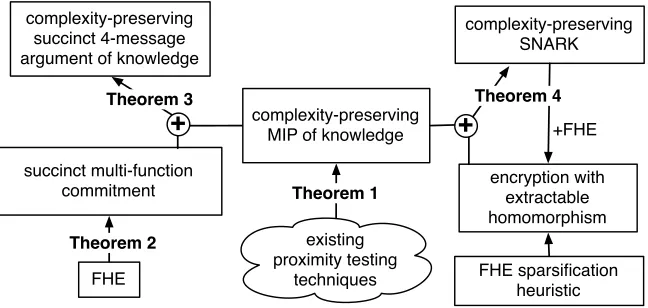
At high-level, we show how PCPs in succinct arguments can be replaced bymulti-prover interactive proofs
(MIPs) [BOGKW88], by using appropriate cryptographic tools, to obtainnew and complexity-preserving
Theorem 1: “There is a one-round succinct MIP of knowledge where each MIP prover runs in time
(|M|+|x|+t)·polylog(t)and space(|M|+|x|+s)·polylog(t)and the MIP verifier runs in time
(|M|+|x|)·polylog(t), when proving and verifying that at-times-space random-access machineM
nondeterministically accepts an inputxwith|x| ≤t.”
With the goal of using our MIP protocol from Theorem 1, we then proceed to the task of “implementing” the MIP model (i.e., construct a succinct argument with a single prover) in a way thatpreservesthe efficiency properties of a given MIP protocol. We show that:
Theorem 3: “Assuming the existence of fully-homomorphic encryption, there exists a complexity-preserving four-message succinct argument of knowledge.”
The main tool in the above theorem is a succinct multi-function commitment, which enables a sender to commit to a vector of functions in time and space complexity that are essentially the same as those needed for a single evaluation of the functions, and where the receiver’s running time is essentially independent of the function.
Theorem 2: “Assuming the existence of fully-homomorphic encryption, there is a succinct multi-function commitment.”
In addition, we explore methods to construct SNARKs based on MIPs. Here, known impossibilities rule out solutions based on black-box reductions to falsifiable assumptions [GW11]. We formulate and study a natural (but non-falsifiable) variant of homomorphic encryption that we callhomomorphism-extractable encryption(HEE), and suggest a candidate construction for this primitive. We show that:
Theorem 4: “Assuming the existence of fully-homomorphic encryption that is homomorphism-extractable, there exists a complexity-preserving SNARK. Furthermore, such encryption schemes are implied by the existence of complexity-preserving SNARKs.”
The aforementioned variant of homomorphic encryption also yields a generic transformation from public-coin interactivearguments(and not only proofs as in [KR09]) to corresponding non-interactive arguments.
In the following section, we discuss and explain in somewhat more detail our results; pointers to techni-cal sections will be provided along the way.
complexity-preserving SNARK
complexity-preserving MIP of knowledge
existing proximity testing
techniques
encryption with extractable homomorphism complexity-preserving
succinct 4-message argument of knowledge
succinct multi-function commitment
+FHE
FHE FHE sparsification
heuristic Theorem 1
Theorem 2
Theorem 3 Theorem 4
+
+
3
Overview Of Our Results
The main idea: functions instead of strings.A seemingly wasteful feature of Kilian-type protocols is that the prover needs to write down an entire PCP oracleΠin order to commit to it; yet, eventually, the verifier is only going to query few locations ofΠ.
But suppose we had a function fΠ that, on input a location i, outputs Πi and is relatively cheap to compute. Can we enable the prover to (succinctly) commit tofΠ“as a function” rather than (as in a Kilian-type protocol) asking him to evaluatefΠ everywhere on its domain and then (succinctly) commit tofΠ’s evaluation table as a string? In other words, can we develop cryptographic tools that let us implement a
function PCPmodel rather than merely the (traditional)string PCPmodel? If we could do so and also find an fΠ that is cheap enough to compute, then we might be able to avoid the inefficiencies of Kilian-type protocols.
Instead of working in a “function PCP” model, we choose to work with an existing model that already has functions as part of its definition:(one-round) multi-prover interactive proofs(MIPs). In the MIP model, there are multiple non-communicating provers, and each proverievaluates his own functionfi on thei-th query qi of the verifier. (The fact that the functions fi need not be equal means that the MIP model is slightly easier to implement than the function PCP model; ultimately, though, our techniques will enable us to implement both.)
The idea of succinct function commitments takes inspiration from the work of Ishai et al. [IKO07], who studied the question of whether succinct arguments can be constructed using “lighter” tools than polynomial-size PCPs at the expense of stronger cryptographic assumptions; indeed, Ishai et al. constructed succinct function commitments for linear functions and then used these to obtain “semi-succinct” arguments based on the (exponentially-long) Hadamard code.
We now discuss in more detail each of our results, following the above motivation.
3.1 A Complexity-Preserving1-Round Succinct MIP Of Knowledge
In the model ofmulti-proverinteractive proofs (MIPs), originally introduced by Ben-Or et al. [BOGKW88], the verifier conducts a simultaneous interactive protocol with several provers that, crucially, are assumed to be unable to communicate during the protocol.
We revisit MIPs and show that, despite the fact that PCPs can be used to construct MIPs and vice versa [TS96], our present ability to exhibit efficient constructions for the two is vastly different. Indeed, as explained above, while the traditional PCP model is about strings (i.e., PCP oracles), the MIP model is aboutfunctions(i.e., the MIP provers); this difference will enable us to exhibit a complexity-preserving MIP construction, while we do not know of any PCP construction with comparable efficiency. Let us explain.
Complexity preservation for PCPs and MIPs. Analogously to the definition of a complexity-preserving succinct argument, we make the following informal definitions:
• A PCP system iscomplexity preservingif, to check that at-times-space random-access machineM
non-deterministically accepts an inputxwith|x| ≤t, the PCP prover runs in time(|M|+t)·polylog(t)
and space(|M|+|x|+s)·polylog(t)and the PCP verifier runs in time(|M|+|x|)·polylog(t).
• An MIP system iscomplexity preservingif, to check that at-times-space random-access machineM
non-deterministically accepts an inputxwith|x| ≤t, each MIP prover runs in time(|M|+t)·polylog(t)
Our first result is that we are able to construct complexity-preserving MIPs:
Theorem 1. There is a complexity-preserving one-round MIP of knowledge: to check that at-times-space random-access machineMnon-deterministically accepts an inputxwith|x| ≤t, each MIP prover runs in time(|M|+|x|+t)·polylog(t)and space(|M|+|x|+s)·polylog(t)and the MIP verifier runs in time (|M|+|x|)·polylog(t). Moreover, each MIP prover can be computed “gate-by-gate” as a circuit by an evaluator algorithm in time(|M|+|x|+t)·polylog(t)and space(|M|+|x|+s)·polylog(t).
Remark 3.1. We do not know how to construct complexity-preserving PCPs (as current state-of-the-art PCPs [BSCGT12, BSCGT13] have essentially-optimal time, but not space, complexity); we find it an in-triguing open problem to understand whether these can be constructed or ruled out (see Section 4.)
Our MIP construction ensures that the verifier’s message only depends on the time boundtand also ensures a proof of knowledge. Both properties play an important role in the other results in this paper. Another important property is that each MIP prover can be evaluated very efficiently as a circuit.
While Theorem 1 may be surprising (due to the close connection between PCPs and MIPs [TS96]), it has a natural high-level explanation of how it circumvents a seemingly inherent inefficiency of PCPs. Namely, unlike in a PCP, where a prover typically has to evaluate a polynomial atΩ(t)points, each honest prover in an MIP is typically asked to evaluate a polynomial only at asinglepoint, and thus naive evaluation of the polynomial suffices; in particular, no MIP prover has to run FFT-like algorithms that require large space. We next briefly discuss our construction.
Construction outline.We follow a standard paradigm of probabilistic checking by proceeding in two steps:
1. We identify a convenient succinctalgebraicconstraint satisfaction problemSACSP (involving prop-erties of polynomials) and then build on a low-degree proximity test to construct a probabilistic verifier (in our case, relying on the help of multiple non-communicating provers) for this problem.
2. We then show how to reduce computations on random-access machines toSACSP.
We need to ensure that both steps satisfy our stringent efficiency requirements. More concretely, we proceed as follows.
Step 1. We let SACSP be a modification of a problem described in [Har04, Proposition 5.4.1] and then build a very efficient MIP for SACSP. (Cf. Remark 3.2.) The main ingredients of our construction
are the low-degree test of Raz and Safra [RS97] for the Reed–Muller code (i.e., multivariate low-degree polynomials), a technique of Ben-Sasson and Sudan [BSS08, Lemma 4.5] for transforming a low-degree test for the Reed–Muller code to a low-degree test for theVanishingReed–Muller code (namely, the subcode consisting of those polynomials vanishing on a certain subset of the field), and a simple consistency check.
The technical challenge when constructing an MIP instead of a PCP is that provers are functions and not strings, so that querying a given function at multiple locations is problematic. In our construction, we show how to “distribute” the various functions across as few provers as possible while at the same time ensuring that we do not have to query any given function more than once. (Actually, we will have to query a function more than once only for the consistency check, and to do so additional care will be needed.)
Step 2. We need a reduction from random-access machine computations to SACSP that preserves the
time and space complexity of a random-access machine and is succinct (i.e., does not “unroll” the machine’s computation); note that succinctness of the reduction is crucial for otherwise the verifier will not have time to invoke it.1 We construct such a reduction in two substeps. First, we invoke a reduction of Ben-Sasson et at. [BSCGT13] from random-access machine computations to SUCCINCTCIRCUITSAT(SCSAT); their reduction ensures that a prover can compute a satisfying assignment to the circuit in suitable time and space. Second, we modify the ideas in [Har04, Proposition 5.4.1] to obtain a reduction fromSCSAT to SACSP
(i.e., we show an arithmetization ofSCSAT that preserves succinctness) that again suitably preserves time and space complexities.
For details see Section 5.3 and Section 6.
Remark 3.2. The problem SACSP (which modifies the one of [Har04, Proposition 5.4.1]) that we use
here isnotthe same as the succinct algebraic constraint satisfaction problem considered in [BSCGT12] and [BSCGT13]; the former is about multivariate polynomials while the latter is about univariate ones.
Further efficiency benefits.We believe that our MIP construction from Theorem 1 not only has efficiency benefits in the asymptotic sense but also in the concrete sense: our construction does not hide large constants and appears to us as quite simple and efficient — or at least certainly more so than present state-of-the-art PCPs. Let us explain.
We know how to construct either PCPs with great soundness but proofs that are long [RS97, MR08] (and thus with fast verifiers but slow provers), or PCPs with short proofs but soundness that is not as great [BSS08, BSGH+05, BSCGT12] (and thus with not-as-slow provers but quite slow verifiers — due to the large number of repetitions needed to achieve, say, constant soundness).
Obtaining a PCP thatsimultaneouslyhas short proof length and great soundness (or, more accurately, a fast prover and a fast verifier) is an exciting open problem. Ben-Sasson et al. [BSCGT12, BSCGT13], who gave PCPs for random-access machine computations with essentially-optimal time complexity and also stud-ied and optimized their concrete efficiency, show recent progress towards this goal, but their constructions are still not as simple and efficient as one could hope for.
In contrast, with MIPs, there is no such thing as proof length, because the provers arefunctions. In other words, provers do not have to write down long proofs, but only answer specific questions of the verifier, which amounts to just a few evaluations of certain polynomials. Thus, we can design a simple and efficient MIP protocol by using the proximity testing tools at the basis of PCPs with long proofs and relatively high soundness, because we will not be paying for proof length. For example, we can leverage the high soundness of the Subspace vs. Point Test of Raz and Safra [RS97] (and its detailed analysis of Moshkovitz and Raz [MR08]) without worrying about the field size or proximity proof length — and this is indeed what we do.
3.2 Complexity-Preserving Succinct Arguments From MIPs?
Our complexity-preserving MIP construction suggests the possibility of obtaining succinct argument con-structions that are complexity preserving. Thus, the question now is:
Can we “implement” the MIP model with asingle proverusing cryptographic means, in a way that preserves its efficiency benefits?
(In particular, we cannot simply deduce a PCP system [TS96] and rely on previous Kilian-type protocols, because doing so would not preserve complexity!) We show two results in this direction, respectively
1
described in Section 3.3 and Section 3.4. Before we do so, however, let us briefly review previous work on MIPs in the context of arguments.
The question of implementing the MIP model for the purpose of constructing succinct arguments was asked by Dwork et al. [DLN+04] with the motivation being non-interactivity, rather than efficiency as in our case. Specifically, after pointing out the unsoundness of the proposed SNARK protocol of Aiello et al. [ABOR00], Dwork et al. suggested that an approach to constructing SNARKs would be to implement the MIP model by encrypting the query for each MIP prover using independent PIR instances and send all the encrypted queries to the same prover. They pointed out that for this approach to work, the PIR should be immune to a specific class of attacks, called “spooky interactions”. They were not able to prove any PIR scheme to have this property, nor exhibit an example of a PIR allowing such attacks. By now we know that:
• PIR schemes that prevent spooky interactions cannot be constructed via black-box reductions to fal-sifiable assumptions [GW11] (though such PIR schemes are implied by the existence of SNARKs); and
• standardPIR schemes are in fact sufficient provided that the MIP protocol is sound against spooky interactions as well (i.e., is secure against no-signaling, rather that only non-communicating, provers) [KRR12]; unfortunately, such MIP protocols can at most support computations that lie insideP.
Along a different direction, the work of [IKO07], mentioned above, constructed a compiler from linear
MIP protocols to four-message interactive arguments by leveragingcommitments with linear decommitment
(which can be obtained, e.g., from additively-homomorphic encryption schemes); by plugging into their compiler a linear MIP based on the Hadamard code, Ishai et al. obtained an argument where the prover-to-verifier communication is small, but the prover-to-verifier running time is not succinct.
3.3 A Complexity-Preserving Four-Message Succinct Argument Of Knowledge
We now describe how we implement the MIP model using standard cryptographic assumptions and obtain a complexity-preserving four-message succinct argument of knowledge.
A simple but wasteful solution.Given a one-message succinct MIP (of knowledge) protocol and a collision-resistant hash family, it is easy to construct a four-message succinct argument (of knowledge): in the first message the verifier sends to the prover a seed for a collision-resistant hash; then the prover commits (sepa-rately and in parallel) to the evaluation table of each MIP prover by sending a Merkle commitment for each; then the verifier sends to the prover the desired message for each MIP prover, and finally the prover replies with an answer to each message, accompanied by an authentication path relative to the appropriate root. Committing to the evaluation table of each MIP prover before any messages are sent by the verifier ensures that a malicious prover cannot “correlate” its answers depending on the messages sent by the verifier in the following message.
However, the above approach does not preserve the efficiency properties of the MIP protocol. For example, suppose that the first honest proverP1of the protocol is a functionf:A→Bthat requires timet to evaluate at a single point. Then, the above approach would require the prover to evaluatef at every point ofA, which could in principle require as much time as|A| ·t. While the MIP protocol could have started out as very efficient, now having to “think” of each prover as a table of values, instead of as a function, could make the resulting constructionmuch lessefficient.2
2For example our MIP construction from Theorem 1 would not preserve complexity (and also be very slow!) if we were to
Even if there are algorithms for evaluatingf everywhere onAthat are faster than the naive “point-by-point” evaluation, these faster algorithms may come with hefty space requirements compared to the space requirement of a single evaluation off. (As discussed in Section 1.1, this is for example the case whenf is a polynomial and we seek to evaluatef faster, at many points, via the use of FFT techniques.)
Thus, the approach of using Merkle trees to implement the MIP protocol does not seem to take us any further, in terms of efficiency, than previous PCP-based protocols.
Ideally, we would want a way to implement the MIP protocol thatpreservesits efficiency: namely, the resulting succinct argument prover and verifier should have time and space complexities that are the same as in the corresponding MIP protocol, up topoly(k)factors, wherekis the security parameter.
Our complexity-preserving solution. As briefly explained above, the main idea towards a complexity-preserving solution is to “think” of the MIP provers as functions, rather than write down the entire truth tables of these functions. For this to be possible, we define and show how to obtain a generic primitive called a succinct multi-function commitment (SMFC), which is a “complexity-preserving analogue” of a Merkle tree commitment for functions.
Concretely, generalizing the idea of commitments with linear decommitment of Ishai et al. [IKO07] to arbitrary functions, we define an SMFC to be a commitment scheme that works as follows. Given a vector of`functionsf~:A→B, where eachfican be evaluated in timet:3
• During a commitment phase, the sender and receiver interact; at the end of this phase, the sender has committed to the vector of functionsf~; both parties maintain a private state for the next phase.
• During a decommitment phase, the receiver may request the value off~at a vectorα~ ∈ A` by inter-acting with the receiver. At the end of this phase, the receiver either outputsβ~∈B`or⊥.
The commitment guarantees that, if both parties are honest, β~ = f~(~α). Moreover, the commitment has the following computational binding property: for any efficient malicious sender, after the commitment phase, there is some vector of functionsf~∗ such that, for any query~α, the receiver either outputsf~∗(~α) or outputs ⊥ (except with negligible probability). We do not make the additional requirement that the commitment is hiding (though our techniques can be enhanced to hide the function being committed to).
The commitment issuccinctin the sense that the sender runs in time`·poly(t)·poly(k)and the receiver in time`·(log|A|+ log|B|)·poly(k)(so that the running time of the receiver does not depend on the time required to evaluate the functions inf~). The commitment iscomplexity-preservingif the sender runs in time
`·t·poly(k)and space`·s·poly(k), wheresis the space complexity each function inf~.
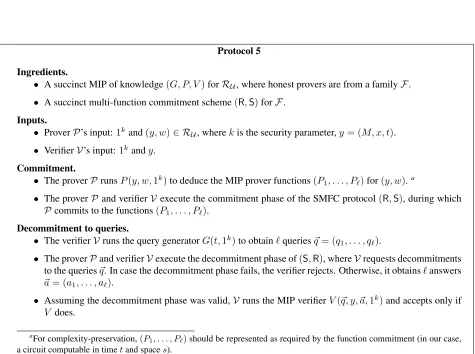
Succinct arguments from succinct multi-function commitments. Let us briefly describe how to obtain succinct arguments, given succinct multi-function commitments. The protocol essentially consists of two phases: in the first, the prover commits to `functions corresponding to the provers P1, . . . , P` given by the one-round MIP protocol. Then, in the second phase, the verifier produces the queriesq1, . . . , q`to the MIP provers, and asks for the corresponding decommitments. In case all the decommitments are valid, and the MIP verifier is satisfied by the corresponding answers, the verifier accepts. The fact that the prover is committed in advance to each one of the`functions ensures that it cannot correlate the answers depending on the joint vector of queries. This allows us to show that:
functions with superpolynomial-size domain, writing out the function’s evaluation table is simply not an option (as it is infeasible); for example, Ishai et al. [IKO07] use linear functions with exponential-size domains and thus cannot rely on Merkle commitments.
3
Claim 1. Assuming the existence of succinct multi-function commitments, there exists a compiler that trans-forms a given succinct MIP of knowledge into a corresponding succinct argument of knowledge. Moreover:
• The round complexity of the succinct argument is the same as that of the function commitment.
• If the function commitment and MIP are complexity-preserving so is the resulting succinct argument.
We show how succinct function commitments can be constructed using fully-homomorphic encryption:
Theorem 2. Assuming the existence of fully-homomorphic encryption:
• There exists a four-message succinct multi-function commitment for all polynomial-time functions.
• There exists a complexity-preserving multi-function commitment for any f~ such that each function in ~
f can be computed “gate-by-gate” as a circuit by an evaluator algorithm in timetand space s(and complexity-preservation holds with respect totands).
Remark 3.3. For complexity-preservation to hold in Theorem 2, it is required that the FHE evaluator algo-rithm operates “locally” in a gate-by-gate fashion. Indeed all known FHE algoalgo-rithms consist of two “local” evaluator algorithms, one for addition and one for multiplication.4
Combining Theorem 1, Claim 1, and Theorem 2, we deduce the existence of complexity-preserving succinct arguments of knowledge from standard assumptions:
Theorem 3. Assuming the existence of fully-homomorphic encryption there exist four-message complexity-preserving succinct arguments forNP.
Remark 3.4. More precisely, the complexity-preservation in Claim 1 holds as long the function representing each MIP prover has a sufficiently tightdeterministicreduction to the representation for which the function commitment is complexity-preserving. In our case, our succinct multi-function commitments are complexity preserving for a suitable circuit representation (cf. Theorem 2) and the provers in our MIP construction have a sufficiently tight reduction to this representation (cf. Theorem 1).
Remark 3.5. Theorem 3 can in fact be strengthened, via a more careful proof, to yieldcomplexity-preserving universal arguments[BG08]. It is an interesting open problem to understand whether there exists public-coincomplexity-preserving universal arguments. (See Section 4.)
We now provide more details regarding our construction of succinct multi-function commitments (given by Theorem 2) and then elaborate on how efficiency is preserved.
Constructing succinct multi-function commitments.Succinct multi-function commitments for functions with polynomial-size domains can of course be constructed generically using succinct arguments for NP together with Merkle hashing. On the other hand, as already discussed, such an approach will not work for functions with superpolynomial-size domains and, moreover, existing succinct arguments for NP are not efficient enough to yield complexity-preserving succinct multi-function commitments even for functions with polynomial-size domains.
We also note that for the purpose of compiling MIPs to succinct arguments, it is sufficient to implement function commitments for the minimal class of functions in which the MIP provers can be implemented.5
4
This requirement can be relaxed; see Remark 5.1.
5This observation only concerns completeness; binding is not required to restrict the committed to function to a member of this
For example, in our MIP construction, the provers consist of low-degree multivariate polynomials.6 Our proof of Theorem 2 will be based on fully-homomorphic encryption schemes, and will give a succinct multi-function commitment for all polynomial-time functions, even with an exponentially-large domain, andalso a complexity-preserving one whenf~can be easily computed as a circuit.
The first step towards a multi-function commitment scheme is noting that it is enough to construct a succinct (single-)function commitment. Once this is achieved a commitment to a vector of functions is done by independently committing to each one of the functions. Hence, we focus on the single-function case.
The starting point of our construction is the cut-and-choose delegation scheme of Chung et al. [CKV10], which works as follows:
• given a functionf to be delegated, during a setup phase, the verifier generateskindependent encryp-tionsc1, . . . , ckof0and then homomorphically computes
ˆ
c1:=Eval(f, c1), . . . ,ˆck:=Eval(f, ck) ;
• afterwards, during the “online” phase, if the verifier wishes to delegate the computation off on a given inputx, the verifier encryptsktimes the inputxto obtainck+1, . . . , c2k, and sends, in random order,c1, . . . , c2kto the prover;
• the prover then homomorphically evaluatesf on each ciphertext to obtainˆc01, . . . ,cˆ02k(in some per-muted order) and send them to the verifier; and, finally,
• the verifier will check thatˆc01= ˆc1, . . . ,ˆc0k= ˆckand thatˆc0k+1, . . . ,cˆ02kall decrypt to the same value.
Crucially, the verifier’s check on the challenges is done “on the ciphertexts”; this enables the security reduc-tion to go through. (And there is an attack if the check is instead performed on the underlying ciphertexts!)
In our setting, we do not have a prover and a weak verifier, but a sender and a weak receiver. In particular, we are not interested in the sender computing a specific functionf, but instead we are interested in the sender committing tosomefunction. Furthermore, we are not willing to allow the receiver to engage with the sender in an expensive setup phase.
We show that that in a sense we can “delegate” the expensive setup phase of the Chung et al. protocol to obtain an interactive function commitment protocol where the receiver is “fully succinct”. More precisely, because the sender is the one deciding the function to compute, we can simply ask him during the first round to evaluate the challengesˆc1:=Eval(f, c1), . . . ,cˆk:=Eval(f, ck)himself for some functionfof his choosing; of course, we cannot do this “in the clear” (as the sender would see the secret challenges), so we conduct the first round under another layer of fully-homomorphic encryption. In the resulting protocol, the receiver is indeed fully succinct.
While the intuition for the security of our modified protocol is strong, proving its binding property does not appear to be trivial. Our security reduction works as follows:
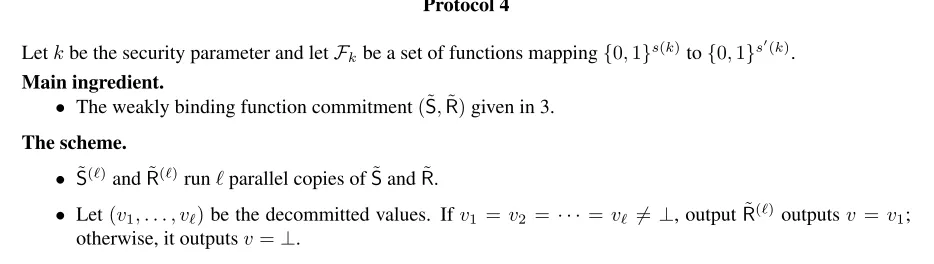
• We first prove a “weak” binding property for a non-amplified version of the protocol. We show that an adversary that is able, with high probability, to open to two different values of the function for the same query during two independent invocations of the decommitment phase can be used to break semantic security in a certain two-prover game.
6
• We then augment the weakly-binding protocol so that we can apply a parallel repetition theorem for interactive arguments (such as [Hai09] or [CL10]), and get a protocol that is strongly binding. This is done by also having the decommitment phase executed under a (second) layer of fully-homomorphic encryption. Unlike typical commitments, where this transformation is rather straightforward, in our case this transformation turns out to be more involved, because the decommitment phase is interactive (and naively making it non-interactive causes an undesired computational overhead).
It may be surprising that, while the security reduction of the Chung et al. [CKV10] protocol is quite straightforward, a simple (and “direct”) proof of security for our protocol seems much harder to find. Per-haps the increased difficulty may be attributed to the fact that the Chung et al. [CKV10] protocol only has one round and in this case parallel repetition is, typically, “simpler” [CHS05]; in contrast, in our case prov-ing security of the protocol amounts to provprov-ing a special case of parallel repetition for interactive arguments with at least four messages for a protocol that is not of the public coin type (or more generally, one for which sampling random protocol continuations [Hai09] is quite challenging).
Sender complexity in our SMFC.The sender in our SMFC protocol is required to doubly homomorphically evaluate each function in the vector f~. In the general case, we do not know how to homomorphically evaluate at-time function in less thant2·poly(k)time [BSCGT13]; a fortiori, the same holds for double homomorphic evaluation. Thus, for arbitrary functions, the running time of the sender in our SMFC protocol is only bounded by`·t2·poly(k).
If, however, we apply our SMFC protocol to a vector of functions f~ where we do know that every function can be computed by a circuit of size at mostt, then we can improve the time bound of the sender to`·t·poly(k). Let us explain why.
The homomorphic evaluation algorithm typically consists of two “local algorithms”, homomorphic ad-dition and multiplication overF2, iteratively applied to the gates of a circuit representation of the function to be evaluated; thus, a circuitCcan be homomorphically evaluated in time|C| ·poly(k). In fact, the same is truealso fordoublehomomorphic evaluation: each of the local algorithms can be generically reduced with a quadratic blow up to a corresponding circuit; but both of these algorithms run in timepoly(k) (in-dependently of|C|), and thus they both have circuits of sizepoly(k); overall, homomorphic evaluation of
|C|can be computed by a circuit of size|C| ·poly(k). We conclude that when the functions inf~have tight reductions to circuits, we can achieve the desired bound of`·t·poly(k)for the running time of the sender. Furthermore, if we also know that each function in our vector of functions f~ can be evaluated as a circuit in timetand spaces(by some “gate-by-gate” evaluator algorithm), then we can also bound the space complexity of the sender by`·s·poly(k). Wheneverst(for example, when the circuits computing the functions have a somewhat succinct representation), this better space bound is very attractive.
See Remark 5.1 for more details.
Thus, overall, in our application of the SMFC protocol in Theorem 3, we use homomorphic encryption in a way that enables us to preserve the efficiency of the MIP protocol we construct in Theorem 1. For details, see Section 7 and Section 8. Finally, unlike the applications in, e.g., [KR09, BCCT12a, GLR11], the FHE scheme in our SMFC construction cannot be substituted by a PIR scheme.
3.4 A Complexity-Preserving SNARK
3.4.1 Known SNARK constructions
Before we discuss our results in this direction, we briefly recall existing SNARK constructions.
In the random-oracle model. Micali [Mic00] showed how to construct publicly-verifiable one-message
succinct non-interactive arguments, in the random oracle model, by applying the Fiat-Shamir paradigm [FS87] to Kilian’s protocol [Kil92]; Valiant [Val08] showed that Micali’s protocol is a proof of knowledge.
In the plain model.Micali’s protocol is essentially as good as one can hope for in the random oracle model. In the plain model, such “totally non-interactive” succinct arguments (against non-uniform provers) are unlikely to exist for “sufficiently hard” NP-languages (as the impossibility results for statistical soundness can be extended to this case). Yet, known impossibility results leave open the possibility of succinct non-interactive arguments in a slightly more relaxed model, where a generator (run by the verifier or a trusted entity) produces ahead of time a shortreference stringσfor the prover and a shortverification stateτfor the verifier (and both strings are independent of the statements to be proven later). The definition of SNARKs in the plain model refers to this more relaxed setting.
A set of works [BCCT12a, DFH12, GLR11] showed how to construct designated-verifier SNARKs (i.e.,
τ needs to remain secret) from a non-standard cryptographic primitive calledextractable collision-resistant hashes. The protocol used in these works revisits a previous protocol proposed by Di Crescenzo and Lipmaa [DCL08] who, in turn, followed up on ideas of Dwork et al. [DLN+04] and Aiello et al. [ABOR00] for “squashing” Kilian’s protocol using succinct private information retrieval schemes.
As already discussed in Section 1.1, a separate line of research [Gro10, Lip12, GGPR12, BCI+13] showed how to construct (publicly-verifiable and designated-verifier) SNARKs where the generator is al-lowed to run as long as the computation to be verified. Bitansky et al. [BCCT12b] showed that this handicap can always be removed via a generic transformation that, in fact, always outputs a complexity-preserving SNARK.
In this paper, we shall aim for a more “direct” construction of complexity-preserving SNARKs, based on our Theorem 1.
Provable limitations.Gentry and Wichs [GW11] showed that no non-interactive succinct argument can be proven to be (adaptively) sound via a black-box reduction to a falsifiable assumption (as defined in [Nao03]), even in the designated-verifier case. Their result suggests that non-standard assumptions, such as knowledge (extractability) assumptions may be inherent for constructing succinctnon-interactivearguments (even if we were to drop the proof of knowledge requirement). Thus, constructing SNARKs by relying on (reasonable) knowledge assumptions might be justified.
3.4.2 Our Theorem
We adopt a similar strategy to the one in [BCCT12a, DFH12, GLR11]:
1. In Kilian’s protocol, the main cryptographic tool is collision-resistant hashes, which are used to com-mit to the PCP string. By defining the non-standard cryptographic pricom-mitive of extractable collision-resistant hashes (ECRH), the works mentioned above show that it is possible to commit and reveal to the PCP string in a single message.
2. Then, [BCCT12a] show that ECRHs are necessary to the construction of SNARKs and exhibit several candidate constructions.
We will also aim at showing that our primitive is necessary and at presenting candidate constructions.
The extractable primitive. We formulate a natural (though non-falsifiable) primitive of homomorphism-extractable encryption(HEE): an encryption scheme where homomorphic operations cannot be performed “obliviously”. Specifically, these are (public- or secret-key) encryption schemes that are homomorphic with respect to some given class of functions F. The scheme has a specialized decryption algorithm Decthat takes as input asourcecipherc=Encpk(m)and anevaluatedcipherˆc(which is allegedly the homomorphic evaluation of some functionf onc). Ifˆcis indeed such an evaluation, thenDecsk(c,ˆc) =f(m); however, if the adversary “obliviously” computes some function ofc, we require thatDecsk(c,ˆc) =⊥. More precisely, the guarantee is given in terms of extraction:
For any efficientAthere is an efficient extractorEAsuch that: ifA, givenc=Encpk(m), outputsˆcsuch thatDecsk(c,ˆc) =v6=⊥, thenEA, given the same inputc, outputs a functionf, such thatf(m) =v.
We stress that the homomorphism-extractability property doesnotprovide any guarantee regarding the ex-tracted functionf (e.g, it may not be in the familyF). In particular, the property does not ensure targeted malleability in the sense of, e.g., [BSW12].
The requirement can then be extended to multiple ciphers (and multiple corresponding functions). Cou-pled with semantic-security, such a primitive effectively yields a two-message succinct multi-function com-mitment. Indeed, whenever the adversary manages to transform c1 = Encpk1(q1), . . . ,c` = Encpk`(q`) into evaluationsˆc1, . . . ,ˆc` that are accepted by the decryption algorithm, the extractor will output corre-sponding functionsf1, . . . , f`that “explain” the evaluations; moreover, because of semantic security, these functions are independent of the plaintext queries. More precisely, for any two vectors of queries~q and~q0
and malicious adversaryA,
~ f
(pk,sk)←Gen(1k)
~c←Encpk(~q)
~ˆc← A(c) ~
f ← EA(c)
and ~ f0
(pk,sk)←Gen(1k)
~c0 ←Encpk(~q0)
~ˆc0← A(c0)
~ f0← E
A(c0)
are computationally indistinguishable distributions over functions.
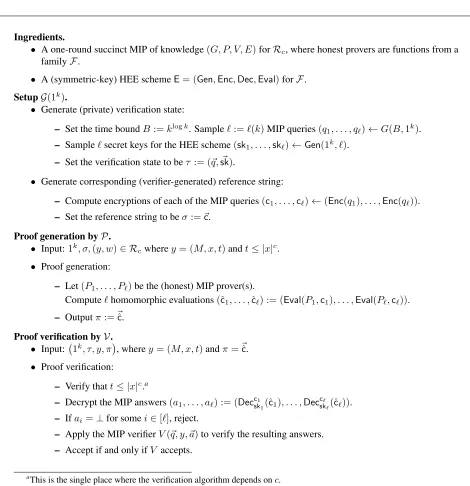
SNARKs from HEE. Given a fully-homomorphic encryption that is homomorphism-extractable, we are able to obtain a SNARK construction that is, in a sense, a “squashed” version of the interactive argument described in Section 3.3: the SNARK verifier simply generates MIP queries and sends them encrypted, using an homomorphism-extractable encryption scheme, to the SNARK prover; the prover, in turn, homo-morphically evaluates each of the MIP provers on the corresponding encrypted query. As before, provided we start from a complexity-preserving MIP with suitable properties and the FHE scheme is local, we obtain acomplexity-preservingSNARK. We thus prove the following theorem:
Theorem 4.
corresponding SNARK. In particular, there exists a complexity-preserving SNARK.7
• Furthermore, the existence of local fully-homomorphic encryption and complexity-preserving SNARKs implies the existence of homomorphism-extractable fully-homomorphic encryption.
The first bullet of Theorem 4 can be seen as a complexity-preserving variant of the PIR-based pro-tocol suggested by Dwork et al. [DLN+04] as a heuristic for squashing Kilian’s protocol;8 indeed, the homomorphism-extractability prevents “spooky attacks” so that the MIP model can be implemented non-interactively. It is interesting to contrast this solution with the one of Kalai et al. [KRR12], who rely on
standard(sub-exponentially secure) FHE to implement the weaker model of no-signaling (rather than non-communicating) provers.
Furthermore, a corollary to our theorem is an analogue of the [KR09] transformation for all public-coin arguments (and not just proofs): indeed, a public-public-coin argument immediately implies a simple MIP protocol, where proverPigets the random coinsr1, . . . , riused in the firstirounds of the protocol. Applying our HEE-based compiler yields a corresponding one-round argument (naturally, succinctness will only be guaranteed if the original public-coin protocol was succinct.)
For details about Theorem 4, see Section 9 and Section 10.
Is the existence of homomorphism-extractable encryption plausible? Leaving efficiency aside and purely from an existential perspective, homomorphism-extractable encryption (HEE) schemes exist as long as extractable collision-resistant hashes (ECRHs) and FHE schemes exist: [BCCT12a] showed how to con-struct SNARKs from ECRHs, and we will show that SNARKs and FHE together imply HEE schemes. However, HEE schemes built from SNARKs that do not preserve complexity are not efficient enough for our purposes. We thus must look for “direct” constructions of HEE schemes.
Consider, for example, the fully-homomorphic encryption (FHE) scheme of [BV11], based on LWE. Their FHE scheme likely doesnot have homomorphism-extractability: consider an adversary that, given a ciphertext c of some messagem, does not apply the honest evaluation algorithm to some function but instead applies some arbitrary transformation tocto obtain a new ciphertextˆc. With high probability, the new ciphertextˆcwill decrypt to some valid plaintext, but such an adversary may not “know” a corresponding function that can be homomorphically evaluated on the original plaintextcto result in the same ciphertextˆc. Intuitively, the reason is that the ciphertext space of [BV11] is not “sparse”: by merely applying an arbitrary operation in the ciphertext space, an adversary can “jump” from a valid ciphertext to another without being aware of what function he is applying on the underlying plaintext.9
Nonetheless, there is a natural method to generate sparsity in a given FHE scheme, and this method seems to serve as a heuristic for ensuring that the resulting encryption scheme can be plausibly assumed to have homomorphism-extractability.
The idea is to create sparsity via “amplification”: we consider a new encryption scheme, built out of the old one, that, in order to encrypt a given messagem, encryptsmunder many different independently-generated public keys, and the new decryption algorithm will check that a given vector of ciphertexts de-crypts to a vector of messages that areall equal. For this amplified encryption scheme, it seems that the
7Both Remarks 3.4 and 7.6 also apply for this theorem; that is, to obtain complexity preservation, we require that MIP prover
has a sufficiently tightdeterministicreduction to the an appropriate circuit representation, which is indeed the case for our MIP construction. We also require that the homomorphism-extractable FHE scheme has a “local” evaluation algorithm, which is the case in all known FHE schemes.
8
We stress, once again, that FHE, cannot be substituted with PIR, because that will not preserve the complexity properties of the MIP protocol.
9
oblivious adversary described earlier does not work anymore: if the adversary only applies algebraic oper-ations to the ciphertexts, he is likely to obtain ciphertexts that decrypt to different values, that is, an invalid ciphertext of the new scheme.
Homomorphism extractability & plaintext awareness. At high-level, a plaintext aware encryption scheme is such where an adversary cannot create a valid cipher, without actually “knowing” the underlying plaintext. Following previous definitions in the random-oracle model, Bellare and Palacio [BP04] formu-lated several notions of plaintext awareness in the plain model. Not surprisingly, homomorphism-extractable encryption can be shown to imply some forms of plaintext awareness (in the plain model). Informally, given a homomorphism-extractable encryption scheme for any class containing the constant functionsf ≡m, and where the evaluation algorithm is also function-hiding, it is possible to construct a plaintext aware encryp-tion scheme as follows. The public-key of the new encrypencryp-tion scheme will be an encrypencryp-tion c0 of0, and an encryption of a messagemis the homomorphic evaluation of the functionf ≡monc0, the decryption algorithm is not modified. The homomorphism-extractability definition in this paper, would suffice for a relatively weak notion of plaintext awareness with a single decryption query, corresponding to one-time (or non-interactive) extraction, see [BP04].
4
Open Problems
Our work leaves open several questions that we believe are interesting to investigate.
Complexity-preserving PCPs. Theorem 1 gives a complexity-preserving MIP. Can one obtain (or rule out) complexity-preserving PCPs? Answering this question in the negative may run into difficult time-space tradeoff questions; still, the specificity of the setting might mean that such tradeoffs are easier to show.
Complexity preservation and public coins.Unlike Kilian’s protocol, the interactive protocol we obtain in Theorem 3 isnotof the public-coin type.10 Is there an efficiency-preserving transformation from MIPs that yields a public-coin succinct argument? (For example, one way to do this would be to construct a public-coin succinct multi-function commitment.) More generally, are there public-coin complexity-preserving succinct arguments whose security can be based on standard cryptographic assumptions? (And can these be proved to in fact be universal arguments? Cf. Remark 3.5.)
Analogously, Theorem 4 only gives complexity-preserving SNARKs for designated verifiers. Is there a “direct” construction of a complexity-preserving publicly-verifiable SNARK? (I.e., without going through the generic transformation of [BCCT12b].)
Complexity preservation and random oracles.Can one obtain complexity-preserving (interactive or non-interactive) succinct arguments in the random-oracle model (with unconditional security)? We do not know of any candidate approaches for this question other than using complexity-preserving PCPs in a Kilian-type protocol; however, as already mentioned, we do not know of complexity-preserving PCPs. A related question is whether there are any succinct function commitments in the random-oracle model.
Power of succinct function commitments. We believe that succinct function commitments are a crypto-graphic primitive of independent interest. What other applications do they have? Also, our construction based on FHE from Theorem 2 supportsallpolynomial-time functions, while for our application we only need to be able to support multivariate polynomials of degreepolylog(k), which may admit simpler (or
10
more efficient) constructions. We note that existing works on polynomial commitment schemes or polyno-mial delegation schemes [KZG10, PST11, BGV11, PRV12, FG12] are not applicable here: the polynopolyno-mial commitment schemes require a long preprocessing phase from the verifier, and the polynomial delegation schemes consider a different model where the verifier knows the polynomial beforehand and delegates it (in contrast, in our setting, the polynomial is some encoding of a witness that is only known to the prover). Another difference is that, in terms of security, we only require that the prover is committed tosomefunction (not necessarily a low-degree polynomial).
5
Definitions
In this section we give basic definitions for the cryptographic primitives that we use (along with any non-standard properties that we may need). Throughout,negl(k)is any negligible function ink.
5.1 Homomorphic Encryption
AnF-homomorphic encryptionschemeEis a tuple of algorithms(Gen,Enc,Dec,Eval). The first three algo-rithmsGen,Enc,Decare the standard generation, encryption and decryption algorithms of a (semantically-secure) public-key encryption scheme. The additional algorithm Evalis a deterministic polynomial-time algorithm that takes as input a public key pk, a ciphertextc = Encpk(m), and (the representation of) a functionf ∈ F and outputs a new ciphertextˆc:=Evalpk(f,c)such thatDecsk(c) =f(m), whereskis the secret key corresponding to the public keypk. IfF is the set of all polynomial-time functions, then we say thatEis afully-homomorphic encryption(FHE) scheme.
For homomorphic evaluation to be meaningful, Evalhas to satisfy a certainsuccinctnessrequirement. Specifically, for any functionf ∈ F, with running timet(n)and output size`(n) on inputs of sizen, and and any ciphertextcencrypting a plaintext of sizen, (i) computingEval(f,c)requirespoly(k+t(n))time (cf. Remark 5.1 below) and (ii) its resultˆchas sizepoly(k+`(n))(which is, in particular, independent of the running timet(n)).
Remark 5.1(complexity of homomorphic evaluation). It is not known how to homomorphically evaluate a t-time random-access machine computation in less than time t2 ·poly(k). Indeed, the homomorphic evaluation algorithm Evalusually consists of two “local algorithms”, homomorphic additionEvalpk(+,·) and homomorphic multiplicationEvalpk(×,·)overF2, that are iteratively applied to the gates of the circuit to be evaluated. Thus, when we wish to homomorphically evaluate a random-access machine computation, we must first obtain a circuit representing such a computation; the problem is that it is not known how to reduce at-time random-access machine computation to the evaluation of a circuit of sizeo(t2). (When the setting allows for the use of non-determinism, however, random-access machines do have small circuits; see, e.g., [BSCGT13].)
On the other hand, if we know “more” aboutf, thenEvalmight be able to run faster.
For example, if we know thatf can be evaluated as a circuit in timetand spaces(by some “gate-by-gate” evaluator algorithm), then we can bound the time and space complexity ofEval(f,·)by t·poly(k)
ands·poly(k)respectively. Wheneverst(for example, when the circuit to be evaluated corresponds to an algorithm using little memory and running for a long time), this better space bound is very attractive.
Finally, we note that what we mentioned in the previous paragraph also holds fordoublehomomorphic evaluation: each ofEvalpk(+,·)andEvalpk(×,·)can be generically reduced (with a quadratic blow up) to a corresponding circuit, and it is not a problem to do so because the running time that we are squaring is only
In light of Remark 5.1, we say that an FHE scheme islocalif it has homomorphic additionEvalpk(+,·) and homomorphic multiplication Evalpk(×,·) algorithms. Throughout this paper, we shall only consider local FHE schemes.11
Schemes satisfying the properties we need (including the local property) were recently constructed by, e.g., Gentry [Gen09], van Dijk et al. [vDGHV10], and Brakerski and Vaikuntanathan [BV11].
For simplicity, in our discussions we usepublic-keyFHE schemes, but in our application we could also use secret-key ones. Up to some loss in efficiency, this is without loss of generality as the former can be constructed from the latter [Rot11].
5.2 Universal Relation andNPRelations
The universal relation [BG08] is defined to be the setRU of instance-witness pairs (y, w), wherey =
(M, x, t),|w| ≤ t, andM is an abstract machine, such thatMaccepts(x, w)after at mosttsteps. While the witnesswfor each instancey = (M, x, t)is of size at mostt, there isno a-prioripolynomial bounding
tin terms of|x|. We denote byLU theuniversal languagecorresponding toRU. At high level, we can say that deciding membership in the universal relation of a given instancey = (M, x, t)is a (non-deterministic)
bounded-halting problemon the machineM.
For any c ∈ N, we denote byRc the subset ofRU consisting of those pairs (y, w) = (M, x, t), w for whicht ≤ |x|c; in other words,R
cis a “generalized”NPrelation, where we do not insist on the same machine accepting different instances, but only insist on the same fixed polynomial bounding the running time in terms of the input size|x|. We denote byLcthe language corresponding toRc.
In this paper, we chooserandom-access machines[CR72, AV77] to be the abstract machine used in the universal relationRU. This concrete choice is crucial in order to discuss the notion of complexity preser-vation for multi-prover interactive proofs (cf. Definition 5.3) and succinct arguments (cf. Definition 5.7 and Definition 5.12). For simplicity, in order avoid technicalities associated with how large is the transition function of a given random-access machine M when viewed as a circuit, we fix any “natural” universal architecture of the machine so that the only variation across different random-access machines is the se-quence of basic instructions making up the program of the machine. Also, because we shall rely on a result of Ben-Sasson et al. [BSCGT13], for consistency with their result, we do not employ the logarithmic-cost criterion but instead count the number of state transitions of the machine and, in terms of space complexity, we measure the maximum number of memory cells used throughout the computation.
5.3 Succinct Multi-Prover Interactive Proofs Of Knowledge
In an interactive proof [GMR89, Bab85] a probabilistic polynomial-time verifier may interactively ask questions to a prover with unbounded computational power in order to decide the truth of a statement. These are a generalization of an “NPproof system”, where the verifier does not ask any questions or toss coins, and only gets a single non-interactive proof from an unbounded prover. It is a celebrated result that IP, the class of all languages having an interactive proof, equalsPSPACE[Sha92].
Ben-Or et al. [BOGKW88] generalized the setting of interactive proofs to one where instead of a single prover there are many. In a multi-prover interactive proof (MIP), a verifier V conducts a simultaneous interactive protocol with each of several provers,P1, . . . , P`, that are assumed to not be able to communicate during the protocol. (But, of course,P1, . . . , P` may share correlated randomness.) It is known thatMIP, the class of all languages having a multi-prover interactive proof, equalsNEXP[BFL90].
11More generally, we require FHE schemes that are able to homomorphically evaluate a given circuitCin timet·poly(k)and
Vector notation. We use vector notation to denote multiple circuits each getting as input a different input as well as a shared input. For example, when we write “a circuit A~” we mean that A~ is a vector of (an unspecified number of) circuits (Ai)i (or (A|i)i if A~ already has a subscript) and when we write “~z =
~
A(~x, y)” we mean thatzi=Ai(xi, y)for eachi.12 (We stress thatAidoes not get to seexj forj 6=i.) Succinctness. While MIP protocols have found applications to program testing [BK89, BFL90] and ap-proximation [FGL+91, AS98, ALM+98], they too, just like PCPs [BFLS91], can be used to enable a weak verifier to check long computations. Specifically, in a succinctMIP protocol, the verifier V runs in time
p(|y|)to check membership of an instancey= (M, x, t)in the universal languageLU, when given the help of`(|y|)provers each running in timep(t), wherepis a fixed universal polynomial (and`is some “prover number” function).
Number of rounds. Aone-round MIP is one where a verifier sends a single messageqi to each prover
Pi, then each prover Pi replies with a messageπi, and finally the verifier accepts or rejects. In fact, we wish to notationally separate the process that generates messages from the process that verifies these and the provers’ replies; we thus denote byGthe (probabilistic) generator that produces the vector of messages~q
and denote byV the corresponding (deterministic) verification test. There are two technical details that we should address here:
• What randomness does V see? The probabilistic generatorGtosses coins to obtain a random stringr
in order to generate the vector of messages~q; so we have the choice of givingr toV, or only~q. It will actually suffice to only give~qtoV, so that, overall, his inputs are(~q, y, ~π).
• What inputs doesGget? In principle,Gmay needy= (M, x, t)as input in order to sample the vector of messages~q. It will actually suffice to only givetas input toG. We call such an MIP anadaptiveMIP.
Knowledge and amplification. An MIP of knowledge is one where we are guaranteed that, when the verifier is convinced on input y, with probability above a certain knowledge threshold ε, by a vector of proversP~∗, an extractorE is able, by interacting with the proversP~∗, to extract a valid witnesswfory. When constructing MIPs, we shall restrict our attention to achieving some constant knowledge threshold, e.g.,ε= 1/2. The knowledge threshold can always be reduced toεk, by independently repeating the basic
`-protocolk times: the new prover would consist ofksets, each consisting of `-provers. In case we are interested in knowledge thresholdεk, all MIP algorithms would also get1kas input.
We now give the formal definition of (one-round) succinct MIPs of knowledge that we are interested in. As mentioned above, in the basic definition we will restrict attention to constant knowledge thresholdε= 1/2.
Definition 5.2. A quadruple of algorithms(G, P, V, E)is a (one-round)succinct MIP of knowledgeif the following conditions are satisfied:
1. Completeness
For every(y, w)∈ RU,
Pr
~ q←G(t)
h
V(~q, y, ~P(~q, y, w)) = 1
i
= 1 ,
where eachPi(·)is defined as the algorithmP(i,·).
12
Of course, a formal treatment here should be in terms of families of vectors of circuits: namely, A~ in fact denotes {A~k}k∈
N = {(A1,k, . . . , A`(k),k)}k∈N for some “vector length function” `: N → N and A~(~x, y) denotes the vector (A1,k(x1, y), . . . , A`(k),k(x`(k), y))for the appropriate “input size”k. Furthermore, when discussing the efficiency ofA~, one
2. Proof of knowledge
For every proverP~∗and instancey= (M, x, t),
Pr
~ q←G(t)
h
V(~q, y, ~P∗(~q, y)) = 1i>1/2 → y, EP~∗
(y,1t)
∈ RU .
Furthermore,Eruns in polynomial time.
3. Succinctness
There exists a fixed polynomialpsuch that for every instancey = (M, x, t),
• the generatorGruns in timep(logt);
• each proverPiruns in timep(t);
• the verifierV runs in timep(|y|);
• the communication transcript has sizep(logt).
A complexity-preserving succinct MIP of knowledge is a succinct MIP of knowledge where the prover time and space complexity, when proving the correctness of a nondeterministic random-access machine computation, is essentially the same as in the original computation:
Definition 5.3. A quadruple of algorithms(G, P, V, E)is acomplexity-preserving (one-round) succinct MIP of knowledgeif it is a (one-round) succinct MIP of knowledge where the succinctness requirement is replaced by the following stronger requirement:
Complexity-preserving succinctness
There exists a fixed polynomialpsuch that for every instancey= (M, x, t)whereMruns in spaces,
• the generatorGruns in timep(logt);
• each proverPiruns in time(|M|+|x|+t)·p(logt);
• each proverPiruns in space(|M|+|x|+s)·p(logt);
• the verifierV runs in time(|M|+|x|+ logt)·p(logt);
• the communication transcript has sizep(logt).
in thek-fold repetition of the protocol (meant to reduce the knowledge threshold), all the above mea-sures may increase upto a factork.
Remark 5.4. When R ∈ NP there is no need to provide a time bound ttoG: we will work with some arbitrary polynomial boundt≤klogk. In such a case, we will simply writeG(1k).
Remark 5.5 (local witness decoding). In Definition 5.2, we can consider a stronger notion of proof of knowledge that requires “local extraction” [BG08, Definition 3.2]:
• There exists a local knowledge extractorEˆsuch that, for every proverP~∗and instancey,
Pr
~ q←G(t)
h
V(~q, y, ~P∗(~q, y)) = 1i>1/2 → ∃w s.t. (y, w)∈ RU and
PrhEˆP~∗(y, i) =wi i
> 23 .
5.4 Succinct Arguments Of Knowledge
A succinct argument [BG08] is a pair of algorithms(P,V)that works as follows. Given an instancey = (M, x, t), a proverP (who is also given as auxiliary input a witnesswproving thaty ∈ LU) and a verifier
Vengage in interactive protocol, at the end of whichV either accepts or rejects.
Definition 5.6. A pair of algorithms(P,V)is asuccinct argumentfor the relationR ⊆ RUif the following
conditions are satisfied:
1. Completeness
For every(y, w)∈ RU andk∈N,
Pr
h
hP(w),Vi(1k, y) = 1
i
= 1 .
2. Soundness
For every polynomial-size proverP∗, instancey /∈ L
R, and large enough security parameterk∈N,
Pr
h
hP∗,Vi(1k, y) = 1
i
≤negl(k) .
3. Succinctness
There exists a universal polynomial p (i.e., independent of R) such that for every instance y = (M, x, t)and large enough security parameterk∈N,
• the proverP runs in timep(k+t);
• the verifierV runs in timep(k+|y|);
• the communication transcript has sizep(k+ logt).
Acomplexity-preservingsuccinct argument is a succinct argument where the prover and verifier complexi-ties are essentially optimal when proving and verifying the correctness of nondeterministic random-access machine computations:
Definition 5.7. A pair of algorithms(P,V)is acomplexity-preserving succinct argument for the rela-tion R ⊆ RU if it is a succinct argument forRwhere succinctness is replaced by the following stronger
requirement:
Complexity-preserving succinctness
There exists a universal polynomial p (i.e., independent of R) such that for every instance y = (M, x, t)whereMruns in spacesand large enough security parameterk∈N,
• the proverP runs in time(|M|+|x|+t)·p(k+ logt);
• the proverP runs in space(|M|+|x|+s)·p(k+ logt);
• the verifierV runs in time(|M|+|x|+ logt)·p(k+ logt);
• the communication transcript has sizep(k+ logt).