ISSN(Online): 2320-9801
ISSN (Print) : 2320-9798
I
nternational
J
ournal of
I
nnovative
R
esearch in
C
omputer
and
C
ommunication
E
ngineering
(An ISO 3297: 2007 Certified Organization)
Vol. 3, Issue 9, September 2015
Text Detection Based On Characterness
Evaluation
Priya Nair, MSupriya L. P
Post Graduate Student, Dept. of CSE, Sree Buddha College of Engineering for Women, Elavumthitta, Pathanamthitta,
Kerala, India
Asst. Professor, Dept. CSE, Sree Buddha College of Engineering for Women, Elavumthitta, Pathanamthitta, Kerala,
India
ABSTRACT: Text in an image provide vital information for interpreting its contents and text in a scene can aid a variety of tasks from navigation to obstacle avoidance and odometry. Detecting text in an image is a challenging research problem. Due to widely varying forms of natural text, a bottom up approach which reflect the characterness of an image in a region is proposed. Most of the text detection methods fail to detect text with low resolution or text in lightning condition. In this paper an LDR (Low Dynamic Range) image is converted into an HDR (High Dynamic Range)image, Since HDR images can't be taken directly due to its contrast, difficulty to display in screen etc., convert it to LDR image which is a combination of different brightness using tone mapping and with this image as input candidate region containing text is extracted then characterness evaluation is performed and after that character is labeled. This approach has an advantage that it has less complexity, less time consuming and has high precision and recall.
KEYWORDS: HDR, Tone Mapping, Region Extraction, Characterness Evaluation, Character Labelling.
I. INTRODUCTION
Text attracts human attention, even when amongst a cluttered background [1]. Detecting text in natural images is an important step for a number of Computer Vision applications, such as computerized aid for visually impaired, automatic geocoding of businesses, and robotic navigation in urban environments [2]. Retrieving texts provides contextual clues for a wide variety of vision tasksin both indoor and outdoor environments. Moreover, it has been shown that the performance of image retrieval algorithms depends critically on the performance of their text detection modules. Detection of text and identification of characters in scene images is a challenging visual recognition problem. As in much of computer vision, the challenges posed by the complexity of these images have been combated with hand- designed features and models that incorporate various pieces of high-level prior knowledge. For instance, solutions have ranged from simple off-the-shelf classifiers trained on hand-coded features to multi-stage pipelines combining many different algorithms for text detection. Edge features, texture descriptors and shape contexts are common features. In to the detection and recognition system, various flavours of probabilistic model have also been applied folding many forms of prior knowledge. On the other hand, with minimal prior knowledge ,some systems with highly flexible learning schemes attempt to learn all necessary information from labelled data. For instance, multi-layered neural network architectures have been applied to character recognition and are competitive with other leading methods.
ISSN(Online): 2320-9801
ISSN (Print) : 2320-9798
I
nternational
J
ournal of
I
nnovative
R
esearch in
C
omputer
and
C
ommunication
E
ngineering
(An ISO 3297: 2007 Certified Organization)
Vol. 3, Issue 9, September 2015
roughly categorized into two groups: region-based and connected component (CC)-based. Region-based methods attempt to detect and localize text regions by texture analysis. Generally, for estimating the likelihood of text, a feature vector extracted from each local region is fed into a classifier. Then neighbouring text regions are merged to generate text blocks. These methods can detect and localize texts accurately even when images are noisy because text regions have distinct textural properties from non-text ones. On the other hand, CC- based methods directly segment candidate text components by edge detection or colour clustering. The non-text components are then pruned with heuristic rules or classifiers. CC based methods have lower computation cost and the located text components can be directly used for recognition, Since the number of segmented candidate components is relatively small. Although the existing methods have reported promising localization performance, there still remain several problems to solve. For region-based methods, the speed is relatively slow and the performance is sensitive to text alignment orientation. On the other hand, CCbased methods cannot segment text components accurately without prior knowledge of text position and scale. Moreover, designing fast and reliable connected component analyser is difficult since there are many non-text components which are easily confused with texts when analysed individually.
In case of " Characterness: An Indicator Of Text In The Wild” [1], Text is detected based on characterness evaluation. In this Text Detection is performed based on four steps. First is Candidate region extraction, in this region is extracted using eMSER algorithm i.e. first colour image is converted into an intensity image then smooth it using guided filter, compute gradient amplitude map and then normalize it to [0,255] range and then MSER algorithm is performed on that. Second Characterness Evaluation is performed based on three cues such as Stroke Width(SW), Perceptual Divergence(PD) and Histogram of Gradient at Edges (eHOG). Third Character labelling is done i.e. separating characters from non-characters using graph cut labelling method and finally Text line is formed based on Mean shift based clustering. This has one disadvantage that it can't detect low resolution images, so to overcome this and for better result here introduced ” Text Detection based on characterness Evaluation. In this images with different brightness is taken and Low Dynamic Range image is converted into High Dynamic Range image, since it can't be taken directly it is again converted to Low Dynamic Range image which is a combination of different brightness. This help to extract or detect fine details in an image. Taking this low dynamic range image with fine details as input, region extraction is performed based on morphological method. After that characterness i.e. the probability of becoming character is determined using three cues, SW (Stroke Width), Perceptual Divergence(PD) and (eHOG) Edge preserving Histogram of Oriented Gradient. To get better result these are integrated using Bayesian Network and after that character labelling is performed.
II. RELATED WORK
Text in images contains valuable information and is exploited in many content-based image and video applications, such as content-based web image search, video information retrieval, mobile based text analysis and recognition. Although the MSER based method is the winning method of the benchmark data, i.e., ICDAR 2011 Robust Reading Competition and has reported promising performance, there remains several problems to be addressed [3]. First, as the MSER algorithm detects a large number of non-characters, most of the character candidates need to be removed before further processing. The existing methods for MSERs pruning, on one hand, may still have room for further improvement in terms of the accuracies; on the other hand, they tend to be slow because of the computation of complex features. Second, current approaches for text candidates construction, which can be categorized as rule based and clustering based methods, work well but are still not sufficient; rule based methods generally require hand tuned parameters, which is time consuming and error pruning; the clustering based method shows good performance but it is complicated by incorporating a second stage processing after minimum spanning tree clustering. MSER based methods have demonstrated very promising performance in many real projects. However, current MSER based methods still have some key limitations, i.e., they may suffer from large number of non-characters candidates in detection and also insufficient text candidates construction algorithms.
ISSN(Online): 2320-9801
ISSN (Print) : 2320-9798
I
nternational
J
ournal of
I
nnovative
R
esearch in
C
omputer
and
C
ommunication
E
ngineering
(An ISO 3297: 2007 Certified Organization)
Vol. 3, Issue 9, September 2015
by maximizing the border energy function; the second stage walks through the tree in a depth-first manner and eliminates nodes by checking them against a cascade of filters: size, aspect ratio, complexity, border energy and texture.
Neumann and Matas [4] presented a two stage algorithm for Extremal Regions pruning. In the first stage, a classifier trained from incrementally computable descriptors (area, bounding box, perimeter, Euler number and horizontal crossing) is used to estimate the class-conditional probabilities of ERs; ERs corresponding to local maximum of probabilities in the ER inclusion relation are selected. In the second stage, ER s passed the first stage are classified as characters and characters using more complex features. As most of the MSERs correspond to non-characters, the purpose of using cascading filters and incrementally computable descriptors in these above two methods is to deal with the computational complexity caused by the high false positive rate. Another challenge of MSER based methods, or more generally, CC-based methods and hybrid methods, is how to group character candidates into text candidates. The existing methods for text candidates construction fall into two general approaches: rule-based and clustering-based methods. Characters candidates are grouped using the text line constrains, whose basic assumption is that characters in a word can be fitted by one or more top and bottom lines. Carlos et al. constructed a fully connected graph over character candidates; they filtered edges by running a set of tests (edge angle, relative position and size difference of adjacent character candidates) and used the remaining connected sub graphs as text candidates.
S. Audithan [5] formulated an efficient and computationally fast method to extract text regions from documents. They proposed Haar discrete wavelet transform to detect edges of candidate text regions. Non-text edges were removed using thresholding technique. They used morphological dilation operator to connect the isolated candidate text edge and then a line feature vector graph was generated based on the edge map. This method exploited an improved canny edge detector to detect text pixels. The stroke information was extracted the spatial distribution of edge pixels. Finally text regions were generated and filtered according to line features.
. G. Rama Mohan Babu, P. Srimaiyee, A. Srikrishna [6] proposed an algorithm based on the non-sub sampled contourlet transform NSCT for text extraction. The contourlet wavelet transform using multiscale and directional filter banks (DFB) captures smooth contours images that were the dominant feature in natural images. The original image was decomposed into eight directional sub band outputs using the DFB and the energy of each sub band were obtained. The Sub bands were categorized as Strong weak based on the value of the computed energy. Weak sub bands were boosted to get the proper edges. Detected edges were dilated using morphological dilation to enlarge or group the identified text regions. Strong boosted edges after dilation were combined with addition followed by logic AND operation to extract text regions. Finally, remaining non text regions were identified eliminated. The method has considered the fact that edges are reliable features of text regardless of colour or intensity, layout, orientation etc. The edge detection operation is performed using the basic operators of mathematical morphology. Using the edges the algorithm has tried to find out text candidate connected components. These components have been labelled to identify different components of the image. Once the components have been identified, the variance is found for each connected component considering the gray levels of those components. Then the text is extracted by selecting those connected components whose variance is less than some threshold value.
J. Zhang and R. Kasturi [7] proposed an unsupervised text detection approach based on Histogram of Oriented Gradient and Graph Spectrum. The proposed approach first extracts text edges from an image and localize candidate character blocks using Histogram of Oriented Gradients, then Graph Spectrum is utilized to capture global relationship among candidate blocks and cluster candidate blocks into groups to generate bounding boxes of text objects in the image. The proposed method is robust to the colour and size of text. The advantages of the proposed method are: (1) Text localization is based on the inherent properties of text edges, so it is robust to the size, color, and orientation of text; (2) Graph spectrum can group character blocks efficiently by capturing global relationships of text features
ISSN(Online): 2320-9801
ISSN (Print) : 2320-9798
I
nternational
J
ournal of
I
nnovative
R
esearch in
C
omputer
and
C
ommunication
E
ngineering
(An ISO 3297: 2007 Certified Organization)
Vol. 3, Issue 9, September 2015
generated from skeletons of those candidates, reject remained false positives. Finally, MSERs are clustered into text regions.
B. Epshtein, E. Ofek, and Y. Wexler [2] proposed a novel image operator that seeks to find the value of stroke width for each image pixel, and demonstrate its use on the task of text detection in natural images . The suggested operator is local and data dependent, which makes it fast and robust enough to eliminate the need for multi-scale computation or scanning windows. Extensive testing shows that the suggested scheme outperforms the latest published algorithms. Its simplicity allows the algorithm to detect texts in many fonts and languages.
III. PROPOSED METHOD
Detecting text in an image is important since it provide valuable information. Different methods and techniques are there for scene text detection. Most of the methods fail to detect text in low resolution or in certain brightness conditions. Here an effective method for text detection in certain brightness condition or low resolution is proposed. This method also fail to detect text with very low resolution.
The proposed system mainly consist of 4 phases _ Dynamic Range Conversion
_ Candidate Region Extraction _ Characterness Evaluation _ Character Labelling
Figure 3.1: Different phases of scene Text Detection (a) Dynamic Range Conversion (b) Candidate Region Extraction (c) Characterness Evaluation (d) Character Labelling
In this first an image is selected and convert it into high dynamic range, Since high dynamic range image can't be taken directly due to its contrast, difficulty to display etc, it is converted to low dynamic range image using tone mapping. This image gives more information and using this as input image region is extracted using morphological method and characterness of the image i.e. the probability to become a character is evaluated using various cues such as Stroke Width (SW), Perceptual Divergence (PD) and Edge preserving Histogram of Gradient Edges (eHOG) and finally these three cues are integrated using Bayesian network or Bayesian multi-cue integration is performed. From these characters want to be labelled and this is done based on some dimensional properties such as area, orientation etc and height-width ratio is opted.
A. Dynamic Range Conversion
In this an image with Low Dynamic Range is converted into a High Dynamic Range image, since due to its contrast and difficulty to display in screen HDR image can't be directly taken so it is converted to a low dynamic range image, which is a combination of different brightness using tone- mapping.
HDR images can represent a greater range of luminance levels than can be achieved using more 'traditional' methods, such as many real-world scenes containing very bright, direct sunlight to extreme shade, or very faint nebulae. This is often achieved by capturing and then combining several different narrower range exposures of the same subject matter. Non-HDR cameras take photographs with a limited exposure range, resulting in the loss of detail in highlights or shadows.
Tone mapping is a technique used in image processing and computer graphics to map one set of colours to another to approximate the appearance of high dynamic range images in a medium that has a more limited dynamic range [9].
B. Candidate Region Extraction
ISSN(Online): 2320-9801
ISSN (Print) : 2320-9798
I
nternational
J
ournal of
I
nnovative
R
esearch in
C
omputer
and
C
ommunication
E
ngineering
(An ISO 3297: 2007 Certified Organization)
Vol. 3, Issue 9, September 2015
using median filter then morphological operations such as erosion and dilation is performed then convolution operation is performed.
C. Characterness Evaluation
Characters attract human attention because their appearance differs from that of their surroundings. Here three novel cues are used to measure the unique properties of characters.
(a) Stroke Width
Stroke width has been one of the widely exploited feature for text detection. Stroke Width Transform (Stroke Width Transform (SWT)) computes the length of a straight line between two edge pixels in the perpendicular direction. It can also be used as a pre-processing step in various algorithms. In [1] a connected image region with uniform colour and half-closed boundary is defined as a Stroke. Stroke width remains a valuable cue even if this assumption is not supported by some uncommon typefaces,. Based on the efficient stroke width computation method, the stroke width cue of region r is defined as:
2
)
(
)
(
)
(
l
E
l
Var
r
SW
,where E(l) and Var(l) are stroke width mean and variance respectively. Larger colour variation indicates larger stroke width variance and vice versa. It shows that characters usually have small SW value
.
Stroke Width Algorithm Input: A region
Output: Stroke width mean E(l) and variance Var(l) Extract the skeleton S of the region.
For each pixel p belongs to S, find its shortest path to the region boundary via distance transform. The corresponding length l of the path is defined as stroke width.
Compute mean E(l) and variance Var(l).
(b) Perceptual Divergence
Perception (from the Latin perceptio, percipio) is the organization, identification, and interpretation of sensory information in order to represent and understand the environment.
Colour contrast is a widely adopted measurement of saliency. For the task of scene text detection, the color of text in natural scenes is typically distinct from that of the surrounding area, in order to ensure reasonable readability of text to a human. Thus, the PD cue is used to measure the perceptual divergence of a region r against its surroundings, which is defined as
B G Rb
j
hj
r
r
hj
r
hj
r
PD
, , 1
*
)
(
)
(
log
)
(
)
(
,where the term is
)
(
)
(
log
)
(
x
q
x
p
x
p
x
, the Kullback-Leibler divergence (KLD) measuring the dissimilarity of two probability distributions in the information theory. The advantage of the discrete form is taken, and replace the probability distributions p(x), q(x) by the colour histograms of two regions h(r ) and h(r*) (r* denotes the region outsider but within its bounding box) in a sub channel respectively.
j
1bis the index of histogram bins [1]. The more different
ISSN(Online): 2320-9801
ISSN (Print) : 2320-9798
I
nternational
J
ournal of
I
nnovative
R
esearch in
C
omputer
and
C
ommunication
E
ngineering
(An ISO 3297: 2007 Certified Organization)
Vol. 3, Issue 9, September 2015
will lead to a reduction in the measured perceptual divergence between distinct colours with the same intensity. In contrast to that here all three sub-channels (i.e., R, G, B) are utilized in the computation of perceptual divergence.
(c)Histogram Of Oriented Gradient at Edges (eHOG)
The Histogram of Gradients (HOGs) is an effective feature descriptor which captures the distribution of gradient magnitude and orientation. From [7], based on the gradient orientation at edges of a region a characterness cue, denoted by eHOG are used. This cue aims to exploit the fact that the edge pixels of characters typically appear in pairs with opposing gradient directions. Firstly, edge pixels of a region r are extracted by the Canny edge detector. Then, gradient orientations of those pixels are quantized into four types,
i.e.,
Type 1:
2
4
7
4
0
or
,Type 2:
4
3
4
, Type 3:
4
5
4
3
andType 4:
4
7
4
5
,where four different colours are used to depict the four types of edge pixels. In this the number of edge pixels in Type 1 should be close to that in Type 3, and so for Type 2 and Type 4. Based on this observation, eHOG cue can be defined as:
4 1 2 4 2 2 3 1)
(
))
(
)
(
(
))
(
)
(
(
)
(
i ir
r
r
r
r
r
eHOG
,where
i(
r
)
denotes the number of edge pixels in Type i within region r , and the denominator(
)
4 1r
i i
is for thesake of scale invariance.
(d) Bayesian multi-cue Integration
The aforementioned cues measure the characterness of a region r from different perspectives. On the basis of their differing intrinsic structures SW and eHOG distinguish characters from non-characters. PD exploits surrounding colour information. Since they are obtained independently and complementary of each other, combining them in the same framework outperforms any of the cues individually. Following the Naive Bayes model, each cue is conditionally independent. The posterior probability that a region is a character (its characterness score) can be computed
according to Bayes theorem as:
)
(
)
(
)
(
)
(
p
c
p
c
p
c
p
=
b c k cue cuek
cue
p
k
p
c
cue
p
c
p
,)
(
)
(
)
(
)
(
,
ISSN(Online): 2320-9801
ISSN (Print) : 2320-9798
I
nternational
J
ournal of
I
nnovative
R
esearch in
C
omputer
and
C
ommunication
E
ngineering
(An ISO 3297: 2007 Certified Organization)
Vol. 3, Issue 9, September 2015
D. Character Labelling
Character labelling can be done based on some dimensions such as area, orientation, bounding box etc. and by taking the height-width ratio. The bounding box is merely the coordinates of the rectangular border that fully encloses a digital image when it is placed over a page, a canvas, a screen or other similar bi dimensional background, in digital image processing. In geometry, the box with the smallest measure (area, volume, or hyper volume in higher dimensions) within which all the points lie is the minimum or smallest bounding or enclosing box for a point set (S) in N dimensions. When other kinds of measures are used, the minimum box is usually called accordingly, e.g., "minimum-perimeter bounding box". A fact which may be used heuristically to speed up computation, the minimum bounding box of a point set is the same as the minimum bounding box of its convex hull. The term "box"/"hyper rectangle" comes from its usage in the Cartesian coordinate system, where it is indeed visualized as a rectangle (two-dimensional case), rectangular parallelepiped (three-dimensional case), etc. In the two-dimensional case it is called the minimum bounding rectangle.
IV.EXPERIMENTAL RESULT
The experimental results of the proposed technique for Detecting Text are discussed in this section. According to literature review, precision, recall and f-measure are the most popularly adopted criteria used to evaluate scene text detection approaches.
A. Results
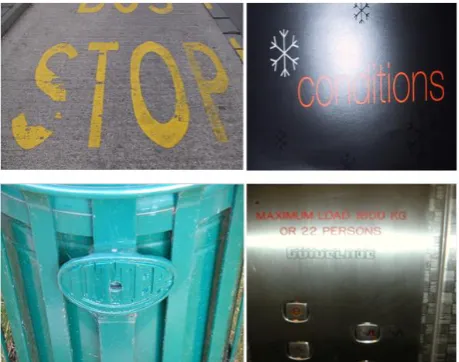
The proposed method is implemented in MATLAB R2013a and is evaluated on ICDAR 2003 Robust Reading Com- petition dataset, which contains 251 test images, 258 trial image and 20 sample images. The standard definitions of word precision and recall defined in ICDAR 2003 Text Locating and Robust Reading competitions were used. The proposed Scene text detection method has been applied for different types of images in varying brightness, colour, font etc. For evaluation precision, recall and f-measure were calculated.
100 * ) det
(
) det
( Pr
ive FalsePosit ectedText
Correctly
ectedText Correctly
ecision
100
*
)
det
(
)
det
(
Re
ive
FalseNegat
ectedText
Correctly
ectedText
Correctly
call
Fig 5.1: (a) Detected text [top] (b) False positive (c) False Negative [bottom]
ISSN(Online): 2320-9801
ISSN (Print) : 2320-9798
I
nternational
J
ournal of
I
nnovative
R
esearch in
C
omputer
and
C
ommunication
E
ngineering
(An ISO 3297: 2007 Certified Organization)
Vol. 3, Issue 9, September 2015
Table 1: Text Detection Results on ICDAR 2003 Dataset
This table shows that in terms of precision proposed method achieve better result than other.
Fig 5.2: Images that are not detected by proposed method
B. Discussion
ISSN(Online): 2320-9801
ISSN (Print) : 2320-9798
I
nternational
J
ournal of
I
nnovative
R
esearch in
C
omputer
and
C
ommunication
E
ngineering
(An ISO 3297: 2007 Certified Organization)
Vol. 3, Issue 9, September 2015
IV. CONCLUSION AND FUTURE WORK
This paper presents a new scene text detection method with several novel techniques. First, this technique uses low dynamic range image conversion to high dynamic range conversion, since high dynamic range image can't be directly taken again converting it into low dynamic range image which contains a combination of different brightness. This helps to extract more finer details of an image or text contained in it, it offers naturalness and also structural fidelity. Second, using above output as input region of an image containing text is extracted using Morphological operation or method. Third, Characterness i.e. probability to become a character is determined by using three novel cues such as stroke width, perceptual divergence and edge preserving histogram of oriented gradient and then Bayesian Multi-cue integration is performed i.e. posterior probability that a region is a character is determined for better result. Finally, character labelling is performed using some dimensional properties or dimension. Thus a better scene text detection method is proposed
.
This technique misses some character with very low resolution and can't detect blurred image also.
REFERENCES.
1. Yao Li, Wenjing Jia, Chunhua Shen, and Anton van den Hengel, 'Characterness: An Indicator of Text in the Wild', IEEE Transactions On Image Processing, Vol. 23, No. 4, April 2014.
2. B Epshtein, E Ofek, and Y Wexler, 'Detecting Text in Natural Scenes with Stroke Width Transform', IEEE Conf. Computer. Vis. Pattern Recognition, 2010.
3. Yi Feng Pan, Xinwen Hou, and Cheng Lin Liu, 'A Hybrid Approach to Detect and Localize Texts in Natural Scene Images', IEEE Transactions on Image Processing, Vol. 20, No. 3, March 2011.
4. Lukas Neumann and Ji Matas, 'Real: Time Scene Text Localization and Recognition', IEEE Conference on Computer Vision and Pattern Recognition,CVPR 2012.
5. S. Audithan, R. M. Chandrasekaran, 'Document Text Extraction From Document Images Using Haar Discrete Wavelet Transform', European Journal Of Scientific Research, Vol.36 No.4.
6. G. RamaMohanBabu, P. Srimaiyee, A. Srikrishna, 'Text Extraction From Heterogeneous Images Using Mathematical Morphology', Journal of Theoretical and Applied Information Technology, 2005 - 2010 JATIT.
7. J. Zhang and R. Kasturi, 'Text detection using edge gradient and graph spectrum', in Proc. IEEE 20th Int. Conf. Pattern Recognition., Aug. 2010. 8. Y. Li and H. Lu, 'Scene text detection via stroke width', in Proc. IEEE Int. Conf. Pattern Recognition., Nov. 2012.
9. "https://en.wikipedia.org/wiki/Tone mapping"
10. Y.F. Pan, X. Hou, C. L. Liu, 'Text localization in natural scene images based on conditional random field', In: ICDAR '09: Proc. of the 2009 10th International Conference on Document Analysis and Recognition. (2009).
11. S.M. Lucas, 'Text locating competition results. Document Analysis and Recognition', International Conference on 0 (2005).
12. S.M. Lucas, A. Panaretos, L. Sosa, A. Tang, S. Wong, R. Young, 'Icdar 2003robust reading competitions', In: ICDAR '03: Proc. of the 7th International Conference on Document Analysis and Recognition.
BIOGRAPHY