Technical Report
Performance Characterization of NetApp Cloud
Volumes ONTAP for Amazon Web Services
Oded Berman, NetAppMay 2020 | TR-4383
Abstract
This technical report examines the performance of NetApp® Cloud Volumes ONTAP® for Amazon Web Services (AWS) for application workloads. NetApp partners, customers and employees should use the presented information to make informed decisions about which workloads are appropriate for Cloud Volumes ONTAP.
TABLE OF CONTENTS
1 Introduction ... 4
2 Executive Summary... 4
3 Measuring Storage Performance ... 4
3.1 Test Methodology ... 5
3.2 Cloud Volumes ONTAP Configuration ... 5
3.3 Workloads ... 7
3.4 Test Environment Diagram... 8
4 Performance Assessment Results ... 8
4.1 Single Node... 9
4.2 High Availability ... 16
Acknowledgments ... 21
Where to Find Additional Information ... 22
Version History ... 22
LIST OF TABLES Table 1) Tested EC2 instance types. ... 5
Table 2) Storage configuration. ... 6
Table 3) Random reads results details. ... 9
Table 4) Transactional/OLTP results details. ... 11
Table 5) Sequential reads results details. ... 12
Table 6) Streaming writes results details. ... 14
Table 7) Mixed reads/writes results details. ... 16
Table 8) Random reads results details. ... 17
Table 9) Transactional/OLTP results details - HA... 18
Table 10) Sequential reads results details – HA. ... 19
Table 11) Streaming writes results details - HA. ... 20
Table 12) Mixed reads/writes results details - HA... 21
LIST OF FIGURES Figure 1) Test environment diagram. ... 8
Figure 2) Random reads workload IOPS and latency. ... 9
Figure 3) Transactional/OLTP workload IOPS and latency – Normal Write. ... 10
Figure 4) Transactional/OLTP workload IOPS and latency – High Write vs. Normal Write. ... 11
Figure 7) Sequential writes throughput – High Write vs. Normal Write. ... 14
Figure 8) Mixed reads/writes workload throughput and latency – Normal Write. ... 15
Figure 9) Mixed reads/writes workload throughput and latency – High Write vs. Normal Write. ... 15
Figure 10) Random reads workload IOPS and latency - HA. ... 17
Figure 11) Transactional/OLTP workload IOPS and latency - HA. ... 18
Figure 12) Sequential reads throughput - HA. ... 19
Figure 13) Sequential writes throughput – HA. ... 20
1 Introduction
NetApp has a long history of providing leading-edge, high-performance, feature-rich data management solutions through its ONTAP family anywhere across the hybrid multicloud, providing the agility and mobility that organizations need in their digital transformation and cloud journey.
The NetApp® Cloud Volumes ONTAP® software-only storage offering is an enterprise-grade storage solution deployed in the public cloud that runs on top of native cloud compute services and manages native cloud block and object storage services. Today, Cloud Volumes ONTAP can be deployed in any of the “big three” cloud providers: Amazon Web Services (AWS), Azure, and Google Cloud. Cloud Volumes ONTAP optimizes cloud storage costs and performance while enhancing data protection, security, and compliance. It delivers a powerful storage solution for any enterprise workload, such as relational and non-relational databases, DevOps, virtual desktop infrastructure (VDI), Kubernetes, file services, disaster recovery, backup and archiving, and more.
Cloud Volumes ONTAP is available in two pricing models: pay as you go (PayGo) and bring your own license (BYOL). For the PayGo model, three types of license packages are available: Explore, Standard, and Premium. Each license package provides different compute and storage capacity options.
This technical report describes the results of performance assessments that were conducted with Cloud Volumes ONTAP for AWS. When deployed in AWS, Cloud Volumes ONTAP uses Amazon Elastic Compute Cloud (EC2), a secure and resizable compute capacity, and Amazon Elastic Block Store (EBS), a high-performance block storage service.
The performance of Cloud Volumes ONTAP is highly dependent on the underlying cloud services being used - the type of EC2 instance, the type and size of EBS volumes, and on the workload. Therefore, several types of workloads, each with different characteristics of I/O operations, were selected to be tested with Cloud Volumes ONTAP using different types of EC2 instances and a non-limiting EBS configuration.
2 Executive Summary
NetApp performed this study to showcase the storage performance and benefits of NetApp Cloud Volumes ONTAP in the AWS cloud. Understanding the performance characteristics of Cloud Volumes ONTAP for AWS is critical to set expectations and to help stakeholders make educated decisions about which of their workloads can be handled by Cloud Volumes ONTAP and to understand what the required cloud resources are.
The results are presented in section 4, Performance Assessment Results. The results provide some basic understanding of the Cloud Volumes ONTAP performance capabilities in the AWS cloud and its
dependency on the underlying infrastructure and the services that are used.
The chosen workloads for this study were transactional/OLTP, sequential reads, sequential writes, and mixed reads/writes. Each of the selected workloads is characterized by different mixture and access patterns of I/O operations.
3 Measuring Storage Performance
NetApp performed these assessments to measure the performance of Cloud Volumes ONTAP 9.7 in single-node and high-availability (HA) configurations with different application workloads. This section describes the methodology that NetApp used to assess Cloud Volumes ONTAP performance and the configuration that was used, as well as the workloads that were tested.
3.1 Test Methodology
For this study, NetApp used Flexible I/O tester (FIO) version 3.16, a tool that can simulate any given workload. FIO generates a number of threads or processes, carrying out the type of I/O combination and patterns that the user specifies to generate the desired workloads. For more information, read the FIO's documentation.
To get the most out of Cloud Volumes ONTAP, multiple FIO clients were used in the various
assessments. The I/O workloads were generated by multiple m5.2xlarge EC2 instances (each with eight virtual CPUs [vCPUs] and 32GB of memory) running Red Hat Enterprise Linux 8.
All tests were performed with NFS v4, which is commonly used in a wide variety of workloads. NFS is a distributed file system, based on a client-server architecture, that enables users to access files and directories on a remote file system, much like the process to access local storage. The NFS protocol provides file-level access to logical storage resources such as a NetApp FlexVol® volume, an allocation of storage space that serves as a data container, hosted on Cloud Volumes ONTAP. A FlexVol volume is the basic storage unit that can be mounted by one or more NFS clients, providing access to users within the limits of the granted permissions.
In this study, multiple FlexVol volumes were configured and accessed by the clients. The goal was to achieve the best performance metrics possible for IOPS, throughput (the amount of data payload), and latency (the response time). All the results that are presented later in this report are the aggregated sum from the clients’ side.
All the EC2 instances that NetApp used in the study, including the instances that Cloud Volumes ONTAP used, were created in the EU-WEST-1 (Ireland) region, in the same availability zone, Virtual Private Cloud, and subnet.
3.2 Cloud Volumes ONTAP Configuration
For this study, Cloud Volumes ONTAP was configured in both single node and high availability (HA) pair as an active-active configuration. Since the performance of Cloud Volumes ONTAP depends greatly on the underlying cloud services that are used (EC2 and EBS), different EC2 types were used and a non-limiting EBS configuration. The EC2 types not only differ in their specifications, but they also incur different costs by AWS and by NetApp and belong to different pricing options (PayGo and BYOL) and PayGo licensing packages. The complete list of supported instances can be found in the supported configurations for Cloud Volumes ONTAP 9.7 in AWS.
The specific combination of resources determines the overall performance of an EC2 instance. For Cloud Volumes ONTAP, the amount of vCPU effects the general performance, whereas the memory size directly affects the read performance. The EBS bandwidth acts as a throughput throttling factor that is independent of read and write performance levels. All of the supported instance types for Cloud Volumes ONTAP are EBS optimized and have dedicated bandwidth to Amazon EBS, with different maximal throughput, depending on the instance type. For additional information on the instance types, visit the
Amazon instance types page and Amazon EBS-optimized instances in the EC2 user guide.
EC2 Instances
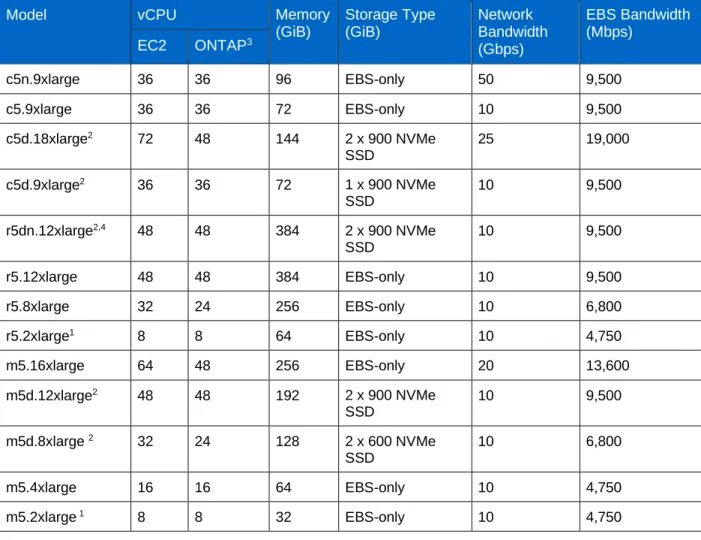
The following table (Table 1) displays the EC2 instance types used by Cloud Volumes ONTAP that were tested:
Table 1) Tested EC2 instance types.
Model vCPU Memory
(GiB) Storage Type (GiB) Network Bandwidth (Gbps) EBS Bandwidth (Mbps) EC2 ONTAP3 c5n.18xlarge 4 72 48 192 EBS-only 100 19,000
Model vCPU Memory (GiB) Storage Type (GiB) Network Bandwidth (Gbps) EBS Bandwidth (Mbps) EC2 ONTAP3 c5n.9xlarge 36 36 96 EBS-only 50 9,500 c5.9xlarge 36 36 72 EBS-only 10 9,500 c5d.18xlarge2 72 48 144 2 x 900 NVMe SSD 25 19,000 c5d.9xlarge2 36 36 72 1 x 900 NVMe SSD 10 9,500 r5dn.12xlarge2,4 48 48 384 2 x 900 NVMe SSD 10 9,500 r5.12xlarge 48 48 384 EBS-only 10 9,500 r5.8xlarge 32 24 256 EBS-only 10 6,800 r5.2xlarge1 8 8 64 EBS-only 10 4,750 m5.16xlarge 64 48 256 EBS-only 20 13,600 m5d.12xlarge2 48 48 192 2 x 900 NVMe SSD 10 9,500 m5d.8xlarge 2 32 24 128 2 x 600 NVMe SSD 10 6,800 m5.4xlarge 16 16 64 EBS-only 10 4,750 m5.2xlarge 1 8 8 32 EBS-only 10 4,750 Note:
1.These instance types can support maximum performance for 30 minutes at least once every 24 hours. If you have a workload that requires sustained maximum performance for longer than 30 minutes, select a different instance type..
2. These instance types, in addition to EBS, include local NVMe storage, which Cloud Volumes ONTAP uses as NetApp Flash Cache. NetApp Flash Cache speeds access to data through real-time intelligent caching. It is effective for random read-intensive workloads, including databases, email, and file services..
3. Currently, Cloud Manager deploys Cloud Volumes ONTAP with 16 vCPUs as a maximum limit, however additional vCPUs are supported . Changing the number of vCPUs currently requires a manual procedure.
4. Instances are not officially supported yet.
Storage Configuration
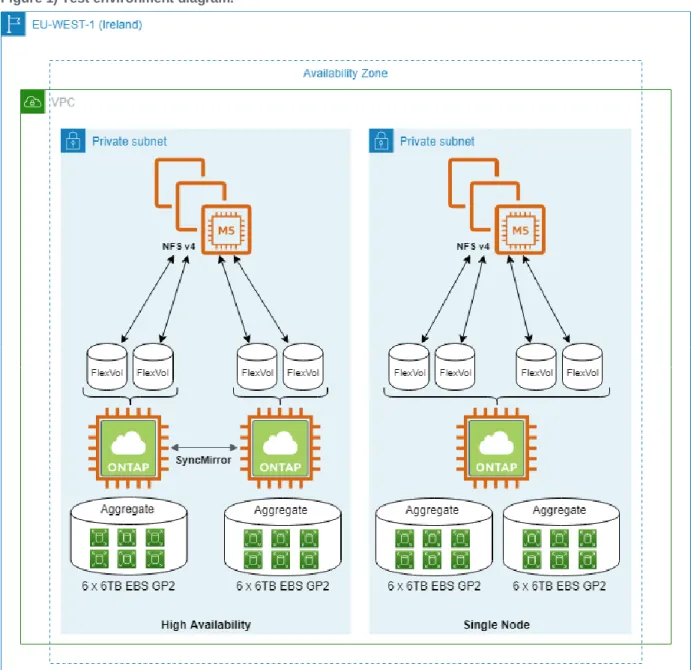
All Cloud Volumes ONTAP nodes were configured with multiple EBS General Purpose SSD (gp2) volumes as shown in the following table (Table 2) – For more information, see diagram in section 3.4, Test Environment Diagram.
Table 2) Storage configuration.
Resources Single Node High Availability Node # of GP2 EBS volumes 12 (each 6TB in size) 6 (each 6TB in size) # of aggregates 2 (each with 6 EBS volumes) 1 (with 6 EBS volumes)
Using General Purpose SSD is the recommended best practice because it balances price performance for a wide variety of workloads and transactional data. Cloud Volumes ONTAP supports other types of EBS volumes, such as EBS Provisioned IOPS SSD (io1), Throughput Optimized HDD (st1) and Cold HDD (sc1). For additional information about Amazon EBS, visit Amazon EBS volume types .
Write Speed
Cloud Volumes ONTAP’s Write Speed option, dramatically affects write performance and can be set to either Normal (default) or High.
When the write speed is set to Normal, data is first written to persistent storage and then an acknowledgment is sent back to the client. This process eliminates the chance of data loss if an unplanned outage occurs.
When the write speed is set to High, data is buffered in memory and an acknowledgment is sent back to the client before the data is committed to persistent storage. High write speed enhances write
performance but also increases the potential for data loss if an unplanned outage occurs. Users should enable a high write speed only if enhanced write performance is required and if data loss can either be tolerated or be handled by the application. For example, data loss from an unplanned outage can be tolerated, or the application (such as Microsoft SQL Server for Always On availability groups or MySQL replication) can handle data loss.
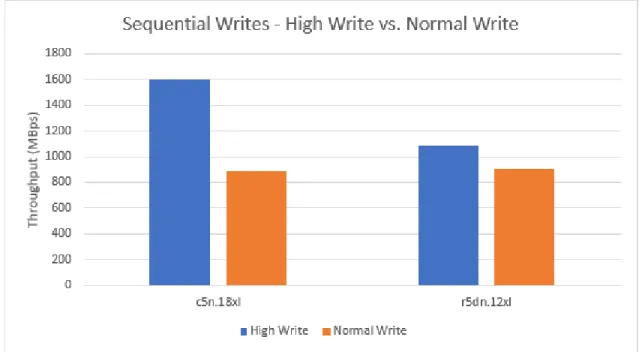
All instances were tested with Write Speed set to Normal. To demonstrate the Write Speed effect on write performance, two single node Cloud Volumes ONTAP instances were tested with the option set to High. In section 4 Performance Assessment Results, the values for both instances, in both Normal and High write speeds are presented in the applicable workloads.
3.3 Workloads
In this study, five different workloads were configured and tested. Each tested workload consisted of a unique I/O mixture and access pattern that simulated workloads that are used in widely deployed applications:
• Random reads (4K block size 100% reads, and 100% random access I/O). A random read is a disk
access pattern whereby small (4K) blocks of data are read from random locations. This workload is used primarily within the context of benchmarking how effective a device is at quickly retrieving small pieces of data from random locations.
• Transactional/OLTP (8KB block size, 80% reads, and 100% random access I/O). A transactional
workload is typically identified by a database that receives numerous requests for data and multiple changes to this data from several users over time. These modifications are called transactions. The transactions are small and primarily random in nature with high concurrency. This type of workload is generated by transactional database applications such as SAP, Oracle, and SQL Server and MySQL databases.
• Sequential reads (64KB block size, 100% reads, and 100% sequential access I/O). In a streaming reads workload, only sequential read operations are performed (and they are concurrent, large, contiguous requests). This workload is typically generated by applications such as media servers (for example, video on demand) and virtual tape libraries.
• Sequential writes (64KB block size, 100% writes, and 100% sequential access I/O). In a streaming writes workload, only sequential write operations are performed (and they are concurrent, large, contiguous requests). This workload is typically generated by applications such as media capture, virtual tape libraries, medical imaging, backup and archiving, and video surveillance.
• Mixed reads/writes (16KB block size, 50% reads, and 100% random access I/O). Many applications
generate a mix of read/write operations that differ in the reads versus writes percentage, block size, and random versus sequential percentage and that typically require high throughput and low latency. A mix of 50% reads and 50% writes is a common starting point for measuring. That kind of workload can be found, for example, in a VDI.
3.4 Test Environment Diagram
Figure 1 displays the environment and AWS resources that NetApp used for the performance assessments.
Figure 1) Test environment diagram.
4 Performance Assessment Results
This section describes the values of the performance metrics that were obtained in the process of assessing NetApp Cloud Volumes ONTAP for AWS for a single-node and HA pair as an active-active configuration deployed in a single availability zone.
4.1 Single Node
The following figures and tables describe the performance metrics of Cloud Volumes ONTAP for AWS in a single node configuration in applicable workloads.
Random Reads
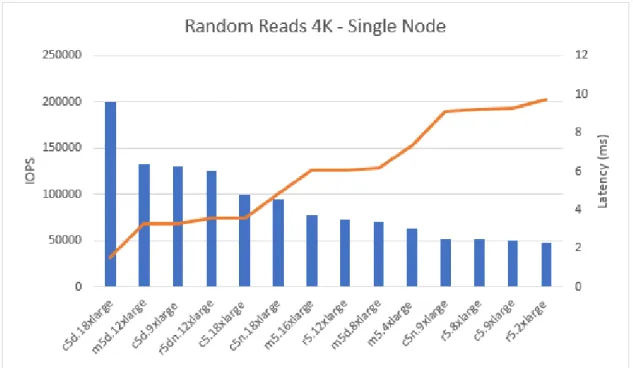
The significant metrics for this type of workload are IOPS and latency, as shown in the following figure and table (Figure 2 and Table 3).
Figure 2) Random reads workload IOPS and latency.
Table 3) Random reads results details.
Model IOPS Throughput (MBps) Latency (ms)
m5.2xlarge N/A N/A N/A
c5d.18xlarge 200263 801 1.52 m5d.12xlarge 132312 529 3.29 c5d.9xlarge 130848 523 3.3 r5dn.12xlarge 125855 503 3.55 c5.18xlarge 99280 397 3.56 c5n.18xlarge 95282 381 4.84 m5.16xlarge 76933 308 6.03 r5.12xlarge 72920 292 6.08 m5d.8xlarge 70663 283 6.19 m5.4xlarge 63331 253 7.35
Model IOPS Throughput (MBps) Latency (ms)
c5n.9xlarge 51753 207 9.09
r5.8xlarge 50819 203 9.22
c5.9xlarge 50537 202 9.29
Transactional/OLTP
The significant metrics for this type of workload are IOPS and latency, as shown in the following figures and tables (Figure 3 and Figure 4 and Table 4).
Figure 4) Transactional/OLTP workload IOPS and latency – High Write vs. Normal Write.
Table 4) Transactional/OLTP results details.
Model IOPS Throughput (MBps) Latency (ms)
c5d.18xlarge 96236 770 4.7 r5dn.12xlarge1 94729 (192188) 758 (1537) 5.9 (2) m5d.12xlarge 91566 733 2.5 c5n.18xlarge1 90002 (123134) 720 (985) 5.3 (3.8) c5.18xlarge 88948 712 4.29 m5.16xlarge 88388 707 2.6 m5d.8xlarge 85164 681 5.5 c5d.9xlarge 82776 662 5.41 r5.12xlarge 79544 636 5.6 r5.2xlarge 61799 494 7.39 m5.4xlarge 61235 490 7.53 c5n.9xlarge 55253 442 8.49 c5.9xlarge 54899 439 5.45 r5.8xlarge 44995 360 10.33
Sequential Reads
The significant metric for this type of workload is throughput, as shown in the following figure and table (Figure 5 and Table 5).
Figure 5) Sequential reads throughput.
Table 5) Sequential reads results details.
Model IOPS Throughput (MBps) Latency (ms)
c5n.18xlarge 64949 4157 5 r5dn.12xlarge 58799 3763 6.9 c5d.18xlarge 45857 2935 6 m5.16xlarge 38139 2441 2 c5.18xlarge 36949 2365 7.3 c5n.9xlarge 28451 1821 16.1 m5d.12xlarge 22961 1470 0.46 r5.12xlarge 22941 1468 0.88 c5d.9xlarge 22082 1413 2.69 c5.9xlarge 19954 1277 11.2 r5.8xlarge 19104 1223 2 m5.4xlarge 19026 1218 4.19
Model IOPS Throughput (MBps) Latency (ms)
r5.2xlarge 18866 1207 1.36
m5.2xlarge 15214 974 0.6
Sequential Writes
The significant metric for this type of workload is throughput, as shown in the following figures and table (Figure 6 and Figure 7 and Table 6).
Figure 7) Sequential writes throughput – High Write vs. Normal Write.
Table 6) Streaming writes results details.
Model IOPS Throughput (MBps) Latency (ms)
c5d.18xlarge 15465 990 32 m5d.12xlarge 14530 930 32 c5n.9xlarge 14496 928 33 r5dn.12xlarge1 14183 (16989) 908 (1087) 47 (11) c5n.18xlarge1 13948 (24951) 893 (1597) 35 (8) c5.9xlarge 13911 890 34 r5.12xlarge 13198 845 36 c5d.9xlarge 12013 769 9.23 r5.8xlarge 10557 676 40.53 m5.16xlarge 10138 649 46.29 m5d.8xlarge 9987 639 43.06 c5.18xlarge 9882 632 8.83 m5.4xlarge 6843 438 37.42 m5.2xlarge 5264 337 14.5 r5.2xlarge 2745 176 44.53
Mixed Reads/Writes
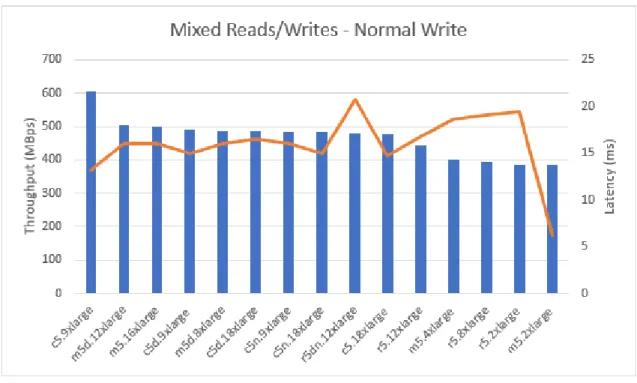
The significant metrics for this type of workload are throughput and latency, as shown in the following figures and table (Figure 8 and Figure 9 and Table 7).
Figure 8) Mixed reads/writes workload throughput and latency – Normal Write.
Table 7) Mixed reads/writes results details.
Model IOPS Throughput (MBps) Latency (ms)
c5.9xlarge 37788 605 13.2 m5d.12xlarge 31403 502 16 m5.16xlarge 31274 500 16 c5d.9xlarge 30618 490 14.98 m5d.8xlarge 30449 487 16 c5d.18xlarge 30371 486 16.5 c5n.9xlarge 30295 485 16 c5n.18xlarge1 30265 (151271) 484 (2420) 15 (2) r5dn.12xlarge1 30085 (83415) 481 (1334) 20.8 (5.9) c5.18xlarge 29812 477 14.72 r5.12xlarge 27714 443 16.72 m5.4xlarge 25103 402 18.65 r5.8xlarge 24556 393 19.09 r5.2xlarge 24059 385 19.45 m5.2xlarge 23991 384 6.2
1. High write speed values in parenthesis.
4.2 High Availability
The following figures and tables describe the performance metrics of Cloud Volumes ONTAP for AWS in a high availability (HA) pair as an active-active configuration deployed in a single availability zone. Results displayed are the sum of both nodes in the HA pair.
Random Reads
The significant metrics for this type of workload are IOPS and latency, as shown in the following figure and table (Figure 10 and Table 8).
Figure 10) Random reads workload IOPS and latency - HA.
Table 8) Random reads results details.
Model IOPS Throughput (MBps) Latency (ms)
c5d.18xlarge 542012 2168 0.29 m5d.12xlarge 502212 2009 1.02 m5d.8xlarge 367894 1472 1.85 r5dn.12xlarge 353734 1415 2.26 r5.12xlarge 352144 1409 2.57 m5.16xlarge 309754 1239 2.83 c5n.18xlarge 267360 1069 3.1 c5n.9xlarge 217368 869 4.21 r5.8xlarge 216202 865 4.12 c5.9xlarge 210914 844 4.33
4.2.2 Transactional/OLTP
The significant metrics for this type of workload are IOPS and latency, as shown in the following figure and table (Figure 11 and Table 9).
Figure 11) Transactional/OLTP workload IOPS and latency - HA.
Table 9) Transactional/OLTP results details - HA.
Model IOPS Throughput (MBps) Latency (ms)
c5.9xlarge 166352 1331 5.25 r5.12xlarge 162506 1300 5.37 m5d.12xlarge 157636 1261 5.54 c5d.18xlarge 157466 1260 5.25 c5n.9xlarge 154934 1239 5.85 m5.16xlarge 152418 1219 5.78 c5n.18xlarge 148458 1188 5.68 m5d.8xlarge 146626 1173 5.72 r5dn.12xlarge 141016 1128 6.39 r5.8xlarge 130118 1041 6.86
Sequential Reads
The significant metric for this type of workload is throughput, as shown in the following figure and table (Figure 12 and Table 10).
Figure 12) Sequential reads throughput - HA.
Table 10) Sequential reads results details – HA.
Model IOPS Throughput (MBps) Latency (ms)
c5n.9xlarge 140198 8973 2.81 r5dn.12xlarge 133472 8542 4.68 c5n.18xlarge 120786 7730 3.9 c5d.18xlarge 92392 5913 2.74 m5.16xlarge 76334 4885 2.04 r5.12xlarge 45828 2933 0.11 m5d.12xlarge 45726 2926 0.41 c5.9xlarge 44526 2850 0.73 r5.8xlarge 39594 2534 0.18 m5d.8xlarge 38272 2449 0.71
Sequential Writes
The significant metric for this type of workload is throughput, as shown in the following figure and table (Figure 13 and Table 11).
Figure 13) Sequential writes throughput – HA.
Table 11) Streaming writes results details - HA.
Model IOPS Throughput (MBps) Latency (ms)
c5n.9xlarge 14010 897 37.64 c5n.18xlarge 12904 826 41.3 m5.16xlarge 12140 777 44.56 m5d.12xlarge 11792 755 72.17 r5.12xlarge 11010 705 47.39 c5d.18xlarge 10556 676 53.84 c5.9xlarge 10402 666 49.92 m5d.8xlarge 10050 643 50.36 r5dn.12xlarge 9922 635 53.84 r5.8xlarge 9146 585 91.58
Mixed Reads/Writes
The significant metrics for this type of workload are throughput and latency, as shown in the following figure and table (Figure 14 and Table 12).
Figure 14) Mixed reads/writes workload throughput and latency – HA.
Table 12) Mixed reads/writes results details - HA.
Model IOPS Throughput (MBps) Latency (ms)
c5.9xlarge 54320 869 16.56 r5.12xlarge 53134 850 17.46 m5d.12xlarge 51146 818 17.99 c5n.18xlarge 49790 797 17.72 c5n.9xlarge 48120 770 19.53 m5d.8xlarge 47890 766 19.24 m5.16xlarge 47294 757 19.4 c5d.18xlarge 45450 727 16.79 r5dn.12xlarge 42122 674 19.15 r5.8xlarge 41418 663 22.37
Acknowledgments
The author gratefully acknowledges the contributions that were made to this technical report by key NetApp team members: Ofir Dagan, Ishai Avramovich, Oryan Rachum, Aviv Degani, Michele Pardini, and Yuval Kalderon. My sincere appreciation and thanks go to all these individuals, who designed and
performed the assessments and provided the insight and expertise that greatly assisted in the creation of this paper.
Where to Find Additional Information
To learn more about the information that is described in this document, review the following documents or websites:
• Cloud Volumes ONTAP (features, architecture, TCO calculator, pricing, and more)
https://cloud.netapp.com/ontap-cloud
• NetApp Cloud Manager and Cloud Volumes ONTAP documentation
https://docs.netapp.com/us-en/occm/
• Getting Started with Cloud Volumes ONTAP for AWS
https://docs.netapp.com/us-en/occm/task_getting_started_aws.html
• Enabling Flash Cache on Cloud Volumes ONTAP in AWS
https://docs.netapp.com/us-en/occm/task_enabling_flash_cache.html#whats-flash-cache
• Planning your Cloud Volumes ONTAP write speed
https://docs.netapp.com/us-en/occm/task_planning_your_config.html#choosing-a-write-speed
• Latest FIO documentation
https://fio.readthedocs.io/en/latest/
• Amazon EBS features
https://aws.amazon.com/ebs/features/
• Amazon EC2 Instance Types
https://aws.amazon.com/ec2/instance-types/
• Cloud Manager – Deploy and Manage NetApp Cloud Data Services in AWS Marketplace
https://aws.amazon.com/marketplace/pp/B07QX2QLXX
Version History
Version Date Document Version History
Version 3 April 2020 Revision of performance with Cloud Volumes ONTAP 9.7 for AWS
Version 2.3 Jan 2019 Updated performance with Cloud Volumes ONTAP 9.5 Version 2.2 July 2018 Updated performance with Cloud Volumes ONTAP 9.4
Updated instance types Added Tiering performance
Version 2.1 February 2018 Updated performance with Cloud Volumes ONTAP 9.3 Version 2.0 June 2017 Updated performance with Cloud Volumes ONTAP 9.2 Added
performance of high availability Version 1.2 May 2017 Additional tests
Version 1.1 January 2016 Updated with tests of additional instance types Version 1.0 February 2015 Initial release
Refer to the Interoperability Matrix Tool (IMT) on the NetApp Support site to validate that the exact product and feature versions described in this document are supported for your specific environment. The NetApp IMT defines the product components and versions that can be used to construct configurations that are supported by NetApp. Specific results depend on each customer’s installation in accordance with published specifications.
Copyright Information
Copyright © 2020 NetApp, Inc. All Rights Reserved. Printed in the U.S. No part of this document covered by copyright may be reproduced in any form or by any means—graphic, electronic, or mechanical, including photocopying, recording, taping, or storage in an electronic retrieval system—without prior written permission of the copyright owner.
Software derived from copyrighted NetApp material is subject to the following license and disclaimer: THIS SOFTWARE IS PROVIDED BY NETAPP “AS IS” AND WITHOUT ANY EXPRESS OR IMPLIED WARRANTIES, INCLUDING, BUT NOT LIMITED TO, THE IMPLIED WARRANTIES OF
MERCHANTABILITY AND FITNESS FOR A PARTICULAR PURPOSE, WHICH ARE HEREBY DISCLAIMED. IN NO EVENT SHALL NETAPP BE LIABLE FOR ANY DIRECT, INDIRECT,
INCIDENTAL, SPECIAL, EXEMPLARY, OR CONSEQUENTIAL DAMAGES (INCLUDING, BUT NOT LIMITED TO, PROCUREMENT OF SUBSTITUTE GOODS OR SERVICES; LOSS OF USE, DATA, OR PROFITS; OR BUSINESS INTERRUPTION) HOWEVER CAUSED AND ON ANY THEORY OF
LIABILITY, WHETHER IN CONTRACT, STRICT LIABILITY, OR TORT (INCLUDING NEGLIGENCE OR OTHERWISE) ARISING IN ANY WAY OUT OF THE USE OF THIS SOFTWARE, EVEN IF ADVISED OF THE POSSIBILITY OF SUCH DAMAGE.
NetApp reserves the right to change any products described herein at any time, and without notice. NetApp assumes no responsibility or liability arising from the use of products described herein, except as expressly agreed to in writing by NetApp. The use or purchase of this product does not convey a license under any patent rights, trademark rights, or any other intellectual property rights of NetApp.
The product described in this manual may be protected by one or more U.S. patents, foreign patents, or pending applications.
Data contained herein pertains to a commercial item (as defined in FAR 2.101) and is proprietary to NetApp, Inc. The U.S. Government has a non-exclusive, non-transferrable, non-sublicensable, worldwide, limited irrevocable license to use the Data only in connection with and in support of the U.S. Government contract under which the Data was delivered. Except as provided herein, the Data may not be used, disclosed, reproduced, modified, performed, or displayed without the prior written approval of NetApp, Inc. United States Government license rights for the Department of Defense are limited to those rights identified in DFARS clause 252.227-7015(b).
Trademark Information
NETAPP, the NETAPP logo, and the marks listed at http://www.netapp.com/TM are trademarks of NetApp, Inc. Other company and product names may be trademarks of their respective owners. TR-4383-0520