Stress Dynamics of Information Systems
Managers: A Contingency Model
ELDON Y. LI AND ABRAHAM B. (RAMI) SHANI
ELDON Y. LI is Professor of MIS at the School of Business, California Polytechnic State University, San Luis Obispo. He received his MS and Ph.D. from Texas Tech University. He is formerly a visiting software scientist at IBM Corporation and a software quality consultant at Bechtel Corporation. He has provided consulting services to many firms for a variety of software projects and has served as management consultant to the clientele of the U.S. Small Business Administration. His current research interests include planning and control of information systems, software engineering, quality assurance, human factors, and information management. He is a Certified Data Educator (CDE) and a Professional Certified in Production and Inventory Management (CPIM). He is a member of EEE-Computing, ACM, AAAI, ACE, DSI, and TIMS.
ABRAHAM B. (RAMI) SHANI is Professor of Organizational Behavior and Management at the School of Business, California Polytechnic State University, San Luis Obispo. He is an international consultant certified by the Association of Applied Behavioral and Social Scientists. He received his Ph.D. in organization behavior from Case Western Reserve University. As an action researcher, he has worked with diverse organizations and industries. He is co-author of two books and many articles. His current research interests include innovation, the management of technology, technology transfer, parallel learning structures, and sociotechnical system design.
ABSTRACT: A field study of 109 information systems (IS) managers explores the relationship among organizational characteristics, job satisfaction, and work stress. The results indicate that work overload is the major source of perceived IS work stress, followed by role conflict, job-induced anxiety, and then role ambiguity. Four organizational contextual factors--IS climate, clarity and sharing of organizational mission, quality of work life, and flexibility of organizational processes--were found to influence significantly work stress and job satisfaction as perceived by IS managers. As expected, job satisfaction was significantly related to IS work stress while IS technological sophistication was not related to IS stress or job satisfaction factors. Contrary to predictions, neither the clarity and awareness of organizational policies nor the quality of IS resources were found to have impact on any IS stressor.
KEY WORDS AND PHRASES: information systems managers, organizational characteristics, job satisfaction, work stress, and information systems characteristics.
Introduction
A GROWING BODY OF EMPIRICAL RESEARCH [29, 35, 37, 54] on the phenomenon of stress has shown that role ambiguity, role conflict, work overload, and job-induced anxiety result in unfavorable individual and organizational outcomes. Stress has been studied in a wide variety of organizations, such as construction corporations [69], government agencies [13], hospitals [33], kibbutzim [66], and the military [63]. Occupation-related stress has been studied in a variety of professions, such as university students [8], university professors [18], purchasing agents [24], nurses [32], police forces [7], computer programmers [9], information systems managers [70], and information systems personnel [34], to mention a few. Surprisingly, only a few studies [9, 22, 34, 70] have been published on the stress phenomenon in the information systems profession.
Information systems (IS) have been perhaps the single most important factor to impact on organizations during the past few decades. It has experienced a rapid growth in almost every organization due to the intense competition in the industry. The recent proliferation of microcomputers and distributed processing in organizations has generated an ever greater demand for IS personnel to implement the state-of-the-art technology [34] . As an IS manager, one must assume a role of increasing responsibility, and cope with the continuous, rapid change of technology in a competitive, dynamic IS environment. This combination of constant change and a diversity of roles puts every IS manager in a position that is susceptible to increasing levels of work stress. The purpose of this study is to investigate the potential effects of organizational characteristics and job satisfaction on the work stress experienced by IS managers. Literature Review
Stress Dynamics
A wide variation in the conceptualization of stress is evident in the literature of medicine, biology, psychology, and management science [63]. In this paper, the conceptual foundation of work-related stress dynamics rests on the work initially conducted by the Institute for Social Research at the University of Michigan, Ann Arbor [37], and further developed by others such as House and Rizzo [29], Kahn [36], Ivancevich, Matteson, and Preston [33], and Iaffaldano and Muchinsky [31]. Stress is viewed as an interaction among organizational characteristics that appear threatening to human beings, and their reactions to the threat as indicated by their overall job satisfaction. Being concerned only with social psychological stress, the focus of our interest is on the individual's perception of stress and the key organizational characteristics at the workplace.
The variables used in this study as the indicators of IS work stress are role ambiguity, role conflict, work overload, and job-induced anxiety. These variables were chosen based upon their significant influence on stress in work organizations as reported in Kahn et al. [37], Ivancevich, Napier, and Wetherbe [34], Nicholson and Goh [54], Weiss [70], Jamal [35], and Rogers, Li, and Shani [63]. Both role ambiguity and role conflict have been associated with personal and organizational outcomes [36]. Role ambiguity is defined as the degree to which clear information is lacking regarding (1) the expectations associated with a role, (2) the methods for fulfilling role expectations, and/or (3) the consequences of role performance [37]. Role ambiguity of the IS professional may result from dealing with conflicting, unclear, or volatile expectations from the IS users as well as having to bring about changes under uncertain authority. In a study that focused on IS managers, role ambiguity along with three other stressors (lack of feedback, career development, and organizational structure and climate) was reported to have the greatest impact on psychological and physiological strain [70]. Role conflict occurs when an individual faces the simultaneous occurrence of two or more role requirements for which the performance of one precludes the performance of the other. Role conflict often occurs when conflicting demands are placed upon the individual by his/her superiors, peers, or subordinates [37, 62, 70].
Work overload refers to too much work or work that is beyond one's capability [20, 48, 64]. A Study by Ivancevich, Napier, and Wetherbe [34] on the stress experienced by IS professionals indicated that work overload and time pressure were significant factors resulting in IS work stress. In a study conducted by Eberhardt and Eberhardt [18], job-induced anxiety was defined as the extent that an individual experiences the symptoms of anxiety resulting from his/her work situation. It is also regarded as a potential consequence of perceived role ambiguity and role conflict. Conceptually, the four indicators of
stress--role ambiguity, role conflict, work overload, and job-induced anxiety--are likely to provide a holistic mapping of stress dynamics in the work setting.
Organizational Characteristics
Across today's industries, organizations are facing ever-increasing competition and a rapid rate of technological change. This intensely competitive and rapidly changing environment forces organizations to alter quickly their strategies [39], structure [19], managerial practices [72] , technology [51 , 60] , and even culture [56, 61 ] . Commitment toward these organizational innovations requires the organization to be more flexible, less bureaucratic, less centralized [6], and in most cases to utilize organizational resources optimally [27].
Computers, information systems, and IS professionals emerged as key factors that in many instances determined an organization's ability to cope with the required changes. At the same time, organizational factors play a vital contextual role in both the effectiveness and the degree of stress experienced by IS professionals. Several organizational factors were found to influence the level of IS work stress [16, 21, 34, 70] . Weiss [70] pointed out that organizational structure and organizational innovation play significant roles as organizational stressors for the IS manager. Clarity of organizational mission, goals, policies, and strategies were found to be the factors influencing an IS manager's success, as well as the sources of frustration [16]. The nature of work design [21] and organizational processes such as decision making [70], rewards system [4, 34], and communication [34] were regarded as work environment stressors. Finally, characteristics of the IS area, such as IS department characteristics [70], the relationship between users and the IS department, organizational attitude toward the IS function [1, 17], and IS organizational as well as technological sophistication [11] all have the potential to influence IS work stress. Job Satisfaction
Perhaps one of the most intriguing elements of work dynamics [56] has to do with the general attitude toward work or toward a job [46, 53]. A wide variety of discussions concerning the definitions and conceptual maps of job satisfaction exist in the literature. Locke [46], Iaffaldano and Muchinsky [31], and Cheney and Scarpello [12] each have provided excellent reviews of the literature. In the broadest sense, job satisfaction refers to affective attitudes or orientations on the part of individuals toward jobs. Most researchers define it as a function of the match between the rewards offered by the work environment and the individual's preferences for those rewards [12]. In recent years, recognition has been given to the importance of the kinds of affective reactions that people experience and to the fact that these reactions are not always tied to economic or material accomplishment [58]. Sources of job satisfaction vary from individual to individual. Organizational researchers have identified an array of work factors that are often related to the levels of employee job satisfaction. Such work factors include work challenge, physical demand, personal interest, the rewards system, goal attainment, superiors, coworkers, subordinates, and fringe benefits, among others [30, 31, 44].
In the IS discipline, the degree of relevance and applicability of what was learned in other disciplines about job satisfaction was raised by Couger and Zawacki [14]. They applied a modified version of the Job Diagnostic Survey (JDS) to a sample of over 1,000 data-processing (DP) professionals and revealed that DP professionals are generally more satisfied than other professionals, but are less satisfied with both coworkers and supervision. They conclude that, while the JDS proved to be a good discriminator, it does not measure actual work outcomes such as productivity, turnover, or absenteeism [14, p. 18] . Bartol [3], in a study of 129 computer specialists among a variety of organizations, examined individual versus organizational predictors of satisfaction and turnover. The research focused on satisfaction with various aspects of the job situation (such as the work itself, supervision, coworkers, pay, and promotions) by utilizing the Job Descriptive Index (JDI) [67]. Mixed results were reported with regard to the initial hypothesis. One can argue that the choice of the JDI and its psychometric characteristics might have had an influence. In a later study, Bartol [4] summed up the JDI scales into one composite score in order to investigate a causal model through path analysis. This composite JDI score facilitated a meaningful investigation about the role that job satisfaction plays in understanding the phenomenon of turnover.
Recently, Goldstein and Rockart [22] administered a questionnaire measuring job characteristics, role conflict, role ambiguity, leadership characteristics, and job satisfaction to 118 programmer/analysts at four large companies. One of the major conclusions from the study is that the Hackman and Oldham [25]
Job Characteristics Model should be extended to include more variables, such as leadership and role variables, in order to better understand the work-related correlates of job satisfaction. Goldstein [23] later conducted a survey measuring work satisfaction, job characteristics, role perceptions, and user interaction characteristics of programmer/analysts. The sample contains 246 programmer/analysts in three locations of a large manufacturing firm. Among the many and unique results of the study, he identifies that the major drawback of the JDS is that the instrument was not designed to study work carried out interdependently [23, p. 43].
Understanding the dynamics of job satisfaction in the IS environment remains a challenge. As can be seen from the studies discussed above, all the investigators would agree that job satisfaction is an important factor for the IS professional. However, they appear to disagree on what really constitutes job satisfaction or what are the most relevant variables to measure. All the instruments utilized were reported to have some drawbacks and additional variables were identified that could have a potential effect on the level of job satisfaction.
Variables to be Studied
IN SHORT, THE ABOVE THREE SETS of variables are included in this study. The first set measures IS work stress and consists of four variables--role ambiguity, role conflict, work overload, and job-induced anxiety. The second set measures organizational characteristics and consists of two groups of variables--organization-wide characteristics and Is-related characteristics. Finally, the third set measures job satisfaction and consists of several facets, taking into account satisfaction with pay, job position, challenge, and other job-related factors.
A Contingency Model of IS Work Stress
AS A FRAMEWORK OF IS WORK STRESS for this study, the three sets of research variables discussed above were hypothesized to have the relationships shown in Figure 1. This framework is somewhat different from those of Weiss [70] and Ivancevich, Napier, and Wetherbe [34], in which job satisfaction was considered as the effect of the organizational stressors instead of the cause. Since the causality between job satisfaction and IS work stress may very likely be bi-directional, hypothesizing a direction opposite to the one in the above two studies does not invalidate Figure I as a contingency model. To facilitate data analysis and the interpretation of the results, this study hypothesizes that job dissatisfaction is a source of IS work stress.
Based on the contingency model in Figure 1, three sets of relationships may be hypothesized among IS work stress, organizational characteristics, and job satisfaction as perceived by the IS managers in this study. This model will be expanded to further explore the effects between various pairs of individual specific variables, each from a different research dimension.
Hypothesis 1: Is managers' work stress is negatively affected by organizational characteristics. For example, the better the quality of work life, or the stronger the support for innovative activities, the lower the degree of work stress perceived by IS managers.
Hypothesis 2: Is managers' work stress is negatively affected by their job satisfaction. That is, the higher the degree of job satisfaction, the lower the degree of work stress perceived by IS managers.
Orgaizational
characteristics Job satisfcation IS work stress
(-)
(+) (-)
Legend: (+) indicates a positive relationship (-) indicates a negative relationship
Figure 1. A Causality Framework of Is Work Stress
Hypothesis 3:1s managers' job satisfaction is positively affected by organizational characteristics. For example, the better the Is climate, or the more flexible the organizational processes, the higher the degree of perceived job satisfaction.
Research Method Subjects
Six hundred eight members of a large national association of IS professionals in the southwest were solicited to participate in this study. The sample represents 608 different companies; 160 (26 percent) of them agreed to participate. Among these individuals, 135 (84 percent) indicated that they supervised some IS personnel. The survey questionnaires were then sent to these IS managers. Of the 135 questionnaires sent, 115 (85 percent) were completed and returned. Among the returned questionnaires, 6 were found to be incomplete, leaving 109 usable. Included in the questionnaire were some basic demographic questions concerning such variables as sex, age, marital status, level of education, type of organization, job title, number of company employees, and number of IS employees. The respondents came from 109 different companies. They represent a wide variety of industries including banking, EDP (electronic data processing) services, education, government, insurance, manufacturing, medical, printing, retailing, utilities, wholesaling, etc. Among them, 70 were top-level managers, while 20 were middle-level and 19 operating-level managers. In terms of number of employees, 18 firms had less than 100 employees; 39 firms had 101 to 500;18 firms had 501 to 1,000; 23 firms had 1,001 to 5,000; and 34 firms had over 5,000 employees. In terms of sales or budget, 33 firms had less than 25 million dollars; 39 firms had 25 to less than 200 million; and 37 firms had 200 million or more. Such distribution in the size and the type of the firms as well as in the level of IS management ensures the representativeness of our sample.
Measures
The instruments used to measure the variables under investigation were mostly adopted from the existing literature. The IS work stress was measured by 21 items (see the appendix): role ambiguity and role conflict were measured by 14 items developed by Rizzo, House, and Lirtzman [59]; work overload was assessed by 3 items developed by Kroes, Hurrell, and Margolis [43]; job-induced anxiety was measured by 4 items adopted from House and Rizzo [29] that measure the extent to which individuals experience symptoms of anxiety resulting from their work situation. Organizational characteristics were measured by 32 items; 22 of them relate to the entire organization (see Table 1) while the other 10 items relate to the IS department. Among the 22 organization-wide items, items 5 and 6 were adopted from Maidique and Hays [47], items 7, 8, and 9 from Litwin and Stringer [45], the rest from Taylor and Bowers [68]. Of the 10 Is-related items (see the appendix), 2 were known to measure IS organizational and technological
sophistication [11]. The remaining 8 items were designed to measure the overall IS climate. One of the 8 items was developed by the authors to measure the user's attitude toward IS, the others were adopted from Bailey and Pearson [1] to measure the relationship between users and the IS department as well as organizational attitude toward the IS function. Job satisfaction was assessed by 8 items adopted from Hoy [30] (see Table 2). Subjects were asked to indicate the extent to which they agree with the condition described by the questionnaire item on a seven-point Likert-type scale, ranging from 1 (strongly disagree) to 7 (strongly agree). Therefore, the self-report score may not represent the actual condition; rather, it is a perception of the respondent toward the condition.
Composite Scores
To validate the instrument and analyze the causal relationships in this study, a composite average of item scores was computed for each scale of IS work stress. The result showed that work overload had the highest mean composite score (4 .99; 3 items, SD = 0.95), followed by role conflict (4.45; 8 items, SD = 1.26), job-induced anxiety (3.16;4items,sD = 1.52),and role ambiguity(2.87;6items,SD = 1.34).In addition, organization-wide characteristics had a mean composite score of 4.42 (22 items, SD = 0.96),Isclimatehad4.89(8items,sD = 1.11),overalljobsatisfactionhad4.93 (8 items, SD = 1.04), overall IS work stress had 3.83 (21 items, SD = 0.98), and overall organizational characteristics had 4.55 (32 items, SD = 0.91). With regard to the individual factors of organization-wide characteristics and job satisfaction, factor analysis was used to extract significant factors and each factor was measured by the corresponding factor scores.
Procedure
The psychometric quality of the instrument was first examined using the data collected from the 109 respondents. Once the quality of data is confirmed, the relationships among the three sets of research variables are explored through correlation analysis and causal modeling. An overall path model treating each set of research variables as a single dimension is first examined. This overall model examines the general direction of the relationship among the three hypothesized dimensions with each being measured by an overall composite score. The overall model is then exploded into a full, detailed path model using the extracted factors in each dimension as the variables. The detailed path model will then be subjected to a "theory trimming" process [4, 5, 28] and the implications of the findings will be discussed.
Results
Psychometric Properties of the Instrument
The reliability, the content validity, and the construct validity of the instrument were first examined. The results indicate that the instrument possesses all three psychometric qualities. The reliability (alpha) coefficients [9, 15] of the scales for perceived organizational characteristics, job satisfaction, and work stress are 0.94, 0.84, and 0.90, respectively. The scale of organization-wide characteristics has a reliability coefficient of 0.92, the scale of IS climate 0.88, and role ambiguity, role conflict, work overload, and job-induced anxiety 0.91, 0.85, 0.70, and 0.83, respectively. The values of these coefficients are at the acceptable level recommended by Nunnally [55].
Factor Analysis
In order to reduce the number of specific variables in the research dimensions of the contingency model, factor analysis was used to extract the factor variables. Each factor variable is then measured by the sum of the specific variables weighted by the factor loadings. This weighted sum is called the "factor score." According to various researchers [55, p. 424; 40, p. 676; 26, p. 260], the factor scores instead of the scores of specific variables can be used in subsequent investigations, given that the instrument is well constructed, valid, and reliable. Since the instrument of this study possesses the desirable psychometric qualities, factor scores of some selected dimensions will be derived and used for further analysis.
The correlation matrix of the 22 items measuring organization-wide characteristics was first subjected to a sphericity test [2] and rejected at the 0.01 significance level; orthogonal factors were then extracted from the correlation matrix and rotated according to the orthogonal varimax criterion [38] .
Individual factors were identified by those items that loaded above 0.4 or below -0.4 [40, p. 662] on the factors resulting from the rotations. Several factor solutions were examined and a six-factor solution was selected. The resulting matrix of the rotated six factors was highly interpretable. These six factors were labeled as: (1) innovation and adaptability, (2) quality of work life (QWL), (3) clarity and awareness of organizational policies, (4) flexibility of organizational processes, (5) clarity and sharing of organizational mission, and (6) quality of resources. The significant factor loadings of these six factors along with the communality estimates are shown in Table 1. The reliability coefficients of these factors were found to be 0.85, 0.86, 0.84, 0.72, 0.87, and 0.68, respectively.
Similar factor analyses were applied to the subjects' responses for the three other scales: (1) IS job satisfaction, (2) IS climate, and (3) IS work stress. With regard to IS organizational and technological sophistication, each of them was considered a unique factor and thus excluded from factor analysis. Table 2 shows the results for IS job satisfaction in which two factors were identified: satisfaction with core job dimensions and satisfaction with rewards and recognition. The reliability coefficients of the two factors were found to be 0.85 and 0.70, respectively.
As for IS climate, two factors were identified. The first factor, labeled as user/Is-department relationship, contains items 1, 3, 4, and 6 (see the appendix for item descriptions). The second factor, labeled as organizational attitude toward the IS function, contains items 2, 5, 7, and 8. Sixty-nine percent of the total variance is explained by these two factors. Regarding IS work stress, four factors were identified that match perfectly the four stressors (role ambiguity, role conflict, job-in-duced anxiety, and work overload) identified from the literature. These four factors explain 63 percent of the total variance. For the purpose of this study, the factor scores of organization-wide characteristics and job satisfaction and the composite scores of IS climate and the four stress scales will be used in subsequent analyses.
Correlation Analysis
The composite scores of the four stress scales were first correlated with the demographic variables. A two-tailed t-test was used to identify the significant correlations. The results showed that the number of years in the present job was significantly related to role ambiguity (r = 0.257; p = 0.007) and overall stress (r = -0.207; p = 0.031). That is, the longer a person has stayed in his or her present job, the less role ambiguity and overall stress that person is experiencing. All other demographic variables (i.e., sex, age, marital status, level of education, years of present employment, number of company employees, and number of IS employees) were not significantly related to any stress factor.
The correlations between the four stress factors and the six organizational contextual factors are shown in Table 3. All significant correlations were found to be negative. Role ambiguity, role conflict, and overall stress related significantly to most of the organizational contextual factors. Neither the clarity and awareness of organizational policies nor the quality of resources related significantly to any stress factor. Moreover, job-induced anxiety related significantly only to quality of work life, flexibility of organizational processes, IS climate, and the overall measure of organizational characteristics. Work overload did not relate significantly to any of the organizational contextual factors, nor did it relate significantly to the overall measure of organizational characteristics.
Similarly, all correlations between the stress factors and the job satisfaction factors as shown in Table 3 were found to be negative. Almost all stress factors (except work overload) related significantly to the two job satisfaction factors, as well as the overall measure of job satisfaction. Work overload did not relate significantly to any satisfaction factor, nor did it relate significantly to the overall measure of job satisfaction.
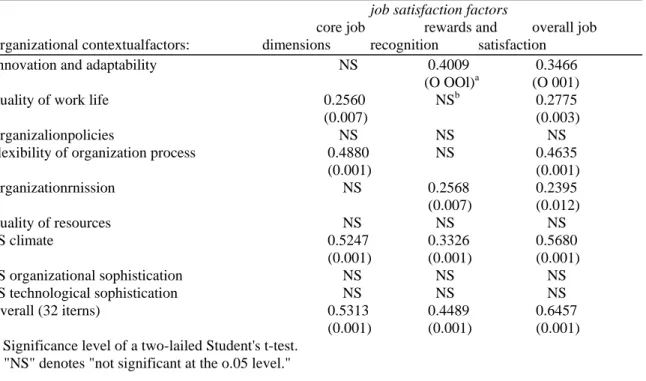
The correlations between job satisfaction factors and the organizational contextual factors are shown in Table 4. All significant correlations were found to be positive. While innovation and adaptability along with clarity and sharing of organizational mission related significantly to satisfaction with rewards and recognition, quality of work life and flexibility of organizational processes related significantly to satisfaction with core job dimensions. The only organizational factor that related significantly to both satisfaction factors was IS climate. These five organizational factors all related significantly to the overall job-satisfaction measure. The other four organizational contextual factors (namely, clarity and awareness of organizational policies, quality of resources, IS organizational sophistication, and IS technological sophistication) did not relate significantly to any job satisfaction factor, nor did they relate significantly to the overall measure of job satisfaction. In conclusion, the results of correlation analyses support the three sets of relationships posited in Figure 1.
Table 1 Factor Loadings and Communality Estimates for Organization-Wide Characteristics innovation adaptability QWL org. policies flex. of org. proc. org. mission quality of resources commu- nality
item description factor loadings
1 2 3 4 5 6
1. The organizational mission is clearly stated. 0.886 0.895 2. The organizational mission is shared throughout this organization. 0.722 0.817 3. The policies of the organization are clearly stated. 0.718 0.760 4. The policies of the organization are well known by each employee. 0.763 0.776 5. Your CEO is actively involved in the innovation process. 0.667 0.572 6. Innovation is highly encouraged in this organization. 0.788 0.837 7. Excessive rules and administrative details make it difficult for new and original
ideas to receive consideration. (R)
0.456 0.234
8. Productivity sometimes suffers from lack of organization and planning. (R) 0.483 0.307 9. The jobs in this organization are clearly defined and logically structured. 0.411 0.265 10. The organization is generally slow to respond to technological changes. (R) 0.480 0.452 11. The changes of technology are too fast to keep track of. (R) 0.521 0.381 12. The organization is generally quick to adopt improved work methods. 0.522 0.651 13. The organization is generally fast to adjust to new demands, conditions, or
circumstances.
0.599 0.445 0.684
14. The equipment and resources you-have to do your work with is adequate. 0.308 15. The equipment and resources you have to do your work with is well maintained. 0.647 16. The organization has a real interest in the welfare and happiness of those who
work here.
0.820 0.700 0.832
17. The organization tries to improve working conditions. 0.892 0.897 18. Work activities are sensibly organized in this organization. 0.531 19. The amount of information you get about what is going on in other departments
and shifts is adequate.
0.498 20. In this company, decisions are made at those levels where the most adequate and
accurate information is available.
0.453 0.638
21. When decisions are being made, the persons affected are being asked for their ideas.
0.488 0.459 0.714
22. People at all levels of a company usually have know-how that could be of use to decision makers. In this company, information is widely shared so that those who make decisions have access to all available know-how.
0.519 0.624
variance explained: 8.607 1.365 1.165 0.808 0.707 0.666 13.318
percent of variance: 39.123 6.205 5.295 3.673 3.214 3.027 60.536 (R) This scale was reversed before it was used for data analysis.
Table 2 Factor Loadings and Communality Estimates for Job Satisfaction
core job rewards &
dimensions recognition communality
item description factor loading
1 2
1. You are satisfied with your present position when you compare
it to other similar positions. 0.623 0.452
2. You are satisfied with the progress that you are making toward
the goals you set for yourself in your present position. 0.729 0.549
3. You are satisfied that the people of your community give proper
recognition for your work as a professional in your business. 0.618 0.431
4. You are satisfied with your present earnings. 0.546 0.410
5. You are satisfied with the amount of interest shown by the 0.586 0.359
community in your company.
6. You are satisfied with your present job when you consider the 0.710 0.646
expectations you had when you took the job.
7. You are satisfied with the work that you do as a professional 0.776 0.656
in your company.
8. You are satisfied with the level of challenge and 0.616 0.500
responsibility you are faced with in your present position.
variance explained: 3.434 0.569 4.003
Table 3 Correlations of Stress Factors with Organizational Contextual and Job Satisfaction Factors role ambiguity role conflict work overload job-induced anxiety overall work stress stress factors organizational contextual factors: innovation and adaptability -0.1934 (0.044)a -0.2081 NSb NS NS
quality of work life -0.2896 (0.002) -0.2681 (0.005) NS -0.2639 (0.006) -0.3329 (0.001) organizational policies NS NS NS NS NS flexibility of organization processes -0.4894 (0.001) -0.3610 (0.001) NS -0.2963 (0.002) -0.4550 (0.001) organizational mission -0.2911 - (0.002) -0.3884 (0.001) NS NS -0.3604 (0.001) quality of resources NS NS NS NS NS IS climate -0.6093 (0.001) -0.4593 (0.001) NS -0.2829 (0.003) -0.5494 (0.001) IS organizational sophistication -0.3266 (0.001) -0.2047 (0.034) NS NS -0.2669 (0.005) IS technological sophistication -0.2987 (0.002) NS NS NS -0.2099 (0.030) overall (32 items) -0.6518 (0.001) -0.5602 (0.001) NS -0.3397 (0.001) -0.6402 (0.001) job satisfaction factors:
core job dimensions -0.6398 (0.001) -0.3396 (0.001) NS -0.4219 (0.001) -0.5361 (0.001) rewards and recognition -0.2866 (0.003) -0.3091 (0.001) NS NS -0.3162 (0.001) overall (8 items) -0.6312 (0.001) -0.4111 (0.001) NS -0.3801 (0.001) -0.5657 (0.001) a. Significance level of a two-tailed Student's t-test.
Table 4 Correlations between Job Satisfaction and Organizational Contextual Factors
job satisfaction factors
core job rewards and overall job organizational contextualfactors: dimensions recognition satisfaction
innovation and adaptability NS 0.4009 0.3466
(O OOl)a (O 001)
quality of work life 0.2560 NSb 0.2775 (0.007) (0.003) organizalionpolicies NS NS NS flexibility of organization process 0.4880 NS 0.4635 (0.001) (0.001) organizationrnission NS 0.2568 0.2395 (0.007) (0.012) quality of resources NS NS NS IS climate 0.5247 0.3326 0.5680 (0.001) (0.001) (0.001) IS organizational sophistication NS NS NS IS technological sophistication NS NS NS overall (32 iterns) 0.5313 0.4489 0.6457 (0.001) (0.001) (0.001) a Significance level of a two-lailed Student's t-test.
b "NS" denotes "not significant at the o.05 level."
Path Analysis
The correlation analysis reported above describes the static relationships among the three sets of research variables. In order to better understand how the research variables interact with one another, ultimately to affect the IS managers' level of work stress, path analysis was conducted.
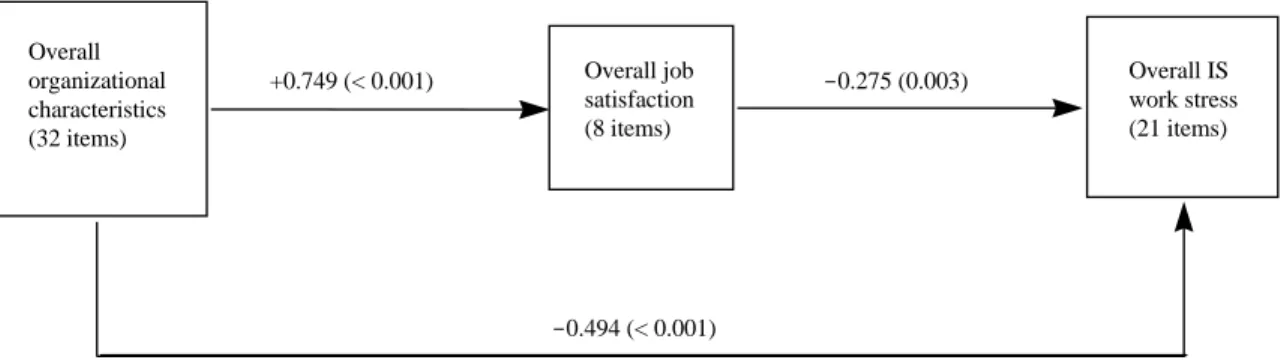
Based on the contingency model of this study, the overall measures of IS managers perceived organizational characteristics, job satisfaction, and work stress were path analyzed. The resulting path coefficients are shown in Figure 2. All coefficients were significant at the 0.01 level and the signs of each coefficient were consistent with the corresponding relationship posited previously in Figure 1.
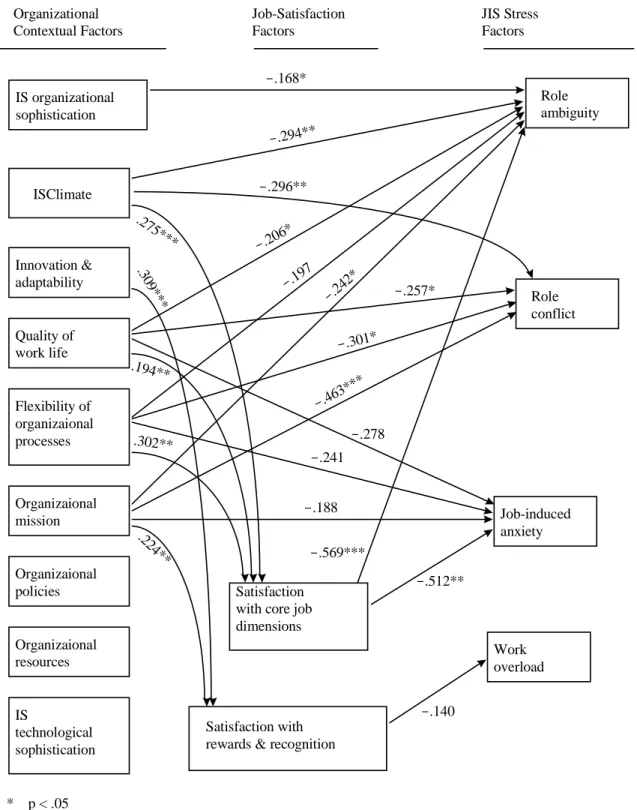
To further explore the effects among the individual factors of each scale, the overall path model in Figure 2 was expanded to a full path model consisting of nine organizational contextual factors, two job satisfaction factors, and four work stress factors. Sixty-two path coefficients were obtained through multiple regression analyses. According to the "theory trimming" process [4, 5, 28], any path having the absolute value of its path coefficient below 0.05 should be excluded from the full model and the remaining paths constitute a restricted path model. The coefficients of this restricted model should be recalculated and reexamined. This trimming and recalculation process should be applied to the subsequent restricted models until the absolute values of all the path coefficients in a model are above the 0.05 cutoff point. Following this practice, our full path model went through seven iterations of trimming and recalculation. The final restricted, detailed path model consisting of 20 paths is shown in Figure 3.
The final path model suggests that quality of work life, flexibility of organizational processes, and the clarity and sharing of organizational mission all have direct effects on perceived role ambiguity, role conflict, and job-induced anxiety. On the other hand, IS technological sophistication, clarity and awareness of organizational policies, and quality of resources do not affect any job satisfaction factor, nor do they affect any IS stress factor. While IS climate (measured by the user/Is-department relationship and organizational attitude toward the IS function) affects both role ambiguity and role conflict directly, IS organizational sophistication affects only role ambiguity directly. Moreover, IS climate, quality of work life, and flexibility of organizational processes affect directly perceived satisfaction with core job dimensions, and the latter in turn affects role ambiguity and job-induced anxiety directly. Innovation and adaptability as well as the clarity and sharing of organizational mission directly affects perceived
satisfaction with rewards and recognition, and the latter in turn directly affects perceived work overload. These results are consistent with those form correlation analyses.
Overall organizational characteristics (32 items) Overall job satisfaction (8 items) Overall IS work stress (21 items) +0.749 (< 0.001) -0.275 (0.003) -0.494 (< 0.001)
Figure 2. The Overall Path Model of Organizational Characteristics, Job Satisfaction, and Is Work Stress
Discussion and Implications
THE RESULTS OF THE STUDY DISCLOSE several important findings. These findings along with their implications are stated as follows:
Work overload, having the highest mean composite score (4.99) among the four stressors experienced by the Is managers, is not directly influenced by any organizational contextual factor. This finding is contrary to the common expectation that positive perceived organizational contextual factors such as good quality of work life, strong support for innovation and adaptability, and effective flexibility of organizational processes may reduce the degree of perceived work overload. This contradiction may be attributed to the nature of the work and the high degree of job mobility in the IS profession. Ivancevich, Napier, and Wetherbe [34] reported that the concern about work overload and not enough time to complete the work is quite common in the IS profession. Much of this time pressure and work overload is due to application backlog [50, pp. 5-6] and the underestimation of job completion time made by the IS managers [53] . To allay the problems, the former situation needs a more productive development technique (such as the use of prototyping [49, pp. 64 68] and automated tools [65, pp. 254-259]) while the latter requires a more effective and accurate time estimation technique. Moreover, the IS field encompasses a theoretical body of knowledge, professional associations, and some professional norms, and is recognized in the community as a viable specialty [3, p. 58]. It is this specialty that makes experienced IS professionals highly marketable. Therefore, in the IS profession, "job hopping" is almost a natural phenomenon [4, 52, 71]. Regardless of being managers or not, those who experience work overload and perceive it as an unbearable stress would more often than not leave their jobs for a lighter workload or a better rewards system elsewhere. This may explain why some organizations had high turnover rates of their IS personnel [52, 71]. In contrast, those who chose to stay with a company have most likely adapted to their work load and do not perceive it as a major stressor, or else they must have found an effective way to cope with the overwork strain. This reasoning was supported by our finding that the overall stress perceived by the IS managers declines as the number of years in the present job increases.
Role ambiguity, having the lowest mean composite score (2.87) among the four stressors perceived by the Is managers, is significantly influenced by many organizational contextual as well as job satisfaction factors. Ivancevich, Napier, and Wetherbe [34] had a similar finding that role ambiguity was not a major stressor perceived by the IS personnel; it was the fifth highest mean score among the seven stressor scales used in their study. The result of this study further suggests that the better the organizational contextual factors (such as IS climate, IS organizational sophistication, flexibility of organizational processes, clarity and sharing of organizational mission, and quality of work life) or the higher the degree of perceived satisfaction with core job dimension, the lower the degree of role ambiguity. The significant negative relationship between the flexibility of organizational processes and the degree of role ambiguity is quite unexpected. Most often one would think that role ambiguity would be more severe if the operating
procedures and policies of an organization keep changing, because it is vital for the organization to adapt to technological or operational changes. On the contrary, the result from this study suggests that in a dynamic environment, such as the IS environment, operating procedures and policies should be updated as soon as the environment is changed. Otherwise, IS managers' perception of organizational reality and their roles in coping with the ever-changing environment may be shattered, thereby increasing the role ambiguity perceived by the IS managers.
An organization having a pleasant IS climate (i.e., having a harmonious user/IS- department relationship and a positive organizational attitude toward the Is function) appears to yield a higher degree of perceived satisfaction with core job dimensions and lower degrees of perceived role ambiguity, role conflict, and job-induced anxiety. This finding provides empirical evidence supporting the concept of "friendly user MIS implementation" introduced by DeSanctis and Courtney [17] in that the relationship between users and the IS department as well as the organizational attitude toward the IS function are considered important to a successful IS implementation. Positive user/Is-department relationship and organizational attitude toward IS function may be established by applying such organizational development techniques as survey feedback, group diagnostic meetings, communication training, and laboratory training, among others. Most recently, Withington [71] indicated that, to ensure IS success, an organization should keep track of and publicize IS department successes in addition to having the IS personnel in close contact with users. Such actions manifest the hard work and valuable contribution of IS personnel and may temper the feelings of jealousy the non-IS employees often have toward them.
A good quality of work life and flexible organizational processes appear to increase perceived satisfaction with core job dimensions and reduce the stress generated by role ambiguity, role conflict, and job-induced anxiety. In this study, quality of work life is measured by the employee's welfare, working conditions, and participation in decision making. An organization should provide its employees with a good quality of work life through which the employees' sense of security and partnership are fostered. This in turn is likely to increase their perceived satisfaction with core job dimensions and reduce their overall work stress. Furthermore, keeping operating procedures and policies reasonable and adaptive to technological and operational changes seems to be an effective method to reduce IS work stress for an organization facing a fast-changing environment. Without such flexibility, an organization will lose its competitive edge and will constantly be striving for survival. Such organizations are likely to cut operating budgets, increase the work load, downgrade the rewards system, and overlook the quality of work life, all resulting in a stressful working environment.
A clearly stated and commonly shared organizational mission appears to increase perceived satisfaction with rewards and recognition and to reduce perceived role ambiguity, role conflict, job-induced anxiety, and work overload. Organizational mission is the foundation of organizational strategies. Based on organizational strategies, IS strategies are then formulated [42]. These strategies are further transformed into operating procedures and policies against which the performance of IS personnel is evaluated. Although an organization must constantly update its operating procedures and policies to keep pace with its dynamic and competitive environment, the clarity and sharing of organizational mission should not be overlooked. A clearly stated and commonly shared organizational mission is likely to result in up-to-date, realistic, and clear operating procedures and policies that enable the IS management effectively to evaluate the performance of their ~ personnel and the IS personnel to know exactly what is expected of them. This will increase their perceived satisfaction with rewards and recognition and, at the same time, reduce their perceived IS work stress.
The higher the level of perceived satisfaction with rewards and recognition, the lower the degree of perceived work overload. Our data indicate that those managers who are satisfied with the rewards and recognition given by the company appear to perceive less work overload than those who are not satisfied. This implies that proper rewards and recognition may significantly reduce perceived work overload and, in turn, may decrease the turnover of IS personnel. This implication is similar to a conclusion reported in the literature that proper rewards lead to increased job satisfaction [41] and decreased turn over of IS personnel [4].
* p < .05 ** p < .01 ***p < .001 Organizational Contextual Factors Job-Satisfaction Factors JIS Stress Factors IS organizational sophistication ISClimate Innovation & adaptability Quality of work life Flexibility of organizaional processes Organizaional mission Organizaional policies Organizaional resources IS technological sophistication Role conflict Role ambiguity Job-induced anxiety Work overload Satisfaction with rewards & recognition
Satisfaction with core job dimensions .2 24 ** .302** .194** .3 09 *** .27 5*** -.294** -.168* -.296** -.301* -.197 -.241 -.257* -.206* -.278 -.242 * -.463* ** -.188 -.569*** -.512** -.140
Figure 3. The Final Detailed Path Model of Organizational Characteristics
Strong support for innovation and adaptability appears to increase significantly perceived satisfaction with rewards and recognition and reduce perceived work overload. Most IS managers were trained to introduce technical changes that bring about necessary system-wide changes in the organization as a whole. Being in an innovative role that usually requires long hours [57], IS managers are likely to perceive work overload unless they have been adequately rewarded and recognized. Regardless of theworkload they are bearing, IS managers must innovate through IS projects. To these managers, the success of their IS projects is another form of reward and recognition. Undoubtedly, these successes depend upon the support of the top management and the users. If the support of top management or the users is lacking, the IS project is doomed to fail.
The level of IS technological sophistication appears to affect neither the job satisfaction nor the work stress factors perceived by Is managers, yet the level of Is organizational sophistication appears slightly to affect perceived role ambiguity. This finding is somewhat different from a recent study by Cheney and Dickson [11], which focused on IS users. They reported that user's job satisfaction along with user's information satisfaction and system utility appears to be impacted significantly and positively by the level of IS organizational sophistication but not by the level of technological sophistication. The result reconfirms that IS technological sophistication is not an important factor determining the level of IS job satisfaction and work stress. Furthermore, it suggests that IS organizational sophistication benefits only the job satisfaction of IS users rather than IS managers. This implies that an unbalanced psychological and physiological strain almost always exists among IS personnel. While IS users can gain more job satisfaction through the improvement of IS organizational sophistication, IS personnel can gain nothing but a slight reduction in their role ambiguity with little, if any, increase in their job satisfaction. In fact, an improvement of IS organizational sophistication will typically uncover another area yet to be improved, and thus may increase application backlog and exacerbate IS work stress. Companies having high levels of IS organizational sophistication should therefore more closely monitor the job satisfaction and work stress perceived by their IS personnel.
Conclusion
THE REQUIREMENT FOR ADAPTATION in the ever-changing IS environment creates a significant challenge to organizations in general and to IS managers in particular. This study investigated the relationship between organizational characteristics, job satisfaction, and work stress as perceived by IS managers. The results suggest that organizational characteristics and job satisfaction have significant negative effects on the IS managers' work stress and that organizational characteristics, on the other hand, have significant positive effects on IS managers' job satisfaction. Therefore, the three major hypotheses in this study were all supported by the results.
Several general conclusions can be further drawn. First, not all factors of perceived organizational characteristics and job satisfaction have impacts on IS managers' work stress. Second, IS climate, the quality of work life, the flexibility of organizational processes, and the clarity and sharing of organizational mission are the four most influential factors on IS job satisfaction and work stress. Third, most organizational contextual factors (except the clarity and awareness of organizational policies, the quality of resources, and IS technological sophistication) have significant impacts on the IS managers' job satisfaction as well as on their work stress. Fourth, those IS managers who perceive higher job satisfaction appear to perceive less IS work stress. Fifth, the longer that IS personnel stay in their present jobs, the lower the degree of their perceived role ambiguity and overall work stress. Finally, positive organizational characteristics (either organization-wide or Is-related) appear to reduce significantly IS managers' work stress either directly or indirectly through their perceived job satisfaction.
Several implications for IS managers emerge from this study. Work overload is common in the IS profession. One should find an effective way to cope with it. Some plausible approaches include: (1) using a more productive development technique to reduce application backlog; (2) producing more accurate estimates of job completion time in the project schedule; (3) providing strong support for innovation; and (4) providing an adequate reward system. Moreover, organizational characteristics in general are the sources of IS work stress and job satisfaction. One should maintain a pleasant user/IS relationship, a positive organizational attitude toward IS, and a good quality of work life for the IS personnel. In addition, an organization's environment is usually dynamic and competitive; one should keep the organizational processes flexible and make sure that the organizational mission is clearly stated and commonly shared. The IS managers should closely link their IS functions with the organizational mission and processes.
As our society becomes more of an "information society," the role of the IS manager is likely to increase in its significance. Understanding the characteristics of the IS department and its potential impact on both organizational members and other organizational functions, in addition to learning more about the role that stress dynamics plays in IS managers' behavior, is likely to result in a more optimal utilization of IS resources. This study provides a preliminary inquiry into the potential effects of organizational
characteristics and job satisfaction on IS managers' work stress. Further research is needed to investigate the potential causality among the organizational characteristics, the stressors, and the IS managers' coping mechanisms and their effects on organizational effectiveness.
ACKNOWLEDGMENTS
This project was supported in part by a grant from the RGK Foundation, Austin, Texas; the support is greatly appreciated. The authors acknowledge the helpful comments of the anonymous referees on earlier versions of this article.
REFERENCES
1. Bailey, J. E., and Pearson, S. W. Development of a tool for measuring and analyzing computer user satisfaction. Management Science, 29, 6 (May 1983), 519-529.
2. Bartlett, M. S. Tests of significance of factor analysis. British Journal of Psychology (Statistical Section J, 3, 77 (1950), 77-85.
3. Bartol, K. M. Individual versus organizational predictors of job satisfaction and turn- over among professionals. Journal of Vocational Behavior, 15 (1979), 55-67.
4. Bartol, K. M. Turnover among DP personnel: a causal analysis. Communications of the ACM, 26, 10 (October 1983), 807-81 1 .
5. Billings, R. S., and Wroten, S. P. Use of path analysis in industrial organizational psychology: criticisms and suggestions. Journal of Applied Psychology, 63, 6 (1978), 677-688.
6. Bleicher, K.; Bleicher, F.; and Herbert, P. Managerial frameworks for innovative responses in high-tech organizations. Business Horizons (November/December 1983 ), 69-78 .
7. Burke, R. J. Burnout in police work. Group and Organization Studies, 12, 2 (June 1987),174-188. 8. Caplan, R. D., and Jones, K. W. Effects of work load, role ambiguity, and type A personality on anxiety, depression, and heart rate. Journal of Applied Psychology, 60, 6 (December 1975), 713-719.
9. Caplan, R. D.; Cobb, S.; French, Jr., J. R. P.; Van Harrison, R.; and Pinneau, Jr., S. R. Job Demands and Worker Health. Washington, DC: U.S. Government Printing Office, 1975.
10. Carmines, E. G., and Zeller, R. A. Reliability and Validity Assessment. Beverly Hills, CA: Sage, 1979.
11. Cheney, P. H., and Dickson, G. W. Organizational characteristics and information systems: an exploratory investigation. Academy of Management Journal, 25,1 (March 1982), 170-184.
12. Cheney, P. H., and Scarpello, V. Job satisfaction and IS research. Journal of Management Information Systems (Winter 1985/86), 21-36.
13. Cohen, S. After-effects of stress on human performance and social behavior: a review of research and theory. Psychological Bulletin, 88 (1980), 82-108.
14. Couger, J. D., and Zawacki, R. A. Motivating and Managing Computer Personnel. New York: John Wiley and Sons, 1980.
15. Cronbach, L. J. Coefficient alpha and the internal structure of tests. Psychometrika, 16 (1951), 297-334.
16. Dansker, B.; Hansen, J. S.; Loftin, R. D.; and Veldwisch, M. A. Issues management in the information planning process. MIS Quarterly, 11, 2 (June 1987), 223-230.
17. DeSanctis, G., and Courtney, J. F. Toward friendly user MIS implementation. Communications of the ACM, 26, 10 (October 1983), 732-738.
18. Eberhardt, B. J., and Eberhardt, M. L Perceptions of and responses to role stress: male-female similarities and differences. Paper presented at the National Academy of Management, Boston, MA, 1984.
19. Etzioni, A., and Jargovsky, P. High tech, basic industry and the future of the American economy. Human Resource Management, 23 (1984), 229-240.
20. French, Jr., J. R. P., and Caplan, R. D. Psychosocial factors in coronary heart disease. Industrial Medicine and Surgery, 39, 9 (September 1970), 383-393.
21. Galbraith, J. Organization Design. Reading, MA: Addison-Wesley, 1977.
22. Goldstein, D. K., and Rockart, J. F. An examination of work-related correlates of job satisfaction in programmer/analysts. MIS Quarterly, 8, 2 (June 1984), 103-115.
23. Goldstein, D. K. The effects of task differences on the work satisfaction, job characteristics, and role perceptions of programmer/analysts. Journal of Management Information Systems, 6, 1 (Summer 1989), 41-58.
24. Greer, C. R., and Castro, M. D. The relationship between perceived unit effectiveness and occupational stress: the case of purchasing agents. The Journal of Applied Behavioral Science, 22, 2 (1986),159-175.
25. Hackman, J. R., and Oldham, G. R. Work Redesign. Reading, MA: Addison-Wesley, 1980.
26. Hair, Jr., J. F.; Anderson, R. E.; and Tatham, R. L. Multivariate Data Analysis with Readings, second edition. New York: Macmillan, 1987.
27. Hanna, D. A. Designing Organizations for High Performance. Reading, MA: Addison-Wesley, 1988. 28. Heise, D. R. Problems in path analysis and causal inference. In Borgatta, E.F., and Bohrnstedt, G.W. (eds.), Sociological Methodology. San Francisco: Jossey-Bass, 1969, 38-73.
29. House, R. J., and Rizzo, J. R. Role conflict and ambiguity as critical variables in a model of organizational behavior. Organizational Behavior and Human Performance, 7 (1972), 467-505.
30. Hoy, F. Small Business Survey Questionnaire. Athens, GA: Small Business Development Center Publications, The University of Georgia, 1983.
31. Iaffaldano, M. T., and Muchinsky, P. M. Job satisfaction and job performance: a meta-analysis. Psychological Bulletin, 97 (1985), 251-273.
32. Ivancevich, J. M., and Matteson, M. T. Nurses and stress. Supervisor Nurse ( 1980) 17-22.
33. Ivancevich, J. M.; Matteson, M. T.; and Preston, C. Occupational stress, type A behavior, and physical well being. Academy of Management Journal, 25 (1982), 237-253.
34. Ivancevich, J. M.; Napier, A. H.; and Wetherbe, J. C. Occupational stress, attitudes and health problems in the information systems professional. Communications of the ACM, 26, 10 (October 1983), 800-806.
35. Jamal, M. Job stress and job performance controversy: an empirical assessment. Organizational Behavior and Human Performance, 33 ( 1984), 1-27.
36. Kahn, R. L. Work and Health. New York: John Wiley and Sons, 1981.
37. Kahn, R. L.; Wolfe, D. M.; Quinn, R. P.; Snoek, J. D.; and Rosenthal, R. A. Organizational Stress: Studies in Role Conflict and Ambiguity. New York: John Wiley and Sons, 1964.
38. Kaiser, H. F. The application of electronic computers to factor analysis. Symposium on the Application of Computers to Psychological Problems, American Psychological Association, 1959.
39. Kanter, R. M., and Buck, J. D. Reorganizing part of Honeywell: from strategy to structure. Organizational Dynamics (Winter 1985), 4-25.
40. Kerlinger, F. N. Foundations of Behavioral Research, second edition. New York: Holt, Rinehart and Winston, 1973.
41. Kerr, S.; Von Glinow, M. A.; and Schriesheim, J. Issues in the study of "professionals" in organizations: the case of scientists and engineers. Organizational Behavior and Human Performance, 18 (1977), 329-345.
42. King, W. R. Strategic planning for management information systems. MIS Quarterly, 2,1 (March 1978), 27-37.
43. Kroes, W. H.; Hurrell, J.; and Margolis, B. L. Job stress in police administrators. Journal of Police Science and Administration, 2 (1974), 145-155.
44. Landy, F. J., and Trumbo, D. A. Psychology of Work Behavior. Homewood, IL: Dorsey Press, 1980. 45. Litwin, G. H., and Stringer, Jr., R. A. Motivation and Organizational Climate. Boston: Division of Research, Graduate School of Business Administration, Harvard University, 1968.
46. Locke, E. A. The nature and causes of job satisfaction. In Dunnette, MD (ed.), Hand-book of Industrial and Organizational Psychology. New York: John Wiley and Sons, 1983, 1297-1349.
47. Maidique, M. A., and Hays, R. M. The art of high-technology management. Sloan Management Review, 25 (Winter 1984), 18-31.
48. Margolis, B. L.; Kroes, W. H.; and Quinn, R. P. Job stress: an unlisted occupational hazard. Journal of Occupational Medicine, 16,10 (October 1974), 659-661.
49. Martin, J. Application Development without Programmers. Englewood Cliffs, NJ: Prentice-Hall, 1982.
50. Martin, J. An Information Systems Manifesto. Englewood Cliffs, NJ: Prentice-Hall, 1984
51. McFarlan, F. W. Information technology changes the way you compete. Harvard Business Review (May/June 1984), 98-103.
53. Mumford, E. Job Satisfaction. London: Longman, 1972.
54. Nicholson, P. J., and Goh, S. C. The relationship of organizational structure and interpersonal attitudes to role conflict and ambiguity in different work environments. Academy of Management Journal, 26, 1(1983), 148-155.
55. Nunnally, J. C. Psychometric Theory, second edition. New York: McGraw-Hill, 1978.
56. Pasmore, W. A. Using Sociotechnical Systems to Design Effective Organizations. New York: John Wiley and Sons, 1988.
57. Pinchot, G. Intrapreneuring. New York: Holt, Rinehart and Winston, 1985.
58. Porter, L. W., and Lawler, E. E. Behavior in Organizations. New York: McGraw-Hill, 1975.
59. Rizzo, J. R.; House, R. M.; and Lirtzman, S. I. Role conflict and ambiguity in complex organizations. Administrative Science Quarterly, 15, 4 (December 1970), 150-163.
60. Rockart, J. F., and Scott Morton, M. S. Implications of changes in information technology for corporate strategy. Interfaces, 14,1 (January/February 1984), 84-95.
61. Roger, F. M., and Larsen, J. K. Silicon Valley Fever. New York: Basic Books, 1984.
62. Rogers, R. E. Perceptions of stress among Canadian and American managers: a cross-cultural analysis. In Selye, H. (ed.), Stress Research, vol. II New York: Van Nostrand Reinhold, 1983, 107-117.
63. Rogers, R. E.; Li, E. Y.; and Shani, A. B. Perceptions of organizational stress among U.S. military officers in Germany: an exploratory study. Group and Organization Studies, 2 (June 1987), 189-207.
64. Russek, H. I., and Zohman, B. L. Relative significance of hereditary diet and occupational stress in coronary heart disease of young adults. American Journal of Medical Science, 235, 3 (March 1958), 266-275.
65. Senn,J.A .Analysis and Design of Information Systems.NewYork:McGraw-Hill,1989.
66. Shirom, A.; Eden, D.; Silberwasser, S.; and Kellermann, J. J. Job stresses and risk factors in coronary heart disease among five occupational categories in kibbutzim. Social Science and Medicine, 7 (1973), 585-603.
67. Smith, P. C.; Kendall, L. M.; and Hulin, C. C. The Measurement of Satisfaction in Work and Retirement. Chicago: Rand McNally, 1969.
68. Taylor, J. C., and Bowers, D. G. Survey of Organizations. Ann Arbor, MI: CRUSK, University of Michigan, 1972.
69. Theorell, T. Selected illnesses somatic factors in relation to two psychosocial stress indices: a prospective study on middle-aged construction building workers. Journal of Psycho-somatic Research, 20 (1976), 7-20.
70. Weiss, M. Effects of work stress and social support on information systems managers.MIS Quarterly, 7, 1 (March 1983), 29-43.
71. Withington, F. G. Managing your IS pros. Datamation (October 15, 1987), 72-81.
72. Zuboff, S. Automate/informate: the two faces of intelligent technology. Organizational Dynamics (Autumn 1985), 4-18.
APPENDIX: Questionnaire Items of Is-Related Characteristics and IS Work Stress* IS-Related Characteristics
IS climate:
1. The manner and methods of interaction, conduct, and association between the user and the IS staff are adequate.
2. The contention between the IS unit and the non-IS units competing for organizational resources or responsibility for success or failure of computer-based information systems or services of interest to both parties is logically resolved.
3. The Is users usually have feelings of assurance or certainty about the systems provided.
4. The IS staff are willing and committed to subjugate external, professional goals in favor of organizationally directed goals and tasks.
5. Upper management usually has a positive degree of internal enthusiasm, support, or participation toward computer-based information systems or services or toward the computer staff that supports them. 6. The manner and methods of information exchange between the user and the IS staff are effective. 7. The hierarchical relationship of the IS function to the overall organizational structure is adequate.
8. The IS users are willing and committed to achieve organizational goals by utilizing the information system capability.
IS sophistication:
9. The status that best characterizes your current IS group's organizational sophistication is:** (1) Definitely in phase I. (5) Definitely in phase III.
(2) Between phase I and phase II. (6) Between phase m and phase IV. (3) Definitely in phase II. (7) Definitely in phase IV.
(4) Between phase II and phase III.
10. The status that best characterizes your current IS group's technological sophistication is:** (1) Definitely in phase I. (5) Definitely in phase III.
(2) Between phase I and phase II. (6) Between phase III and phase IV. (3) Definitely in phase II. (7) Definitely in phase IV.
(4) Between phase II and phase III.
IS Work Stress:
role ambiguity:
1. I have clear, planned goals and objectives for my job. (R) 2. I know that I have divided my time properly. (R)
3. I know what my responsibilities are. (R) 4. I know exactly what is expected of me. (R)
5. I feel certain about how much authority I have on the job. (R) 6. Explanation is clear of what has to be done. (R)
role conflict:
7. I have to do things that should be done differently under different conditions. 8. I receive an assignment without the manpower to complete it.
9. I have an assignment without the manpower to carry out an assignment. 10. I work with two or more groups who operate quite differently. 11. I receive incompatible requests from two or more people.
12. I do things that are apt to be accepted by one person and not by others. 13. I receive an assignment without adequate resources and materials to execute it. 14. I work on unnecessary things.
work overload:
15. How often does your job require you to work very hard physically or mentally?** * 16. How often does your job leave you with little time to get everything done?*** 17. How often do you notice a marked increase in your work load ?***
job-induced anxiety:
18. I feel fidgety or nervous because of my job.
19. Problems associated with work have kept me awake at night.
20. I have experienced physical health-related problems as a result of my job. 21. I have difficulty relaxing at the end of the day.
* Most items, except those specified otherwise, are measured on 7-point Likert-type scale having 1 = strongly disagree, 3 = slightly disagree, 5 = slightly agree, and 7 = strongly agree.
** The characteristics of each of the five phases can be found in Cheney and Dickson [1982].
***This item is measured on 7-point Likert-type scale having 1 = never, 2 = very seldom, 3 = once in a while, 4 = occasionally, 5 = fairly often, 6 = very often, and 7 = always.