A Sequential Three-Stage Integer Goal Programming (IGP) Model
for Faculty-Course-Time-Classroom Assignments
Raed Al-Husain, Mohamad K. Hasan and Hameed Al-Qaheri*
Department of Quantitative Methods and Information Systems College of Business Administration, Kuwait University, Kuwait E-mail: [email protected], [email protected], [email protected]
Keywords:integer goal programming, timetabling, university scheduling problem
Received:March 19, 2010
Developing university schedules that could take into account factors such as faculties’ preferences to courses, timeslots, and classrooms, in a timely fashion while being unbiased and meeting university requirements, is a hurdle in many universities around the world.This paper exploits the use of three-stage integer goal programming (IGP) technique to solve the university scheduling problem, as an expansion of an earlier two-stage model attempt conducted by the authors. Segmenting the problem into three stages enabled reaching a complete schedule in a timely manner and a high satisfactory level among faculties, while meeting all university requirements. The output of every stage is used as an input to the following stage, and goals are satisfied using the priority sequence approach according to their order of importance based on some college, department, and major regulations and requirements. Povzetek: Z novo metodo IGP naredijo univerzitetni urnik.
*Corresponding Author
1
Introduction
The utilization of optimization techniques to ensure more efficient and effective operational workflow has long been a major factor in the success of organizations in different industries; hence the need for such techniques in the educational sector is no exception. Scheduling problems in universities, such as offering required courses at the same time on the same day, assigning the wrong class size to the wrong classroom, inevitable biased faculty-course assignment, and relatively long time to complete the schedule have all been problematic issues associated with using manual and judgmental approaches when developing course schedules. This paper exploits the use of three-stage integer goal programming (IGP) technique to solve the university scheduling problem, as an expansion of an earlier two-stage model attempt conducted by the authors [12]. The three-stage model is developed and solved in a sequential order, where faculties assigned to courses, courses assigned to different time slots, and then time slots assigned to classrooms respectively. In our approach, each stage is optimally solved such that the outputs of each stage are fed as inputs to the following stage. In every stage, university, college, and departments regulations are considered as a set of goals to be achieved along with faculties’ preferences. The model has been tested at the College of Business Administration in Kuwait University using Excel Premium Solver.
The rest of the paper is organized as follows: Section 2 present a selective review of literature, Section
3 covers the Three-Stage integer goal programming(IGP) model formulation, Section 4 cover the experimentation and discusses the results of the three stages follow by an overall analysis and assessment of the three stage model in section, conclusion and future research are discussed in Section 6.
2
Review of literature
The idea of developing sophisticated models to solve the university scheduling problem has been around since the early 70s [14] [11]. The techniques used range from the utilization of optimization models to complex heuristics models. Some models solved the problem of faculties’ assignment to courses only [23] [6]. Other models took into consideration the time slot factors as well [10] [6][7][15][17] and some models took into account faculty-time-classroom assignment [13][1][2].
Most of the work mentioned used the approach of decomposing the problem into distinct and interrelated stages versus the approach of solving the problem as a complex single stage model. Using such approach has the advantage of significantly reducing computation time while finding a relatively satisfying solution.
is to reach a relatively close to optimality solution in relatively reasonable time [13][16] [8] [3][9].
More recently, the use of variable neighbourhood search (VNS) approaches for the university examination timetabling problem has been investigated. The technique has proven to produce high quality solution across a wide range of problems, but with relatively large amount of computational time [18]. Another heuristic approach that has been utilization in the College of Engineering at Virginia Tech is the use of Benders' partitioning. An improved quality course schedules, in terms of the total distance travelled by the faculty members from their offices to the classrooms where the courses are offered, has been obtained [19]. Moreover, the use of genetic algorithm meta-heuristic has been another heuristic approach to the university timetabling problem. The approach considers timetable in a bottom-up fashion at the various levels of department, faculty or entire university, which is claimed to be the first application of meta-heuristics to a timetabling problem [20]. Hyper-heuristics method has also been utilized in solving the university timetabling problem. Burke used a novel direction in hype-heuristics, unified graph-based hyper-heuristic (GHH) framework, under which a number of local search-based algorithms are studied to search upon sequences of low-level graph colouring heuristics [21]. More complicated approaches has also been utilized by using a multi-objective evolutionary algorithm that uses a variable-length chromosome
representation and incorporates a micro-genetic
algorithm and a hill-climber for local exploitation and a goal-based Pareto ranking scheme for assigning the relative strength of solutions [22].
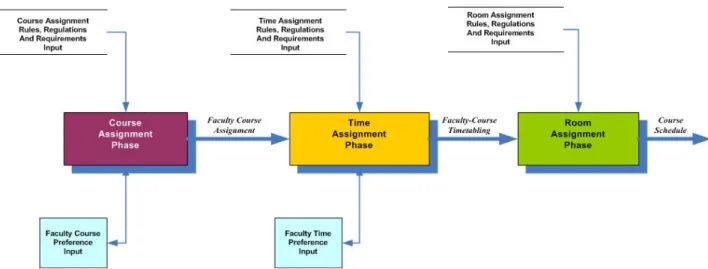
The aim of this paper is to solve the university scheduling problem by extending the work of Badri [6] by using a three-stage (sequential) integer goal programming (IGP) model with different university, college, department and major rules and regulations as shown in Figure 1. Introducing goal programming technique into every stage has enabled the fulfilment of many rules and regulations. The use of integer goal programming technique in developing a comprehensive schedule at the College of Business Administration in
Kuwait University has proven to outperform manual approaches that had been adopted. Results have proven to be both efficient and effective. Resources are optimally utilized, faculties are fairly satisfied, and students are efficiently progressed in a timely manner through their graduation requirements.
The work of this paper represents an extension of an earlier study conducted by the authors [12]. The major difference of this study and that of Badri’s [6][7] and Hasan’s[12] is the inclusion of the classroom availability regulations to the model. Hence, a complete schedule that could take into account faculty preferences to courses and timeslots, and classroom availability regulations of the college can be developed.
3
A sequential three-stage integer
goal programming (IGP) model
formulation
The approach that has be followed to solve the university scheduling problem is through segmenting the problem into three distinct yet interrelated stages, the faculty-course assignment stage, the faculty-courses-timeslot assignment stage, and then the timeslot-room assignment stage. The inputs of every stage is translated into goals and solved according to their order of importance, where goals are given priorities according to their order of importance. The output of every stage, which represents an optimal assignment, is then fed to the next stage to act as an input. This process continues until the final stage is solved and a complete scheduled is created. Figure 1 shows the schematic diagram of the entire modelling process for solving the university scheduling problem.
A detailed description of the three-stage integer goal linear programming (IGP) model that is applied to solve the university scheduling problem is discussed next. See Hasan. et al[12] for a full description of the two-stage integer goal programming model.
3.1
Stage I: faculty-course assignment
integer goal programming (IGP) model
formulation
3.1.1
Stage I model notations:
:
i Faculty member
:
j Courses number
:
i
L Maximum number course loads for faculty
i
:
j
N Number of sections offered for course
j
:
ij
X Number of sections for course
j
that will beassigned to faculty member
i
:
ij
R The preference for faculty member
i
to teachcourse
j
, whereRij= {0, 1, 2, 3, 4, 5} such that the value of 5 represents is a very favourable course, and 0 not desired at all.4
Stage I model goals and
constraints
In this section we formulate the integer goal programming (IGP) model of stage I that represents the rules and regulations of Kuwait University, College of Business Administration, and the requirements of the Department of Quantitative Methods for assigning courses to faculty.
Stage I IGP model:
Satisfying goals with their priorities and the other requirements, Stage I GLP model can be written as following:
Stage I IGP Model has five goals and one hard constraint and are described as follows:
Goal 1:
Each faculty member i should take exactly his
maximum course loads Li. This goal has a priorityP1
and the objective is to minimize both of
d
1i andd
1i
i
.Goal 2:
The number of course sections Nj for course j should
all be covered by faculty members. This goal has a
priorityP1and the objective is to minimize both of
j
d
2 andd
2j j.Goal 3:
Each faculty member should take at least one of the College Level Courses (CLC) course section. This goal is a department level requirement and is given a priority levelP2 and the objective is to minimize d3i i.
Goal 4:
Each faculty member should take at least one of the Major Level Courses (MLC) section. This goal represents another department level requirement and is
)]
(
)
(
[
w
2 2 2 3 3 4 4 5
1 1 1 m
1 i 1
m ii i m
i i m
i j
j n
j i
i
d
d
d
P
d
P
d
P
d
d
P
Minimize
Subject to:
m
i
L
d
d
X
ij i i in j
,...,
2
,
1
1 1
1
n j
N d d
Xij j j j
m i
,..., 2 , 1
2 2 1
m i
d d Xij i i
n CLC j
,..., 2 , 1 1
3
3
m i
d d Xij i i n
MLC j
,..., 2 , 1 1
4
4
m i
L d d X
R ij i i i
n j
ij 5 5 5 1,2,...,
n
j
m
i
R
X
ij ij,
1
,
2
,...,
and
1
,
2
,...,
Otherwise
2
0
if
0
0
,
,
,
,
,
,
,
,
,
,
1 2 2 3 3 4 4 5 51
i i i i i i j j i
i
d
d
d
d
d
d
d
d
d
d
for
i
1
,
2
,...,
m
and
j
1
,
2
,....,
n
given a priority levelP3 and the objective is to minimize
i
d4 i.
Goal 5:
Maximize the total preference for each faculty member
i
that has a course loads
L
i. This goal has a priorityP4and the objective is to minimize d5i i.
Hard Constraints:
Finally we have one more hard constrain that does not
allow any faculty member
i
to take more than twosections for the same course
j
. This constraint is represented by the following formula:n j
,...,m , i
Xij 2 12 and 1,2,...,
4.1
Stage II: faculty-course-time
assignment integer goal programming
model formulation
4.1.1
Stage II model notations:
} ...., 3 , 2 , 1 { where , faculty to assigned that course for number section : K k i j k ij ij :
d Days of the week, where d {1, 2}
} ,
, {
1 Sunday Tuesday Thuresday that
such
} ,
{
2 Monday Wednesday and
:
p Period of the day, where
p
{
m
,
a
}
time time afternoon a and morning m that such p d
tdp:Timeslot number in aday andperiod
, where tdp {1, 2,...}
Otherwise 0 sec if 1 p period in d day of t slot time during k tion j course to assigned i faculty
Xijkijtdp ij
:
dp
t
O Number of rooms available at time slot number
tdp
4.1.2
Stage II model goals and constraints:
In this section we formulate the goal programming model that represents the rules and regulation of Kuwait
University, College of Business Administration
requirements for assigning time slots to Faculty-Course assignment resulting from stage I.
Stage II IGP model:
Satisfying the goals with their priorities and the other requirements, the second stage IGP can be written as follows: ) ( ) ( ) (
1
1 2
2 3
2 4 4 5 5 6 6 7 7
8i i j t jt j t jt t
t P d P d Pd Pd P d d P d
d P Minimize da da dm dm dp dp Subject to:
i j k dp t t t t k j i ij dp dp dp dpij
d
d
O
t
X
1 1
i k dm jt jt t k j i ij dm dm dmij d d j CLC t
X 2 2 2 and
i k da jt jt t k j i ij da da daij d d j CLC t
X 3 3 1 and
i jMLC t i jULC t t ijk k t k j i
k dm da
da ij ij dm ij ij d d X
X 4 4 4 0
i j k t i j k t
t k j i t k j i
ij p ij p
p ij p
ij X d d
X
1 2
2
1 1.5( ) 5 5 0
0 )
( 3 .
2 7 7
2 2 2 2
X X d di j k
t k j i t i j k
t k j i t ij a ij a ij m ij m number e l a is M that such i M d d X R j k i i t k j i t t k j i ij dp ij dp dp
ij 8 8 , arg
dp j k t k ji i I t
X
ij
dp
ij
1 ,dp i j MLC
t j
i t
X
dp
1 1 0 ) ( 3 .2 6 6
1 1 1 1
X X d di j k
t k j i t i j k
ij t
t k j
i i j k
X
dp
dp
ij 1 , ,
0 ' all and binary, are
allX ds
dp ijt
ijk
Stage II IGP Modelhas seven goals and three hard constraints and are described as follows:
Goal 1:
Total number of courses assigned in a specific time slot
cannot exceed the number of rooms available for that time slot. This goal has a priorityP1 and the objective is
to minimize
d
tdp
t
dp 1 .
Goal 2:
This goal eliminates timing conflict of courses that can be taken at the same time for similar CLC. Total number of similar CLC assigned during a specific time slot in morning-time cannot exceed 2 sections for the same course. This goal has a priorityP2 and the objective is to
minimized jt j CLC tdm
dm and
2
.
Goal 3:
Total number of similar CLC assigned during a specific time slot in afternoon-time cannot exceed 1 section for the same course. This goal has a priorityP3 and the
objective is to minimize
d
jtj
CLC
t
dada
and
3
.
Goal 4:
Reduce the gaps between MLC. The MLC should be 4 times more condensed during the morning-time than they are during the afternoon-time, where 4 is just any number that the department wishes to choose. This goal has a
priorityP4 and the objective is to minimize
d
4 .Goal 5:
This is more like a guideline, where 60% of courses should preferably be offered during the odd days and 40% during the even days. This goal has a priorityP5
and the objective is to minimize
d
5 .Goal 6:
This is more like a guideline, where 70% of courses should preferably be offered during the morning-time and 30% during the afternoon-time. These goals have a
priorityP6 and the objective is to minimize
d
6,d
7Goal 7:
This goal maximizes the faculty preferences on their class times. This goal has a priorityP7 and the objective
is to minimize
d
8i
i
Hard Constrains:
1. Sum of sections taught for every faculty in every specific time slot must be at most equal to 1.
dp j k
t k j
i i I t
X
ij
dp
ij
1 ,2. Sum of MLC offered during a specific time slot during same day must equal at most 1.
dp i j MLC
t j
i t
X
dp
1
1
3. Sum of time slots for each section for every faculty, every course, and every section must equal 1.
ij t
t k j
i i j k
X
dp
dp
ij 1 , ,
4.2
Stage III: room assignment integer
goal programming model formulation
4.2.1
Stage III model notations:
:
L Floor Level, where
L
1
,
2
,
3
:C Room size category, where
C
1
,
2
,
3
,
4
C rLC
category
size and L level floor in number room
:
101,...,112,201,...,214,301,...,318
LC
r where
} 3 , 2 , 1 { where location,
level floor the based number department
:
L L
D D
:
LC
p Room level location preference, where
2,4,5
LC
p such that 2 is the least preferred room
level location, and 5 is highly preferred room level location for a course to be placed.
4.2.2
Stage III model goals and constraints:
Stage III IGP model:
d Minimize
Subject to:
LC
LC dp c ij c LC r
r t k ij r
i j k t
M
d
d
X
p
c LC
LC dp c ij
c dp ij
r
r t k ij L C
k i t
X 1 , ,
LC dp
i
r t k
ij t LC r
X
LC dp c ij
c 1 , , ,
0 ' all and binary, are
allX dpLC ds
c ij ck t r
ij
Stage III IGP Model has one goal and two hard constraints and are described as follows:
Goal 1:
enough sum-product of the decision variable
LC dp c ij ck t r
ij
X ,
the assignment of faculty
i
to coursej
c of size categoryC section
c
ij
k in time period tdp to a room locationrLC,
with the location preference
LC
r
p and M is a large
number. The objective is to minimize the under
deviation, d of the sum-product.
Hard Constraints
1. Each section of a course that has been assigned a
specific faculty and time should be located in one room only.
c LC
LC dp c ij
c dp ij
r
r t k ij L C
k i t
X 1 ,,
2. Each room is assigned to at most one faculty in a
specific time period.
LC dp
i
r t k
ij t LC r
X
LC dp c ij
c 1 , , ,
5
Experimentation
The model was initially applied to generate the schedule
for 4 different majors representing 2 different
departments at the College of Business Administration in Kuwait University for the semester of fall 2009. Namely, the Marketing major (MRKT) at the Department of Management and Marketing; and the majors of Information Systems (IS), Logistics and Supply Chain Management (LSCM) and Statistics (STAT) at the Department of Quantitative Methods and Information Systems (QMIS).
5.1
Data collection
Each of the above mentioned majors had to fill in the model inputs for every stage sequentially until the final schedule is completed. Model inputs include faculty members, number of courses and their sections to be offered, faculty-course preferences, required load to be taught for every faculty, course-timeslot preferences, and the university, college, and department rules and regulations of assignment. Examples of these regulations include the ratio of courses to be offered in the morning sessions versus in the afternoon sessions, the ratio of courses to be offered during Day 1 (Sunday, Tuesday, and Thursday) versus Day 2 (Monday and Wednesday), and the amount of dispersion of major level classes. For further discussion of stage I and stage II models, please refer to [12].
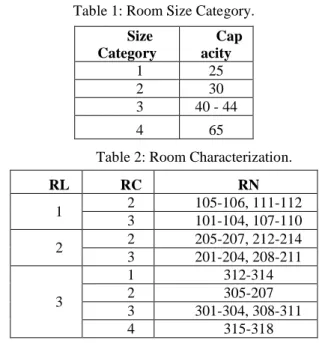
The same procedure has been followed in stage III, the timeslot-room assignment model. Inputs of this model include room information, i.e. number of rooms, their size category, and their floor location. Each room was given a size category, room category (RC) based on its capacity as shown in Table1. This distinction ensures that rooms are assigned to courses of the right Expected Course Category (ECC) size only. Moreover, departments are located in 3 different Levels, Room Level (RL), at the College of Business Administrations in Kuwait University; hence
rooms were distinguished based on their floor level in order to be able to assign them as close as possible to the department that is offering the course. Table 2shows the room characterization where RN is the Room Number.
Table 1: Room Size Category.
Size Category
Cap acity
1 25
2 30
3 40 - 44
4 65
Table 2: Room Characterization.
RL RC RN
1 2 105-106, 111-112
3 101-104, 107-110
2 2 205-207, 212-214
3 201-204, 208-211
3
1 312-314
2 305-207
3 301-304, 308-311
4 315-318
5.2
Stage I results
The output of this stage, the faculty-course assignment stage, represents an optimal assignment of faculty members to courses and their sections according to the imposed rules and regulations. Thirteen different scenarios were tested to ensure the effectiveness of the model. These scenarios take into account the occurrences of three different cases that could arise when developing a schedule. Cases include the situation where the faculties’ loads = the total course sections offered, the faculties’ load > the total course sections offered, and the faculties’ load < the total course sections offered.
In the first case, most goals were 100% met except for the last goal, the faculty-course preferences goal. Satisfaction level of this goal, i.e. faculty getting their first choice of courses, ranged from 85.2% to 73.3%. However, when it came to the second choice preferences, all faculties were 100% satisfied.
In the second and third cases, where the load of faculties available is not equal to the amount of courses offered, the satisfaction of the goals ranged from 100% to 54.9% based on the amount of variation of the faculties’ load available and the amount of courses offered. For further discussion of stage I results, please refer to [12].
5.3
Stage II results
MLC during the morning timeslots as desired, hence there has been an under achievement of the goal by 42%. Moreover, about 90% of the faculties got their first choice of preferences when it came to their desired timeslot in the schedule. Combining the faculty satisfaction level of the two stages together, 73.6% of the faculties were able to get their first choices of preferences, and 100% of the faculties were able to get at least their second choice of preferences. For further discussion of stage II model, please refer to [12].
5.4
Stage III results
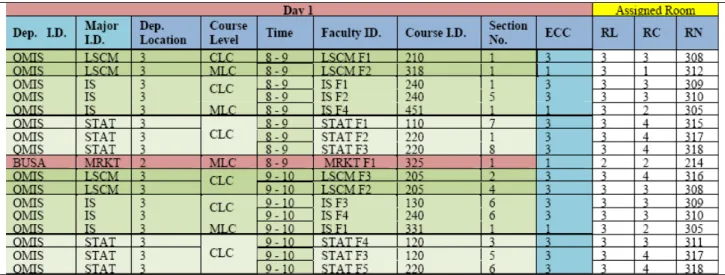
Upon the completion of stage I & II of the model, an optimal assignment of both faculties to courses, and then those courses to different timeslots is obtained. The result is then used as an input to stage III model, timeslot-room assignment. Based on the formulation of stage III model, a complete schedule was obtained . Table 3 shows part of the generated schedule.
All timeslots were successfully assigned to different room locations, the right course size were assigned to the right room size, and courses were distributed in the college to the desired floor based on the department that is offering these courses.
Table 3: Room Assignment Distribution.
6
Overall analysis and assessment of
the three stage model
Breaking the university scheduling problem into three stages has greatly improved the solution process and computation time of such a complex problem. Once all the required input data of every stage were available, computation time for each stage were few seconds using the Excel Premium Solver. Moreover, although the output of every stage represents a local optima of the overall problem, considering the satisfaction level of assigning faculties to courses and courses to different timeslots, then the efficient and effective allocation of timeslots to the right rooms, and the computation time of solving the entire problem, the decomposition of the scheduling problem is considered an advantage rather than a disadvantage. On the other hand, solving the entire scheduling problem in one complex model might result in an infeasible solution when global optimum is desired.
7
Conclusion and future research
Developing an effective, unbiased, and timely schedules have long been an issue in universities around the world. The utilization of optimization techniques, however, has proven to overcome such a complex problem. Although different approaches have been used to resolve this problem and reach an “optimal” schedule, the
consideration of factors such as faculties’ preferences to different courses and timeslots, an efficient room assignment, and university rules and regulations of assignment have all been hindrances to be considered all at once. Moreover, computation time has always been a problem when all of the above factors were considered in one complex model.
This paper utilizes the integer goal programming(IGP) technique and the idea of breaking (decomposing) the problem into smaller sub problems, i.e. different stages, in order to simplify formulation and swiftly reach a satisfying solution to the overall scheduling problem. The method used in satisfying goals is the priority sequence approach, where goals are satisfied according to their order of importance based on some university, college, and department regulations and requirements. The output of every stage has been used as an input to the subsequent stage until a complete schedule is developed.
shown in an earlier study. The overall satisfaction level when combining the two results reached up to 73.6%, as far as faculties getting their first choices of preferences. Nonetheless, faculties’ satisfaction level reached up to 100% when it came to getting at least their second choices of preferences. The room assignment stage has successfully used the results obtained in the previous stages and efficiently distributes courses with an assigned timeslots to the desired room location.
Work is underway to eventually integrate the three-stage model of this paper with a Decision Support System (DSS) such as the ScheduleExpert of Cornell in order to build an ultimate scheduling tool that will enable users to develop quick and effective schedules that are demand driven by the students through a new development of students planer DSS rather than supply driven by the college. The integration between the University scheduling DSS and the student planer DSS in a unique integrated DSS, will be a great tool that will efficiently and effectively enhance the whole Kuwait University registration system.
References
[1] Al-Yakoob, S. M. and Sherali, H. D. (2006). Mathematical programming models and algorithms for a class-faculty assignment problem. European Journal of Operational Research173, 488-507. [2] Al-Yakoob, S. M. and Sherali, H. D. (2007). A
mixed-integer programming approach to a class timetabling problem: A case study with gender
policies and traffic considerations. European
Journal of Operational Research180, 1028-1044. [3] Aladag, C., Hocaoglu,G. and Basaran, M. (2009).
The effect of neighborhood structures on tabu search algorithm in solving course timetabling problem. Expert Systems with Applications, in press.
[4] Anderson, D., Sweeney, D., Williams, T. (2008).
An Introduction to Management Science : Quantitative Approaches to Decision Making, 11e. [5] Badri, M. A. (1996). A Linear Goal Programming
Model for Solving the Optimal Faculty Assignment Problem. King Sauod University Journal; Vol. 8; Business Administration 2; 537 – 566; Reiad. [6] Badri, M. A. (1996). A two-stage multi-objective
scheduling model for [faculty-course-time]
assignments. European Journal of Operational
Research94 (1), 16-28.
[7] Badri, M. A., Davis, D. L., Davis, D. F., Hollingsworth, J. (1998). A multi-objective course scheduling model: Combining faculty preferences for courses and times. Computers and Operations Research25 (4), 303-316.
[8] Broek, J., Hurkens C., and Woeginger G. (2009). Timetabling problems at the TU Eindhoven.
European Journal of Operational Research 196 (2009) 877–885
[9] De Causmaecker, P., Demeester, P., and Berghe, G. (2009). A decomposed metaheuristic approach for a
real-world university timetabling problem.
European Journal of Operational Research, 195, 307–318.
[10] Dinkel, J. and J .Mote. (1989). An Efficient Decision Support System For Academic Course
Scheduling. Operations Research. 37(6), 853-864
[11] Harwood, G. and Lawless, R. (1975). Optimizing organizational goals in assigning faculty teaching schedules. Decision Science6, 513-524.
[12] Hasan, M., Al-Husain, R., Al-Qaheri, H. (2009). Course Assignment for University Faculties. Arab Journal of Administrative Sciences, Vol 17, No.1, pp. 169-191.
[13] Hinkin, T. R. and Thompson, G. M. (2002). SchedulExpert: Scheduling Courses in the Cornell
University School of Hotel Administration.
Interfaces32(6), 45-57
[14] Lee, S. and Schniederjans, M. (1983). Muticriteria
Assignment Problem: A goal programming
approach. Interfaces13, 75-81.
[15] Mirrazavi, SK. Mardle, SJ. And Tamiz, M. (2003). A two-phase multiple objective approach to university timetabling utilizing optimization and evolutionary solution methodologies. Journal of the Operational Research Society 54, 1155 – 1166. [16] Pongcharoen, P., Promtet W., Yenradeec, P., and
Hicksd C. (2008). Stochastic Optimization
Timetabling Tool for University Course
Scheduling. Intentional Journal of Production Economics,112, 903–918
[17] Valouxis, C. and Housos, E. (2003). Constraint programming approach for school timetabling.
Computers & Operations Research 30; 1555 – 1572.
[18] Burke, EK., Eckersley, AJ., McCollum, B., Petrovic, S., Qu, R. (2010). Hybrid variable neighbourhood approaches to university exam timetabling. European Journal of Operational Research, Vol. 206, No. 1, pp. 46-53.
[19] Subhash, Sarin C., Wang, Yuqiang., Varadarajan, Amrusha. (2010). A university-timetabling problem and its solution using Benders' partitioning--a case study.
Journal of Scheduling, Vol. 13, No. 2, pp. 131-141.
[20] Aderemi, O., Adewumi, Babatunde, A., Sawyerr, M., Montaz, Ali. (2009). A heuristic solution to the university timetabling problem. Engineering Computations, Vol. 26, No. 8, pp. 972-984.
[21] Qu, R., Burke, EK. (2009). Hybridizations within a graph-based hyper-heuristic framework for university timetabling problems.The Journal of the Operational Research Society, Vol. 60, No. 9, 1273-1285.
[22] Cheong, C Y., Tan, K C., Veeravalli, B. (2009). A multi-objective evolutionary algorithm for examination timetabling.Journal of Scheduling, Vol. 12, No. 2, pp. 121-146.