Available Online at www.ijpret.com 651
INTERNATIONAL JOURNAL OF PURE AND
APPLIED RESEARCH IN ENGINEERING
AND TECHNOLOGY
A PATH FOR HORIZING YOUR INNOVATIVE WORK
HIERARCHICAL SUPER-RESOLUTION-BASED INPAINTING USING IMAGE
PROCESSING.
DIPALI WANKHADE1, MAHESH INGLE2
1. P.G student, E&TC department MGI-COET Shegaon. 2. Faculty Member, E&TC department MGI-COET Shegaon.
Accepted Date: 15/03/2016; Published Date: 01/05/2016
\
Abstract- This paper give the novel introduction of framework for exemplar-based inpainting. Firstly its perform the inpainting on a coarse version of the input image, then hierarchical super-resolution algorithm is used to recover details on the missing areas. It is easier to inpaint low-resolution pictures than high-resolution ones, Hence that is the advantages of this approach. The gain is both in terms of computational complexity and visual quality. However, to be less sensitive to the parameter setting of the inpainting method, the low-resolution input picture is in painted several times by using different configurations. Results are efficiently combined with a loopy belief propagation and details are recovered by a single-image super-resolution algorithm. Experimental results in a context of image editing and texture synthesis demonstrate the effectiveness of the proposed method.
Keywords: Diffusion, Computation, In painting, Exemplar Based, Super-resolution.
Corresponding Author: MS. DIPALI WANKHADE
Access Online On:
www.ijpret.com
How to Cite This Article:
Dipali Wankhade, IJPRET, 2016; Volume 4 (9): 651-655
Available Online at www.ijpret.com 652 INTRODUCTION
low-Available Online at www.ijpret.com 653
resolution image. The proposed method builds upon the super-resolution based inpainting method proposed in which is based on exemplar-based inpainting like approach and single-image exemplar-based super-resolution. The main novelty of the proposed algorithm is the combination of multiple inpainted versions of the input picture. The rationale behind this approach is to cope with the sensitivity of exemplar-based algorithms to parameters such as the patch size and the filling order. Different combinations have been tested and compared. Besides this major point, different adjustments regarding exemplar-based inpainting and SR methods are described such as the use of the coherence measure to constrain the candidate search.
III. SUPER-RESOLUTION ALGORITHM OVERVIEW
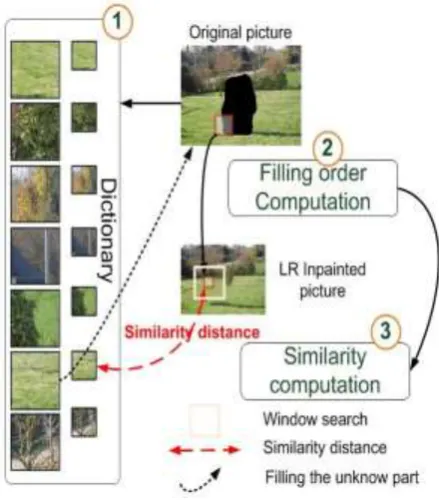
Image completion of large missing regions is a challenging task. As presented in the previous section, there are a number of solutions to tackle the inpainting problem. In this paper, we propose a new inpainting framework relying on both the combination of low-resolution inpainting pictures method and a single-image super-low-resolution algorithm. In the following sections, we briefly present the main ideas of this paper and the reasons why the proposed method is new and innovative. The proposed method is composed of two main and sequential operations. The first one is a non-parametric patch sampling method used to fill in missing regions. The inpainting algorithm is preferably applied on a coarse version of the input picture. Indeed a low-resolution picture is mainly represented by its dominant and important structures of the scene. We believe that performing the inpainting of such a low-resolution image is much easier than performing it on the full resolution. A low-resolution image is less contaminated by noise and is composed by the main scene structures. In other words, in this kind of picture, local orientation singularities which could affect the filling order computation are strongly reduced. Second, as the picture to inpaint is smaller than the original one, the computational time is significantly reduced compared to the one necessary to inpaint the full resolution image. To give more robustness, we inpaint the low-resolution picture with different settings like patch’s size, filling order. By combining these results, a final low-resolution inpainted picture is obtained. Results will show that the robustness and the visual relevance of inpainting is improved. The second operation is run on the output of the first step. Its goal is to enhance the resolution and the subjective quality of the inpainted areas. Given a low-resolution input image, which is the result of the first inpainting step, we recover its high-resolution using a single-image super-resolution approach. Fig. 1 describes the main concept underlying the SR method namely:
1) a low-resolution image is first built from the original picture.
2) an inpainting algorithm is applied to fill in the holes of the low-resolution picture. Different settings are used and inpainted pictures are combined.
3) the quality of the inpainted regions is improved by using a single-image super-resolution method.
Available Online at www.ijpret.com 654 Fig. 1. The framework of the SR method.
Fig.2. Flowchart of the super-resolution algorithm. (b)
Available Online at www.ijpret.com 655 IV. CONCLUSION
A novel inpainting approach has been presented in this paper. The input picture is first down sampled. then several inpaintings are performed. The low-resolution inpainted pictures are combined by globally minimizing an energy term. Once the combination is completed, a hierarchical single image super resolution method is applied to recover details at the native resolution. Experimental results on a wide variety of images have demonstrated the effectiveness of the proposed method. One interesting avenue of future work would be to extend this approach to the temporal dimension. Also, we plan to test other SR methods to bring more robustness to the method. But the main important improvement is likely the use of geometric constraint and higher-level information such as scene semantics in order to improve the visual relevance.
V. REFERENCES
1. T. Chan and J. Shen, “Variational restoration of non-flat image features: Models and
algorithms,” SIAM J. Appl. Math., vol. 61, no. 4, pp. 1338–1361, 2001
2. A. Criminisi, P. Perez, and K. Toyama. Object removal by exemplar-based inpainting. In
Proc. Conf. Comp. Vision Pattern Rec., Madison, WI, Jun 2003.
3. EFROS, A., AND LEUNG, T. 1999. Texture synthesis by non-parametric sampling. In IEEE
International Conference on Computer Vision, 1033– 1038.
4. D. Tschumperlé and R. Deriche, “Vector-valued image regularization with PDEs: A
common framework for different applications,” IEEE Trans. Pattern Anal. Mach. Intell., vol. 27, no. 4, pp. 506–517, Apr. 2005.
5. T. Chan and L. Vese, Variational image restoration and segmentation models and
approximations, IEEE Trans. Image Process, to appear.
6. A. A. Efros and T. K. Leung. Texture synthesis by non-parametric sampling. In
Proceedings of the 7th IEEE International Conference on Computer Vision, pages 1033– 1038, 1999.
7. A. Gagalowicz and S. De Ma. Sequential synthesis of natural textures. In Selected Papers
on Digital Image Processing, pages 184–210. SPIE Optical Engineering Press, 1990.
8. D. Tschumperle´ and R. Deriche. Diffusion PDE’s on Vector-Valued images. IEEE Signal
Processing Magazine, 19(5):16–25, 2002.
9. A.C. Kokaram, R.D. Morris, W.J. Fitzgerald, P.J.W. Rayner. Detection of missing data in