COSMOLOGICAL NARRATIVE IN THE SYNAGOGUES OF LATE ROMAN-BYZANTINE PALESTINE
Bradley Charles Erickson
A dissertation submitted to the faculty of the University of North Carolina at Chapel Hill in partial fulfillment of the requirements for the degree of Doctor of Philosophy in the Department
of Religious Studies.
Chapel Hill 2020
© 2020
ABSTRACT
Bradley Charles Erickson: Cosmological Narrative in the Synagogues of Late Roman-Byzantine Palestine
(Under the Direction of Jodi Magness)
The night sky provided ancient peoples with a visible framework through which they could view and experience the divine. Ancient astronomers looked to the night sky for practical reasons, such as the construction of calendars by which time could evenly be divided, and for prognosis, such as the foretelling of future events based on the movements of the planets and stars. While scholars have written much about the Greco-Roman understanding of the night sky, few studies exist that examine Jewish cosmological thought in relation to the appearance of the Late Roman-Byzantine synagogue Helios-zodiac cycle. This dissertation surveys the ways that ancient Jews experienced the night sky, including literature of the Second Temple (sixth century BCE – 70 CE), rabbinic and mystical writings, and Helios-zodiac cycles in synagogues of ancient Palestine. I argue that Judaism joined an evolving Greco-Roman cosmology with ancient Jewish traditions as a means of producing knowledge of the earthly and heavenly realms.
ACKNOWLEDGEMENTS
I wish to express my sincere appreciation to my adviser, Dr. Jodi Magness, and committee members, Drs. Zlatko Pleše, David Lambert, Jennifer Gates-Foster, and Maurizio Forte. Dr. Magness in particular provided critiques, suggestions, and encouragement throughout the writing and editing process. Without Dr. Magness, this project would not have been realized. I am fortunate to have worked with Dr. Magness and such a distinguished committee.
The research for this dissertation was made possible through a number of fellowships from the Carolina Center for Jewish Studies, the Digital Innovation Lab, and the Research
Laboratories of Archaeology at the University of North Carolina at Chapel Hill. Apart from these organizations, I would have been unable to travel or afford the equipment needed to perform the digital analysis in this dissertation.
I also wish to thank Shua Kisilevitz and the Israel Antiquities Authority for providing me access to a number of archaeological sites where I was given the opportunity to make
photogrammetric models.
A number of additional professors provided advice and served as sounding boards for my theory and methodology, including Drs. Joseph Lam, Erin and Robert Darby, Lauren Leve, and Bart Ehrman. I am thankful for their aid.
TABLE OF CONTENTS
LIST OF FIGURES ... XI
CHAPTER 1: INTRODUCTION ... 1
1.1THE PRESENT STUDY ... 1
1.2TERMINOLOGICAL CONSIDERATIONS ... 2
1.3HISTORY OF SCHOLARSHIP ... 3
1.4DIGITAL METHODOLOGY... 14
1.5CHAPTER SUMMARIES ... 15
CHAPTER 2: LITERARY LANDSCAPE OF ANCIENT JEWISH ASTRONOMY AND ASTROLOGY ... 17
2.1HISTORICAL ... 18
2.1.1 Enochic Tradition ... 20
2.1.2 Sethian Tradition ... 25
2.1.3 Abrahamic Tradition ... 28
2.2CALENDRICAL ... 31
2.2.1 Babylonian Calendar ... 32
2.2.2 Egyptian Calendars ... 35
2.2.2 Greek Calendars ... 38
2.2.3 Israelite/Jewish Calendars ... 43
2.3ASTROLOGICAL ... 52
2.3.1 Sibylline Oracles ... 53
2.3.2 Testament of Solomon ... 55
2.3.4 2 Enoch ... 62
2.3.5 Dead Sea Scrolls ... 65
2.3.6 Rabbinic Literature ... 70
2.3.7 Sepher Ha-Razim ... 73
2.4CULTIC ... 76
2.4.1 Philo: Joseph’s Dream, Negation of Alexandrian Astrology, and the Menorah ... 77
2.4.2 Josephus: Omens and the Tabernacle (Jewish War 6 and Antiquities. 3) ... 79
2.5SUMMARY AND CONCLUSION ... 82
CHAPTER 3: THE HELIOS-ZODIAC CYCLE IN THE SYNAGOGUES OF ANCIENT PALESTINE ... 84
3.1NA’ARAN SYNAGOGUE ... 88
3.1.1 Basic Information ... 88
3.1.2 Excavation and Research ... 88
3.1.3 Description of the Synagogue ... 90
3.1.4 Helios-zodiac Cycle ... 94
3.1.5 Archaeoastronomical Analysis ... 98
3.1.5 Summary and Analysis ... 99
3.2BETH ALPHA SYNAGOGUE ... 100
3.2.1 Basic Information ... 100
3.2.2 Excavation and Research ... 101
3.2.3 Description of the Synagogue ... 102
3.2.3 Helios-Zodiac Cycle ... 109
3.2.4 Archaeoastronomical Analysis ... 116
3.2.5 Summary and Analysis ... 118
3.3.1 Excavation and Research ... 120
3.3.2 Description of the Synagogue ... 121
3.3.3 Helios-zodiac Cycle ... 125
3.3.4 Archaeoastronomical Analysis ... 127
3.3.5 Summary and Analysis ... 129
3.4SUSIYA SYNAGOGUE ... 129
3.4.1 Basic Information ... 129
3.4.2 Excavation and Research ... 130
3.4.3 Description of the Synagogue ... 131
3.4.4 Helios-zodiac Cycle ... 133
3.4.5 Archaeoastronomical Analysis ... 133
3.4.6 Summary and Analysis ... 134
3.5HAMMATH TIBERIAS ... 136
3.5.1 Basic Information ... 136
3.5.2 Excavation and Research ... 138
3.6.3 Description of the Synagogues ... 142
3.5.4 Helios-zodiac Cycle of Stratum IIa (“Severos Synagogue) ... 149
3.5.5 Archaeoastronomical Analysis ... 155
3.5.6 Summary and Analysis ... 155
3.6SEPPHORIS SYNAGOGUE ... 159
3.6.1 Basic Information ... 159
3.6.2 Excavation and Research ... 160
3.6.3 Description of the Synagogue ... 160
3.6.4 Helios-zodiac Cycle ... 166
3.6.6 Summary and Analysis ... 175
3.7HUQOQ SYNAGOGUE ... 176
3.7.1 Basic Information ... 176
3.7.2 Excavation and Research ... 177
3.7.3 Description of the Synagogue ... 177
3.7.4 Helios-zodiac Cycle ... 182
3.7.5 Archaeoastronomical Analysis ... 186
3.7.6 Summary and Analysis ... 186
3.8ADDITIONAL EVIDENCE: ... 187
3.8.1 En Gedi ... 187
3.8.2 Wadi Hamam ... 193
3.8.3 Yafia ... 195
3.8SUMMARY AND CONCLUSION ... 196
3.8.1 Clockwise vs. Counterclockwise Zodiac Progression ... 196
3.8.2 Calendrical Aspect of Helios Medallion ... 198
3.8.3 Helios-zodiac Cycles and Synagogue Narratives ... 199
CHAPTER 4: THE HELIOS-ZODIAC CYCLE IN ITS GRECO-ROMAN CONTEXT ... 201
4.1TEMPLE,DOMESTIC, AND PUBLIC STRUCTURES WITH HELIOS-ZODIAC CYCLES ... 201
4.1.1 Temple Context ... 201
4.1.2 Domestic and Public Contexts ... 208
4.2HELIOS-ZODIAC CYCLE IN MITHRAEA ... 220
4.2.1 Textual Evidence ... 220
4.2.2 Heddernheim Tauroctony ... 226
4.2.3 Walbrook Tauroctony ... 229
4.2.5 Two Mithraea in Ancient Palestine ... 233
4.3HELIOS-ZODIAC CYCLES IN ASTROLOGY BOARDS ... 236
4.3.1 Literary Context ... 236
4.3.1 Grand/Grannus Astrology Board... 239
4.3.2 Bianchini Tablet ... 241
4.3.3 Tanis Astrology Board/Window Pane ... 243
4.3.4 Daressy Tablet ... 244
4.4SUMMARY AND ANALYSIS ... 247
CHAPTER 5: THE HELIOS-ZODIAC CYCLE IN THE LANDSCAPE OF LATE ROMAN-BYZANTINE PALESTINE ... 250
5.1GRECO-ROMAN COSMIC DEVOTION IN LATE ANTIQUITY ... 250
5.2COSMIC VENERATION IN ANTIQUE CHRISTIANITY ... 256
5.2ISRAELITE AND JEWISH COSMIC VENERATION ... 263
5.4THE CONTEXTUALIZED SYNAGOGUE HELIOS-ZODIAC CYCLE ... 270
5.4.1 The Central Medallion ... 270
5.4.2 The Zodiac Cycle ... 274
5.4.3 The Seasons... 278
5.5THE LOCATION OF THE HELIOS-ZODIAC CYCLE AND CREATION ... 280
APPENDIX ... 284
ACCESS ... 284
PHOTOGRAMMETRY ... 285
3DMODELING ... 285
STELLARIUM ... 286
LIST OF FIGURES
Figure 1. Map of Late Roman-Byzantine synagogues containing. ... 87
Figure 2. Original plan of Na’aran in Vincent and Benoit, “Un Sanctuaire,” plate 5. ... 91
Figure 3. Drawing of the Nave mosaic of Na'aran in Vincent and Benoit ... 92
Figure 4. Na'aran Stellarium model with mosaic floor plan ... 99
Figure 5. Sukenik's plan of Beth Alpha ... 103
Figure 6. Beth Alpha mosaic floor. ... 105
Figure 7.’Aqedah Panel of Beth Alpha. ... 106
Figure 8. Temple/Torah Shrine at Bath Alpha... 108
Figure 9. Beth Alpha Helios-zodiac cycle ... 110
Figure 10. Beth Alpha Stellarium model with render of mosaic floor ... 117
Figure 11. Plan of Huseifa synagogue ... 122
Figure 12. Huseifa Stellarium model ... 128
Figure 13. Plan of the Susiya synagogue ... 131
Figure 14. Susiya Stellarium model ... 134
Figure 15. Mosaic floor of Hammath Tiberias synagogue ... 140
Figure 16. Detail of Hammath Tiberias Synagogue nave ... 144
Figure 17. Detail of ark/Torah shrine panel of Hammath Tiberias synagogue ... 146
Figure 18. Detail of Hammath Tiberias Helios-zodiac panel. ... 150
Figure 19. Coin of Caracalla ... 156
Figure 21. Coin of Aurelian ... 156
Figure 22. Coin of Constantine I... 157
Figure 23. Proposed reconstruction of Agrippa’s world map ... 158
Figure 24. Mosaic floor of Sepphoris synagogue ... 162
Figure 25. Sepphoris Helios-zodiac cycle ... 168
Figure 26. Southern panels of the Huqoq synagogue nave ... 180
Figure 27. Detail of aquatic scene in the Huqoq synagogue... 181
Figure 28. Detail of Huqoq Helios-zodiac cycle ... 184
Figure 29. Mosaic floor of En Gedi synagogue. ... 189
Figure 30. Detail of En Gedi inscription ... 192
Figure 31. Farnese Atlas in the Museo Archaeologico Nazionale, Naples ... 197
Figure 32. Sketch of Dendera zodiac ... 202
Figure 33 Dendera Zodiac on display in the Louvre ... 204
Figure 34. Robert Wood's drawing of Dendera Zodiac ... 206
Figure 35. First-century relief of Palmyrene divine triad ... 206
Figure 36 Münster Helios-zodiac mosaic ... 209
Figure 37. Sketch of Antioch Helios-zodiac cycle ... 211
Figure 38. Bottom-left quarter of the Helios-zodiac cycle at Antioch ... 212
Figure 39. Helios-zodiac cycle in a triclinium in Sparta ... 214
Figure 40. Plan of the triclinium mosaic containing the Helios-zodiac cycle ... 216
Figure 41. The Helios-zodiac cycle of the Astypalaea bath house ... 218
Figure 43 Walbrook tauroctony on display in the Museum of London ... 230
Figure 44 Drawing of the Ponza zodiac cycle ... 232
Figure 45. Marble medallion containing the tauroctony found at Caesarea Maritima ... 235
Figure 46. Grand astrology board ... 240
Figure 47 The Bianchini Tablet on display in the Louvre ... 242
Figure 48 Squeeze of Daressy tablet ... 245
Figure 49. Helios surrounded by vines in Tomb of the Julii ... 260
Figure 50. Sixth-century ampulla from Monaz, Italy ... 262
Figure 51. Instructions to access Stellarium data... 288
Figure 52. Instructions to access Stellarium data... 288
Chapter 1: Introduction
1.1 The Present Study
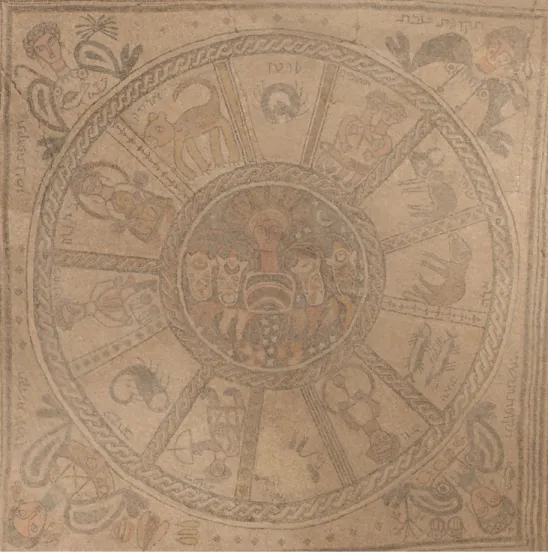
To date, depictions of a Helios-zodiac cycle have been discovered in the floor mosaics of nine ancient Palestinian synagogues: Na’aran, Beth Alpha, Huseifa, Susiya, Yafi`a, Hamath Tiberias, Sepphoris, Wadi Hamam, and Huqoq, with a tenth synagogue—En Gedi—that has names of the zodiac and months inscribed on its mosaic floor. While each Helios-zodiac cycle possesses unique features, the general appearance consists of a central medallion of the solar deity Helios surrounded by the cosmic iconography of Oceanus, a crescent moon, and stars.1 A
concentric circle, divided into twelve sections or medallions, surrounds the central medallion with each section containing a sign of the zodiac. The medallion and zodiac wheel are inscribed in a square panel with personifications of the seasons in the four interstitial corners.
The present study examines the appearance of the Helios-zodiac cycle in Late Roman-Byzantine Palestinian synagogues and the cultural milieu in which they were created.2 The
1 Oceanus is often depicted as a series of waves out of which Helios emerges on his journey
across the sky. The crescent moon, when depicted, is always in the waxing-crescent lunar phase except for Beth Alpha, where the moon is portrayed as a waning crescent. The stars that surround Helios likely depict a heavenly backdrop, but in some synagogues discussed in Chapter 3, a larger, distinct star next to Helios may depict the morning star Phosphorous/planet Venus.
2 In this dissertation, I use the term Late Roman to denote the fourth-fifth centuries, and the term
primary goals are (1) to identify narratives of Jewish cosmological thought/practice, (2) to contextualize the synagogue Helios-zodiac cycles with Jewish cosmological though/practice and comparable Greco-Roman material, and (3) to examine archaeoastronomical evidence for synagogue orientation and the appearance of the Helios-zodiac cycle. I demonstrate that these synagogue congregations combined Greco-Roman astronomical knowledge with Jewish traditions to create uniquely Jewish cosmological narratives. In other words, Jews were active participants in the development of what is often viewed as Greco-Roman astronomy.
I build my argument by examining Jewish and Greco-Roman literary sources and material culture. To arrive at the conclusion, special attention is given to Greco-Roman
astrological and astronomical sources, especially Helios-zodiac designs found in Mithraea and zodiac astrology boards. In my concluding chapter, I consider why Helios-zodiac cycles are found in ancient Palestinian synagogues but not in contemporary Christian churches.
In the remainder of this chapter, I provide a brief description of astronomical and astrological terminology used throughout the work, summarize the history of synagogue scholarship noting my dissertation’s contribution to the field, present the digital methodology behind my work, and outline the chapters following the introduction.
1.2 Terminological Considerations
Throughout this study, I use the terms astronomy and astrology in a technical sense. Astronomy is the predictable, mathematical motion of celestial objects whereas astrology is the influence upon/by celestial objects on people and earthly events. The dual distinction of
Of the means of prediction through astronomy, O Syrus, two are the most
important and valid. One, which is first both in order and in effectiveness, is that whereby we apprehend the aspects of the movements of sun, moon, and stars in relation to each other and to the earth, as they occur from time to time; the second is that in which by means of the natural character of these aspects themselves we investigate the changes which they bring about in that which they surround.3
In this study, I operate with Ptolemy’s vocabulary for describing the study of the sky, although not all ancient astronomers/astrologers made such clear distinctions. Astronomy refers to the mechanical motions of celestial bodies, including the sun, moon, planets, stars, and comets. Astrology refers to the influence that these movements have on the earth.
The celestial zodiac, in a technical sense, is composed of twelve 30-degree divisions of the night sky that form a 20-degree band through which the sun, moon, and planets appear to move throughout the year. The ecliptic, which occupies the center of the 20-degree zodiac band, creates an imaginary plane that sits co-planar to the Earth’s orbit of the sun. The movement of the earth around the sun gives the impression that the sun, moon, and planets all move within 10 degrees to either side of the ecliptic, hence the 20-degree band. The twelve discrete sections of the zodiac are named after constellations that fall within each respective zodiac region. Some zodiac constellations, however, take up more space than their 30-degree division.
1.3 History of Scholarship
Louis-Hugues Vincent and Charles Clermont-Ganneau discovered the first Helios-zodiac
3 Ptolemy of Alexandria, Tetrabiblos, trans. Frank Egleston Robbins, LCL 435 (Cambridge,
cycle in the synagogue of Na’aran in 1921.4 Eliezer Sukenik brought a second Helios-zodiac
cycle to light in 1928 in the mosaic floor of the Beth Alpha synagogue. Concerning the discoveries at Na’aran and Beth Alpha, Sukenik wrote:
We see here pictorial expression of belief in the influence of the planets on the affairs of this world. Even Judaism could not withstand this universal influence which permeated all religions and peoples in the ancient world…even the sages of Israel were addicted to it.5
Sukenik believed the synagogue Helios-zodiac cycle demonstrated an acceptance of astrological practice/thought in Judaism. In support of his argument, Sukenik referenced the existence of astrological discourse in Josephus, rabbinic literature, and piyyutim.6 Sukenik did not, however,
offer an interpretation of the Helios-zodiac cycle within the larger framework of the Beth Alpha mosaic floor nor did he explain how the Helios-zodiac cycle was viewed by synagogue
congregants.
Erwin Goodenough was the first scholar to consider the Helios-zodiac cycle as indicative of Jewish practice. In a multi-volume work published from 1953—1968, Goodenough argued that the Helios-zodiac cycle was one set among many symbols that evidenced a Hellenized,
4 See Vincent and Pierre Benoit, “Un Sanctuaire dans la Région de Jéricho: La Synagogue de
Na’arah,” Revue Biblique 68, no. 2 (April 1961): 161-177; Vincent, “Le Sanctuaire Juif D’ ‘Aïn Douq,” Revue Biblique 16, no. 3/4 (October and July 1919): 442-443; Vincent, “La Synagogue de Noarah,” Revue Biblique 30, no. 4 (October 1921): 579-601; Clermont-Ganneau, “New Hebrew Mosaic Unearthed by Turkish Shell: Palestine Campaign Echo,” Times (of London),
Friday, October 10, 1919.
5 Sukenik, The Ancient Synagogue of Beth Alpha: An Account of the Excavations Conducted on
Behalf of the Hebrew University, Jerusalem (Piscataway, NJ: Georgias Press, 2007), 56.
mystical form of Judaism which arose in opposition to the “literary” rabbinic Judaism of late antiquity.7 Goodenough’s interpretation was significant as it complicated the traditional view of
the mid-twentieth century that a single form of rabbinic Judaism was practiced throughout ancient Palestine.8
Goodenough’s theory was challenged by several scholars. The most direct argument against Goodenough’s thesis was made by Ephraim Urbach, who used material culture and rabbinic literature to argue that rabbinic Judaism had become diverse enough for the rabbis to allow figured images—such as Helios—in synagogues.9 Michal Avi-Yonah argued against
Goodenough’s interpretation of the synagogue Helios-zodiac cycle and suggested that it represents a calendar of the 24 priestly courses from 1 Chron 24.10 Avi-Yonah further argued
that the Helios-zodiac cycle is compatible with rabbinic halakha and is not indicative of non-rabbinic Judaism.11 Rachel Hachlili, a student of Avi-Yonah’s, supports a calendrical
interpretation of the Helios-zodiac cycle. Hachlili interprets each zodiac sign within the cycle as a month while Helios and the moon depict a day-night cycle.12 Hachlili argues for a regional
7 Goodenough, Jewish Symbols in the Greco Roman Period: Abridged Edition. Edited by Jacob
Neusner (Princeton, NJ: Princeton University Press, 1988), 59-62.
8 Goodenough, Jewish Symbols, 12-13.
9 Urbach, “The Rabbinical Laws of Idolatry in the Second and Third Centuries in the Light of
Archaeological and Historical Facts,” Israel Exploration Journal 9, nos. 3-4 (1959): 149-165, 229-45.
10 Avi-Yonah, “The Caesarea Inscription of the Twenty Four Priestly Courses,” in The Teacher's
Yoke: Studies in Memory of Henry Trantham (Waco: Baylor University Press, 1964), 55-56.
11 Avi-Yonah, “Caearea,” 57.
typology of synagogue Helios-zodiac motifs, suggesting they originated from an “Antioch school” of design that used similar images to depict an agricultural calendar.13
Beyond the calendrical school of thought, Gideon Foerester—another of Avi-Yonah’s students—understands the Helios-zodiac cycle to have served as a visual guide to liturgical prayer in the synagogue.14 Ehud Netzer and Ze’ev Weiss have offered a symbolic interpretation
of the Helios-zodiac cycle in the Sepphoris synagogue, suggesting that it represents God’s creative power within a larger narrative of redemption.15
Another school of thought interprets the figure of Helios as a divine being. Morton Smith suggested that Helios represents an angelic figure who occupies the fourth level of heaven in 2 Enoch, Sepher Ha’Razim, and the Greek Apocalypse of Baruch.16 Jodi Magness has argued that
Helios is the “super-angel” Metatron found in 3 Enoch, the Babylonian Talmud, and the Apocalypse of Zerubbabel based on a contextual analysis with Late Roman-Byzantine art, architecture, and literature.17 Luce Wadeson has argued that Helios represents Elijah in the
(Leiden: Brill, 2014), 236.
13 Hachlili, “The Zodiac in Ancient Jewish Synagogal Art: A Review,” Jewish Studies Quarterly
9, no. 3 (2002): 236.
14 Foerster, “The Zodiac in Ancient Synagogues and Its Place in Jewish Thought,” EretzIsrael
19 (1988): 231-233.
15 Netzer and Weiss, Power and Redemption: A Synagogue Mosaic from Sepphoris (Jerusalem:
Israel Museum), 35-37.
16 Smith, “Helios in Palestine,” Eretz-Israel (1982): 209-210.
17 Magness, "Heaven on Earth: Helios and the Zodiac Cycle in Ancient Palestinian
divine chariot.18 Martin Goodman has suggested that Helios is the God of the Jews, arguing that
in any other context, such representation of a divine being would be interpreted as the central deity of the people who occupied the building.19
Debates on the nature and interpretation of the synagogue Helios-zodiac cycle reflect a larger chronological debate within synagogue studies. In the early twentieth century, Heinrich Kohl and Karl Watzinger suggested the second–third centuries as a logical period for the
construction of monumental Galilean synagogues. They argued that Galilean Judaism during this period flourished under the guidance of Rabbi Judah Ha-Nasi.20 Sukenik, following his
excavation of Beth Alpha, added a second synagogue type—apsidal synagogues—comparable to churches built in the Late Roman-Byzantine period.21
Avi-Yonah synthesized the work of Kohl, Watzinger, and Sukenik and argued for a threefold typology.22 Avi-Yonah identified synagogues with basilica design and three-door,
Jerusalem-facing facades as “early” (Galilean) synagogues dating to the second-to-third
18 Lucy Wadeson, “Chariots of Fire: Elijah and the Zodiac in Synagogue Floor Mosaics of Late
Antique Palestine,” ARAM 20 (2008): 1-41.
19 Goodman, “The Jewish Image of God in Late Antiquity,” in Judaism in the Roman World:
Collected Essays (Boston: Brill, 2006), 205-218.
20 Kohl and Watzinger, Antike Synagogen in Galilaea (Osnabrück: Otto Zeller, 1975), 138. 21 Sukenik, Ancient Synagogues in Palestine and Greece (London: British Academy, 1934),
27-37.
22 Avi-Yonah, “Synagogue,” Encyclopedia of Archaeological Excavations in the Holy Land
(Englewood Cliffs, N.J.: Prentice-Hall, 1978), 1129-1138; Avi-Yonah, “Synagogue Architecture in the Classical Period,” in Jewish Art: An Illustrated History, ed. Cecil Roth (New York:
centuries.23 Following this early style of synagogue architecture was a “transitional”
(broadhouse) that exhibited features from the “early” and “late” synagogues. Avi-Yonah dated the “transitional” synagogue to the third-to-fourth centuries.24 This was followed by the “late”
synagogue, dating to the fifth-to-sixth centuries, which include features such as a forecourt, narthex, and a Jerusalem-facing apse, similar to contemporary churches.25
Avi-Yonah’s typology was widely accepted until the excavation of the Capernaum synagogue in the 1960s, when thousands of fourth and fifth-century coins were discovered in sealed contexts beneath the floor and in the foundations.26 Because the Capernaum synagogue
is a basilica without an apse, and it has a three-door, Jerusalem-facing facade, it should be an “early” synagogue dating to the second-to-third centuries. Stanislao Loffreda, one of the excavators who published the Capernaum synagogue, cites Avi-Yonah’s strict adherence to the synagogue typology in the face of contrary evidence at Capernaum.27 Avi-Yonah argued that
even though the Capernaum synagogue contained material suggesting a Late Roman date, its overall architectural design indicates it belongs to the second-to-third centuries.28
Though the Capernaum synagogue excavation brought Avi-Yonah’s typology into
23 Avi-Yonah, “Synagogues,” 1129-1130; “Synagogue Architecture,” 158-173. 24 Avi-Yonah, “Synagogues,” 1130-1131; “Synagogue Architecture,” 173-175. 25 Avi-Yonah, “Synagogues,” 1131-1132; “Synagogue Architecture,” 175-176. 26 Virgilio Corbo, La Sinagoga di Cafarnao, 126-139; Stanislao Loffredo, "The Late
Chronology of the Synagogue of Capernaum,” Israel Exploration Journal 23, no. 1 (1973): 37.
27 Loffredo, "Late Chronology,” 37.
question, some archaeologists, such as Gideon Foerster, rejected evidence contrary to Avi-Yonah’s typology.29 Carol and Eric Meyers have argued in favor of Avi-Yonah’s synagogue
typology based on their excavations of “Galilean type” synagogues at Khirbet Shem’a, Meiron, Gush Halav, and Nabratein, which they date to the second–third centuries.30 Magness has
argued for a later date for each of the Meyers’s synagogues, re-dating them to the fourth or fifth century based on site stratigraphy, ceramics, and numismatics.31 Magness has further
questioned the validity of using presumed regional earthquake dates for dating destruction layers.32 Uzi Leibner recently published the excavation report of Wadi Hamam and argued that
the Wadi Hamam synagogue is a “Galilean type” synagogue dating to an earlier period. Leibner
29 See Foerster, “Notes on Recent Excavations at Capernaum,” in Ancient Synagogues Revealed,
ed. Lee I. Levine (Jerusalem: Israel Exploration Society, 1981), 57-59.
30 See Eric Meyers, M., A. Thomas Kraabel, and James F. Strange, Ancient Synagogue
Excavations at Khirbet Shema', Upper Galilee, Israel 1970-1972 (Durham, NC: Duke University Press, 1976); Eric Meyers, Strange, and Carol Meyers, Excavations at Ancient Meiron, Upper Galilee, Israel, 1971-72, 1974-75, 1977 (Cambridge, Mass: American Schools of Oriental Research, 1981); Meyers, Meyers, and Strange, Excavations at the Ancient Synagogue of Gush
Ḥalav (Winona Lake, Ind: Eisenbrauns, 1990); Eric Meyers, Gabriela Bijovsky, and Carol Meyers, Excavations at Ancient Nabratein Synagogue and Environs (Winona Lake, Ind: Eisenbrauns, 2009).
31 See Magness, "Synagogue Typology and Earthquake Chronology at Khirbet Shema', Israel."
Journal of Field Archaeology 24, no. 2 (1997): 211-20; Magness, "The Ancient Synagogue at Nabratein." Bulletin of the American Schools of Oriental Research, no. 358 (2010): 61-68; Magness, “A Response to Eric M. Meyers and James F. Strange,”in Judaism in Late Antiquity,
Part III: Where We Stand: Issues and Debates in Ancient Judaism, Volume 4: The Special Problem of the Synagogue, eds. Edited by Alan J. Avery-Peck and Jacob Neusner (Leiden: Brill, 1999), 79–91; Magness, "The Question of the Synagogue: The Problem of Typology,” in Where We Stand: Issues and Debates in Ancient Judaism (Leiden, The Netherlands: Brill, 2001): 1-48.
discounts any evidence that might suggest a Late Roman date.33
Magness, in a review of the Nabratein synagogue report, summarizes what is at stake in the synagogue typology.34 If there is an early “Galilean type” synagogue, it means that
post-Constantinian monumental Christian churches were inspired by synagogue architecture and art. If monumental synagogues were first constructed in the fourth century, it would mean that monumental synagogues developed alongside monumental churches or that synagogues were influenced by church architecture.
The current study supports a Late Roman-Byzantine (fourth–seventh century) date for the synagogues at Na’aran, Beth Alpha, Huseifa, Susiya, Hamat Tiberias, Sepphoris, Wadi Hamam, Yafia, En Gedi, and Huqoq. At Beth Alpha, an inscription mentioning the emperor Justin indicates that the mosaic was laid in the sixth century, either during the reign of Justin I (r. 518-527) or Justin II (r. 565-574).35 The remaining synagogues are not so easily dated. In Chapter 3,
I survey the remains of each synagogue containing a Helios-zodiac cycle to establish their dates. The synagogue dates are important to the present study for two reasons: (1) I argue that the depictions of Helios, the zodiac, and the seasons reflect similar literary descriptions and artistic
33 For example, Leibner says because 14 of 568 sherds of “Byzantine pottery” were found while
digging shovel-test probes, the low occurrence of Byzantine pottery can be discounted. Leibner,
Khirbet Wadi Hamam: A Roman Period Village and Synagogue in the Lower Galilee, Qedem Reports 13 (2019), 8. For a critique of the Wadi Hamam excavation report, see Jodi Magness, Review of "Khirbet Wadi Ḥamam, A Roman-Period Village and Synagogue in the Lower Galilee, edited by Uzi Leibner," Journal for the Study of Judaism 50, 3: 427-430.
34 See Magness, The Archaeology of the Holy Land: From the Destruction of Solomon's Temple
to the Muslim Conquest (Cambridge: Cambridge University Press, 2012), 308-309.
portrayals of the Late Roman period and (2) I argue that the architecture of certain synagogues may have been intentionally aligned with astral phenomenon in a fashion similar to public basilicas and Late Roman churches.
Aside from the issue of the Helios-zodiac cycle, a limited number of studies have been conducted on Jewish engagement with astronomy and astrology. The first scholar to consider seriously ancient Jewish use of astronomy and astrology was James Charlesworth. In 1977, Charlesworth responded to an article written by Manfred Lehmann in which Lehmann had argued for a normative ancient Jewish practice, and that any use of astrology was a minor sectarian phenomenon.36 In contrast, Charlesworth believed that Greco-Roman astrological
thought permeated Judaism and was not relegated to sectarian groups.
While Charlesworth rightly considered evidence of Jewish use of astronomy and astrology as indicative of practice, he viewed Jewish astronomy and astrology as wholly borrowed from Greco-Roman sources.37 In this study, I argue that Judaism developed its own
astronomical and astrological narratives in the same fashion as Greco-Roman astronomy and astrology—by building on what others believed while integrating new ideas to make
astronomical and astrological knowledge distinctly unique.
The most prolific area of scholarship dealing with Jewish astronomy and astrology relates
36 Lehman, “New Light on Astrology in Qumran and the Talmud,” Revue de Qumrân 8, no. 4
(32) (1975): 599-602; and James Charlesworth, “Jewish Astrology in the Talmud,
Pseudepigrapha, the Dead Sea Scrolls, and Early Palestinian Synagogues,” Harvard Theological Review 70, no. 3 (July - October 1977), 183.
to the calendrical and horoscopic texts found among the Dead Sea Scrolls. In 1957, Józef T. Milik dedicated a paragraph to a scroll that mentioned zodiac signs:
Un genre littéraire bien connu par les tablettes babyloniennes est celui des horoscopes. Deux colonnes frag-mentaires de la grotte 4 indiquent les signes du zodiaque se référant aux divers jours du mois.38
Beyond mentioning the scroll’s existence, however, Milik did not offer further interpretation. Over the past twenty years, scholars have begun to address the astrological texts from Qumran. Mathias Albani believes the Qumran community did not practice horoscopic astrology, although astrological texts were kept in the community’s literary collection.39 Helen Jacobus
has provided the most thorough analysis of calendrical and astrological texts in the Dead Sea Scrolls. She shows that the Qumran community was concerned with astrological practices and that certain scrolls provided a template for interpreting the impact celestial and natural
phenomenon had on an individual’s life.40
Outside of Qumran and the Dead Sea Scrolls, Kocku von Stuckrad has surveyed a range of Jewish and Christian texts, arguing that both traditions joined extant astrological practices with religious identities.41 Annette Yoshiko Reed has written about the tension between
38 Milik, Dix Ans de Découvertes dans le Désert de Juda (Paris: Éditions du Cerf, 1957),38. 39 See Albani, “Horoscopes in the Qumran Scrolls,” The Dead Sea Scrolls After Fifty Years, vol.
2, eds. James VanderKam and Peter Flint (Leiden: Brill, 1999), 317-319; Albani, “Horoscopes,”
Encyclopedia of the Dead Sea Scrolls, ed. Lawrence Schiffman and James VanderKam (Oxford: Oxford University Press, 1994),370-373.
40 Jacobus, Zodiac Calendars in the Dead Sea Scrolls and Their Reception (Leiden, The
Netherlands: Brill, 2015); “4Q318: A Jewish Zodiac Calendar at Qumran?” In Studies on the Texts of the Desert of Judah 90 (Leiden: Brill, 2010).
Josephus’s dual portrayal of Abraham as a Chaldean “scientist” and the progenitor of Judaism who rejects astrology. Reed argues that Josephus’s cultural context led him to celebrate
Abraham’s contribution to ancient wisdom while rejecting Jewish engagement with first-century Greco-Roman astrology.42
A largely unexplored method for analyzing Jewish astronomy and astrology and the appearance of the Helios-zodiac cycle in the synagogue is archaeoastronomy, which
contextualizes material culture with how past cultures understood phenomena in the sky. The field of archaeoastronomy was born in 1963 when Gerald Hawkins presented his findings of the alignment of Stonehenge orthostats and ground depressions with celestial phenomena in the journal Nature.43 While Hawkins used the term “astro-archaeology,” the term
“archaeoastronomy” has become normative as it places emphasis on the archaeological method of such studies.44
In this study, I perform a basic archaeoastronomical analysis of synagogues known to have contained Helios-zodiac cycles, looking primarily at the relation of their architecture to the
Zeitverständnis (New York: Walter de Gruyter, 2000), and “Jewish and Christian Astrology in Late Antiquity—A New Approach,” Numen 47/1 (2000): 1–40.
42 Reed, “Abraham as Chaldean Scientist and Father of the Jews: Josephus, ‘Ant.’ 1.154-168,
and the Greco-Roman Discourse about Astronomy/Astrology,” Journal for the Study of Judaism in the Persian, Hellenistic, and Roman Period 35, no. 2 (2004): 119-58.
43 Hawkins, “Stonehenge Decoded,” Nature 200 (1963): 306–308.
44 For a discussion of the use of the term archaeoastronomy, see José Celdrán, “Foreword,” in
sun. My methodology for conducting this analysis is presented in the next section. A step-by-step explanation of the digital portion of the archaeoastronomical analysis can be found in the
appendix together with links to access the digital data.
1.4 Digital Methodology
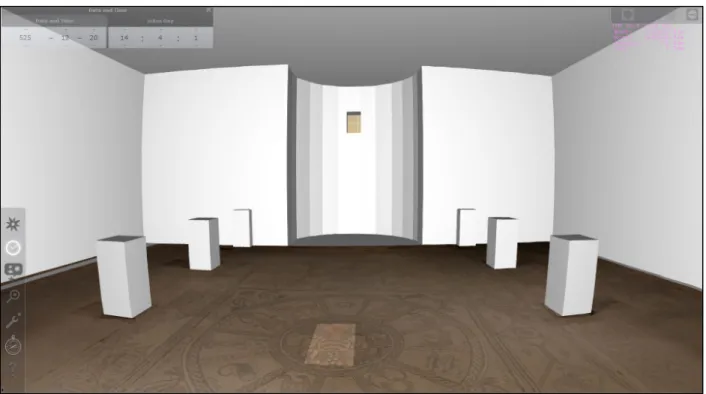
The digital portion of the current study tests for the archaeoastronomical alignment of the synagogue with astral phenomenon. To accomplish this archaeoastronomical analysis, I
conducted the following procedure:
1. Created 3D models of the eight synagogues containing Helios-zodiac cycles. 2. Imported each model into the open-source planetarium software Stellarium. 3. Oriented and positioned each synagogue with its correct latitude, longitude, and
elevation.
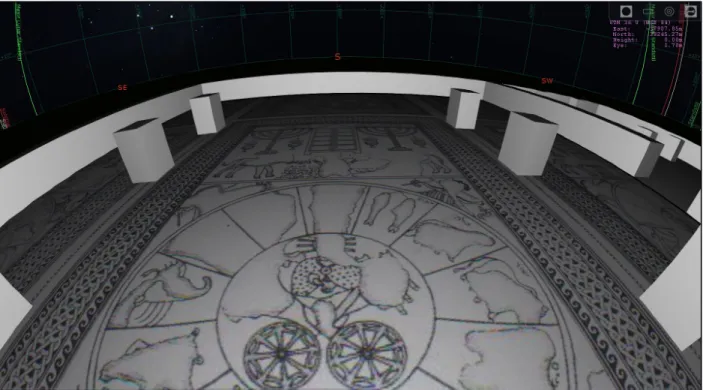
4. Simulated the night sky for a given year when the synagogue would have stood. A major component of the first step—creating 3D models—was rendering images of each synagogue’s mosaic floor to test for astronomical alignment with the Helios-zodiac cycle iconography. Because no holistic, high-detailed images existed for any of the mosaic floors, I made photogrammetric models of accessible synagogues.45 Photogrammetry is a process by
which an object or space can be spatially mapped with two-dimensional data. For the accessible synagogues, I created scalable 3D models of synagogue remains from which the mosaic floor
45 For the methodology of creating the synagogue photogrammetric models, see Bradley
Erickson, "Synagogue Modeling Project Report: A Multifaceted Approach to 3D, Academic Modeling," in Ancient Manuscripts in Digital Culture: Visualisation, Data Mining,
could be exported as a texture. These textures were then imported to the 3D models and the planetarium software. The accessible synagogues for which I made photogrammetric models include Beth Alpha, Hammath Tiberias, Sepphoris, and Huqoq. The Na’aran synagogue was reburied following excavation, and the synagogues at Huseifa and Susiya were inaccessible during my research trips to Israel. Portions of the surviving mosaic of the Wadi Hamam synagogue are currently displayed in the Israel Museum and the synagogue itself has been
reburied. For inaccessible synagogues (i.e. Na’aran, Huseifa, Susiya, Yafia and Wadi Hamam) I relied on published photographs and drawings of the mosaic floor instead of creating my own.
The results of the digital study offer new insights into synagogue architecture and the Helios-zodiac cycle. For example, the Beth Alpha synagogue is only preserved to a variable height of 0.55—1.65 m. If there was a window in the back of the apse wall between 3.5—4.5 m above ground level, the sunlight through this window would have struck the Helios medallion on the winter solstice. I discuss the archaeoastronomical analysis in detail in the third chapter where I analyze each synagogue individually.
1.5 Chapter Summaries
The remaining chapters consist of the following:
In chapter two, I survey Jewish literature dealing with astronomical and astrological knowledge. I subdivide my survey into the following categories: historical, calendrical, astrological, and cultic. The survey shows that ancient Judaism had a range of concerns in dealing with the cosmos.
including the direction of its progression (i.e. clockwise or counter-clockwise) and how each zodiac sign within the cycle aligns with the season under which it sits. Special attention is given to the dating of each synagogue and to the orientation of the building’s architecture as it relates to the movement of the sun. In this chapter, I use astronomical data generated from each synagogue’s geo-coordinates, orientation, and archaeological remains. I also contextualize the iconography of the Helios-zodiac cycle with contemporary literature, such as the descriptions of Helios, Oceanus, and the Horai (seasonal goddesses) in the third-to-fourth century Greek epic
Dionysiaca.
In chapter four, I analyze the wider context of how Helios-zodiac cycles were used in the Greco-Roman world including in domestic structures, cultic settings, Mithraea, and astrology boards.
In the concluding chapter, I argue that the synagogue Helios-zodiac cycle represents a
thema mundi—the location of the cosmos at the moment of creation—with emphasis on the Temple Mount as the axis of the cosmos. I contextualize my argument with evidence of cosmic veneration in Judaism, Christianity, and Greco-Roman religious traditions.
---
Chapter 2: Literary Landscape of Ancient Jewish Astronomy and
Astrology
In this chapter, I survey the literary landscape of ancient Jewish engagement with astronomical and astrological narrative. The survey includes texts from the Hellenistic through Rabbinic periods of Mesopotamia, Palestine, and Egypt. The goal of this survey is not to be exhaustive but to display the range of beliefs as well as the development of those beliefs that ancient Jews held about the cosmos. This chapter is a necessary prolegomenon to a discussion of the appearance of zodiac imagery in ancient synagogues. We can only begin to understand the narratives embodied by synagogue zodiacs by first understanding through extant literature how the zodiac and night sky were perceived by ancient Jews. I have broken the literary survey into four sections: historical, calendrical, astrological, and cultic.1 While each section contains its
own short introduction explaining its necessity and setting the stage for the discussion of the texts therein, I provide a summary of the argument made in each section below.
In the historical section, I outline three traditions that herald Enoch, Seth, and Abraham, respectively, as the fathers of astronomical knowledge. I argue that once astronomical
knowledge, likely inherited from Babylon, was established in Judaism, it was important for Hellenistic and Roman Jewish authors to view one of their own ancestors as the progenitor of that knowledge.
1 These four divisions are my own to better organize the discussion. Certain texts contained
In the calendrical section, I survey the varied means of reckoning calendars in ancient Mesopotamia, Greece, and Egypt to argue that the calendrical tradition and thus the means of interpreting the night sky were inherited dually from Babylon and Egypt. I also examine the different calendrical systems at play in ancient Judaism, notably the solar calendar shared by 1 Enoch, Jubilees, and the Dead Sea Scrolls (DSS).
In the astrological chapter, I examine pseudepigrapha, DSS, rabbinic literature, and the
Sepher Ha-Razim to trace different methods of ancient Jewish views of how the movements of the sky affected/were affected by the earth.
In the cultic section, I examine descriptions of the temple and temple implements as reflecting cosmic heavenly realities in the writings of Philo and Josephus.
In the conclusion to the chapter, I synthesize the many currents of ancient Jewish astronomical and astrological thought to set the stage for the discussion of the use of
cosmological narrative in ancient synagogues. We now turn to the first category of astronomical and astrological thought: the Hellenistic to Early Roman Jewish concern of establishing a patriarchal figure as the father of cosmic knowledge.
2.1 Historical
developed in Babylon once Egyptians moved and brought their practices to Chaldea.2 The
first-century BCE Roman statesman Cicero referred to astrology as originating in Babylon and being an inferior practice to that of astronomy.3 In Natural Histories, the first-century historian Pliny
the Elder suggested that the Greek Titan Atlas invented astrology or that astrology was discovered in the kingdom of Egypt or Assyria and brought to Greece.4
A key feature of Greco-Roman astronomy and astrology is that cosmological knowledge is gained through observation. In ancient Jewish thought, it is not through observation but direct revelation that humans gain knowledge of the cosmos, with the exception of one story from Josephus regarding Abraham, which I discuss below.
Three extant traditions claim Jewish forefathers as the progenitors of astronomical knowledge. In the books of 1 Enoch and Jubilees, the figure of Enoch is presented as having received visions of the movements of the heavenly bodies and subsequently passing that knowledge on to his descendants. In one section of Josephus’ Antiquities of the Jews
(Antiquities) and certain Gnostic traditions, Seth is identified as the person to whom God
2 Diodorus Siculus, The Library of History, trans. C.H. Oldfather, LCL 279 (Cambridge, MA:
Harvard University Press, 2015), 1.81.6.
3 Cicero never defines the terms “astronomy” and “astrology,” though based on context, they are
similar to Ptolemy’s definition discussed in Chapter 1 wherein “astronomy” is the movement of the stars and “astrology” is the effect those movements have on the earth. Cicero, “On
Divination,” in On Old Age, On Friendship, On Divination, trans. W.A. Falconer, Loeb Classical Library 154 (Cambridge, MA: Harvard University Press, 2015), 2.87.
4 Pliny the Elder, Natural History, trans. H. Rackham, Loeb Classical Library 330 (Cambridge,
revealed the mysteries of the heavens and who subsequently preserved those mysteries for his descendants on a set of tablets. Elsewhere in Antiquities, Josephus claims that Abraham developed astronomy in Chaldea and then introduced it to Egypt.
2.1.1 Enochic Tradition
The character of Enoch first appears in the genealogy of Genesis 5, which connects Adam to Noah.5 The genealogy follows a formulaic pattern. A forefather is named. That
forefather has a son. That patriarch dies. The son becomes the new patriarch. Enoch is unique in this list not because of the information the authors included about him but because of a peculiar word choice.6 Whereas all the other forefathers prior to Noah are said to have died (Hebrew: תוּמ), Enoch is described as having “walked with God, and ceased to be, because God took him.”51F
7
While it is possible that the verb חַקָל was a figurative description of death, several ancient authors and entire traditions of later Judaism and early Christianity interpreted it to mean that Enoch became immortal. The Septuagint (LXX) translates the verb חַקָל as μετέθηκεν, the aorist indicative active of μετατίθημι, generally meaning to move an object from one place to
5 Gen 5:18-24. Enoch is also mentioned in the genealogy of Adam to Noah in 1 Chronicles 1:1,
which repeats the genealogy in Gen 5.
6 It is of interest, however, that Enoch lived for 365 years (i.e. number of days in an ancient
Egyptian civil year) and is listed as the seventh forefather from Adam in the genealogy (i.e. seven as a significant number representing the number of ancient moving planets).
another.8 The LXX is not the only work to interpret Enoch as having been transported to heaven
instead of dying. In Antiquities, Josephus says that “Enoch lived 365 years and then returned to the divinity, whence it comes that there is no record in the chronicles of his death.”9 He does not
discuss Enoch beyond this reference to the Genesis genealogy.
During the Hellenistic period, a literary tradition developed around the figure of Enoch. 1 Enoch states that Enoch had visions of heaven and even traveled between the heavens.10 The
text of 1 Enoch, however, does not indicate what happened to Enoch following his visionary journeys. In two further Enochic works that rely on material from 1 Enoch, which are often titled
2 Enoch and 3 Enoch, Enoch is brought to heaven to reside there permanently.11 3 Enoch,
which dates to the fifth century, tells the story of a figure named Rabbi Ishmael the High Priest who visits heaven and sees Enoch, who has been transformed into Metatron and serves as the messenger of God.12
8 All LXX references from Detlef Fraenkel and Alfred Rahlfs, Septuaginta: Vetus Testamentum
Graecum. (Göttingen: Vandenhoeck & Ruprecht, 2004).
9 It is also apparent that Josephus used the LXX and not the Tanakh because when the number of
years of a patriarch’s life differs between the two texts, Josephus uses the dates found in the LXX. Josephus, Jewish Antiquities: Volume 1: Books 1-3, trans. H. St. J. Thackeray, Loeb Classical Library 242 (Cambridge, MA: Harvard University Press, 2014), 1.85-86.
10 “1 Enoch,” in The Old Testament Pseudepigrapha, trans. E. Isaac, ed. James Charlesworth,
vol. 1 (Peabody, MA: Hendrickson Publishers, 2013).
11 “2 Enoch,” in The Old Testament Pseudepigrapha, trans. F. I. Andersen, vol. 1 (Peabody,
MA: Hendrickson Publishers, 2013); “3 Enoch,” in The Old Testament Pseudepigrapha, trans. P. Alexander, vol. 1 (Peabody, MA: Hendrickson Publishers, 2013).
The book of 1 Enoch, in addition to being the first known work of the Enochic literary body, is part of a corpus of Genesis-expansion literature that includes Jubilees and the Genesis Apocryphon.13 Fragments of all three works were found among the DSS, which included the
only extant—albeit partially preserved—copy of the Genesis Apocryphon.14 In the Genesis
Apocryphon, Lamech confronts his wife Bethonosh and blames her pregnancy on the
Watchers.15 After Bethonosh assures Lamech that he is the real father, Lamech expresses his
doubts to his father Methuselah. Lamech asks Methuselah to visit Methuselah’s father Enoch. The narrative implies that Enoch would be able to settle Lamech’s questioning because Enoch possessed sacred knowledge of all history, including the siring of Lamech and Bethonosh’s
13 Both Jubileesand the Genesis Aporcyphon appear to reference 1 Enoch. See Jub 4:17-25 in
The Old Testament Pseudepigrapha, trans. O. S. Wintermute, ed. James Charlesworth, vol. 2 (Peabody, MA: Hendrickson Publishers, 2009); 1Q20, The Dead Sea Scrolls: Study Edition: 1Q1-4Q273, eds. Florentino García Martínez and Eibert J. C. Tigchelaar, vol. 1 (Grand Rapids, MI: Eerdmans, 2005).
14 On the Genesis Apocryphon scroll (1Q20), Hebrew letters were used to number different
sections. Only the headings of pe, ‘ayin, and tsadeh remain, suggesting that sixteen sections are missing from the beginning and an unknown number of sections are missing from the end of the work. For a discussion of the discovery and translation of the text, see Géza Vermès, “Genesis Apocryphon: 1Q20,” in The Complete Dead Sea Scrolls in English (New York: Penguin Press, 1997), 48-49.
15 The Watchers are a group of fallen angles introduced in Genesis 6:4, where they are called
םיִל ִפְנַּה (i.e. the fallen ones). The LXX calls them γίγαντες (i.e. giants). In 4QEnoch ar (=4Q202)
child.16 The remainder of the Enochic portion of the Genesis Apocryphon was not preserved but
seems to have included an exchange between Methuselah and Enoch.
Jubilees is a Hellenistic work, the oldest of which is a partially preserved DSS that dates to the end of the second century BCE.17 In Jubilees, Moses receives instruction over the course
of forty days and forty nights on Mount Sanai concerning the division of time and the past and future history of Israel. Jubilees is an expansion of Exodus 24:18 in which Moses enters the cloud of God on Mount Sinai and is said to have stayed there for forty days and forty nights. In the revelatory narrative of Jubilees, Enoch is said to be the first human to learn writing and the accurate movement of the heavenly bodies.18 The author of Jubilees states that Enoch wrote
about the signs of heaven in a book to establish a calendar.19 The book that Enoch is cited as
writing in Jubilees is most likely “The Astronomical Book of Enoch,” which is one of the five sections within the larger work of 1 Enoch. While 1 Enoch is preserved most completely in Ethiopic manuscripts dating to the fifteenth–eighteenth century, four fragmentary Aramaic scrolls of “The Astronomical Book of Enoch”were discovered at Qumran.20 “The Astronomical
Book of Enoch” is concerned primarily with establishing a 364-day solar calendar. The
16 Because of Lamech’s assumption of Enoch’s all-encompassing knowledge, it is likely that the
author of the Genesis Apocryphon was aware of 1 Enoch, making 1 Enoch the earlier of the two works.
17 19 Jubilees scrolls have been identified in five caves at Qumran. Vermès, Complete Dead Sea
Scrolls, 507.
18 Jub 4:17. 19 Jub 4:17.
calendrical component of 1 Enoch is discussed in greater detail in the following section on the calendrical use of Jewish astronomy.
At least two historians of antiquity were also aware of the Enochic tradition of
cosmological revelation. The first-century Greek-born Roman freedman Alexander Polyhistor, quoted in Eusebius’ Preparation for the Gospels, said that the Greeks believed Atlas invented astrology. Polyhistor argued, however, that Atlas was really Enoch and that God had revealed all astrological wisdom to him.21
The Enochic tradition of heavenly knowledge is concerned primarily with the use of an accurate calendar as well as a correct understanding of past and future historical events. Jubilees,
1 Enoch, and the Genesis Apocryphon all display evidence of being written by one or more marginalized groups who claimed their knowledge was correct, in opposition to perceived counternarratives. An example of this is the schismatic use of the 364-day solar calendar discussed in 1 Enoch and Jubilees, contrary to the lunisolar calendar of the Second Temple priesthood. In the Enochic tradition, Enoch is a divine figure who reveals the mystery of the heavens to Israel, without whom Israel would have no knowledge of the cosmos.
21 Eupolomus, in The Old Testament Pseudepigrapha, trans. F. Fallon, ed. James Charlesworth,
2.1.2 Sethian Tradition
Like Enoch, Seth is briefly mentioned in the Genesis 5 genealogy of Adam to Noah.22
In Genesis 5, Seth is the first son of Adam. In Genesis 4, Seth is introduced following Cain’s genealogy, in which Seth is labeled as Adam and Eve’s third son and born as a replacement for Abel.23 It is likely that the Cainite (Genesis 4) and Sethian (Genesis 5) genealogies from Adam
were separate traditions eventually joined together, with the Genesis 5 genealogy being a later priestly addition to the Pentateuch during the Persian period.
In Antiquities, Josephus claims that Adam predicted the world would be consumed by fire and flood at different times. Though Josephus as author attributes the prophecy to Adam in
Antiquities, the character of Adam in Josephus’ writing never makes such a statement. It is likely that Josephus was drawing from the pseudepigraphic, Hellenistic work the Life of Adam and Eve.24 In the narrative, Eve gathers her children following the death of Adam and tells them that
the archangel Michael had informed her and Adam that the world would be judged first by water and then by fire.25 Eve instructs her children to inscribe everything they had seen and heard from
22 Gen 5:3-8. Seth is also mentioned in the genealogy of Adam to Noah in 1 Chron 1:1.
23 In Gen 4, Seth is introduced at the end of Cain’s genealogy as the third son of Adam and Eve. 24 Josephus is likely drawing on the Hebrew or Aramaic text on which the Latin translation of
the Life of Adam and Eve was based. For a discussion of the recension and translational history of the Life of Adam and Eve, see M.D. Johnson, “The Life of Adam and Eve: A New Translation and Introduction,” in The Old Testament Pseudipigrapha, vol. 2, 249-252.
her and Adam on two tablets.26 One tablet was to be made of stone to survive a judgment of
water and the second tablet was to be made of clay so it could survive judgment by fire. The Life of Adam and Eve concludes with a statement that Seth made and preserved these tablets.27
In Antiquities, Josephus says that Seth constructed two pillars that contained “all wisdom of the heavens and the order of the cosmos.”28 Josephus says these pillars were erected in Egypt
and that the pillar made of stone still exists to this day, implying that the pillar of clay was destroyed by the Genesis flood.29
A second-to-fourth century Gnostic tradition heralded Seth and Noah’s wife Norea as the progenitors of the human race. In the fourth century, the church historian Epiphanius of Salamis described this gnostic group as “Sethian Gnostics,” arguing that they had originated in Egypt, and attributed seven literary works to Seth. While Epiphanius does not list their names, two works discovered at Nag Hammadi are relevant to this discussion. The first is Revelation of
26 Andrei Orlov has argued for the existence of an Enochic “two tablets” tradition and has
suggested that Josephus borrowed Enoch’s achievements and attributed them to Seth. While Orlov’s argument demonstrates that later Christian Enochic traditions joined the two patriarchal stories, there is no evidence that Josephus borrowed from Enochic legends. The DSS fragment 4Q203 7 and 8 mention “two tablets” and a “second tablet,” but the name of the author of the tablets is not preserved. It is just as likely that these fragments of 1 Enoch refer to Seth rather than to Enoch. Andrei A. Orlov, “Overshadowed by Enoch’s Greatness: ‘Two Tablets’ Traditions from the Book of Giants to Palaea Historica,” Journal for the Study of Judaism 32 (2001): 137–158; Life of Adam and Eve 50.
Adam.30 In this work, Adam is 700 years old when he reveals secret cosmological wisdom to his
son Seth.31 Revelation of Adam ends with the statement that Seth passed on Adam’s revelation to
his descendants.
A second Gnostic text is The Three Tablets of Seth. This text purports to be the work of Dositheus, a Gnostic leader, who reads from Seth’s tablets and relates their teachings to a group described as “the elect.”32 The tablets consist of a set of seven cosmological hymns. While The
Three Tablets of Seth suggests that Seth authored three tablets whereas the previously described traditions mention two, it is significant that Seth is again viewed as inscribing sacred, esoteric wisdom on tablets for future generations.
Each Sethian tradition claims Seth as the purveyor of divine knowledge. Though Seth learned this knowledge from his parents who in turn learned it from God, it is Seth who recorded and preserved the knowledge for future generations. Seth and Enoch share in a revelatory
tradition through which God has revealed the structure and movement of the cosmos.
30 Also known as The Apocalypse of Adam. See “Revelation of Adam,” in The Nag Hammadi
Scriptures, ed. and trans. Madeleine Scopello and Marvin Meyer (New York: Harper Collins, 2007), 343-356.
31 In the LXX, Adam is said to have lived 930 years, bearing Seth at the age of 230 and then
living for another 700 years. In the Tanakh, Adam lives for 930 years, bearing Seth at the age of 130 and then living another 800 years. The author(s) of Revelation of Adam most likely drew from the LXX tradition and either interpreted the text to mean Adam lived a total of 700 years or that Adam is relating this divine mystery 230 years prior to his death.
32 Three Tablets of Seth in The Gnostic Scriptures, ed. and trans. by Bentley Leyton (New York:
2.1.3 Abrahamic Tradition
Elsewhere in Antiquities, Josephus claims that while living in Chaldea, Abraham was the first to make the monotheistic declaration that God is one.33 He argues that Abraham deduced
the principle of monotheism through observing the irregularities of the movements of the sun, moon, and celestial entities.34 Because these bodies moved irregularly yet in set, regular
patterns, Abraham argued that a greater being must control celestial movement.35 Josephus says
that the Chaldeans rose against Abraham’s teachings, and Abraham was forced to re-settle in Canaan.36
When a famine struck Canaan, Abraham was forced to travel to Egypt. While in route to Egypt, Abraham declared that Egypt was a land of great learning. Abraham said that he would convert to Egyptian religious practices if he determined their practices to be better than his own, or he would convert the Egyptians to monotheism if his practice proved better. Abraham
eventually found favor both with the king of Egypt and the Egyptian intelligentsia. Josephus explains that Abraham taught the Egyptians “arithmetic” (ἀριθμητικὴν) and “astronomy”
33 Although Abraham was known as Abram in the Pentateuch while in Chaldea, Josephus refers
to him interchangeably as Abram and Abraham.
34 Josephus, Ant. 1.155-156.
35 Josephus considers shifting celestial patterns as phenomenon that change from day-to-day,
such as the time of sunset or the apparent length of lunar phases. These irregular patterns, however, take place within larger set patterns, such as the perceived rotation of the sun around earth once in a 365.25-day period. If a higher power controls the regular patterns, it must mean that the irregular patterns contained therein are also controlled by that same power.
36 Josephus cites the ancient historians Berosus, Nicolaus of Damascus, and Hecataeus as
(ἀστρονομία), about which they had no prior knowledge. Josephus adds parenthetically that the Egyptians, following Abraham’s teaching, taught arithmetic and astronomy to the Greeks. It is important for Josephus to portray Abraham as bringing cosmological knowledge to Egypt because in doing so, Josephus lays claim to all Greco-Roman astronomical knowledge as originating in Judaism.37
Josephus was not the only ancient author to discuss Abraham as the forefather of celestial wisdom. In Preparation of the Gospels, Eusebius quotes Polyhistor who quotes from
Eupolomus’ Concerning the Jews of Assyria. In the description, Euplomus writes that Abraham taught the Egyptian priests at Heliopolis science and astrology, recounting that Abraham had learned the practices from the inherited teachings of Enoch while in Babylon.38
It is possible that Josephus discusses Abraham’s astronomical interests as a way of controlling the Abrahamic narrative. If other authors identified Abraham as a Chaldean
astrologer, Josephus may have wanted to recast Abraham as concerned only with the movement of celestial objects and not the influence those objects had on the world. This could also account for why Josephus’s Abraham is the only figure in Jewish literature who learns about the cosmos through observation. Whereas God revealed the order of the heavens to Enoch and Seth,
Abraham learns about cosmic order through observation. If Josephus wants to cast Abraham as a
37 Josephus, Ant. 1.165-168.
38 Eupolomus, The Old Testament Pseudepigrapha, vol. 2, 861-872; Eusebius of Caesarea,
Greco-Roman philosopher, one way to do that is to depict Abraham as an observer of the stars to contradict counter-narratives that portrayed Abraham as a Chaldean astrologer.39
It is of note that Josephus’s story of Abraham and the discovery and teaching of astronomy contradicts Josephus’s earlier story concerning Seth. If Seth learned all celestial wisdom and wrote that wisdom on two tablets—one of which Josephus said was still visible in his day — how could Abraham discover that same material generations later? Josephus never accounts for this discrepancy and likely included two separate cosmological discovery traditions in his writings.
---
The three traditions discussed in this section reflect two distinct methods of relating to the stars. The first is an esoteric method in which knowledge of the cosmos must be learned through revelation. For Seth, Eve passed on the teaching that she and Adam received directly from God. This teaching was recorded on tablets that served as a medium of knowledge in Judaism and Gnosticism. In Enochic tradition, the angel Uriel revealed to Enoch the movements of the planets and stars as well as calendrical time. Enoch returned to earth, teaching his revelation, which by the time of the writing of Jubilees had become a distinct work of its own. In future developments of the Enochic tradition, Enoch no longer resided on earth but in heaven, where he became a divine, mediating figure.
39 For a discussion of Josephus’ portrayal of Abraham as a Greco-Roman philosopher, see Louis
Josephus’ story of Abraham discovering monotheism through the movement of the sky is the only occurrence of a Jewish forefather learning about the divine through observing the stars. Josephus’ goal in telling this story was likely to combat Hellenistic and Greco-Roman narratives that portrayed Abraham as an astrologer.40
2.2 Calendrical
In this section, I briefly analyze the calendars of Babylon, Egypt, and Greece to show how they influenced the calendrical systems of ancient Judaism. I argue that the Jewish
priesthood and civil authorities leading up to the First Jewish Revolt and the Rabbinic class that developed following the revolt maintained a lunisolar calendar that had originally developed in Babylon. Evidence of this exists in the descriptions of calendrical time in the Hebrew Bible, references to Babylonian months in the Elephantine Papyri, and descriptions of festival dates in rabbinic literature. I argue that a competing Jewish solar calendar developed under Ptolemaic influence in the third century BCE in opposition to the lunisolar calendar observed by the
Jerusalem temple authorities and the Seleucids. The chapter begins with a survey of the calendars and calendrical systems of the ancient Near East followed by an analysis of the solar calendars of ancient Judaism.
40 The term “Chaldean” was synonymous with the practice of astrology in antiquity. See Tamsyn
2.2.1 Babylonian Calendar
By the end of the second millennium BCE, the Babylonian calendar had become institutional throughout much of the ancient Near East, having been adopted by the Middle Assyrian Empire and continuing to be used by the Neo-Assyrian Empire, the Neo-Babylonian Empire, the Achaemenid Empire, the Seleucids, the Hasmoneans, the Parthians, and the Nabateans.41 This calendar was lunar and consisted of twelve months of either 29 or 30 days
with a thirteenth intercalated lunar month added every two-to-three years to bring the lunar year into conjunction with the seasons of the solar year.42 Before the calendar became fixed in the
sixth century BCE, a scholarly class of scribes and priests advised the king on when to end the current month and begin the next one.43 Because the New Moon can appear to last for up to
three days, it was not until the first sliver of the waxing crescent moon appeared that the New
41 Mark Cohen, The Cultic Calendars of the Ancient Near East (Bethesda, MA: CDL Press,
1993), 13, 207; Sacha Stern, Calendars in Antiquity (Oxford: Oxford University Press, 2012), 71-72.
42 12 months x 29.5 days = 354 days in a lunar year. The lunar year falls behind the solar year by
10.75 days a year (365 - 354). Prior to the 6th c. BCE, intercalations were ordered by the king. One example is King Hammurabi of the First Babylonian Dynasty (c. 18th c. BCE) ordering that the next month will be deemed a “second Ulul” (i.e. the sixth month of the Babylonian calendar) instead of the beginning of Tašritú (i.e. the seventh month). These intercalations were ordered the month before they occurred since the beginning of the following month was tied to the appearance of the New Moon. For Hammurabi, see Britton and Walker, “Astronomy and Astrology in Mesopotamia,” in Astronomy before the Telescope (London: British Museum Press), 45; Stern, Calendars, 95. For the division of the year, see Wayne Horowitz, “Sundays in Mesopotamia,” in Living the Lunar Calendar, ed. Jonathan Ben-Dov et. al. (Oxford: Oxbow Books, 20012), 9; Robert Chadwick, “The Origins of Astronomy and Astrology in
Mesopotamia,” Archaeoastronomy (1984): 91.
43 Simo Parpola, “Part 2 A: Introduction and Appendixes,” in Letters from Assyrian Scholars to