Effectiveness and cost-effectiveness of a proactive, goal-oriented,
integrated care model in general practice for older people. A cluster
randomized controlled trial: Integrated Systematic Care for older People
– the ISCOPE study
Short title: Effectiveness and cost-effectiveness of an integrated care model in general practice: the ISCOPE-study
1
2
3
4
5 6 7
8 9
Copyright
The Corresponding Author has the right to grant on behalf of all authors and does grant on behalf of all authors, a worldwide license to the Publishers and its licensees in perpetuity, in all forms, formats and media (whether known now or created in the future), to i) publish, reproduce, distribute, display and store the Contribution, ii) translate the Contribution into other languages, create adaptations, reprints, include within collections and create summaries, extracts and/or, abstracts of the Contribution, iii) create any other derivative work(s) based on the Contribution, iv) to exploit all subsidiary rights in the Contribution, v) the inclusion of electronic links from the contribution to third party material where-ever it may be located; and, vi) license any third party to do any or all of the above.
Competing interests: none declared.
Funding/Support: This study was funded by ZonMw, the Netherlands, Organization for Health Research and Development: ZonMw No. 311060201.
Role of the Sponsor: The sponsor had no role in the design and conduct of the study; collection, management, analysis, and interpretation of the data; and preparation, review, or approval of the manuscript.
Ethical approval
The medical ethical committee of Leiden University Medical Center approved the study in 2009.
Trial registration
Netherlands trial register, NTR1946. 12
Abstract
Background
Older people often experience complex problems. Because of multiple problems, care for older people in general practice needs to shift from a ‘problem-based, disease-oriented’ care aiming at improvement of outcomes per disease, to a ‘goal-oriented care’, aiming at improvement of functioning and personal quality of life, integrating all health care providers. Feasibility and cost-effectiveness of this pro-active and integrated way of working is not yet established.
Methods
Design: Cluster randomized trial.
Participants: all persons aged ≥75 years in 59 general practices (30 intervention, 29 control), with a combination of problems, as identified with a structured postal questionnaire with 21 questions on 4 health domains.
Intervention: for participants with problems on ≥3 domains general practitioners (GPs) made an integrated care plan using a functional geriatric approach. Control practices: care as usual. Outcome measures: i) quality of life (QoL), ii) activities of daily living, iii) satisfaction with delivered healthcare and iv) cost-effectiveness of the intervention, at 1-year follow-up. Trial registration: Netherlands trial register, NTR1946.
Results 31
32 33
34 35 36
37 38
39 40 41
42 43
44 45 46
Of the 11,476 registered eligible older persons, 7285 (63%) participated in the screening. 1921 (26%) had problems on ≥3 health domains. For 225 randomly chosen persons a care plan was made. No beneficial effects were found on QoL, patients’ functioning or healthcare use/costs. GPs experienced better overview of the care and stability, eg. less unexpected demands, in the care.
Conclusions
GPs prefer proactive integrated care. ‘Horizontal’ care using care plans for older people with complex problems can be a valuable tool in general practice. However, no direct beneficial effect was found for older persons.
53 54
55 56 57
58 59
Introduction
With the aging population an ever-increasing number of older people with multiple health problems will be depending on health care. In recent decades health care has tended to be organized by means of problem-based, disease-oriented care programs. However, one disease and/or its intervention could influence the diagnosis, impact or treatment of another disease. These interactions between diseases and their treatment complicate the determination of disease-specific treatment goals. Thus, for older persons with multiple health problems, this model does not suffice [1;2].
In these older patients, illness presentation and the consequences of disease is better clarified with integrative disease models rather than by simple medical models [1]. Since wellbeing and providing for oneself without assistance from others is of increasing importance for older patients with multiple health problems [3], care for older people needs to shift from problem-based, disease-oriented care aiming at improvement of outcomes per disease, to goal-oriented, integrated care. An integrated, care model, aiming at global health outcomes, is more suitable than a model mainly aiming at improving individual disease outcomes [4]. The problems older people are facing are not always known to care providers. The general practitioner (GP) may sometimes suspect the presence of some of these problems, but usually only acts on demand. Therefore, this model of care should be provided in a proactive way in order to set and prioritize goals together with the patient and to empower the patient to reach these goals.
63
64 65
66 67 68
69 70
71 72 73
74 75
76 77 78
79 80
81 82 83
Although this shift in care model sounds ideal in theory, actual implementation in primary care can be difficult. Models that have been investigated, range from light interventions to intensive guided care [5-7]. However, until now, no important positive effects have been shown. Also, although some studies examined cost savings, to our knowledge few studies have evaluated cost-effectiveness.
Both systematic reviews reported on complex or multi-factorial interventions to prevent functional decline and hospitalisation. The review of Beswick et al showed an effect on nursing home admission, hospital admission and physical functioning and the review of Lin et al showed no benefit on hospitalizations and institutionalisations and a small effect on functional ability. The effect of complex interventions could probably be larger if the people who are most likely to benefit are targeted. Simple and effective screening is therefore needed [8]. In the
abovementioned two systematic reviews the included studies used several selection tools to target the interventions, such as the opinion of the physician about the person’s health, computer assisted predictive index for risk of hospitalisation, and functional decline and tests for physical functioning. Often somatic or physical problems were used to select people for interventions. As we found in our research that complex problems, i.e. the accumulation and interaction of
different health problems, also psychological and social health problems, lead to a decline in physical, mental and social functioning [9], in our study we aimed our intervention at those who have problems in several different health domains. Also the intervention targets multiple health domains.
The ISCOPE (Integrated Systematic Care for Older PEople) study aims to assess the effectiveness and cost-effectiveness of a simple structural monitoring system to detect the 85
86
87 88 89
90 91
92 93 94
95 96
97 98 99
100 101
102 103 104
105 106
deterioration in somatic, functional, mental or social health of individuals aged 75 years and over followed by the execution of a care plan for those people with a combination of somatic,
functional, mental and social problems. The ISCOPE study operationalizes horizontal care by developing a care plan for older persons with complex problems, i.e. a combination of
functional, somatic (health and illness), mental and/or social problems. The care plan focuses on function rather than on disease and aims to restore, maintain or maximize functional
independence, or to compensate for loss of autonomy by appropriate support (functional approach). Although the approach is functional, underlying disease can still be a focus of attention. The goals, wishes and expectations of the older person are the starting point for the care plan [10]. To identify older persons with complex problems pro-actively, the ISCOPE study uses a simple structural screening and monitoring system to detect deterioration in somatic, functional, mental or social health of individuals aged ≥ 75 years, and brings this to the attention of the general practitioner (GP).
108 109
110 111 112
113 114
115 116 117
118 119
Materials and Methods
Design Overview
The study is an observer-blinded cluster randomized-controlled trial with randomization at the level of the general practice. To avoid contamination we used a complete consent
pre-randomization design [11;12]. The Medical Ethical Committee of the Leiden University Medical Center approved the study. The study was registered in the Netherlands Trial Register
(NTR1946).
Setting and Participants
Recruitment of general practices
All 560 GPs in the region of Leiden, the Netherlands, were invited to participate. In the initial invitation letter, we provided as little information as possible about the intervention to prevent behavioral change in the control group of GPs [13]. Before inviting the older people to
participate, we asked GPs to classify all enlisted older people into three categories according to their own perception: i) not vulnerable, ii) possibly vulnerable, and iii) vulnerable. The GPs were asked to classify their older people according to their perception of vulnerability of the older person in order to capture characteristics of the non-responder group. GPs were not provided with a specific definition of vulnerability. Instead, they were asked to indicate ‘in their opinion’ which of their patients were considered vulnerable in the context of this study. [14]
Recruitment of participants 122
123
124
125
126 127
128 129 130
131
132 133
134 135
136 137 138
139 140
In the Netherlands all community-dwelling persons are registered at a GP. During the inclusion period (September 2009 to September 2010) all persons aged ≥ 75 years received an invitation by mail from their GP to participate in the study. The GPs excluded people with terminal illness or an expected life expectancy of ≤ 3 months. Also included with this invitation were a screening questionnaire (Additional file 1) addressing four domains of health and an informed consent form. All older people who participated in the screening provided written informed consent. After 3 weeks the non-responders were contacted again by telephone and, if required, were assisted by telephone or visited at home to fill in the screening questionnaire. A total of 7285 older persons responded by sending in the complete screening questionnaire (Fig. 1).
Randomization and Interventions
Training of GPs
After randomization (after screening), the GPs and practice nurses of the intervention practices were trained (during 2 sessions of 3 hours each) by a GP specialized in geriatric care to deliver pro-active integrated care, including designing, conducting and adjusting a care plan (Text box, Additional file 2). The GPs practiced care plan making during the training period with two or three older patients within their own practice. During the intervention the GPs had the possibility to consult a GP with special post-graduate training in geriatricsand they received an extra training of three hours on resources and organization of care to older people in primary care.
Screening questionnaire
The screening questionnaire contained questions on four domains of health: functional, somatic (health and illness), mental and social and each domain contained 4-9 questions.[9] A positive answer to two or more questions in a domain led to a positive score on the domain. The 144
145
146 147 148
149 150
151 152 153
154 155
156 157 158
159 160 161 162 163 164
questions were derived from existing validated questionnaires [15-18] and were based on predictors related to functional decline. [19-22] The screening questionnaire captures
accumulation and interaction of deficits.[9] Individuals with problems on three as well as four domains were classified as having complex problems which is associated with poor outcomes on disability, feelings of loneliness, health related quality of life and GP contact time.[9] In the intervention practices, the GPs received the results of the screening questionnaire of their own patients. In the control practices, GPs did not receive feedback about the screening questionnaire and provided care as usual to their older patients.
Care plan
In the intervention practices, the GP or the practice nurse (under supervision of the GP) made an integrated care plan for participants with complex problems. This care plan consisted of two steps. The first was an inventory of the existing health problems using problem areas as introduced by Bangma, stemming from Dutch rehabilitation medicine: somatic, activities of daily living, social, mental and communicative problems [23]. The wishes and expectations of the older person about goals to be achieved were explored in a dialogue with the participant and informal caregiver(s). Subsequently, a care plan was made, taking the priorities and goals of the older person and informal caregiver as a starting point (Additional file 3). The GP/practice nurse, together with the older person, formulated actions to be taken and evaluation plans for follow-up. Other care professionals were involved where needed (multidisciplinary consultation). For the purpose of the present study, in order to be able to complete the care plans within the set time period of the study, the participating GPs made care plans for a maximum of 10 randomly chosen participants with complex problems. These care plans were made in a time period of two 168
169
170 171 172
173 174
175 176 177
178 179
180 181 182
183 184
185 186 187
188 189
to three months. For the other selected participants care plans could be made after the first ten randomly chosen participants. For the participants with complex problems who were not selected usual care was provided. These participants were not included in the final analysis.
Outcomes and Follow-up
At baseline and at 1-year follow-up participants were visited by a research nurse to measure outcomes. At 6 months post-baseline the EQ-5D was sent by mail.
To show the outcome of the screening a comparison was made between participants with complex problems and participants without complex problems with data from the EPR and data from the questionnaires.
Primary outcome
The primary outcomes were quality of life at 1-year follow-up and competence in activities of daily living. Quality of life was measured by Cantril’s ladder that has steps ranging from 0 to 10. [24] Activities of daily living was measured with the Groningen Activities Restriction Scale (GARS). [25] The GARS is a questionnaire that assesses disabilities in competence in 9 BADL items and 9 IADL items. (range 18-72, higher score means more disability).
These primary outcome measures were chosen because our ultimate goal was to improve functioning and the ability to live independently. As we expected improvement of functioning might not always be feasible to achieve but quality of life can still be influenced, we chose ADL-functioning as well as quality of life as primary outcomes.
191 192
193 194
195
196 197 198 199 200
201 202 203 204
205 206
207 208 209
210 211
Secondary outcomes
Because we used a comprehensive intervention we used a wide array of secondary outcomes. As secondary outcomes we examined satisfaction with delivered care of the older persons, the GPs and informal caregivers .
Older people: Participants were asked to indicate their satisfaction with and confidence in their GP, pharmacist, specialist, physiotherapist, hospital and home care on a 5-point Likert scale. The 5 levels of satisfaction were then dichotomized into ‘satisfied’ (including very satisfied, satisfied and neutral) and ‘dissatisfied’ (including dissatisfied and very dissatisfied) [26]. Answers to the questions regarding confidence were dichotomized in the same way.
General practitioners: Outcomes related to the experiences of the GPs were established with questionnaires and focus groups. At baseline and at 1-year follow-up, questionnaires were sent to GPs in the intervention group asking them about the overview of care needs, stability in the care situation, and (expected) improvement in the care situation for each participant for whom they had made a care plan (answers on a 10-point scale). To evaluate the experiences of the GPs with the screening and care plans, two focus groups were organized (each with four GPs). In both groups, three GPs had extra staff available to enable them to place more focus on the care of their older patients. The first group consisted of GPs who did not manage or only partly managed to complete care plans, and the second group consisted of GPs who completed all the care plans.
Informal caregivers: At baseline and at 1-year follow-up, informal caregivers were sent a questionnaire about the amount of time spent on care for the older participant (hours per week spent on household activities, personal care, and activities outside the house), the burden of this care (score 0-10) and their quality of life (score 0-10) [27].
Other secondary outcomes 214
215
216 217 218
219 220
221 222 223
224 225
226 227 228
229 230
231 232 233
Cognitive function was measured with the Mini-Mental State Examination (MMSE) with scores ranging from 0-30 points (higher score means less cognitive problems) [28]. Depressive
symptoms were assessed with the 15-item Geriatric Depression Scale (GDS-15), with scores ranging from 0 (optimal) to 15 (higher score means more depression) [29]. The GDS-15 was administered only to participants with an MMSE score ≥ 18 points. Self-rated health was measured using the question ‘How do you rate your health in general?’ on a 5-point scale ranging from 1 to 5, and the question ‘How do you rate your health compared to one year ago?’ on a 5-point scale ranging from 1 to 5. Self-rated loneliness was assessed with the Loneliness Scale of De Jong Gierveld (DJG) an 11-item questionnaire covering both emotional loneliness (6 items) and social loneliness (5 items) that was specifically developed for use in elderly
populations (higher score means more social problems) [18].
Since the study was aimed at identifying older people with complex problems, we also evaluated combined outcomes indicating complexity. We used the total score on the ISCOPE screening questionnaire and a combined Z score of the GARS score (functional domain), self-rated health (somatic domain), GDS score (mental domain), and DJG score (social domain).
Process evaluation and contents of the care plan
The content of the care plans is described by the median number of defined problems, goals and actions (with interquartile range; IQR), the percentage of problems, goals and actions, and the ‘level’ of functional approach used in the description of the problem-goal-action sequence: handicap/limitation, complaint/symptom, disease/diagnosis, other. To categorize the problems, type of goals and type of actions we used a partly deductive (start with predefined categories 238
239
240 241 242
243 244
245 246 247
248 249
250 251 252
253 254
255
256 257
based on anatomic areas for the problems) and partly inductive (include extra categories) process.
Sample size
The required sample size was based on the change in BADL. In the Leiden 85-plus Study we found a decrease of ~1.4 points per year, with a standard deviation (SD) of 3 [21;30]. Based on this result we decided on a change of 1.0 point as a clinically relevant difference. With a power of 85%, a significance level of 0.05 we needed a sample size of 163 patients per group (IBM SPSS Sample Power 3). To take cluster randomisation into account we used the following formula: ESS = mk / (1+ ICC(m-1)) with m = number of vulnerable elderly of 75 years and older in a general practice, k = number of practices, ESS = “effective sample size” as calculated as if we use randomization on a patient level [31]. Assuming that about 10 participants with complex problems would be feasible per general practice, an intra-cluster correlation coefficient (ICC) of 0.05 [31], and also taking dropout into account, it was estimated that about 60 general practices should be recruited.
Analysis non-response screening
To compare responders (with and without complex problems) and non-responders, we used patient data from two health centers: a rural and a city GP health center (total of 629 patients) who participated in the ISCOPE study. Anonymous data from the electronic patient records (EPR) were available for participants and non-participants. A comparison was made of socio-demographic data, diseases (International Classification of Primary Care (ICPC) codes), medication, use of care, and the GP’s appraisal of vulnerability. For each health domain, 261
262 263
264
265
266 267
268 269 270
271 272
273 274 275 276
277
278
279 280
corresponding items in the EPR were compared (e.g. for the functional domain the number of home visits and number of referrals to physiotherapy were compared, and for the somatic domain the number of prevalent diseases (ICPC-codes) was compared).
Statistical Analysis
Descriptive statistics were used to compare baseline characteristics of the participants in the intervention and control practices. Means and SD are used for continuous variables that were normally distributed and medians with IQR for continuous variables that were not normally distributed. Proportions are used to describe differences in categorical variables. In both groups, mortality differences between participants with complex problems were analyzed using Cox regression analysis. Differences in median scores between baseline and follow-up in the GP questionnaire were tested with Mann-Whitney U-tests, because incomplete scoring in the GP questionnaires prevented a paired analysis,
The primary analysis focused on the difference in Cantril’s ladder score and ADL score (GARS BADL and IADL) between participants with complex problems for whom a care plan should have been made (intervention group) compared with all participants with complex problems in the care as usual practices (control group).
Analyses were performed on an intention-to-treat basis and per protocol basis. A sensitivity analysis for effectiveness was performed in the group of participants with problems in 4 domains. A linear mixed model (LMM) analysis was used, correcting for age, sex, baseline scores and clustering of patients per general practice. The model included a variable for time of measurement (baseline and 1-year follow-up) and a variable for allocation (with value 0 in 284
285
286 287
288
289 290 291
292 293
294 295 296 297 298
299 300
301 302 303
304 305
control patients and value 1 at 1 year follow-up in intervention group patients). The estimate for time of measurement shows the change in score for the control group. The estimate for the allocation shows the difference in change in score between the intervention and control group. Because we assumed that the intervention would have no effect on mortality (which was
confirmed by the analysis on mortality) and we were exploring the effect in those that survived, participants who died during follow-up were excluded from the primary outcome analyses. The LMM analysis corrects for outcomes missing at random.
Analysis of focus groups
Focus group interviews were recorded and transcribed verbatim. We used thematic analysis
involving coding, categorizing and theme identification. All incentives and barriers for screening and care plans mentioned in the verbatim reports were coded and analysed independently by two
researchers (JWB, WdE).
Economic evaluation
The cost-effectiveness of the intervention from a societal perspective during the 1-year follow-up was analyzed (Additional file 4).
Role of the funding source
This study was funded by ZonMw, the Netherlands Organization for Health Research and Development: ZonMw No. 311060201. The sponsor had no role in the design and conduct of the study; collection, management, analysis, and interpretation of the data; and preparation, review,
or approval of the manuscript. 307
308
309 310 311
312 313
314 315 316
317 318
319 320 321
322 323
324
325
326
Results
Participants
General practitioners
Of the 560 GPs approached, 104 (19%) working in 59 general practices agreed to participate. Concern about the workload was the main reason for non-participation (28%); also, 4% had just left the practice, 4% had very few older people enlisted, 7% were not interested in the project, and 4% already implemented an intervention in the care for their older patients. The remaining practices had other reasons for non-participation or did not respond (34%).
The participating practices were representative for the urbanized area in the vicinity of the city of Leiden (the Netherlands).
Older people
The participation of older persons is shown in Fig. 1. Of the 12,066 registered people aged ≥ 75 years, 590 (5%) were not eligible because they were deceased (0.9%), too ill (1.4%), admitted to a nursing home (1.1%), non-Dutch speaking (0.3%), or for other reasons (1.1%).
Screening
Of the 11,476 registered eligible older persons, 7285 (63%) participated in the screening and 4191 (37%) declined or did not respond for other reasons. One third of the population (2240, 31%) was assisted by a relative (n=1396, 19%) or a research nurse (n=844, 12%).
330
331
332
333
334 335
336 337 338
339 340
341 342 343
344 345
346
347
348
Non-response analysis
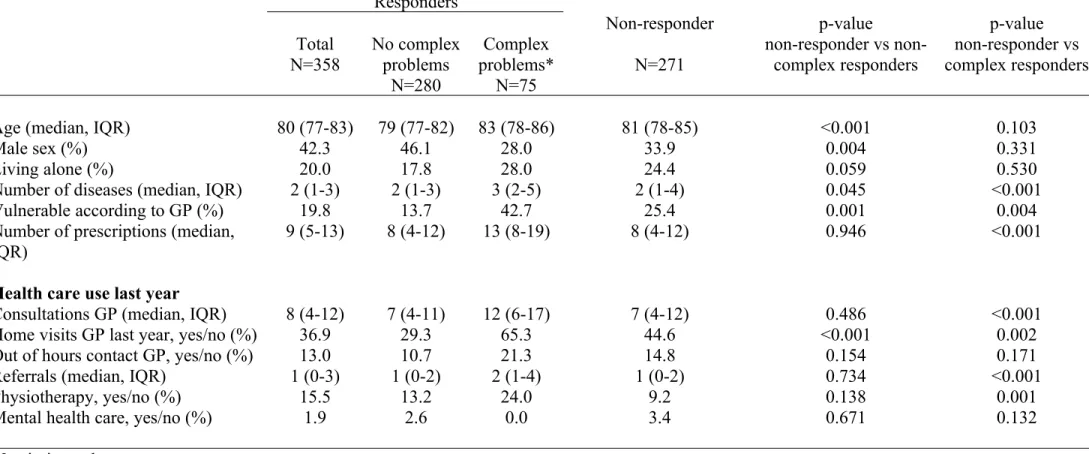
responders are compared to responders (both non-complex and complex) in table 1. Non-responders had the same number of disease and prescriptions but were more vulnerable
according to the GP than non-complex responders. Complex responders had more disease and prescriptions, and were more vulnerable according to GP than both other groups. Health care use in non-responders was similar to non-complex responders. Complex responders had more GP consultations, GP home visits, physiotherapy and primary mental health care than both other groups.
Screening results
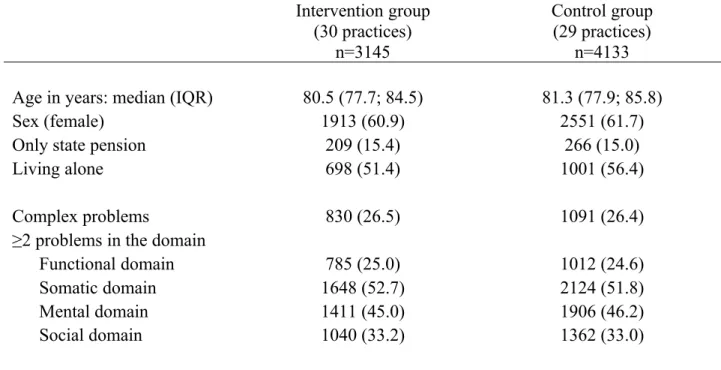
Table 2 shows the characteristics and screening results of participants who returned the screening questionnaire in the 30 intervention practices and of participants in the 29 control practices. Median age, sex, income, living circumstances and outcomes of the screening questionnaire were similar. Overall, 26% of the participants had complex problems. Participants with complex problems have a poorer score on all questionnaire outcomes compared to participants without complex problems (see additional tables).
Participants with complex problems
Non-response analysis of participants with complex problems
At baseline there were no significant differences in sex and reasons for non-participation between non-participants in the intervention group and non-participants in the control group (Fig.1; p-values see additional tables). The median age of the non-participants in the control 352
353
354 355 356
357 358
359 360 361
362 363
364 365 366
367 368
369
370 371
group was higher than that in the intervention group (84.2 vs 82.5 years; p=0.038); At the follow up measurement this was 83.1 vs 84.1; p=0.536.
Comparison of outcomes between intervention and control groups
Intra-cluster correlation coefficient
After analysis of the data we found an ICC of 0.002. Post hoc, a power of 85% was calculated for this study.
Patient outcomes
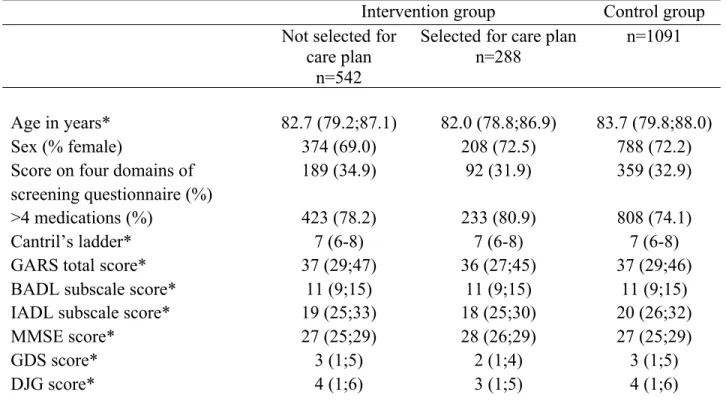
In total 288 participants with complex problems were randomly selected for a care plan out of the intervention practices. Table 3 shows the characteristics of the participants with complex problems in the intervention and control practices. Participants in the intervention practices selected for a care plan (n=288) were similar to those who were not selected for a care plan (Table 3).
During the 1-year follow-up, 19 (6.6%) participants in the intervention group and 87 (8.0%) in the control group died (p=0.479).
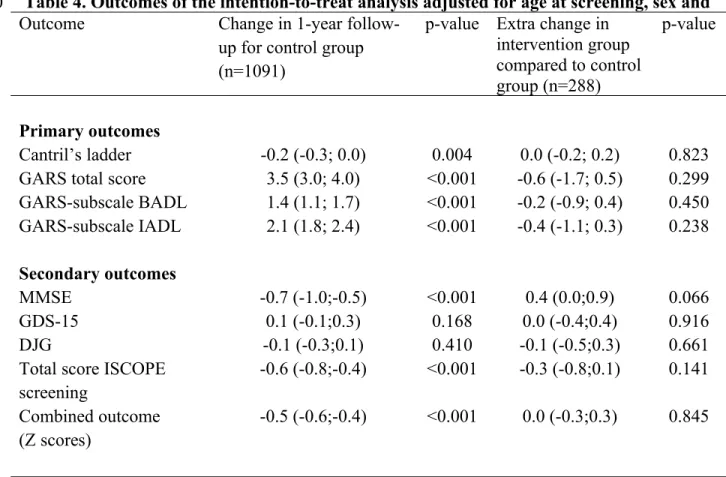
Table 4 presents the primary and secondary outcomes for the intention-to-treat analysis. In the control group the change in GARS score at 1-year follow-up (3.5; 95% confidence interval (CI): 3.0; 4.0) shows that this group is deteriorating rapidly. There was no difference in change in the score on Cantril’s ladder or GARS score (total, BADL or IADL) between participants who were 374
375
376 377
378
379 380 381
382 383
384 385 386
387 388
389 390 391
392 393
randomized to have a care plan made in the intervention group and participants with complex problems in the control group. Also, there was no difference in secondary patient outcomes. In a per-protocol analysis, i.e. in the intervention group only including participants for whom a care plan was made, no difference was found between the two groups (see additional tables). A sensitivity analysis in participants with problems in 4 domains showed similar results.
Satisfaction with care
Older people’s satisfaction with care
During the 1-year follow-up, the number of people satisfied with the GP increased in the intervention group (from 96.8% to 97.8%, p=0.218) and decreased in the control group (from 94.5% to 93.7%, p=0.039). No difference between the two groups was observed on confidence in the GP, or on satisfaction with and confidence in the other care providers.
GPs’ satisfaction with care
GPs returned baseline questionnaires for 202 participants with a care plan and returned 1-year follow-up questionnaires for 146 of these participants. GPs reported an improvement in the overview of care needs [from median 7.0 (IQR 6.0-8.0) to 8.0 (IQR 7.0-9.0); p<0.001] and experienced more stability in the care situation [from median 7.0 (IQR 6.0-8.0) to 8.0 (IQR 7.0-8.0); p<0.001]. Although baseline expectations for improvement in the care situation were low, the reported actually experienced improvement at 1-year follow-up was good [median 5.5 (IQR 2.0-7.0) and 7.0 (IQR 6.0-8.0), respectively; p<0.001].
397 398
399 400 401
402 403
404 405 406
407 408
409 410 411
412 413
414 415 416
In the focus groups the GPs felt that new information had emerged from the screening, indicating (in particular) their possible ‘blind spot’ for mental and social issues. Some GPs feared that ‘medicalization’ was stimulated by the screening. GPs experienced more control over the care situation and were more aware of the functioning and wishes of the older people. However, they found the protocolized way of working difficult and suggested that it was perhaps more suited to the practice nurse. Some GPs preferred to focus on the medical task. Organising
multidisciplinary consultations was found to be cumbersome.
Informal caregivers
Of the 269 responding informal caregivers (40 in the intervention group, 143 in the control group), the majority were children of the older person (60% and 59%, respectively); their median age was 61 (IQR 51-70) years and 62 (IQR 56-75) years, respectively; and in the intervention group 35% was male compared with 28% in the control group. The intervention group spent a median number of 5 (IQR 2-20) hours per week on household activities, 3 (2-14) on personal care and 4 (2-6) hours on outside activities. For the control group this was 5 (IQR 3-12), 3 (IQR 1-10) and 3 (IQR 1-7) respectively. Between baseline and 1-year follow-up there was no
significant difference between the groups in the (change in) time spent on care for the older participant, the burden felt by the informal caregiver, and their quality of life (see additional tables).
Process evaluation and content of care plan
A total of 288 randomly chosen participants with complex problems were assigned to receive a care plan. Of these, in 7% (n=20) the GP indicated that the drafted care plan was not carried out 419
420
421 422 423
424 425
426 427 428
429 430
431 432 433
434 435
436 437 438
439
due to death, referral to a nursing home, moving house, etc. In 15% (n=43) the GP did not prepare the care plan due to time constraints or other logistic problems. Three GPs did not manage to make any care plan at all. The median number of problems, goals and actions in the care plans was 3 (IQR 2-4), 4 (2-5) and 3 (2-5), respectively. The five most prevalent problems were: depressive complaints (20% of patients), loneliness/isolation (19%), decreased mobility (19%), memory complaints (17%), and hearing complaints (12%). The five most prevalent actions were: action by the patient or informal caregiver (13% of actions), such as engaging in social activities, referral to another physician (9%), further diagnostic interventions (9%), frequent check-up by the GP (7%), and optimizing the medication (7%). In the problem-goal-action sequences, 46% of descriptions were expressed as handicap/limitation, 46% as complaint/ symptom and 8% as disease/diagnosis.
Economic evaluation
Costs were estimated at €236 per care plan (Additional file 4), which includes training of GPs and practice nurses (16%), screening (21%), making the care plan (30%) and carrying out the care plan (34%). These care plan costs constituted only 1.3% of the total healthcare costs during the 1-year follow-up. No differences were found in the use of other types of healthcare or in total health care costs.
442 443
444 445 446
447 448
449 450 451
452 453
454
455 456
457 458 459
Discussion
This study evaluated a proactive horizontal approach by the GP for older patients, consisting of a brief (postal) screening questionnaire and making an integrated care plan for (some) patients with complex problems. The GPs had successfully taken on the functional approach, as seen from the contents of the care plans. GPs experienced better overview of care needs and more stability, eg less unexpected care demands, in the care for individual patients with complex problems. Older patients with complex problems were already largely satisfied with the care offered by their GP and the change in satisfaction was therefore small. Nevertheless, no
significant improvement was found in quality of life or functional status after 1-year follow-up in participants with complex problems in the intervention group compared with those in the usual care group. In addition, there was no significant difference in change of somatic problems and mental/social functioning, or in complexity. Except for the care plans, patients in the intervention group had the same amount of healthcare use and costs as the control group.
Comparison with literature
Two systematic reviews evaluated studies on complex interventions (with individualized assessment and provision, or referral to appropriate care) to prevent functional decline in older people [5,6]. Although one review showed a reduction in admissions to hospitals/nursing homes, a reduction in falls, and an improvement in functioning, the effects were only modest [5].
Moreover, the effects were mainly in studies conducted before 1993, suggesting that modification of care after 1993 was of little additional value; this idea has recently been confirmed [32]. The more recent review showed small effects on functioning, but mainly in 461
462 463
464 465 466
467 468
469 470 471
472 473
474 475 476
477 478
479 480 481
studies performed in the US and not in non-US countries [6]. This latter review showed no effects on hospitalization, institutionalization or mortality; in addition, due to significant heterogeneity between the reviewed studies, the net benefit could not be determined [6]. Two other systematic reviews on comprehensive care programs for people with multi-morbidity were also unable to determine net benefit due to heterogeneity [33, 34]. The present study also
examined the cost-effectiveness and preferences of GPs and older persons which, until now, has scarcely been investigated.
Strengths and limitations
The ISCOPE study was performed in a large number of practices in urbanized and sub-urbanized areas, involving single-handed practices and group practices, thereby guaranteeing
generalizability to other practices in the Netherlands. Outcomes were measured during home visits, thereby increasing the reliability and completeness of the measurements. Because about 37% of the older people did not participate in the ISCOPE study, this could have led to a selection of healthier (or perhaps less healthy) older persons or people more likely to accept the suggested intervention. A non-response evaluation showed that non-participants were slightly more vulnerable than the participants; this difference might decrease with more extensive reminding procedures.
Although only three GPs were unable to make any care plan, we have no data on the fidelity to the intervention after the initial establishment of the care plan. This might have been an issue contributing to the lack of effect.
484 485
486 487 488
489 490
491 492 493
494 495
496 497 498
499 500
501 502 503
We were unable to obtain repeated assessments over a longer period. Repeated assessments might have amplified the proactive aspect of the intervention, possibly leading to a detectable effect on the outcomes.
Possible reasons for no effect in functioning
There are a few possible reasons for the lack of effect on the functioning of older persons in the present study. First, many changes in the care for older people in primary care have been instigated since the early 1990s [5]. The present study started in a climate of growing interest in preventive and proactive care for older people, which ensured enthusiasm among participating GPs; government and care professionals were already moving in this direction. In 2007 the National Program for Elderly Care was set up, aiming to improve the quality of care for older people by developing coherent care better suited to the individual needs of older persons [35]. Although this climate of change implies that GPs were keen to participate in this study, no extra provisions (i.e. financial compensation to implement proactive care for older people) were yet in place; this keeps the risk of contamination in the usual care practices low. However, GPs (also in the control group) might have had an increased awareness of the need to work proactively for their older patients, as policy reports on this subject were issued in 2007 and 2010 (mission statements of the Dutch College of General Practice (DCGP) [36] and of the Royal Dutch Medical Association [37], and a guideline for the care for older people in general practice issued by the DCGP [36].
Second, unsolicited care programs or other devices might not work because those who would expect benefit from the offered service or device have already obtained it [38-40]. In this study, 506
507
508 509 510
511 512
513 514 515
516 517
518 519 520
521 522
523 524 525
because the initiative for a care plan did not originate from the participant, executing the plan did not bring the desired changes.
Third, interventions targeted at specific risk factor management may be more effective than organizational interventions with a broader focus [33, 34]. Indeed, the focus of our intervention may have been too broad and may have diluted the effect of each particular outcome measure, thus reducing the power to detect a difference. For this reason, we used quality of life as primary outcome and we also investigated combined scores of questionnaires as a secondary outcome; however, this also revealed no effect of the intervention.
Fourth, the intervention may not have been sufficiently intense to be able to cause effect. However, one meta-analysis demonstrated that the intensity of the complex interventions made no difference to its effectiveness [5]. Possibly, the participants were relatively healthy with little room for improvement. However, a sensitivity analysis in the group with problems in 4 domains also failed to show an effect.
Five, a change in approach in organization and delivery of care does not necessarily lead to effects on the level of functioning or quality of life of the patient. The two meta-analyses showed no positive effect on functioning of any of the interventions, possibly due to the use of non-responsive ADL and IADL instruments [5,6]. Perhaps outcomes related to healthcare delivery, such as patient experience with continuity of care [41], or more individualized outcomes such as goal attainment scaling [42], might have elicited more response than traditional outcome
measures of functioning [43-46]. Unfortunately, at the start of the present study, these latter outcomes were not widely available for practical use in research with community-dwelling older people, but might be promising for use in future studies.
528 529
530 531 532
533 534
535 536 537
538 539
540 541 542
543 544
545 546 547
Six, a randomized trial may not be appropriate for this sort of interventions as the services offered comprise a complex mix of uncontrollable variables embedded in a social process, more than a treatment program alone [47]. The success of the offered services depends on factors other than functioning (such as building a relationship with the client, the perceived need for care, past experiences with health care, etc.) which cannot be measured or controlled in such a way as to meet the requirements of randomized controlled trials. The increase in satisfaction with care among both the older people and the GPs might reflect these factors. Although failure to show an effect should not be used solely as an excuse to discontinue the service, it remains important to find evidence regarding the cost-effectiveness of new ways of working.
Implications
The question remains as to which outcomes will convince healthcare professionals and
policymakers in their decision-making regarding implementation of an intervention. The present study showed no beneficial effect on functioning and quality of life of older persons, or on healthcare costs; therefore, this integrated care model cannot be recommended for this particular goal. Nevertheless, in the Netherlands, healthcare organization for older people in general practice has assumed its own momentum. GPs are increasingly interested and motivated to implement proactive care to prevent functional decline in vulnerable older persons [48] and see this as an improvement of their care. Since 2011, health insurers in the Netherlands have provided funding to GPs to innovate services towards proactive care for older people,
encompassing two main elements: case finding and care plans. This lack of congruence between research and policy is an issue that should receive more attention.
550 551
552 553 554
555 556
557 558 559
560 561
562 563 564
565 566
567 568 569
570 571
Integrative and proactive care for older community-dwelling people will probably be an essential instrument in primary care to be able to manage the care since (in the present political climate) the need to cut costs results in more older people living independently in the community rather than in care homes, but still requiring health care. This study also shows that GPs working with a proactive care plan report the benefit of increased stability in the care of older persons. We think that horizontal care using care plans for older people with complex problems can be a valuable tool in general practice. However, since no direct beneficial effect was found for older
persons, based on this study we cannot recommend this intervention to improve patient outcomes in general practice.
573 574
575 576 577
578 579
Acknowledgments
The authors thank the participating practices (GPs, practice nurses and staff), and all the participants and research nurses for their contribution and commitment to the study. We also thank Dr. A.W. Wind (coordinator of the “Postgraduate training for GPs with special interest in the geriatrics” of the Dutch College of General Practitioners, organized by the Department of Public Health and Primary Care. Leiden University Medical Center) for her contribution to the design of the intervention.
583
584 585
586 587 588
References
1. Fried LP, Storer DJ, King DE, Lodder F. Diagnosis of illness presentation in the elderly. J Am Geriatr Soc. 1991 Feb;39:117-23.
2. Tinetti ME. Performance-oriented assessment of mobility problems in elderly patients. J Am Geriatr Soc. 1986 Feb;34(2):119-26.
3. Fried TR, McGraw S, Agostini JV, Tinetti ME. Views of older persons with multiple morbidities on competing outcomes and clinical decision-making. J Am Geriatr Soc. 2008 Oct;56:1839-44.
4. De Maeseneer J, Boeckxstaens P. James Mackenzie Lecture 2011: Multimorbidity, goal-oriented care, and equity. Br J Gen Pract. 2012 Jul;62:e522-4.
5. Beswick AD, Rees K, Dieppe P, Ayis S, Gooberman-Hill R, et al. Complex interventions to improve physical function and maintain independent living in elderly people: a systematic review and meta-analysis. Lancet. 2008 Mar 1;371:725-35
6. Lin JS, Whitlock EP, Eckstrom E, Fu R, Perdue LA, et al. Challenges in synthesizing and interpreting the evidence from a systematic review of multifactorial interventions to prevent functional decline in older adults. J Am Geriatr Soc. 2012 Nov;60:2157-66
7. Boult C, Reider L, Frey K, Leff B, Boyd CM, et al. Early effects of "Guided Care" on the quality of health care for multimorbid older persons: a cluster-randomized controlled trial. J Gerontol A Biol Sci Med Sci. 2008 Mar;63:321-7.
8. Stott DJ, Langhorne P, Knight PV. Multidisciplinary care for elderly people in the community. Lancet. 2008 Mar 1;371:699-700.
9. Van Houwelingen AH, Den Elzen WPJ, Le Cessie S, Blom JW, Gussekloo J. Consequences of interaction of functional, somatic, mental and social problems in community-dwelling older people. PLoS One. 2015 Apr 21;10(4):e0121013.
10. Junius-Walker U, Stolberg D, Steinke P, Theile G, Hummers-Pradier E, et al. Health and treatment priorities of older patients and their general practitioners: a cross-sectional study. Qual Prim Care. 2011;19:67-76.
11. Schellings R, Kessels AG, ter Riet G, Sturmans F, Widdershoven GA, et al. Indications and requirements for the use of prerandomization. J Clin Epidemiol. 2009 Apr;62:393-9.
12. Schellings R, Kessels AG, Ter Riet G, Kleijnen J, Leffers P, et al. Members of research ethics committees accepted a modification of the randomized consent design. J Clin Epidemiol. 2005 Jun;58:589-94.
13. Smelt AF, van der Weele GM, Blom JW, Gussekloo J, Assendelft WJ. How usual is usual care in pragmatic intervention studies in primary care? An overview of recent trials. Br J Gen Pract. 2010 Jul;60:e305-18.
14. Drewes YM, Blom JW, Assendelft WJ, Stijnen T, den Elzen WP, Gussekloo J. Variability in vulnerability assessment of older people by individual general practitioners: a cross-sectional study. PLoS One. 2014 Nov 7;9:e108666.
15. Weeks SK, McGann PE, Michaels TK, Penninx BW. Comparing various short-form Geriatric Depression Scales leads to the GDS-5/15. J Nurs Scholarsh 2003;35:133-137.
16. Steverink S, Slaets JP, Schuurmans H, Van Lis M. Measuring frailty: developing and testing the GFI (Groningen frailty Indicator). Gerontologist 2001;41:236-237.
17. McCusker J, Bellavance F, Cardin S, Trepanier S. Screening for geriatric problems in the emergency department: reliability and validity. Identification of Seniors at Risk (ISAR) Steering Committee. Acad Emerg Med 1998;5:883-893.
18. de Jong Gierveld, J., & Kamphuis, F.H. The development of a Rasch-type loneliness-scale. Applied Psychological Measurement. 1985; 9:289-299
19. Stek ML, Gussekloo J, Beekman AT, van Tilburg W, Westendorp RG. Prevalence, correlates and recognition of depression in the oldest old: the Leiden 85-plus study. J Affect Disord. 2004 Mar;78:193-200
20. Artero S, Touchon J, Ritchie K. Disability and mild cognitive impairment: A longitudinal population-based study. Int J Geriatr Psychiatry 2001;16: 1092–1097.
21. Drewes YM, den Elzen WP, Mooijaart SP, de Craen AJ, Assendelft WJ, et al. The effect of cognitive impairment on the predictive value of multimorbidity for the increase in disability in the oldest old: the Leiden 85-plus Study. Age Ageing. 2011 May;40:352-7
22. Perissinotto CM, Stijacic Cenzer I, Covinsky KE. Loneliness in older persons a predictor of functional decline and death. Arch Intern Med. 2012 Jul 23;172:1078-83
23. Hertogh CMPM, Deerenberg-Kessler W, Ribbe MW. The problem-oriented multidisciplinary approach in Dutch nursing home care. Clin Rehabil. 1996; 10:135-142
24. Cantril H. (1965). The pattern of human concerns. New Brunswick, NJ: Rutgers University Press. 25. Kempen GI, Miedema I, Ormel J, Molenaar W. The assessment of disability with the Groningen
Activity Restriction Scale. Conceptual framework and psychometric properties. Soc Sci Med. 1996 Dec;43:1601-10.
26. Collins K, O'Cathain A. The continuum of patient satisfaction—from satisfied to very satisfied. Soc Sci Med. 2003 Dec;57:2465-70.
27. Lutomski JE, Baars MA, Schalk BW, Boter H, Buurman BM, et al; TOPICS-MDS Consortium. The development of the Older Persons and Informal Caregivers Survey Minimum DataSet (TOPICS-MDS): a large-scale data sharing initiative. PLoS One. 2013 Dec 4;8(12):e81673.
28. Folstein MF, Folstein SE, McHugh PR. "Mini-mental state". A practical method for grading the cognitive state of patients for the clinician. J Psychiatr Res 1975 Nov;12:189-98
29. D'Ath P, Katona P, Mullan E, Evans S, Katona C. Screening, detection and management of depression in elderly primary care attenders. I: The acceptability and performance of the 15 item Geriatric Depression Scale (GDS15) and the development of short versions. Fam Pract. 1994 Sep;11:260-6
30. de Ruijter W, Westendorp RG, Macfarlane PW, Jukema JW, Assendelft WJ, et al. The routine electrocardiogram for cardiovascular risk stratification in old age: the Leiden 85-plus study. J Am Geriatr Soc. 2007 Jun;55:872-7.
31. Killip S, Mahfoud Z, Pearce K. What is an intracluster correlation coefficient? Crucial concepts for primary care researchers. Ann Fam Med 2004 May;2:204-8
32. Metzelthin SF, van Rossum E, de Witte LP, Ambergen AW, Hobma SO, et al. Effectiveness of interdisciplinary primary care approach to reduce disability in community dwelling frail older people: cluster randomised controlled trial. BMJ. 2013 Sep 10;347:f5264.
33. de Bruin SR, Versnel N, Lemmens LC, Molema CC, Schellevis FG, et al. Comprehensive care programs for patients with multiple chronic conditions: a systematic literature review. Health Policy. 2012 Oct;107:108-45.
34. Smith SM, Soubhi H, Fortin M, Hudon C, O'Dowd T. Interventions for improving outcomes in patients with multimorbidity in primary care and community settings. Cochrane Database Syst Rev. 2012 Apr 18;4:CD006560.
35. http://www.nationaalprogrammaouderenzorg.nl/english/the-national-care-for-the-elderly-programme/ 36. http://nhg.artsennet.nl/English.htm
37. http://knmg.artsennet.nl/Over-KNMG/About-KNMG.htm
38. de Craen AJ, Gussekloo J, Blauw GJ, Willems CG, Westendorp RG. Randomised controlled trial of unsolicited occupational therapy in community-dwelling elderly people: the LOTIS trial. PLoS Clin Trials. 2006 May;1:e2.
39. van der Weele GM, de Waal MW, van den Hout WB, de Craen AJ, Spinhoven P, et al. Effects of a stepped-care intervention programme among older subjects who screened positive for depressive symptoms in general practice: the PROMODE randomised controlled trial. Age Ageing. 2012 Jul;41:482-8.
40. Gussekloo J, de Bont LE, von Faber M, Eekhof JA, de Laat JA, et al. Auditory rehabilitation of older people from the general population--the Leiden 85-plus study. Br J Gen Pract. 2003 Jul;53:536-40 664
41. Uijen AA, Schellevis FG, van den Bosch WJ, Mokkink HG, van Weel C, et al. Nijmegen Continuity Questionnaire: development and testing of a questionnaire that measures continuity of care. J Clin Epidemiol. 2011 Dec;64:1391-9
42. Rockwood K, Stolee P, Fox RA. Use of goal attainment scaling in measuring clinically important change in the frail elderly. J Clin Epidemiol. 1993 Oct;46:1113-8
43. Steenbeek D, Gorter JW, Ketelaar M, Galama K, Lindeman E. Responsiveness of Goal Attainment Scaling in comparison to two standardized measures in outcome evaluation of children with cerebral palsy. Clin Rehabil. 2011 Dec;25:1128-39.
44. Rockwood K, Howlett S, Stadnyk K, Carver D, Powell C, et al. Responsiveness of goal attainment scaling in a randomized controlled trial of comprehensive geriatric assessment. J Clin Epidemiol. 2003 Aug;56:736-43
45. Rockwood K, Fay S, Song X, MacKnight C, Gorman M; Video-Imaging Synthesis of Treating Alzheimer's Disease (VISTA) Investigators. Attainment of treatment goals by people with Alzheimer's disease receiving galantamine: a randomized controlled trial. CMAJ. 2006 Apr 11;174:1099-105.
46. Wright JG, Young NL. The patient-specific index: asking patients what they want. J Bone Joint Surg Am. 1997 Jul;79:974-83.
47. Clark J. Preventive home visits to elderly people. Their effectiveness cannot be judged by randomised controlled trials. BMJ. 2001 Sep 29;323:708.
48. Drewes YM, Koenen JM, de Ruijter W, van Dijk-van Dijk DJ, van der Weele GM, et al. GPs' perspectives on preventive care for older people: a focus group study. Br J Gen Pract. 2012 Nov;62:e765-72.
690 691 692 693 694 695 696 697 698 699 700 701 702 703 704 705 706 707 708 709 710 711 712
Appendixes
Appendix 1 Screening questionnaire
Appendix 2 Framework and content of the intervention of the ISCOPE study
Appendix 3 Format of care plan by the general practitioner for older people with complex problems
Appendix 4 Economic analysis Additional tables
Key points
Older people have multiple problems which are not always known to their general practitioner. Proactive, integrated care for older people could improve independence and quality of life but is not common in general practice.
This study investigates feasibility and cost-effectiveness of this way of working. This improves satisfaction of general practitioners about the care.
No effect on outcomes in older people is shown. 714
715
716 717 718
719 720 721 722 723 724 725
726 727
728 729 730
Table 1. Non-response in screening
Responders Total
N=358
No complex problems
N=280
Complex problems*
N=75
Non-responder N=271
p-value
responder vs non-complex responders
p-value non-responder vs complex responders
Age (median, IQR) 80 (77-83) 79 (77-82) 83 (78-86) 81 (78-85) <0.001 0.103
Male sex (%) 42.3 46.1 28.0 33.9 0.004 0.331
Living alone (%) 20.0 17.8 28.0 24.4 0.059 0.530
Number of diseases (median, IQR) 2 (1-3) 2 (1-3) 3 (2-5) 2 (1-4) 0.045 <0.001
Vulnerable according to GP (%) 19.8 13.7 42.7 25.4 0.001 0.004
Number of prescriptions (median, IQR)
9 (5-13) 8 (4-12) 13 (8-19) 8 (4-12) 0.946 <0.001
Health care use last year
Consultations GP (median, IQR) 8 (4-12) 7 (4-11) 12 (6-17) 7 (4-12) 0.486 <0.001
Home visits GP last year, yes/no (%) 36.9 29.3 65.3 44.6 <0.001 0.002
Out of hours contact GP, yes/no (%) 13.0 10.7 21.3 14.8 0.154 0.171
Referrals (median, IQR) 1 (0-3) 1 (0-2) 2 (1-4) 1 (0-2) 0.734 <0.001
Physiotherapy, yes/no (%) 15.5 13.2 24.0 9.2 0.138 0.001
Mental health care, yes/no (%) 1.9 2.6 0.0 3.4 0.671 0.132
Table 2. Characteristics and screening results of participants who returned the screening questionnaire.
Intervention group (30 practices)
n=3145
Control group (29 practices)
n=4133 Age in years: median (IQR) 80.5 (77.7; 84.5) 81.3 (77.9; 85.8)
Sex (female) 1913 (60.9) 2551 (61.7)
Only state pension 209 (15.4) 266 (15.0)
Living alone 698 (51.4) 1001 (56.4)
Complex problems 830 (26.5) 1091 (26.4)
≥2 problems in the domain
Functional domain 785 (25.0) 1012 (24.6)
Somatic domain 1648 (52.7) 2124 (51.8)
Mental domain 1411 (45.0) 1906 (46.2)
Social domain 1040 (33.2) 1362 (33.0)
N (%) unless stated otherwise 733
734 735 736
Table 3. Baseline characteristics of participants with complex problems.
Intervention group Control group Not selected for
care plan n=542
Selected for care plan
n=288 n=1091
Age in years* 82.7 (79.2;87.1) 82.0 (78.8;86.9) 83.7 (79.8;88.0)
Sex (% female) 374 (69.0) 208 (72.5) 788 (72.2)
Score on four domains of screening questionnaire (%)
189 (34.9) 92 (31.9) 359 (32.9) >4 medications (%) 423 (78.2) 233 (80.9) 808 (74.1)
Cantril’s ladder* 7 (6-8) 7 (6-8) 7 (6-8)
GARS total score* 37 (29;47) 36 (27;45) 37 (29;46) BADL subscale score* 11 (9;15) 11 (9;15) 11 (9;15) IADL subscale score* 19 (25;33) 18 (25;30) 20 (26;32)
MMSE score* 27 (25;29) 28 (26;29) 27 (25;29)
GDS score* 3 (1;5) 2 (1;4) 3 (1;5)
DJG score* 4 (1;6) 3 (1;5) 4 (1;6)
*(median, IQR)
GARS Groningen Activity Restriction Scale BADL Basic Activities of Daily Living
IADL Instrumental Activities of Daily Living MMSE Mini Mental State Examination
GDS Geriatric Depression scale
DJG De Jong-Gierveld Loneliness scale 740
741
Table 4. Outcomes of the intention-to-treat analysis adjusted for age at screening, sex and Outcome Change in 1-year
follow-up for control grofollow-up (n=1091)
p-value Extra change in intervention group compared to control group (n=288)
p-value
Primary outcomes
Cantril’s ladder -0.2 (-0.3; 0.0) 0.004 0.0 (-0.2; 0.2) 0.823 GARS total score 3.5 (3.0; 4.0) <0.001 -0.6 (-1.7; 0.5) 0.299 GARS-subscale BADL 1.4 (1.1; 1.7) <0.001 -0.2 (-0.9; 0.4) 0.450 GARS-subscale IADL 2.1 (1.8; 2.4) <0.001 -0.4 (-1.1; 0.3) 0.238 Secondary outcomes
MMSE -0.7 (-1.0;-0.5) <0.001 0.4 (0.0;0.9) 0.066
GDS-15 0.1 (-0.1;0.3) 0.168 0.0 (-0.4;0.4) 0.916
DJG -0.1 (-0.3;0.1) 0.410 -0.1 (-0.5;0.3) 0.661
Total score ISCOPE screening
-0.6 (-0.8;-0.4) <0.001 -0.3 (-0.8;0.1) 0.141 Combined outcome
(Z scores)
-0.5 (-0.6;-0.4) <0.001 0.0 (-0.3;0.3) 0.845
baseline score. 750
Text box: Training for both general practitioners (GPs) and practice nurses together. Session 1 - Theory on care plans using a functional integrative approach.
- Practicing care plans for own patient and discussing care plans in the group. - Planning for the 10 care plans in the study.
Session 2 - Discuss care plans for own patients.
- Plan organising the intervention in own practice, i.e. allocate responsibilities, care
plan-making and registering, organising multi-disciplinary meetings, evaluating care plans, organising a list of community resources for older people.
Session 3 - Develop an overview of local resources for own region together with practice nurse. - Discussion on fall interventions with occupational therapist.
752 753