Tablet Coating 2
Tablet Coating 2
SUGAR COATING
SUGAR COATING
• Sugar coating is a multistage process and can
be divided into the following steps:
1. Sealing of the tablet cores
2. Subcoating
3. Smoothing (syruping)
4. Coloring
• Initially the tablet cores to be sugar coated are sealed against the
entry of water by the application of a water-impermeable polymer.
Shellac has traditionally been used for this purpose and is indeed still
used a today, although more reliable materials, such as cellulose
acetate phthalate and polyvinyl acetate phthalate, also find favor.
• This step is performed to prevent moisture penetration into the tablet
core.
• Without seal coat, overwetted tablets resulting from pan ladling
process, would absorb excess moisture leading to tablet softening.
• In spray process, overwetting does not occur and the application of
subcoats and further coats can be adjusted which can eliminate the
seal coating step.
SUGAR COATING- Sealing
• To attain the typically rounded profile of a sugar coated tablet ,the
sealed tablet core must be built up to gain the desired profile.
• This process of subcoating is usually performed by adding bulking
agents such as calcium carbonate or talc to the applied sucrose
solutions. A gum such as acacia is also added to the applied
suspension.
• This step consists of applying a sticky binder solution to the tablets
followed by a dusting of subcoating powder and then drying.
• Subsequent subcoats are applied in the same manner until the tablet
edges are covered and the desired thickness is achieved.
• For spray processes the subcoating suspension containg both the
binder and the insoluble powder is sprayed intermittently on the
tablet bed.
• Control of drying rate is critical. For obtaining rapid application of
subcoat.
SUGAR COATING-
SUGAR COATING-
Subcoating
• The subcoated tablets will have to be made smooth
before the next stage can be commenced. This is
accomplished by the application of a few coats of
sucrose syrup.
• Nearly all sugar-coated tablets are colored as
appearance is usually considered to be of great
importance with this dosage form. The pigments used
are those permitted by the national legislation of the
country where the products are to be marketed.
SUGAR COATING- Smoothing
• After the colour-coating stage the tablets will require a
separate
polishing
stage for them to acquire an
acceptable appearance. Several methods can be used,
but commonly
beeswax
and
carnauba wax
are used in
the process.
• To facilitate identification sugar-coated tablets are usually
printed with a manufacturer’s logo or code.
• Process details
• Typically tablets are sugar coated by a panning technique. The simplest form would be a traditional sugar-coating pan with a supply of drying
air (preferably of variable temperature and thermostatically controlled)
and a fan-assisted extract to remove dust- and moisture-laden air.
• Methods of applying the coating syrup include manually using a scoop (dipper), and automatic control. In modern equipment some form of
automatic control is available for the application of coating syrups.
• Ideal characteristics of sugar-coated tablets
• Tablets must comply with finished product specifications and any appropriate compendial requirements.
• Sugar-coated tablets should ideally be of a perfectly smooth rounded contour with even color coverage. Most manufacturers take advantage
of the aesthetic appeal of a sugar-coated tablet and polish to a high
gloss.
• Coating faults
These are usually associated with process defects, such as
splitting
of the coat on
storage
, caused by
inadequate
FUNCTIONAL COATINGS
tablet coatings that perform a pharmaceutical function, such as
conferring controlled or enteric release on the dosage form.
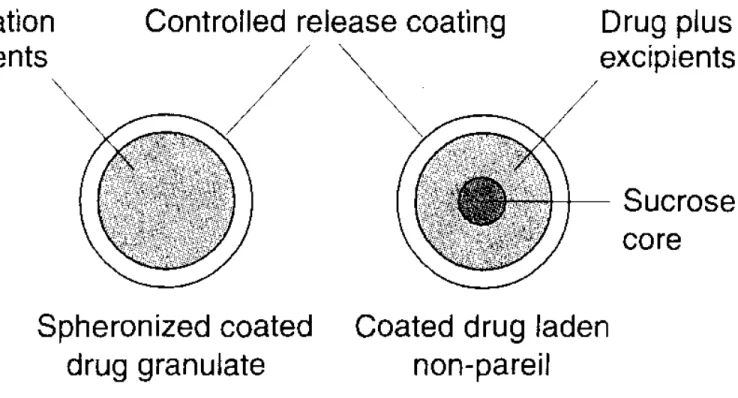
• Controlled-release coatings
• Film coating provides an extremely effective way of conferring a
controlled-release aspect to a tablet or, more usually, a
• After coating, these particles are filled into hard gelatin shells, or
occasionally compressed directly into tablets by a process which
permits minimal rupture of the applied film.
• The coatings involved use polymers with restricted water solubility or
permeability, and include ethylcellulose and modified acrylate
Multiparticulates commonly referred to as ‘pellets’ or ‘beads’, find favor
over conventional non-disintegrating tablets for controlled release use,
owing to a number of factors:
1. Their small size (typically 0.7—2.00 mm) allows them to pass through
the constricted pyloric sphincter and distribute themselves along the
gastrointestinal tract. This tends to overcome the disadvantage that
whole tablets have of a rather irregular passage through the
2.
Whole, non-disintegrating tablets can be liable to
lodge
in
restrictions within the gastrointestinal tract, and this can lead to
•
Mechanisms of drug release from multiparticulates
•
Diffusion
• On contact with the aqueous fluids of the gastrointestinal tract,
water will enter the interior of the particle by diffusion. Dissolution of
the drug will occur and drug solution will diffuse across the
Erosion
Some coatings can be designed to erode gradually with time, thereby
releasing the drug contained within the pellet.
• Osmosis
Enteric coating
This technique is used to protect the tablet core from disintegration in the
acid environment of the stomach for one or more of the following
reasons:
1. Prevention of acid attack on active constituents unstable at low pH
2. To protect the stomach from the irritant effect of certain drugs
3. To facilitate absorption of a drug that is preferentially absorbed distal to
Polymer are insoluble
in
aqueous media at low pH, but as the pH rises
they experience a sharp, well defined increase in solubility at a
specific pH.
•
STANDARDS FOR COATED TABLETS
1. Film-coated tablets must comply with the uniformity of mass test unless otherwise justified and authorized
2. Film-coated tablets comply with the disintegration test for uncoated
tablets except that the apparatus is operated for 30 minutes. The
requirement for coated tablets other than film coated is modified to
include a 60-minute operating time. Furthermore, the test may be
repeated using 0.1 N HCl in the event that any tablets fail to