EMERGENT DESIGN: TRACING AND STUDYING
KNOWLEDGE TRANSFER THROUGH COMPOSITION NETWORKS
E. Ashley Hall
A dissertation submitted to the faculty at the University of North Carolina at Chapel Hill in partial fulfillment of the requirements for the degree of Doctor of Philosophy in the
Department of English and Comparative Literature
Chapel Hill
2013
Approved by:
Daniel Anderson
Jane Danielewicz
Jordynn Jack
Erika Lindemann
ABSTRACT
E. Ashley Hall: Emergent Design: Tracing and Studying Knowledge Transfer through Composition Networks
(Under the direction of Daniel Anderson)
In recent years, composition scholars have taken an interest in studying the transfer of writing-related knowledge. This dissertation takes up the question of writing-related transfer within the larger context of education reform, examining our assumptions about transfer, our teaching practices, and our methods for studying
writing-related transfer. I make contributions to the field of rhetoric and composition by proposing emergent design, a theory and method for studying writing-related transfer, and by offering three possible pathways for composition teachers who want to teach for transfer.
In chapter one, I analyze the rhetoric of education reform using selected texts published during the thirty-year period between 1983 and 2013 to demonstrate how four-year public colleges and universities in the U.S. faced a version of what Harvard Business Professor Clayton Christensen calls “the innovator’s dilemma.” I take up appeals for education reform as case studies to examine how the discursive framing of problems and solutions shapes beliefs concerning the need for education reform and the subsequent course(s) of action that should be pursued. My analysis reveals that
fundamental underlying assumption about the purpose of higher education.
In chapter two, I survey the history of transfer studies to support my position that the concept of transfer provides a rhetorical warrant in discourses of education reform. I first offer my working definition of transfer and provide a survey of major debates about transfer. I then show that transfer studies routinely produce results that fail to provide evidence that the hypothesized transfer occurred. I argue that this problem is caused because researchers are expecting one kind of transfer (high road) and therefore designing hypothesis-driven experiments to look for it; our teaching practices, however, more frequently assume a different kind of transfer (low road). I show how acknowledging this contradiction can explain why so many studies fail to demonstrate transfer. I conclude the chapter by discussing the relevance of this problem to the field of rhetoric and composition. I do so by showing that we lack a suitable method for investigating high road and low road transfer of writing-related knowledge and skills.
were in part designed to promote transfer. I analyze the results using emergent design and compare my findings to other studies of writing transfer.
Chapter four contributes to emerging efforts by composition and rhetoric
scholars to promote transfer from first-year composition to future rhetorical situations. I extend previous research on transfer studies by theorizing and proposing a series of transfer-oriented pedagogical interventions for use in first-year composition courses: (1) developing genre-based writing assignments, (2) using design plans to prompt
ACKNOWLEDGEMENTS
This project is the outcome of a network of people, ideas, and things circulating in and around the University of North Carolina at Chapel Hill’s Writing Program over the past four years. Without that network, this project would not have been possible. I therefore want to acknowledge not only the people, but also the idea networks and material and digital resources that created spaces of “the adjacent possible,” out of which this project emerged. In particular, I want to thank the people, ideas, and things of The Studio for Instructional Technologies and English Studies (SITES) where I spent so much time
throughout this project. I also want to express my gratitude to the people, ideas, and things of the Office for Undergraduate Research at the University of North Carolina at Chapel Hill, especially Dr. Patricia Pukkila and Dr. Donna Bickford. Their support, both intellectual and material, were invaluable.
grounded throughout this process and for continually sharing your depth of knowledge about teaching writing, thank you.
To my friends and colleagues who were part of the People, Ideas, and Things project, thank you for exploring the possibilities with me. I especially want to thank Sydney Stegall and Benjamin Whitley who worked tirelessly on our projects, travelled to and presented at conferences with us, and co-‐authored essays about PIT; thanks to Brittany Spruill, Jill Dwiggins, Jenny Shen, and the other members of the undergraduate team (there are too many to name individually) who helped launch and develop the project. Thanks, also, to the teachers in the University of North Carolina at Chapel Hill’s Writing Program who
experimented with PIT in their composition courses, especially Doreen Thierauf, Jason Loan, Chelsea Redecker Milbourne, Erin Branch, Heather Branstetter, Ashley King, “the Adams” (Engel, McCune, and Harris), Rebecca Nesvet, April Munroe, and all the others who were part of the team.
And finally, to Jennifer Ware, who was by my side through it all and who never stopped believing in me: you have shown me every day and in every way what partnership is; thank you.
TABLE OF CONTENTS
LIST OF TABLES ... x LIST OF FIGURES ... xii CHAPTER
I. PROBLEMS AND SOLUTIONS:
DISCOURSES OF EDUCATION REFORM ... 13 II. A TALE OF TWO TRANSFERS ... 48 III. EMERGENT DESIGN:
A METHOD AND THEORY FOR STUDYING TRANSFER ... 101 IV. A RHETORIC FOR USING DISRUPTIVE TECHNOLOGIES
TO TEACH FOR TRANSFER ... 175
LIST
OF
TABLES
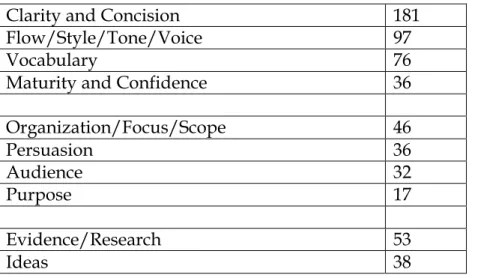
Table 3.1 Provisional categories used to code responses to
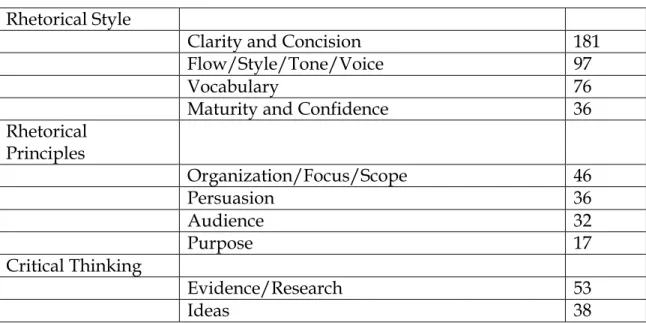
the question “what does it mean to write well?” ...137 Table 3.2 Illustration of categories being grouped into clusters ...138 Table 3.3 Illustration of clusters as over-arching
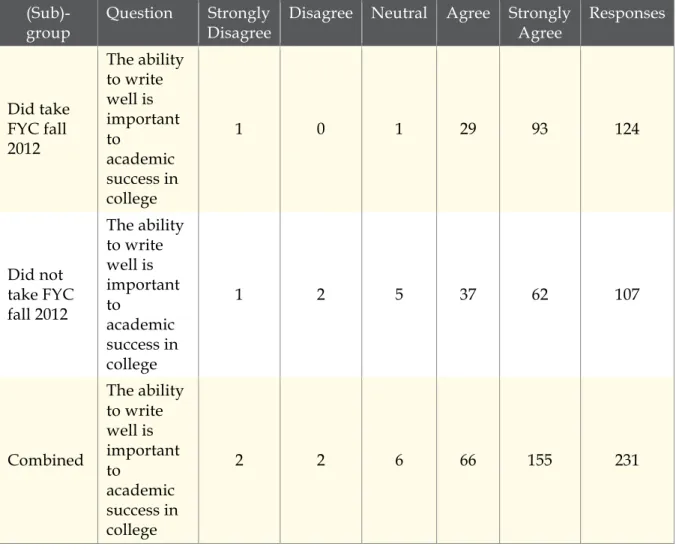
conceptual categories ...139 Table 3.4 Likert-Scale of phase one results showing student
agreement with the statement about writing ability
and academic success ...142 Table 3.5 Likert-Scale of phase three results showing student
agreement with the statement about writing ability
and academic success ...144 Table 3.6 Likert-Scale of phase one pre-test results showing
student attitudes about themselves as writers ...145 Table 3.7 Likert-Scale of phase three post-test results showing
student attitudes about themselves as writers ...147 Table 3.8 Likert-Scale of phase one pre-test results showing
student attitudes about ENGL 105 and their expectations
related to transfer ...159 Table 3.9 Likert-Scale of phase three combined post-test results
showing student attitudes about ENGL 105 and transfer ...162 Table 3.10 Likert-Scale of phase three post-test results for students
who completed the fall 2012 semester but had not yet
taken first-year composition ...166 Table 4.1 Rhetorical chart for a genre-based writing in the
sciences assignment ...188 Table 4.2 Rhetorical chart for a genre-based writing in the
social sciences assignment ...189 Table 4.3 Rhetorical chart for a genre-based writing in the
Table 4.4 Rhetorical chart for a student writing a research paper ...210 Table 4.5 Rhetorical chart for a student conducting
undergraduate research ...211 Table 4.6 Connecting essential learning outcomes
with high-impact practices ...220 Table 4.7 Rhetorical chart for Young Scholars
in Writing assignment ...227
LIST
OF
FIGURES
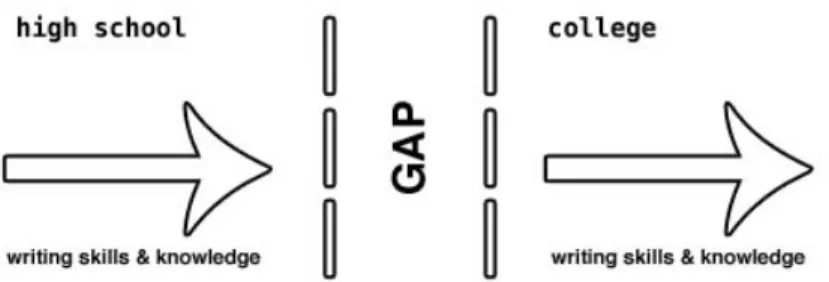
Fig. 3.1 Graphic illustration depicting my interpretation
of the problem presented by the proposal ...118 Fig. 3.2 Graphic illustration depicting my interpretation
of ENGL 105 presented as a fulcrum ...119 Fig. 3.3 Statistical comparison of participants’ change
in attitudes about ENGL 105, transfer, and
writing in general over time for subset of students
who took first-year composition in fall 2012 ...164 Fig. 3.4 Statistical comparison of participants’ change
in attitudes about ENGL 105, transfer, and
writing in general over time for subset of students
who did not take first-year composition in fall 2012 ...165 Fig. 4.1 Reprint of Driscoll’s findings ...183 Fig. 4.2 Attitude change over time for students who
took first-year composition in fall 2012 ...184 Fig. 4.3 Attitude change over time for students who
C
HAPTERO
NEP
ROBLEMS ANDS
OLUTIONS:
D
ISCOURSES OFE
DUCATIONR
EFORMThe Innovator’s Dilemma in Higher Education
In October of 2010, creativity expert Sir Ken Robinson delivered a TED1 Talk entitled “Changing Education Paradigms.” Robinson began his talk by asserting that, “every nation on earth, at the moment, is reforming public education” (Robinson 00:17). While this claim might be over-stated (certainly there are places where public education is not actively being reformed), the claim underscores the tremendous attention being paid to the “problems” in contemporary educational systems. Critiques of higher education in the U.S. have come from a wide range of sources including journalists publishing in mainstream media outlets such as The New York Times, professors and administrators publishing in academic journals and trade magazines such as The Chronicle of Higher Education, and commissions issuing government reports.
Sir Robinson, astutely I believe, points out that one of the main obstacles
currently thwarting educational reformers is that “they’re trying to meet the future by doing what they did in the past” (Robinson 1:10). This is what Harvard Business Professor Clayton Christensen calls “the innovator’s dilemma” within the context of
business and industry. Christensen’s thesis is that once companies gain and hold dominant positions in the marketplace, they are incentivized to continue the practices that led to their initial success. The development of new practices or products that might disrupt the established business model is more difficult. As a result, market-leading companies tend to shift from a creative and forward-looking posture to a more conservative stance in which they are apt to maintain the status quo. Christensen argues that these factors lead to the innovator’s dilemma, a situation in which creative
opportunities are consistently overlooked.
Although Christensen focuses his analyses on corporate examples, many of the conclusions he draws may also be applied to the university system, and especially to attempts to reform higher education over the past thirty years. In other words, as Sir Ken Robinson puts it, when today’s institutions of higher education try to meet the demands of the future by doing what has served them well in the past, we can say that they face their own version of the innovator’s dilemma. This is not to say, however, that there is a lack of desire for innovation.
is unlikely to return to pre-recession levels” (Bush and Hunt). This observation led them to embrace professor Ralf Wolff’s claim that “[o]ur business model is broken” (Bush and Hunt).
More recent news may, in fact, lend credence to this claim. An Inside Higher Ed article published on October 29, 2013, entitled “The End of History?” reports that Elizabeth City State University, an historically black college that is part of the larger University of North Carolina system, is considering the elimination of degree programs in history, physics, and political science (Rivard, n. pag.). The impetus for this change is not pedagogical but rather financial, a result of funding declines and enrollment
shortfalls, according to Provost Ali Khan (Rivard, n. pag.).
evidence from these studies that shows positive learning outcomes achieved through online courses. Thus, rising costs resulting from a broken business model are framed as the problem and online courses that cut costs are framed as the solution.
While Bush and Hunt group both reports together to support their argument, the two are substantially different in terms of both authorship and findings. The report they describe as the U.S. Department of Education’s (DOE) was actually prepared for not by the DOE. Instead, The Center for Technology and Learning, which, according to its web site2 performs research and development for government and business and which lists the Department of Education as one of its clients, is responsible for the authorship of the first report. In fact, placed above the publication and copyright information for the report there is the following disclaimer:
This report was prepared for the U.S. Department of Education under Contract Number … The views expressed herein do not necessarily represent the positions or policies of the Department of Education. No official endorsement by the U.S. Department of Education is intended or should be inferred. (Center for Technology in Learning ii)
While Bush and Hunt misattribute authorship of the report to the Department of Education, the research methods used to compile the data and present findings in this report were rigorous. For example, the research team reviewed more than one thousand empirical studies of online learning and “found that, on average, students in online learning conditions performed modestly better than those receiving face-to-face
instruction” (ix). Although the Center for Technology and Learning is a private firm contracted by the government to conduct research, it can be described as somewhat more impartial than Yoramm Neumann, who stands to benefit3 personally and
professionally from persuading readers that online education is overwhelmingly more effective than face-to-face instruction. Given Bush and Hunt’s (incorrect) reliance upon the ethos of the U.S. Department of Education and their description of Mickey Shachar and Yoram Neumann as “internationally known scholars,” the evidence used to
support their appeal for a widespread adoption of online courses as an effective and innovative cost-cutting measure is dubious at best.
Despite the questionable nature of their evidence, Bush and Hunt’s more general appeal for the exploration of technology as a means to accomplish education reform is worth examination. Public colleges and universities currently face a wide range of challenges, many of which do involve technology. Some technological challenges are cultural, while others are logistical, and still others are primarily economic. And new technologies are, or can be, useful resources for those interested in reforming higher education. However, shifting courses online as a cost-cutting measure is not necessarily
the single best solution for meeting “the needs of tech-savvy, far-flung, diverse student populations.” In fact, while this proposal fits neatly into the problem-solution
arrangement of Bush and Hunt’s argument, their assertion that “today–-right now--colleges and universities must embrace new digital and online delivery tools to make educational content available to degree-seeking students wherever they are, whenever they need it” smacks of technological determinism and evinces a rather simplistic notion of the role technologies (both old and new) play in student learning within institutions of higher education.
Bush and Hunt’s focus on the online delivery of content instead of, for example, on how online environments might foster collaboration or enable greater dialogue between students and teachers is only one manifestation of the simplistic view of technology they adopt. Additionally, Bush and Hunt’s view of relevant technology for education reform as exclusively digital and online is overly narrow. Instead, Clayton Christensen’s broader definition of technology as “the processes by which an
organization transforms labor, capital, materials, and information into products and services of greater value” is useful, especially when we understand the differences between sustaining technologies and disruptive technologies (xiii). According to
see that Bush and Hunt’s push for widespread adoption of online courses as a cost-cutting measure is not actually innovative. Instead, it provides an example of the innovator’s dilemma in higher education. I will return to this point after first establishing that discourses of education reform have faced a similar version of the innovator’s dilemma for at least the past three decades.
The rhetoric of education reform published during the thirty-year period
between 1983 and 2013 demonstrates how four-year public colleges and universities in the U.S. face a version of the innovator’s dilemma. Appeals for education reform reveal how the discursive framing of problems and solutions shapes beliefs concerning the need for education reform and the subsequent course(s) of action that should be pursued. Further, transfer–-the movement of knowledge or skill from one domain to another–-is a fundamental underlying assumption about the purpose of higher
education. Case studies show that (often unstated) assumptions about transfer function rhetorically as warrants. Rhetorician Steven Toulmin theorized the role warrants play in his canonical work The Uses of Arguments. According to Toulmin, a warrant provides the logical basis that brings together, or as he puts it creates a “bridge” between, a claim and the evidence used to support it (98-99). Transfer is frequently the connecting logic in arguments concerning education reform. In the last chapter, I return to Christensen’s concept of disruptive technologies, offering three pedagogical interventions as
Using Business Concepts to Analyze Discourses of Education Reform
Understanding critiques of higher education by borrowing language and concepts from business management, as I propose in this project, is not altogether without precedent. We have already seen an example of this in how Bush, Hunt, and Wolff all use language and concepts borrowed from business management to critique American institutions of higher education. Professor David Hartley of the Department of Education at the University of Oxford observes that “[m]anagement theory in education tends to be ‘imported’ from management theory in business” and notes that the inverse does not generally occur (Hartley 788). Hartley explains
In the immediate aftermath of the 1973 oil crisis … managerial rhetoric in education had been broadly normative. Professional accountability was to prevail until the early 1980s before it met a steady stream of incremental changes whose purpose was to enable an economic neo-liberal ideology by the deployment of rational4 or control rhetorics. (788)
Hartely shows how the discourses of business management are appropriated by those within educational institutions. Furthermore, Hartley’s work suggests that rhetorical analysis can help us understand how the language used to call for education reform in turn shapes policy and influences public opinion. We can see this shaping by examining A Nation at Risk, a report published in 1983 by the National Commission for Excellence
4 In Hartley’s analysis, normative rhetoric “appeals to the social and emotional needs of employees” and is juxtaposed with rational rhetoric, which “is all about standardization, hierarchy, audit, performance management and efficiency” (786).
in Education (NCEE) at the request of Terrel H. Bell, Secretary of Education during Ronald Reagan’s first term in office.
Communication scholars Sandra Hunt and Ann Staton have argued that A Nation at Risk “catapulted the issue of educational reform into the public sphere” (271). They
further note its significance within the civic arena by observing that “[n]ot since the Soviet launching of Sputnik in 1957 [had] the topic of educational reform figured so prominently in American public discourse” (271). Holly McIntush agrees, commenting that “what cannot be overestimated is the influence this document [A Nation at Risk] has had on public discourse” (McIntush 420).
Bell, who convened the commission responsible for authoring A Nation at Risk, describes the responses to the report as “overwhelming,” reporting that the document’s “impact far exceeded my highest expectations” (Bell Thirteenth Man 131). According to Peter Hlebowitsch, the report itself directly reached “an estimated audience of 5 million readers” (84). The text was also discussed much more broadly in the public sphere. Bell comments on the wider media attention the document received:
Our press clipping service revealed that the commission’s report was on the front page of all the major newspapers in every city–-small, medium, and large--across the nation. Editorials appeared the next day. The news on the three major TV networks featured A Nation at Risk … Newspapers printed the full text of A Nation at Risk in their Sunday editions.
day after day. (Bell Thirteenth Man 131)
Hunt and Staton suggest that “[b]ecause of the role the mass media played in
disseminating the report, the Commission’s work became a ‘rhetorical opportunity’ for the Reagan administration” (285). This definition of A Nation at Risk as a rhetorical opportunity supports Hunt and Staton’s related position that “communication about educational reform-–as manifest not only in [A Nation at Risk] but also in the replies it generated-–is inherently persuasive and, hence, rhetorical” (278). A Nation at Risk attracted tremendous attention both in the mass media and in professional journals, acting as a catalyst for national awareness of the need for and interest in education reform.
Background and Context for A Nation at Risk
Bell contends that the “overwhelming” response generated by A Nation at Risk prompted Reagan to reverse course on his plan to downgrade the department’s cabinet-level status and cut its funding. Bell explains that after attending a series of conferences hosted to discuss the report (some of which were also attended by President Reagan), discussion of the planned cuts abated until after Reagan was elected to a second term. Bell recalls:
Following the release of the report and this series of conferences, I heard no more about abolishing the Department of Education. Even David Stockman, director of the Office of Management and Budget, said in a subsequent Cabinet meeting called to plan federal spending cuts that the “sensitive area of education” should be exempted from the budget cutting. (Bell "Reflections" 593)
Bell describes the ways that A Nation at Risk shaped education policy:
Even David Stockman joined the chorus. The notes I scribbled on the face of a subsequent cabinet meeting agenda indicated that he gave the usual admonition to the cabinet to send in budget cuts for the next fiscal year that would drastically reduce expenditures. But he added an
unprecedented concession: “The sensitive issue of education is an
Bell’s account of how Reagan and Stockman responded to the national interest in education reform sparked by A Nation at Risk make the document’s immediate political impact clear.
As McIntush points out, “A Nation at Risk was not a temporary sensation” (421). For example, Hunt and Staton explain that “[i]n the months and years that followed the release of [A Nation at Risk], educational reform action was taken by other constituencies, including legislative, gubernatorial, judicial, executive, corporate. …” (275). One year after A Nation at Risk’s initial publication, the U.S. Department of Education published a follow-up report titled The Nation Responds, “a state-by-state profile of reforms
implemented since the release of [A Nation at Risk]” (Hunt and Staton 275). While many of the responses to A Nation at Risk were positive,5 there were also some biting critiques. Hunt and Staton found that responses that evaluated A Nation at Risk also critiqued its recommendations, its assumptions about teachers, and the accuracy of the data used (279).
Among these critiques was William Gardner’s response to A Nation at Risk. Gardner wrote, “Because I operate on the assumption that the value of reports such as this is the critical discussion they generate, discussion which in turn generates action, I want to enter several comments in the areas where I think Risk is weak or flat-out wrong and expand the debate in what I think are new directions” (13). Gardner then goes on to enumerate the problems he perceives in the report (such as the report’s misidentifying the problems facing education altogether and providing overly
simplistic solutions to address intensely complex problems) and uses them as an
occasion to present an opposing argument. Gardner was not the only scholar to reply in this way. Another example of the back and forth dialogue can be found in a 1983 issue of The Elementary School Journal, which published an excerpt of the A Nation at Risk report followed by three “reaction papers” (Slavin; Bossert; Hall). Robert Slavin of Johns Hopkins University, for example, questions the entire premise of the “risk” the National Committee on Excellence in Education asserts in A Nation at Risk by questioning the committee’s reliance upon declines in SAT scores as a measure of education crisis. He contextualizes his critique by explaining that simply reporting declining scores fails to account for broader socio-cultural factors such as a national effort to increase
graduation rates. As a result of this focus on countering attrition, Slavin explains that “[t]he great majority of the additional students retained in high school were drawn from the lowest-achieving segment of the student population, who would have
formerly dropped out of the system much earlier” (132). Thus, according to Slavin, the declining SAT scores are more reflective of success in a different area of concern, “the positive trend that few Americans would wish to reverse: universal access to a high school education” (Slavin 132).
Nation at Risk was thus not only a rhetorical catalyst that shaped the policies of the
Reagan administration but also an opportunity for education reform discourse from both sides.
That A Nation at Risk became a centerpiece of national attention is indisputable. What is less clear is whether the reforms proposed in the report were innovative solutions to the problems it outlined. Next, I analyze the rhetorical problem-solution arrangement structure of the report to explain how this document is an example of the innovator’s dilemma in higher education.
Framing Problems in A Nation at Risk
Scholars who have studied the language and rhetoric of A Nation at Risk “portrayed it more as a political document than a blueprint for reform” (Hunt and Staton 279). These political dimensions emerge in the greater rhetorical emphasis placed on the language used to frame the problems than on the language used to invent,
as well as a state and local responsibility” (594). Moreover, Bell explains that this
outcome was precisely what the report’s authors desired: “The intent of A Nation at Risk was to call the attention of the American people to the need to rally around their schools” (“Reflections” 593). Theodore Sizer, an education reform scholar from Brown University who largely disagreed with the National Committee on Excellence in Education’s
recommendations, seemed to concur with Bell’s assessment of the rhetorical strategies used to frame the problems in A Nation at Risk. In an interview with Gelareh Asayesh, Sizer notes that “the purple rhetoric of the report was a thunderclap and that was great” (Asayesh 13). However, the document may have been more effective politically than as an agent of educational change: “I don’t think it was on target substantively, but it certainly was on target politically … the political judgment of how to express the problem was absolutely sound” (Asayesh 13). Still, not everyone who critiqued the report’s substance found the rhetorical framing of problems so effective. For instance, according to Franza, the National Committee on Excellence in Education’s rhetorical strategies led to problems in logic that included “double think” and weak arguments based almost entirely upon appeals rooted in pathos used to generate reactionary fear among readers. Franza found these strategies ineffective, concluding, “[s]omeone might say the language is necessary to draw attention to the findings. But if attention is gained at the expense of credibility, no lasting effect is possible” (Pedersen et al. 24). Bell,
(“Reflections” 593).
Ultimately, however, Bell and Franza agree on the report’s very limited impact on day-to-day teaching and learning practices. Franza suggests the rhetorical hyperbole limited the report’s credibility while Bell maintains that the report had been rhetorically effective because it was successful in gaining (and holding) the public’s attention. Bell also views it as politically successful because it was able to prompt legislation focused on education reform. Where it fell short, Bell concedes, is the framing of solutions. Framing Solutions in A Nation at Risk
The popular response to A Nation at Risk, especially in the mass media, was overwhelmingly positive (Fowler; Gardner). In addition to the depictions presented by Bell (discussed above), Fowler notes that “[m]ore astonishing than the content of the report … has been the reaction to it–-‘praised,’ ‘warmly embraced,’ ‘hailed,’ ‘long awaited’” (43). The scholarly response from teachers and administrators at the primary, secondary, and post-secondary levels was strikingly more critical. The bulk of such criticism concerned the content of the report and, in particular, the solutions it proposed. The framing of solutions within A Nation at Risk shows how educational reform can be understood in terms of the innovator’s dilemma.
The commission’s findings were grouped into four categories: “content,
Committee on Excellence in Education states that “the topics are familiar” and “there is little mystery about what we believe must be done. Many schools, districts, and states are already giving serious and constructive attention to these matters” (23). So, after loudly ringing the alarm bells and eliciting an emotional response grounded in the fear that “Our nation is at risk,” the National Committee on Excellence in Education seems to say, “but we already knew that and we’re already working to solve this problem.” Both the language used to frame the solutions and the solutions themselves thus led some to remark that there was nothing new in the report (Block; Finn; Spady) apart from ineffective “quick fixes” (Albrecht 684; Goldman 24) or what Gordon Donaldson described as “a dangerous smokescreen” (29).
The first example of this familiar fix phenomenon can be seen in “Recommendation A,” focused on content. The commission wrote:
We recommend that State and local high school graduation requirements be strengthened and that, at a minimum, all students seeking a diploma be required to lay the foundations in the Five New Basics by taking the following curriculum during their 4 years of high school: (a) 4 years of English; (b) 3 years of mathematics; (c) 3 years of science; (d) 3 years of social studies; and (e) one-half year of computer science. (National Commission on Excellence in Education 24)
Characterized as the “Five New Basics,” there is very little new in these
Recommendations presented as these “New Basics” led some to speculate that the National Committee on Excellence in Education’s recommendations amounted to simple naiveté and/or snobbery (Tye and Tye). William Spady expresses similar sentiments in his response, aptly titled “The Illusion of Reform.” Spady recounts his years of frustration attempting to implement education reforms only to face what
“began to seem like a futile and exhausting climb up a steep and endless mountain” (31). Spady acknowledges the feeling of elation he experienced initially as a result of the political and media attention that A Nation at Risk attracted:
[A]long came the National Committee on Excellence in Education. In one brief document they swept away all possible legitimate resistance to every one of my “reform” issues, and more. Their rhetoric was so powerful and persuasive that, within weeks, its fallout even got the President to set aside his plan for abolishing the Department of Education and to start talking seriously about improving rather than undermining the public schools. (31)
Spady’s celebration of the effective rhetorical strategies used to frame the problems in the report is countered, however, by his concerns for the framing of the subsequent solutions:
evaluate “new” recommendations that are actually “old recommendations.” (emphasis in original, 31)
Spady’s reactions help us see that, indeed, the rhetorical strategies used in the
document were more effective in attracting attention and eliciting emotional responses than in persuading readers to adopt the recommended solutions. Further, the emphasis on effective rhetorical problem framing is linked with an innovative blind spot resulting in new solutions that were some two decades old.
Likewise, similar rhetorical strategies were used to present solutions in response to the second category of problems identified in the report. In the section outlining solutions to the problems associated with expectations, the National Committee on Excellence in Education recommended
[t]hat schools, colleges, and universities adopt more rigorous and
measurable standards, and higher expectations, for academic performance and student conduct, and that 4-year colleges and universities raise their requirements for admission. (27)
tenor and message in the recommendations demonstrates why so many educators and administrators were discontent with the framing and substance of the solutions
presented in A Nation at Risk and provides the basis for understanding the report as an example of the innovator’s dilemma in higher education.
The dilemma is further revealed in the specific implementation
recommendations the National Committee on Excellence in Education made within the document itself. For instance, the first item listed in the implementation sub-section pertaining to standards and expectations is that “[g]rades should be indicators of academic achievement so they can be relied upon as evidence of a student’s readiness for further study” (27). Such commonplaces make it clear why critics such as Spady, Finn, Block, Tye and Tye, and Bossert, among others, castigated the report for
presenting solutions that were “nothing new,” “shopworn,” and “retrograde” (Hunt and Staton 278). For instance, Bossert writes that “The task of improving our schools is an important and complex one. But the commission’s call for the ‘Five New Basics’ … does not provide a clear blueprint for change” (141). Instead, as the examples discussed above illustrate, the solutions presented in the report simply call for students and teachers to do more of what they were already doing (in the content category), to work harder (in the standards and expectations category), and to do it over a longer period (in the time category).
course. As Cornbleth and Gottlieb put it, “[t]he recommendations themselves call for more of the same rather than something different” (69). The solutions amount roughly to increases in quantity: more courses, higher expectations, longer school days or longer academic years: “[i]n effect, quantity becomes quality” (Cornbleth and Gottlieb 69). Phillip Schlechty points out how such familiar solutions are at odds with the problems they seek to address. “They [the National Committee on Excellence in Education] raised national awareness that there really is a problem. But all they said was all we have to do is do more of what we’re doing … which misframes the problem” (Asayesh 12). Such framing led some to characterize the solutions as “unimaginative and traditional in the worst sense” (Asayesh 13). Viewed through the lens of the innovator’s dilemma, the National Committee on Excellence in Education’s solutions are better described as sustaining rather than disruptive technologies. In this light, it makes sense that the document was indeed more effective as a political treatise than as a blueprint for innovation in education reform.
recommendations had not been extensive enough” (281). Furthermore, in his own reflections on A Nation at Risk ten years after its initial publication, Bell states directly that “we soon learned that gains in student achievement, declines in high school drop out rates, and other desired outcomes cannot be attained simply by changing standards and mandating procedures and practices” (“Reflections” 593). Bell even articulates the innovator’s dilemma in his reflections, noting that “schools resist change, and this fact must be taken into account by those who would reform them” (594). Bell came to realize that innovation, especially in the context of education reform, is a complex and messy process.
The key lesson from A Nation at Risk is that its solutions constituted a series of sustaining rather than disruptive technologies, and thus the report illustrates the innovator’s dilemma in discourses of education reform. In his retrospective comments about the report, Bell acknowledges some of the more pernicious implications of reform efforts that fall under the sway of such dilemmas: “We have foolishly concluded that any problems with the levels of academic achievement have been caused by faulty schools staffed by inept teachers” (593). Education reforms must move beyond scapegoating and more-of-the-same solutions.
Case Study Two: Academically Adrift
In 2011, Mark Bauerlein, Professor of English at Emory University, described Academically Adrift (2011) as “the most talked about higher education book of the year”
(Bauerlein 354). We have already seen how the media attention A Nation at Risk
In a similar fashion, the attention attracted by Academically Adrift has returned the issue of education reform to center stage. Written by sociologists from New York University (Richard Arum) and the University of Virginia (Josipa Roksa), this scholarly project was presumably intended primarily for academic audiences. Recently, however, it has gained more widespread popular attention for its critique of higher education in America and its call for reform. As Kevin Carey wrote in an article for The Chronicle of Higher Education,
[i]t was no surprise that The Chronicle gave prominent coverage to the conclusion that “American higher education is characterized by limited or no learning for a large proportion of students,” but few people anticipated that the book would become the rare piece of serious academic
scholarship that jumps the fence and roams free into the larger culture. (n. pag.)
Academically Adrift was covered in a wide variety of mainstream media outlets
Academically Adrift had generated “a national furor” (20). Thus, while Academically Adrift
was not authored by a federal blue ribbon commission as A Nation at Risk was, both texts received considerable attention in the mainstream media, and both focused national attention on problems in U.S. educational institutions. In the next section, I analyze the framing of problems and solutions in Academically Adrift to demonstrate that these discursive strategies are evidence of the continued presence of the innovator’s dilemma in discourses of higher education reform.
Framing Problems and Solutions in Academically Adrift
When A Nation at Risk first appeared in 1983, education reform was not a major issue debated in the public sphere, but by the time Academically Adrift was published in 2011, education reform had become a quotidian topic in both civic and professional discourse communities. As Bonnie Irwin, Professor of English and Dean of Arts and Humanities at Eastern Illinois University puts it, Academically Adrift was only one example of “the myriad books bemoaning the crisis in higher education published in 2011” (581). The crisis detailed in Academically Adrift is, therefore, not a new one. Instead, in many ways, it echoes and repeats the depictions of crises in American education that are evident in A Nation at Risk.
reform, demonstrates a repetition of the framing and arrangement patterns in A Nation at Risk.
Arum and Roksa begin their argument by “[taking] on a well-worn theme--the failure of the U.S. education system, in this case, higher education” (Calhoon-Dillahunt 495). Since the problems were no longer as fresh as they were thirty years earlier when A Nation at Risk first appeared, the framing of such problems as an immanent crisis
constituting a rhetorical exigence have to be renewed and revitalized. To this end, Arum and Roksa begin by citing Derek Bok, former president of Harvard University, who identifies one of the most pressing problems currently facing our nation as the fact that many college graduates are finishing their undergraduate degrees “without being able to write well enough to satisfy their employers … reason clearly or perform competently in analyzing complex, nontechnical problems” (Bok quoted in Arum and Roksa 1). Arum and Roksa elaborate on this point by observing that “[b]usiness leaders have begun to ask whether graduates have acquired the necessary skills to ensure economic competitiveness” (1). In ways similar to A Nation at Risk, Academically Adrift frames problems not as individual challenges or even issues confined to a particular business, industry, or academic major, but as a systematic national crisis. According to Bok and to Arum and Roksa, the current system of higher education is failing to
prepare students for the challenges they will face after graduation. And in both cases, this problem is connected directly to national economic and professional concerns.
A Nation at Risk suggests “[o]ur once unchallenged preeminence in commerce,
throughout the world” (5), likening the threat to our nation to an act of war. When Arum and Roksa point out the impact to employers across the U.S. of the problems associated with academically adrift students, we see similar discursive strategies: in both texts systemic problems in U.S. education institutions are framed as not only having national significance but of being national problems in need of solutions.
beyond the data they generate” (489). Haswell goes as far as to caution his readers that Academically Adrift is “simply not anchored in a research method readers can either trust
or challenge” (489). Unlike Haswell, who suggests that readers eschew the book
altogether, Attewell sees some value in the debate it sparked: “That [Academically Adrift] provokes a flurry of questions and counter-arguments is testament to the importance of its questions, and to the valuable contribution it makes” (226).
Haswell’s and Attewell’s critiques are typical of the concerns raised by scholars who have, up to this point, reviewed and replied to Academically Adrift and resemble those expressed by teachers and administrators who replied to the National Committee on Excellence in Education’s A Nation at Risk, especially in the ways in which replies question the authors’ assumptions about teachers, the accuracy of data, the use of strong language, and the conclusions and recommendations put forth. Moreover, from these examples we can see that both A Nation at Risk and Academically Adrift created a “rhetorical opportunity” not only for the authors of the document but also for those who responded to, agreed with, and critiqued their arguments.
over three decades and, furthermore, that now, finally, the crisis has reached such a point that social action in the shape of education reform must be undertaken.
Arum and Roksa explicitly acknowledge the persistent language of crisis in calls for education reform to create a rhetorical exigence for their own work, explaining that “[l]imited learning in the U.S. higher education system cannot be defined as a crisis because institutional and system-level organizational survival is not being threatened in any significant way” (124). Arum and Roksa see the evidence of limited learning they have catalogued and presented as a problem but clarify in this statement that the real crisis is that a majority of stakeholders (students, parents, teachers, administrators, and policymakers) do not perceive it as a crisis; instead, the system and its stakeholders, according to Arum and Roksa, are perfectly content to stay the course, adrift though it may be, with “limited learning” routinely accepted. Arum and Roksa elaborate:
“Limited learning on college campuses is not a crisis because the institutional actors implicated in the system are receiving the organizational outcomes that they seek, and therefore neither the institutions themselves nor the system as a whole is in any way challenged or threatened” (125). This rhetorical maneuver, which frames the crisis as the failure to recognize that there is in fact a crisis, immediately precedes Arum and Roksa’s proposed “potential reforms” (125).
institutions could focus increased attention on the academic component of
undergraduate learning without fundamental challenges to the existing system” (129, emphasis added). For example, Arum and Roksa’s first suggestion is that students entering college should be better academically prepared so as to avoid the need for “remedial” coursework (126). Where we saw the authors of A Nation at Risk call for colleges and universities to raise their standards presented as a solution to the crisis in education, here we see Arum and Roksa call for secondary schools to raise their
standards as a solution to the crisis in education. This is followed by a call for
“academically rigorous instruction,” which they imply is constituted by courses that require “more than forty pages of reading per week and more than twenty pages of writing over the course of the semester” (129). This reform recommendation is comparable, at the collegiate level, to the National Committee on Excellence in Education’s curriculum prescribed in the Five New Basics.
Tracing Transfer Warrants in Discourses of Education Reform
Carol Geary Schneider, who has been President of the Association of American Colleges and Universities (AAC&U) since 1996, begins her introduction to George Kuh’s 2008 report on a proposed course of education reform by saying, “[t]his report on ‘high-impact educational practices’ speaks directly to what is arguably our most
important national challenge in higher education: helping America’s extraordinarily diverse students reap the full benefits – economic, civic, and personal – of their studies in college” (1). Again, the familiar rhetorical strategy proposes systemic problems in U.S. institutions of higher education, which she explains constitute a “national challenge” (Schnider 1).
With hyperbolic rhetoric, Schneider asserts: “the nation’s future … depends on the United States’ ability to help a much larger fraction of Americans achieve high levels of knowledge and skills” (5). Schneider supports her claim, reporting on surveys conducted by Peter D. Hart Research Associates, noting that “[i]n AAC&U’s 2006 LEAP-commissioned6 survey of employers, 63 percent reported that too many college graduates lack the skills they need to succeed in the global economy” (5). Schneider suggests that these problems are so grave that they constitute a potential threat to both individual students and to the nation’s future. Thus, we see rhetorical strategies similar to those used in A Nation at Risk and Academically Adrift. Moreover, such framing
immediately precedes a direct call for a specific agenda of higher education reforms,
showing a repetition of the same problem-solution arrangement pattern. In each case, the authors follow a similar discursive sequence in which they affirm pre-existing beliefs in the value of higher education while simultaneously trying to persuade audiences of the need to change and improve the system.
We can trace these moves in Schneider’s text. For instance, Schneider asks, “[h]ow do we help students actually achieve the forms of learning that serve them best, in the economy, in civic society, and in their own personal lives?” (7). First, this
question affirms an existing, widely held, tri-partite belief in the value and function of higher education in America. Each year, approximately twenty-one million students are persuaded to obtain some form of higher education at an accredited college or
eighteen-to-twenty-four-year-olds attending accredited two-year and four-year colleges and universities “rose from 15 percent in 2000 to 41 percent in 2010” (National Center for Education Statistics). In practical terms, when people elect to spend money on a product, good, or service, it is an indication that they have been sufficiently persuaded of the value in doing so. Thus, the increasing overall percentage of eighteen-to-twenty-four year olds who elect to spend money to enroll in two or four-year accredited colleges or universities despite the rising cost of tuition and fees shows evidence that the belief that higher education will benefit students is unflagging. By first appealing to the widely held belief that obtaining a college degree will actually help students prosper in
personal, professional, and civic arenas, Schneider affirms the value of education. Then, by asking how students might “actually achieve the forms of learning that will serve them best” in those arenas, she implies that currently students are not actually achieving the best forms of learning.
In addition to simply re-tracing the repeated framing of problems-as-crisis preceding a call for education reform, we can also identify another unifying rhetorical strategy present in all three texts: the use of transfer as an (often unstated) assumption about the purpose, nature, and function of higher education. In these texts, transfer operates rhetorically as a warrant, or the logical bridge, bringing together the evidence of crisis with the claimed need for education reform.
(“Transfer of Learning” 6,452). They add that “positive transfer7 occurs when learning in one context improves performance in some other context” (Perkins and Salomon, “Transfer of Learning” 6,452). Based on this definition, we can see that Schneider’s linking of a college education to students’ “economic, civic, and personal” prosperity, implies the concept of transfer. Schneider’s inference is that a college education enables students to prosper after college because they are assumed to be able to apply a broad range of skills learned during college. The centrality of transfer is even more explicit when Schneider asserts that Kuh’s report serves, in part, to answer the question, “What do students need to know and be able to do?” (2). This question arises in the context of Schneider’s discussion of a college degree, which she frames as being (1) a rhetorical artifact signifying completion of the required courses and (2) an agent of transfer:
the long-term “college success” question encompasses not only whether students have earned a degree, but also whether graduates are in fact achieving the level of preparation–-in terms of knowledge, capabilities, and personal qualities–-that will enable them to both thrive and contribute in a fast-changing economy and in turbulent, highly demanding global, societal, and often personal contexts. (2)
Here we see that transfer is unstated but central to Schneider’s larger argument. In Schneider’s view, the college degree simultaneously signifies the completion of required coursework and the training needed to “thrive” in future situations. This
argument only makes sense if students’ ability to transfer knowledge and skills from college forward to future situations is assumed to be a routine expectation for higher education.
Aaron Pallas, Professor of Sociology and Education at Columbia University, argues that “we take the primary mission of undergraduate education to be the
development of broad cognitive competencies such as critical thinking skills, complex reasoning, and the ability to communicate ideas and arguments in writing clearly and effectively” (214), suggesting that transfer is, in fact, commonly assumed to be a fundamental goal of higher education. As we will see in the next chapter, educational researchers and cognitive psychologists investigating transfer often look for precisely the kind of higher order thinking skills that Pallas describes as “broad cognitive
competencies.” Those higher order thinking skills are then assumed to transfer over the short-term, while students are still enrolled as undergraduates, and over the long-term, after students graduate. We don’t expect college graduates to be explicitly tested on the content of their undergraduate coursework in post baccalaureate situations; we expect them to be able to transfer and apply the skills they learned in the classroom to new situations after college. Pallas, following so many others, builds upon this assumption of transfer, suggesting that if they cannot provide students with these critical skills and knowledge, “then most colleges and universities are falling far short of their
responsibilities” (214). Pallas’s remarks,8 therefore, make assumptions about transfer more explicit than they typically are when they remain unstated. What’s more, they
show how such assumptions about transfer can provide the logical basis for framing problems in education. We can see another example of this when Arum and Roksa argue that,
[T]he future of a democratic society depends upon education a generation of young adults who can think critically, reason deeply, and communicate effectively. Only with the individual mastery of such competencies can today’s complex and competitive world be successfully understood and navigated by the next generation of college graduates. (31)
Similarly, when Schneider questions “whether graduates are in fact achieving [a high] level of preparation,” she illustrates that transfer is not only assumed but also suggests the problem that it may not be happening,9 at least not consistently.
In each case, we see that assumptions about transfer provide the basis for framing problems that demand education reform. Moreover, we see that Schneider’s depiction of employers’ “increasingly urgent tones” echoes the language used to convey a sense of urgency in A Nation at Risk and Academically Adrift. The assumption that students should be able to transfer knowledge or skills from one situation (e.g., a course taken in college) to another situation (e.g., post-baccalaureate employment) helps provide the logical basis for at least some of the framing of problems in A Nation at Risk and Academically Adrift.
C
HAPTERT
WOA
T
ALE OFT
WOT
RANSFERS“Whenever teachers instruct, they implicitly convey their beliefs about knowledge transfer. Teachers assume not only a certain knowledge base on the part of students but also an ability on the students’ part to bring that knowledge to bear on new instructional situations. Furthermore, teachers make assumptions about the knowledge that students will transfer from new instruction to future learning experiences: They will learn from writing one composition how to write well on subsequent essays, they will learn from reading Gulliver’s Travels how to understand other satires, and so on.”
-- Peter Smagorinsky and Michael Smith in “The Nature of Knowledge in Composition and Literary Understanding”
In the last chapter, I argued that a shared cultural belief that an
support my position that the concept of transfer provides a rhetorical warrant in discourses of education reform.
Transfer is central to our beliefs about general education and our beliefs about the nature, function, and purpose of writing instruction as part of a general education. As Smagorinsky and Smith have noted, “debates about the specificity of knowledge that are raging in educational psychology raise issues that lie below the surface of discussions about how to investigate and teach composition” (298). Thus, in keeping with other composition scholars who have investigated writing-related transfer, I draw from the work of cognitive psychologists and educational
researchers.
This chapter is organized into four parts. In part one, I first present my
P
ARTO
NE:
D
EFININGT
RANSFER“To what extent is knowledge specific to particular situations? To what extent can learners transfer knowledge from one context to another? Can people learn general skills that help them solve problems in a variety of fields? Do people exercise a ‘mental muscle’ when they attempt to solve particular problems?” -- Peter Smagorinsky and Michael Smith
in “The Nature of Knowledge in Composition and Literary Understanding”
“Any survey of what education hopes to achieve discloses that transfer is integral to our expectations and aspirations for education.” -- David Perkins and Gavriel Salomon in “Teaching for Transfer”
new situations. These wholly new contexts can be analyzed as “rhetorical situations.” A rhetorical situation10 is an occasion in which an individual (or entity) becomes a rhetor. A rhetor addresses one or more audiences within a particular context and uses written, spoken, or multimodal discourse for a specific purpose. Many
rhetorical situations emerge in response to an exigence, an occurrence that invites or demands a rhetorical response. A rhetorical situation involving successful transfer11 is one in which the rhetor is able to accomplish his/her rhetorical objective because s/he is able to draw from previous rhetorical training and adapt, thereby
overcoming a gap in spoken, written, or multimodal composing skills. However, before I discuss specific rhetorical skills in relation to transfer, I will first review the literature on transfer.
Cognitive psychologists and educational researchers who investigate learning processes have studied transfer in great depth for more than a century. Transfer was taken up as an object of scholarly investigation as early as the turn of the twentieth century, when E. L. Thorndike and R. S. Woodworth published an essay titled “The Influence of Improvement in One Mental Function upon the Efficiency of Other
10 See Bitzer (1968) for a canonical definition of the rhetorical situation. See Vatz
(1973) for a response that complicates Bitzer’s argument. And see Edbauer (2005) for a discussion of rhetorical ecologies. I do not discuss any of these in this chapter, opting instead to offer my own working definition of how theories of the rhetorical situation are relevant to issues of transfer.
11 Perkins and Salomon have also theorized that negative transfer is possible. Negative transfer occurs when previous skills or knowledge interfere with or impede the
P
ARTT
WO:
T
ROUBLINGR
ESULTS FROMT
RANSFERS
TUDIESDespite a number of investigations that challenged widely held assumptions about transfer, a fundamental belief that knowledge and skills are, in fact, routinely transferred persisted throughout the twentieth century and remains prevalent today. Throughout the early twentieth century, a variety of studies failed to provide
empirical evidence in support of the belief that knowledge gained in one area can be shown to transfer to (and enhance) knowledge in another area.
enough to be statistically reliable with respect to words not of Latin origin” (32-33). The results of these studies showed that the knowledge and skills that were
presumed to transfer could not be demonstrated through empirical testing. Nonetheless, a fundamental belief that knowledge and skills transfer from one course to another persisted.
Scholarly debate about under what conditions transfer happens and how to study it continued throughout the twentieth century. For example, in 1976, David R. Olsen published “Culture, Technology, and Intellect,” arguing that literacy transfer is inextricably linked to the evolution of what he called “exosomatic” organs (192). Drawing from the work of Eric Havelock, Walter Ong, and Marshall McLuhan, Olsen asserted that the ability to transfer thinking skills is highly dependent not just on mental activities, natural aptitude, or formal training but also on the
technological environment surrounding a person. He explained that certain
Ong, and McLuhan) typically argue that the technology of writing (and reading) enables mental processes and thinking styles that are fundamentally different from those of oral cultures. Even though they may not explicitly use the term “transfer,” the concept is central to their work because they argue that one set of skills (reading and writing) enables other skills (abstract critical thinking, the subordination of ideas, etc.).
Early work that explored the relationship between literacy and transfer, such as Olsen’s work described above, routinely hypothesized that literacy should and does transfer easily, especially in purely functional terms. Reading a book for one class, for example, would translate easily to reading a book about a different subject for another class. Likewise, writing an essay for one class would easily translate to writing another essay for a different class. As Salomon and Perkins put it, “lay people and scholars alike commonly expect far and wide transfer from literacy” (“Rocky Roads” 130). Widespread claims about the broader implications for literacy transfer, however, have been difficult to measure empirically. This is largely due to the school-based setting in which most literacy training occurs.
Historically, most scholars who have explicitly discussed transfer have come from social scientific disciplines in which theories are empirically tested. In the social sciences, studies that are conducted with valid and reliable research
literacy acquisition happens in a school-based context where a variety of skills and subjects are being taught and learned simultaneously (“Teaching for Transfer” 24). These circumstances have made it difficult for researchers, especially those working in Western European and American cultural contexts, to conduct empirical studies in which they are able to isolate specific variables related to literacy and to study them in relationship to transfer. Nonetheless, literacy has continued to be theorized as a mechanism for the transfer of cognitive abilities (Olsen; Perkins and Salomon, “Teaching for Transfer”; Scribner and Cole).
One noteworthy investigation of literacy was able to use quasi-empirical methods to examine literacy transfer successfully. In 1981, Sylvia Scribner and Michael Cole published the results of their study conducted in a Liberian cultural context in which Vai and Arabic written languages were learned and used, but were not formally taught in a school-based setting. This particular cultural context
allowed Scribner and Cole to study literacy in isolation and to control for the variable of concurrent coursework that is typical in Western and European school-based settings.
Scribner and Cole’s work is one of the few studies of literacy transfer that has been able to isolate key literacy variables in a quasi-empirical fashion and to
hypothesized transfer did not appear” (Perkins and Salomon, “Teaching for Transfer” 24). Specifically, “with the exception of one transfer task (sorting), neither Vai nor Arabic literacy affected performance on tasks that tap higher order or metalinguistic skills” (Salomon and Perkins, “Rocky Roads” 130). These results call into question fundamental assumptions about the transfer-ability of literacy skills and their relationship to higher-order cognitive processes that had been, up to this point, mostly taken for granted.
Since reading and writing are typically taught in school, alongside an array of other subjects, social scientists following Scribner and Cole have had difficulty attempting to quantify literacy transfer and design valid and reliable studies in which literacy training could be isolated. They also have had difficulty controlling other variables, such as concurrent coursework in other subjects, because even in subjects where reading and writing were not the subject matter per se (such as biology or sociology), reading and writing skills were required and applied to the study of the subject matter in question.