ELECTRIC FORCES AND ELECTRIC FIELDS
Properties of electric charge
Charge is the fundamental quantity that underlies all electrical phenomena. The symbol for charge is
q, and the SI unit for charge is the Coulomb (C). Only two types of charge have been discovered
positive (due to protons) and negative (due to electrons). The magnitude of the charge on a proton exactly equals the magnitude of the charge on an electron which we call the elementary charge.
e = 1.60 X 10⁻¹⁹ C
e = elementary charge (magnitude of the charge of a proton or electron) C = Coulomb; SI unit for charge
Electric charge is always conserved. When an object carries no net charge it is said to be electrically neutral. When charge is transferred from one object to another, the first object will lose the exact amount of charge that the second object gains.
Charge is quantized. Charge on a proton or electron is the smallest amount of free charge (e). Any charge greater than e will be of some integer multiple of e.
Like charges repel and unlike charges attract. Charges exert forces on other charges over a distance. This force is directly proportional to the product of the two charges and inversely proportional to the square of the distance between the two charges (Coulomb’s law). Coulomb’ law is covered in more detail below.
Conductivity of solids
Materials can be classified based on their ability to transfer electric charge.
1. Conductors are materials like metals that have electrons which are loosely bound to the outskirts of their atoms and can therefore easily move from one atom to another.
2. Insulators (nonconductors) are materials in which electric charges do not move freely (glass, rubber, wood, etc.).
3. Semiconductors are insulators in their pure state but can be made to be excellent conductors by adding small amounts of other atoms to them (this is called doping). Silicon and germanium are two common semiconductors. Semiconductors are very useful in electrical devices since their properties can be changed by doping.
Polarization of molecules in an insulator
Charging by Conduction
Insulators and conductors can be charged through direct contact. For example, a glass rod (insulator) can be given a positive charge by rubbing it with silk. Friction causes electrons to be transferred from the rod to the silk. The silk now having excess electrons will be negative and the rod now having a deficiency of electrons will be positive. A neutral, ungrounded conductor can also be given a charge through direct contact with an object that already has a charge. As shown in the diagram below, when the charged rod touches the electroscope (instrument that detects the presence of charge), charge is transferred between the rod and the electroscope. When the rod is removed, the electroscope retains a charge that is the same sign as the charge of the rod.
Charging by Induction
Calculating Electric Force
Coulomb’s law is used to calculate the magnitude of the electric force between two charged objects. The direction of the force depends upon the signs of the charges. Coulomb’s law states that the magnitude of the electric force is directly proportional to the product of the two charges and inversely proportional to the square of the distance between the charges (inverse square law). The electrostatic force is similar to the gravitational force except that the electrostatic force relates charges rather than masses, can be either attractive or repulsive, and is much stronger than the gravitational force. Remember that force is a vector quantity so you must take into account direction when necessary.
k=8.99 X 10⁹ N m2/C2 Example 1:
As shown right, two particles, each of charge +Q, are fixed at opposite corners of a square of side length s that lies in the plane of the page. A positive test charge +q is placed at a third corner. What is the magnitude, in terms of given quantities and fundamental constants, and direction of the net force acting on the test charge due to the other two charges?
Example 2:
As shown below, two 25.0 g spheres are hanging from lightweight strings that are each 35.0 cm in length. Each has the same charge. They repel each other and make an angle of 5.00 to the vertical. What is the magnitude of the charge on each sphere?
Electric fields
A field is a property of space in which a material object experiences a force. The electric force, like the gravitational force, is a field force since charged objects exert forces on other charged objects without direct contact. An electric field is produced by any charged object and exists in the space around it. If a second charge is placed at some point in the field, the force on the second charge can be calculated if the strength of the field at that point is known (F=Eq). This makes calculation of the electric force at a point easier, just like it is easier to calculate the force of gravity on earth (mg) using the earth’s gravitational field (g) rather than Newton’s universal law of gravitation (Fg=Gm1m2/r2). The chart
below shows the similarities and differences between gravitational and electrostatic forces and fields.
Gravitational Force Electrostatic Force
G=6.67 x 10⁻¹¹ Nm2/kg2 is very small
Inverse square force Attractive only
is very large
Inverse square force Attractive or repulsive
Gravitational Field Electrostatic Field (+ charge)
g points towards the mass g is measured in N/kg = m/s2
E points away from a positive charge or towards a negative charge
E is measured in N/C=V/m
The magnitude of a gravitational field is calculated by force per unit mass whereas the magnitude of an electric field is force per unit charge.
By substituting Coulomb’s law in for force in the equation above it can be shown that the electric field due to a point charge is equal to
The direction of the electric field is the same as the direction of the electric force that would be exerted on a small positive charge (away from a positive charge, toward a negative charge) as shown in the diagrams to the right.
Electric field lines are often used in diagrams to help visualize the strength and direction of the electric field in a region of space around charges or charged objects. The separation among the arrows indicates the relative strength of the field (as separation increases field strength decreases) and the direction of the field is indicated by the direction of the arrows (same direction as force on positive charge). When electric field lines are drawn, the following rules must be followed:
(1) lines begin on a positive charge (or infinity) and terminate on a negative charge (or infinity) (2) the number of lines drawn leaving a positive charge or approaching a negative charge is
proportional to the magnitude of the charge (3) no two field lines can cross each other.
Diagram (a) below illustrates the electric field lines around opposite charges, (b) around two positive charges, and (c) in between the plates of a parallel plate capacitor.
Calculating electric fields due to point charges
The magnitude of the electric field due to a point charge is calculated using the equation E=kq/r2. The direction of the field depends on the sign of the charge producing the field (directly away from a positive charge, directly toward a negative charge). Since electric fields are vector quantities, if more than one point charge is present the net electric field is found by the vector sum of the fields produced by each charge.
Example 3:
Three charges are arranged as shown below. Calculate the magnitude and state the direction of the net electric field 3.0 cm to the left of the -1.00 C charge.
2 .0 0 c m 5 .0 0 c m
5 . 0 0 C - 3 .0 0 C
- 1 .0 0 C
q2 q3
Example 4:
Two point charges, Q1 and Q2, are located a distance 0.20 meter apart, as shown below. Charge Q1 =
+8.0C. The net electric field is zero at point P, located 0.40 meter from Q1 and 0.20 meter from Q2.
a. Determine the magnitude and sign of charge Q2.
b. Determine the magnitude and direction of the net force on charge Q1
Motion of point charges in electric fields
When a charged particle is placed in an electric field, the charge will
experience a force. The direction of the electric force is always parallel to the field with the force on a positive charge directed with the field and the
force on a negative charge opposite the field. If the electric force is the only
force acting on the particle, the particle will accelerate in the direction of the force. As shown in the diagram to the right, the electron accelerates to the
right since the electric force on a negative charge is opposite to the direction of the electric field. The magnitude of the acceleration can be found using Newton’s second law as shown below.
Charged particle moving parallel to an electric field
If a charged particle is projected parallel to an electric field, the particle’ motion will be one dimensional. As shown in the diagram below, an electron is projected with an initial velocity vo into a uniform electric field. The field will exert a constant force on the electron directed to the left. The electron will slow to a stop and reverse directions as it accelerates at a constant rate to the left. This is analogous to an object tossed straight up near the surface of the Earth.
The man inside the metal cage (Faraday cage) is shielded from the electric shock.
If a charged particle is projected perpendicular to a uniform electric field (as shown below), then the charge will follow a parabolic trajectory just like an object thrown perpendicular to a gravitational field (projectile motion).
Uncharged conductors in electric fields
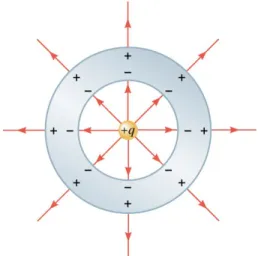
As shown below, if an uncharged conductor is placed in an external electric field, free electrons within the conductor will move until equilibrium is reached. Once equilibrium is reached, any excess charge will reside entirely on the surface of the conductor with the electric field at any point inside equaling zero. The sign of the surface charge induced on the conductor will be opposite that of the sign of the charge producing the field and the field lines will always be perpendicular to the surface.
Since the electric field inside a conductor at equilibrium is
zero, a hollow metal conductor, even one with holes like a
cage, will shield its contents from electric fields created outside the conductor. A conductor that does this is
often called a Faraday cage (see diagram to the right).
surfaces of the conductor. Of course, the electric field within the conductor itself will be zero once equilibrium is reached.
Charged conductors in electrostatic equilibrium
When an isolated (not grounded) conductor contains excess charge (positive or negative), the charge will distribute itself on the surface of the conductor according to its shape. Once there is no net movement of the charge, the conductor is said to be in electrostatic equilibrium.
Characteristics of conductors that are in electrostatic equilibrium
1. Electric field is zero everywhere inside the conductor. 2. Any excess charge resides entirely on its outer surface. 3. Electric field is perpendicular to the surface.
4. On irregular shaped objects, charge density and, therefore,
electric field strength will be greatest where the radius of curvature is smallest (at sharp points as shown in the