The Asian Society of Open and Distance Education, Japan ISSN 1347-9008 http://www.asianjde.org
This is an open access article under the CC BY-SA license
16
A Learning Analytics Approach to Identify Factors Influencing Enrolment in
Open and Distance Learning in India
Yasmin1
Abstract: Knowing insights as to why learners from diverse social and demographic profile choose to enroll in distance education can be a useful tool for Open and Distance Learning (ODL) Institutions to understand the requirements of their target segment, help in fine-tuning service offerings for attracting potential students and finally retaining them throughout the course duration. Conducted in the Indian context and deploying a learning analytics approach using primary data, this study attempts to identify the dominating factors that can potentially affect the enrollment of students of diverse socio-demographic profile to distance education. The study finds that significant differences in perceptions exist across various demographic and social segments towards various factors influencing enrollment in ODL system such as affordable course fees, nearness of study centre, personal satisfaction etc. The study concludes that depending upon their social and demographic profile, ODL learners are likely to have highly diverse motivations to join distance courses and thus they cannot be considered as a homogenous group.
Keywords: Open & Distance Learning (ODL), Enrollment, IGNOU, Influencing Factor, India, Learning analytics
Introduction
Progressive enrolment in higher education through Open and Distance Learning (ODL) has been a salient feature in the evolution of higher education, especially in developing countries. Although, distance education may not have replaced on-campus education, its flexibility has made it an attractive alternative for learners who are not able or do not want to participate in on-campus education. ODL, not essentially requiring a physical presence in the classroom, offers immense flexibility to students to learn, as per their convenience of time, place and space (Jegede, Fisher& Curtin, 1995). As a result, ODL has been able to provide inclusiveness in higher education by lowering various learning barriers namely remoteness in geographical location, inadequate prior educational attainment or financial limitations (Powell and Keen, 2006 cited in Yasmin, 2013). Concurrently, ODL has also emerged as an important element for lifelong learning to adult learners (Schneller & Holmberg, 2014). There are many factors that attract learners to distance education. Among them, ease of access, flexibility in pursuing courses and taking examinations (Gautam, 1990), freedom to choose subject and medium of study (Paulsen, 1993), opportunity to collaborate with students who live far apart and of diverse backgrounds (Anderson, 2006), socializing and convenience (Ridley et al, 1997), etc. are considered as dominating factors attracting students to ODL system. In addition, job expectations, career growth and improvement of social status are also significant influencing factors for enrollment in the ODL system.
1[email protected]; Student Registration Division, Indira Gandhi National Open University, New Delhi, India; ORCID:
17
Using a learning analytic approach, this paper attempts to explore and identify the dominating factorsaffecting the enrollment of students with diverse socio-demographic profile towards distance education in India.
Literature
Researchers studying ODL learners’ characteristics have generally focused on social and demographic variables like age, sex, marital status, regional background, employment, occupation, social class, academic qualification, etc. Some studies have also taken into consideration programme structure and availability of courses in the ODL system vis-à-vis regular on-campus systems for understanding characteristics of distance education learners.
While ODL has been able to attract learners of diverse age groups, they appear to have highly diverse motivations, varied personal and socio-economic reasons to join distance courses in preference to regular full-time courses. These are mainly availability of time, mental maturity of learners, non-existence of colleges in one’s locality and heavy expenses to be met in formal college education, etc. (Koul,1982; Sahoo, 1985 cited in Rathore, 1993). While, some learners are motivated by the possibility of career advancement (MacBrayne, 1995) or updating their knowledge, others are motivated by the sheer joy of learning. Whilst many students prefer distance education due to constraints in their personal lives (Sherry, 1997), many distance education learners are self-directed who prefer ODL because it allows them to study at their own pace (Schneller & Holmberg, 2014). Literature survey also reveals that factors like changing personal or family circumstances, financial problems of unemployed individuals, etc. had been impeding many potential students for joining ODL courses (McIntosh, 1978). For younger male students (upto 24 years of age) and matured female students (25-44 years age), job related goals are found to be prime considerations for enrolment in the ODL courses (Wanieweicz, 1986 cited in Singh et al, 2012, IGNOU, 2018).
Holmberg (1995) stated that there is no evidence to indicate that distance education learners should be regarded as a homogenous group. Gibson (1998), however, found that ODL learners do share demographic and situational similarities, which can provide the basis for identifying typical distance learner in higher education. Karka (1996) argued that individual students’ characteristics and life circumstances appear to have the greatest impact on ODL participation. Burt (1996) observed that institutions have to understand that the dynamics of the demographics and student performance drives the need for a change in educational provision; otherwise institutions would be losing out on a vast and expanding distant population.
In the Indian context, studies reveal that improvement of qualifications and desire for continuing with higher education acts as the major motivation for students for joining distance courses (IGNOU, 2018). Learners of higher age group enroll in ODL system to improve academic qualifications, occupational efficiency and social status (Sharma, 2001; IGNOU, 2018). Another study in the Indian context by Mascreen et al (2012) identified factors like reputation of the ODL institution, personal development, practical issues, personal satisfaction, etc. influence student enrollment in the master’s courses through distance education. The study also concludes that male in the age group of 31-35 years pursue master programme as they are otherwise stuck at the entry level at the job and thus aim for promotion through higher qualification. In another exploratory study, while comparing the motivational level of regular and distance students in India, Singh et al (2012) concluded that to increase the extrinsic motivation level of ODL students, recognition and worth of the degrees obtained from ODL Institutions should be increased. The study also recommended that ODL degrees should enable the learners eligible to appear for job interviews and write various competitive examinations.
18
Purpose of the Study
Headquartered at New Delhi, Indira Gandhi National Open University (IGNOU) is the largest and widely recognized ODL Institution in India. IGNOU has a countrywide network of 67 Regional Centres and over 3500 learners support centres. Since its inception in 1985, IGNOU has been exhibiting its capability for achieving inclusive and sustainable growth in higher education and skill development. Every year about 600,000-700,000 students gets freshly enrolled in various academic courses of IGNOU. The admission takes place in two cycles i.e. July and January cycle. In 2018, IGNOU had cumulative student strength of about 3 million.
IGNOU learners are spread all over the country and they have a diverse social and demographic profile. During 2017-18 academic year, about 650,000 students took admission in around240 programmes comprising of certificate, diploma, undergraduate, postgraduate and doctoral courses. Out of these students, about 44% were female, 31% married and 20% employed. Around 31% of enrolled students were in 26-35 years age group and about 18% were more than 35 years old. In the above context of varying social demographic profile, this study attempts to determine the prime motivators or dominating influencing factors for learners in enrolling in distance education courses in IGNOU. Learning analytics has been deployed to predict whether certain factors are predominating in attracting students of a particular social or demographic category to ODL courses or not.
Methodology Research Design
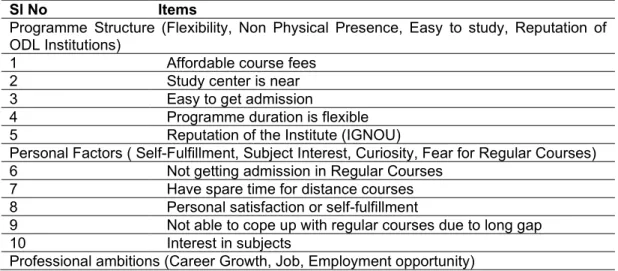
The study employed an exploratory and quantitative research design. Responses were recorded using a structured questionnaire comprising two sections. While Section A comprised of demographic data of the learners e.g. age group, gender, marital status, employment status, etc. Section B contained 20 (twenty) items, grouped in four broad categories (Table 1) viz. (i) Programme Structure; (ii) Personal factors; (iii) Professional ambitions; and (iv) Social & Family Factors, to determine how many of these items or factors would influence the student’s decision to take a distance learning course in IGNOU. Response options in Section-B were based in 5 point based Likert scale [Strongly Agree (5); Agree (4); Neither agree nor disagree (3), Disagree (2) and Strongly Disagree (1)] for enabling meaningful statistical analysis. To get further insights, respondents were also asked to write down a few lines outlining the reasons for joining the courses.
Table 1. Survey Questionnaire Items
Sl No Items
Programme Structure (Flexibility, Non Physical Presence, Easy to study, Reputation of ODL Institutions)
1 Affordable course fees
2 Study center is near
3 Easy to get admission
4 Programme duration is flexible
5 Reputation of the Institute (IGNOU)
Personal Factors ( Self-Fulfillment, Subject Interest, Curiosity, Fear for Regular Courses)
6 Not getting admission in Regular Courses
7 Have spare time for distance courses
8 Personal satisfaction or self-fulfillment
9 Not able to cope up with regular courses due to long gap
10 Interest in subjects
19
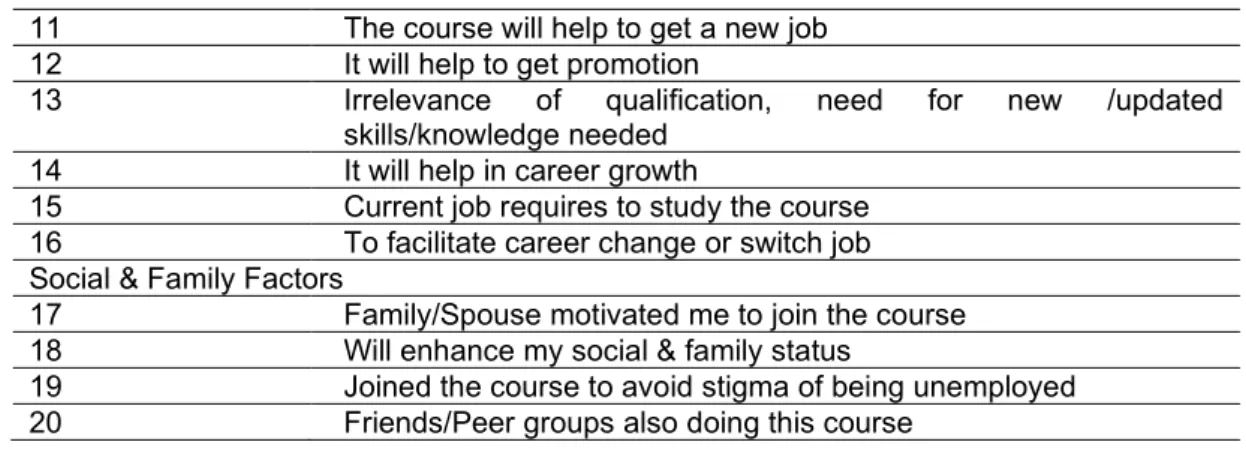
11 The course will help to get a new job
12 It will help to get promotion
13 Irrelevance of qualification, need for new /updated
skills/knowledge needed
14 It will help in career growth
15 Current job requires to study the course
16 To facilitate career change or switch job
Social & Family Factors
17 Family/Spouse motivated me to join the course
18 Will enhance my social & family status
19 Joined the course to avoid stigma of being unemployed
20 Friends/Peer groups also doing this course
The categories and survey items were chosen from the literature reviews and after deliberation with domain experts. A test questionnaire was first administered on a small sample to ensure that the final version contained only those relevant items that could actually elicit the intended responses on learners’ preference for distance learning.
Data Collection
The population for the study consisted of all students in the IGNOU. Primary data was collected during the month of March-April, 2019 through a face to face interaction with 132 (one hundred thirty two) IGNOU learners selected through random sampling technique. The survey sheets were compiled and arranged in a dataset. To get the feel of the total dataset, a descriptive analysis was carried out using commercially available statistical software. The descriptive statistic reveals that about 46.2% of respondents are female, 43.9% are married, 55.3% belong to the age group of 26 years or more and 55.3% are employed (Table 2). This affirms adequate representation of various social and demographic categories of learners in the sample.
Table 2. Descriptive Statistics
Gender Number Percent
Female 61 46.2
Male 71 53.8
Total 132 100.0
Marital Status Number Percent
Married 58 43.9
Single 74 56.1
Total 132 100.0
Qualification Number Percent
Secondary 47 35.6
Graduate 65 49.2
Post Graduate 20 15.2
Total 132 100.0
Age in Years Number Percent
<25 59 44.7
26-35 35 26.5
35-45 30 22.7
>45 8 6.1
20
Employment Status Number Percent
Employed 73 55.3
Unemployed 59 44.7
Total 132 100.0
The Scale
To estimate the scale reliability or internal consistency of the survey items, the primary data were analyzed for computing Cronbach’s Alpha, which was found to be 0.70. In exploratory research, the Cronbach’s alpha should generally be 0.7 or more. Thus, items considered in this study qualify for further analysis. The measure of sampling adequacy was checked using Kaiser-Meyer-Olkin (KMO) which was found to be 0.57 and Bartlett’s test of Sphericity was found to be significant at 0.000.
Data Analysis
The mean and standard deviation of the items are computed using statistical software. The result (Table 3) indicates that out of twenty items, eleven items have mean more than 3 (three) or these are biased towards an agreement.
Interest in the subject (Mean: 4.19), flexibility of the programme (Mean: 4.0) and reputation of the university (IGNOU) (Mean: 3.96) have higher mean scores, while ‘joined the course to avoid stigma of being unemployed’ (Mean:1.49) has lowest mean score which could be because the respondents are becoming conscious while answering the questionnaire. Interestingly, there is a general disagreement among learners that the course undertaken will help them in getting a promotion in the job (Mean: 2.04) or the current job mandates or necessitates studying the course (Mean: 1.75). Respondents also broadly disagreed that they joined distance course because they could not get admission in regular courses (Mean: 2.15) or they would not be able to cope up with regular courses (Mean: 2.20). Like earlier, this may also be due to learners becoming conscious while responding to the questionnaire.
Table 3. Mean and Standard Deviation of Items
Sl No Items Mean Std.
Deviation
1 Interest in subjects 4.19 0.86
2 Programme duration is flexible 4.00 0.86
3 Reputation of the Institute (IGNOU) 3.96 0.98
4 It will help in career growth 3.91 1.39
5 Will enhance my social & family Status 3.77 1.32
6 Easy to get admission 3.55 1.49
7 Affordable course fees 3.52 1.32
8 To facilitate career change or switch job 3.51 1.34
9 Personal satisfaction or self-fulfillment 3.48 1.63
10 The course will help to get a new job 3.41 1.34
11 Study center is near 3.26 1.51
12 Have spare time for distance courses 2.70 1.59
13 Family/Spouse motivated me to join the course 2.65 1.66
14 Irrelevance of qualification, need for new /updated
skills/knowledge needed 2.48 1.53
15 Not able to cope up with regular courses due to long gap 2.20 1.56
16 Not getting admission in Regular Courses 2.15 1.56
21
18 Friends/Peer groups also doing this course 2.02 1.55
19 Current job requires to study the course 1.75 1.26
20 Joined the course to avoid stigma of being unemployed 1.49 0.96
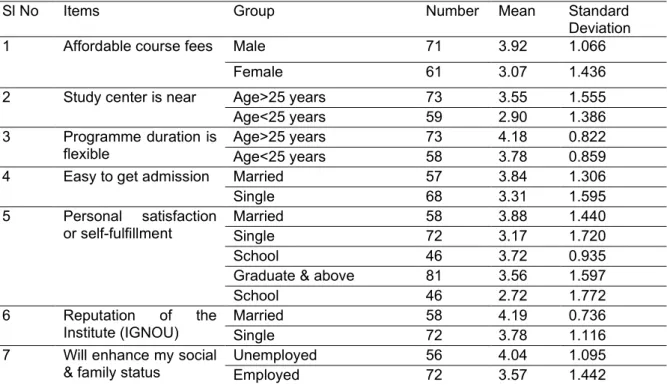
Preceding literature review indicates that ODL learners might have highly diverse motivations to join distance courses. To explore this further, statistical analysis was conducted comparing the means of paired samples (e.g. Male & Female; Employed & Unemployed; Married & Unmarried, etc.) to find the factors or items where the differences of their means are statistically significant (significance level >95%). The result (Table 4) reveals that significant differences (>95% level) in mean are prevalent in several parameters among various social and demographic paired groups.
While Male learners perceived that course fees are low (Mean: 3.92), female learners (Mean: 3.07) are broadly indifferent on this parameter. One of the underlying reasons may be that while males are mostly self-funding their study, females are generally funded by their family.
Matured or learners of higher age group (Age>25 years) broadly agreed the location of the study centers are near (mean: 3.55). For young learners (<25 years), on the contrary, nearness of the study center (mean: 2.90) is not a dominating factor for enrollment. Matured learners also perceived the course timings are flexible to a greater extent (mean: 4.18) than younger learners.Flexible course timings are also a prominent factor for educationally qualified (graduate and above) learners for pursuing higher or add-on degree courses (mean: 4.15) through ODL. This may be explained considering other competing engagements (job, family, etc.) of matured learners that renders greater significance to flexibility and convenience of ODL courses.
Married learners strongly agreed that the online admission process in IGNOU is easier (mean: 3.84) than their unmarried counterparts (mean: 3.31).This may be because married learners are generally pre-occupied with social and domestic responsibilities, thus they look for an easy admission process which can be completed at their convenience of even sitting at home or at their workplace.
Table 4. Comparison of Means of Grouped Samples (Significance level >95%)
Sl No Items Group Number Mean Standard
Deviation
1 Affordable course fees Male 71 3.92 1.066
Female 61 3.07 1.436
2 Study center is near Age>25 years 73 3.55 1.555
Age<25 years 59 2.90 1.386
3 Programme duration is
flexible Age>25 years Age<25 years 73 58 4.18 3.78 0.822 0.859
4 Easy to get admission Married 57 3.84 1.306
Single 68 3.31 1.595
5 Personal satisfaction
or self-fulfillment Married Single 58 72 3.88 3.17 1.440 1.720
School 46 3.72 0.935
Graduate & above 81 3.56 1.597
School 46 2.72 1.772
6 Reputation of the
Institute (IGNOU) Married Single 58 72 4.19 3.78 0.736 1.116 7 Will enhance my social
22
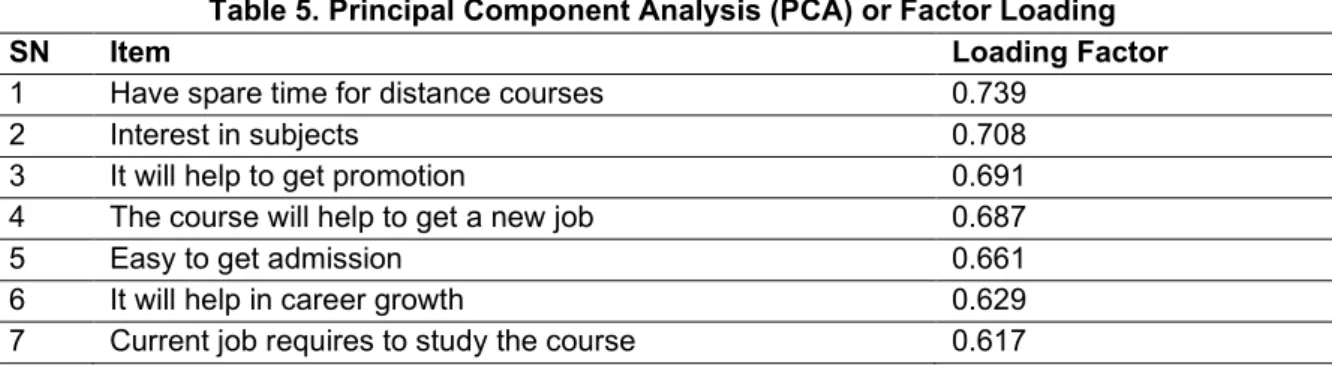
On the contrary, younger and unmarried learners do not mind visiting the ODL institutions and completing the admission process even offline. Compared to unmarried learners, the married learners are also largely motivated by personal satisfaction in joining the course (mean: 3.88) especially in a reputed institution like IGNOU (mean: 4.19). Personal satisfaction is also a dominating factorfor attracting qualified (graduate and above) learners to distance courses (mean: 3.90).For unemployed learners, enhancement of status (mean: 4.04) is a strong motivator for joining the course compared to employed learners. While carrier advancement opportunity has emerged as a major dominating factor for enrollment across all learners’ segment, the influence is seen to be predominant to employed (mean: 4.20) andsecondary or school pass out (mean: 4.52) learners. To further understand the dominating factors for enrollment of students in distance education, a further statistical inquiry was performed using the Principal Component Analysis (PCA) or factor extraction method. In order to set a criterion for selecting the items, only those which loaded 0.6 (60%) or more were retained. Out of the twenty questionnaire items, PCA identified seven factors with a loading factor of 0.6 and above (Table 5.).
These seven factors that dominate student enrollment in distance education are broadly independent or they are not correlated to other remaining factors. Out of these seven factors, four factors viz., (i) interest in subjects, (ii) relative ease to get admission, (iii) prospect of getting a new job and (iv) help in career growth have mean more than 3.0 (Table 3) . Thus, these four factors have positive dominating influencing factors for learners to take admission in distance education.
Table 5.Principal Component Analysis (PCA) or Factor Loading
SN Item Loading Factor
1 Have spare time for distance courses 0.739
2 Interest in subjects 0.708
3 It will help to get promotion 0.691
4 The course will help to get a new job 0.687
5 Easy to get admission 0.661
6 It will help in career growth 0.629
7 Current job requires to study the course 0.617
On the other hand, three factors viz., (i) current job requirement, (ii) help to get promotion and (iii) have spare time for distance course, have mean less than 3.0. Thus, these three factors may not have any positive influence in attracting distance learners.
Findings and Discussions
Preceding data analysis reveals that significant differences in perceptions are present across various demographic and social segments regarding various enrollment motivating parameters like ‘self-fulfillment’, ‘nearness of study centers’, ‘affordable course fees’, ‘programme flexibility’, ‘enhancement of social status’, etc. While ‘ease of getting admission’ (access) is widely accepted as greater enabler for distance education, this study also found ‘getting a new job’ as a major influencing factor for enrolment in distance education, especially for younger and unemployed learners. While, for employed and matured learner ‘career growth prospect’ is a major motivator for enrollment. Outcome of the PCA or factor analysis suggests that the widely accepted motivating factors like ‘flexibility in programme duration’, ‘affordable course fees’, ‘nearness of study center’, ‘reputation of the institute’ and ‘personal satisfaction’ are not independent influencing factors for enrolment in distance education. Rather, behavior of these factors may be considered as correlated to other independent factors like
23
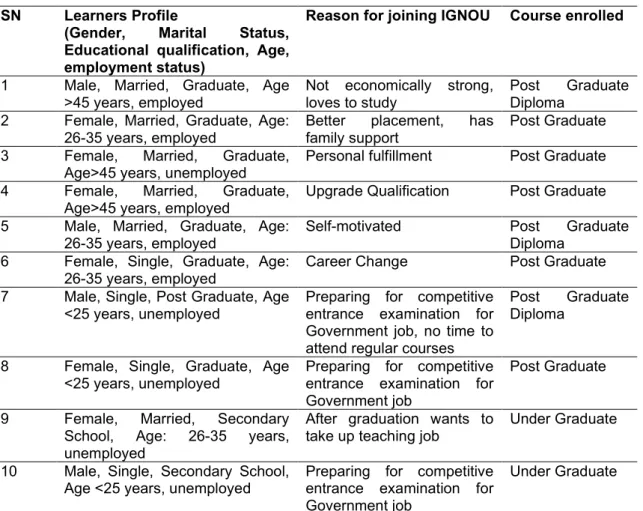
interest in subjects, relative ease to get admission, prospect of getting a new job, help in career growth, etc.To supplement analytical findings and to obtain further insights, respondents were asked to write one or two lines as to why they choose to join ODL courses at IGNOU. Select responses are enumerated at Table 6. It is observed that qualitative responses support analytical findings. Face to face interactions revealed that young learners, in general, want to join a reputed ODL institution to obtain recognized degrees that will help them getting a new job or appearing in competitive examination for employment. However, most often these learners join the course without knowing the relevance or suitability of the programme for them. On the contrary, educationally qualified, employed and learners of higher age group take a conscious or informed decision to choose a course that will help in personal enrichment.
These matured learners belonging to higher age group also prefer to go to a reputed institute for obtaining a degree of their choice that will help enhancing social and academic status as well as to brighten their career advancement opportunities. Interaction with learners also revealed that matured learners are more serious about completing the course on time than their younger counterparts. Younger learners, who are mostly unemployed with fewer household responsibilities, prefer rather a carefree approach to the ODL course.
Thus, the analytical research findings and qualitative responses of learners (Table 6.) complement each other to reaffirm earlier literature survey findings that ODL learners have highly diverse motivations to join distance courses and thus they cannot be considered as a homogenous group.
Table 6. Select qualitative responses from learners joining distance courses in IGNOU SN Learners Profile
(Gender, Marital Status, Educational qualification, Age, employment status)
Reason for joining IGNOU Course enrolled
1 Male, Married, Graduate, Age
>45 years, employed Not economically strong, loves to study Post Graduate Diploma
2 Female, Married, Graduate, Age:
26-35 years, employed Better placement, has family support Post Graduate
3 Female, Married, Graduate,
Age>45 years, unemployed Personal fulfillment Post Graduate
4 Female, Married, Graduate,
Age>45 years, employed Upgrade Qualification Post Graduate
5 Male, Married, Graduate, Age:
26-35 years, employed Self-motivated Post Graduate Diploma
6 Female, Single, Graduate, Age:
26-35 years, employed Career Change Post Graduate
7 Male, Single, Post Graduate, Age
<25 years, unemployed Preparing for competitive entrance examination for Government job, no time to attend regular courses
Post Graduate Diploma
8 Female, Single, Graduate, Age
<25 years, unemployed Preparing for competitive entrance examination for Government job
Post Graduate
9 Female, Married, Secondary
School, Age: 26-35 years, unemployed
After graduation wants to
take up teaching job Under Graduate
10 Male, Single, Secondary School,
Age <25 years, unemployed Preparing for competitive entrance examination for Government job
24
With the degree of attrition or dropout rate in distance education is persisting at an alarming level,ODL institutions need to revisit their policies and programs so that learners feel more motivated to complete the course (Yasmin, 2013). It is envisaged that findings of this study will be useful for the policy makers of ODL institutions to understand the requirements of their target segment, help in fine-tuning service offerings for attracting potential students and finally retaining them throughout the course duration.
Conclusion and Suggestions
The survey sample for this study was based at IGNOU HQ, New Delhi, India. As such, generalizing the results in the context of other countries with varying social and economic conditions may be done with caution. As a future study, another exploratory research in this area with large samples across the different states or provinces of India may provide further insights especially identifying underlying relationships among influencing parameters.
References
Anderson, T. (2006). Higher education evolution: Individual freedom afforded by educational social software. In M. Beaudoin (Ed.), Perspectives on the future of higher education in the digital age
(pp. 77-90).New York: Nova Science Publishers.
Burt, Gordon. (1996). Quality provision for students: The implications of social choice theory. The
America Journal of Distance Education, 10(1), 37-49.
Gautam, R. (1990). A study of success in distance learning system in relation to some key learned and institutional variables. In M.B. Buch (2000) (Ed.), Fifth survey of research in education,
Vol-II (1988-1992) (pp. 1573-1574). New Delhi: NCERT.
Gibson, C.C. (1998). The Distance Learner in Context. In C. C Gibson (Ed.), Distance Learners in
Higher Education: Institutional Responses for Quality Outcomes (pp. 113-125). Madison,
Wisconsin: Atwood Publishing, ISBN: 1-891859-22-6 (paperback).
Holmberg, Borje. (1995). Theory and Practice of Distance Education (2nded.). New York: Routledge,
ISBN: 0-415-11292-3.
Indira Gandhi National Open University (IGNOU). (2018). Research in Distance Education, New Delhi. Retrieved May 26, 2019 from http://egyankosh.ac.in//handle/123456789/42441.
Jegede, O., Fraser, B., & Curtin, D. (1995). The Development and Validation of a Distance and Open Learning Environment Scale. Educational Technology Research and Development, 43(1), 89-94. Retrieved May 11, 2019 from http://www.jstor.org/stable/30220116.
Karka, S. (1996). Deterrents to participation in adult education, ERIC Digest No 59.ED 275889.
Retrieved May 12, 2019 from https://eric.ed.gov/?id=ED275889.
Koul, B.N. (1982). Correspondence Courses.In Rao, B.A. &Ravishankar, S., (Eds.),Readings in
Educational Technology. Bombay: Himalaya Publishing House.
MacBrayne, P. S. (1995), Distance education: The Way of the future for rural community colleges.
25
Mascreen, C., Pai,Y. P., & Pai, R. Y. (2012). Identifying Factors for the Enrollment of Students towardsDistance Education for Master’s Course: A Student’s Perspective. International Journal of Digital Society (IJDS), 3 (3), 689-694.
McIntosh, N. E. (1978). What do we know about our students? Recent research on women in adult education: The Open University experience. International Council for Correspondence
Education: Dynamic and Diversified, Vol.2, New Delhi.
Paulsen, M. F. (1993). The hexagon of cooperative freedom: A distance education theory attuned to computer conferencing. DEOSNEWS, 3 (2).
Powell, R. J. & Keen, C. (2006). The Axiomatic Trap: Stultifying Myths in Distance Education. Higher
Education,52(2), 283-301.
Rathore, H. C. S. (1993). Management of Distance Education in India. New Delhi: Ashish Publishing House, ISBN: 81-7024-532-X.
Ridley, D. R., Bailey, B. L., Davies, E.S., Hash, S. G., & Varner, D. A. (1997). Evaluating the Impact of On-line Course Enrollments on FTEs at an Urban University. Annual Forum Paper. Retrieved May 4, 2019 from https://eric.ed.gov/?id=ED410871.
Sahoo, P. K. (1985). A Study of Correspondence Education in an Indian University, Unpublished Ph.D. Thesis. Baroda: M.S. University.
Schneller, Chripa., & Holmberg, Carl. (2014). Impact of Distance Education on Adult Learning: Distance education in European higher education - The offer (Report 1). UNESCO Institute for
Lifelong Learning; International Council for Open Distance Education; StudyPortals B.V., ISBN:
978-92-820-1210-9.
Sharma, R. (2001). Online Delivery of Programmes: A case study of IGNOU. The International Review of Research In Open And Distributed Learning, 1(2). doi:http://dx.doi.org/10.19173/irrodl.v1i2.18 Sherry, L. (1997). Issues in distance learning. International Journal of Educational
Telecommunications, 1(4), 337–365.
Singh, S., Singh, A., & Singh, K. (2012). Motivation levels among traditional and open learning undergraduate students in India. The International Review of Research in Open and Distributed
Learning,13(3), 19-40.
Waniewicz, G. (1986). The adult learners: Who are they, why and where do they learn? ICDE Conference Paper.
Yasmin, Dr. (2013) Application of the classification tree model in predicting learner dropout behaviour
in open and distance learning, Distance Education, 34(2), 218-231, DOI:
10.1080/01587919.2013.793642.
About the Author
Dr. Yasmin is currently assigned as Assistant Director (Student Registration Division) at the Indira Gandhi National Open University (IGNOU), New Delhi, India. She has been associated with open and distance learning (ODL) for more than fourteen years in the capacity of faculty member, programme coordinator, policy maker and regulator of Distance Education in India. Her major areas of research interest are data mining, issues related to gender, inclusiveness and social justice in ODL etc.
Mailing Address: Indira Gandhi National Open University (IGNOU), Students Registration Division, Maidan Garhi, New Delhi-110068, India. E-mail: [email protected]