The Eect of Heavy Fermion or F-Semiconductor
Systems on Gd-Intermetallic Systems
A. Yazdani
1Abstract. Based on the instability of magnetic behavior through the concept of local exchange and hybridization, a new class of heavy fermion is constructed with a stable local magnetic ion, \Gd". The lattice constant, DC/AC- magnetic susceptibility, (T ), and electrical resistivity, (T ), measurement in the magnetic unstable intermetallic compounds of Gd2AxB1 x, show that (I) The hidden magnetic
internal energy is manifested by shape and eld dependence is strongly at x = 0:4, (II) The lattice parameter of a crystal and magnetic structure, as well as high transition temperature, \Tc", strongly
depends on the conductive electron concentration. Both the functional change of the lattice parameter (non-Vegard behavior) and magnetic character with electron concentration suggest that the free electrons are not completely free and are somehow participating in the band functions and magnetic character, and that (III) There is a coexistence of Kondo behavior and magnetic ordering \re-entrant antiferromagnet" for x = 0:4 in the range of temperature 30 < Tk< 90 K with TN= Tmax= 30 K, so that (IV) Finally, the
metal insulator-like behavior with a complete quench of magnetic ordering occurs antiferromagnetically, named superparamagnet, at a certain conductive electron, \x = 0:3", where the sample is eld dependent (on which , it it is suggested,P"ijJij= 0).
Keyword: Possibility of Kondo eect on \Gd".
INTRODUCTION
The instability of three dimensional intermetallic com-pounds of an \F-atomic" state, in which some of the F-electrons become itinerant at low temperatures, has dominated heavy fermion \HF" research since 1980, based on the unstable ground state magnetic ion, \Ce, U" [1-3]. In contrast, no new families of \HF" on a true stable ground state with an integral F-electron and ordered local moments on the F-state, such as \Gd", have been discovered. This experimental report is part of a report to observe the Kondo lattice behavior, which results in HF-formation for Gd-Intermetallic on the duality of conductive electron concentration \c.e.c". A key area of investigation is the study of exchange uctuation and magnetic moment instability, named \energetic moment", caused by the width of the V.B.S (Virtual Bond State), in terms of inter band mixing, due to strong spin polarization as F d exchange and
1. Faculty of Basic Sciences, Department of Physics, Tarbiat Modares University, P.O. Box 14155-175, Tehran, Iran. E-mail: [email protected]
Received 15 March 2006; received in revised form 5 March 2008; accepted 13 July 2008
d d interaction [4], which is manifested by the hidden energy of shape dependence [5]. The characteris-tic competition (or even completeness) between the magnetic intersite interaction \RKKY-exchange" and demagnetizing on site, named the \Kondo interaction", could be the cause of instability. The competition and, nally, completeness is related to the strength and sign of coupling between the conductive electrons, \c.e.", and local 4F-state (L.F), which gives rise to the magnetic polarization of (c.e.) [6] (Jf cJexDI+ JexDI)
direct and indirect exchange interaction, \DI, IDI". The relative strength of the \exchange interaction" and the mixing of potential \Vf c" manifest themselves on
the boundary of duality of the Localized Conduction (L-C) electron, which belongs to either the \HF" or mixed (s d) valence region [7,8]. This is observed on the resistivity anomalies near the magnetic ordering temperature, as well as the instability of the magnetic structure, where it is described in Anderson [9,10] and Kondo [11] models, in terms of hybridization or electron transfer within a dened ground state and moment compensation, respectively. However, in the Kondo/Anderson theory of magnetic impurities, this occurs due to virtual excitation, whereby an F-electron is promoted to a band state at the Fermi level and
the F-hole is lled by a conduction electron with spin of the opposite sign. Such virtual uctuations in the valence, thus, resulting in spin uctuations, quench the magnetic moment at low temperatures [12]. However, the relative localization and delocalization of the F-electron will aect both the F-F interaction via the interatomic space, \rc", comprised of the mean free
path, \m", of conduction electrons and the interband
mixing, by which it strongly aects the character of \c.c.", as in the mixing of \5d 6s" on the Gd-intermetallic system [13]. The dominant interaction between the 4f and 5d character of the conduction electron is also pointed out [14].
In order to understand the cause and rule of the above theoretical assumption on a stable ground state, the similarity in the reported data on the selected ternary intermetallic compound, Gd2AuxAl1 x (0 <
x < 1), oers an opportunity to:
a) Investigate a system similar to both transition metals, where itinerant electrons play an important role and to those with well-localized spin, in terms of the intermediate of a 6s 5d electron (duality of c.e.c);
b) Prove that the sign and strength of the exchange parameter, J(0), determining the nature of the conduction electron, has aected the topological position of the magnetic ions;
c) Show the peculiarity of the onset of unstable ferro-magnetic ordering, \F.M", at a fairly high temper-ature and the being stable re-entrant \AF.M" at a low temperature, where exp< free-ion;
d) Consider the non-Vegard rule behavior, which is caused by a distortion of the topological position of magnetic ions in the \a b" plane;
e) Clear out the hidden energy, due to the energetic moment, which is caused by the internal and the uctuation eld.
SAMPLE PREPARATION
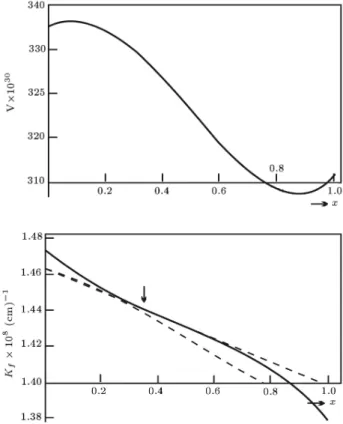
The samples were prepared by the melting stochio-metric method, using a 4N-element for Gd and a 5N for Al and Au in a standard arc-melting furnace in an Ar-atmosphere. The X-ray diraction of these compounds, which were taken before and after the annealing process, revealed an orthorhombic crystal structure with a Pnma space group [15]. The lattice parameters were found to be strongly sensitive to the annealing processes, especially for the compositional range of 0:2 < x < 0:7 (Figures 1a and 1b), where the shape dependence of the magnetic structure man-ifested, as described in detail, in [5]. The annealing temperature, Ta, was 650C for 96 hours.
Figure 1a. Lattice constant of the system Gd2AuxAl1 x.
Figure 1b. Variation of \Kf" of Fermi sphere with x. Magnetic measurements were performed by (i) Vibrating the sample magnetometer in the range of temperature 4.2 to 300 K and in a eld up to 20 kOe; and (ii) A.C. magnetic susceptibility by the standard induction method in a closed refrigerator down to 10 K and in an A.C. eld up to 30 Oe.
Electrical resistivity measurements were carried out using (i) The closed refrigerator method; and (ii) Two selected samples by a super conducting magnet cryostat (cryogenic liquid He). The current and voltage contacts were made with silver paint.
RESULTS AND DISCUSSION
The measured magnetic susceptibility, (T ), and re-sistivity, (T ), of the selected samples are given in Figures 1 to 4.
The lattice constants, magnetic behavior and the strength of their correlation are evaluated where: a) The lattice parameters of these systems show
strong deviation from Vegard's rule, which is one of the most frequently used methods in studying the eect of intermediate valence (the unstable magnetic behavior of Ce, Yb and Sm intermetallic systems). Figure 1a shows the lattice constants de-pendence on the conduction electron concentration. The volume of the unit cell increases as \c.e.c" increases (Al+3 was substituted for Au+1), while
the ionic radius R(Au+1) >R(Al+3) (Figure 1b).
b) A typical Curie-Weis (C-W) behavior with a cor-responding high paramagnetic Curie temperature ( = T ) is observed with low value of eective moment, e = 4:2 5:2, in the range of
available temperature, which is a function of c.e.c, as in Figure 2. Discontinuous linear distribution of 1(T ) reveals chemical clusters, which may
introduce short range interaction.
c) The eects of increasing c.e.c on (T ) are strongly noticeable at relatively high magnetic transition temperature, Tc, in respect of (T ), to a lower value
(increasing Tc) with increasing c.e by Tc= 20C
with x = 0:2 (Figure 2). It becomes more destabilized in the range of x = 0:2 0:4. This variation is more prominent for x = 0:4, where the main magnetic instability occurs and Tcis dicult
to be estimated (Figure 3a).
d) At temperatures below 300C and in low magnetic
Figure 2. Temperature dependence of the susceptibility (T ) and 1 for () x = 0:8, () x = 0:6, (+) x = 0:4,
and ( ) x = 0:4 in high eld.
Figure 3a. Temperature dependence of D.C
susceptibility for x = 0:4 in dierent shapes and elds.
elds, two closed magnetic transitions, followed by a broad maximum, are observed (Figure 3a). The small plateau, which is observed at intermediate temperature, is typical of a re-entrant, near the F.M-SG transition temperature.
These two transitions, with a small intermediate plateau temperature, are developed by increasing the c.e.c, which is associated with the depression of (T ), as mentioned before, and are distributed among each other in such a way as to become one transition with a broad range of ordering temperature at certain c.e.c (x = 0:4). This transition is found to be a too smeared mixture of two transitions, so, it is dicult to estimate the transitions magnetic order from (T ), due to the great dispersion of exchange near double FM-AF.M percolation in a low eld. The system almost reaches P. M. around x = 0:4, dened by the low value of (T ). However, this behavior could be due to a canted system or by absorbing conduction electrons that reduce the FM moments; the latter can even result in moment compensation, which is expected when leaving the stable moment regime, which is the main goal of this paper.
The low value of e, dened by p, which
corresponds to a high Tc, is also a conrmation of the
above suggestion.
Moreover, the dependence of the distortion of the crystal structure and the sign and strength of exchange, Jij, on the c.e.c, as well as the hidden energy of
the magnetic shape dependence (Figure 3a) [5], bring up the question of if, really, there are any strong correlations between the magnetic phase transition and c.e.c. This correlation is more pronounced by the continued lowering of the magnetic transition with a low value of (T ), which is due to the energetic moment compensation. That is, the magnetic structure of x = 0:4 should be expected to follow the Kondo
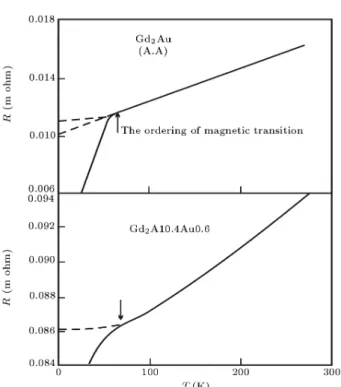
Figure 3b. Temperature dependence of the resistivity for x = 0:4, x = 0:6 and x = 0.
behavior, by which the experimental measurement on (T ) supports the authors suggestion (Figure 3b). Where, as the density of conduction electrons increases, the beautiful sharpness of (T ) at T = 60 K for Gd2Au
is spread out for x = 0:6 and completed at x = 0:4 in the Kondo regime, where it is rounded and a minimum is formed around T = 60 K (Figure 3b).
Such virtual uctuation in the valence, thus, results in spin uctuations, which quench the magnetic moment at low temperatures.
Consequently, if x = 0:4 is close to the critical value, near the leaving of the stable moment regime, then, it should behave extremely sensitively to the physical parameters, which take the sample to its stable position, by which the following external parameters are applied:
(i) The shape of the sample at x = 0:2 [5];
(ii) The critical external magnetic eld, at x = 0:4, in the eld of Hex= 15 kOe (as in Figure 3a) and
nally;
(iii) The critical electron concentration at x = 0:3. An important dramatic phenomena, named su-perparamagnet, is observed at x = 0:3 which is a stable magnetic moment region. Here, the system is eld and shape independent and a complete P. M. order (Figures 4a and 4b), dened by the linear eld dependence of (H), 1(T ), in the
range of 20 kOe and temperature range of 0-300, is exhibited.
Finally, the completeness of the Kondo lattice-like
Figure 4a. Temperature dependence of the D.C susceptibility for various isotherms for x = 0:3.
Figure 4b. Field dependence of magnetization for various isotherms for x = 0:3.
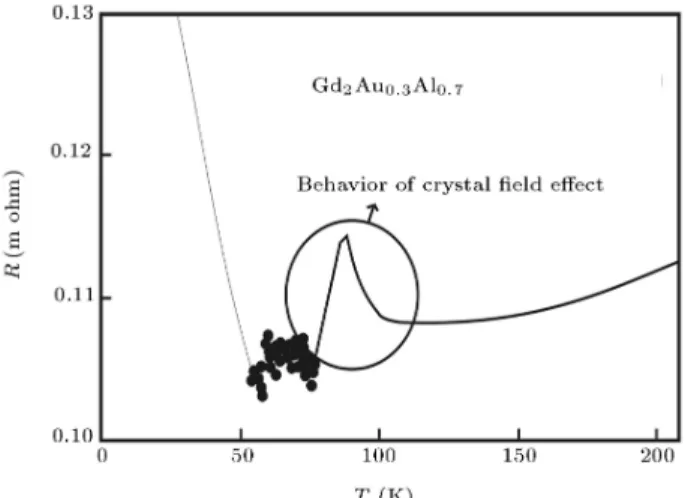
behavior, named the HF formation, is suggested for this composition, which is conrmed by (T ) in Figure 4c and is curved to a maximum around 80 K.
Consequently, the following corresponding results could be concluded:
a) Local electron behavior, which is manifested by a depression of the magnetic susceptibility, the hidden energetic moment caused by continuous lowering of the magnetic transition temperature, with a low value of (T );
b) Itinerant electron behavior, which is shown by electrical resistivity, as well as the structure dis-tortion of the topological position of the magnetic ions, is presumed to be due to the short range ordering eect, as the thermal uctuation of intra-cluster exchange extends through the long range of inter-layer interaction. The uctuation is around the internal magnetic eld. The internal and eld uctuation are originated from the spin-spin
ex-Figure 4c. Temperature dependence of the resistivity for x = 0:3.
change, which is due to the interatomic space and the number of nearest neighbors (n.n) (included in the clustering region of 3.39A<RC<3.6A) [16].
However, the understandings from this experi-mental observation are the following: while the \c" parameter is almost expanded linearly, the \a" and \b" parameters are drastically being nonlinearly contracted and expanded, respectively (Figure 1). This means that distortion in the \a b" plane depends on the interatomic space in the clustering region, Rc, and
the other factors, such as pair potential [17]. The created distortion energy can be either removed or minimized by changing the heat treatment, dened by the annealing processes. The change of unit cell then aects the two non equivalent lattice sites of 8 n.n [16]. This can be considered as a kind of topological distortion (via Fermi sphere \KF"). The
strong distortion in the \a b" plane is due to the strong intra-plane exchange interaction of the magnetic ions (Jsn! Jin)(a b) [5].
The distortion depends on the energy of a band and some part of the exchange. The crystal will strain itself, such that to lower either, or both, the energy of the band that contains the conduction electrons (c.e), and exchange energy, will result in lowering the free energy of the crystal.
This distortion can change the sign and strength of the phase transition and, also, the phonon disper-sion, due to the magnetoelastic behavior, because the magnetic phase transition strongly aects (T ) around x = 0:4 (Figure 3b). A phonon with a well dened wave-number, thereby, couples coherently with the spin polarized conduction electron (c.e).
Consequently, a deformed potential, for these spin polarized particles (heavy quasi particles) that are par-ticipating in the crystal structure, increasing Tc ,with
lowering the corresponding (T ), and nonlinearity of (T ), is obtained.
From the above discussion, it can be suggested that the coexistence of ne-particles (ions) and quasi-like particles (polarized c.e. with inter band mixing in the clustering region) will stabilize the system in certain external magnetic elds (e.g. x = 0:4, H = 15 kOe), as well as certain values of \c.e.c" (x = 0:3). This will make a balance between the topological distortion and exchange, to minimize the free energy, as well as lowering the entropy (Figure 4b).
The dramatic dierence in the magnetic struc-ture, at low and high elds, at x = 0:4, is almost due to the equality of the external and inter local eld, \:Hin = :Hex". The broad magnetic transition,
which may also be due to the domination of the mag-neto energy coupling, (JsI), completely breaks down.
This will minimize the exchange energy of the magnetic ions indicated by the low ordering temperature, Tof,
the characteristic temperature above which the system is almost PM (in high eld (straight line 1(T ), in
high magnetic eld (Figure 3)). This also indicates the coincidence of p with Tof.
At temperatures below Tof > p (below which a
deviation from linearity, of 1(T ) can be observed)
where Hin Hex, the exchange uctuation may start
becoming frozen antiferromagnetically by short range intracluster interaction (associated with cluster). The clustering region starts tunnelling, on which interclus-ter ininterclus-teraction competes with intraclusinterclus-ter exchange through the strong polarized \c.e".
This condition is the crossover of a dierent kind of magnetic instability, which is related to the exchange splitting of the HF-band. The coincidence of magnetic ordering and increase in resistivity, as shown in Figure 3, for x = 0:4, may also indicate the existence of an antiferromagnetic gap energy [18], which is due to interband mixing developed by intracluster exchange.
However, the Kondo lattice-like behavior is sug-gested for this composition (x = 0:4), as is conrmed by (T ) for 30 < Tk > 90, Figure 3, (Tf corresponds
to Tmax = TN = 30 K). Consequently, the changes of
(T ) can be explained by two phenomena; long range magnetic ordering, developed by the spin polarization of the conduction electrons, \Jcf (interplaner), and
scattering of c.e,s (spin ip intracluster exchange). The Kondo lattice behavior may be developed by the peculiar dispersion of the, so called, band quasi particle, through the s ! d transformation (Jfd> 0).
Thus, one will have P"ijJij = 0, in the clustering
region, so, the strong electron phonon coupling is also suggested. In this case, it has been observed that the system is eld independent and in PM order, dened by the linear dependency of (H) and 1(T ) (Figures 4a
and 4b). The magnetization measurement, (H), on polycrystalline samples with two dierent shapes (needle and powder), so far seem to imply that the F.M moment can hardly be saturated in nite magnetic
elds up to 20 kOe. Any experiment on the magnetic anisotropy of a single crystal of these samples (based on Gd, which is in an s-state) has not yet been performed, since, for these metallic systems, a simple interpreta-tion of the Crystal Field Eect (CFE), via the ionic point charge of the neighboring ions, does not work. CF- schemes are essentially due to the eect of the instability of a 5d-intermediate character (originating from both the atomic RE conguration (4f 5d 6s2) and
strong spin polarization of c.e as interband mixing, in terms of the coupling of anisotropic 4f charge clouds to \semic-c.e" and phonon), developed by an intercluster interaction, which forms a V.B.S. The produced CFE, which is masked in D.C susceptibility in low eld (J = 500 Oe), can be revealed in A.C. susceptibility in low eld (H = 10 Oe), at temperature T > 100K
(Figure 5).
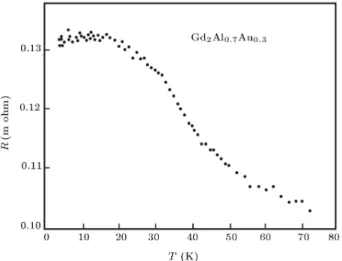
Figure 4d. Temperature dependence of the resistivity for x = 0:3 in superconducting magnet cryostat (cryogenic liquid He).
Figure 5. Temperature dependence of the A.C.
susceptibility for x = 0:3 in low magnetic eld (H = 10Oe).
Thus, the system can lead to HF-formation, developed by the completeness of the Kondo lattice (Kondo - behavior at any T , Figures 4c and 4d) dened by the virtual band state (V.B.S.).
The completeness of strong short range intraclus-ter produces a potential barrier attributed to both (i) The transition from coherent to incoherent scattering, where the Mean Free Path (MFP) of conduction electron mis much shorter than the size of clustering
region \Rc" (ii) Distortion in the (a b) plan and
expansion in c-directions (Figure 1).
Under these circumstances, complete quenching of local moments, in the clustering region of the lattice, will occur where P"ijJij = 0. The quenching is
supported by the AF.M coupling developed by a partial overlap of up spin and down spin semielectrons and of the balancing of quasi particles (strong polarized electrons located on atomic space) and ne particles (magnetic - ions) developed by intercluster interaction (Figures 4a and 4b).
Thus, the magneto elastic coupling can drastically alter the character of the phase transitions and, hence, strong correlation between (T ) and (T ) will exist. The characteristic, in this case, lies well below the CF-energy, where it appears to be at 100 < Tcf 200,
developed by the interband mixing of d-like electrons in low eld.
CONCLUSION
Based on the s-state of \Gd" and experimental mea-surements in two dierent limiting boundaries: Re-sistivity (T ) and D.C/AC susceptibility (T ), the following assumptions can be suggested.
a) The ground state of \4f" is assumed to be com-pletely stable with well dened local moments, as Gd is in an s-state.
b) The mixed f-valence uctuation can be avoided, while the exchange uctuation originating from spin/spin interaction (local eld) plays an impor-tant role and is manifested by short range interac-tion of the instability of the magnetic structure at high temperature. This behavior is related to the number of magnetic ions and interatomic spaces in the clustering related to the number of magnetic ions and inter - atomic space in the clustering region \RC"[15].
c) The interband mixing, as in opposite directions (valence local uctuation), or the existence of an AF.M energy gap [18] through the intra-cluster in-teraction, is possible, where the formation of a new Kondo lattice for the \Gd" intermetallic compound with the magnetic ordering is observable.
d) Finally, HF formation takes place by the com-pleteness of the Kondo lattice through the intra
planner short range exchange (Jij Jsh), which is
developed by intracluster exchange, via a virtual bound state (V.B.S) at x = 0:3 (Figure 4). The form of V.B.S can be considered by the eect of 5d-electrons originating from the atomic Gd-conguration [4F n \5d 6s2"]. This can cause
severe anisotropy in RKKY conduction electrons, which is masked in D.C magnetic measurements (H = 5000 Oe) and manifested in A.C. magnetic susceptibility (H = 10 Oe) at 100 < T < 200 (Figure 4c).
REFERENCES
1. Coles, B.R. \Heavy-fermion intermetallic compounds", Contemporary Physics, 28(2), pp. 143-157 (1987). 2. Kontani, M., Ido, H. and Hisinioka, T. \Magnetic
properties of Ce2Cu8Al9 single crystal: New heavy
fermion material", Journal of the Physical Society of Japan, 63(3), pp. 863-866 (March 1994).
3. Lohneysen, H.Y., Pietrus, T., Poetisch, G., Schlager, H.G. and Schroder, A. \Non-Fermi-liquid behavior in a heavy-fermion alloy at a magnetic instability", Physical Review Letters, 72, p. 3262 (May 1994). 4. Campbell, I.A. \Indirect exchange for rare earths in
metals", J. Phys. F. Metal, 2(3), p. L47 (1972); Beznosor, A.B., Etemenky, V.V. and Gnezdilov, V.P. \d f-exchange resonance in gadolinium: Theory and experiment", J.M.M.M, 43(3), pp. 243-248 (1984); Baberschke, K., Bachor, B. and Barnery, S.E. \Crystal elds and exchange parameters in LaAl2: Eu2+ and
LaAl2: Gd3+ single crystals", Physical Review B, 21,
p. 2666 (1980).
5. Yazdani, A. and Gardner, J.S.T. \Stabilization of reentrance AFM on Gd2Al system in a certain electron
concentration", Phys Stat. Sol. (b), 208(465), pp. 465-472 (1998).
6. Herbst, J.F. \Atom-to-solid core-level shifts for the rare-earth elements", Physical Review B, 28(8), p. 4204 (1983).
7. Wesselinowa, J.M. \Dynamic behavior of the s d model", Phys Stat. Sol. (b), 20(2), pp. 585-593 (1983).
8. Schuh, B. \Hybrid pairing and heavy fermions", Phys. Stat. Sol. (b), 131(1), pp. 243-248 (1985)
9. Anderson, P.W. \Localized magnetic states in metals", Phys. Review, 124(1), pp. 41-53 (1961).
10. Anderson, P.W. and Brinkma, W.F. \Anisotropic superuidity in 3He: A possible interpretation of
its stability as a spin-uctuation eect", Phys. Rev. Letter, 30, p. 1108 (1973).
11. Kondo, J. \Resistance minimum in dilute magnetic alloys", Progress in Theoretical Physics, 32(1), pp. 37-49 (1964); Bell, A. and Caplin, A.D. \Dilute transi-tion metal alloys and the Kondo problem", Contemp. Phys., 16(4), pp. 375-394 (1975).
12. Lawrence, J.M., Riseborough, P.S. and Parks, R.D. \Valence uctuation phenomena", Reports on Progress in Physics, 44, pp. 1-84 (1981).
13. Freeman, A.F. and Harmon, B.N. \Spin-polarized energy-band structure, conduction-electron polariza-tion, spin densities, and the neutron magnetic form factor of ferromagnetic gadolinium", Physical Review B., 10, p. 1979 (1974).
14. Eagles, D.M. \Further improvements in a model for 5d electrons in heavy rare earth metals and compounds", J. Less Common Metals, 107(2), pp. 231-242 (1985). 15. Buschon, K.H.J. and Van der Goot, A.S. \The crystal
structure of rare-earth aluminium compounds R2Al",
J. Less Common Metal, 24(1), pp. 117-120 (1971). 16. Yazdani, A. and Ramazani, A. \Satisfactory of RKKY
model on complicated Gd2X intermetallic system (I)",
J. Sci. IR. IRAN, 9(3), pp. 273-283 (1988).
17. Shidlovsky, A.A. and Wallace, W.E. \Magnetic and crystallographic characteristics of the ternary inter-metallic compounds containing lanthanides and iron or cobalt", J. Solid State Chem., 2(2), pp. 193-198 (1970).
18. Das, I., Sampathkumaran, E.V. and Vijayaraghovan, R. \Possible evidence for an energy gap below the Neel temperature in ternary rare-earth compounds", Phys. Rev. B, 44 (1991).